DEGREE OF FREEDOM OF A KINEMATIC
MECHANISM
KINEMATICS & DYNAMICS OF
MACHINES (RME4C001)
BY
BIVASEET PRADHAN
DEGREES OF FREEDOM OF A RIGID BODY IN A 2D-
PLANE
The degrees of freedom (DOF) of a rigid body is
defined as the number of independent
movements it has.
 To determine the DOF of this body we must
consider how many distinct ways the body can be
moved.
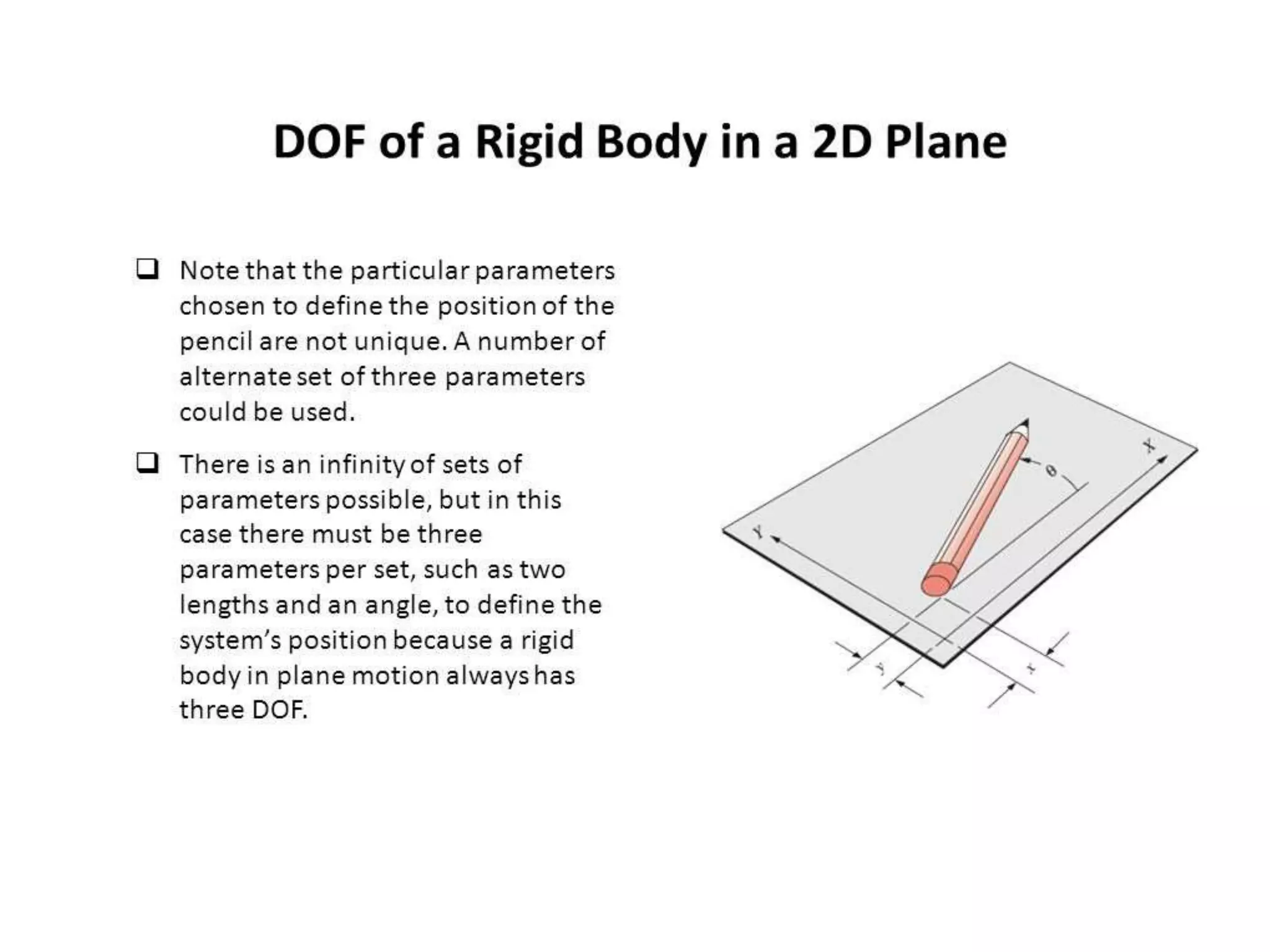
In a two dimensional plane such as this computer
screen/white board, there are 3 DOF.
The body can be translated along the x axis,
translated along the y axis, and rotated about its
centroid.
DEGREES OF FREEDOM OF A RIGID BODY IN SPACE/3D
PLANE
An unrestrained rigid body in space has six
degrees of freedom: three translating motions
along the x, y and z axes and three rotary
motions around the x, y and z axes
respectively.
The rigid body has 6 DOF in space but due to
formation of linkage one or more DOF is lost
due to the presence of constraint on the body.
The total number constraints cannot be zero
as the body has to be fixed at some place to
make the linkage possible. Thus the degree of
freedom is given by
DOF= 6- (Numbers of Restraints)
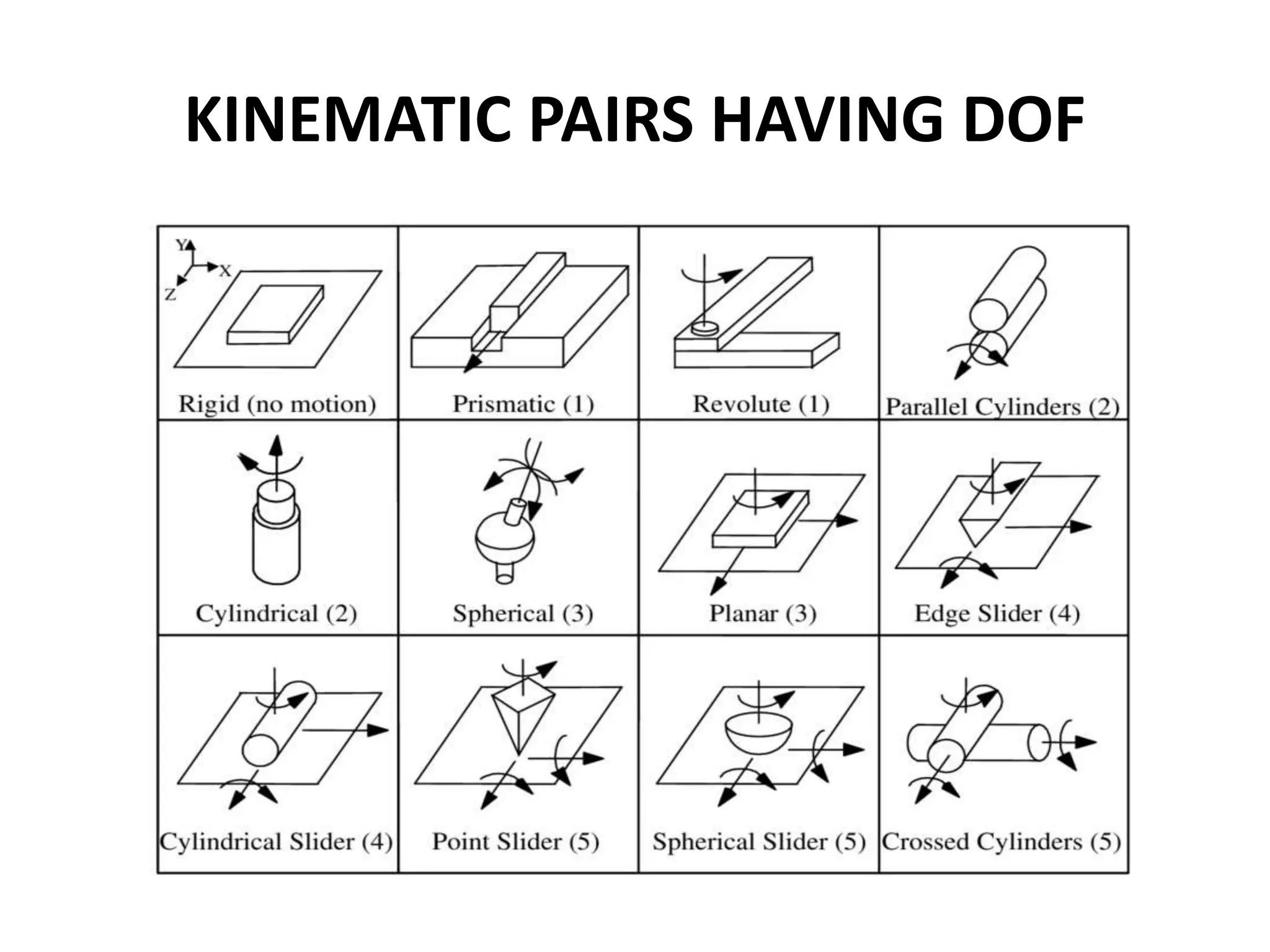
KINEMATIC PAIRS HAVING DOF
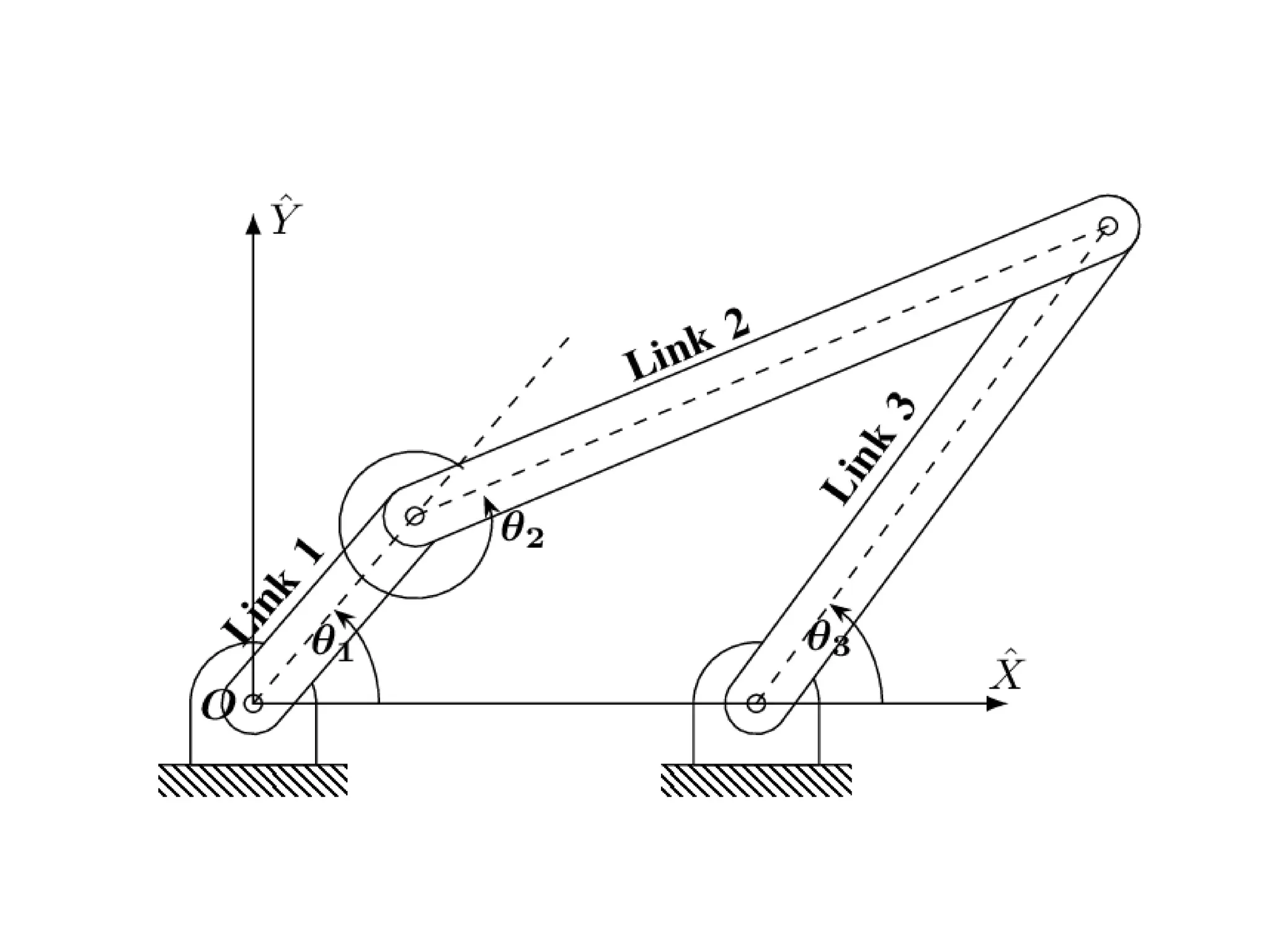
KINEMATIC CHAIN
a) Kinematic chain:
A kinematic chain is an assembly of links which
are interconnected through joints or pairs, in
which the relative motions between the links
is possible and the motion of each link relative
to the other is definite.
b) Non-kinematic chain:
 In case the motion of a link results in
indefinite motions of others links, it is a non-
kinematic chain.
The reason for this indefinite motion lies in
the fact that if we give motion to any of the
link in the chain then the other links can take
indefinite position.
c) Redundant chain:
There is no motion possible in the redundant
chain. It can be observed from the following
figure that this chain is locked due to its
geometry.
DEGREE OF FREEDOM IN A MECHANISM IN 3D
PLANE
Degrees of freedom of a mechanism in space can be
explained as follows:
Let
N or L = total number of links in a mechanism
F or M = degrees of freedom
J1 = number of pairs having one degree of freedom
J2 = number of pairs having two degree of freedom
and so on.
When one of the links is fixed in a mechanism
Then, the number of the movable links are = N - 1
Degrees of freedom of (N- 1) movable links = 6(N-1)
 Because each movable link has six degree of
freedom) Each pair having one degree of freedom
imposes 5 restraints on the mechanism reducing
its degrees of freedom by 5J1 this is because of
the fact that the restraint on any of the link is
common to the mechanism as well.
 Other pairs having 2, 3, 4 and 5 degrees of
freedom reduce the degree of freedom of the
mechanism by putting constraints on the
mechanism as well.
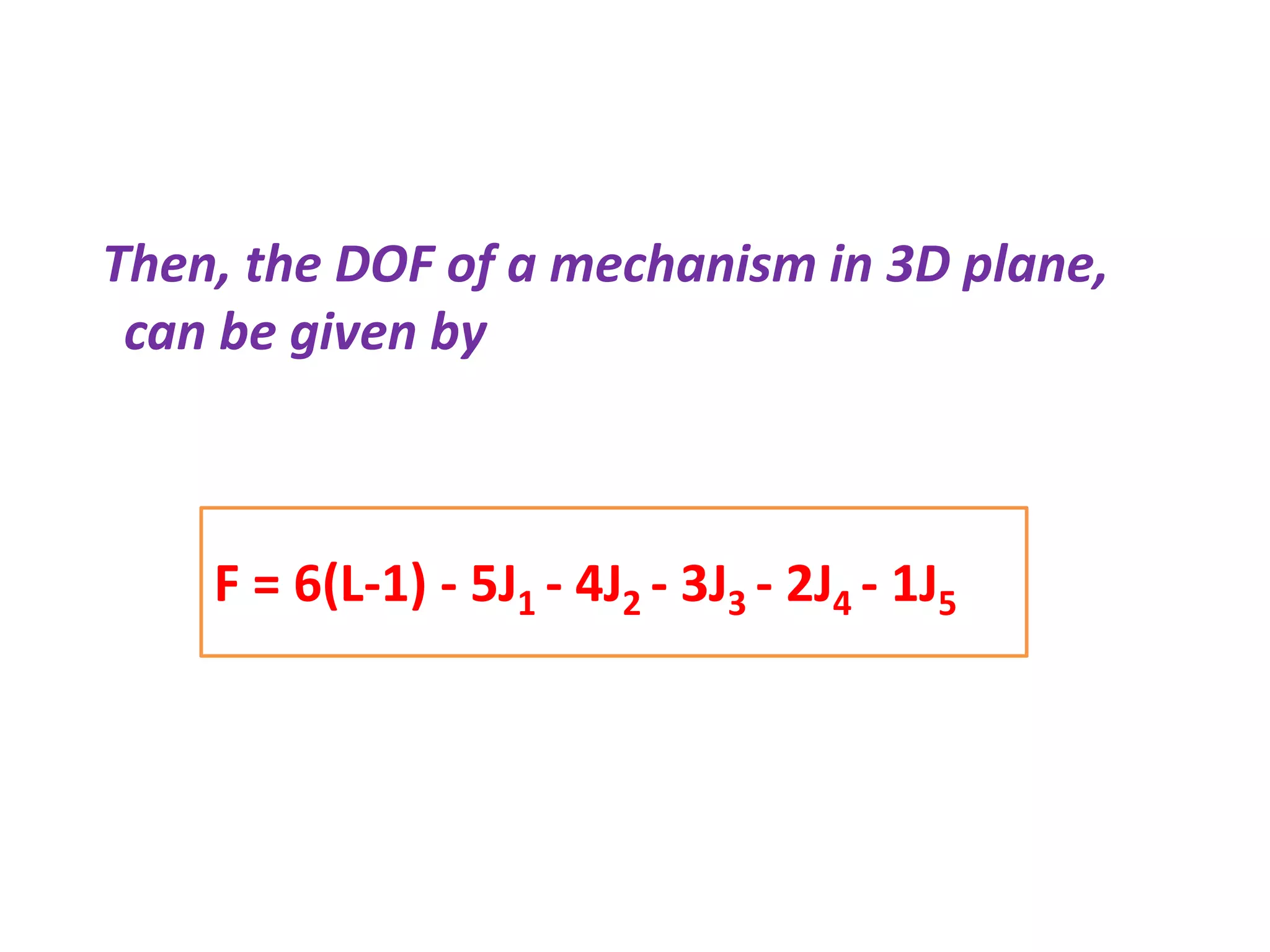
Then, the DOF of a mechanism in 3D plane,
can be given by
F = 6(L-1) - 5J1 - 4J2 - 3J3 - 2J4 - 1J5
DEGREE OF FREEDOM IN A MECHANISM
IN 2D-PLANE
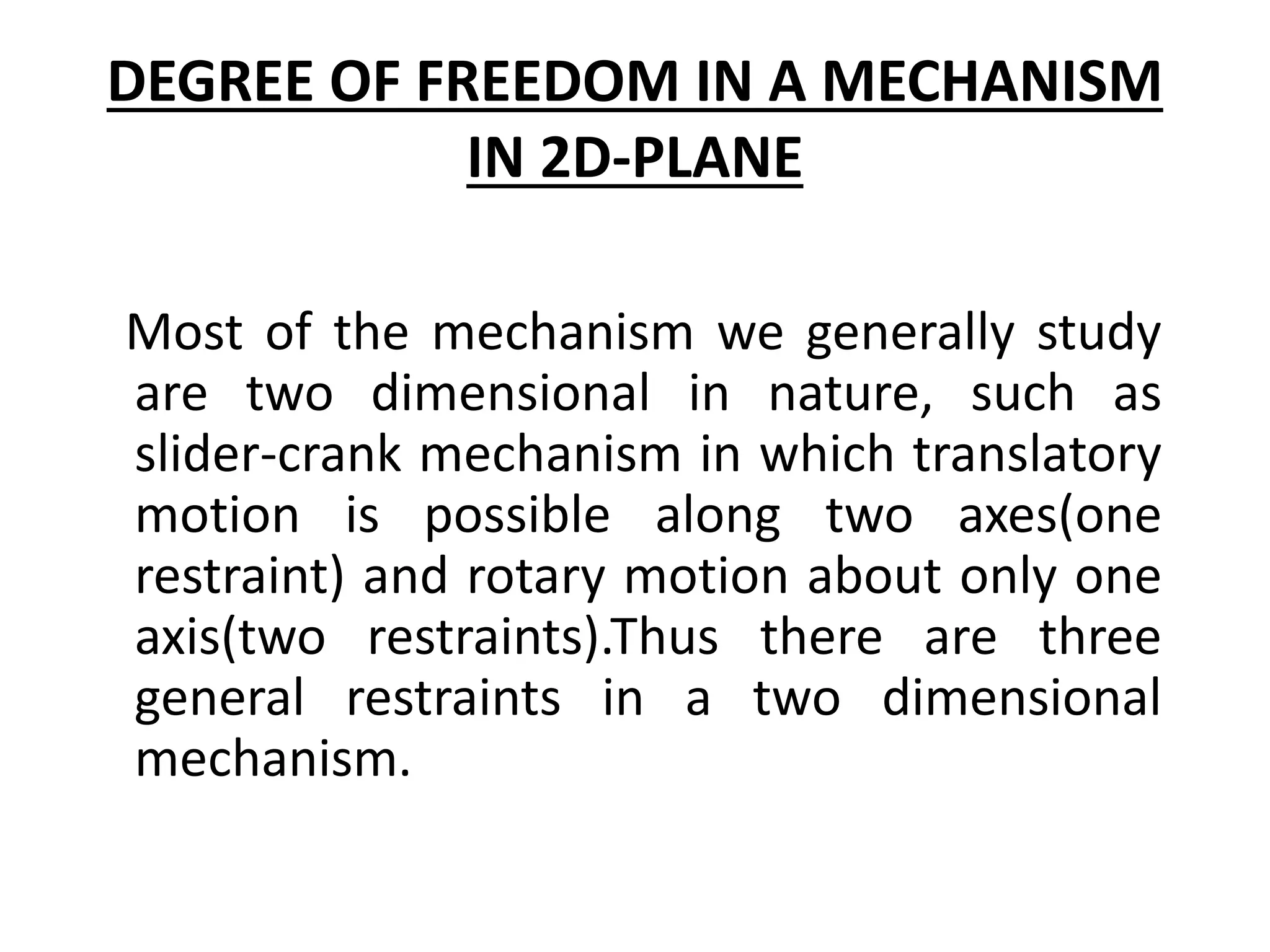
Most of the mechanism we generally study
are two dimensional in nature, such as
slider-crank mechanism in which translatory
motion is possible along two axes(one
restraint) and rotary motion about only one
axis(two restraints).Thus there are three
general restraints in a two dimensional
mechanism.
Therefore, for plane mechanism, the following relation
can be used for degrees of freedom,
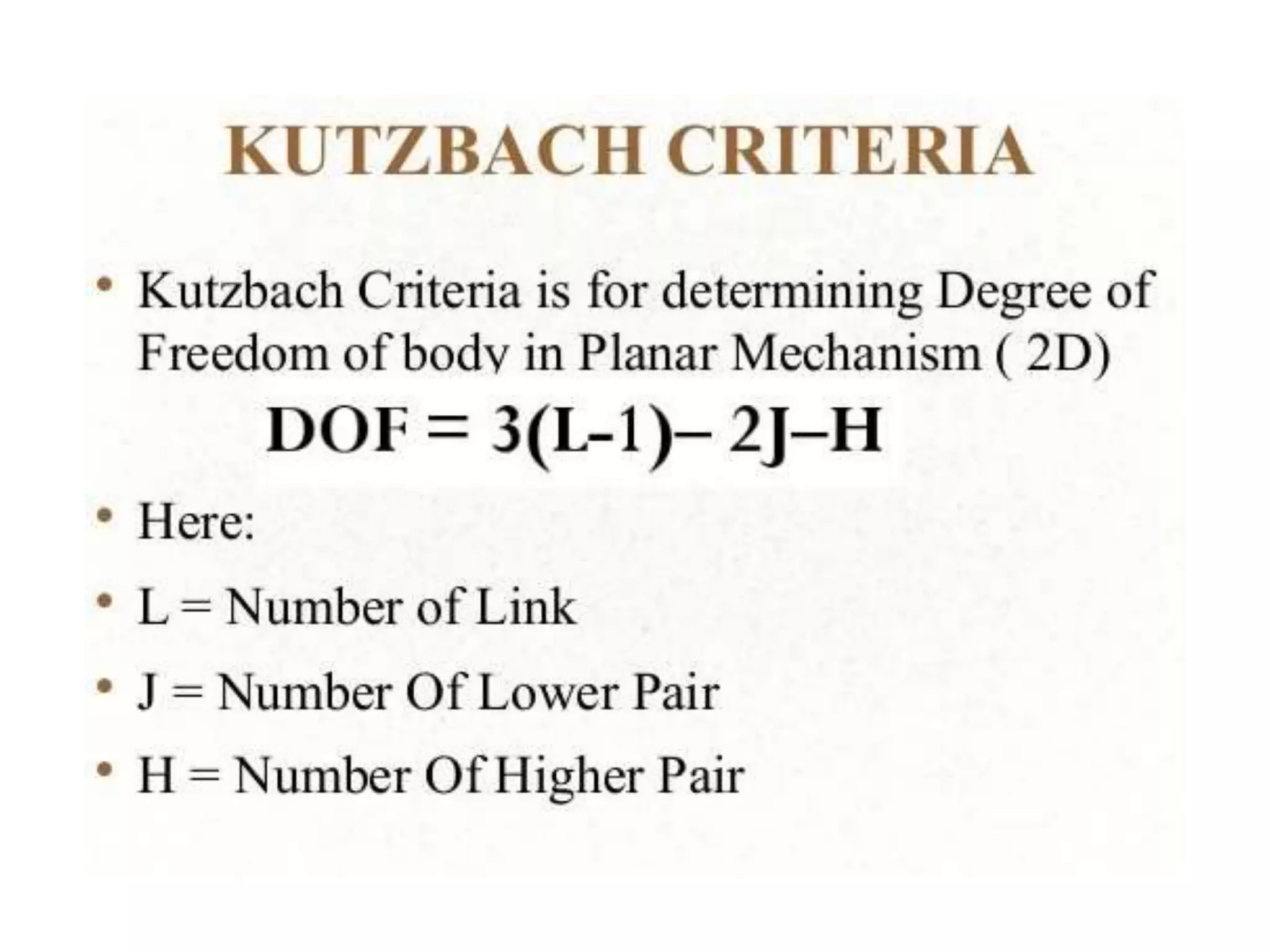
This equation is known as Gruebler’s criterion for
degrees of freedom of plane mechanism.
When the J1 is termed as binary joints and J2 is termed
as higher pairs then the above equation known as
kutzbach’s criterion.
It should be noted here that gruebler’s criterion does
not take care of geometry of the mechanism so it can
give wrong prediction. So, inspection should be done in
certain cases to find the degrees of freedom.
F = 3 (L-1) - 2J1 - 1J2
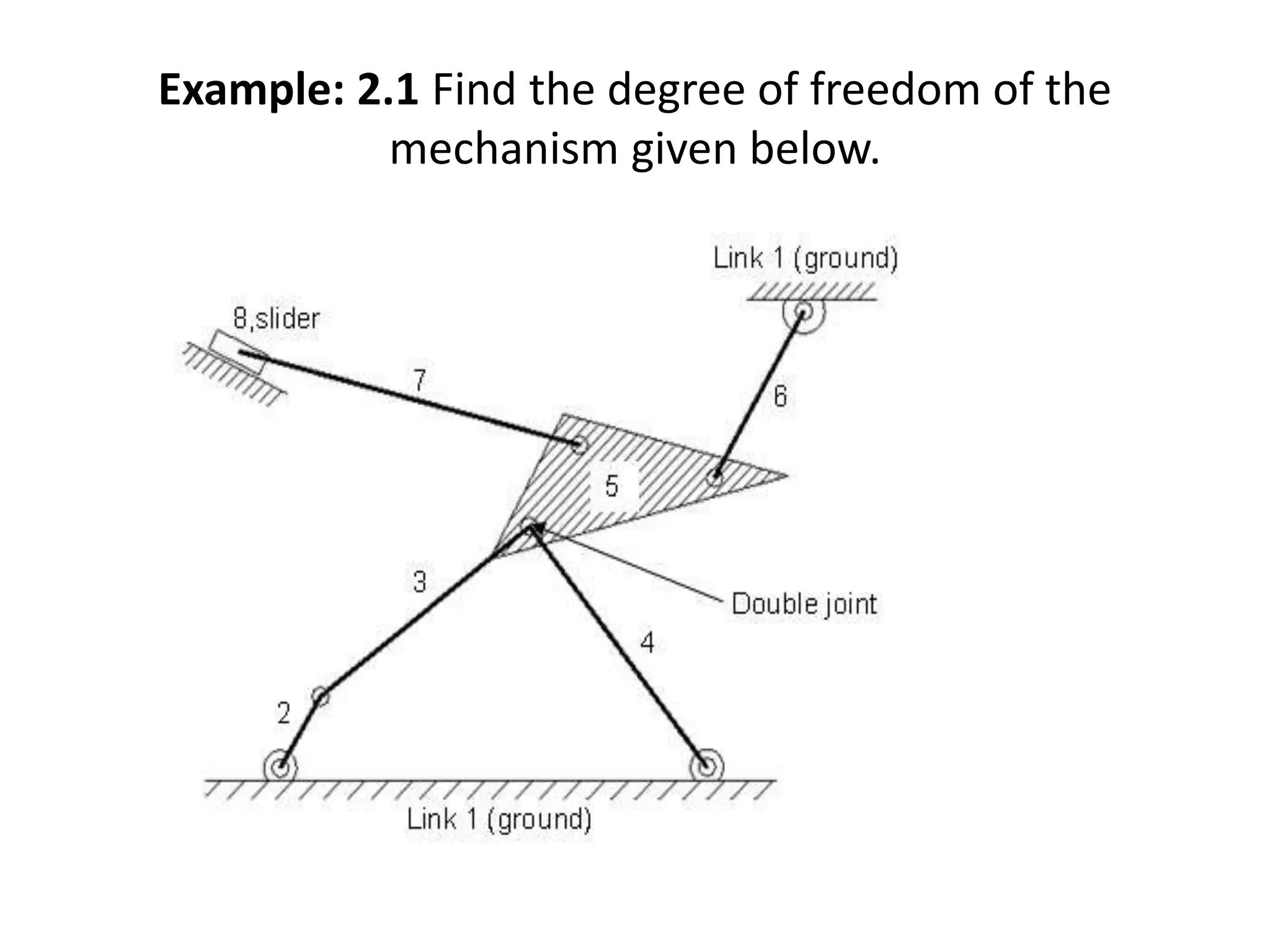
Example: 2.1 Find the degree of freedom of the
mechanism given below.
Solution:
Number of links=8
Numbers pairs having one degrees of freedom=10 by counting
How to calculate pairs
Pair 1 Link 1 (ground) and link 2 constitute a single turning pair
Pair 2 Link 2 and link 3 constitute a single turning pair
Pair 3 Link 3 and link 5 constitute a single turning pair
Pair 4 Link 4 and link 5 constitute a single turning pair
Pair 5 Link 5 and link 6 constitute a single turning pair
Pair 6 Link 6 and ground (link 1) constitute a turning pair
Pair 7 Link 5 and link 7 constitute a turning pair
Pair 8 Link 7 and link 8 constitute a turning pair
Pair 9 Link 8 and ground (link 1) constitute a sliding pair
Pair 10 Link 4 and ground (link 1) constitute a turning pair
As all the pair calculated have one degree of freedom so there is only term J1 is used
as it denotes the pair having single degree of freedom.
J1 = 10 (as all pairs have one degree of freedom)
F = 3 (N-1) - 2J1 - 1J2
DOF=3(8-1)-2×10=1
The degree of freedom is one for this mechanism.
Example 2.2 Find the degree of freedom of the
mechanism given below.
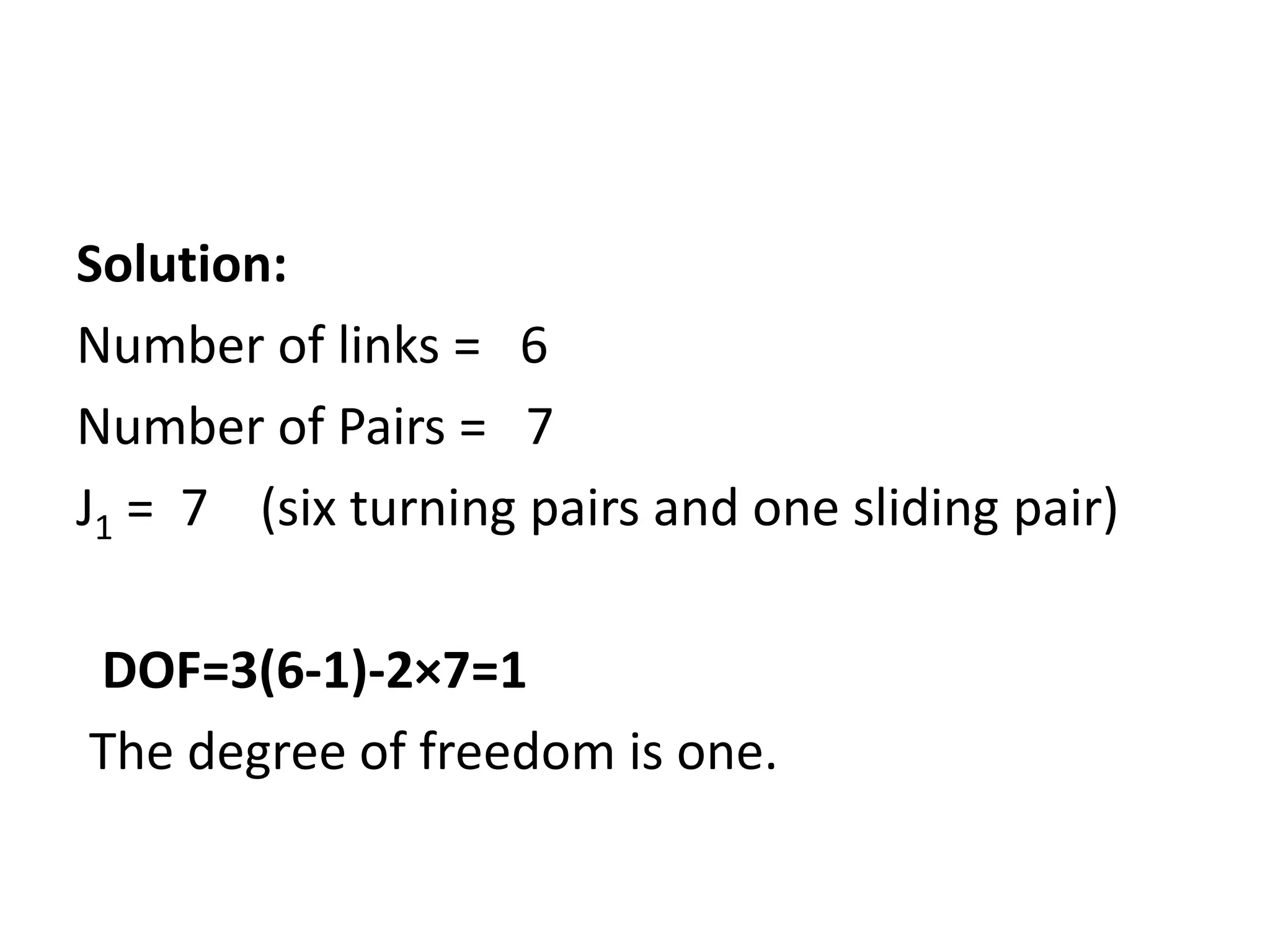
Solution:
Number of links = 6
Number of Pairs = 7
J1 = 7 (six turning pairs and one sliding pair)
DOF=3(6-1)-2×7=1
The degree of freedom is one.
Example 2.3: Find the mobility or degree of freedom of
the following mechanism.
Solution:
Number of links = 7
Number of Pairs = 8
J1 = 7 (six turning pairs and one sliding pair)
J2 = 1 (Fork joint is two DOF joint)
DOF=3(7-1)-2×7-1×1=3
The degree of freedom is one.
Condition of DOF
If DOF < 0, Preloaded Structure/ super structure
If DOF = 0, structure
If DOF = 1, kinematic chain or constrained chain
or mechanism
If DOF > 1, unconstrained chain or mechanism

DEGREE OF FREEDOM OF A KINEMATIC MECHANISM

  • 1.
    DEGREE OF FREEDOMOF A KINEMATIC MECHANISM KINEMATICS & DYNAMICS OF MACHINES (RME4C001) BY BIVASEET PRADHAN
  • 2.
    DEGREES OF FREEDOMOF A RIGID BODY IN A 2D- PLANE The degrees of freedom (DOF) of a rigid body is defined as the number of independent movements it has.  To determine the DOF of this body we must consider how many distinct ways the body can be moved. In a two dimensional plane such as this computer screen/white board, there are 3 DOF. The body can be translated along the x axis, translated along the y axis, and rotated about its centroid.
  • 4.
    DEGREES OF FREEDOMOF A RIGID BODY IN SPACE/3D PLANE An unrestrained rigid body in space has six degrees of freedom: three translating motions along the x, y and z axes and three rotary motions around the x, y and z axes respectively.
  • 6.
    The rigid bodyhas 6 DOF in space but due to formation of linkage one or more DOF is lost due to the presence of constraint on the body. The total number constraints cannot be zero as the body has to be fixed at some place to make the linkage possible. Thus the degree of freedom is given by DOF= 6- (Numbers of Restraints)
  • 7.
  • 8.
    KINEMATIC CHAIN a) Kinematicchain: A kinematic chain is an assembly of links which are interconnected through joints or pairs, in which the relative motions between the links is possible and the motion of each link relative to the other is definite.
  • 10.
    b) Non-kinematic chain: In case the motion of a link results in indefinite motions of others links, it is a non- kinematic chain. The reason for this indefinite motion lies in the fact that if we give motion to any of the link in the chain then the other links can take indefinite position.
  • 12.
    c) Redundant chain: Thereis no motion possible in the redundant chain. It can be observed from the following figure that this chain is locked due to its geometry.
  • 14.
    DEGREE OF FREEDOMIN A MECHANISM IN 3D PLANE Degrees of freedom of a mechanism in space can be explained as follows: Let N or L = total number of links in a mechanism F or M = degrees of freedom J1 = number of pairs having one degree of freedom J2 = number of pairs having two degree of freedom and so on. When one of the links is fixed in a mechanism Then, the number of the movable links are = N - 1 Degrees of freedom of (N- 1) movable links = 6(N-1)
  • 15.
     Because eachmovable link has six degree of freedom) Each pair having one degree of freedom imposes 5 restraints on the mechanism reducing its degrees of freedom by 5J1 this is because of the fact that the restraint on any of the link is common to the mechanism as well.  Other pairs having 2, 3, 4 and 5 degrees of freedom reduce the degree of freedom of the mechanism by putting constraints on the mechanism as well.
  • 16.
    Then, the DOFof a mechanism in 3D plane, can be given by F = 6(L-1) - 5J1 - 4J2 - 3J3 - 2J4 - 1J5
  • 17.
    DEGREE OF FREEDOMIN A MECHANISM IN 2D-PLANE Most of the mechanism we generally study are two dimensional in nature, such as slider-crank mechanism in which translatory motion is possible along two axes(one restraint) and rotary motion about only one axis(two restraints).Thus there are three general restraints in a two dimensional mechanism.
  • 19.
    Therefore, for planemechanism, the following relation can be used for degrees of freedom, This equation is known as Gruebler’s criterion for degrees of freedom of plane mechanism. When the J1 is termed as binary joints and J2 is termed as higher pairs then the above equation known as kutzbach’s criterion. It should be noted here that gruebler’s criterion does not take care of geometry of the mechanism so it can give wrong prediction. So, inspection should be done in certain cases to find the degrees of freedom. F = 3 (L-1) - 2J1 - 1J2
  • 22.
    Example: 2.1 Findthe degree of freedom of the mechanism given below.
  • 23.
    Solution: Number of links=8 Numberspairs having one degrees of freedom=10 by counting How to calculate pairs Pair 1 Link 1 (ground) and link 2 constitute a single turning pair Pair 2 Link 2 and link 3 constitute a single turning pair Pair 3 Link 3 and link 5 constitute a single turning pair Pair 4 Link 4 and link 5 constitute a single turning pair Pair 5 Link 5 and link 6 constitute a single turning pair Pair 6 Link 6 and ground (link 1) constitute a turning pair Pair 7 Link 5 and link 7 constitute a turning pair Pair 8 Link 7 and link 8 constitute a turning pair Pair 9 Link 8 and ground (link 1) constitute a sliding pair Pair 10 Link 4 and ground (link 1) constitute a turning pair As all the pair calculated have one degree of freedom so there is only term J1 is used as it denotes the pair having single degree of freedom. J1 = 10 (as all pairs have one degree of freedom) F = 3 (N-1) - 2J1 - 1J2 DOF=3(8-1)-2×10=1 The degree of freedom is one for this mechanism.
  • 24.
    Example 2.2 Findthe degree of freedom of the mechanism given below.
  • 25.
    Solution: Number of links= 6 Number of Pairs = 7 J1 = 7 (six turning pairs and one sliding pair) DOF=3(6-1)-2×7=1 The degree of freedom is one.
  • 26.
    Example 2.3: Findthe mobility or degree of freedom of the following mechanism.
  • 27.
    Solution: Number of links= 7 Number of Pairs = 8 J1 = 7 (six turning pairs and one sliding pair) J2 = 1 (Fork joint is two DOF joint) DOF=3(7-1)-2×7-1×1=3 The degree of freedom is one.
  • 28.
    Condition of DOF IfDOF < 0, Preloaded Structure/ super structure If DOF = 0, structure If DOF = 1, kinematic chain or constrained chain or mechanism If DOF > 1, unconstrained chain or mechanism