Comparators
Comparators
• Comparators have very limited ranges of motion, but
very high sensitivities (and therefore accuracies). As
a result the comparators are often calibrated against
standards such as gauge blocks.
• The basic requirements of these instruments are,
- rigidity of the design
- linear magnification within the operation range
- coarse and fine offset adjustments
Comparators
• Accuracies commonly below 1/10 thousandth of an
inch
• These instruments try to reduce the friction that is
such a problem for the dial indicators
• There are four common principles used to design
these instruments,
- mechanical
- pneumatic
- electrical
- optical
• Types of Comparators:
– The comparators differ principally in the method used for
amplifying and recording the variation measured. Most
commonly available comparators are of the following
types:
• Mechanical comparators
• Optical comparators
• Electric and electronic comparator machines
• Pneumatic comparators
• Fluid displacement comparator machines
• Projection comparators
• Multi-check comparator
• Automatic gauging
Uses of comparators
• The various ways in which the comparators can be used
are as follows:
I. In mass production, where components are to be
checked at a very fast rate.
II. As laboratory standards from which working or
inspection gauges are set and correlated.
III. For inspecting newly purchased gauges.
IV. Attached with some machines, comparators can be used
as working gauges to prevent work spoilage and to
maintain required tolerances at all stages of
manufacturing.
V. In selective assembly of parts, where parts are graded in
three or more groups depending upon their tolerance.
Mechanical Comparators
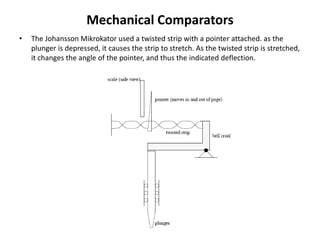
• The Johansson Mikrokator used a twisted strip with a pointer attached. as the
plunger is depressed, it causes the strip to stretch. As the twisted strip is stretched,
it changes the angle of the pointer, and thus the indicated deflection.
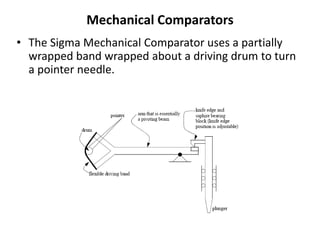
• The Sigma Mechanical Comparator uses a partially
wrapped band wrapped about a driving drum to turn
a pointer needle.
Mechanical Comparators
Sigma comparator
• Sigma comparator is the most widely used for higher precision work.
Magnification ranges from 300 to 5000.
• Figure shows the details of the magnifying system of the comparator.
Plunger mounted on a pair of slit diaphragms obtains the frictionless
linear motion.
• A knife-edge is mounted on it and bears upon the face of the moving
member of a cross strip hinge.
• This hinge consists of the moving component and a fixed member, which
are connected by thin flexible strips alternately at right angles to each
other.
• A ‘Y’ arm is attached to the moving member which has an effective ‘I’. If
the distance of the hinge from the knife-edge be ‘a’ then the magnification
of the first stages is I/a. A phosphor – bronze strip is attached to the two
extremities of the Y arm and is passed round a radius ‘r’ attached to the
pointer spindle. The second stage magnification is R/r where R is the
length of pointer. Then total magnification is I/a x R/r. The magnification
can be altered by tightening one end slackening the other screw attaching
the knife-edge to the plunger and thus adjusting the distance ‘a’.
Sigma Mechanical Comparator
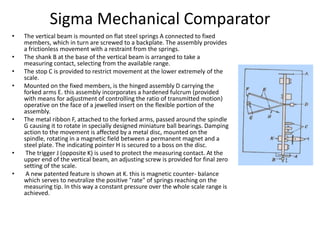
• The vertical beam is mounted on flat steel springs A connected to fixed
members, which in turn are screwed to a backplate. The assembly provides
a frictionless movement with a restraint from the springs.
• The shank B at the base of the vertical beam is arranged to take a
measuring contact, selecting from the available range.
• The stop C is provided to restrict movement at the lower extremely of the
scale.
• Mounted on the fixed members, is the hinged assembly D carrying the
forked arms E. this assembly incorporates a hardened fulcrum (provided
with means for adjustment of controlling the ratio of transmitted motion)
operative on the face of a jewelled insert on the flexible portion of the
assembly.
• The metal ribbon F, attached to the forked arms, passed around the spindle
G causing it to rotate in specially designed miniature ball bearings. Damping
action to the movement is affected by a metal disc, mounted on the
spindle, rotating in a magnetic field between a permanent magnet and a
steel plate. The indicating pointer H is secured to a boss on the disc.
• The trigger J (opposite K) is used to protect the measuring contact. At the
upper end of the vertical beam, an adjusting screw is provided for final zero
setting of the scale.
• A new patented feature is shown at K. this is magnetic counter- balance
which serves to neutralize the positive "rate" of springs reaching on the
measuring tip. In this way a constant pressure over the whole scale range is
achieved.
Sigma comparator
• Some features of this instrument:
– The shock will not be transmitted since the knife-edge
moves away from the moving member of the hinge.
– A non-ferrous disc is mounted on the pointer spindle
and it is made to move in field of a permanent magnet
to obtain deadbeat reading.
– Parallax error is avoided by having a reflective strip on
the scale.
– A magnet plunger on the flame and keeper bar on the
top of the plunger is used to have the constant
pressure over the range of the instrument.
Mechanical Comparators:
• Advantages
– These are usually cheaper in comparison to other devices of amplifying.
– These do not require any external supply such as electricity or air and as such
the variations in outside supplies do not affect the accuracy.
– Usually the mechanical comparators have linear scale which is easily
understood.
– These are usually robust and compact and easy to handle.
– For ordinary workshop conditions, these are suitable and being portable can
be issued from a store.
–
• Disadvantages:
– The mechanical comparators have got more moving parts than other types.
Due to more moving parts, the friction is more and ultimately the accuracy is
less.
– Any slackness in moving parts reduces the accuracy considerably.
– The mechanism has more inertia and this may cause the instruments to be
sensitive to vibration.
– The range of the instrument is limited as the pointer moves over a fixed scale.
Mechanical and Optical Comparators
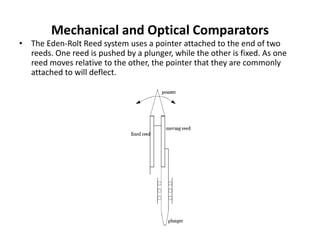
• The Eden-Rolt Reed system uses a pointer attached to the end of two
reeds. One reed is pushed by a plunger, while the other is fixed. As one
reed moves relative to the other, the pointer that they are commonly
attached to will deflect.
Optical Comparators
• These devices use a plunger to rotate a mirror. A
light beam is reflected off that mirror, and simply
by the virtue of distance, the small rotation of
the mirror can be converted to a significant
translation with little friction.
• All optical comparators involve some system of
magnification, generally through tilting of a
mirror which provides an optical lever by
reflecting a beam of light.
• The Cooke comparator works on this principle.
Optical Comparators
• A plunger working in a head
consists of a mechanical lever
carrying two pivots at its ends.
On one end a plunger actuates
it and the other end actuates a
mirror. A circular scale is
provided. The mirror onto the
scale accordingly reflects a
beam of light coming through
an electric bulb.
• Optical comparators are used
in metrology labs and standard
room, but not in routine
production checking.
• The optical system offers the
advantage of lightness &
simplicity in its indicating unit.
Cooke
Optical Comparators:
• Advantages
– it has small number of moving parts and hence a higher accuracy.
– In the optical comparators, the scale can be made to move past a
datum line and thus have high range and no parallax errors.
– It has very high magnification.
– Optical lever is weightless.
• Disadvantages:
– As the instrument has high magnification, heat from the lamp,
transformer etc. may cause the setting to drift.
– An electrical supply is necessary.
– The apparatus is usually large and expensive.
– When the scale is projected on a screen, then it is essential to use the
instrument to a dark room in order to take the readings easily.
– The instruments in which the scale is viewed through the eyepiece of a
microscope are not convenient for continuous use.
Pneumatic Comparators
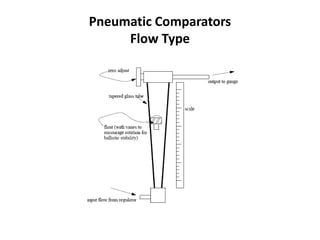
• Flow type
- the float height is essentially proportional to the
air that escapes from the gauge head
- master gauges are used to find calibration points
on the scales
- the input pressure is regulated to allow
magnification adjustment
- a pressure bleed off valve allows changes to the
base level for offset
Pneumatic Comparators
Flow Type
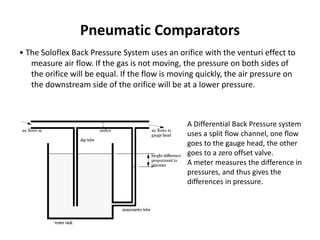
• The Soloflex Back Pressure System uses an orifice with the venturi effect to
measure air flow. If the gas is not moving, the pressure on both sides of
the orifice will be equal. If the flow is moving quickly, the air pressure on
the downstream side of the orifice will be at a lower pressure.
Pneumatic Comparators
A Differential Back Pressure system
uses a split flow channel, one flow
goes to the gauge head, the other
goes to a zero offset valve.
A meter measures the difference in
pressures, and thus gives the
differences in pressure.
Pneumatic Comparators
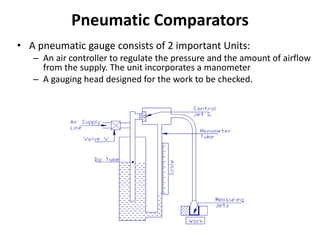
• A pneumatic gauge consists of 2 important Units:
– An air controller to regulate the pressure and the amount of airflow
from the supply. The unit incorporates a manometer
– A gauging head designed for the work to be checked.
Pneumatic Comparators
• Air supply from the supply is fed into the instrument at pressure higher than the
constant pressure required in the manometer.
• Air enters the tube extending downwards into a tank of liquid. Initially the tube is
filled with liquid to the same level as that in the tank.
• Entry of air into the top of the tube exerts pressure on the liquid to completely
empty it. Any excess pressure than that necessary to clear the tube will escape
into the tank as air bubbles. The pressure between the valve V and the control jet
G is therefore always the same, irrespective of any variation in the air supply
pressure.
• The air will now pass through the control jet at the full controlled pressure and will
reach the measuring jet S. If this jet S cannot pass the full volume of the air from
the control jet, then a pressure will tend to develop between them.
• The back pressure is instantly released through the opening into the manometer
tube where it will change the height of the liquid, which indicates the amount of
back pressure built up.
• The back pressure is the result of restriction at the measuring jet due to the effect
of variations in the dimension of the work being checked so that the variations in
the height of the liquid of the manometer are a measure of the dimension
variations.
• The pneumatic method is easily adaptable for the examination of bores, since the
machining element can be housed inside the plug used for accommodating the
component. This method is very simple and minimum wear of working parts takes
place, but it requires a supply of air to provide the motive force.
Pneumatic Comparators
• Advantages
– The gauging member does not come into contact with the part to be
measured and hence practically no wear takes place on the gauging member.
– It has usually very small number of moving parts and in some cases none.
Thus the accuracy is more due t less friction and less inertia.
– Measuring pressure is very small and the jet of air helps in cleaning the dust, if
any, from the part to be measured.
– It is possible to have very high magnification.
– The indicating instrument can be remote from the measuring unit.
– It is very suitable device for measuring diameter of holes where the diameter
is small compared with the length.
– It is probably the best method for determining the ovality and taperness of
the circular bores.
• Disadvantages:
– It require elaborate auxiliary equipment such as accurate pressure regulato.
– The scale is generally not uniform.
– When indicating device is the glass tube, then high magnification is necessary
in order to avoid the meniscus errors.
– The apparatus is not easily portable and is rather elaborate for many industrial
applications.
– Different gauging heads are required for different dimensions.
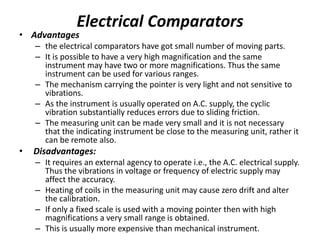
Electrical Comparators:
• Electrical and electronic comparators depend
on wheat stone bridge circuit for their
operations. For the bridge is to balance
electrically the ratio of the resistance’s in each
pair must be equal.
• The principle of electrical comparator
(electrical limit gauge) is explained with
reference to the adjacent figure.
• If alternating current is applied to the bridge,
the inductance and capacitance of the arms
must also be accounted for along with
resistance. The pair of coils forms a pair of
inductance. The movement of the plunger
displaces an armature thus causing a variation
in the inductance in the coils. The amount of
unbalance caused by movement of measuring
plunger is amplified and shown on a linear
scale magnifications of about 30,000 are
possible with this system.
• Zero setting arrangement is provided. The
degree of magnification is adjustable and
other examples of electrical comparators are
electricator, electric gage and sigma electronic
comparator.
Electrical Comparators
• Advantages
– the electrical comparators have got small number of moving parts.
– It is possible to have a very high magnification and the same
instrument may have two or more magnifications. Thus the same
instrument can be used for various ranges.
– The mechanism carrying the pointer is very light and not sensitive to
vibrations.
– As the instrument is usually operated on A.C. supply, the cyclic
vibration substantially reduces errors due to sliding friction.
– The measuring unit can be made very small and it is not necessary
that the indicating instrument be close to the measuring unit, rather it
can be remote also.
• Disadvantages:
– It requires an external agency to operate i.e., the A.C. electrical supply.
Thus the vibrations in voltage or frequency of electric supply may
affect the accuracy.
– Heating of coils in the measuring unit may cause zero drift and alter
the calibration.
– If only a fixed scale is used with a moving pointer then with high
magnifications a very small range is obtained.
– This is usually more expensive than mechanical instrument.
Coordinate Measuring Machines
• Measure x-y-z coordinates using touch probes
• These measurements can be made by positioning the probe by hand, or
automatically in more expensive machines.
• reasonable accuracies are 5 micro in. or 1 micro metre.
• The method these machines work on is measurement of the position of the
probe using linear position sensors. These are based on moire fringe
patterns (also used in other systems).
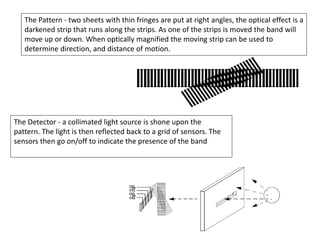
1. The Pattern - two sheets with thin fringes are put at right angles, the
optical effect is a darkened strip that runs along the strips. As one of the
strips is moved the band will move up or down. When optically magnified
the moving strip can be used to determine direction, and distance of
motion.
2. The Detector - a collimated light source is shone upon the pattern. The
light is then reflected back to a grid of sensors. The sensors then go on/off
to indicate the presence of the band.
The Pattern - two sheets with thin fringes are put at right angles, the optical effect is a
darkened strip that runs along the strips. As one of the strips is moved the band will
move up or down. When optically magnified the moving strip can be used to
determine direction, and distance of motion.
The Detector - a collimated light source is shone upon the
pattern. The light is then reflected back to a grid of sensors. The
sensors then go on/off to indicate the presence of the band

Comparators

  • 1.
  • 2.
    Comparators • Comparators havevery limited ranges of motion, but very high sensitivities (and therefore accuracies). As a result the comparators are often calibrated against standards such as gauge blocks. • The basic requirements of these instruments are, - rigidity of the design - linear magnification within the operation range - coarse and fine offset adjustments
  • 3.
    Comparators • Accuracies commonlybelow 1/10 thousandth of an inch • These instruments try to reduce the friction that is such a problem for the dial indicators • There are four common principles used to design these instruments, - mechanical - pneumatic - electrical - optical
  • 4.
    • Types ofComparators: – The comparators differ principally in the method used for amplifying and recording the variation measured. Most commonly available comparators are of the following types: • Mechanical comparators • Optical comparators • Electric and electronic comparator machines • Pneumatic comparators • Fluid displacement comparator machines • Projection comparators • Multi-check comparator • Automatic gauging
  • 5.
    Uses of comparators •The various ways in which the comparators can be used are as follows: I. In mass production, where components are to be checked at a very fast rate. II. As laboratory standards from which working or inspection gauges are set and correlated. III. For inspecting newly purchased gauges. IV. Attached with some machines, comparators can be used as working gauges to prevent work spoilage and to maintain required tolerances at all stages of manufacturing. V. In selective assembly of parts, where parts are graded in three or more groups depending upon their tolerance.
  • 6.
    Mechanical Comparators • TheJohansson Mikrokator used a twisted strip with a pointer attached. as the plunger is depressed, it causes the strip to stretch. As the twisted strip is stretched, it changes the angle of the pointer, and thus the indicated deflection.
  • 7.
    • The SigmaMechanical Comparator uses a partially wrapped band wrapped about a driving drum to turn a pointer needle. Mechanical Comparators
  • 8.
    Sigma comparator • Sigmacomparator is the most widely used for higher precision work. Magnification ranges from 300 to 5000. • Figure shows the details of the magnifying system of the comparator. Plunger mounted on a pair of slit diaphragms obtains the frictionless linear motion. • A knife-edge is mounted on it and bears upon the face of the moving member of a cross strip hinge. • This hinge consists of the moving component and a fixed member, which are connected by thin flexible strips alternately at right angles to each other. • A ‘Y’ arm is attached to the moving member which has an effective ‘I’. If the distance of the hinge from the knife-edge be ‘a’ then the magnification of the first stages is I/a. A phosphor – bronze strip is attached to the two extremities of the Y arm and is passed round a radius ‘r’ attached to the pointer spindle. The second stage magnification is R/r where R is the length of pointer. Then total magnification is I/a x R/r. The magnification can be altered by tightening one end slackening the other screw attaching the knife-edge to the plunger and thus adjusting the distance ‘a’.
  • 9.
    Sigma Mechanical Comparator •The vertical beam is mounted on flat steel springs A connected to fixed members, which in turn are screwed to a backplate. The assembly provides a frictionless movement with a restraint from the springs. • The shank B at the base of the vertical beam is arranged to take a measuring contact, selecting from the available range. • The stop C is provided to restrict movement at the lower extremely of the scale. • Mounted on the fixed members, is the hinged assembly D carrying the forked arms E. this assembly incorporates a hardened fulcrum (provided with means for adjustment of controlling the ratio of transmitted motion) operative on the face of a jewelled insert on the flexible portion of the assembly. • The metal ribbon F, attached to the forked arms, passed around the spindle G causing it to rotate in specially designed miniature ball bearings. Damping action to the movement is affected by a metal disc, mounted on the spindle, rotating in a magnetic field between a permanent magnet and a steel plate. The indicating pointer H is secured to a boss on the disc. • The trigger J (opposite K) is used to protect the measuring contact. At the upper end of the vertical beam, an adjusting screw is provided for final zero setting of the scale. • A new patented feature is shown at K. this is magnetic counter- balance which serves to neutralize the positive "rate" of springs reaching on the measuring tip. In this way a constant pressure over the whole scale range is achieved.
  • 10.
    Sigma comparator • Somefeatures of this instrument: – The shock will not be transmitted since the knife-edge moves away from the moving member of the hinge. – A non-ferrous disc is mounted on the pointer spindle and it is made to move in field of a permanent magnet to obtain deadbeat reading. – Parallax error is avoided by having a reflective strip on the scale. – A magnet plunger on the flame and keeper bar on the top of the plunger is used to have the constant pressure over the range of the instrument.
  • 11.
    Mechanical Comparators: • Advantages –These are usually cheaper in comparison to other devices of amplifying. – These do not require any external supply such as electricity or air and as such the variations in outside supplies do not affect the accuracy. – Usually the mechanical comparators have linear scale which is easily understood. – These are usually robust and compact and easy to handle. – For ordinary workshop conditions, these are suitable and being portable can be issued from a store. – • Disadvantages: – The mechanical comparators have got more moving parts than other types. Due to more moving parts, the friction is more and ultimately the accuracy is less. – Any slackness in moving parts reduces the accuracy considerably. – The mechanism has more inertia and this may cause the instruments to be sensitive to vibration. – The range of the instrument is limited as the pointer moves over a fixed scale.
  • 12.
    Mechanical and OpticalComparators • The Eden-Rolt Reed system uses a pointer attached to the end of two reeds. One reed is pushed by a plunger, while the other is fixed. As one reed moves relative to the other, the pointer that they are commonly attached to will deflect.
  • 13.
    Optical Comparators • Thesedevices use a plunger to rotate a mirror. A light beam is reflected off that mirror, and simply by the virtue of distance, the small rotation of the mirror can be converted to a significant translation with little friction. • All optical comparators involve some system of magnification, generally through tilting of a mirror which provides an optical lever by reflecting a beam of light. • The Cooke comparator works on this principle.
  • 14.
    Optical Comparators • Aplunger working in a head consists of a mechanical lever carrying two pivots at its ends. On one end a plunger actuates it and the other end actuates a mirror. A circular scale is provided. The mirror onto the scale accordingly reflects a beam of light coming through an electric bulb. • Optical comparators are used in metrology labs and standard room, but not in routine production checking. • The optical system offers the advantage of lightness & simplicity in its indicating unit. Cooke
  • 15.
    Optical Comparators: • Advantages –it has small number of moving parts and hence a higher accuracy. – In the optical comparators, the scale can be made to move past a datum line and thus have high range and no parallax errors. – It has very high magnification. – Optical lever is weightless. • Disadvantages: – As the instrument has high magnification, heat from the lamp, transformer etc. may cause the setting to drift. – An electrical supply is necessary. – The apparatus is usually large and expensive. – When the scale is projected on a screen, then it is essential to use the instrument to a dark room in order to take the readings easily. – The instruments in which the scale is viewed through the eyepiece of a microscope are not convenient for continuous use.
  • 16.
    Pneumatic Comparators • Flowtype - the float height is essentially proportional to the air that escapes from the gauge head - master gauges are used to find calibration points on the scales - the input pressure is regulated to allow magnification adjustment - a pressure bleed off valve allows changes to the base level for offset
  • 17.
  • 18.
    • The SoloflexBack Pressure System uses an orifice with the venturi effect to measure air flow. If the gas is not moving, the pressure on both sides of the orifice will be equal. If the flow is moving quickly, the air pressure on the downstream side of the orifice will be at a lower pressure. Pneumatic Comparators A Differential Back Pressure system uses a split flow channel, one flow goes to the gauge head, the other goes to a zero offset valve. A meter measures the difference in pressures, and thus gives the differences in pressure.
  • 19.
    Pneumatic Comparators • Apneumatic gauge consists of 2 important Units: – An air controller to regulate the pressure and the amount of airflow from the supply. The unit incorporates a manometer – A gauging head designed for the work to be checked.
  • 20.
    Pneumatic Comparators • Airsupply from the supply is fed into the instrument at pressure higher than the constant pressure required in the manometer. • Air enters the tube extending downwards into a tank of liquid. Initially the tube is filled with liquid to the same level as that in the tank. • Entry of air into the top of the tube exerts pressure on the liquid to completely empty it. Any excess pressure than that necessary to clear the tube will escape into the tank as air bubbles. The pressure between the valve V and the control jet G is therefore always the same, irrespective of any variation in the air supply pressure. • The air will now pass through the control jet at the full controlled pressure and will reach the measuring jet S. If this jet S cannot pass the full volume of the air from the control jet, then a pressure will tend to develop between them. • The back pressure is instantly released through the opening into the manometer tube where it will change the height of the liquid, which indicates the amount of back pressure built up. • The back pressure is the result of restriction at the measuring jet due to the effect of variations in the dimension of the work being checked so that the variations in the height of the liquid of the manometer are a measure of the dimension variations. • The pneumatic method is easily adaptable for the examination of bores, since the machining element can be housed inside the plug used for accommodating the component. This method is very simple and minimum wear of working parts takes place, but it requires a supply of air to provide the motive force.
  • 21.
    Pneumatic Comparators • Advantages –The gauging member does not come into contact with the part to be measured and hence practically no wear takes place on the gauging member. – It has usually very small number of moving parts and in some cases none. Thus the accuracy is more due t less friction and less inertia. – Measuring pressure is very small and the jet of air helps in cleaning the dust, if any, from the part to be measured. – It is possible to have very high magnification. – The indicating instrument can be remote from the measuring unit. – It is very suitable device for measuring diameter of holes where the diameter is small compared with the length. – It is probably the best method for determining the ovality and taperness of the circular bores. • Disadvantages: – It require elaborate auxiliary equipment such as accurate pressure regulato. – The scale is generally not uniform. – When indicating device is the glass tube, then high magnification is necessary in order to avoid the meniscus errors. – The apparatus is not easily portable and is rather elaborate for many industrial applications. – Different gauging heads are required for different dimensions.
  • 22.
    Electrical Comparators: • Electricaland electronic comparators depend on wheat stone bridge circuit for their operations. For the bridge is to balance electrically the ratio of the resistance’s in each pair must be equal. • The principle of electrical comparator (electrical limit gauge) is explained with reference to the adjacent figure. • If alternating current is applied to the bridge, the inductance and capacitance of the arms must also be accounted for along with resistance. The pair of coils forms a pair of inductance. The movement of the plunger displaces an armature thus causing a variation in the inductance in the coils. The amount of unbalance caused by movement of measuring plunger is amplified and shown on a linear scale magnifications of about 30,000 are possible with this system. • Zero setting arrangement is provided. The degree of magnification is adjustable and other examples of electrical comparators are electricator, electric gage and sigma electronic comparator.
  • 23.
    Electrical Comparators • Advantages –the electrical comparators have got small number of moving parts. – It is possible to have a very high magnification and the same instrument may have two or more magnifications. Thus the same instrument can be used for various ranges. – The mechanism carrying the pointer is very light and not sensitive to vibrations. – As the instrument is usually operated on A.C. supply, the cyclic vibration substantially reduces errors due to sliding friction. – The measuring unit can be made very small and it is not necessary that the indicating instrument be close to the measuring unit, rather it can be remote also. • Disadvantages: – It requires an external agency to operate i.e., the A.C. electrical supply. Thus the vibrations in voltage or frequency of electric supply may affect the accuracy. – Heating of coils in the measuring unit may cause zero drift and alter the calibration. – If only a fixed scale is used with a moving pointer then with high magnifications a very small range is obtained. – This is usually more expensive than mechanical instrument.
  • 24.
    Coordinate Measuring Machines •Measure x-y-z coordinates using touch probes • These measurements can be made by positioning the probe by hand, or automatically in more expensive machines. • reasonable accuracies are 5 micro in. or 1 micro metre. • The method these machines work on is measurement of the position of the probe using linear position sensors. These are based on moire fringe patterns (also used in other systems). 1. The Pattern - two sheets with thin fringes are put at right angles, the optical effect is a darkened strip that runs along the strips. As one of the strips is moved the band will move up or down. When optically magnified the moving strip can be used to determine direction, and distance of motion. 2. The Detector - a collimated light source is shone upon the pattern. The light is then reflected back to a grid of sensors. The sensors then go on/off to indicate the presence of the band.
  • 25.
    The Pattern -two sheets with thin fringes are put at right angles, the optical effect is a darkened strip that runs along the strips. As one of the strips is moved the band will move up or down. When optically magnified the moving strip can be used to determine direction, and distance of motion. The Detector - a collimated light source is shone upon the pattern. The light is then reflected back to a grid of sensors. The sensors then go on/off to indicate the presence of the band