Chapter 4

     Nucleic Acids
  “The Flow of Genetic
Information in the Cell”
Nucleic Acids
Polymers specialized for the storage,
transmission, and use of genetic
information.
DNA = deoxyribonucleic acid
RNA = ribonucleic acid
The monomeric units (building blocks
of nucleic acids) are nucleotides.
Nucleotides
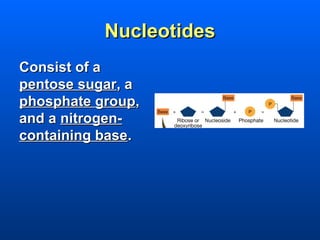
Consist of a
pentose sugar, a
phosphate group,
and a nitrogen-
containing base.
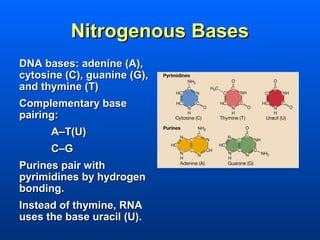
Nitrogenous Bases
DNA bases: adenine (A),
cytosine (C), guanine (G),
and thymine (T)
Complementary base
pairing:
      A–T(U)
      C–G
Purines pair with
pyrimidines by hydrogen
bonding.
Instead of thymine, RNA
uses the base uracil (U).
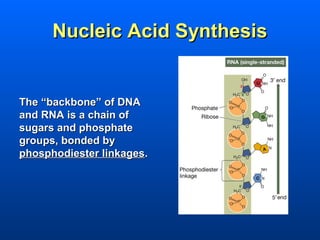
Nucleic Acid Synthesis


The “backbone” of DNA
and RNA is a chain of
sugars and phosphate
groups, bonded by
phosphodiester linkages.
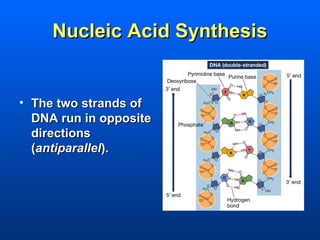
Nucleic Acid Synthesis


• The two strands of
  DNA run in opposite
  directions
  (antiparallel).
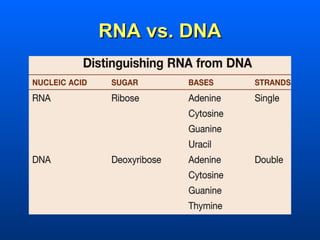
RNA vs. DNA
DNA
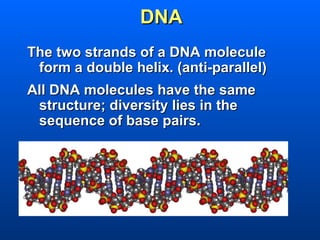
The two strands of a DNA molecule
 form a double helix. (anti-parallel)
All DNA molecules have the same
 structure; diversity lies in the
 sequence of base pairs.
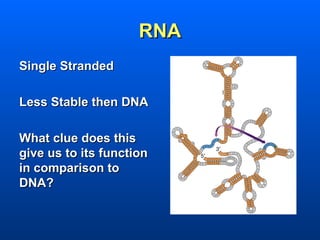
RNA
Single Stranded

Less Stable then DNA

What clue does this
give us to its function
in comparison to
DNA?
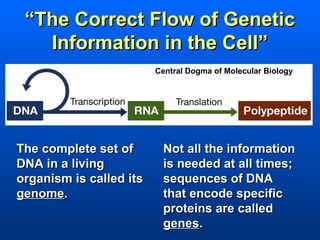
“The Correct Flow of Genetic
   Information in the Cell”
                         Central Dogma of Molecular Biology


The complete set of       Not all the information
DNA in a living           is needed at all times;
organism is called its    sequences of DNA
genome.                   that encode specific
                          proteins are called
                          genes.

Chapter 4

  • 1.
    Chapter 4 Nucleic Acids “The Flow of Genetic Information in the Cell”
  • 2.
    Nucleic Acids Polymers specializedfor the storage, transmission, and use of genetic information. DNA = deoxyribonucleic acid RNA = ribonucleic acid The monomeric units (building blocks of nucleic acids) are nucleotides.
  • 3.
    Nucleotides Consist of a pentosesugar, a phosphate group, and a nitrogen- containing base.
  • 4.
    Nitrogenous Bases DNA bases:adenine (A), cytosine (C), guanine (G), and thymine (T) Complementary base pairing: A–T(U) C–G Purines pair with pyrimidines by hydrogen bonding. Instead of thymine, RNA uses the base uracil (U).
  • 5.
    Nucleic Acid Synthesis The“backbone” of DNA and RNA is a chain of sugars and phosphate groups, bonded by phosphodiester linkages.
  • 6.
    Nucleic Acid Synthesis •The two strands of DNA run in opposite directions (antiparallel).
  • 7.
  • 8.
    DNA The two strandsof a DNA molecule form a double helix. (anti-parallel) All DNA molecules have the same structure; diversity lies in the sequence of base pairs.
  • 9.
    RNA Single Stranded Less Stablethen DNA What clue does this give us to its function in comparison to DNA?
  • 10.
    “The Correct Flowof Genetic Information in the Cell” Central Dogma of Molecular Biology The complete set of Not all the information DNA in a living is needed at all times; organism is called its sequences of DNA genome. that encode specific proteins are called genes.