BIOLOGY
Campbell • Reece • Urry • Cain • Wasserman • Minorsky • Jackson
© 2015 Pearson Education Ltd
TENTH EDITION
Global Edition
Lecture Presentation by
Nicole Tunbridge and
Kathleen Fitzpatrick
10Cell Respiration
© 2015 Pearson Education Ltd
Life Is Work
a) Living cells require energy from outside sources
b) Some animals, such as the giraffe, obtain energy by
eating plants, and some animals feed on other
organisms that eat plants
© 2015 Pearson Education Ltd
Figure 10.1
© 2015 Pearson Education Ltd
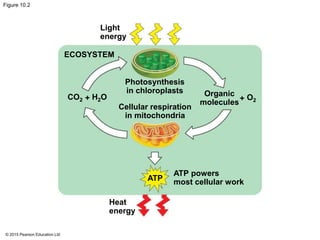
a) Energy flows into an ecosystem as sunlight and
leaves as heat
b) Photosynthesis generates O2 and organic molecules,
which are used in cellular respiration
c) Cells use chemical energy stored in organic
molecules to generate ATP, which powers work
© 2015 Pearson Education Ltd
Figure 10.2
Light
energy
Organic
molecules
O2CO2 H2O+
Photosynthesis
in chloroplasts
Cellular respiration
in mitochondria
ECOSYSTEM
ATP powers
most cellular workATP
Heat
energy
+
© 2015 Pearson Education Ltd
BioFlix: The Carbon Cycle
© 2015 Pearson Education Ltd
Concept 10.1: Catabolic pathways yield energy by
oxidizing organic fuels
a) Catabolic pathways release stored energy by
breaking down complex molecules
b) Electron transfer plays a major role in these pathways
c) These processes are central to cellular respiration
© 2015 Pearson Education Ltd
Catabolic Pathways and Production of ATP
a) The breakdown of organic molecules is exergonic
b)Fermentation is a partial degradation of sugars that
occurs without O2
c) Aerobic respiration consumes organic molecules
and O2 and yields ATP
d) Anaerobic respiration is similar to aerobic respiration
but consumes compounds other
than O2
© 2015 Pearson Education Ltd
a) Cellular respiration includes both aerobic and
anaerobic respiration but is often used to refer to
aerobic respiration
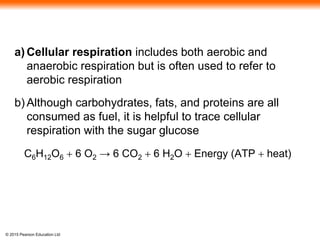
b) Although carbohydrates, fats, and proteins are all
consumed as fuel, it is helpful to trace cellular
respiration with the sugar glucose
C6H12O6 + 6 O2 → 6 CO2 + 6 H2O + Energy (ATP + heat)
© 2015 Pearson Education Ltd
Redox Reactions: Oxidation and Reduction
a) The transfer of electrons during chemical reactions
releases energy stored in organic molecules
b) This released energy is ultimately used to synthesize
ATP
© 2015 Pearson Education Ltd
The Principle of Redox
a) Chemical reactions that transfer electrons between
reactants are called oxidation-reduction reactions, or
redox reactions
b) In oxidation, a substance loses electrons,
or is oxidized
c) In reduction, a substance gains electrons, or is
reduced (the amount of positive charge is reduced)
© 2015 Pearson Education Ltd
Stepwise Energy Harvest via NAD+ and the Electron
Transport Chain
a) In cellular respiration, glucose and other organic
molecules are broken down in a series of steps
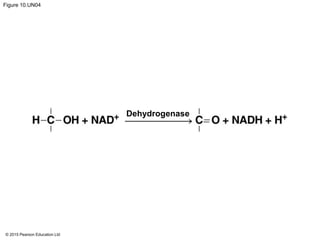
b) Electrons from organic compounds are usually first
transferred to NAD+, a coenzyme
c) As an electron acceptor, NAD+ functions as an
oxidizing agent during cellular respiration
d) Each NADH (the reduced form of NAD+) represents
stored energy that is tapped to synthesize ATP
© 2015 Pearson Education Ltd
Figure 10.4
NAD+
2 e− + 2 H+
2[H]
(from food)
Nicotinamide
(oxidized form)
Reduction of NAD+
2 e− + H+
NADH
Nicotinamide
(reduced form)
Oxidation of NADH
H+
H+
Dehydrogenase
© 2015 Pearson Education Ltd
Figure 10.UN04
Dehydrogenase
© 2015 Pearson Education Ltd
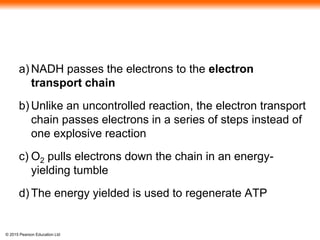
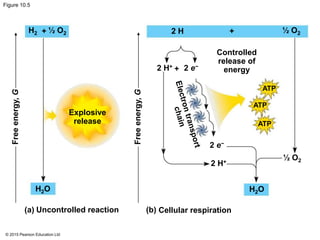
a) NADH passes the electrons to the electron
transport chain
b) Unlike an uncontrolled reaction, the electron transport
chain passes electrons in a series of steps instead of
one explosive reaction
c) O2 pulls electrons down the chain in an energy-
yielding tumble
d) The energy yielded is used to regenerate ATP
© 2015 Pearson Education Ltd
Figure 10.5
H2 + ½ O2 2 H + ½ O2
2 H+
2 e−
2 e−2 H+
+
H2O
½ O2
Controlled
release of
energy
ATP
ATP
ATP
Explosive
release
Cellular respirationUncontrolled reaction(a) (b)
Freeenergy,G
Freeenergy,G
H2O
© 2015 Pearson Education Ltd
The Stages of Cellular Respiration: A Preview
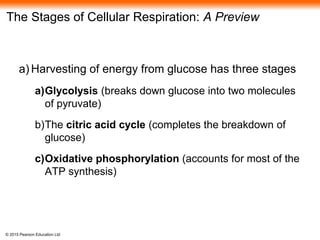
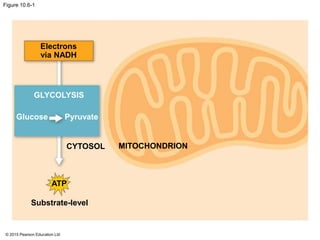
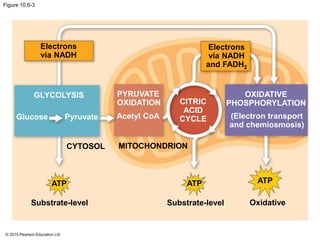
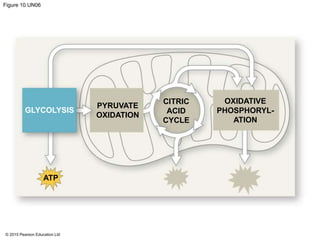
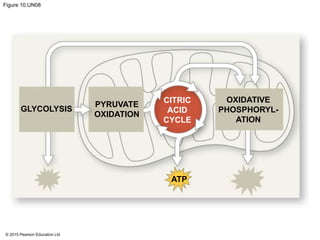
a) Harvesting of energy from glucose has three stages
a)Glycolysis (breaks down glucose into two molecules
of pyruvate)
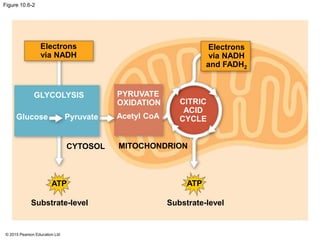
b)The citric acid cycle (completes the breakdown of
glucose)
c)Oxidative phosphorylation (accounts for most of the
ATP synthesis)
© 2015 Pearson Education Ltd
Figure 10.UN05
1.
2.
3.
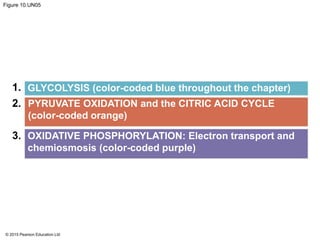
GLYCOLYSIS (color-coded blue throughout the chapter)
PYRUVATE OXIDATION and the CITRIC ACID CYCLE
(color-coded orange)
OXIDATIVE PHOSPHORYLATION: Electron transport and
chemiosmosis (color-coded purple)
© 2015 Pearson Education Ltd
Figure 10.6-1
Electrons
via NADH
ATP
CYTOSOL MITOCHONDRION
Substrate-level
GLYCOLYSIS
Glucose Pyruvate
© 2015 Pearson Education Ltd
Figure 10.6-2
Electrons
via NADH
Electrons
via NADH
and FADH2
ATP ATP
CYTOSOL MITOCHONDRION
Substrate-level Substrate-level
GLYCOLYSIS PYRUVATE
OXIDATION CITRIC
ACID
CYCLEAcetyl CoAGlucose Pyruvate
© 2015 Pearson Education Ltd
Figure 10.6-3
Electrons
via NADH
Electrons
via NADH
and FADH2
ATP ATP ATP
CYTOSOL MITOCHONDRION
Substrate-level Substrate-level Oxidative
GLYCOLYSIS PYRUVATE
OXIDATION CITRIC
ACID
CYCLE
OXIDATIVE
PHOSPHORYLATION
(Electron transport
and chemiosmosis)
Acetyl CoAGlucose Pyruvate
© 2015 Pearson Education Ltd
BioFlix: Cellular Respiration
© 2015 Pearson Education Ltd
a) The process that generates most of the ATP is called
oxidative phosphorylation because it is powered by
redox reactions
© 2015 Pearson Education Ltd
a) Oxidative phosphorylation accounts for almost 90%
of the ATP generated by cellular respiration
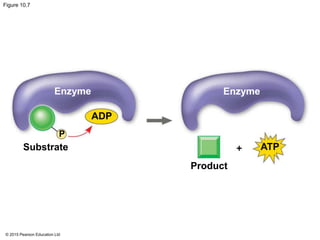
b) A smaller amount of ATP is formed in glycolysis and
the citric acid cycle by substrate-level
phosphorylation
c) For each molecule of glucose degraded to CO2 and
water by respiration, the cell makes up to 32
molecules of ATP
© 2015 Pearson Education Ltd
Figure 10.7
Enzyme Enzyme
Substrate
Product
ATP
ADP
P
© 2015 Pearson Education Ltd
Concept 10.2: Glycolysis harvests chemical energy by
oxidizing glucose to pyruvate
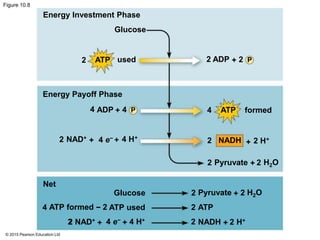
a) Glycolysis (“sugar splitting”) breaks down glucose into
two molecules of pyruvate
b) Glycolysis occurs in the cytoplasm and has two major
phases
a)Energy investment phase
b)Energy payoff phase
c) Glycolysis occurs whether or not O2 is present
© 2015 Pearson Education Ltd
Figure 10.UN06
GLYCOLYSIS
PYRUVATE
OXIDATION
CITRIC
ACID
CYCLE
OXIDATIVE
PHOSPHORYL-
ATION
ATP
© 2015 Pearson Education Ltd
Figure 10.8
Energy Investment Phase
Glucose
Energy Payoff Phase
Net
2 ATP used 2 ADP + 2 P
4 ADP + 4 P 4 ATP formed
NAD+
4 e−2 + + 4 H+
2 H+2 NADH
Pyruvate2
2
2
2
2
2
2
2 H+H+
4
4
Glucose Pyruvate
ATPATP usedATP formed
H2O
NADH
−
2 NAD+
+
+
+
++ +
2 H2O
4e−
© 2015 Pearson Education Ltd
Concept 10.3: After pyruvate is oxidized, the citric acid
cycle completes the energy-yielding oxidation of
organic molecules
a) In the presence of O2, pyruvate enters the
mitochondrion (in eukaryotic cells) where the oxidation
of glucose is completed
© 2015 Pearson Education Ltd
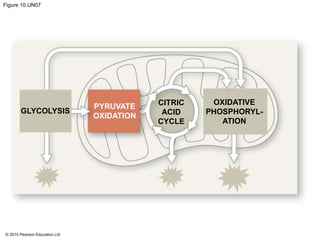
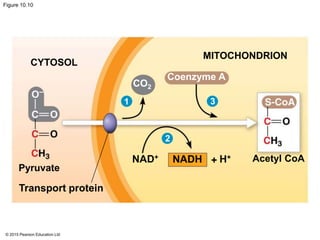
Oxidation of Pyruvate to Acetyl CoA
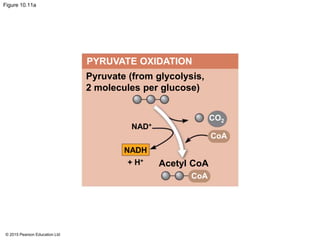
a) Before the citric acid cycle can begin, pyruvate must
be converted to acetyl Coenzyme A (acetyl CoA),
which links glycolysis to the citric acid cycle
b) This step is carried out by a multienzyme complex
that catalyses three reactions
© 2015 Pearson Education Ltd
Figure 10.UN07
GLYCOLYSIS
PYRUVATE
OXIDATION
CITRIC
ACID
CYCLE
OXIDATIVE
PHOSPHORYL-
ATION
© 2015 Pearson Education Ltd
Figure 10.10
CYTOSOL
Pyruvate
Transport protein
MITOCHONDRION
Acetyl CoANAD+ H+NADH +
CO2
Coenzyme A
1
2
3
© 2015 Pearson Education Ltd
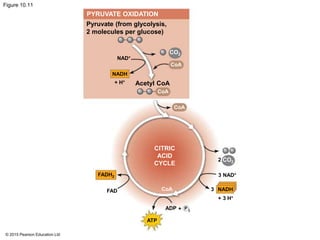
The Citric Acid Cycle
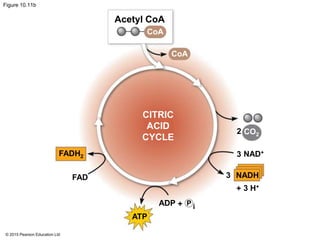
a) The citric acid cycle, also called the Krebs cycle,
completes the break down of pyruvate to CO2
b) The cycle oxidizes organic fuel derived from pyruvate,
generating 1 ATP, 3 NADH, and 1 FADH2 per turn
© 2015 Pearson Education Ltd
Figure 10.11
PYRUVATE OXIDATION
Pyruvate (from glycolysis,
2 molecules per glucose)
NADH
NAD+
CO2
CoA
CoA
+ H+
CoA
CoA
CO2
CITRIC
ACID
CYCLE
FADH2
FAD
ATP
ADP + P
i
NAD+
+ 3 H+
NADH3
3
2
Acetyl CoA
© 2015 Pearson Education Ltd
Figure 10.11a
PYRUVATE OXIDATION
Pyruvate (from glycolysis,
2 molecules per glucose)
NADH
NAD+
CO2
CoA
CoA
+ H+
Acetyl CoA
© 2015 Pearson Education Ltd
Figure 10.11b
CoA
CoA
CO2
CITRIC
ACID
CYCLE
FADH2
FAD
ATP
ADP + P i
NAD+
+ 3 H+
NADH3
3
2
Acetyl CoA
© 2015 Pearson Education Ltd
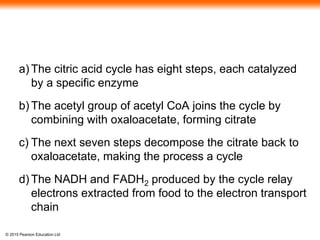
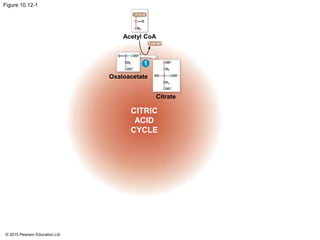
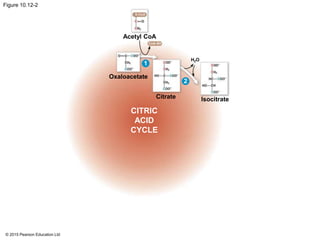
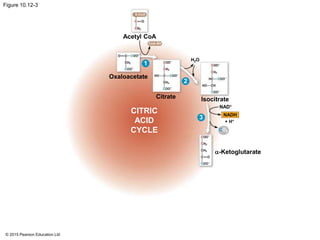
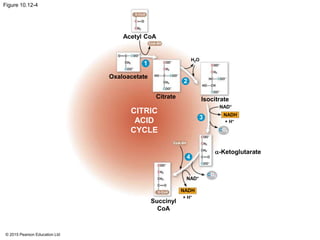
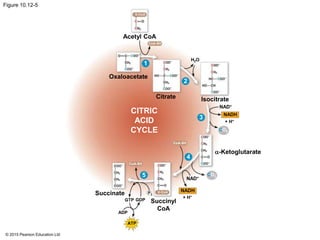
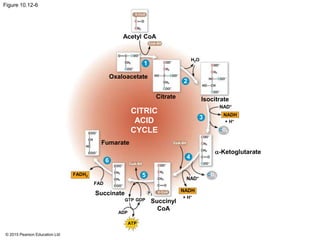
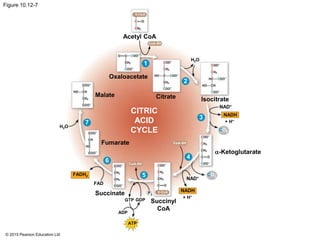
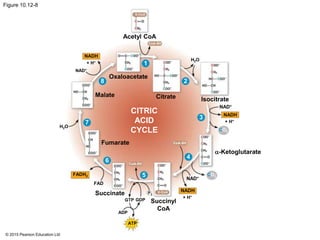
a) The citric acid cycle has eight steps, each catalyzed
by a specific enzyme
b) The acetyl group of acetyl CoA joins the cycle by
combining with oxaloacetate, forming citrate
c) The next seven steps decompose the citrate back to
oxaloacetate, making the process a cycle
d) The NADH and FADH2 produced by the cycle relay
electrons extracted from food to the electron transport
chain
© 2015 Pearson Education Ltd
Figure 10.UN08
GLYCOLYSIS
PYRUVATE
OXIDATION
CITRIC
ACID
CYCLE
OXIDATIVE
PHOSPHORYL-
ATION
ATP
© 2015 Pearson Education Ltd
Figure 10.12-1
Acetyl CoA
Oxaloacetate
CoA-SH
Citrate
CITRIC
ACID
CYCLE
1
© 2015 Pearson Education Ltd
Figure 10.12-2
Acetyl CoA
H2O
Oxaloacetate
CoA-SH
Citrate
CITRIC
ACID
CYCLE
Isocitrate
1
2
© 2015 Pearson Education Ltd
Figure 10.12-3
Acetyl CoA
H2O
+ H+
Oxaloacetate
CoA-SH
Citrate
-Ketoglutarate
NAD+
CO2
NADH
CITRIC
ACID
CYCLE
Isocitrate
1
2
3
© 2015 Pearson Education Ltd
Figure 10.12-4
Acetyl CoA
H2O
+ H+
Oxaloacetate
CoA-SH
Citrate
-Ketoglutarate
CoA-SH
NAD+
CO2
NADH
CO2
NAD+
NADH
+ H+
Succinyl
CoA
CITRIC
ACID
CYCLE
Isocitrate
1
2
4
3
© 2015 Pearson Education Ltd
Figure 10.12-5
Acetyl CoA
H2O
+ H+
Oxaloacetate
CoA-SH
Citrate
-Ketoglutarate
CoA-SH
NAD+
CO2
NADH
CO2
NAD+
NADH
+ H+
Succinyl
CoA
ATP
ADP
GTP GDP
Succinate
CITRIC
ACID
CYCLE
P i
Isocitrate
1
2
5
4
3
CoA-SH
© 2015 Pearson Education Ltd
Figure 10.12-6
Acetyl CoA
H2O
+ H+
Oxaloacetate
CoA-SH
Citrate
-Ketoglutarate
CoA-SH
NAD+
CO2
NADH
CO2
NAD+
NADH
+ H+
Succinyl
CoA
ATP
ADP
GTP GDP
Succinate
FAD
FADH2
Fumarate
CITRIC
ACID
CYCLE
P i
Isocitrate
1
2
5
6
4
3
CoA-SH
© 2015 Pearson Education Ltd
Figure 10.12-7
Acetyl CoA
H2O
+ H+
Oxaloacetate
CoA-SH
Citrate
-Ketoglutarate
CoA-SH
NAD+
CO2
NADH
CO2
NAD+
NADH
+ H+
Succinyl
CoA
ATP
ADP
GTP GDP
Succinate
FAD
FADH2
Fumarate
H2O
Malate
CITRIC
ACID
CYCLE
P i
Isocitrate
1
2
5
6
4
3
7
CoA-SH
© 2015 Pearson Education Ltd
Figure 10.12-8
Acetyl CoA
H2O
+ H+
Oxaloacetate
CoA-SH
Citrate
-Ketoglutarate
CoA-SH
NAD+
CO2
NADH
CO2
NAD+
NADH
+ H+
Succinyl
CoA
ATP
ADP
GTP GDP
Succinate
FAD
FADH2
Fumarate
H2O
Malate
CITRIC
ACID
CYCLE
+ H+
NAD+
P i
NADH
Isocitrate
1
2
5
6
4
3
7
8
CoA-SH
© 2015 Pearson Education Ltd
Concept 10.4: During oxidative phosphorylation,
chemiosmosis couples electron transport to ATP
synthesis
a) Following glycolysis and the citric acid cycle, NADH
and FADH2 account for most of the energy extracted
from food
b) These two electron carriers donate electrons to the
electron transport chain, which powers ATP synthesis
via oxidative phosphorylation
© 2015 Pearson Education Ltd
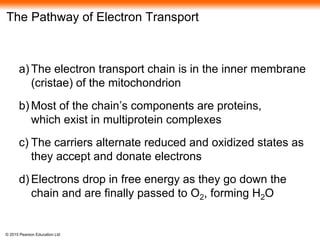
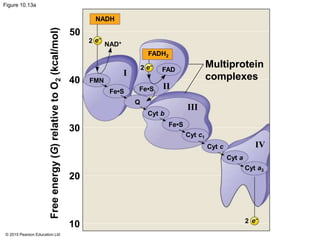
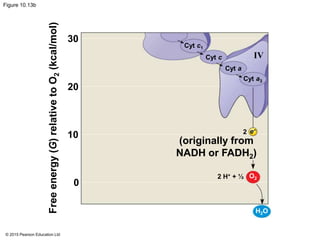
The Pathway of Electron Transport
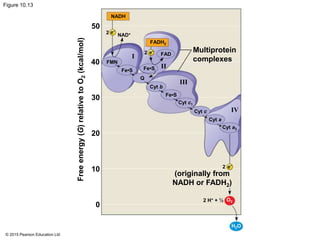
a) The electron transport chain is in the inner membrane
(cristae) of the mitochondrion
b) Most of the chain’s components are proteins,
which exist in multiprotein complexes
c) The carriers alternate reduced and oxidized states as
they accept and donate electrons
d) Electrons drop in free energy as they go down the
chain and are finally passed to O2, forming H2O
© 2015 Pearson Education Ltd
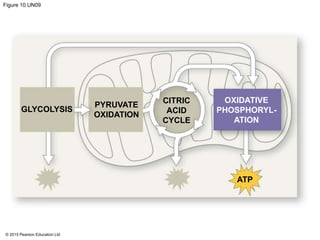
Figure 10.UN09
GLYCOLYSIS
CITRIC
ACID
CYCLE
PYRUVATE
OXIDATION
ATP
OXIDATIVE
PHOSPHORYL-
ATION
© 2015 Pearson Education Ltd
Figure 10.13
NADH
e−
2 NAD+
FADH2
FAD2 e−
FMN
Fe•S
Q
Fe•S
Cyt b
Fe•S
Cyt c1
Cyt c
Cyt a
Cyt a3
e−2
(originally from
NADH or FADH2)
2 H+ + ½ O2
H2O
Multiprotein
complexesI
II
III
IV
50
40
30
20
10
0
Freeenergy(G)relativetoO2(kcal/mol)
© 2015 Pearson Education Ltd
Figure 10.13a
50
40
30
20
10
Freeenergy(G)relativetoO2(kcal/mol)
NADH
e−
2
NAD+
FADH2
Fe•S
e−
FMN
Fe•S
Q
Cyt b
FAD
I
II
FAD
Multiprotein
complexes
III
Fe•S
Cyt c1
Cyt c
Cyt a
Cyt a3
IV
2
e−
2
© 2015 Pearson Education Ltd
Figure 10.13b
30
20
10
Freeenergy(G)relativetoO2(kcal/mol)
0
Cyt c1
Cyt c
Cyt a
Cyt a3
IV
e−
2
2 H+ + ½ O2
H2O
(originally from
NADH or FADH2)
© 2015 Pearson Education Ltd
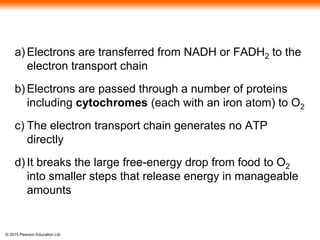
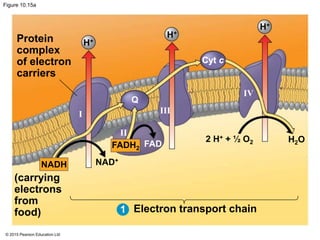
a) Electrons are transferred from NADH or FADH2 to the
electron transport chain
b) Electrons are passed through a number of proteins
including cytochromes (each with an iron atom) to O2
c) The electron transport chain generates no ATP
directly
d) It breaks the large free-energy drop from food to O2
into smaller steps that release energy in manageable
amounts
© 2015 Pearson Education Ltd
Chemiosmosis: The Energy-Coupling Mechanism
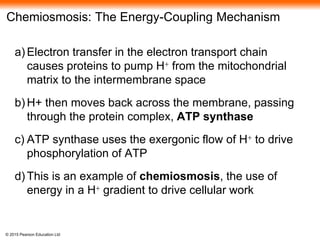
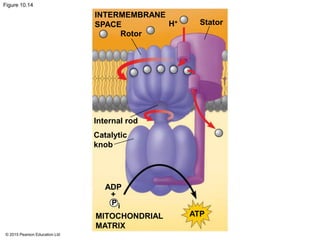
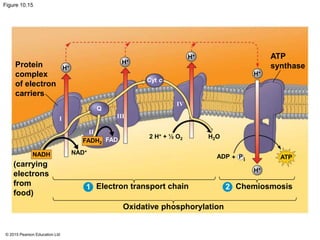
a) Electron transfer in the electron transport chain
causes proteins to pump H+ from the mitochondrial
matrix to the intermembrane space
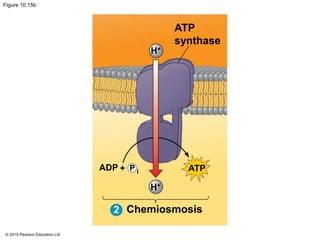
b) H+ then moves back across the membrane, passing
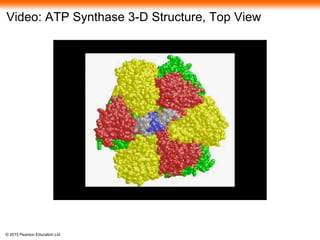
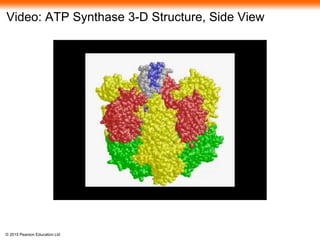
through the protein complex, ATP synthase
c) ATP synthase uses the exergonic flow of H+ to drive
phosphorylation of ATP
d) This is an example of chemiosmosis, the use of
energy in a H+ gradient to drive cellular work
© 2015 Pearson Education Ltd
Figure 10.14
INTERMEMBRANE
SPACE
Rotor
H+ Stator
Internal rod
Catalytic
knob
ADP
+
P i
MITOCHONDRIAL
MATRIX
ATP
© 2015 Pearson Education Ltd
Video: ATP Synthase 3-D Structure, Top View
© 2015 Pearson Education Ltd
Video: ATP Synthase 3-D Structure, Side View
© 2015 Pearson Education Ltd
Figure 10.15
Protein
complex
of electron
carriers
(carrying
electrons
from
food)
ATP
synthase
Electron transport chain Chemiosmosis
Oxidative phosphorylation
2 H+ + ½ O2 H2O
ADP + Pi
H+
ATP
H+
H+
H+
H+
Cyt c
Q
I
II
III
IV
FADFADH2
NADH NAD+
1 2
© 2015 Pearson Education Ltd
Figure 10.15a
Protein
complex
of electron
carriers
2 H+ + ½ O2 H2O
H+
NAD+
1
H+
H+
NADH
FADH2
Cyt cCyt c
IV
III
II
I
FAD
(carrying
electrons
from
food) Electron transport chain
Q
© 2015 Pearson Education Ltd
Figure 10.15b
H+
2
H+
ADP + P i ATP
Chemiosmosis
ATP
synthase
© 2015 Pearson Education Ltd
a) The energy stored in a H+ gradient across a
membrane couples the redox reactions of the
electron transport chain to ATP synthesis
b) The H+ gradient is referred to as a proton-motive
force, emphasizing its capacity to do work
© 2015 Pearson Education Ltd
An Accounting of ATP Production by Cellular
Respiration
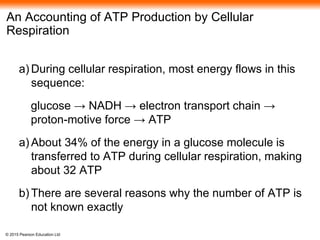
a) During cellular respiration, most energy flows in this
sequence:
glucose → NADH → electron transport chain →
proton-motive force → ATP
a) About 34% of the energy in a glucose molecule is
transferred to ATP during cellular respiration, making
about 32 ATP
b) There are several reasons why the number of ATP is
not known exactly
© 2015 Pearson Education Ltd
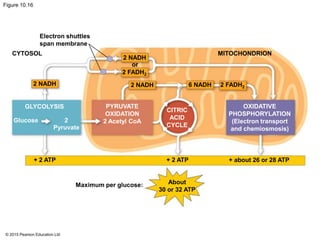
Figure 10.16
Electron shuttles
span membrane
CYTOSOL
2 NADH
or
2 FADH2
2 NADH 2 FADH26 NADH
MITOCHONDRION
OXIDATIVE
PHOSPHORYLATION
(Electron transport
and chemiosmosis)
CITRIC
ACID
CYCLE
PYRUVATE
OXIDATION
2 Acetyl CoA
GLYCOLYSIS
Glucose 2
Pyruvate
+ 2 ATP + 2 ATP
Maximum per glucose: About
30 or 32 ATP
+ about 26 or 28 ATP
2 NADH
© 2015 Pearson Education Ltd
Concept 10.5: Fermentation and anaerobic
respiration enable cells to produce ATP without the use
of oxygen
a) Most cellular respiration requires O2 to produce ATP
b) Without O2, the electron transport chain will cease to
operate
c) In that case, glycolysis couples with anaerobic
respiration or fermentation to produce ATP
© 2015 Pearson Education Ltd
a) Anaerobic respiration uses an electron transport chain
with a final electron acceptor other than O2, for example
sulfate
b) Fermentation uses substrate-level phosphorylation
instead of an electron transport chain to generate ATP
© 2015 Pearson Education Ltd
Types of Fermentation
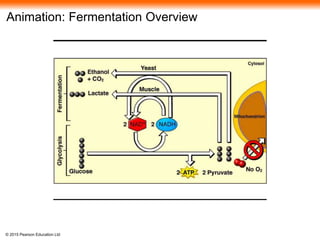
a) Fermentation consists of glycolysis plus reactions that
regenerate NAD+, which can be reused by glycolysis
b) Two common types are alcohol fermentation and
lactic acid fermentation
© 2015 Pearson Education Ltd
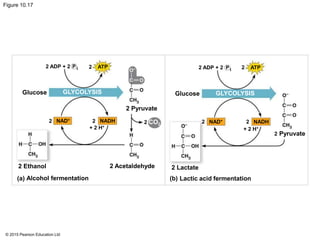
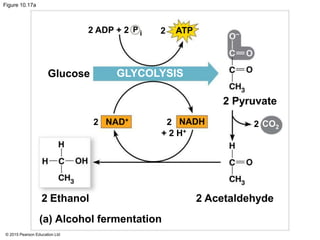
a) In alcohol fermentation, pyruvate is converted to
ethanol in two steps
a)The first step releases CO2
b)The second step produces ethanol
b) Alcohol fermentation by yeast is used in brewing,
winemaking, and baking
© 2015 Pearson Education Ltd
Figure 10.17
2 ADP + 2 P i 2 ATP
Glucose
2 NAD+ NADH2
+ 2 H+
2 Pyruvate
CO22
2 Ethanol
(a) Alcohol fermentation
2 Acetaldehyde 2 Lactate
Lactic acid fermentation
2 ADP + 2 P i 2 ATP
GLYCOLYSIS
NAD+
+ 2 H+
NADH22
2 Pyruvate
(b)
GLYCOLYSIS Glucose
© 2015 Pearson Education Ltd
Figure 10.17a
2 ADP + 2 P i
NAD+
+ 2 H+
GLYCOLYSISGlucose
2 ATP
22
2 Ethanol 2 Acetaldehyde
2 Pyruvate
(a) Alcohol fermentation
2 CO2
NADH
© 2015 Pearson Education Ltd
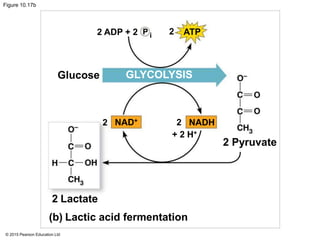
Figure 10.17b
2 ADP + 2 P i
NAD+
+ 2 H+
GLYCOLYSISGlucose
2 ATP
22
Lactate
(b) Lactic acid fermentation
NADH
2 Pyruvate
2
© 2015 Pearson Education Ltd
Animation: Fermentation Overview
© 2015 Pearson Education Ltd
a) In lactic acid fermentation, pyruvate is reduced by
NADH, forming lactate as an end product, with no
release of CO2
b) Lactic acid fermentation by some fungi and bacteria is
used to make cheese and yogurt
c) Human muscle cells use lactic acid fermentation to
generate ATP when O2 is scarce
© 2015 Pearson Education Ltd
Comparing Fermentation with Anaerobic and Aerobic
Respiration
a) All use glycolysis (net ATP = 2) to oxidize glucose
and harvest chemical energy of food
b) In all three, NAD+ is the oxidizing agent that accepts
electrons during glycolysis
© 2015 Pearson Education Ltd
a) The processes have different mechanisms for
oxidizing NADH:
a)In fermentation, an organic molecule (such as pyruvate
or acetaldehyde) acts as a final electron acceptor
b)In cellular respiration electrons are transferred to the
electron transport chain
b) Cellular respiration produces 32 ATP per glucose
molecule; fermentation produces 2 ATP per glucose
molecule
© 2015 Pearson Education Ltd
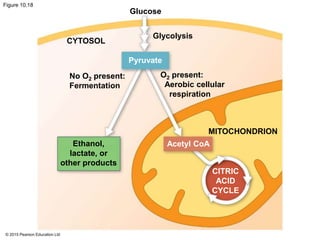
Figure 10.18
Glucose
Glycolysis
CYTOSOL
Pyruvate
No O2 present:
Fermentation
O2 present:
Aerobic cellular
respiration
Ethanol,
lactate, or
other products
MITOCHONDRION
Acetyl CoA
CITRIC
ACID
CYCLE
© 2015 Pearson Education Ltd
The Evolutionary Significance of Glycolysis
a) Ancient prokaryotes are thought to have used glycolysis
long before there was oxygen in the atmosphere
b) Very little O2 was available in the atmosphere until
about 2.7 billion years ago, so early prokaryotes likely
used only glycolysis to generate ATP
c) Glycolysis is a very ancient process
© 2015 Pearson Education Ltd
Concept 10.6: Glycolysis and the citric acid cycle
connect to many other metabolic pathways
a) Gycolysis and the citric acid cycle are major
intersections to various catabolic and anabolic
pathways
© 2015 Pearson Education Ltd
The Versatility of Catabolism
a) Catabolic pathways funnel electrons from many kinds
of organic molecules into cellular respiration
b) Glycolysis accepts a wide range of carbohydrates
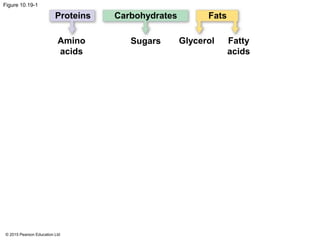
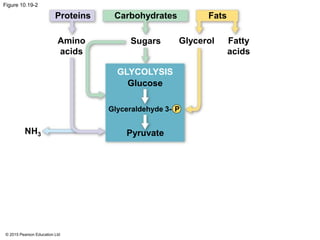
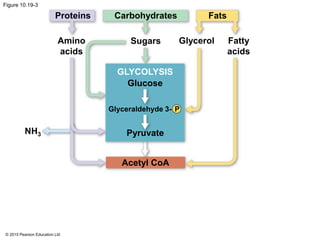
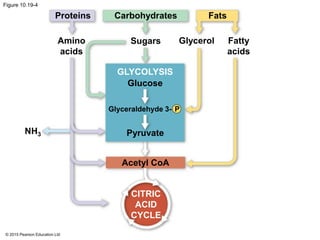
c) Proteins must be digested to amino acids; amino
groups can feed glycolysis or the citric acid cycle
© 2015 Pearson Education Ltd
a) Fats are digested to glycerol (used in glycolysis) and
fatty acids (used in generating acetyl CoA)
b) Fatty acids are broken down by beta oxidation and
yield acetyl CoA
c) An oxidized gram of fat produces more than twice as
much ATP as an oxidized gram of carbohydrate
© 2015 Pearson Education Ltd
Figure 10.19-1
Proteins Carbohydrates Fats
Amino
acids
Sugars Glycerol Fatty
acids
© 2015 Pearson Education Ltd
Figure 10.19-2
Proteins Carbohydrates Fats
Amino
acids
Sugars Glycerol Fatty
acids
GLYCOLYSIS
Glucose
Glyceraldehyde 3- P
PyruvateNH3
© 2015 Pearson Education Ltd
Figure 10.19-3
Proteins Carbohydrates Fats
Amino
acids
Sugars Glycerol Fatty
acids
GLYCOLYSIS
Glucose
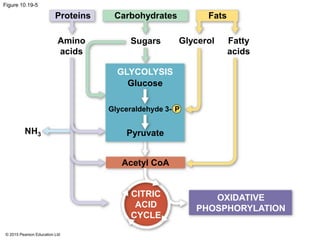
Glyceraldehyde 3- P
Pyruvate
Acetyl CoA
NH3
© 2015 Pearson Education Ltd
Figure 10.19-4
Proteins Carbohydrates Fats
Amino
acids
Sugars Glycerol Fatty
acids
GLYCOLYSIS
Glucose
Glyceraldehyde 3- P
Pyruvate
Acetyl CoA
CITRIC
ACID
CYCLE
NH3
© 2015 Pearson Education Ltd
Figure 10.19-5
Proteins Carbohydrates Fats
Amino
acids
Sugars Glycerol Fatty
acids
GLYCOLYSIS
Glucose
Glyceraldehyde 3- P
Pyruvate
Acetyl CoA
CITRIC
ACID
CYCLE
OXIDATIVE
PHOSPHORYLATION
NH3
© 2015 Pearson Education Ltd
Biosynthesis (Anabolic Pathways)
a) The body uses small molecules to build other
substances
b) These small molecules may come directly from food,
from glycolysis, or from the citric acid cycle
© 2015 Pearson Education Ltd
Regulation of Cellular Respiration via Feedback
Mechanisms
a) Feedback inhibition is the most common mechanism
for metabolic control
b) If ATP concentration begins to drop, respiration
speeds up; when there is plenty of ATP, respiration
slows down
c) Control of catabolism is based mainly on regulating
the activity of enzymes at strategic points in the
catabolic pathway
© 2015 Pearson Education Ltd
Figure 10.UN17

10 ge lecture presentation

  • 1.
    BIOLOGY Campbell • Reece• Urry • Cain • Wasserman • Minorsky • Jackson © 2015 Pearson Education Ltd TENTH EDITION Global Edition Lecture Presentation by Nicole Tunbridge and Kathleen Fitzpatrick 10Cell Respiration
  • 2.
    © 2015 PearsonEducation Ltd Life Is Work a) Living cells require energy from outside sources b) Some animals, such as the giraffe, obtain energy by eating plants, and some animals feed on other organisms that eat plants
  • 3.
    © 2015 PearsonEducation Ltd Figure 10.1
  • 4.
    © 2015 PearsonEducation Ltd a) Energy flows into an ecosystem as sunlight and leaves as heat b) Photosynthesis generates O2 and organic molecules, which are used in cellular respiration c) Cells use chemical energy stored in organic molecules to generate ATP, which powers work
  • 5.
    © 2015 PearsonEducation Ltd Figure 10.2 Light energy Organic molecules O2CO2 H2O+ Photosynthesis in chloroplasts Cellular respiration in mitochondria ECOSYSTEM ATP powers most cellular workATP Heat energy +
  • 6.
    © 2015 PearsonEducation Ltd BioFlix: The Carbon Cycle
  • 7.
    © 2015 PearsonEducation Ltd Concept 10.1: Catabolic pathways yield energy by oxidizing organic fuels a) Catabolic pathways release stored energy by breaking down complex molecules b) Electron transfer plays a major role in these pathways c) These processes are central to cellular respiration
  • 8.
    © 2015 PearsonEducation Ltd Catabolic Pathways and Production of ATP a) The breakdown of organic molecules is exergonic b)Fermentation is a partial degradation of sugars that occurs without O2 c) Aerobic respiration consumes organic molecules and O2 and yields ATP d) Anaerobic respiration is similar to aerobic respiration but consumes compounds other than O2
  • 9.
    © 2015 PearsonEducation Ltd a) Cellular respiration includes both aerobic and anaerobic respiration but is often used to refer to aerobic respiration b) Although carbohydrates, fats, and proteins are all consumed as fuel, it is helpful to trace cellular respiration with the sugar glucose C6H12O6 + 6 O2 → 6 CO2 + 6 H2O + Energy (ATP + heat)
  • 10.
    © 2015 PearsonEducation Ltd Redox Reactions: Oxidation and Reduction a) The transfer of electrons during chemical reactions releases energy stored in organic molecules b) This released energy is ultimately used to synthesize ATP
  • 11.
    © 2015 PearsonEducation Ltd The Principle of Redox a) Chemical reactions that transfer electrons between reactants are called oxidation-reduction reactions, or redox reactions b) In oxidation, a substance loses electrons, or is oxidized c) In reduction, a substance gains electrons, or is reduced (the amount of positive charge is reduced)
  • 12.
    © 2015 PearsonEducation Ltd Stepwise Energy Harvest via NAD+ and the Electron Transport Chain a) In cellular respiration, glucose and other organic molecules are broken down in a series of steps b) Electrons from organic compounds are usually first transferred to NAD+, a coenzyme c) As an electron acceptor, NAD+ functions as an oxidizing agent during cellular respiration d) Each NADH (the reduced form of NAD+) represents stored energy that is tapped to synthesize ATP
  • 13.
    © 2015 PearsonEducation Ltd Figure 10.4 NAD+ 2 e− + 2 H+ 2[H] (from food) Nicotinamide (oxidized form) Reduction of NAD+ 2 e− + H+ NADH Nicotinamide (reduced form) Oxidation of NADH H+ H+ Dehydrogenase
  • 14.
    © 2015 PearsonEducation Ltd Figure 10.UN04 Dehydrogenase
  • 15.
    © 2015 PearsonEducation Ltd a) NADH passes the electrons to the electron transport chain b) Unlike an uncontrolled reaction, the electron transport chain passes electrons in a series of steps instead of one explosive reaction c) O2 pulls electrons down the chain in an energy- yielding tumble d) The energy yielded is used to regenerate ATP
  • 16.
    © 2015 PearsonEducation Ltd Figure 10.5 H2 + ½ O2 2 H + ½ O2 2 H+ 2 e− 2 e−2 H+ + H2O ½ O2 Controlled release of energy ATP ATP ATP Explosive release Cellular respirationUncontrolled reaction(a) (b) Freeenergy,G Freeenergy,G H2O
  • 17.
    © 2015 PearsonEducation Ltd The Stages of Cellular Respiration: A Preview a) Harvesting of energy from glucose has three stages a)Glycolysis (breaks down glucose into two molecules of pyruvate) b)The citric acid cycle (completes the breakdown of glucose) c)Oxidative phosphorylation (accounts for most of the ATP synthesis)
  • 18.
    © 2015 PearsonEducation Ltd Figure 10.UN05 1. 2. 3. GLYCOLYSIS (color-coded blue throughout the chapter) PYRUVATE OXIDATION and the CITRIC ACID CYCLE (color-coded orange) OXIDATIVE PHOSPHORYLATION: Electron transport and chemiosmosis (color-coded purple)
  • 19.
    © 2015 PearsonEducation Ltd Figure 10.6-1 Electrons via NADH ATP CYTOSOL MITOCHONDRION Substrate-level GLYCOLYSIS Glucose Pyruvate
  • 20.
    © 2015 PearsonEducation Ltd Figure 10.6-2 Electrons via NADH Electrons via NADH and FADH2 ATP ATP CYTOSOL MITOCHONDRION Substrate-level Substrate-level GLYCOLYSIS PYRUVATE OXIDATION CITRIC ACID CYCLEAcetyl CoAGlucose Pyruvate
  • 21.
    © 2015 PearsonEducation Ltd Figure 10.6-3 Electrons via NADH Electrons via NADH and FADH2 ATP ATP ATP CYTOSOL MITOCHONDRION Substrate-level Substrate-level Oxidative GLYCOLYSIS PYRUVATE OXIDATION CITRIC ACID CYCLE OXIDATIVE PHOSPHORYLATION (Electron transport and chemiosmosis) Acetyl CoAGlucose Pyruvate
  • 22.
    © 2015 PearsonEducation Ltd BioFlix: Cellular Respiration
  • 23.
    © 2015 PearsonEducation Ltd a) The process that generates most of the ATP is called oxidative phosphorylation because it is powered by redox reactions
  • 24.
    © 2015 PearsonEducation Ltd a) Oxidative phosphorylation accounts for almost 90% of the ATP generated by cellular respiration b) A smaller amount of ATP is formed in glycolysis and the citric acid cycle by substrate-level phosphorylation c) For each molecule of glucose degraded to CO2 and water by respiration, the cell makes up to 32 molecules of ATP
  • 25.
    © 2015 PearsonEducation Ltd Figure 10.7 Enzyme Enzyme Substrate Product ATP ADP P
  • 26.
    © 2015 PearsonEducation Ltd Concept 10.2: Glycolysis harvests chemical energy by oxidizing glucose to pyruvate a) Glycolysis (“sugar splitting”) breaks down glucose into two molecules of pyruvate b) Glycolysis occurs in the cytoplasm and has two major phases a)Energy investment phase b)Energy payoff phase c) Glycolysis occurs whether or not O2 is present
  • 27.
    © 2015 PearsonEducation Ltd Figure 10.UN06 GLYCOLYSIS PYRUVATE OXIDATION CITRIC ACID CYCLE OXIDATIVE PHOSPHORYL- ATION ATP
  • 28.
    © 2015 PearsonEducation Ltd Figure 10.8 Energy Investment Phase Glucose Energy Payoff Phase Net 2 ATP used 2 ADP + 2 P 4 ADP + 4 P 4 ATP formed NAD+ 4 e−2 + + 4 H+ 2 H+2 NADH Pyruvate2 2 2 2 2 2 2 2 H+H+ 4 4 Glucose Pyruvate ATPATP usedATP formed H2O NADH − 2 NAD+ + + + ++ + 2 H2O 4e−
  • 29.
    © 2015 PearsonEducation Ltd Concept 10.3: After pyruvate is oxidized, the citric acid cycle completes the energy-yielding oxidation of organic molecules a) In the presence of O2, pyruvate enters the mitochondrion (in eukaryotic cells) where the oxidation of glucose is completed
  • 30.
    © 2015 PearsonEducation Ltd Oxidation of Pyruvate to Acetyl CoA a) Before the citric acid cycle can begin, pyruvate must be converted to acetyl Coenzyme A (acetyl CoA), which links glycolysis to the citric acid cycle b) This step is carried out by a multienzyme complex that catalyses three reactions
  • 31.
    © 2015 PearsonEducation Ltd Figure 10.UN07 GLYCOLYSIS PYRUVATE OXIDATION CITRIC ACID CYCLE OXIDATIVE PHOSPHORYL- ATION
  • 32.
    © 2015 PearsonEducation Ltd Figure 10.10 CYTOSOL Pyruvate Transport protein MITOCHONDRION Acetyl CoANAD+ H+NADH + CO2 Coenzyme A 1 2 3
  • 33.
    © 2015 PearsonEducation Ltd The Citric Acid Cycle a) The citric acid cycle, also called the Krebs cycle, completes the break down of pyruvate to CO2 b) The cycle oxidizes organic fuel derived from pyruvate, generating 1 ATP, 3 NADH, and 1 FADH2 per turn
  • 34.
    © 2015 PearsonEducation Ltd Figure 10.11 PYRUVATE OXIDATION Pyruvate (from glycolysis, 2 molecules per glucose) NADH NAD+ CO2 CoA CoA + H+ CoA CoA CO2 CITRIC ACID CYCLE FADH2 FAD ATP ADP + P i NAD+ + 3 H+ NADH3 3 2 Acetyl CoA
  • 35.
    © 2015 PearsonEducation Ltd Figure 10.11a PYRUVATE OXIDATION Pyruvate (from glycolysis, 2 molecules per glucose) NADH NAD+ CO2 CoA CoA + H+ Acetyl CoA
  • 36.
    © 2015 PearsonEducation Ltd Figure 10.11b CoA CoA CO2 CITRIC ACID CYCLE FADH2 FAD ATP ADP + P i NAD+ + 3 H+ NADH3 3 2 Acetyl CoA
  • 37.
    © 2015 PearsonEducation Ltd a) The citric acid cycle has eight steps, each catalyzed by a specific enzyme b) The acetyl group of acetyl CoA joins the cycle by combining with oxaloacetate, forming citrate c) The next seven steps decompose the citrate back to oxaloacetate, making the process a cycle d) The NADH and FADH2 produced by the cycle relay electrons extracted from food to the electron transport chain
  • 38.
    © 2015 PearsonEducation Ltd Figure 10.UN08 GLYCOLYSIS PYRUVATE OXIDATION CITRIC ACID CYCLE OXIDATIVE PHOSPHORYL- ATION ATP
  • 39.
    © 2015 PearsonEducation Ltd Figure 10.12-1 Acetyl CoA Oxaloacetate CoA-SH Citrate CITRIC ACID CYCLE 1
  • 40.
    © 2015 PearsonEducation Ltd Figure 10.12-2 Acetyl CoA H2O Oxaloacetate CoA-SH Citrate CITRIC ACID CYCLE Isocitrate 1 2
  • 41.
    © 2015 PearsonEducation Ltd Figure 10.12-3 Acetyl CoA H2O + H+ Oxaloacetate CoA-SH Citrate -Ketoglutarate NAD+ CO2 NADH CITRIC ACID CYCLE Isocitrate 1 2 3
  • 42.
    © 2015 PearsonEducation Ltd Figure 10.12-4 Acetyl CoA H2O + H+ Oxaloacetate CoA-SH Citrate -Ketoglutarate CoA-SH NAD+ CO2 NADH CO2 NAD+ NADH + H+ Succinyl CoA CITRIC ACID CYCLE Isocitrate 1 2 4 3
  • 43.
    © 2015 PearsonEducation Ltd Figure 10.12-5 Acetyl CoA H2O + H+ Oxaloacetate CoA-SH Citrate -Ketoglutarate CoA-SH NAD+ CO2 NADH CO2 NAD+ NADH + H+ Succinyl CoA ATP ADP GTP GDP Succinate CITRIC ACID CYCLE P i Isocitrate 1 2 5 4 3 CoA-SH
  • 44.
    © 2015 PearsonEducation Ltd Figure 10.12-6 Acetyl CoA H2O + H+ Oxaloacetate CoA-SH Citrate -Ketoglutarate CoA-SH NAD+ CO2 NADH CO2 NAD+ NADH + H+ Succinyl CoA ATP ADP GTP GDP Succinate FAD FADH2 Fumarate CITRIC ACID CYCLE P i Isocitrate 1 2 5 6 4 3 CoA-SH
  • 45.
    © 2015 PearsonEducation Ltd Figure 10.12-7 Acetyl CoA H2O + H+ Oxaloacetate CoA-SH Citrate -Ketoglutarate CoA-SH NAD+ CO2 NADH CO2 NAD+ NADH + H+ Succinyl CoA ATP ADP GTP GDP Succinate FAD FADH2 Fumarate H2O Malate CITRIC ACID CYCLE P i Isocitrate 1 2 5 6 4 3 7 CoA-SH
  • 46.
    © 2015 PearsonEducation Ltd Figure 10.12-8 Acetyl CoA H2O + H+ Oxaloacetate CoA-SH Citrate -Ketoglutarate CoA-SH NAD+ CO2 NADH CO2 NAD+ NADH + H+ Succinyl CoA ATP ADP GTP GDP Succinate FAD FADH2 Fumarate H2O Malate CITRIC ACID CYCLE + H+ NAD+ P i NADH Isocitrate 1 2 5 6 4 3 7 8 CoA-SH
  • 47.
    © 2015 PearsonEducation Ltd Concept 10.4: During oxidative phosphorylation, chemiosmosis couples electron transport to ATP synthesis a) Following glycolysis and the citric acid cycle, NADH and FADH2 account for most of the energy extracted from food b) These two electron carriers donate electrons to the electron transport chain, which powers ATP synthesis via oxidative phosphorylation
  • 48.
    © 2015 PearsonEducation Ltd The Pathway of Electron Transport a) The electron transport chain is in the inner membrane (cristae) of the mitochondrion b) Most of the chain’s components are proteins, which exist in multiprotein complexes c) The carriers alternate reduced and oxidized states as they accept and donate electrons d) Electrons drop in free energy as they go down the chain and are finally passed to O2, forming H2O
  • 49.
    © 2015 PearsonEducation Ltd Figure 10.UN09 GLYCOLYSIS CITRIC ACID CYCLE PYRUVATE OXIDATION ATP OXIDATIVE PHOSPHORYL- ATION
  • 50.
    © 2015 PearsonEducation Ltd Figure 10.13 NADH e− 2 NAD+ FADH2 FAD2 e− FMN Fe•S Q Fe•S Cyt b Fe•S Cyt c1 Cyt c Cyt a Cyt a3 e−2 (originally from NADH or FADH2) 2 H+ + ½ O2 H2O Multiprotein complexesI II III IV 50 40 30 20 10 0 Freeenergy(G)relativetoO2(kcal/mol)
  • 51.
    © 2015 PearsonEducation Ltd Figure 10.13a 50 40 30 20 10 Freeenergy(G)relativetoO2(kcal/mol) NADH e− 2 NAD+ FADH2 Fe•S e− FMN Fe•S Q Cyt b FAD I II FAD Multiprotein complexes III Fe•S Cyt c1 Cyt c Cyt a Cyt a3 IV 2 e− 2
  • 52.
    © 2015 PearsonEducation Ltd Figure 10.13b 30 20 10 Freeenergy(G)relativetoO2(kcal/mol) 0 Cyt c1 Cyt c Cyt a Cyt a3 IV e− 2 2 H+ + ½ O2 H2O (originally from NADH or FADH2)
  • 53.
    © 2015 PearsonEducation Ltd a) Electrons are transferred from NADH or FADH2 to the electron transport chain b) Electrons are passed through a number of proteins including cytochromes (each with an iron atom) to O2 c) The electron transport chain generates no ATP directly d) It breaks the large free-energy drop from food to O2 into smaller steps that release energy in manageable amounts
  • 54.
    © 2015 PearsonEducation Ltd Chemiosmosis: The Energy-Coupling Mechanism a) Electron transfer in the electron transport chain causes proteins to pump H+ from the mitochondrial matrix to the intermembrane space b) H+ then moves back across the membrane, passing through the protein complex, ATP synthase c) ATP synthase uses the exergonic flow of H+ to drive phosphorylation of ATP d) This is an example of chemiosmosis, the use of energy in a H+ gradient to drive cellular work
  • 55.
    © 2015 PearsonEducation Ltd Figure 10.14 INTERMEMBRANE SPACE Rotor H+ Stator Internal rod Catalytic knob ADP + P i MITOCHONDRIAL MATRIX ATP
  • 56.
    © 2015 PearsonEducation Ltd Video: ATP Synthase 3-D Structure, Top View
  • 57.
    © 2015 PearsonEducation Ltd Video: ATP Synthase 3-D Structure, Side View
  • 58.
    © 2015 PearsonEducation Ltd Figure 10.15 Protein complex of electron carriers (carrying electrons from food) ATP synthase Electron transport chain Chemiosmosis Oxidative phosphorylation 2 H+ + ½ O2 H2O ADP + Pi H+ ATP H+ H+ H+ H+ Cyt c Q I II III IV FADFADH2 NADH NAD+ 1 2
  • 59.
    © 2015 PearsonEducation Ltd Figure 10.15a Protein complex of electron carriers 2 H+ + ½ O2 H2O H+ NAD+ 1 H+ H+ NADH FADH2 Cyt cCyt c IV III II I FAD (carrying electrons from food) Electron transport chain Q
  • 60.
    © 2015 PearsonEducation Ltd Figure 10.15b H+ 2 H+ ADP + P i ATP Chemiosmosis ATP synthase
  • 61.
    © 2015 PearsonEducation Ltd a) The energy stored in a H+ gradient across a membrane couples the redox reactions of the electron transport chain to ATP synthesis b) The H+ gradient is referred to as a proton-motive force, emphasizing its capacity to do work
  • 62.
    © 2015 PearsonEducation Ltd An Accounting of ATP Production by Cellular Respiration a) During cellular respiration, most energy flows in this sequence: glucose → NADH → electron transport chain → proton-motive force → ATP a) About 34% of the energy in a glucose molecule is transferred to ATP during cellular respiration, making about 32 ATP b) There are several reasons why the number of ATP is not known exactly
  • 63.
    © 2015 PearsonEducation Ltd Figure 10.16 Electron shuttles span membrane CYTOSOL 2 NADH or 2 FADH2 2 NADH 2 FADH26 NADH MITOCHONDRION OXIDATIVE PHOSPHORYLATION (Electron transport and chemiosmosis) CITRIC ACID CYCLE PYRUVATE OXIDATION 2 Acetyl CoA GLYCOLYSIS Glucose 2 Pyruvate + 2 ATP + 2 ATP Maximum per glucose: About 30 or 32 ATP + about 26 or 28 ATP 2 NADH
  • 64.
    © 2015 PearsonEducation Ltd Concept 10.5: Fermentation and anaerobic respiration enable cells to produce ATP without the use of oxygen a) Most cellular respiration requires O2 to produce ATP b) Without O2, the electron transport chain will cease to operate c) In that case, glycolysis couples with anaerobic respiration or fermentation to produce ATP
  • 65.
    © 2015 PearsonEducation Ltd a) Anaerobic respiration uses an electron transport chain with a final electron acceptor other than O2, for example sulfate b) Fermentation uses substrate-level phosphorylation instead of an electron transport chain to generate ATP
  • 66.
    © 2015 PearsonEducation Ltd Types of Fermentation a) Fermentation consists of glycolysis plus reactions that regenerate NAD+, which can be reused by glycolysis b) Two common types are alcohol fermentation and lactic acid fermentation
  • 67.
    © 2015 PearsonEducation Ltd a) In alcohol fermentation, pyruvate is converted to ethanol in two steps a)The first step releases CO2 b)The second step produces ethanol b) Alcohol fermentation by yeast is used in brewing, winemaking, and baking
  • 68.
    © 2015 PearsonEducation Ltd Figure 10.17 2 ADP + 2 P i 2 ATP Glucose 2 NAD+ NADH2 + 2 H+ 2 Pyruvate CO22 2 Ethanol (a) Alcohol fermentation 2 Acetaldehyde 2 Lactate Lactic acid fermentation 2 ADP + 2 P i 2 ATP GLYCOLYSIS NAD+ + 2 H+ NADH22 2 Pyruvate (b) GLYCOLYSIS Glucose
  • 69.
    © 2015 PearsonEducation Ltd Figure 10.17a 2 ADP + 2 P i NAD+ + 2 H+ GLYCOLYSISGlucose 2 ATP 22 2 Ethanol 2 Acetaldehyde 2 Pyruvate (a) Alcohol fermentation 2 CO2 NADH
  • 70.
    © 2015 PearsonEducation Ltd Figure 10.17b 2 ADP + 2 P i NAD+ + 2 H+ GLYCOLYSISGlucose 2 ATP 22 Lactate (b) Lactic acid fermentation NADH 2 Pyruvate 2
  • 71.
    © 2015 PearsonEducation Ltd Animation: Fermentation Overview
  • 72.
    © 2015 PearsonEducation Ltd a) In lactic acid fermentation, pyruvate is reduced by NADH, forming lactate as an end product, with no release of CO2 b) Lactic acid fermentation by some fungi and bacteria is used to make cheese and yogurt c) Human muscle cells use lactic acid fermentation to generate ATP when O2 is scarce
  • 73.
    © 2015 PearsonEducation Ltd Comparing Fermentation with Anaerobic and Aerobic Respiration a) All use glycolysis (net ATP = 2) to oxidize glucose and harvest chemical energy of food b) In all three, NAD+ is the oxidizing agent that accepts electrons during glycolysis
  • 74.
    © 2015 PearsonEducation Ltd a) The processes have different mechanisms for oxidizing NADH: a)In fermentation, an organic molecule (such as pyruvate or acetaldehyde) acts as a final electron acceptor b)In cellular respiration electrons are transferred to the electron transport chain b) Cellular respiration produces 32 ATP per glucose molecule; fermentation produces 2 ATP per glucose molecule
  • 75.
    © 2015 PearsonEducation Ltd Figure 10.18 Glucose Glycolysis CYTOSOL Pyruvate No O2 present: Fermentation O2 present: Aerobic cellular respiration Ethanol, lactate, or other products MITOCHONDRION Acetyl CoA CITRIC ACID CYCLE
  • 76.
    © 2015 PearsonEducation Ltd The Evolutionary Significance of Glycolysis a) Ancient prokaryotes are thought to have used glycolysis long before there was oxygen in the atmosphere b) Very little O2 was available in the atmosphere until about 2.7 billion years ago, so early prokaryotes likely used only glycolysis to generate ATP c) Glycolysis is a very ancient process
  • 77.
    © 2015 PearsonEducation Ltd Concept 10.6: Glycolysis and the citric acid cycle connect to many other metabolic pathways a) Gycolysis and the citric acid cycle are major intersections to various catabolic and anabolic pathways
  • 78.
    © 2015 PearsonEducation Ltd The Versatility of Catabolism a) Catabolic pathways funnel electrons from many kinds of organic molecules into cellular respiration b) Glycolysis accepts a wide range of carbohydrates c) Proteins must be digested to amino acids; amino groups can feed glycolysis or the citric acid cycle
  • 79.
    © 2015 PearsonEducation Ltd a) Fats are digested to glycerol (used in glycolysis) and fatty acids (used in generating acetyl CoA) b) Fatty acids are broken down by beta oxidation and yield acetyl CoA c) An oxidized gram of fat produces more than twice as much ATP as an oxidized gram of carbohydrate
  • 80.
    © 2015 PearsonEducation Ltd Figure 10.19-1 Proteins Carbohydrates Fats Amino acids Sugars Glycerol Fatty acids
  • 81.
    © 2015 PearsonEducation Ltd Figure 10.19-2 Proteins Carbohydrates Fats Amino acids Sugars Glycerol Fatty acids GLYCOLYSIS Glucose Glyceraldehyde 3- P PyruvateNH3
  • 82.
    © 2015 PearsonEducation Ltd Figure 10.19-3 Proteins Carbohydrates Fats Amino acids Sugars Glycerol Fatty acids GLYCOLYSIS Glucose Glyceraldehyde 3- P Pyruvate Acetyl CoA NH3
  • 83.
    © 2015 PearsonEducation Ltd Figure 10.19-4 Proteins Carbohydrates Fats Amino acids Sugars Glycerol Fatty acids GLYCOLYSIS Glucose Glyceraldehyde 3- P Pyruvate Acetyl CoA CITRIC ACID CYCLE NH3
  • 84.
    © 2015 PearsonEducation Ltd Figure 10.19-5 Proteins Carbohydrates Fats Amino acids Sugars Glycerol Fatty acids GLYCOLYSIS Glucose Glyceraldehyde 3- P Pyruvate Acetyl CoA CITRIC ACID CYCLE OXIDATIVE PHOSPHORYLATION NH3
  • 85.
    © 2015 PearsonEducation Ltd Biosynthesis (Anabolic Pathways) a) The body uses small molecules to build other substances b) These small molecules may come directly from food, from glycolysis, or from the citric acid cycle
  • 86.
    © 2015 PearsonEducation Ltd Regulation of Cellular Respiration via Feedback Mechanisms a) Feedback inhibition is the most common mechanism for metabolic control b) If ATP concentration begins to drop, respiration speeds up; when there is plenty of ATP, respiration slows down c) Control of catabolism is based mainly on regulating the activity of enzymes at strategic points in the catabolic pathway
  • 87.
    © 2015 PearsonEducation Ltd Figure 10.UN17