Mollusks
  3 classes: Gastropods,
bivalves, and cephalopods
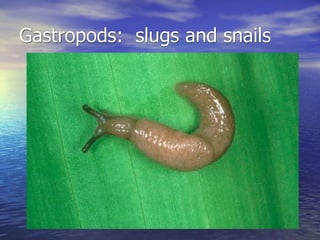
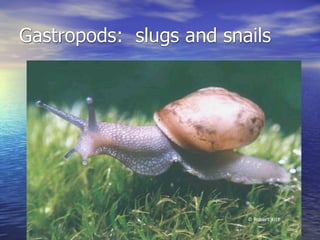
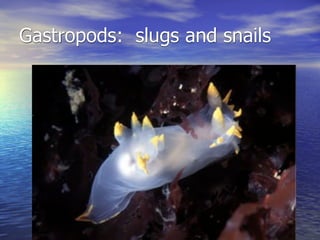
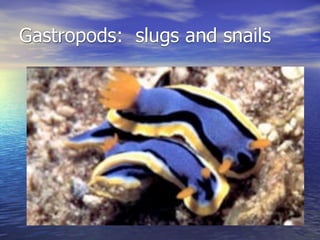
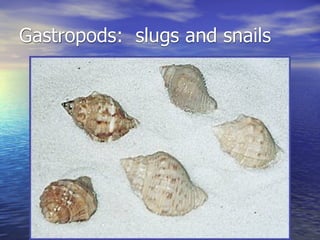
Gastropods: slugs and snails
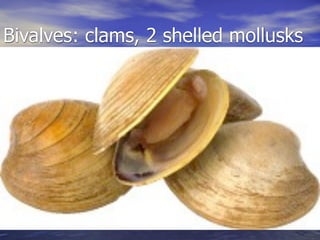
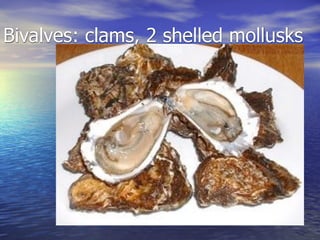
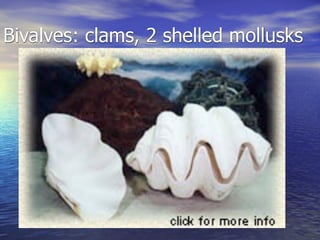
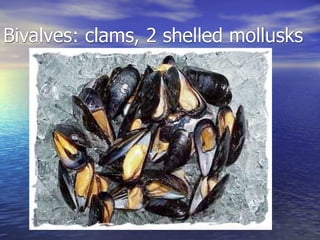
Bivalves: clams, 2 shelled mollusks
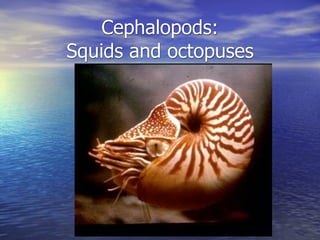
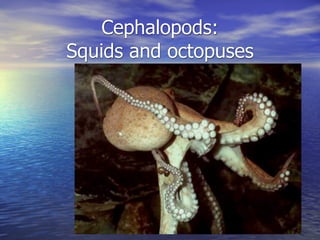
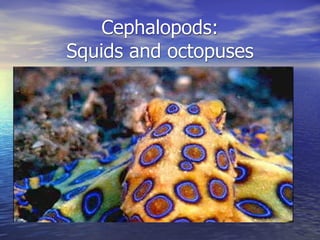
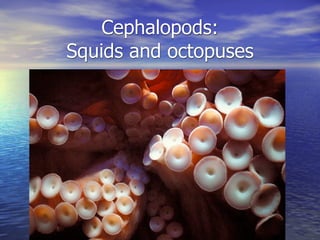
Cephalopods:
Squids and octopuses
Cephalopods:
Squids and octopuses
Cephalopods:
Squids and octopuses
Cephalopods:
Squids and octopuses
Cephalopods:
Squids and octopuses
Cephalopods:
Squids and octopuses
Facts:
Facts:
1. MOST live in the ocean, SOME in fresh
   water and/or land
Facts:
1. MOST live in the ocean, SOME in fresh
   water and/or land
2. 1mm to giant squid 18m
Facts:
1. MOST live in the ocean, SOME in fresh
   water and/or land
2. 1mm to giant squid 18m
3. Most are slow–- except squid, 40km/h
   and 4m out of water
Facts:
1. MOST live in the ocean, SOME in fresh
   water and/or land
2. 1mm to giant squid 18m
3. Most are slow–- except squid, 40km/h
   and 4m out of water
4. Bodies are alike
• Foot: uses to move
• Visceral mass: contains organs
• Foot: uses to move
• Visceral mass: contains organs
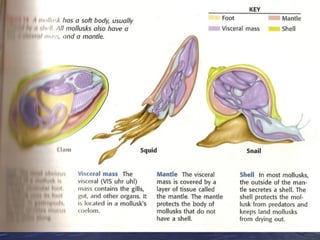
• Mantle: covers organs, protects mollusks
 without a shell
• Foot: uses to move
• Visceral mass: contains organs
• Mantle: covers organs, protects mollusks
  without a shell
• Shell: Most mollusks -- secreted by the
  mantle
Eating!
Eating!

• Clams: filter water
Eating!

• Clams: filter water
• Snails and slugs: radula—ribbon-like
 tongue with curved teeth
Eating!

• Clams: filter water
• Snails and slugs: radula—ribbon-like
  tongue with curved teeth
• Cephalopods: catch prey with tentacles
Heart!
Heart!

• Open circulatory system--gastropods and
 bivalves
Heart!

• Open circulatory system--gastropods and
 bivalves
  – Heart pumps blood into open spaces in
    animal’s body
Heart!

• Open circulatory system--gastropods and
 bivalves
  – Heart pumps blood into open spaces in
    animal’s body
• Closed circulatory system--cephalopods
Heart!

• Open circulatory system--gastropods and
 bivalves
  – Heart pumps blood into open spaces in
    animal’s body
• Closed circulatory system--cephalopods
  – Heart pumps blood through blood vessels
Brain!
Brain!

• Mollusks have nerves throughout body
 control--breathing, eating and moving
Brain!

• Mollusks have nerves throughout body
 control--breathing, eating and moving
Brain!

• Mollusks have nerves throughout body
 control--breathing, eating and moving


• Cephalopods have more complex nervous
 system
  – Most advanced of all invertebrates
Brain!

• Mollusks have nerves throughout body
 control--breathing, eating and moving


• Cephalopods have more complex nervous
 system
  – Most advanced of all invertebrates
  – Smartest invertebrate
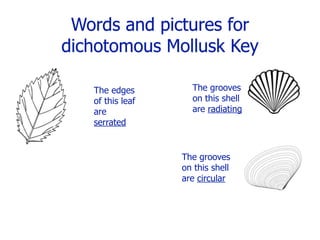
Words and pictures for
dichotomous Mollusk Key

   The edges        The grooves
   of this leaf     on this shell
   are              are radiating
   serrated


                  The grooves
                  on this shell
                  are circular
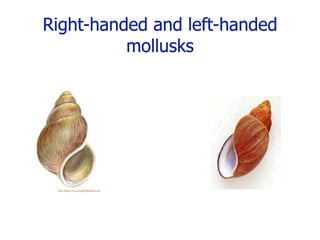
Right-handed and left-handed
          mollusks
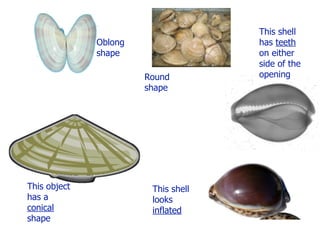
This shell
              Oblong                 has teeth
              shape                  on either
                                     side of the
                       Round         opening
                       shape


This object             This shell
has a                   looks
conical                 inflated
shape
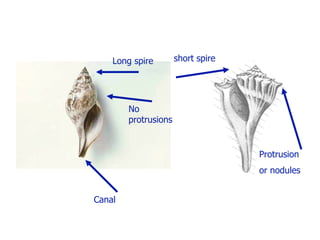
Canal
            Long spire        short spire


                No
                protrusions


                                            Protrusion
                                            or nodules


        Canal
Mollusks
Mollusks
Mollusks

Mollusks