Nematoda, Nematomorpha,
Tardigrada
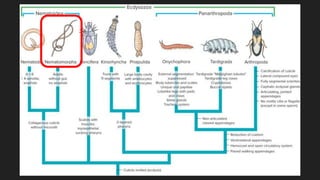
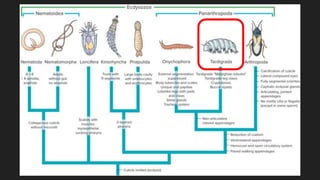
Ecdysozoa
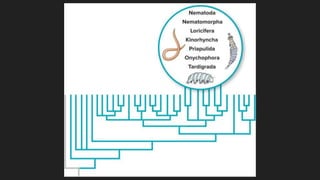
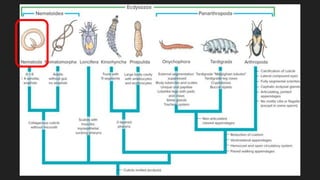
Protostomes that must shed their cuticle in order to grow
- Like the Lophotrochozoa, ecdysozoans do not share a common body plan
- Some are pseudocoelomate
- Nematoda and Nematomorpha
- Some are acoelomate
- Some are eucoelomate
- Panarthropoda (contains Tardigrada and Arthropoda)
Phylum Nematoda
Diversity
- 25,000 named species
- Maybe 500,000 - possibly more
Distribution
- Polar to tropics
- Marine, freshwater, and terrestrial
“In short, if all the matter in the universe except
the nematodes were swept away, our world
would still be dimly recognizable, and if, as
disembodied spirits, we could then investigate it,
we should find its mountains, hills, vales, rivers,
lakes, and oceans represented by a film of
nematodes. The location of towns would be
decipherable, since for every massing of human
beings there would be a corresponding massing
of certain nematodes. Trees would still stand in
ghostly rows representing our streets and
highways. The location of the various plants and
animals would still be decipherable, and, had we
sufficient knowledge, in many cases even their
species could be determined by an examination
of their erstwhile nematode parasites."
Phylum Nematoda
Phylum Nematoda
Life Style
- Nematodes are parasites of most all plants and animals
- Medical, veterinary, and agricultural losses are billion annually
- Many are free-living and feed on
- Bacteria,
- Yeasts,
- Fungal hyphae,
- Algae
- Predatory species may feed on rotifers, tardigrades, small annelids, or other
nematodes
Phylum Nematoda
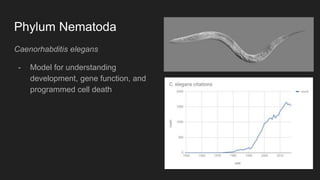
Caenorhabditis elegans
- Model for understanding
development, gene function, and
programmed cell death
Phylum Nematoda
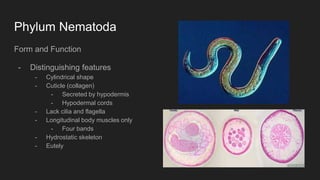
Form and Function
- Distinguishing features
- Cylindrical shape
- Cuticle (collagen)
- Secreted by hypodermis
- Hypodermal cords
- Lack cilia and flagella
- Longitudinal body muscles only
- Four bands
- Hydrostatic skeleton
- Eutely
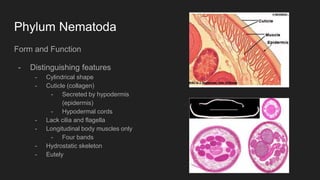
Phylum Nematoda
Form and Function
- Distinguishing features
- Cylindrical shape
- Cuticle (collagen)
- Secreted by hypodermis
(epidermis)
- Hypodermal cords
- Lack cilia and flagella
- Longitudinal body muscles only
- Four bands
- Hydrostatic skeleton
- Eutely
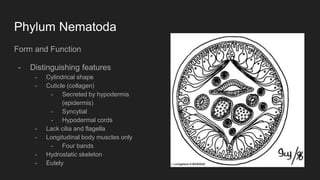
Phylum Nematoda
Form and Function
- Distinguishing features
- Cylindrical shape
- Cuticle (collagen)
- Secreted by hypodermis
(epidermis)
- Syncytial
- Hypodermal cords
- Lack cilia and flagella
- Longitudinal body muscles only
- Four bands
- Hydrostatic skeleton
- Eutely
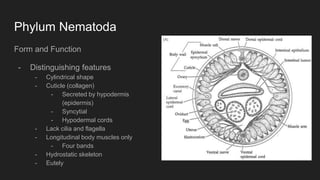
Phylum Nematoda
Form and Function
- Distinguishing features
- Cylindrical shape
- Cuticle (collagen)
- Secreted by hypodermis
(epidermis)
- Syncytial
- Hypodermal cords
- Lack cilia and flagella
- Longitudinal body muscles only
- Four bands
- Hydrostatic skeleton
- Eutely
Phylum Nematoda
Form and Function
Alimentary canal
- Mouth
- Muscular pharynx
- Non-muscular intestine
- Uses pressure of pseudocoelom
- Short rectum
- Anus
- Feces expelled through body pressure
Phylum Nematoda
Form and Function
Circulation and Respiration
- No dedicated organ systems
- Diffusion used
Phylum Nematoda
Form and Function
Nervous System
- Ring of nervous tissue and ganglia around pharynx
- Dorsal and ventral nerve cords
- Sensory papillae near head and tail
- Amphids on either side of head
- Primary sense organ
Phylum Nematoda
Form and Function
Reproduction
- Most are dioecious
- Female larger than male
- Fertilization is internal
- Development is direct
- Cuticle shed after each larval stage
Phylum Nematoda
Representative nematodes
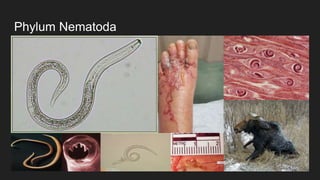
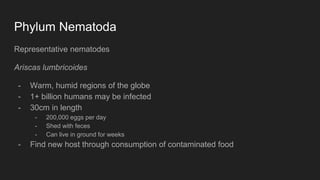
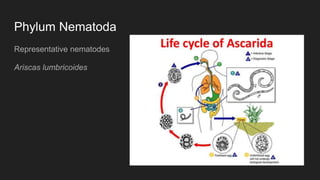
Ariscas lumbricoides
- Warm, humid regions of the globe
- 1+ billion humans may be infected
- 30cm in length
- 200,000 eggs per day
- Shed with feces
- Can live in ground for weeks
- Find new host through consumption of contaminated food
Phylum Nematoda
Representative nematodes
Ariscas lumbricoides
Phylum Nematoda
Representative nematodes
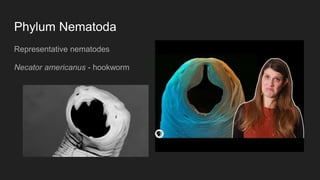
Necator americanus - hookworm
Phylum Nematoda
Representative nematodes
Parelaphostrongylus tenuis - moose brain
worm
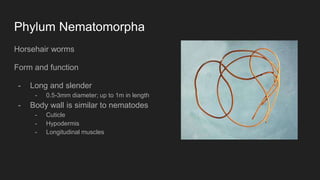
Phylum Nematomorpha
Horsehair worms
Form and function
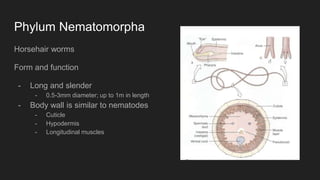
- Long and slender
- 0.5-3mm diameter; up to 1m in length
- Body wall is similar to nematodes
- Cuticle
- Hypodermis
- Longitudinal muscles
Phylum Nematomorpha
Horsehair worms
Form and function
- Long and slender
- 0.5-3mm diameter; up to 1m in length
- Body wall is similar to nematodes
- Cuticle
- Hypodermis
- Longitudinal muscles
Phylum Nematomorpha
Horsehair worms
Form and function
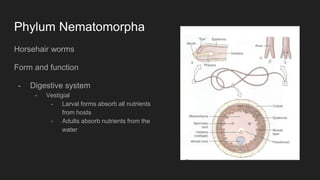
- Digestive system
- Vestigial
- Larval forms absorb all nutrients
from hosts
- Adults absorb nutrients from the
water
Phylum Nematomorpha
Horsehair worms
Form and function
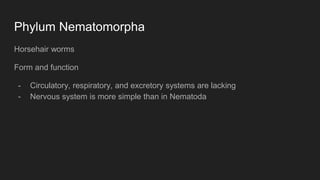
- Circulatory, respiratory, and excretory systems are lacking
- Nervous system is more simple than in Nematoda
Phylum Nematomorpha
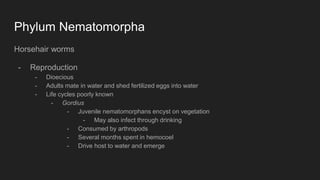
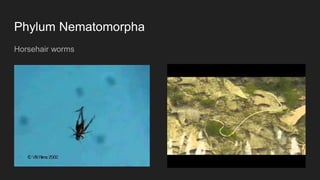
Horsehair worms
- Reproduction
- Dioecious
- Adults mate in water and shed fertilized eggs into water
- Life cycles poorly known
- Gordius
- Juvenile nematomorphans encyst on vegetation
- May also infect through drinking
- Consumed by arthropods
- Several months spent in hemocoel
- Drive host to water and emerge
Phylum Nematomorpha
Horsehair worms
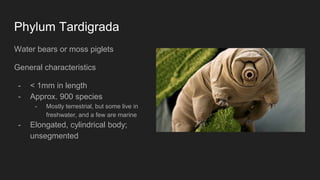
Phylum Tardigrada
Water bears or moss piglets
General characteristics
- < 1mm in length
- Approx. 900 species
- Mostly terrestrial, but some live in
freshwater, and a few are marine
- Elongated, cylindrical body;
unsegmented
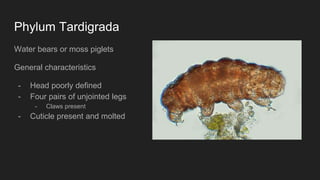
Phylum Tardigrada
Water bears or moss piglets
General characteristics
- Head poorly defined
- Four pairs of unjointed legs
- Claws present
- Cuticle present and molted
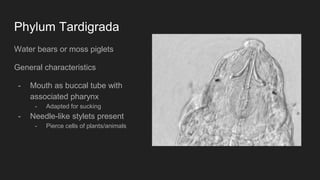
Phylum Tardigrada
Water bears or moss piglets
General characteristics
- Mouth as buccal tube with
associated pharynx
- Adapted for sucking
- Needle-like stylets present
- Pierce cells of plants/animals
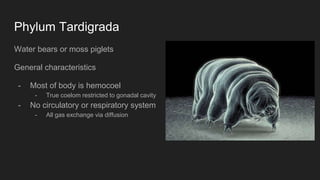
Phylum Tardigrada
Water bears or moss piglets
General characteristics
- Most of body is hemocoel
- True coelom restricted to gonadal cavity
- No circulatory or respiratory system
- All gas exchange via diffusion
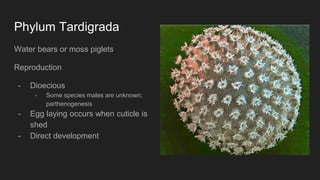
Phylum Tardigrada
Water bears or moss piglets
Reproduction
- Dioecious
- Some species males are unknown;
parthenogenesis
- Egg laying occurs when cuticle is
shed
- Direct development
Phylum Tardigrada
Water bears or moss piglets
Hard to kill
- Diapause (encystment) - internal physiological mechanism
- Cuticle shed, and then replaced by several layers of simpler cuticle
- Lack legs and such.
- Quiescence (cryptobiosis) - state or dormancy maintained by environmental
factors
- Metabolic activities are non-existent
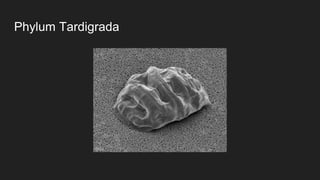
- Form a tun
- Withdraw legs, and lose much body water
Phylum Tardigrada
Phylum Tardigrada
Water bears or moss piglets
Hard to kill
- Cryptobiosis - can survive
- Anhydrobiosis - desiccation resistance
- Cryobiosis - temperature resistance
- Survive for years at -18C, can even survive -196C for a time
- Survive up to 151C
- Anyoxybiosis - no oxygen
- Vacuum - can survive in space
- Radiation - Ion radiation that would kill us is shrugged off

Nematoda, nematomorpha, tardigrada

  • 1.
  • 2.
    Ecdysozoa Protostomes that mustshed their cuticle in order to grow - Like the Lophotrochozoa, ecdysozoans do not share a common body plan - Some are pseudocoelomate - Nematoda and Nematomorpha - Some are acoelomate - Some are eucoelomate - Panarthropoda (contains Tardigrada and Arthropoda)
  • 5.
    Phylum Nematoda Diversity - 25,000named species - Maybe 500,000 - possibly more Distribution - Polar to tropics - Marine, freshwater, and terrestrial “In short, if all the matter in the universe except the nematodes were swept away, our world would still be dimly recognizable, and if, as disembodied spirits, we could then investigate it, we should find its mountains, hills, vales, rivers, lakes, and oceans represented by a film of nematodes. The location of towns would be decipherable, since for every massing of human beings there would be a corresponding massing of certain nematodes. Trees would still stand in ghostly rows representing our streets and highways. The location of the various plants and animals would still be decipherable, and, had we sufficient knowledge, in many cases even their species could be determined by an examination of their erstwhile nematode parasites."
  • 6.
  • 7.
    Phylum Nematoda Life Style -Nematodes are parasites of most all plants and animals - Medical, veterinary, and agricultural losses are billion annually - Many are free-living and feed on - Bacteria, - Yeasts, - Fungal hyphae, - Algae - Predatory species may feed on rotifers, tardigrades, small annelids, or other nematodes
  • 8.
    Phylum Nematoda Caenorhabditis elegans -Model for understanding development, gene function, and programmed cell death
  • 9.
    Phylum Nematoda Form andFunction - Distinguishing features - Cylindrical shape - Cuticle (collagen) - Secreted by hypodermis - Hypodermal cords - Lack cilia and flagella - Longitudinal body muscles only - Four bands - Hydrostatic skeleton - Eutely
  • 10.
    Phylum Nematoda Form andFunction - Distinguishing features - Cylindrical shape - Cuticle (collagen) - Secreted by hypodermis (epidermis) - Hypodermal cords - Lack cilia and flagella - Longitudinal body muscles only - Four bands - Hydrostatic skeleton - Eutely
  • 11.
    Phylum Nematoda Form andFunction - Distinguishing features - Cylindrical shape - Cuticle (collagen) - Secreted by hypodermis (epidermis) - Syncytial - Hypodermal cords - Lack cilia and flagella - Longitudinal body muscles only - Four bands - Hydrostatic skeleton - Eutely
  • 12.
    Phylum Nematoda Form andFunction - Distinguishing features - Cylindrical shape - Cuticle (collagen) - Secreted by hypodermis (epidermis) - Syncytial - Hypodermal cords - Lack cilia and flagella - Longitudinal body muscles only - Four bands - Hydrostatic skeleton - Eutely
  • 13.
    Phylum Nematoda Form andFunction Alimentary canal - Mouth - Muscular pharynx - Non-muscular intestine - Uses pressure of pseudocoelom - Short rectum - Anus - Feces expelled through body pressure
  • 14.
    Phylum Nematoda Form andFunction Circulation and Respiration - No dedicated organ systems - Diffusion used
  • 15.
    Phylum Nematoda Form andFunction Nervous System - Ring of nervous tissue and ganglia around pharynx - Dorsal and ventral nerve cords - Sensory papillae near head and tail - Amphids on either side of head - Primary sense organ
  • 16.
    Phylum Nematoda Form andFunction Reproduction - Most are dioecious - Female larger than male - Fertilization is internal - Development is direct - Cuticle shed after each larval stage
  • 17.
    Phylum Nematoda Representative nematodes Ariscaslumbricoides - Warm, humid regions of the globe - 1+ billion humans may be infected - 30cm in length - 200,000 eggs per day - Shed with feces - Can live in ground for weeks - Find new host through consumption of contaminated food
  • 18.
  • 19.
  • 20.
  • 22.
    Phylum Nematomorpha Horsehair worms Formand function - Long and slender - 0.5-3mm diameter; up to 1m in length - Body wall is similar to nematodes - Cuticle - Hypodermis - Longitudinal muscles
  • 23.
    Phylum Nematomorpha Horsehair worms Formand function - Long and slender - 0.5-3mm diameter; up to 1m in length - Body wall is similar to nematodes - Cuticle - Hypodermis - Longitudinal muscles
  • 24.
    Phylum Nematomorpha Horsehair worms Formand function - Digestive system - Vestigial - Larval forms absorb all nutrients from hosts - Adults absorb nutrients from the water
  • 25.
    Phylum Nematomorpha Horsehair worms Formand function - Circulatory, respiratory, and excretory systems are lacking - Nervous system is more simple than in Nematoda
  • 26.
    Phylum Nematomorpha Horsehair worms -Reproduction - Dioecious - Adults mate in water and shed fertilized eggs into water - Life cycles poorly known - Gordius - Juvenile nematomorphans encyst on vegetation - May also infect through drinking - Consumed by arthropods - Several months spent in hemocoel - Drive host to water and emerge
  • 27.
  • 30.
    Phylum Tardigrada Water bearsor moss piglets General characteristics - < 1mm in length - Approx. 900 species - Mostly terrestrial, but some live in freshwater, and a few are marine - Elongated, cylindrical body; unsegmented
  • 31.
    Phylum Tardigrada Water bearsor moss piglets General characteristics - Head poorly defined - Four pairs of unjointed legs - Claws present - Cuticle present and molted
  • 32.
    Phylum Tardigrada Water bearsor moss piglets General characteristics - Mouth as buccal tube with associated pharynx - Adapted for sucking - Needle-like stylets present - Pierce cells of plants/animals
  • 33.
    Phylum Tardigrada Water bearsor moss piglets General characteristics - Most of body is hemocoel - True coelom restricted to gonadal cavity - No circulatory or respiratory system - All gas exchange via diffusion
  • 34.
    Phylum Tardigrada Water bearsor moss piglets Reproduction - Dioecious - Some species males are unknown; parthenogenesis - Egg laying occurs when cuticle is shed - Direct development
  • 35.
    Phylum Tardigrada Water bearsor moss piglets Hard to kill - Diapause (encystment) - internal physiological mechanism - Cuticle shed, and then replaced by several layers of simpler cuticle - Lack legs and such. - Quiescence (cryptobiosis) - state or dormancy maintained by environmental factors - Metabolic activities are non-existent - Form a tun - Withdraw legs, and lose much body water
  • 36.
  • 37.
    Phylum Tardigrada Water bearsor moss piglets Hard to kill - Cryptobiosis - can survive - Anhydrobiosis - desiccation resistance - Cryobiosis - temperature resistance - Survive for years at -18C, can even survive -196C for a time - Survive up to 151C - Anyoxybiosis - no oxygen - Vacuum - can survive in space - Radiation - Ion radiation that would kill us is shrugged off

Editor's Notes

  • #6 Nathan Augustus Cobb, a nematologist working for the U.S. Department of Agriculture, famously put it this way in 1915: