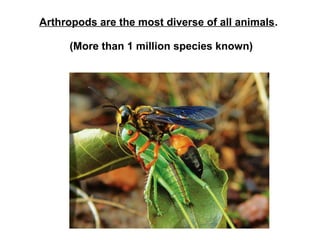
Arthropods are the most diverse of all animals.
(More than 1 million species known)
Characteristics:
– Bilateral simmetry
– Exoskeleton (cuticle) made of chitin (prevents from
predators and dry)
– Jointed appendages (legs and antennae)
– Segmented body parts (head, thorax and abdomen –
some of them have a cephalothorax)
• The exoskeleton is made of
many layers of chitin.
– hard material that
protects the body
– must be shed in order to
grow (ecdisis)
24.1 Arthropod Diversity
• Tienen órganos sensoriales muy desarrollados:
antenas con sensors químicos, ojos compuestos,
receptors de presión en la zona dorsal…
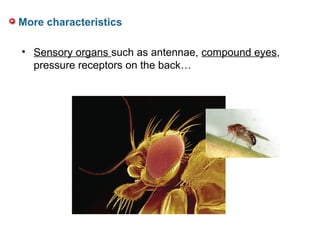
• Sensory organs such as antennae, compound eyes,
pressure receptors on the back…
More characteristics
• Sexual reproduction.
Some of them with
sexual dimorphism
• They lay eggs. Most of them with metamorphosis
More characteristics
• Arthropods have an open circulatory system.
• They breathe through trachea or gills.
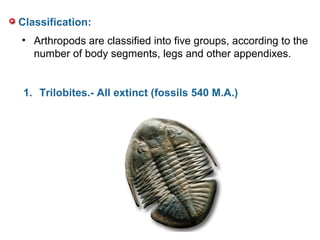
• Arthropods are classified into five groups, according to the
number of body segments, legs and other appendixes.
Classification:
1. Trilobites.- All extinct (fossils 540 M.A.)
24.1 Arthropod Diversity
– Cuerpos alargados y muchos pares de patas
MILPIES
(Diplópodos)
CIENPIES
(Quilópodos)
2. Miriápodos: Muchos pares de patas
Un par de patas por segment (cienpiés) o
dos pares de patas (milpies)
Un par de antenas y aparato buccal
masticador
Respiran por tráqueas
Carnívoros (cienpiés) y herbívoro
(milpies)
Sexos separados y sin metamorfosis
Cuerpo segmentado con cabeza diferenciada
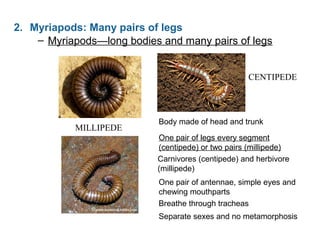
– Myriapods—long bodies and many pairs of legs
MILLIPEDE
CENTIPEDE
One pair of legs every segment
(centipede) or two pairs (millipede)
One pair of antennae, simple eyes and
chewing mouthparts
Breathe through tracheas
Carnivores (centipede) and herbivore
(millipede)
Separate sexes and no metamorphosis
Body made of head and trunk
2. Myriapods: Many pairs of legs
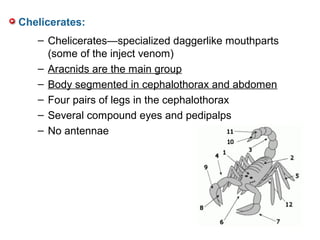
– Chelicerates—specialized daggerlike mouthparts
SPIDER
ACARI
SCORPION
ACARI (tick)
3. Chelicerates: 4 pais of legs
– Chelicerates—specialized daggerlike mouthparts
(some of the inject venom)
– Aracnids are the main group
– Body segmented in cephalothorax and abdomen
– Four pairs of legs in the cephalothorax
– Several compound eyes and pedipalps
– No antennae
Chelicerates:
24.1 Arthropod Diversity
– Los quelíceros son appendices bucales modificados
(algunos inyectan veneno).
– Los arácnidos son el principal grupo
– Cuerpo dividido en cefalotórax y abdomen.
– Cuatro pares de patas en el cefalotórax
– Varios ojos simples y pedipalpos
– Sin antenas
Quelicerados:
24.1 Arthropod Diversity
– Spiders, scorpions and acari
Chelicerates:
– Carnivores
– Tracheal respiration.
– Lay eggs
– No metamorphosis
24.1 Arthropod Diversity
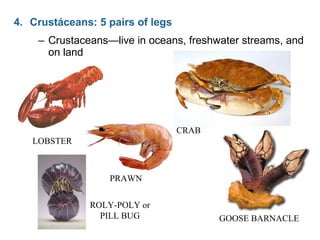
– Crustaceans—live in oceans, freshwater streams, and
on land
LOBSTER
PRAWN
CRAB
GOOSE BARNACLE
ROLY-POLY or
PILL BUG
4. Crustáceans: 5 pairs of legs
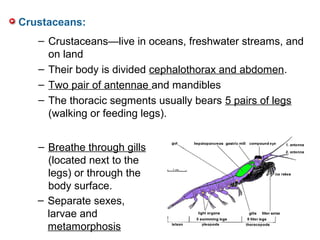
– Crustaceans—live in oceans, freshwater streams, and
on land
– Their body is divided cephalothorax and abdomen.
– Two pair of antennae and mandibles
– The thoracic segments usually bears 5 pairs of legs
(walking or feeding legs).
Crustaceans:
– Breathe through gills
(located next to the
legs) or through the
body surface.
– Separate sexes,
larvae and
metamorphosis
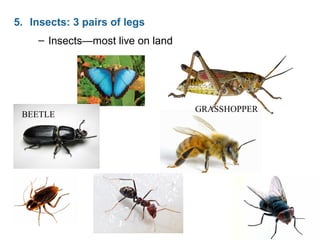
– Insects—most live on land
GRASSHOPPER
BEETLE
5. Insects: 3 pairs of legs
– Insects—most live on land, have six legs
– Body divided in three parts (head, thorax and
abdomen)
Insects:
24.1 Arthropod Diversity
– Insects—most live on land, have six legs
– Body divided in three parts (head, thorax and
abdomen)
– One pair of antennae (smell and touch) and
compound eyes on the head
– The structure of the mouth depends on their feeding
habits.
Insects:
– Three pairs of legs on the thorax and often one or two
pairs of wings
Insects:
– Tracheal respiration.
– Lay eggs
– Undergo metamorphosis
(complete or incomplete)

Arthropods

  • 1.
    Arthropods are themost diverse of all animals. (More than 1 million species known)
  • 2.
    Characteristics: – Bilateral simmetry –Exoskeleton (cuticle) made of chitin (prevents from predators and dry) – Jointed appendages (legs and antennae) – Segmented body parts (head, thorax and abdomen – some of them have a cephalothorax)
  • 3.
    • The exoskeletonis made of many layers of chitin. – hard material that protects the body – must be shed in order to grow (ecdisis)
  • 4.
    24.1 Arthropod Diversity •Tienen órganos sensoriales muy desarrollados: antenas con sensors químicos, ojos compuestos, receptors de presión en la zona dorsal…
  • 5.
    • Sensory organssuch as antennae, compound eyes, pressure receptors on the back… More characteristics
  • 6.
    • Sexual reproduction. Someof them with sexual dimorphism • They lay eggs. Most of them with metamorphosis More characteristics • Arthropods have an open circulatory system. • They breathe through trachea or gills.
  • 7.
    • Arthropods areclassified into five groups, according to the number of body segments, legs and other appendixes. Classification: 1. Trilobites.- All extinct (fossils 540 M.A.)
  • 8.
    24.1 Arthropod Diversity –Cuerpos alargados y muchos pares de patas MILPIES (Diplópodos) CIENPIES (Quilópodos) 2. Miriápodos: Muchos pares de patas Un par de patas por segment (cienpiés) o dos pares de patas (milpies) Un par de antenas y aparato buccal masticador Respiran por tráqueas Carnívoros (cienpiés) y herbívoro (milpies) Sexos separados y sin metamorfosis Cuerpo segmentado con cabeza diferenciada
  • 9.
    – Myriapods—long bodiesand many pairs of legs MILLIPEDE CENTIPEDE One pair of legs every segment (centipede) or two pairs (millipede) One pair of antennae, simple eyes and chewing mouthparts Breathe through tracheas Carnivores (centipede) and herbivore (millipede) Separate sexes and no metamorphosis Body made of head and trunk 2. Myriapods: Many pairs of legs
  • 10.
    – Chelicerates—specialized daggerlikemouthparts SPIDER ACARI SCORPION ACARI (tick) 3. Chelicerates: 4 pais of legs
  • 11.
    – Chelicerates—specialized daggerlikemouthparts (some of the inject venom) – Aracnids are the main group – Body segmented in cephalothorax and abdomen – Four pairs of legs in the cephalothorax – Several compound eyes and pedipalps – No antennae Chelicerates:
  • 12.
    24.1 Arthropod Diversity –Los quelíceros son appendices bucales modificados (algunos inyectan veneno). – Los arácnidos son el principal grupo – Cuerpo dividido en cefalotórax y abdomen. – Cuatro pares de patas en el cefalotórax – Varios ojos simples y pedipalpos – Sin antenas Quelicerados:
  • 13.
    24.1 Arthropod Diversity –Spiders, scorpions and acari Chelicerates: – Carnivores – Tracheal respiration. – Lay eggs – No metamorphosis
  • 14.
  • 15.
    – Crustaceans—live inoceans, freshwater streams, and on land LOBSTER PRAWN CRAB GOOSE BARNACLE ROLY-POLY or PILL BUG 4. Crustáceans: 5 pairs of legs
  • 16.
    – Crustaceans—live inoceans, freshwater streams, and on land – Their body is divided cephalothorax and abdomen. – Two pair of antennae and mandibles – The thoracic segments usually bears 5 pairs of legs (walking or feeding legs). Crustaceans: – Breathe through gills (located next to the legs) or through the body surface. – Separate sexes, larvae and metamorphosis
  • 17.
    – Insects—most liveon land GRASSHOPPER BEETLE 5. Insects: 3 pairs of legs
  • 18.
    – Insects—most liveon land, have six legs – Body divided in three parts (head, thorax and abdomen) Insects:
  • 19.
    24.1 Arthropod Diversity –Insects—most live on land, have six legs – Body divided in three parts (head, thorax and abdomen) – One pair of antennae (smell and touch) and compound eyes on the head – The structure of the mouth depends on their feeding habits. Insects:
  • 20.
    – Three pairsof legs on the thorax and often one or two pairs of wings Insects: – Tracheal respiration. – Lay eggs – Undergo metamorphosis (complete or incomplete)