

Subphylum: Chelicerata
General characters:
Body: Prosoma (6) and Opisthosoma (12)
A pair of chelicerae on the 1st prosomal
segment
 One pair of pedipalps + 4 pairsof walking
legs
 Three classes:
1.Arachnida
2. Merostomata
3. Pycnogonida
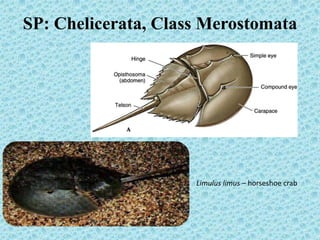
SP: Chelicerata, Class Merostomata
Limulus limus – horseshoe crab
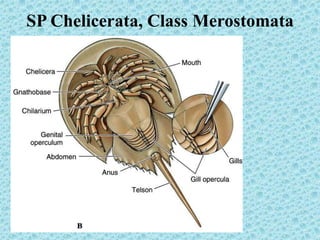
SP Chelicerata, Class Merostomata
SP: Chelicerata, Class Pycnogonida
SP Chelicerata, Class Arachnida, Order Araneae
General characters:
Includes: scorpions, spiders, ticks and mites
All areterresterial
 No antennae or true jaws
 Head is not distinct
 The body: prosoma (6) + opisthosoma
 Respiration by:
1. lung books or tracheae in terresterial forms
2. through skin in parasitic forms
3. gill books in aquatic forms
 Excretion by Malpighian tubules or coxal glands
 Open Circulatory system
 Separate sexes. Viviparous or Oviparous
 Mostly carnivorous but some are ectoparasites
Class: Arachnida
Classification
of
Arachnida
O:
Scorpionidea
O: Scorpionidea
 Terrestarial
 Body: pro-, meso- and meta- soma
 Prosoma: one pair of chelicera,
one pair of pedipalps,
4 pairs of walking legs
 Mesosoma: 6 segments
 A pair of pectins on the 2nd segment of mesosoma
 Respiration: by 4 pairs of lung books
 Viviparous
 eg Buthus quinquestriatus (scorpion)
Lethally Poisonous Scorpions
Centruroides exilicauda
Leiurus quinquestriatus
Class Arachnida, Order Scorpionida
Paninus imperator (Emperor scorpion)
O: Araneida
 Terrestarial
 Body: pro-, and opistho- soma
 Prosoma: one pair of chelicera (non-chelate),
one pair of pedipalps (non-chelate),
4 pairs of walking legs
 Opisthosoma: 12 segments
 Spinnerets: 2-4 pairs
 Respiration: by lung books
 Oviparous
 eg Lycosa ferox (wolf spider)
SP Chelicerata, Class Arachnida, Order Araneae
Spinnerets
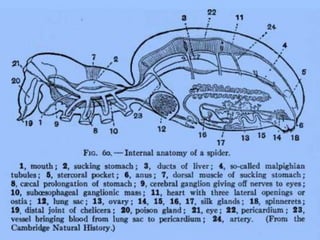
Anatomy of spider
Regional Poisonous Spiders
Lactrodectus mactans
Loxosceles reclusa
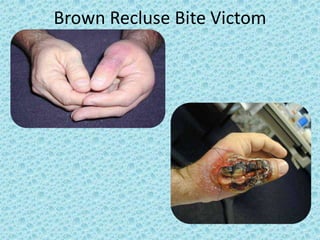
Brown Recluse Bite Victom
Tan Tarantula
Argiope aurantia
Aphonopelma anax
Golden Orb Spider/Garden Spider
Class Arachnida, Order Opiliones
Class Arachnida, Order Solifugae
Eremobates sp
Class Arachnida: Ticks and mites
• No external division or segmentation
• Found almost everywhere
• Chiggers: feed on dermal tissues of
humans
• Dust mites: can cause allergies
• Hair follicle mites: infect most of
us, but we are unaware of it
• Ticks spread disease: Rocky mountain
fever and Lyme’s disease
Class Arachnida, Order Acari
Dermacentor variabilis American dog tick
Rhipicephalus sanguineus Brown dog tick
Rocky mountain spotted fever
Class Arachnida, Order Acari
Ixodes scapularis Deer tick
Lyme disease
Class Arachnida, Order Acari
Eutrombicula alfreddugesi Chigger
Sarcoptes scabiei scabies mite
Class Arachnida, Order AcariDermatophagoides spp
Dust mite
Class Arachnida, Order Amblypygi
CHARACTERISTICS
Second largest phylum in the animal kingdom
(80000 living species and 40000 fossil species)
Soft bodied animals
Body: head, foot and visceral hump
Microscopic to macroscopic
They include
chitons, snails, slugs, clams, oysters, cuttlefish,
squids, octopods, scaphopods, …….
Slow to active organisms
Coelomate, triploplastic, unsegmented
Terrestrial, freshwater, or marine
environments
Occur in a wide variety of environments
Have different modes of nutrition
Bilateral symmetry, torsion and coiling in
gastropods
True coelom is reduced
Skin is soft and often secrets the exoskeleton or
the shell
Respiration by one to many gills (ctenidia)
Radula in most molluscs
Circulatory system of open type (except
cephalopods)
Blood contains haemocyanin and amoebocytes
The nervous system is composed of a nerve
ring around the oesophagus and two pairs of
nerve cords
Sense organs include tentacles, eye
spots, statocysts in foot and osphradia beside gills
Excretion by a pair of u- shaped metanephridia
Molluscs are unisexual (dioecious) but some
are hermaphrodite (monoecious)
Fertilization is mostly external and rarely
internal
Development is direct (no larva) or indirect
through free swimming trochophore and/or
veliger larvae
GENERAL BODY PLAN
Head
Ventrally located muscular foot
Dorsally located visceral mass
Mantle / pallium – for shell/spicule secretion
Radula (except for bivalves)
Complete digestive tract
Gonads in visceral mass
Monoecious or dioecious
• Subphylum Conchifera: with 1 shell; (-)
spicules
1. Class Gastropoda
2. Class Bivalvia
3. Class Cephalopoda
4. Class Scaphopoda
5. Class Monoplacophora
• Subphylum Aculifera: with multiple shell
plates; (+) spicules
1. Class Polyplacophora
2. Class Aplacophora
CLASSIFICATION
invertebrates : chelicera

invertebrates : chelicera

  • 2.
    Subphylum: Chelicerata General characters: Body:Prosoma (6) and Opisthosoma (12) A pair of chelicerae on the 1st prosomal segment  One pair of pedipalps + 4 pairsof walking legs  Three classes: 1.Arachnida 2. Merostomata 3. Pycnogonida
  • 5.
    SP: Chelicerata, ClassMerostomata Limulus limus – horseshoe crab
  • 6.
  • 7.
  • 8.
    SP Chelicerata, ClassArachnida, Order Araneae
  • 10.
    General characters: Includes: scorpions,spiders, ticks and mites All areterresterial  No antennae or true jaws  Head is not distinct  The body: prosoma (6) + opisthosoma  Respiration by: 1. lung books or tracheae in terresterial forms 2. through skin in parasitic forms 3. gill books in aquatic forms  Excretion by Malpighian tubules or coxal glands  Open Circulatory system  Separate sexes. Viviparous or Oviparous  Mostly carnivorous but some are ectoparasites Class: Arachnida
  • 11.
  • 12.
    O: Scorpionidea  Terrestarial Body: pro-, meso- and meta- soma  Prosoma: one pair of chelicera, one pair of pedipalps, 4 pairs of walking legs  Mesosoma: 6 segments  A pair of pectins on the 2nd segment of mesosoma  Respiration: by 4 pairs of lung books  Viviparous  eg Buthus quinquestriatus (scorpion)
  • 14.
    Lethally Poisonous Scorpions Centruroidesexilicauda Leiurus quinquestriatus
  • 15.
    Class Arachnida, OrderScorpionida Paninus imperator (Emperor scorpion)
  • 18.
    O: Araneida  Terrestarial Body: pro-, and opistho- soma  Prosoma: one pair of chelicera (non-chelate), one pair of pedipalps (non-chelate), 4 pairs of walking legs  Opisthosoma: 12 segments  Spinnerets: 2-4 pairs  Respiration: by lung books  Oviparous  eg Lycosa ferox (wolf spider)
  • 19.
    SP Chelicerata, ClassArachnida, Order Araneae
  • 20.
  • 22.
  • 26.
    Regional Poisonous Spiders Lactrodectusmactans Loxosceles reclusa
  • 27.
  • 28.
    Tan Tarantula Argiope aurantia Aphonopelmaanax Golden Orb Spider/Garden Spider
  • 29.
  • 30.
    Class Arachnida, OrderSolifugae Eremobates sp
  • 31.
    Class Arachnida: Ticksand mites • No external division or segmentation • Found almost everywhere • Chiggers: feed on dermal tissues of humans • Dust mites: can cause allergies • Hair follicle mites: infect most of us, but we are unaware of it • Ticks spread disease: Rocky mountain fever and Lyme’s disease
  • 35.
    Class Arachnida, OrderAcari Dermacentor variabilis American dog tick Rhipicephalus sanguineus Brown dog tick Rocky mountain spotted fever
  • 36.
    Class Arachnida, OrderAcari Ixodes scapularis Deer tick Lyme disease
  • 37.
  • 38.
    Class Arachnida, OrderAcari Eutrombicula alfreddugesi Chigger Sarcoptes scabiei scabies mite
  • 39.
    Class Arachnida, OrderAcariDermatophagoides spp Dust mite
  • 40.
  • 43.
    CHARACTERISTICS Second largest phylumin the animal kingdom (80000 living species and 40000 fossil species) Soft bodied animals Body: head, foot and visceral hump Microscopic to macroscopic They include chitons, snails, slugs, clams, oysters, cuttlefish, squids, octopods, scaphopods, ……. Slow to active organisms Coelomate, triploplastic, unsegmented
  • 44.
    Terrestrial, freshwater, ormarine environments Occur in a wide variety of environments Have different modes of nutrition Bilateral symmetry, torsion and coiling in gastropods True coelom is reduced Skin is soft and often secrets the exoskeleton or the shell Respiration by one to many gills (ctenidia) Radula in most molluscs Circulatory system of open type (except cephalopods)
  • 45.
    Blood contains haemocyaninand amoebocytes The nervous system is composed of a nerve ring around the oesophagus and two pairs of nerve cords Sense organs include tentacles, eye spots, statocysts in foot and osphradia beside gills Excretion by a pair of u- shaped metanephridia Molluscs are unisexual (dioecious) but some are hermaphrodite (monoecious) Fertilization is mostly external and rarely internal Development is direct (no larva) or indirect through free swimming trochophore and/or veliger larvae
  • 46.
    GENERAL BODY PLAN Head Ventrallylocated muscular foot Dorsally located visceral mass Mantle / pallium – for shell/spicule secretion Radula (except for bivalves) Complete digestive tract Gonads in visceral mass Monoecious or dioecious
  • 47.
    • Subphylum Conchifera:with 1 shell; (-) spicules 1. Class Gastropoda 2. Class Bivalvia 3. Class Cephalopoda 4. Class Scaphopoda 5. Class Monoplacophora • Subphylum Aculifera: with multiple shell plates; (+) spicules 1. Class Polyplacophora 2. Class Aplacophora CLASSIFICATION