Back to the Drawing Board New Rules and Routines
New Routines 1. I am going to start checking for supplies once again  What:  I will come around and check to make sure each and every student is bringing their composition notebook and binder to class  WHY:  students are able to keep all papers safe and organized Students will always have class notes as a resource for in class activities  Students get in the habit of being prepared: COLLEGE READINESS
2. POP QUIZZES  WHAT: every week or two Short quiz. Can use your notes  WHY:  Check to see understanding before test Encourage students to take notes during class Raise test and quiz averages for your grade
3. STAGGER EXIT SLIPS  WHAT:  exit slips will now be given first thing the following day after a lecture  WHY:  Encourages students to get in the habit of studying consistently instead of just before the test Reviews as well as evaluates  Encourages students to take notes  Allows students to process information over time
CLARIFICATION YOU WILL BE RESPONSIBLE FOR TAKING THE EXIT SLIP WHETHER YOU WERE HERE OR NOT Why: it is YOUR responsibility to make up for lost class time. We will not reach our goal if students continue to miss content  How: emailing Ms. Cota  Looking up power points on the blog.  Coming in after school before the following class period.
New Class Rules #1 All phones should be put away for the entirety of the class period  Why: they have proven to be a distraction to learning while in class (and you don’t even get service anyway)
#2 Students will come prepared to each and every class period  Why: our class time is valuable and cannot be wasted by lack of preparation
#3 Students will follow directions the first time they are given  Why: classes are designed to give students the most content in the best way. It is imperative that students follow directions in order for the class period to be successful.
#4 Students will be respectful, considerate, and academically supportive of their peers.  Why: in order to effectively learn students need to feel safe. Group work needs to be effective in order for students to truly explore material and use class time efficiently.
#5 Class points will be awarded calmly and efficiently  Any exclamations or challenges to a class point will result in a loss of point to that team.
So to quickly review  Rule #1: all phones should be put away for the entirety of the class period  Rule #2: Students will come prepared to each and every class period Rule #3: Students will follow directions the first time they are given  Rule #4: students will be respectful, considerate, and academically supportive of peers Rule #5: Class points will be awarded calmly and efficiently
Critical thinking
Expectations: Transitions Conversation :  there should be minimal conversation. All conversation should be directed towards accomplishing the task and done at a level 1 noise level   Help :  ask two peers before you ask me Activity :  you should be efficiently transitioning to the designated area with all required material in 30 seconds or less Movement :  quietly and calmly moving to a new location  Participation :  I will know you are participating if you are in the new location with all required materials and are ready to listen to further instructions in 30 seconds or less.
Do you remember the expectations for lectures?
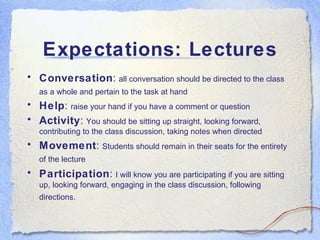
Expectations: Lectures Conversation :  all conversation should be directed to the class as a whole and pertain to the task at hand   Help :  raise your hand if you have a comment or question Activity :  You should be sitting up straight, looking forward, contributing to the class discussion, taking notes when directed Movement :  Students should remain in their seats for the entirety of the lecture   Participation :  I will know you are participating if you are sitting up, looking forward, engaging in the class discussion, following directions.
CRITICAL THINKING Critical thinking involves: asking questions defining a problem  examining evidence  analyzing assumptions and biases  avoiding emotional reasoning  avoiding oversimplification considering other interpretations tolerating ambiguity.
Critical thinkERS Critical thinkers are:  skeptical  open-minded  value fair-mindedness respect evidence and reasoning  respect clarity and precision look at different points of view will change point of view when reason leads them to do so
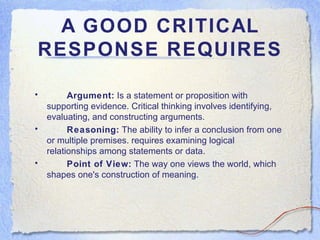
A GOOD CRITICAL RESPONSE REQUIRES Argument:  Is a statement or proposition with supporting evidence. Critical thinking involves identifying, evaluating, and constructing arguments. Reasoning:  The ability to infer a conclusion from one or multiple premises. requires examining logical relationships among statements or data. Point of View:  The way one views the world, which shapes one's construction of meaning.
WHY DO THIS?! EVENTUALLY YOU WILL BE YOUR OWN TEACHER
STEPS TO CRITICAL THINKING Write this down:   highlight what the question is asking  2. Rewrite the question in your own words  3. bullet point all terms or concepts that relate to the question 4. organize ideas into an outline  5. write the answer to the question from your outline  6.  RE-READ THE ANSWER TO THE QUESTION TO MAKE SURE IT MAKES SENSE.

11 29-11 upload

  • 1.
    Back to theDrawing Board New Rules and Routines
  • 2.
    New Routines 1.I am going to start checking for supplies once again What: I will come around and check to make sure each and every student is bringing their composition notebook and binder to class WHY: students are able to keep all papers safe and organized Students will always have class notes as a resource for in class activities Students get in the habit of being prepared: COLLEGE READINESS
  • 3.
    2. POP QUIZZES WHAT: every week or two Short quiz. Can use your notes WHY: Check to see understanding before test Encourage students to take notes during class Raise test and quiz averages for your grade
  • 4.
    3. STAGGER EXITSLIPS WHAT: exit slips will now be given first thing the following day after a lecture WHY: Encourages students to get in the habit of studying consistently instead of just before the test Reviews as well as evaluates Encourages students to take notes Allows students to process information over time
  • 5.
    CLARIFICATION YOU WILLBE RESPONSIBLE FOR TAKING THE EXIT SLIP WHETHER YOU WERE HERE OR NOT Why: it is YOUR responsibility to make up for lost class time. We will not reach our goal if students continue to miss content How: emailing Ms. Cota Looking up power points on the blog. Coming in after school before the following class period.
  • 6.
    New Class Rules#1 All phones should be put away for the entirety of the class period Why: they have proven to be a distraction to learning while in class (and you don’t even get service anyway)
  • 7.
    #2 Students willcome prepared to each and every class period Why: our class time is valuable and cannot be wasted by lack of preparation
  • 8.
    #3 Students willfollow directions the first time they are given Why: classes are designed to give students the most content in the best way. It is imperative that students follow directions in order for the class period to be successful.
  • 9.
    #4 Students willbe respectful, considerate, and academically supportive of their peers. Why: in order to effectively learn students need to feel safe. Group work needs to be effective in order for students to truly explore material and use class time efficiently.
  • 10.
    #5 Class pointswill be awarded calmly and efficiently Any exclamations or challenges to a class point will result in a loss of point to that team.
  • 11.
    So to quicklyreview Rule #1: all phones should be put away for the entirety of the class period Rule #2: Students will come prepared to each and every class period Rule #3: Students will follow directions the first time they are given Rule #4: students will be respectful, considerate, and academically supportive of peers Rule #5: Class points will be awarded calmly and efficiently
  • 12.
  • 13.
    Expectations: Transitions Conversation: there should be minimal conversation. All conversation should be directed towards accomplishing the task and done at a level 1 noise level Help : ask two peers before you ask me Activity : you should be efficiently transitioning to the designated area with all required material in 30 seconds or less Movement : quietly and calmly moving to a new location Participation : I will know you are participating if you are in the new location with all required materials and are ready to listen to further instructions in 30 seconds or less.
  • 14.
    Do you rememberthe expectations for lectures?
  • 15.
    Expectations: Lectures Conversation: all conversation should be directed to the class as a whole and pertain to the task at hand Help : raise your hand if you have a comment or question Activity : You should be sitting up straight, looking forward, contributing to the class discussion, taking notes when directed Movement : Students should remain in their seats for the entirety of the lecture Participation : I will know you are participating if you are sitting up, looking forward, engaging in the class discussion, following directions.
  • 16.
    CRITICAL THINKING Criticalthinking involves: asking questions defining a problem examining evidence analyzing assumptions and biases avoiding emotional reasoning avoiding oversimplification considering other interpretations tolerating ambiguity.
  • 17.
    Critical thinkERS Criticalthinkers are: skeptical open-minded value fair-mindedness respect evidence and reasoning respect clarity and precision look at different points of view will change point of view when reason leads them to do so
  • 18.
    A GOOD CRITICALRESPONSE REQUIRES Argument: Is a statement or proposition with supporting evidence. Critical thinking involves identifying, evaluating, and constructing arguments. Reasoning: The ability to infer a conclusion from one or multiple premises. requires examining logical relationships among statements or data. Point of View: The way one views the world, which shapes one's construction of meaning.
  • 19.
    WHY DO THIS?!EVENTUALLY YOU WILL BE YOUR OWN TEACHER
  • 20.
    STEPS TO CRITICALTHINKING Write this down: highlight what the question is asking 2. Rewrite the question in your own words 3. bullet point all terms or concepts that relate to the question 4. organize ideas into an outline 5. write the answer to the question from your outline 6. RE-READ THE ANSWER TO THE QUESTION TO MAKE SURE IT MAKES SENSE.