CHEMISTRY
OF
PHENOLS
Ms. J. Princess Gracia, M.Sc.,M.Phil.,
Assistant Professor,
Department of Chemistry,
Bon Secours College for Women, Thanjavur.
Introduction-
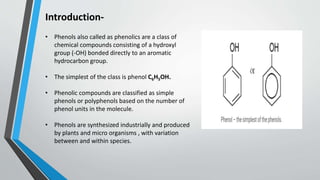
• Phenols also called as phenolics are a class of
chemical compounds consisting of a hydroxyl
group (-OH) bonded directly to an aromatic
hydrocarbon group.
• The simplest of the class is phenol C6H5OH.
• Phenolic compounds are classified as simple
phenols or polyphenols based on the number of
phenol units in the molecule.
• Phenols are synthesized industrially and produced
by plants and micro organisms , with variation
between and within species.
PREPARATION OF PHENOLS
FROM HALOARENES –
chlorobenzene is an example of haloarenes
which is formed by the mono substitution of benzene ring. when
chlorobenzene is fused with sodium hydroxide at 623K and 320 atm sodium
phenoxide is produced.
Finally ,sodium phenoxide on acidification gives
phenols.
FROM BENZENE SULPHONIC ACID -
Benzene sulphonic acid can be
obtained from benzene by reacting it with oleum.
Benzene sulphonic acid thus formed is treated with molten sodium
hydroxide at high temperature which leads to the formation of sodium
phenoxide on acidification gives phenols.
FROM DIAZONIUM SALTS
When an aromatic primary amine is
treated with nitrous (NaNO2 + HCL ) acid at 273 – 278 k , diazonium salts are
highly reactive in nature.upon warming with water , these diazonium salts
hydrolyze to phenols.
Phenols can also be obtained from diazonium salts by
treating it with dilute acids.
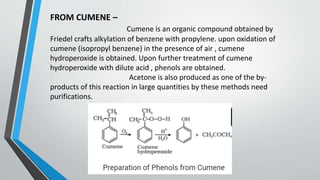
FROM CUMENE –
Cumene is an organic compound obtained by
Friedel crafts alkylation of benzene with propylene. upon oxidation of
cumene (isopropyl benzene) in the presence of air , cumene
hydroperoxide is obtained. Upon further treatment of cumene
hydroperoxide with dilute acid , phenols are obtained.
Acetone is also produced as one of the by-
products of this reaction in large quantities by these methods need
purifications.
PHYSICAL PROPERTIES-
• They are colorless liquids or crystalline solids but become colored due
to slow oxidation with air.
• Due to the presence of strong intermolecular hydrogen bonding ,
phenols have a higher boiling point than the corresponding
hydrocarbon or aryl haildes.
• Due to their ability to form hydrogen bonds with water , phenols are
moderately soluble in H2O.
• They are acidic in nature and stronger acids than alcohols. This is due to
the fact Sp2 hybridized carbon of phenol to which –OH is attached, is
highly electronegative which causes a decrease in electron density on
oxygen.
REACTIONS OF PHENOL INVOLVINGTHE CLEAVAGE OF O-H BOND
KOLBE’S REACTION –
REIMER –TIEMANN REACTION –
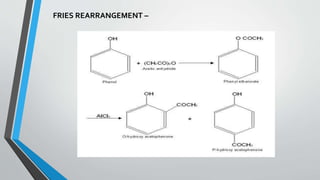
FRIES REARRANGEMENT –
ACETYLATION -
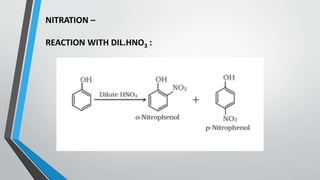
NITRATION –
REACTION WITH DIL.HNO3 :
REACTION WITH CONCENTRATED HNO 3 :
HALOGENATION –
BROMINATION IN SOLVENTS OF LOW POLARITY LIKE CS2 :
THE REACTION OF PHENOL WITH BROMINE WATER -
USES-
• The main use of phenol is as precursors for plastics
• Phenol is also a useful precursor to a huge collection of drugs, most
notably aspirin but also several herbicides and pharmaceutical
drugs.
• Phenol is an element in liquid / liquid phenol – chloroform
abstraction technique used in molecular biology for procurement of
nucleic acids from tissues or cell culture samples.
• It is used as an antiseptic
• It is used as a disinfectant in household cleaners.
• It is used in the preparation of resins , dyes, explosives, lubricants ,
pesticides etc.
THANKYOU !!!!!

Phenols

  • 1.
    CHEMISTRY OF PHENOLS Ms. J. PrincessGracia, M.Sc.,M.Phil., Assistant Professor, Department of Chemistry, Bon Secours College for Women, Thanjavur.
  • 2.
    Introduction- • Phenols alsocalled as phenolics are a class of chemical compounds consisting of a hydroxyl group (-OH) bonded directly to an aromatic hydrocarbon group. • The simplest of the class is phenol C6H5OH. • Phenolic compounds are classified as simple phenols or polyphenols based on the number of phenol units in the molecule. • Phenols are synthesized industrially and produced by plants and micro organisms , with variation between and within species.
  • 3.
    PREPARATION OF PHENOLS FROMHALOARENES – chlorobenzene is an example of haloarenes which is formed by the mono substitution of benzene ring. when chlorobenzene is fused with sodium hydroxide at 623K and 320 atm sodium phenoxide is produced. Finally ,sodium phenoxide on acidification gives phenols.
  • 4.
    FROM BENZENE SULPHONICACID - Benzene sulphonic acid can be obtained from benzene by reacting it with oleum. Benzene sulphonic acid thus formed is treated with molten sodium hydroxide at high temperature which leads to the formation of sodium phenoxide on acidification gives phenols.
  • 5.
    FROM DIAZONIUM SALTS Whenan aromatic primary amine is treated with nitrous (NaNO2 + HCL ) acid at 273 – 278 k , diazonium salts are highly reactive in nature.upon warming with water , these diazonium salts hydrolyze to phenols. Phenols can also be obtained from diazonium salts by treating it with dilute acids.
  • 6.
    FROM CUMENE – Cumeneis an organic compound obtained by Friedel crafts alkylation of benzene with propylene. upon oxidation of cumene (isopropyl benzene) in the presence of air , cumene hydroperoxide is obtained. Upon further treatment of cumene hydroperoxide with dilute acid , phenols are obtained. Acetone is also produced as one of the by- products of this reaction in large quantities by these methods need purifications.
  • 7.
    PHYSICAL PROPERTIES- • Theyare colorless liquids or crystalline solids but become colored due to slow oxidation with air. • Due to the presence of strong intermolecular hydrogen bonding , phenols have a higher boiling point than the corresponding hydrocarbon or aryl haildes. • Due to their ability to form hydrogen bonds with water , phenols are moderately soluble in H2O. • They are acidic in nature and stronger acids than alcohols. This is due to the fact Sp2 hybridized carbon of phenol to which –OH is attached, is highly electronegative which causes a decrease in electron density on oxygen.
  • 8.
    REACTIONS OF PHENOLINVOLVINGTHE CLEAVAGE OF O-H BOND KOLBE’S REACTION –
  • 9.
  • 10.
  • 11.
  • 12.
  • 13.
  • 14.
    HALOGENATION – BROMINATION INSOLVENTS OF LOW POLARITY LIKE CS2 :
  • 15.
    THE REACTION OFPHENOL WITH BROMINE WATER -
  • 16.
    USES- • The mainuse of phenol is as precursors for plastics • Phenol is also a useful precursor to a huge collection of drugs, most notably aspirin but also several herbicides and pharmaceutical drugs. • Phenol is an element in liquid / liquid phenol – chloroform abstraction technique used in molecular biology for procurement of nucleic acids from tissues or cell culture samples. • It is used as an antiseptic • It is used as a disinfectant in household cleaners. • It is used in the preparation of resins , dyes, explosives, lubricants , pesticides etc.
  • 17.