Physical Properties of Esters

   Esters are polar molecules and exhibits dipole-dipole interaction as well as
    van der Waals.
   Esters are more polar than ethers but less polar than alcohols.
   They participate in hydrogen bonds as hydrogen-bond acceptors
    (recipient), but cannot act as hydrogen-bond donors, unlike their parent
    alcohols.
   This ability to participate in hydrogen bonding confers some water-solubility
    (fairly soluble in water).
   Esters are more volatile (volatility is the tendency of a substance to
    vaporize) than carboxylic acids of similar molecular weight.
   Esters have lower melting point and lower boiling point than the
    corresponding amides.
Chemical Properties of Esters

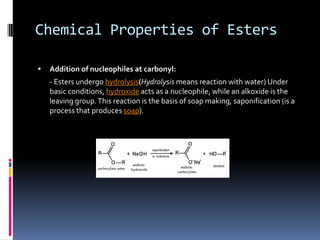
   Addition of nucleophiles at carbonyl:
    - Esters undergo hydrolysis(Hydrolysis means reaction with water) Under
    basic conditions, hydroxide acts as a nucleophile, while an alkoxide is the
    leaving group. This reaction is the basis of soap making, saponification (is a
    process that produces soap).
Chemical Properties of Esters

   Reduction:
    -Compared to ketones and aldehydes, esters are relatively resistant to
    reduction (reduction refers to all chemical reactions in which atoms have
    their oxidation state changed).
   Ester pyrolysis:
    -is a vacuum pyrolysis reaction converting esters containing a β-hydrogen
    atom into the corresponding carboxylic acid and the alkene.
Sources of Esters

   Sources of Esters
1.)Making esters from carboxylic acids and
   alcohols(Esterfication)
 -Esters are produced when carboxylic acids are
   heated with alcohols in the presence of an acid
   catalyst (conc. H2S04).
2.) Making esters from alcohols and acid
   chlorides
 If you add an acid chloride to an alcohol, you get
   a vigorous (even violent) reaction at room
   temperature producing an ester and clouds of
   steamy acidic fumes of hydrogen chloride.
Uses of Esters

  Solvents
 Esters have no free OH groups and so they tend to
  be insoluble in water. However, they are very good
  solvents for polar organic compounds, such as
  lacquers, printing ink, polystyrene and cement, as
  well as being used in the pharmaceutical industry.
  Plasticizers
 Plasticizers are added to plastics to make
  themselves better plastics and more flexible. Loss of
  these additives over time means they become
  brittle. Esters of benzene and 1,2 dicarboxylic acid
  are used in PVC.
Uses of Esters

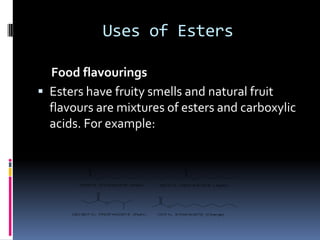
  Food flavourings
 Esters have fruity smells and natural fruit
  flavours are mixtures of esters and carboxylic
  acids. For example:

Esters

  • 1.
    Physical Properties ofEsters  Esters are polar molecules and exhibits dipole-dipole interaction as well as van der Waals.  Esters are more polar than ethers but less polar than alcohols.  They participate in hydrogen bonds as hydrogen-bond acceptors (recipient), but cannot act as hydrogen-bond donors, unlike their parent alcohols.  This ability to participate in hydrogen bonding confers some water-solubility (fairly soluble in water).  Esters are more volatile (volatility is the tendency of a substance to vaporize) than carboxylic acids of similar molecular weight.  Esters have lower melting point and lower boiling point than the corresponding amides.
  • 2.
    Chemical Properties ofEsters  Addition of nucleophiles at carbonyl: - Esters undergo hydrolysis(Hydrolysis means reaction with water) Under basic conditions, hydroxide acts as a nucleophile, while an alkoxide is the leaving group. This reaction is the basis of soap making, saponification (is a process that produces soap).
  • 3.
    Chemical Properties ofEsters  Reduction: -Compared to ketones and aldehydes, esters are relatively resistant to reduction (reduction refers to all chemical reactions in which atoms have their oxidation state changed).  Ester pyrolysis: -is a vacuum pyrolysis reaction converting esters containing a β-hydrogen atom into the corresponding carboxylic acid and the alkene.
  • 4.
    Sources of Esters Sources of Esters 1.)Making esters from carboxylic acids and alcohols(Esterfication)  -Esters are produced when carboxylic acids are heated with alcohols in the presence of an acid catalyst (conc. H2S04). 2.) Making esters from alcohols and acid chlorides  If you add an acid chloride to an alcohol, you get a vigorous (even violent) reaction at room temperature producing an ester and clouds of steamy acidic fumes of hydrogen chloride.
  • 5.
    Uses of Esters Solvents  Esters have no free OH groups and so they tend to be insoluble in water. However, they are very good solvents for polar organic compounds, such as lacquers, printing ink, polystyrene and cement, as well as being used in the pharmaceutical industry. Plasticizers  Plasticizers are added to plastics to make themselves better plastics and more flexible. Loss of these additives over time means they become brittle. Esters of benzene and 1,2 dicarboxylic acid are used in PVC.
  • 6.
    Uses of Esters Food flavourings  Esters have fruity smells and natural fruit flavours are mixtures of esters and carboxylic acids. For example: