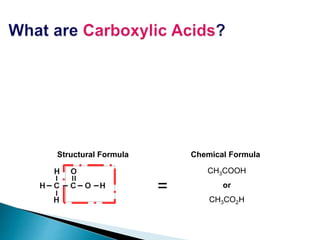
Structural Formula Chemical Formula
CH3COOH
or
CH3CO2H
=
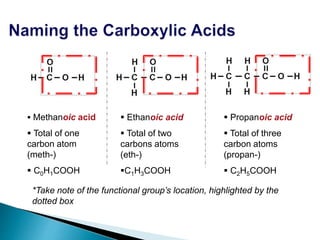
 Methanoic acid
 Total of one
carbon atom
(meth-)
 C0H1COOH
 Ethanoic acid
 Total of two
carbons atoms
(eth-)
C1H3COOH
 Propanoic acid
 Total of three
carbon atoms
(propan-)
 C2H5COOH
*Take note of the functional group’s location, highlighted by the
dotted box
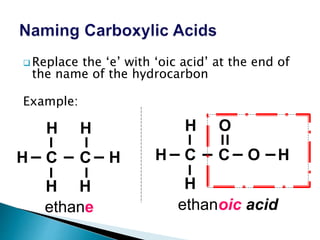
 Replace the ‘e’ with ‘oic acid’ at the end of
the name of the hydrocarbon
Example:
H H
H C C H
H H
ethane
H O
H C C O H
H
ethanoic acid
Since these are acidic compounds, therefore easily
lose H+ ion and covert in carboxylate ion (RCOO-)
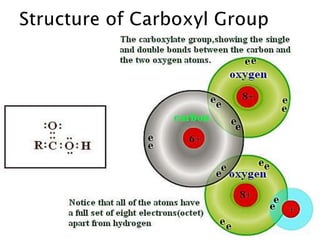
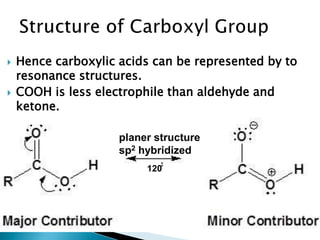
 Hence carboxylic acids can be represented by to
resonance structures.
 COOH is less electrophile than aldehyde and
ketone.
120̊̊
planer structure
sp2 hybridized
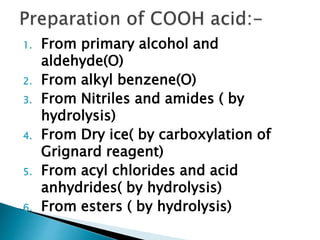
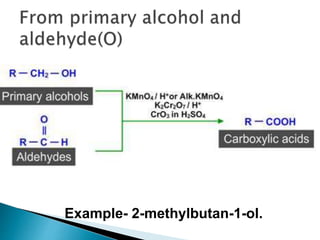
1. From primary alcohol and
aldehyde(O)
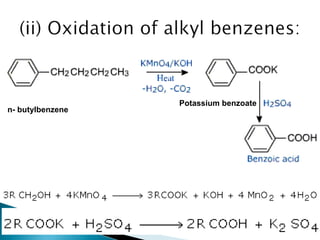
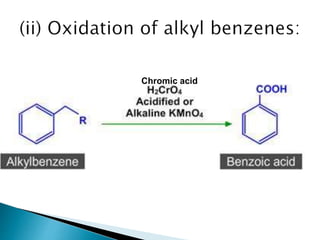
2. From alkyl benzene(O)
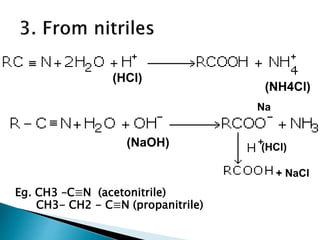
3. From Nitriles and amides ( by
hydrolysis)
4. From Dry ice( by carboxylation of
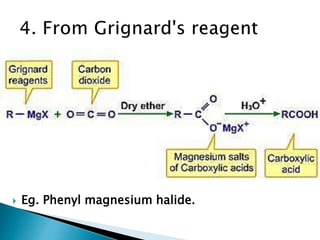
Grignard reagent)
5. From acyl chlorides and acid
anhydrides( by hydrolysis)
6. From esters ( by hydrolysis)
Example- 2-methylbutan-1-ol.
n- butylbenzene
Potassium benzoate
Chromic acid
Eg. CH3 –C≡N (acetonitrile)
CH3- CH2 - C≡N (propanitrile)
(HCl)
(NH4Cl)
(NaOH) (HCl)
Na
+ NaCl
 Eg. Phenyl magnesium halide.
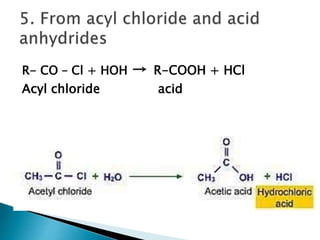
R- CO – Cl + HOH → R-COOH + HCl
Acyl chloride acid
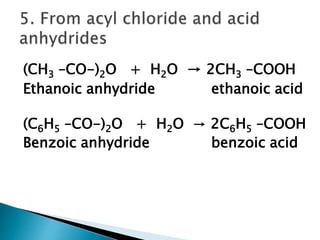
(CH3 –CO-)2O + H2O → 2CH3 –COOH
Ethanoic anhydride ethanoic acid
(C6H5 –CO-)2O + H2O → 2C6H5 –COOH
Benzoic anhydride benzoic acid
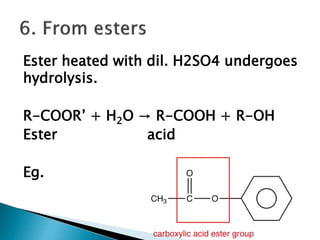
Ester heated with dil. H2SO4 undergoes
hydrolysis.
R-COOR’ + H2O → R-COOH + R-OH
Ester acid
Eg.
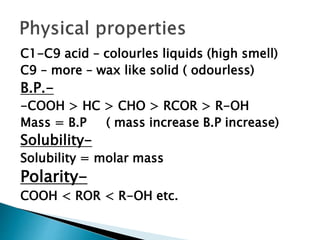
C1-C9 acid – colourles liquids (high smell)
C9 – more – wax like solid ( odourless)
B.P.-
-COOH > HC > CHO > RCOR > R-OH
Mass = B.P ( mass increase B.P increase)
Solubility-
Solubility = molar mass
Polarity-
COOH < ROR < R-OH etc.
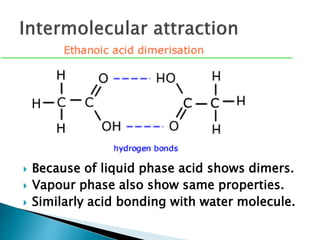
 Because of liquid phase acid shows dimers.
 Vapour phase also show same properties.
 Similarly acid bonding with water molecule.
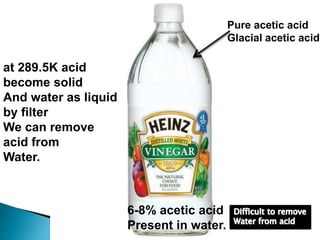
6-8% acetic acid
Present in water.
Pure acetic acid
Glacial acetic acid
at 289.5K acid
become solid
And water as liquid
by filter
We can remove
acid from
Water.
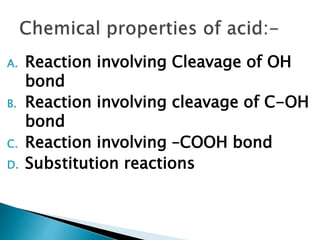
A. Reaction involving Cleavage of OH
bond
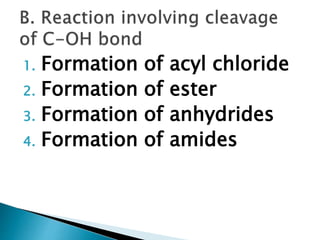
B. Reaction involving cleavage of C-OH
bond
C. Reaction involving –COOH bond
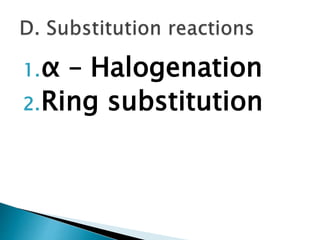
D. Substitution reactions
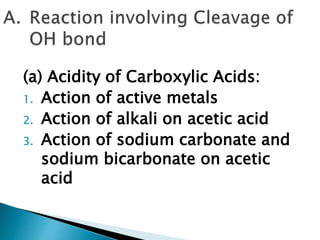
(a) Acidity of Carboxylic Acids:
1. Action of active metals
2. Action of alkali on acetic acid
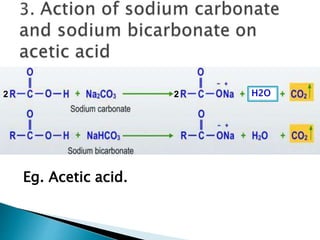
3. Action of sodium carbonate and
sodium bicarbonate on acetic
acid
 Carboxylic acids can be easily ionize and exist in a
dynamic equilibrium between the carboxylate ion and
hydronium ion. Hence they show acidic nature.
R COOH + H2O ⇌ RCOO- + H3O+
 The equilibrium constant K for given,
 K = [RCOO−][H3O+][RCOOH][H2O]
Since water present in large excess; the same equation
is written as,

K x [H2O] = [RCOO−][H3O+][RCOOH]

Ka = [RCOO−][H3O+][RCOOH]
 Ka show acidic value can also be expressed
in terms of pKa. pKa= -logKa
 Larger the Ka value larger the ion and
stronger the acid.
 Acid is more acidic then phenol and alcohol
because of OH of acid readily loses a H ion
then alcohol and phenol.
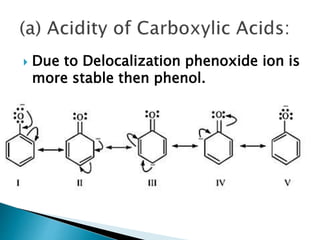
 Due to Delocalization phenoxide ion is
more stable then phenol.
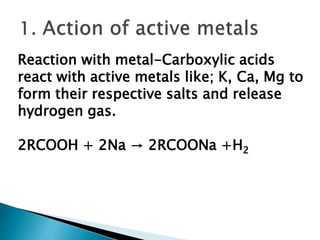
Reaction with metal-Carboxylic acids
react with active metals like; K, Ca, Mg to
form their respective salts and release
hydrogen gas.
2RCOOH + 2Na → 2RCOONa +H2
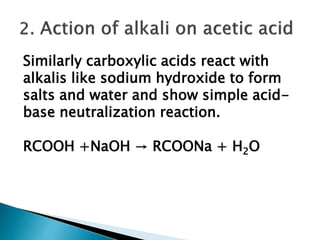
Similarly carboxylic acids react with
alkalis like sodium hydroxide to form
salts and water and show simple acid-
base neutralization reaction.
RCOOH +NaOH → RCOONa + H2O
Eg. Acetic acid.
2 H2O2
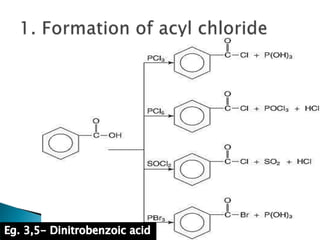
1. Formation of acyl chloride
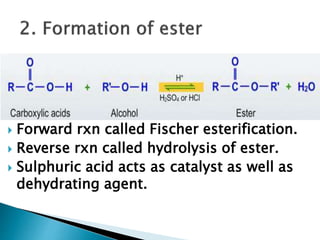
2. Formation of ester
3. Formation of anhydrides
4. Formation of amides
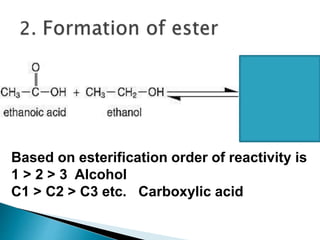
 Forward rxn called Fischer esterification.
 Reverse rxn called hydrolysis of ester.
 Sulphuric acid acts as catalyst as well as
dehydrating agent.
Based on esterification order of reactivity is
1 > 2 > 3 Alcohol
C1 > C2 > C3 etc. Carboxylic acid
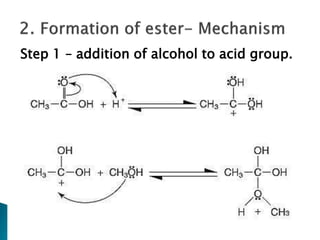
Step 1 – addition of alcohol to acid group.
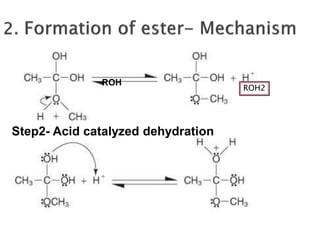
ROH
ROH2
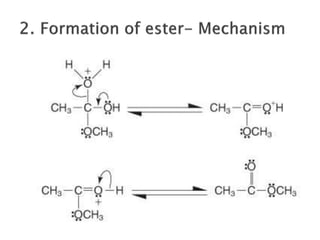
Step2- Acid catalyzed dehydration
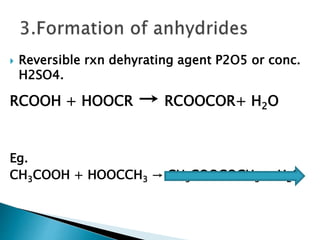
 Reversible rxn dehyrating agent P2O5 or conc.
H2SO4.
RCOOH + HOOCR → RCOOCOR+ H2O
Eg.
CH3COOH + HOOCCH3 → CH3COOCOCH3 + H2O
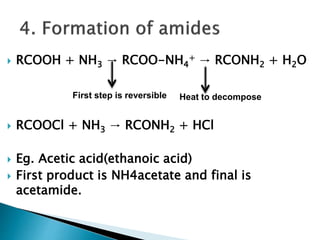
 RCOOH + NH3 → RCOO-NH4
+ → RCONH2 + H2O
 RCOOCl + NH3 → RCONH2 + HCl
 Eg. Acetic acid(ethanoic acid)
 First product is NH4acetate and final is
acetamide.
First step is reversible Heat to decompose
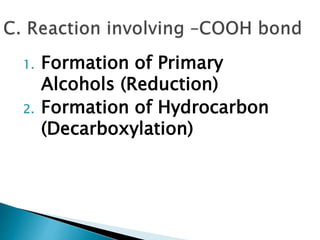
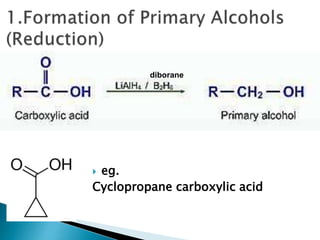
1. Formation of Primary
Alcohols (Reduction)
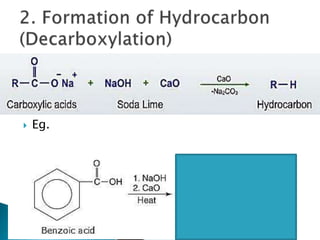
2. Formation of Hydrocarbon
(Decarboxylation)
 eg.
Cyclopropane carboxylic acid
diborane
 Eg.
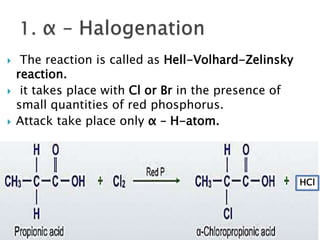
1.α – Halogenation
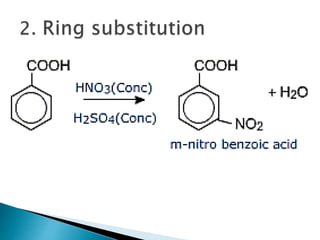
2.Ring substitution
 The reaction is called as Hell-Volhard-Zelinsky
reaction.
 it takes place with Cl or Br in the presence of
small quantities of red phosphorus.
 Attack take place only α – H-atom.
HCl
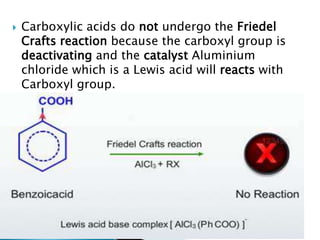
 Carboxylic acids do not undergo the Friedel
Crafts reaction because the carboxyl group is
deactivating and the catalyst Aluminium
chloride which is a Lewis acid will reacts with
Carboxyl group.
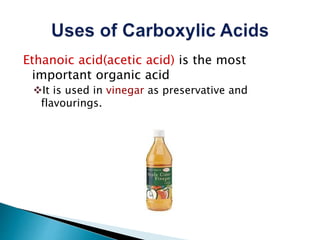
Ethanoic acid(acetic acid) is the most
important organic acid
It is used in vinegar as preservative and
flavourings.
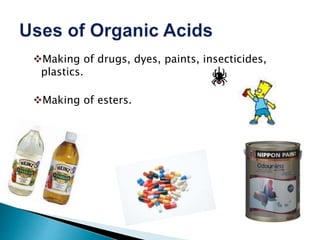
Making of drugs, dyes, paints, insecticides,
plastics.
Making of esters.
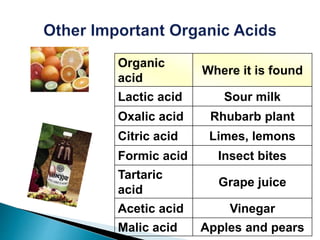
Organic
acid
Where it is found
Lactic acid Sour milk
Oxalic acid Rhubarb plant
Citric acid Limes, lemons
Formic acid Insect bites
Tartaric
acid
Grape juice
Acetic acid Vinegar
Malic acid Apples and pears

Carboxylicacids

  • 2.
    Structural Formula ChemicalFormula CH3COOH or CH3CO2H =
  • 3.
     Methanoic acid Total of one carbon atom (meth-)  C0H1COOH  Ethanoic acid  Total of two carbons atoms (eth-) C1H3COOH  Propanoic acid  Total of three carbon atoms (propan-)  C2H5COOH *Take note of the functional group’s location, highlighted by the dotted box
  • 4.
     Replace the‘e’ with ‘oic acid’ at the end of the name of the hydrocarbon Example: H H H C C H H H ethane H O H C C O H H ethanoic acid
  • 5.
    Since these areacidic compounds, therefore easily lose H+ ion and covert in carboxylate ion (RCOO-)
  • 6.
     Hence carboxylicacids can be represented by to resonance structures.  COOH is less electrophile than aldehyde and ketone. 120̊̊ planer structure sp2 hybridized
  • 7.
    1. From primaryalcohol and aldehyde(O) 2. From alkyl benzene(O) 3. From Nitriles and amides ( by hydrolysis) 4. From Dry ice( by carboxylation of Grignard reagent) 5. From acyl chlorides and acid anhydrides( by hydrolysis) 6. From esters ( by hydrolysis)
  • 8.
  • 10.
  • 11.
  • 12.
    Eg. CH3 –C≡N(acetonitrile) CH3- CH2 - C≡N (propanitrile) (HCl) (NH4Cl) (NaOH) (HCl) Na + NaCl
  • 13.
     Eg. Phenylmagnesium halide.
  • 14.
    R- CO –Cl + HOH → R-COOH + HCl Acyl chloride acid
  • 15.
    (CH3 –CO-)2O +H2O → 2CH3 –COOH Ethanoic anhydride ethanoic acid (C6H5 –CO-)2O + H2O → 2C6H5 –COOH Benzoic anhydride benzoic acid
  • 16.
    Ester heated withdil. H2SO4 undergoes hydrolysis. R-COOR’ + H2O → R-COOH + R-OH Ester acid Eg.
  • 17.
    C1-C9 acid –colourles liquids (high smell) C9 – more – wax like solid ( odourless) B.P.- -COOH > HC > CHO > RCOR > R-OH Mass = B.P ( mass increase B.P increase) Solubility- Solubility = molar mass Polarity- COOH < ROR < R-OH etc.
  • 18.
     Because ofliquid phase acid shows dimers.  Vapour phase also show same properties.  Similarly acid bonding with water molecule.
  • 19.
    6-8% acetic acid Presentin water. Pure acetic acid Glacial acetic acid at 289.5K acid become solid And water as liquid by filter We can remove acid from Water.
  • 20.
    A. Reaction involvingCleavage of OH bond B. Reaction involving cleavage of C-OH bond C. Reaction involving –COOH bond D. Substitution reactions
  • 21.
    (a) Acidity ofCarboxylic Acids: 1. Action of active metals 2. Action of alkali on acetic acid 3. Action of sodium carbonate and sodium bicarbonate on acetic acid
  • 22.
     Carboxylic acidscan be easily ionize and exist in a dynamic equilibrium between the carboxylate ion and hydronium ion. Hence they show acidic nature. R COOH + H2O ⇌ RCOO- + H3O+  The equilibrium constant K for given,  K = [RCOO−][H3O+][RCOOH][H2O] Since water present in large excess; the same equation is written as,  K x [H2O] = [RCOO−][H3O+][RCOOH]  Ka = [RCOO−][H3O+][RCOOH]
  • 23.
     Ka showacidic value can also be expressed in terms of pKa. pKa= -logKa  Larger the Ka value larger the ion and stronger the acid.  Acid is more acidic then phenol and alcohol because of OH of acid readily loses a H ion then alcohol and phenol.
  • 24.
     Due toDelocalization phenoxide ion is more stable then phenol.
  • 25.
    Reaction with metal-Carboxylicacids react with active metals like; K, Ca, Mg to form their respective salts and release hydrogen gas. 2RCOOH + 2Na → 2RCOONa +H2
  • 26.
    Similarly carboxylic acidsreact with alkalis like sodium hydroxide to form salts and water and show simple acid- base neutralization reaction. RCOOH +NaOH → RCOONa + H2O
  • 27.
  • 28.
    1. Formation ofacyl chloride 2. Formation of ester 3. Formation of anhydrides 4. Formation of amides
  • 30.
     Forward rxncalled Fischer esterification.  Reverse rxn called hydrolysis of ester.  Sulphuric acid acts as catalyst as well as dehydrating agent.
  • 31.
    Based on esterificationorder of reactivity is 1 > 2 > 3 Alcohol C1 > C2 > C3 etc. Carboxylic acid
  • 32.
    Step 1 –addition of alcohol to acid group.
  • 33.
  • 35.
     Reversible rxndehyrating agent P2O5 or conc. H2SO4. RCOOH + HOOCR → RCOOCOR+ H2O Eg. CH3COOH + HOOCCH3 → CH3COOCOCH3 + H2O
  • 36.
     RCOOH +NH3 → RCOO-NH4 + → RCONH2 + H2O  RCOOCl + NH3 → RCONH2 + HCl  Eg. Acetic acid(ethanoic acid)  First product is NH4acetate and final is acetamide. First step is reversible Heat to decompose
  • 37.
    1. Formation ofPrimary Alcohols (Reduction) 2. Formation of Hydrocarbon (Decarboxylation)
  • 38.
  • 39.
  • 40.
  • 41.
     The reactionis called as Hell-Volhard-Zelinsky reaction.  it takes place with Cl or Br in the presence of small quantities of red phosphorus.  Attack take place only α – H-atom. HCl
  • 43.
     Carboxylic acidsdo not undergo the Friedel Crafts reaction because the carboxyl group is deactivating and the catalyst Aluminium chloride which is a Lewis acid will reacts with Carboxyl group.
  • 44.
    Ethanoic acid(acetic acid)is the most important organic acid It is used in vinegar as preservative and flavourings.
  • 48.
    Making of drugs,dyes, paints, insecticides, plastics. Making of esters.
  • 49.
    Organic acid Where it isfound Lactic acid Sour milk Oxalic acid Rhubarb plant Citric acid Limes, lemons Formic acid Insect bites Tartaric acid Grape juice Acetic acid Vinegar Malic acid Apples and pears