Er. Nawaraj Bhandari
Topic 6
Computer Arithmetic
Computer
Architecture
Arithmetic & Logic Unit
 Does the calculations
 Everything else in the computer is there to service this unit
 Handles integers
 May handle floating point (real) numbers
 May be separate Floating-point unit (maths co-processor)
 May be on chip separate FPU (486DX +)
ALU Inputs and Outputs
Arithmetic & Logic Unit
 Operands for arithmetic and logic operations are presented to the ALU
in registers, and the results of an operation are stored in registers.
 These registers are temporary storage locations within the processor
that are connected by signal paths to the ALU
 The ALU may also set flags as the result of an operation. For example,
an overflow flag is set to 1 if the result of a computation exceeds the
length of the register into which it is to be stored
 The flag values are also stored in registers within the processor. The
processor provides signals that control the operation of the ALU and
the movement of the data into and out of the ALU.
Integer Representation
 Only have 0 & 1 to represent everything
 Positive numbers stored in binary
 e.g. 41=00101001
 No minus sign
 No period
 Sign-Magnitude
 Two’s compliment
Sign-Magnitude
 Left most bit is sign bit
 0 means positive
 1 means negative
 +18 = 00010010
 -18 = 10010010
 Problems
 Need to consider both sign and magnitude in arithmetic
 Two representations of zero (+0 and -0)
+ 010 = 00000000
- 010 = 10000000 (sign magnitude)
Two’s Compliment
 Like sign magnitude, twos complement representation uses the most
significant bit as a sign bit, making it easy to test whether an integer is
positive or negative.
 It differs from the use of the sign-magnitude representation in the way
that the other bits are interpreted
Two’s Compliment
 +3 = 00000011
 +2 = 00000010
 +1 = 00000001
 +0 = 00000000
 -1 = 11111111
 -2 = 11111110
 -3 = 11111101
Benefits
 One representation of zero
 Arithmetic works easily
 Negating is fairly easy
 3 = 00000011
 Boolean complement gives 11111100
 Add 1 to LSB 11111101
Negation Special Case 1
 0 = 00000000
 Bitwise not 11111111
 Add 1 to LSB +1
 Result 1 00000000
 Overflow is ignored, so:
 - 0 = 0 
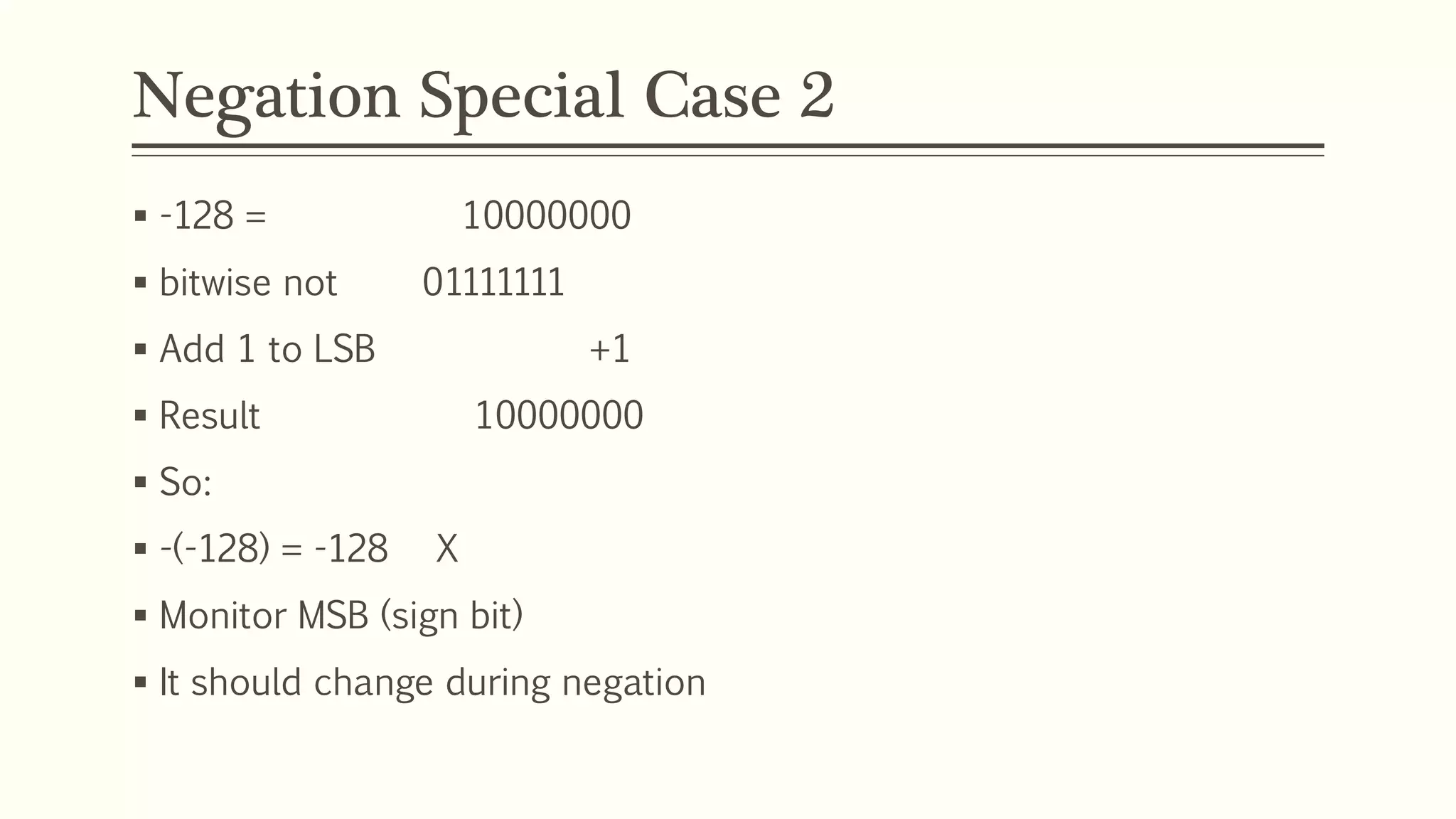
Negation Special Case 2
 -128 = 10000000
 bitwise not 01111111
 Add 1 to LSB +1
 Result 10000000
 So:
 -(-128) = -128 X
 Monitor MSB (sign bit)
 It should change during negation
Addition and Subtraction
 Normal binary addition
 Monitor sign bit for overflow
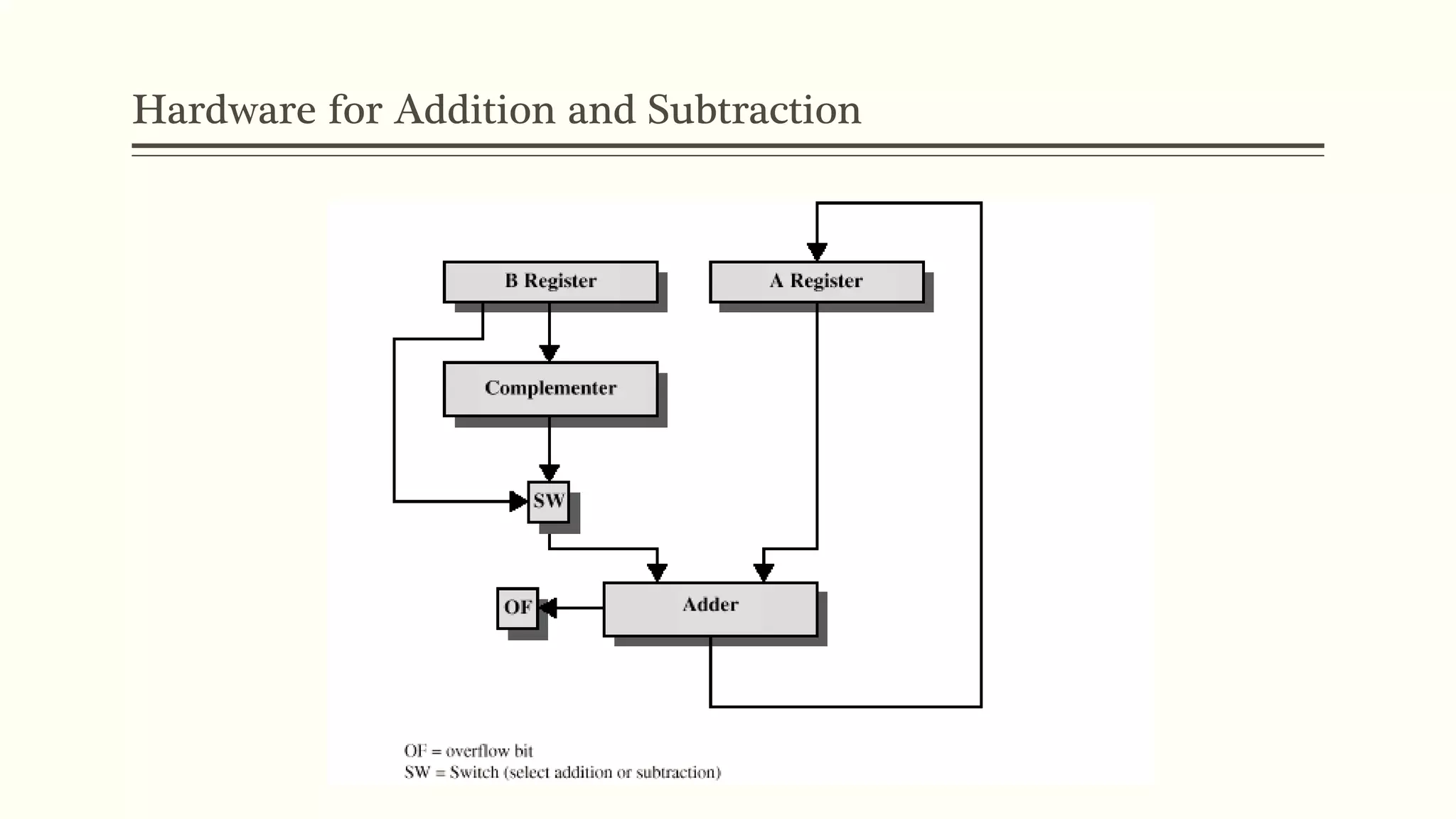
 Take twos compliment of substahend and add to minuend
 i.e. a - b = a + (-b)
 So we only need addition and complement circuits
Hardware for Addition and Subtraction
Floating Point
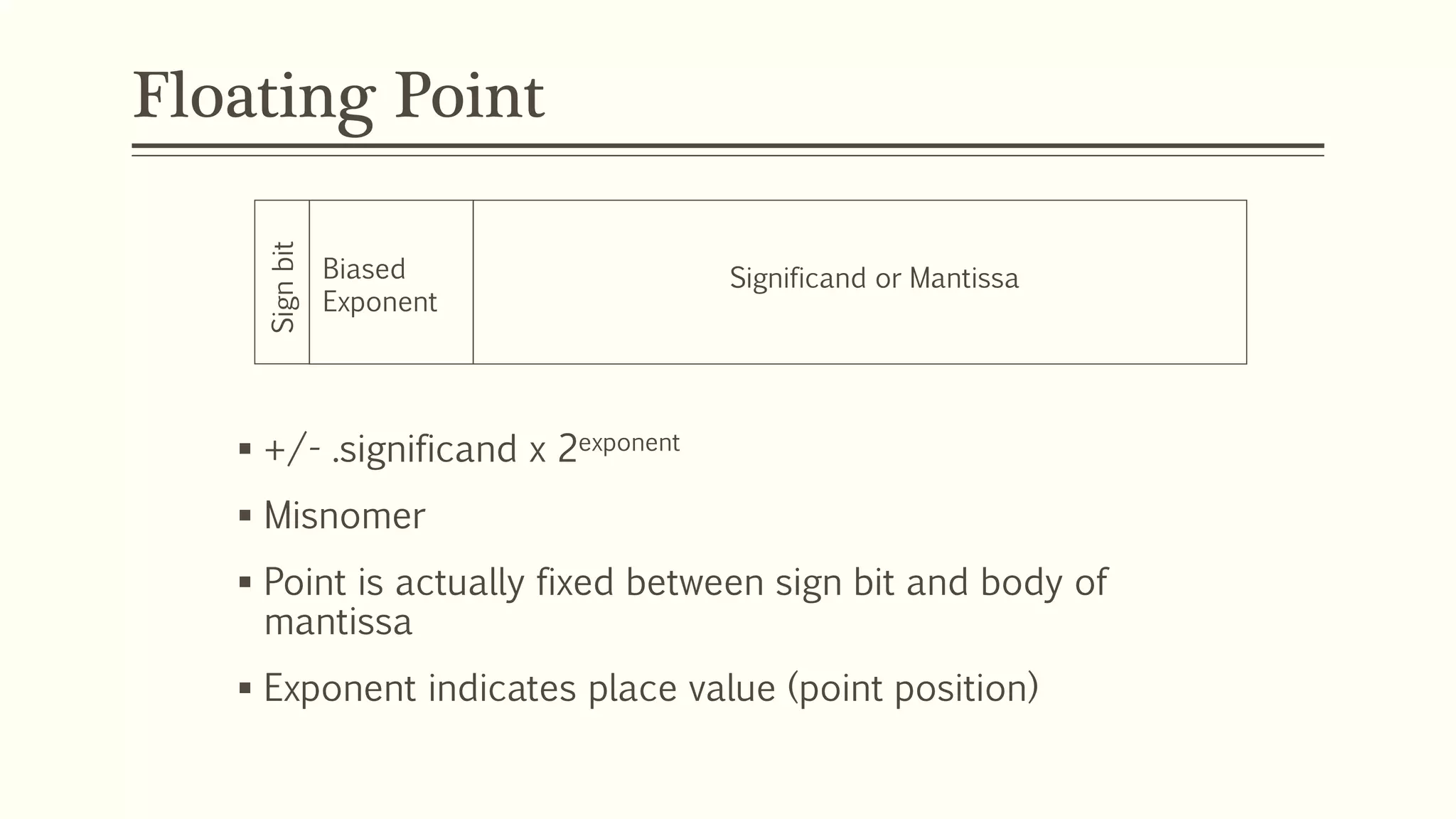
 +/- .significand x 2exponent
 Misnomer
 Point is actually fixed between sign bit and body of
mantissa
 Exponent indicates place value (point position)
Signbit
Biased
Exponent
Significand or Mantissa
Floating Point Examples
Signs for Floating Point
 Mantissa is stored in 2s compliment
 Exponent is in excess or biased notation
 e.g. Excess (bias) 128 means
 8 bit exponent field
 Pure value range 0-255
 Subtract 128 to get correct value
 Range -128 to +127
Normalization
 FP numbers are usually normalized
 i.e. exponent is adjusted so that leading bit (MSB) of mantissa is 1
 Since it is always 1 there is no need to store it
 (c.f. Scientific notation where numbers are normalized to give a single
digit before the decimal point
 e.g. 3.123 x 10³)
FP Ranges
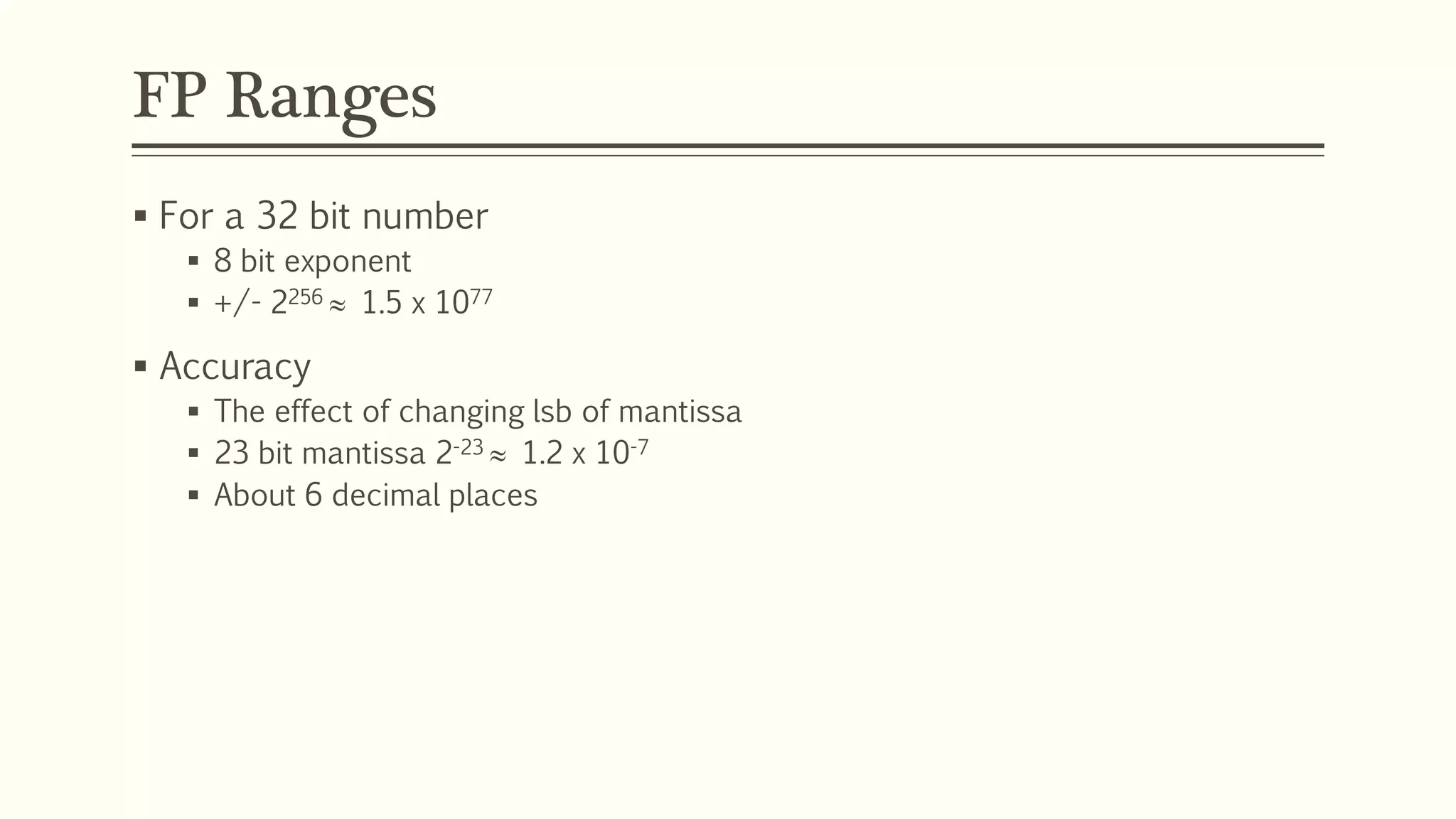
 For a 32 bit number
 8 bit exponent
 +/- 2256  1.5 x 1077
 Accuracy
 The effect of changing lsb of mantissa
 23 bit mantissa 2-23  1.2 x 10⁻⁷
 About 6 decimal places
Expressible Numbers
Density of Floating Point Numbers
IEEE 754
 Standard for floating point storage
 32 and 64 bit standards
 8 and 11 bit exponent respectively
 Extended formats (both mantissa and exponent) for intermediate
results
IEEE 754 Formats
FP Arithmetic +/-
 Check for zeros
 Align significands (adjusting exponents)
 Add or subtract significands
 Normalize result
FP Arithmetic x/
 Check for zero
 Add/subtract exponents
 Multiply/divide significands (watch sign)
 Normalize
 Round
 All intermediate results should be in double length storage
Required Reading
 Stallings Chapter 9
 IEEE 754 on IEEE Web site
ANY QUESTIONS?

Chapter 6

  • 1.
    Er. Nawaraj Bhandari Topic6 Computer Arithmetic Computer Architecture
  • 2.
    Arithmetic & LogicUnit  Does the calculations  Everything else in the computer is there to service this unit  Handles integers  May handle floating point (real) numbers  May be separate Floating-point unit (maths co-processor)  May be on chip separate FPU (486DX +)
  • 3.
  • 4.
    Arithmetic & LogicUnit  Operands for arithmetic and logic operations are presented to the ALU in registers, and the results of an operation are stored in registers.  These registers are temporary storage locations within the processor that are connected by signal paths to the ALU  The ALU may also set flags as the result of an operation. For example, an overflow flag is set to 1 if the result of a computation exceeds the length of the register into which it is to be stored  The flag values are also stored in registers within the processor. The processor provides signals that control the operation of the ALU and the movement of the data into and out of the ALU.
  • 5.
    Integer Representation  Onlyhave 0 & 1 to represent everything  Positive numbers stored in binary  e.g. 41=00101001  No minus sign  No period  Sign-Magnitude  Two’s compliment
  • 6.
    Sign-Magnitude  Left mostbit is sign bit  0 means positive  1 means negative  +18 = 00010010  -18 = 10010010  Problems  Need to consider both sign and magnitude in arithmetic  Two representations of zero (+0 and -0) + 010 = 00000000 - 010 = 10000000 (sign magnitude)
  • 7.
    Two’s Compliment  Likesign magnitude, twos complement representation uses the most significant bit as a sign bit, making it easy to test whether an integer is positive or negative.  It differs from the use of the sign-magnitude representation in the way that the other bits are interpreted
  • 8.
    Two’s Compliment  +3= 00000011  +2 = 00000010  +1 = 00000001  +0 = 00000000  -1 = 11111111  -2 = 11111110  -3 = 11111101
  • 9.
    Benefits  One representationof zero  Arithmetic works easily  Negating is fairly easy  3 = 00000011  Boolean complement gives 11111100  Add 1 to LSB 11111101
  • 10.
    Negation Special Case1  0 = 00000000  Bitwise not 11111111  Add 1 to LSB +1  Result 1 00000000  Overflow is ignored, so:  - 0 = 0 
  • 11.
    Negation Special Case2  -128 = 10000000  bitwise not 01111111  Add 1 to LSB +1  Result 10000000  So:  -(-128) = -128 X  Monitor MSB (sign bit)  It should change during negation
  • 12.
    Addition and Subtraction Normal binary addition  Monitor sign bit for overflow  Take twos compliment of substahend and add to minuend  i.e. a - b = a + (-b)  So we only need addition and complement circuits
  • 13.
    Hardware for Additionand Subtraction
  • 14.
    Floating Point  +/-.significand x 2exponent  Misnomer  Point is actually fixed between sign bit and body of mantissa  Exponent indicates place value (point position) Signbit Biased Exponent Significand or Mantissa
  • 15.
  • 16.
    Signs for FloatingPoint  Mantissa is stored in 2s compliment  Exponent is in excess or biased notation  e.g. Excess (bias) 128 means  8 bit exponent field  Pure value range 0-255  Subtract 128 to get correct value  Range -128 to +127
  • 17.
    Normalization  FP numbersare usually normalized  i.e. exponent is adjusted so that leading bit (MSB) of mantissa is 1  Since it is always 1 there is no need to store it  (c.f. Scientific notation where numbers are normalized to give a single digit before the decimal point  e.g. 3.123 x 10³)
  • 18.
    FP Ranges  Fora 32 bit number  8 bit exponent  +/- 2256  1.5 x 1077  Accuracy  The effect of changing lsb of mantissa  23 bit mantissa 2-23  1.2 x 10⁻⁷  About 6 decimal places
  • 19.
  • 20.
    Density of FloatingPoint Numbers
  • 21.
    IEEE 754  Standardfor floating point storage  32 and 64 bit standards  8 and 11 bit exponent respectively  Extended formats (both mantissa and exponent) for intermediate results
  • 22.
  • 23.
    FP Arithmetic +/- Check for zeros  Align significands (adjusting exponents)  Add or subtract significands  Normalize result
  • 24.
    FP Arithmetic x/ Check for zero  Add/subtract exponents  Multiply/divide significands (watch sign)  Normalize  Round  All intermediate results should be in double length storage
  • 25.
    Required Reading  StallingsChapter 9  IEEE 754 on IEEE Web site
  • 26.