Data Types
Complements
Fixed Point Representation
Floating Point Representation
Overflow Detection
Data Representation
Data Types
 Binary information in digital computers is stored in
memory or registers.
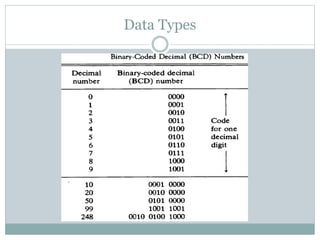
 The data types found in digital registers or memory
is classified as one of the following types:
 Numbers used in arithmetic computation
 Letters of alphabets used in data processing
 Other symbols used for specific purpose
Data Types
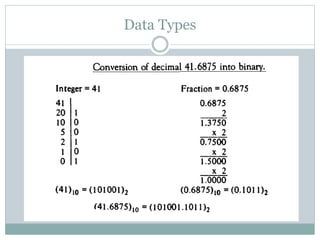
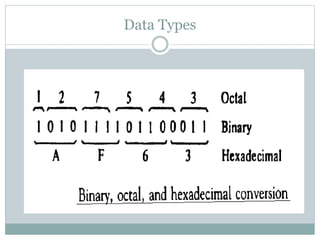
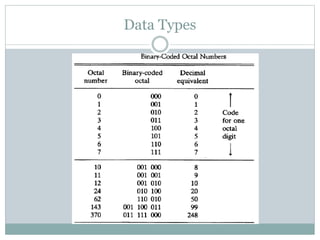
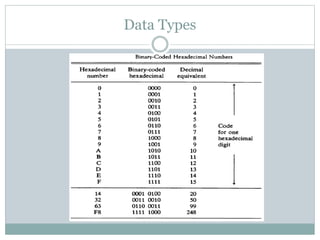
 A number system of base or radix (r) is a system that
uses distinct symbols for r digits
 Binary ->0,1
 Octal->0,1,2,3,4,5,6,7
 Decimal->0,1,2,3,4,5,6,7,8,9
 Hexadecimal->0,1,2,3,4,5,6,7,8,9,A,B,C,D,E,F
Data Types
Data Types
Data Types
Data Types
Data Types
Data Types
Data Types
 Many application of digital computers require the
handling of data that consists not only of numbers
but also letters of alphabets and certain special
characters.
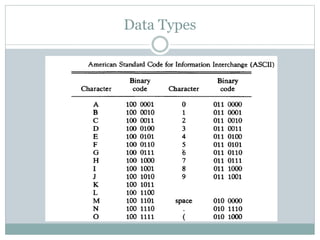
 The standard alphanumeric binary code is
ASCII(American Standard code for Information
Interchange)which uses 7 bits to code 128 characters.
Data Types
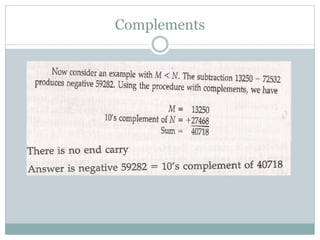
Complements
 Complements are used in digital computers for
simplifying the subtraction operation.
 There are two types of complement for base r-system
 (r-1)’s complement
 r’s complement
Complements
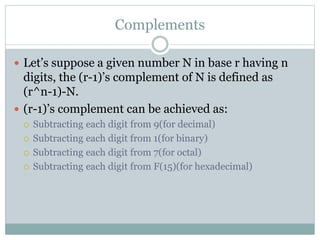
 Let’s suppose a given number N in base r having n
digits, the (r-1)’s complement of N is defined as
(r^n-1)-N.
 (r-1)’s complement can be achieved as:
 Subtracting each digit from 9(for decimal)
 Subtracting each digit from 1(for binary)
 Subtracting each digit from 7(for octal)
 Subtracting each digit from F(15)(for hexadecimal)
Complements
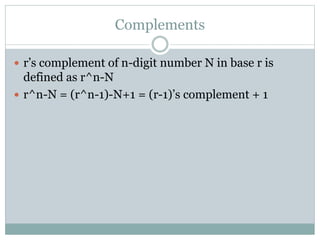
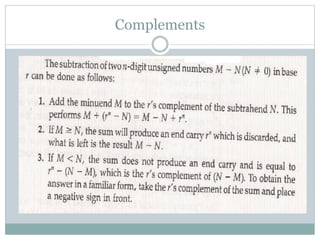
 r’s complement of n-digit number N in base r is
defined as r^n-N
 r^n-N = (r^n-1)-N+1 = (r-1)’s complement + 1
Complements
Complements
Complements
Fixed Point Representation
 Sign bit placed in the leftmost position of the
number determine if the number is positive or
negative. It is 1 for negative and o for positive.
 In addition to sign bit a number may have decimal or
binary point. There are two ways of specifying the
position of the binary point in register.
 By giving it fixed position
 By employing floating point representation
Fixed Point Representation
 The fixed point assumes one of the following case:
 Binary point in the extreme left to make stored number
fraction .
 Binary point in extreme right to make the stored number an
integer
 Floating point representation uses the second
register to store a number that designates the
position of the binary point.
Fixed Point Representation
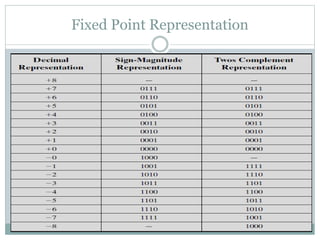
 When an integer binary number is positive, sign is
represented by o and magnitude by positive binary
number.
 When it is negative sign bit is represented by 1 and
rest of the number can be represented in one of the
following ways:
 Signed-Magnitude Representation
 Signed-1’s Complement Representation
 Signed-2’s Complement Representation
Fixed Point Representation
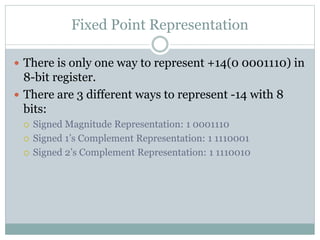
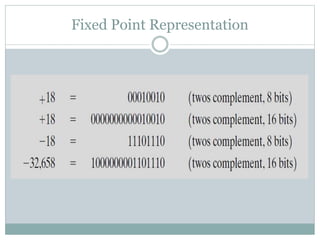
 There is only one way to represent +14(0 0001110) in
8-bit register.
 There are 3 different ways to represent -14 with 8
bits:
 Signed Magnitude Representation: 1 0001110
 Signed 1’s Complement Representation: 1 1110001
 Signed 2’s Complement Representation: 1 1110010
Fixed Point Representation
 The 1’s complement imposes difficulties because it
has two representation of 0(+0[0000] and -0[1111]).
 It is seldom used in arithmetic operation except in
some older compilers.
 It is useful in logical operation since change from 1to
0, 0 to 1 is equivalent to logical complement
function.
Fixed Point Representation
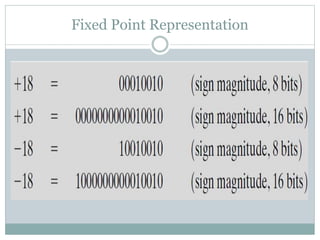
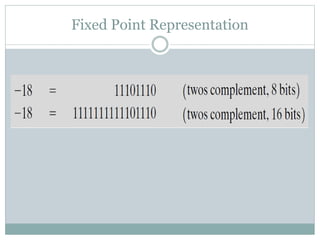
 Sometime there is need to convert the data from one
bit length to another(4 bit to 8 bit etc.)
 This conversion is very simple to apply in case of
signed magnitude representation, just shifting of the
signed bit is required.
 But this method won’t be applicable in case of signed
2’complement.
 In the case of 2’s complement representation, the
process called sign extension is implemented.
Fixed Point Representation
Arithmetic Addition
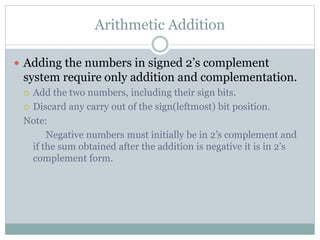
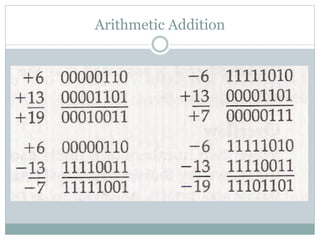
 Adding the numbers in signed 2’s complement
system require only addition and complementation.
 Add the two numbers, including their sign bits.
 Discard any carry out of the sign(leftmost) bit position.
Note:
Negative numbers must initially be in 2’s complement and
if the sum obtained after the addition is negative it is in 2’s
complement form.
Arithmetic Addition
Arithmetic Subtraction
 2’s complement subtraction includes following steps:
 Take the 2’s complement of number to be subtracted including
the sign bit.
 Add it the next number.
 Discard the carry out of the sign bit position
Arithmetic Subtraction
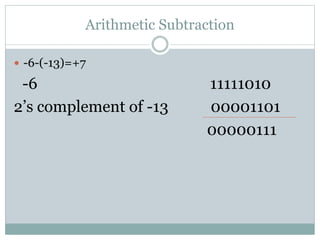
 -6-(-13)=+7
-6 11111010
2’s complement of -13 00001101
00000111
Floating Point Representation
 With a fixed point notation it is possible to represent
a range of positive and negative integers centered on
0.
 This approach has limitation. Very large nor can very
small fractions can be represented.
 In decimal numbers we use scientific notation to
represent very large and very small numbers.
 Same approach can be used to represent binary
numbers.
Floating Point Representation
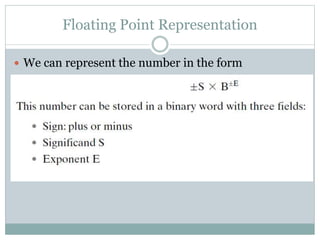
 We can represent the number in the form
Floating Point Representation
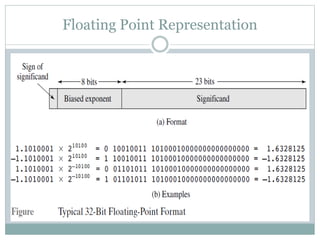
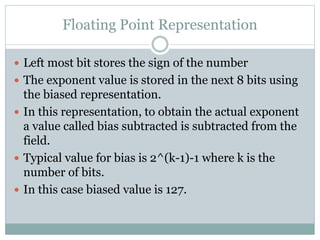
 Left most bit stores the sign of the number
 The exponent value is stored in the next 8 bits using
the biased representation.
 In this representation, to obtain the actual exponent
a value called bias subtracted is subtracted from the
field.
 Typical value for bias is 2^(k-1)-1 where k is the
number of bits.
 In this case biased value is 127.
Floating Point Representation
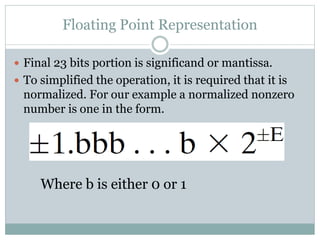
 Final 23 bits portion is significand or mantissa.
 To simplified the operation, it is required that it is
normalized. For our example a normalized nonzero
number is one in the form.
Where b is either 0 or 1
Floating Point Representation
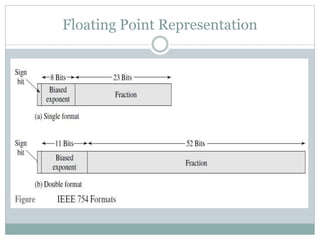
 Floating point representation is defined in IEEE
Standard 754.
 It defines both 32 bit single and 64 bit double format
with 8-bit and 16 bit exponent.
Overflow
 When two numbers of n digits each are added and
sum occupies (n+1) digits, we say that an overflow
occur.
 In many computers when overflow occurs,
corresponding flag is set which is later checked by
the user.
 When two unsigned numbers are added, an overflow
is detected from the end carry out of the most
significant position.
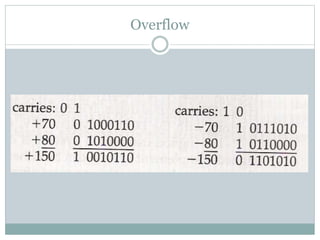
Overflow
 In case of signed number overflow condition can be
detected by observing the carry into the sign bit
position and carry out of the sign bit position.
 If these two carries aren’t equal, an overflow
condition is produced.
 If two carries are applied to exclusive-OR gate, an
overflow will be detected when output of the gate is
equal to 1.
Overflow

Data Reprersentation

  • 1.
    Data Types Complements Fixed PointRepresentation Floating Point Representation Overflow Detection Data Representation
  • 2.
    Data Types  Binaryinformation in digital computers is stored in memory or registers.  The data types found in digital registers or memory is classified as one of the following types:  Numbers used in arithmetic computation  Letters of alphabets used in data processing  Other symbols used for specific purpose
  • 3.
    Data Types  Anumber system of base or radix (r) is a system that uses distinct symbols for r digits  Binary ->0,1  Octal->0,1,2,3,4,5,6,7  Decimal->0,1,2,3,4,5,6,7,8,9  Hexadecimal->0,1,2,3,4,5,6,7,8,9,A,B,C,D,E,F
  • 4.
  • 5.
  • 6.
  • 7.
  • 8.
  • 9.
  • 10.
    Data Types  Manyapplication of digital computers require the handling of data that consists not only of numbers but also letters of alphabets and certain special characters.  The standard alphanumeric binary code is ASCII(American Standard code for Information Interchange)which uses 7 bits to code 128 characters.
  • 11.
  • 12.
    Complements  Complements areused in digital computers for simplifying the subtraction operation.  There are two types of complement for base r-system  (r-1)’s complement  r’s complement
  • 13.
    Complements  Let’s supposea given number N in base r having n digits, the (r-1)’s complement of N is defined as (r^n-1)-N.  (r-1)’s complement can be achieved as:  Subtracting each digit from 9(for decimal)  Subtracting each digit from 1(for binary)  Subtracting each digit from 7(for octal)  Subtracting each digit from F(15)(for hexadecimal)
  • 14.
    Complements  r’s complementof n-digit number N in base r is defined as r^n-N  r^n-N = (r^n-1)-N+1 = (r-1)’s complement + 1
  • 15.
  • 16.
  • 17.
  • 18.
    Fixed Point Representation Sign bit placed in the leftmost position of the number determine if the number is positive or negative. It is 1 for negative and o for positive.  In addition to sign bit a number may have decimal or binary point. There are two ways of specifying the position of the binary point in register.  By giving it fixed position  By employing floating point representation
  • 19.
    Fixed Point Representation The fixed point assumes one of the following case:  Binary point in the extreme left to make stored number fraction .  Binary point in extreme right to make the stored number an integer  Floating point representation uses the second register to store a number that designates the position of the binary point.
  • 20.
    Fixed Point Representation When an integer binary number is positive, sign is represented by o and magnitude by positive binary number.  When it is negative sign bit is represented by 1 and rest of the number can be represented in one of the following ways:  Signed-Magnitude Representation  Signed-1’s Complement Representation  Signed-2’s Complement Representation
  • 21.
    Fixed Point Representation There is only one way to represent +14(0 0001110) in 8-bit register.  There are 3 different ways to represent -14 with 8 bits:  Signed Magnitude Representation: 1 0001110  Signed 1’s Complement Representation: 1 1110001  Signed 2’s Complement Representation: 1 1110010
  • 22.
    Fixed Point Representation The 1’s complement imposes difficulties because it has two representation of 0(+0[0000] and -0[1111]).  It is seldom used in arithmetic operation except in some older compilers.  It is useful in logical operation since change from 1to 0, 0 to 1 is equivalent to logical complement function.
  • 23.
  • 24.
    Fixed Point Representation Sometime there is need to convert the data from one bit length to another(4 bit to 8 bit etc.)  This conversion is very simple to apply in case of signed magnitude representation, just shifting of the signed bit is required.  But this method won’t be applicable in case of signed 2’complement.  In the case of 2’s complement representation, the process called sign extension is implemented.
  • 25.
  • 26.
  • 27.
  • 28.
    Arithmetic Addition  Addingthe numbers in signed 2’s complement system require only addition and complementation.  Add the two numbers, including their sign bits.  Discard any carry out of the sign(leftmost) bit position. Note: Negative numbers must initially be in 2’s complement and if the sum obtained after the addition is negative it is in 2’s complement form.
  • 29.
  • 30.
    Arithmetic Subtraction  2’scomplement subtraction includes following steps:  Take the 2’s complement of number to be subtracted including the sign bit.  Add it the next number.  Discard the carry out of the sign bit position
  • 31.
    Arithmetic Subtraction  -6-(-13)=+7 -611111010 2’s complement of -13 00001101 00000111
  • 32.
    Floating Point Representation With a fixed point notation it is possible to represent a range of positive and negative integers centered on 0.  This approach has limitation. Very large nor can very small fractions can be represented.  In decimal numbers we use scientific notation to represent very large and very small numbers.  Same approach can be used to represent binary numbers.
  • 33.
    Floating Point Representation We can represent the number in the form
  • 34.
  • 35.
    Floating Point Representation Left most bit stores the sign of the number  The exponent value is stored in the next 8 bits using the biased representation.  In this representation, to obtain the actual exponent a value called bias subtracted is subtracted from the field.  Typical value for bias is 2^(k-1)-1 where k is the number of bits.  In this case biased value is 127.
  • 36.
    Floating Point Representation Final 23 bits portion is significand or mantissa.  To simplified the operation, it is required that it is normalized. For our example a normalized nonzero number is one in the form. Where b is either 0 or 1
  • 37.
  • 38.
    Floating Point Representation Floating point representation is defined in IEEE Standard 754.  It defines both 32 bit single and 64 bit double format with 8-bit and 16 bit exponent.
  • 39.
    Overflow  When twonumbers of n digits each are added and sum occupies (n+1) digits, we say that an overflow occur.  In many computers when overflow occurs, corresponding flag is set which is later checked by the user.  When two unsigned numbers are added, an overflow is detected from the end carry out of the most significant position.
  • 40.
    Overflow  In caseof signed number overflow condition can be detected by observing the carry into the sign bit position and carry out of the sign bit position.  If these two carries aren’t equal, an overflow condition is produced.  If two carries are applied to exclusive-OR gate, an overflow will be detected when output of the gate is equal to 1.
  • 41.