William Stallings
Computer Organization
and Architecture
8th Edition


Chapter 9
Computer Arithmetic
Arithmetic & Logic Unit
• Does the calculations
• Everything else in the computer is there to
  service this unit
• Handles integers
• May handle floating point (real) numbers
• May be separate FPU (maths co-
  processor)
• May be on chip separate FPU (486DX +)
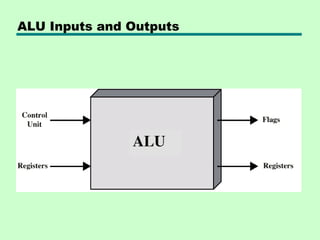
ALU Inputs and Outputs
Integer Representation
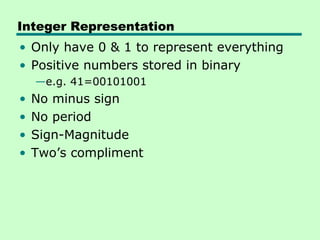
• Only have 0 & 1 to represent everything
• Positive numbers stored in binary
    —e.g. 41=00101001
•   No minus sign
•   No period
•   Sign-Magnitude
•   Two’s compliment
Sign-Magnitude
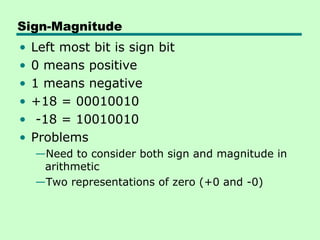
•   Left most bit is sign bit
•   0 means positive
•   1 means negative
•   +18 = 00010010
•    -18 = 10010010
•   Problems
    —Need to consider both sign and magnitude in
     arithmetic
    —Two representations of zero (+0 and -0)
Two’s Compliment
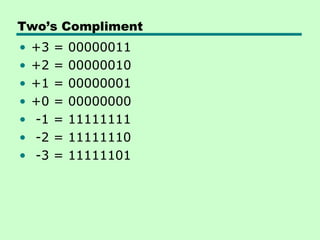
•   +3   =   00000011
•   +2   =   00000010
•   +1   =   00000001
•   +0   =   00000000
•   -1   =   11111111
•   -2   =   11111110
•   -3   =   11111101
Benefits
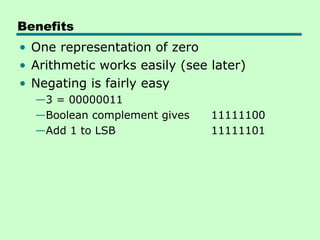
• One representation of zero
• Arithmetic works easily (see later)
• Negating is fairly easy
  —3 = 00000011
  —Boolean complement gives    11111100
  —Add 1 to LSB                11111101
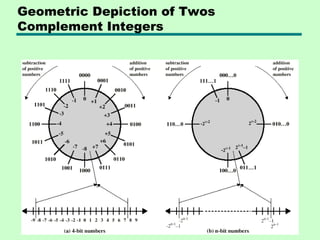
Geometric Depiction of Twos
Complement Integers
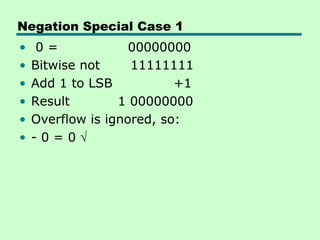
Negation Special Case 1
•    0=             00000000
•   Bitwise not     11111111
•   Add 1 to LSB           +1
•   Result        1 00000000
•   Overflow is ignored, so:
•   -0=0√
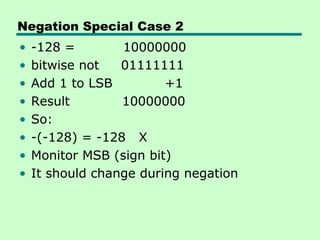
Negation Special Case 2
•   -128 =        10000000
•   bitwise not   01111111
•   Add 1 to LSB         +1
•   Result        10000000
•   So:
•   -(-128) = -128 X
•   Monitor MSB (sign bit)
•   It should change during negation
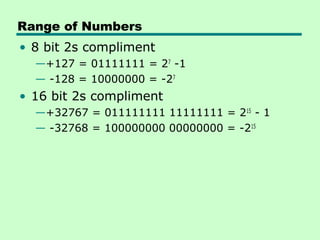
Range of Numbers
• 8 bit 2s compliment
  —+127 = 01111111 = 27 -1
  — -128 = 10000000 = -27
• 16 bit 2s compliment
  —+32767 = 011111111 11111111 = 215 - 1
  — -32768 = 100000000 00000000 = -215
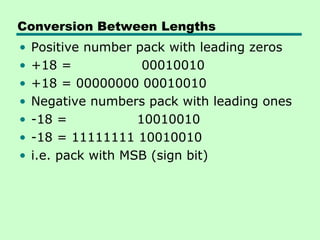
Conversion Between Lengths
•   Positive number pack with leading zeros
•   +18 =             00010010
•   +18 = 00000000 00010010
•   Negative numbers pack with leading ones
•   -18 =            10010010
•   -18 = 11111111 10010010
•   i.e. pack with MSB (sign bit)
Addition and Subtraction
• Normal binary addition
• Monitor sign bit for overflow

• Take twos compliment of substahend and
  add to minuend
  —i.e. a - b = a + (-b)


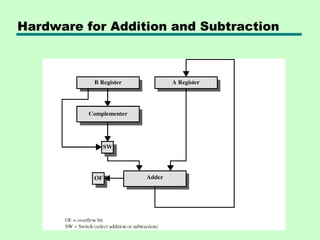
• So we only need addition and complement
  circuits
Hardware for Addition and Subtraction
Multiplication
•   Complex
•   Work out partial product for each digit
•   Take care with place value (column)
•   Add partial products
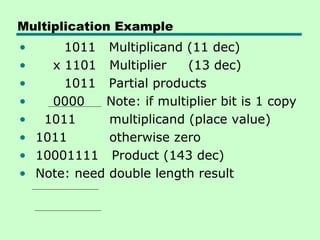
Multiplication Example
•     1011 Multiplicand (11 dec)
•   x 1101 Multiplier     (13 dec)
•     1011 Partial products
•   0000    Note: if multiplier bit is 1 copy
• 1011       multiplicand (place value)
• 1011       otherwise zero
• 10001111 Product (143 dec)
• Note: need double length result
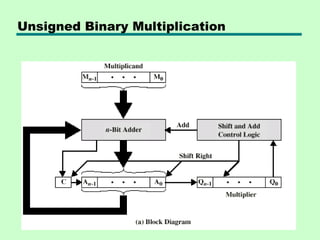
Unsigned Binary Multiplication
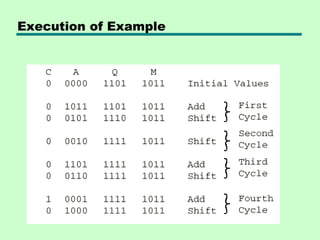
Execution of Example
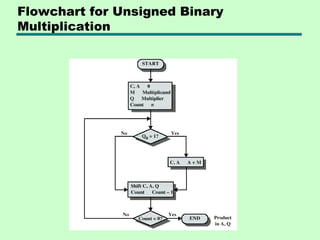
Flowchart for Unsigned Binary
Multiplication
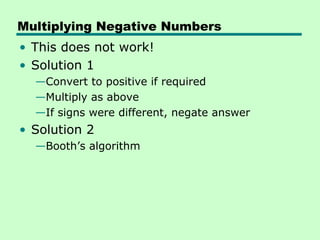
Multiplying Negative Numbers
• This does not work!
• Solution 1
  —Convert to positive if required
  —Multiply as above
  —If signs were different, negate answer
• Solution 2
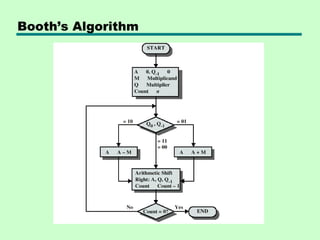
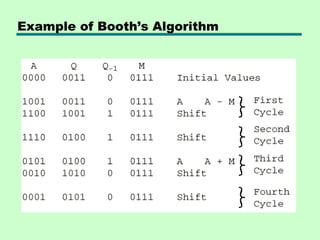
  —Booth’s algorithm
Booth’s Algorithm
Example of Booth’s Algorithm
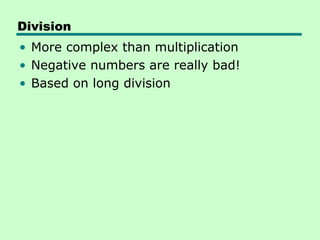
Division
• More complex than multiplication
• Negative numbers are really bad!
• Based on long division
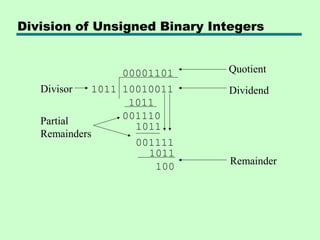
Division of Unsigned Binary Integers


                  00001101    Quotient
   Divisor   1011 10010011    Dividend
                   1011
                  001110
   Partial          1011
   Remainders
                    001111
                      1011
                               Remainder
                        100
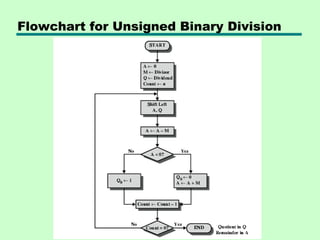
Flowchart for Unsigned Binary Division
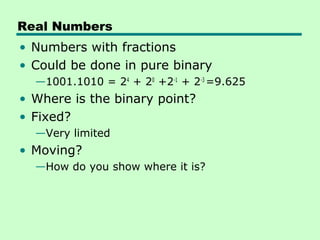
Real Numbers
• Numbers with fractions
• Could be done in pure binary
  —1001.1010 = 24 + 20 +2-1 + 2-3 =9.625
• Where is the binary point?
• Fixed?
  —Very limited
• Moving?
  —How do you show where it is?
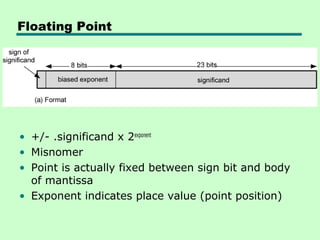
Floating Point


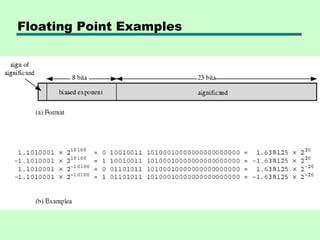
• +/- .significand x 2exponent
• Misnomer
• Point is actually fixed between sign bit and body
  of mantissa
• Exponent indicates place value (point position)
Floating Point Examples
Signs for Floating Point
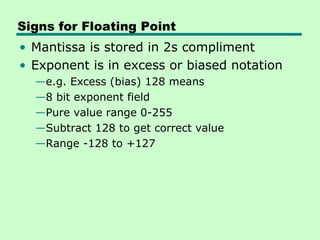
• Mantissa is stored in 2s compliment
• Exponent is in excess or biased notation
  —e.g. Excess (bias) 128 means
  —8 bit exponent field
  —Pure value range 0-255
  —Subtract 128 to get correct value
  —Range -128 to +127
Normalization
• FP numbers are usually normalized
• i.e. exponent is adjusted so that leading
  bit (MSB) of mantissa is 1
• Since it is always 1 there is no need to
  store it
• (c.f. Scientific notation where numbers are
  normalized to give a single digit before
  the decimal point
• e.g. 3.123 x 10³)
FP Ranges
• For a 32 bit number
  —8 bit exponent
  —+/- 2256 ≈ 1.5 x 1077
• Accuracy
  —The effect of changing lsb of mantissa
  —23 bit mantissa 2-23 ≈ 1.2 x 10⁻⁷
  —About 6 decimal places
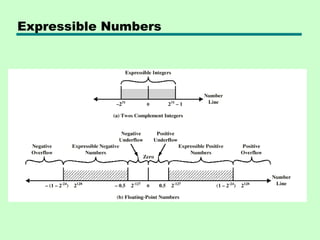
Expressible Numbers
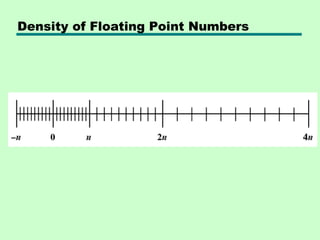
Density of Floating Point Numbers
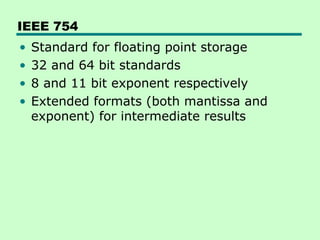
IEEE 754
•   Standard for floating point storage
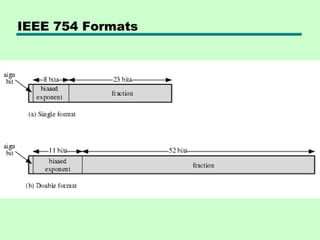
•   32 and 64 bit standards
•   8 and 11 bit exponent respectively
•   Extended formats (both mantissa and
    exponent) for intermediate results
IEEE 754 Formats
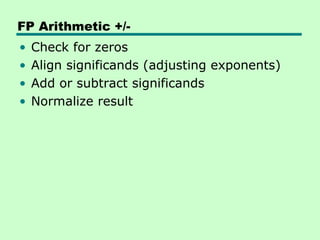
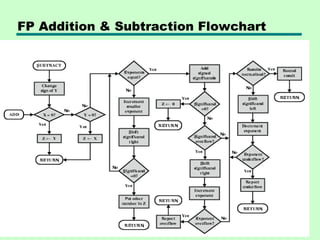
FP Arithmetic +/-
•   Check for zeros
•   Align significands (adjusting exponents)
•   Add or subtract significands
•   Normalize result
FP Addition & Subtraction Flowchart
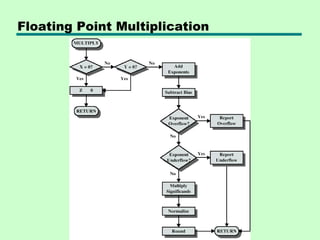
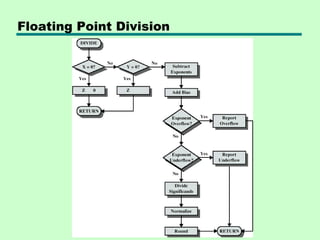
FP Arithmetic x/÷
•   Check for zero
•   Add/subtract exponents
•   Multiply/divide significands (watch sign)
•   Normalize
•   Round
•   All intermediate results should be in
    double length storage
Floating Point Multiplication
Floating Point Division
Required Reading
• Stallings Chapter 9
• IEEE 754 on IEEE Web site

09 arithmetic

  • 1.
    William Stallings Computer Organization andArchitecture 8th Edition Chapter 9 Computer Arithmetic
  • 2.
    Arithmetic & LogicUnit • Does the calculations • Everything else in the computer is there to service this unit • Handles integers • May handle floating point (real) numbers • May be separate FPU (maths co- processor) • May be on chip separate FPU (486DX +)
  • 3.
  • 4.
    Integer Representation • Onlyhave 0 & 1 to represent everything • Positive numbers stored in binary —e.g. 41=00101001 • No minus sign • No period • Sign-Magnitude • Two’s compliment
  • 5.
    Sign-Magnitude • Left most bit is sign bit • 0 means positive • 1 means negative • +18 = 00010010 • -18 = 10010010 • Problems —Need to consider both sign and magnitude in arithmetic —Two representations of zero (+0 and -0)
  • 6.
    Two’s Compliment • +3 = 00000011 • +2 = 00000010 • +1 = 00000001 • +0 = 00000000 • -1 = 11111111 • -2 = 11111110 • -3 = 11111101
  • 7.
    Benefits • One representationof zero • Arithmetic works easily (see later) • Negating is fairly easy —3 = 00000011 —Boolean complement gives 11111100 —Add 1 to LSB 11111101
  • 8.
    Geometric Depiction ofTwos Complement Integers
  • 9.
    Negation Special Case1 • 0= 00000000 • Bitwise not 11111111 • Add 1 to LSB +1 • Result 1 00000000 • Overflow is ignored, so: • -0=0√
  • 10.
    Negation Special Case2 • -128 = 10000000 • bitwise not 01111111 • Add 1 to LSB +1 • Result 10000000 • So: • -(-128) = -128 X • Monitor MSB (sign bit) • It should change during negation
  • 11.
    Range of Numbers •8 bit 2s compliment —+127 = 01111111 = 27 -1 — -128 = 10000000 = -27 • 16 bit 2s compliment —+32767 = 011111111 11111111 = 215 - 1 — -32768 = 100000000 00000000 = -215
  • 12.
    Conversion Between Lengths • Positive number pack with leading zeros • +18 = 00010010 • +18 = 00000000 00010010 • Negative numbers pack with leading ones • -18 = 10010010 • -18 = 11111111 10010010 • i.e. pack with MSB (sign bit)
  • 13.
    Addition and Subtraction •Normal binary addition • Monitor sign bit for overflow • Take twos compliment of substahend and add to minuend —i.e. a - b = a + (-b) • So we only need addition and complement circuits
  • 14.
    Hardware for Additionand Subtraction
  • 15.
    Multiplication • Complex • Work out partial product for each digit • Take care with place value (column) • Add partial products
  • 16.
    Multiplication Example • 1011 Multiplicand (11 dec) • x 1101 Multiplier (13 dec) • 1011 Partial products • 0000 Note: if multiplier bit is 1 copy • 1011 multiplicand (place value) • 1011 otherwise zero • 10001111 Product (143 dec) • Note: need double length result
  • 17.
  • 18.
  • 19.
    Flowchart for UnsignedBinary Multiplication
  • 20.
    Multiplying Negative Numbers •This does not work! • Solution 1 —Convert to positive if required —Multiply as above —If signs were different, negate answer • Solution 2 —Booth’s algorithm
  • 21.
  • 22.
  • 23.
    Division • More complexthan multiplication • Negative numbers are really bad! • Based on long division
  • 24.
    Division of UnsignedBinary Integers 00001101 Quotient Divisor 1011 10010011 Dividend 1011 001110 Partial 1011 Remainders 001111 1011 Remainder 100
  • 25.
    Flowchart for UnsignedBinary Division
  • 26.
    Real Numbers • Numberswith fractions • Could be done in pure binary —1001.1010 = 24 + 20 +2-1 + 2-3 =9.625 • Where is the binary point? • Fixed? —Very limited • Moving? —How do you show where it is?
  • 27.
    Floating Point • +/-.significand x 2exponent • Misnomer • Point is actually fixed between sign bit and body of mantissa • Exponent indicates place value (point position)
  • 28.
  • 29.
    Signs for FloatingPoint • Mantissa is stored in 2s compliment • Exponent is in excess or biased notation —e.g. Excess (bias) 128 means —8 bit exponent field —Pure value range 0-255 —Subtract 128 to get correct value —Range -128 to +127
  • 30.
    Normalization • FP numbersare usually normalized • i.e. exponent is adjusted so that leading bit (MSB) of mantissa is 1 • Since it is always 1 there is no need to store it • (c.f. Scientific notation where numbers are normalized to give a single digit before the decimal point • e.g. 3.123 x 10³)
  • 31.
    FP Ranges • Fora 32 bit number —8 bit exponent —+/- 2256 ≈ 1.5 x 1077 • Accuracy —The effect of changing lsb of mantissa —23 bit mantissa 2-23 ≈ 1.2 x 10⁻⁷ —About 6 decimal places
  • 32.
  • 33.
    Density of FloatingPoint Numbers
  • 34.
    IEEE 754 • Standard for floating point storage • 32 and 64 bit standards • 8 and 11 bit exponent respectively • Extended formats (both mantissa and exponent) for intermediate results
  • 35.
  • 36.
    FP Arithmetic +/- • Check for zeros • Align significands (adjusting exponents) • Add or subtract significands • Normalize result
  • 37.
    FP Addition &Subtraction Flowchart
  • 38.
    FP Arithmetic x/÷ • Check for zero • Add/subtract exponents • Multiply/divide significands (watch sign) • Normalize • Round • All intermediate results should be in double length storage
  • 39.
  • 40.
  • 41.
    Required Reading • StallingsChapter 9 • IEEE 754 on IEEE Web site