Er. Nawaraj Bhandari
Digital Logic
Chapter 2:
Boolean algebra and Logic Gates
Boolean algebra
 Boolean algebra is a mathematical system for the manipulation of
variables that can have one of two values.
 In formal logic, these values are “true” and “false.”
 In digital systems, these values are “on” and “off,” 1 and 0, or “high”
and “low.”
 Boolean expressions are created by performing operations on
Boolean variables.
 Common Boolean operators include AND, OR, and NOT.
3
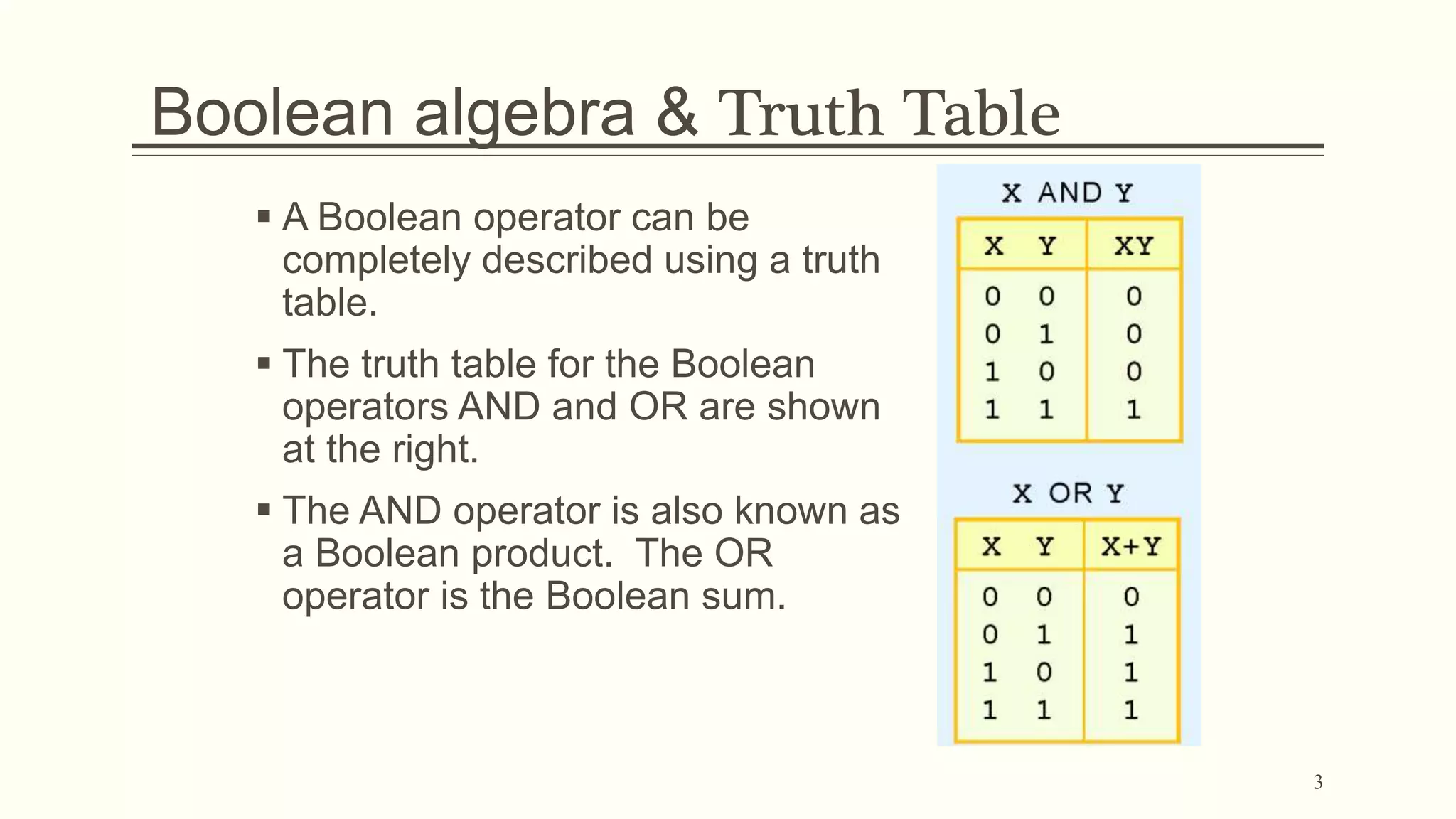
 A Boolean operator can be
completely described using a truth
table.
 The truth table for the Boolean
operators AND and OR are shown
at the right.
 The AND operator is also known as
a Boolean product. The OR
operator is the Boolean sum.
Boolean algebra & Truth Table
4
Boolean Algebra
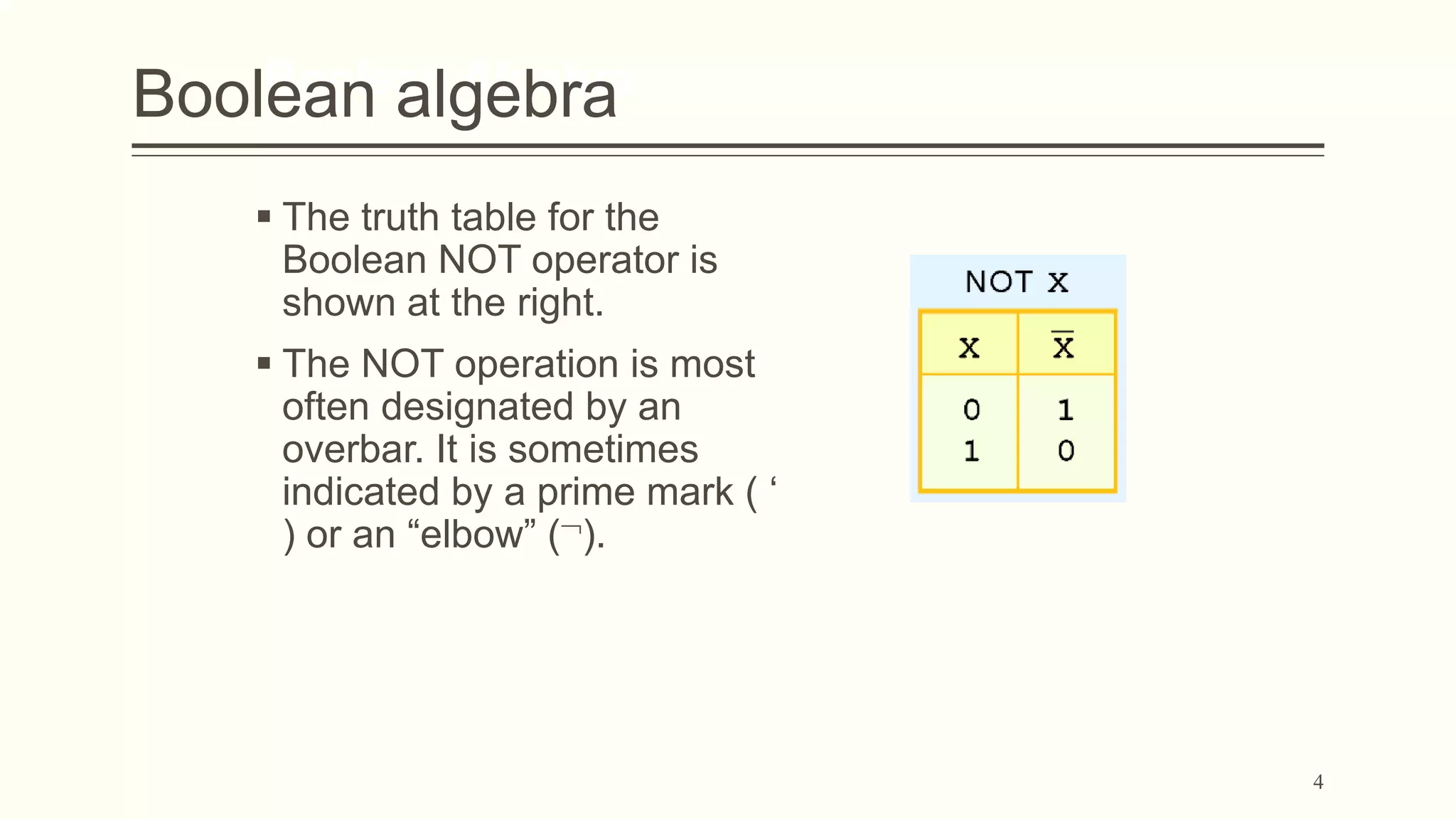
 The truth table for the
Boolean NOT operator is
shown at the right.
 The NOT operation is most
often designated by an
overbar. It is sometimes
indicated by a prime mark ( ‘
) or an “elbow” ().
Boolean algebra
5
Boolean Algebra
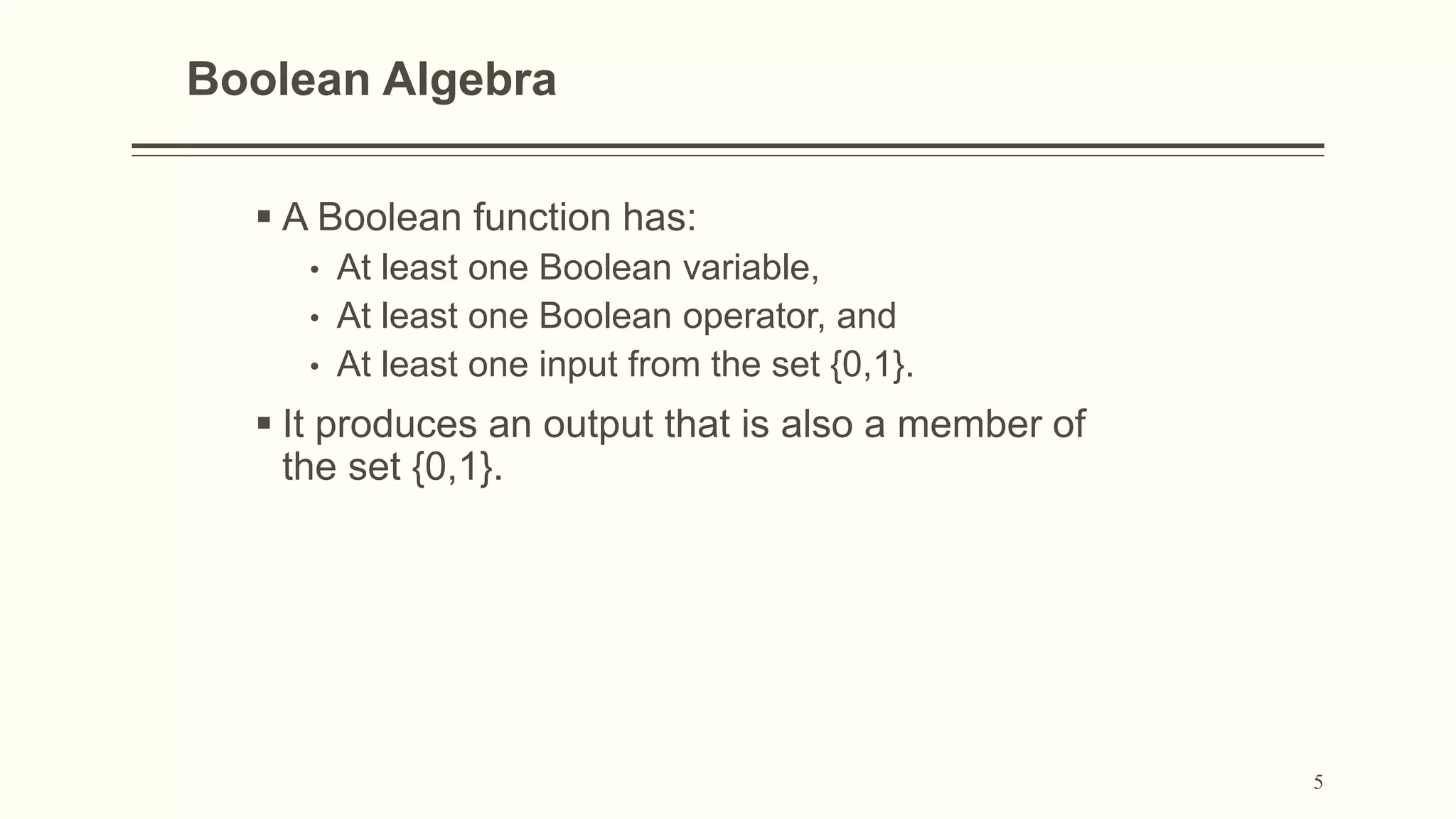
 A Boolean function has:
• At least one Boolean variable,
• At least one Boolean operator, and
• At least one input from the set {0,1}.
 It produces an output that is also a member of
the set {0,1}.
Basic Theory of Boolean Algebra
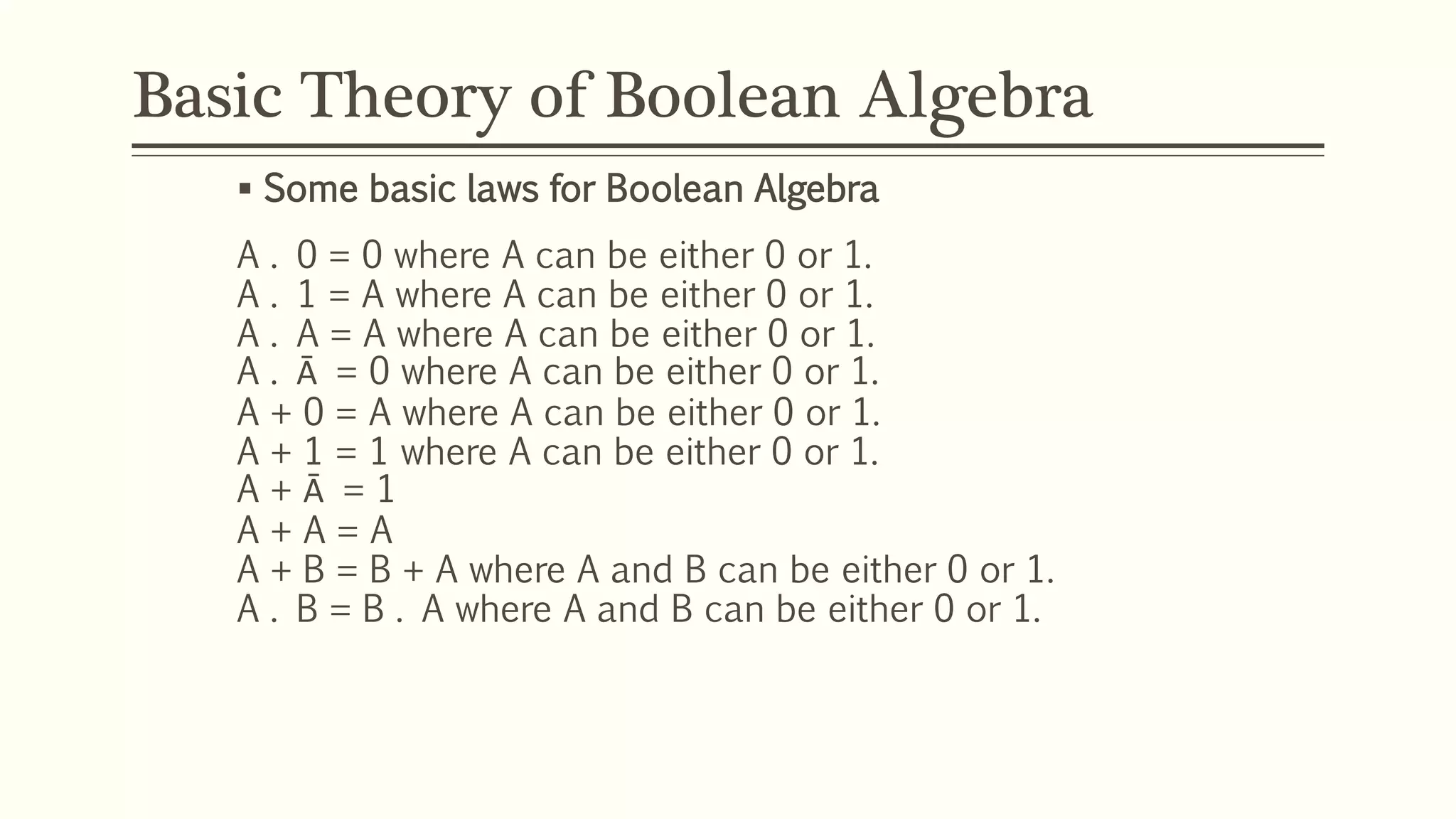
 Some basic laws for Boolean Algebra
A . 0 = 0 where A can be either 0 or 1.
A . 1 = A where A can be either 0 or 1.
A . A = A where A can be either 0 or 1.
A . Ā = 0 where A can be either 0 or 1.
A + 0 = A where A can be either 0 or 1.
A + 1 = 1 where A can be either 0 or 1.
A + Ā = 1
A + A = A
A + B = B + A where A and B can be either 0 or 1.
A . B = B . A where A and B can be either 0 or 1.
Duality theorem
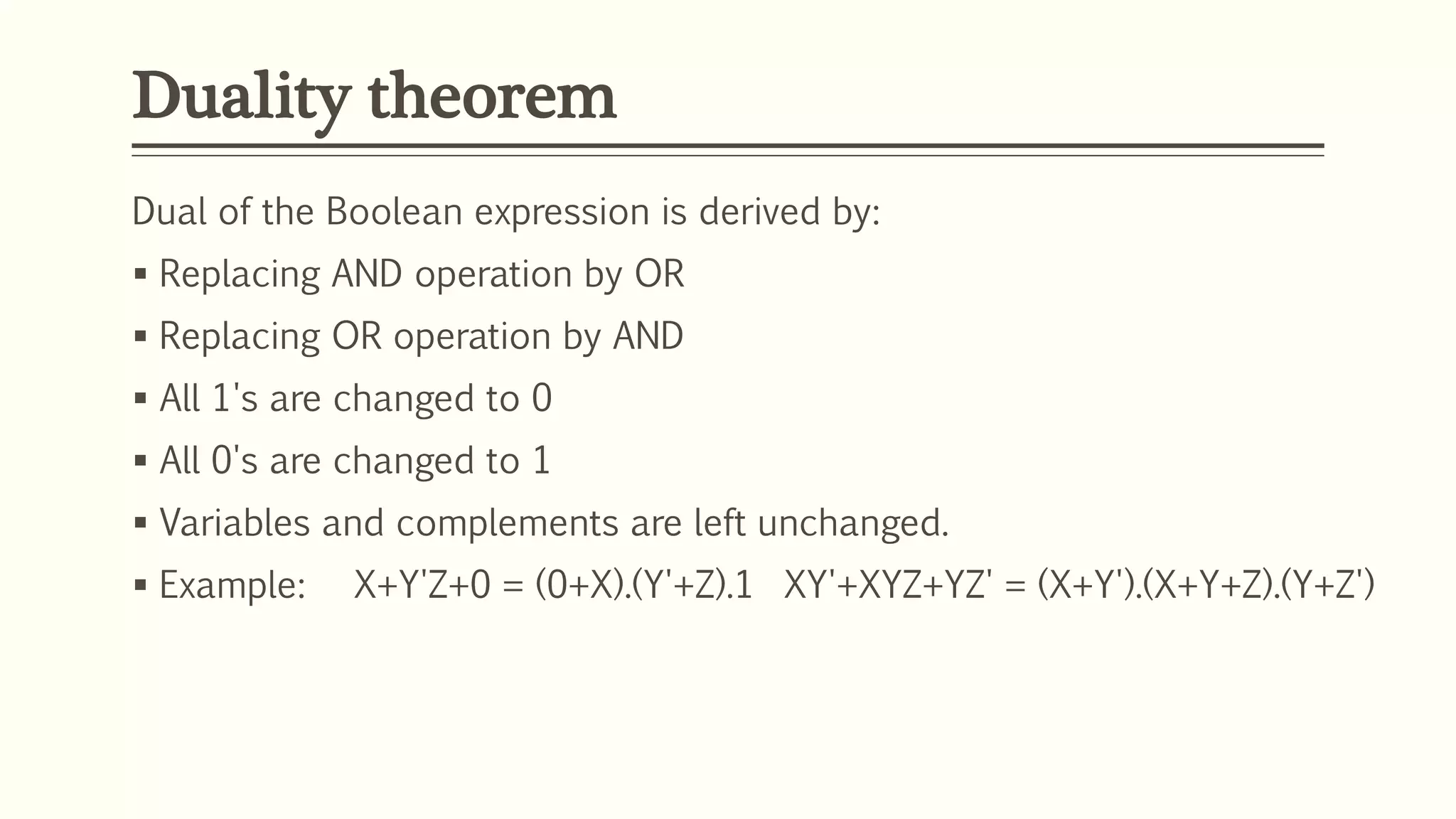
Dual of the Boolean expression is derived by:
 Replacing AND operation by OR
 Replacing OR operation by AND
 All 1's are changed to 0
 All 0's are changed to 1
 Variables and complements are left unchanged.
 Example: X+Y'Z+0 = (0+X).(Y'+Z).1 XY'+XYZ+YZ' = (X+Y').(X+Y+Z).(Y+Z')
Postulates
(1) A + 0 = A A · 1 = A identity
(2) A + NOT[A] = 1 A · NOT[A] = 0 complement
(3) A + B = B + A A · B = B · A commutative law
(4)
A + (B + C) = (A + B) +
C
A · (B · C) = (A · B) · C associative law
(5)
A + (B · C) = (A + B) · (A
+ C)
A · (B + C) = (A · B) + (A
· C)
distributive law
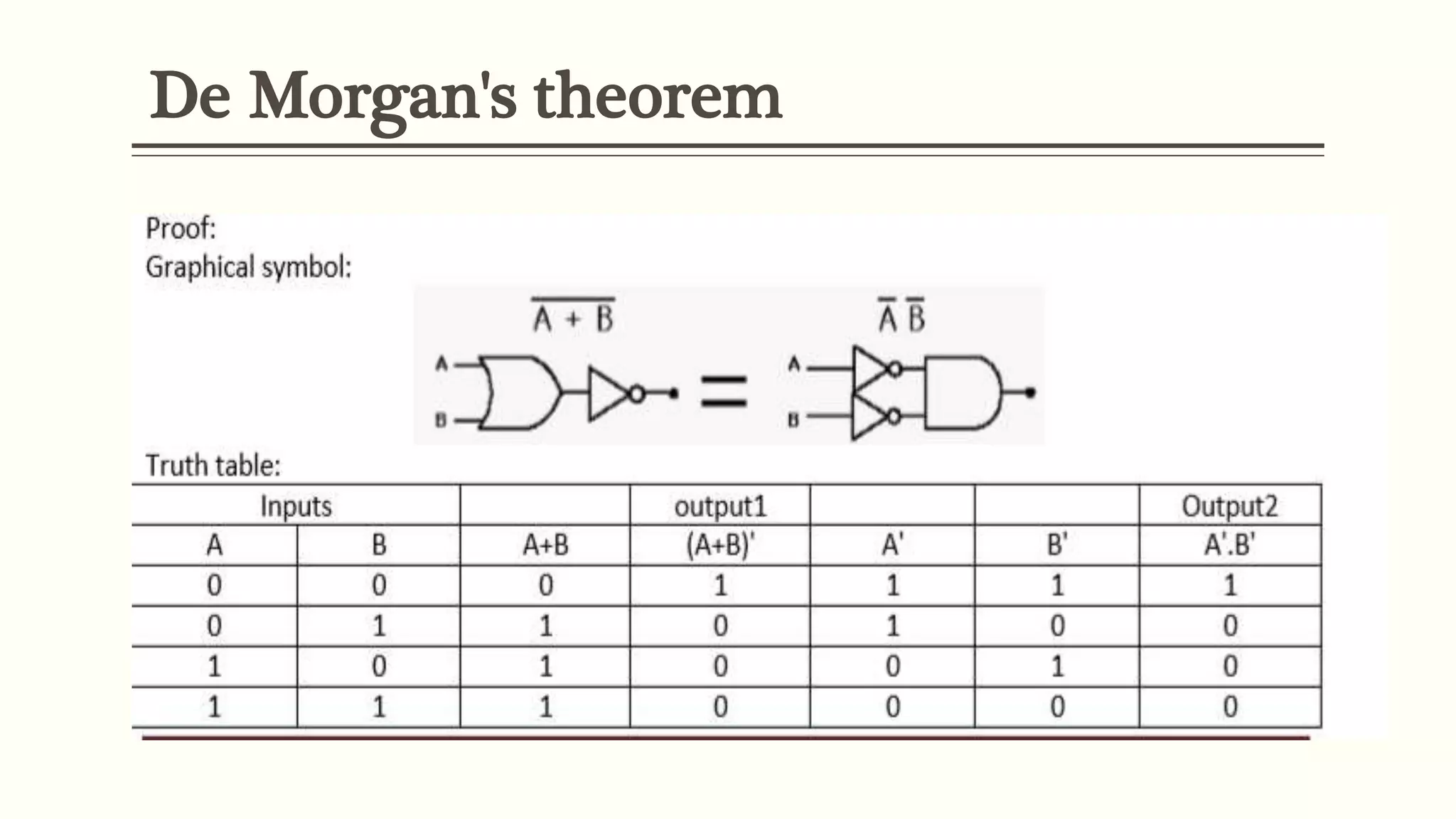
De Morgan's theorem
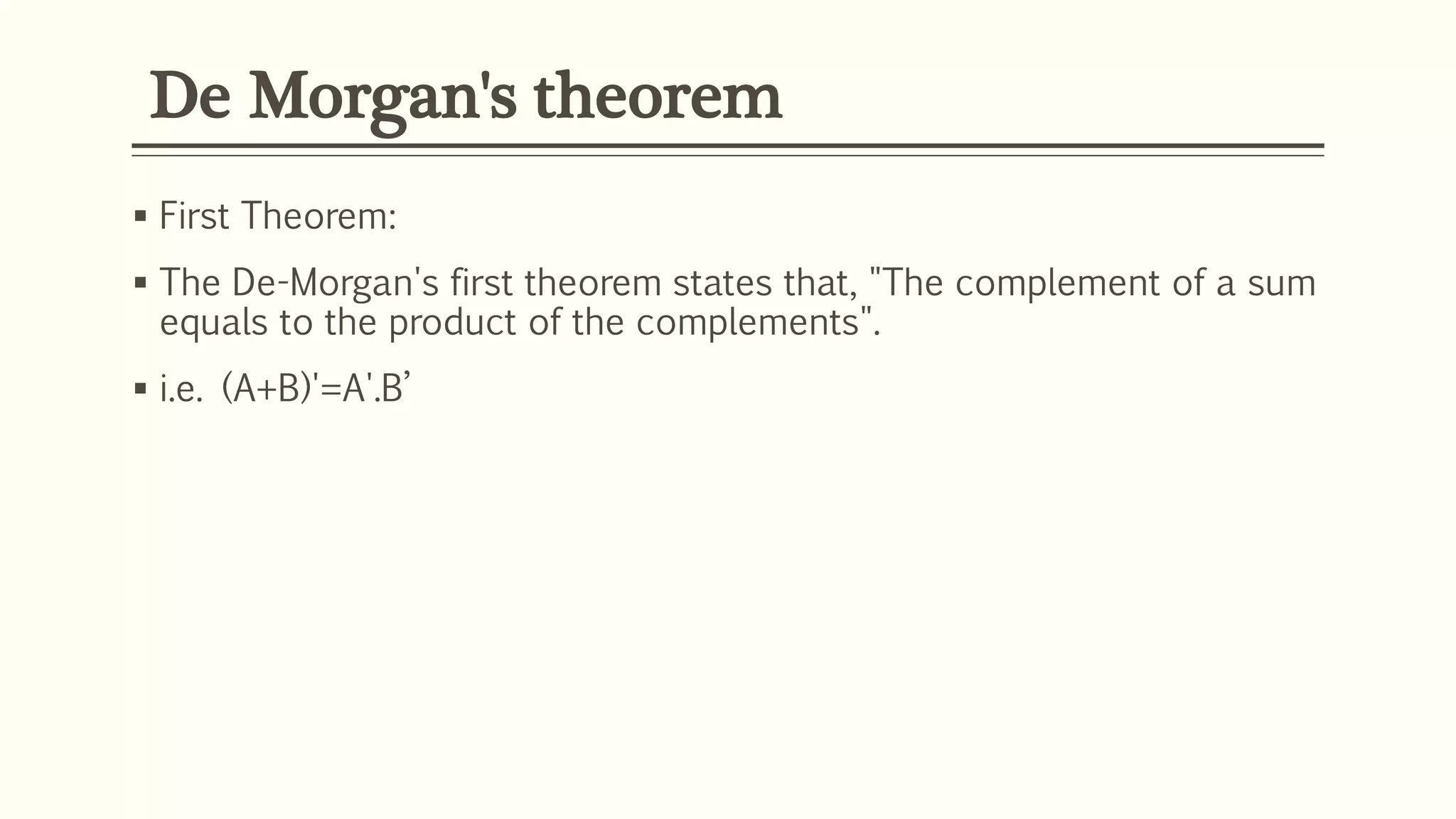
 First Theorem:
 The De-Morgan's first theorem states that, "The complement of a sum
equals to the product of the complements".
 i.e. (A+B)'=A'.B’
De Morgan's theorem
De Morgan's theorem
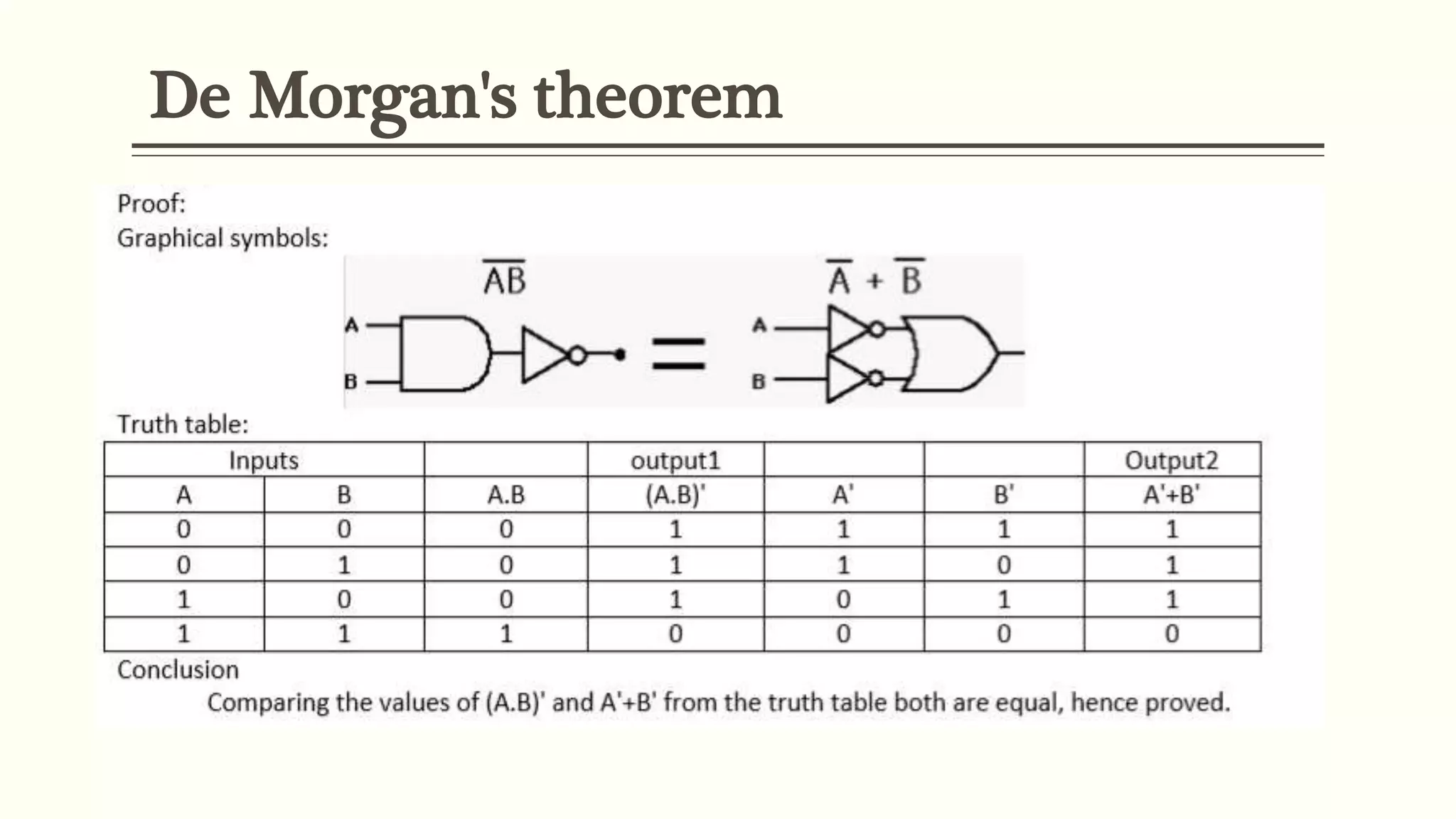
Second Theorem:
De Morgan's second theorem states that, "The complement of a product is
equal to the sum of the complements."
i.e. (A.B)'=A'+B'
De Morgan's theorem
Introduction to Logic Gates
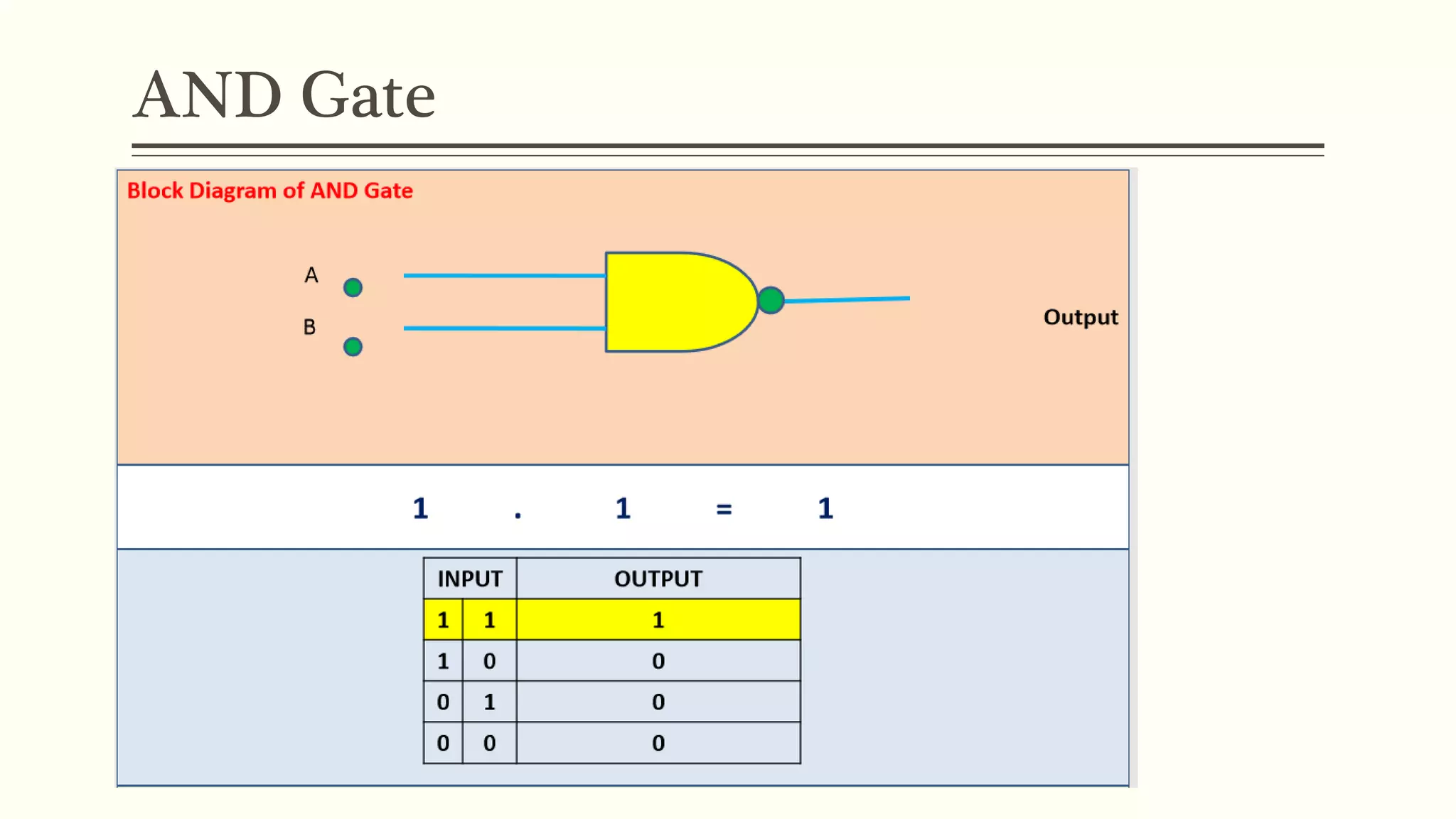
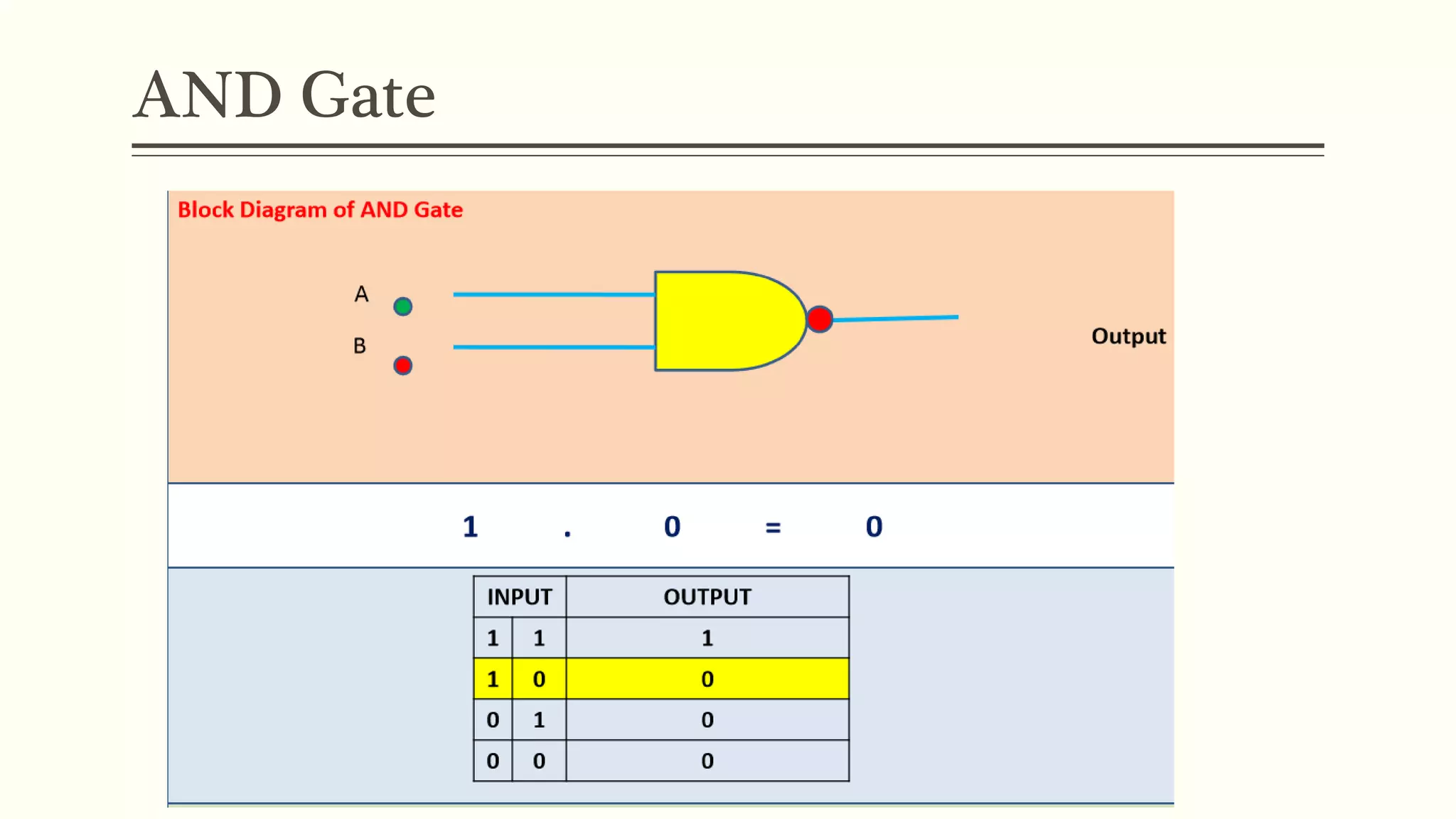
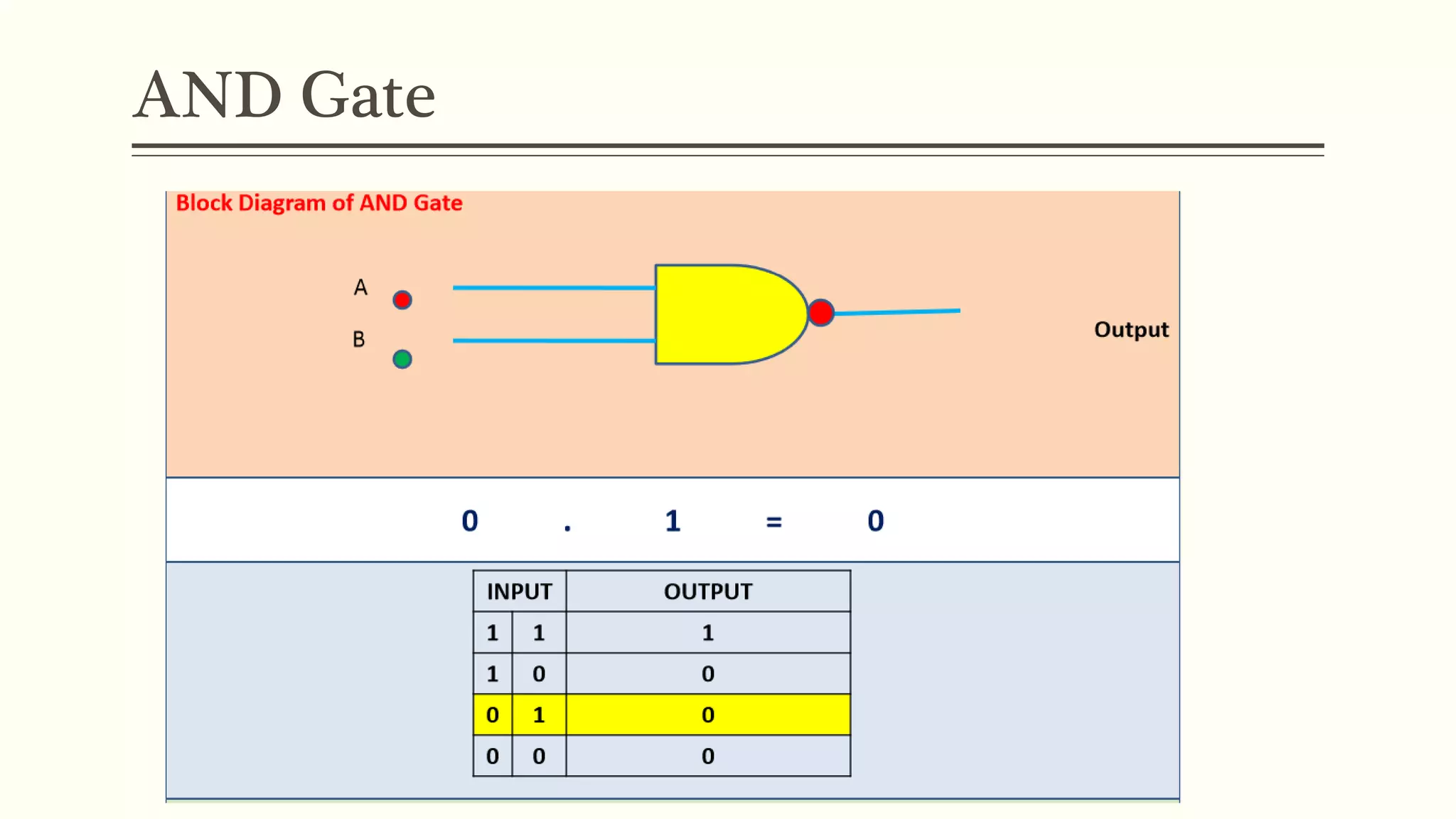
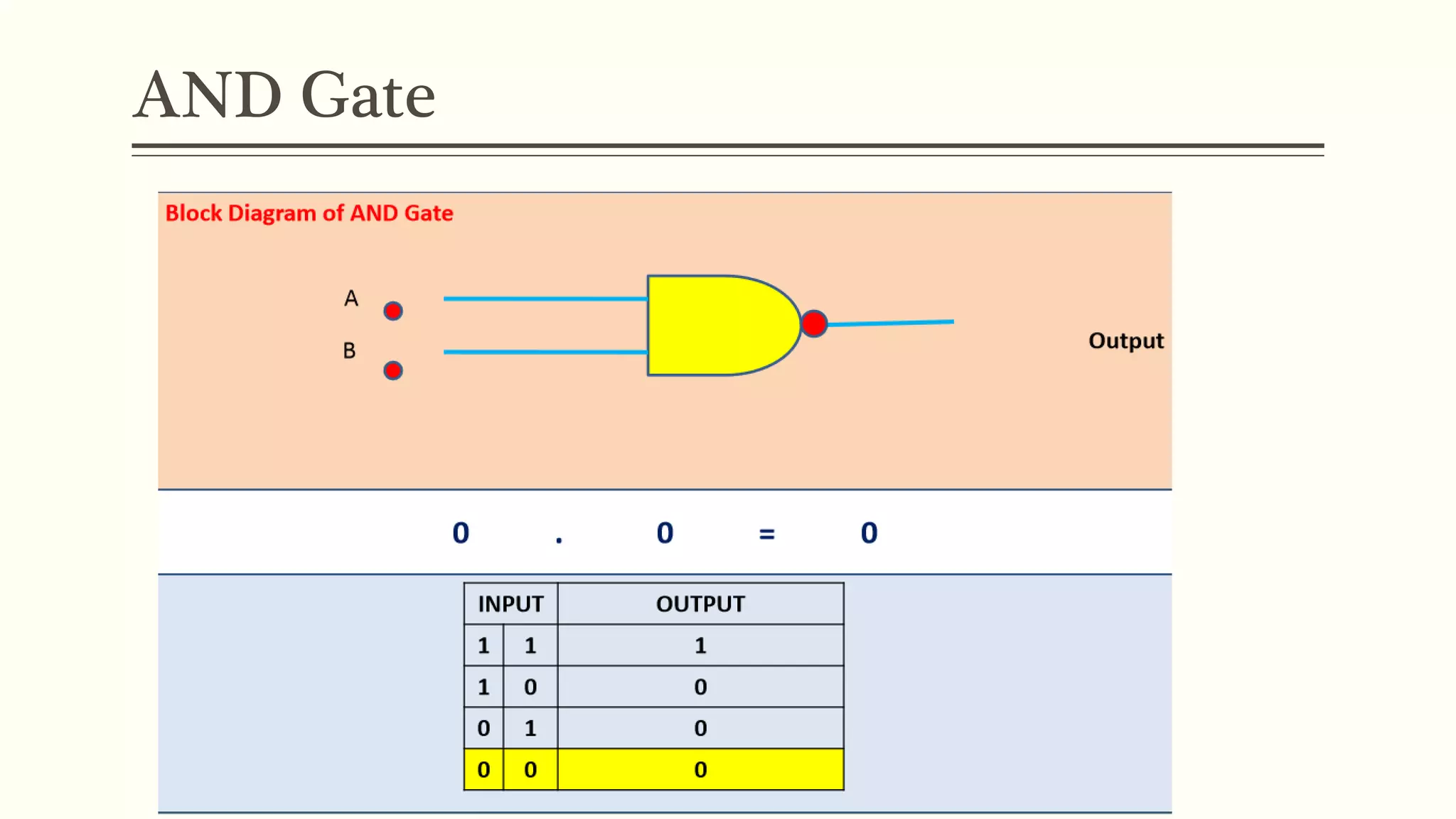
AND Gate
It is an electronic circuit, which generates an output signal of 1 if and only
if all input signals are also 1
An AND gate is the physical realization of the logical multiplication ( AND
operation
AND Gate
AND Gate
AND Gate
AND Gate
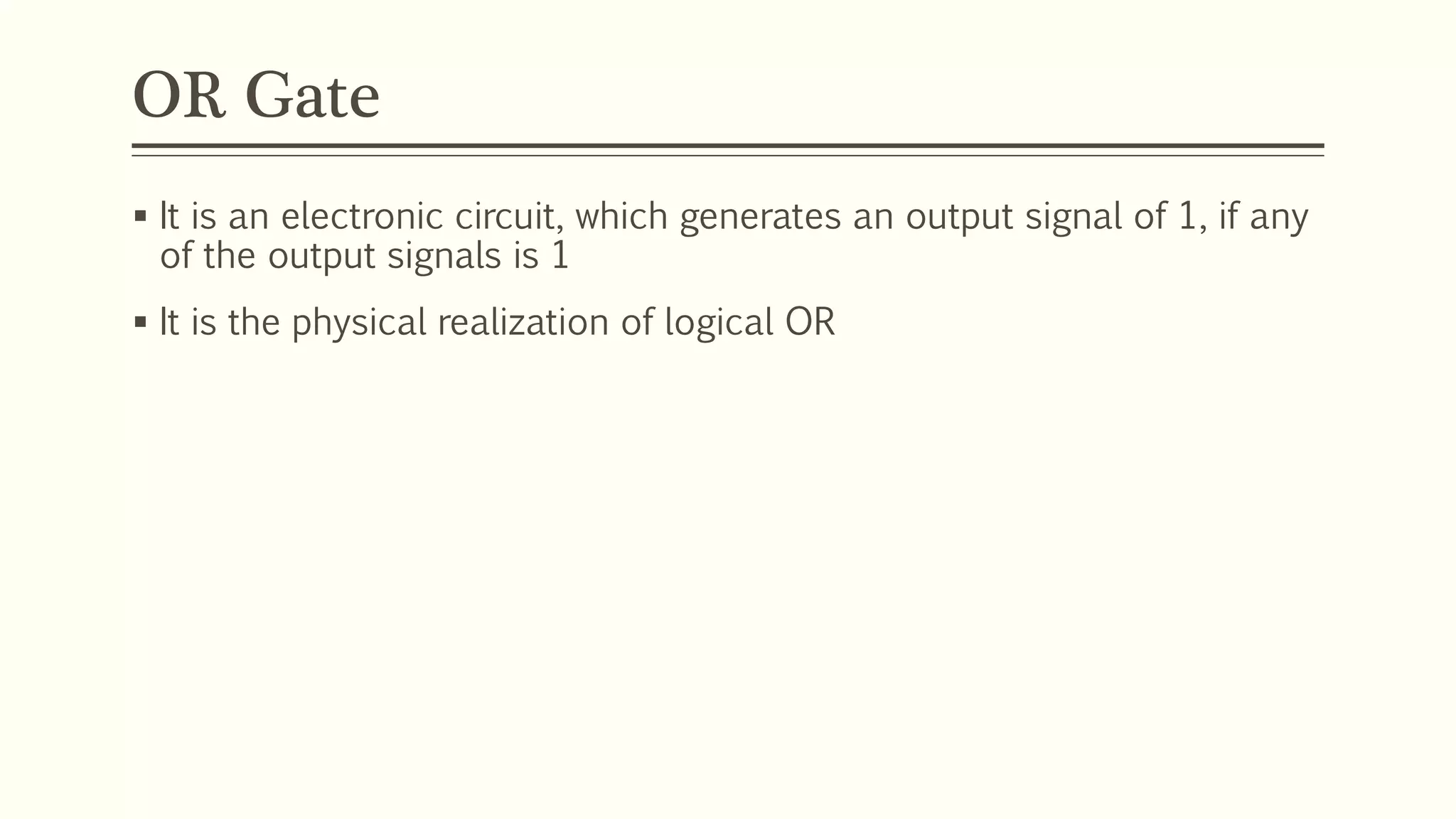
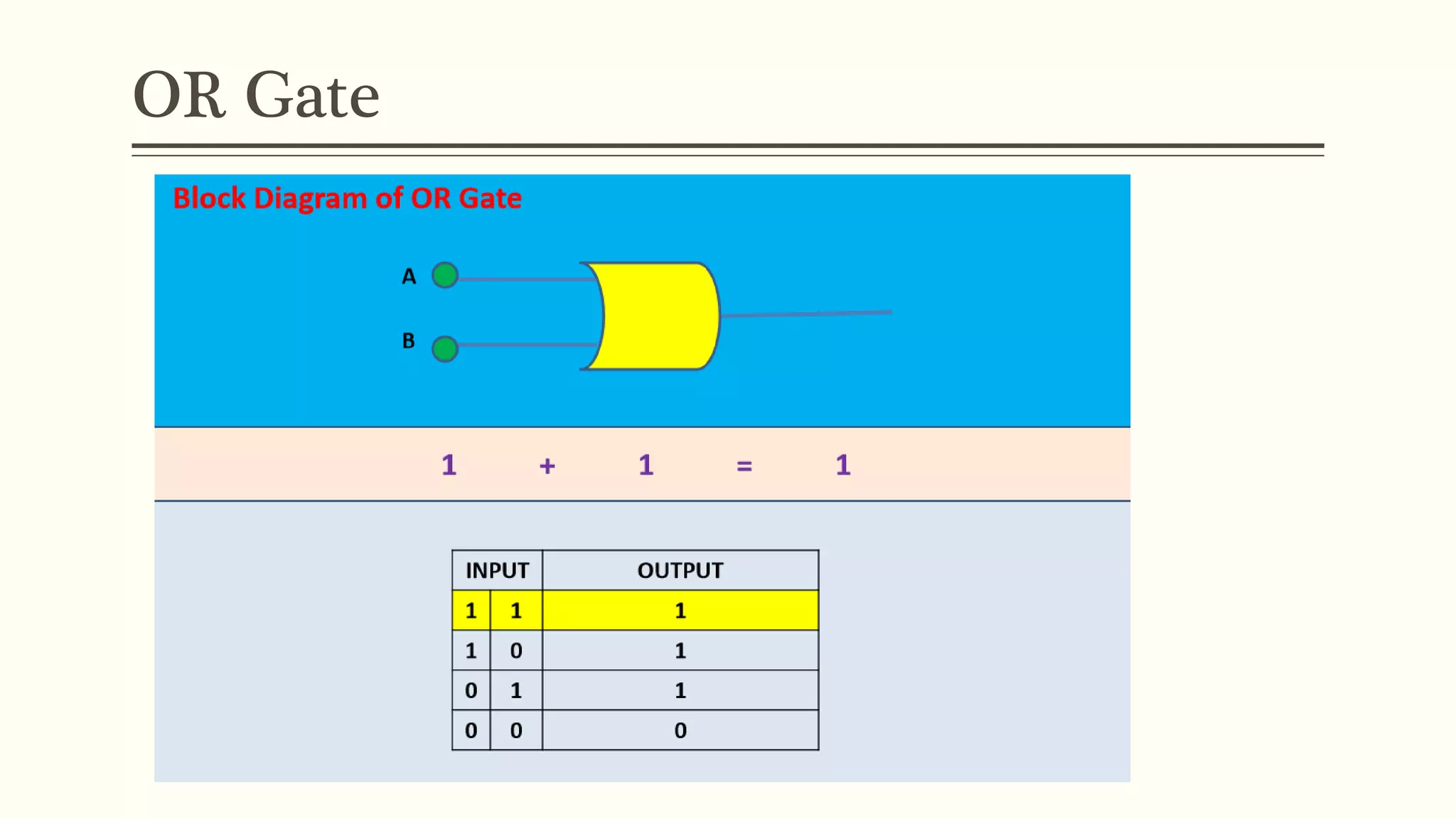
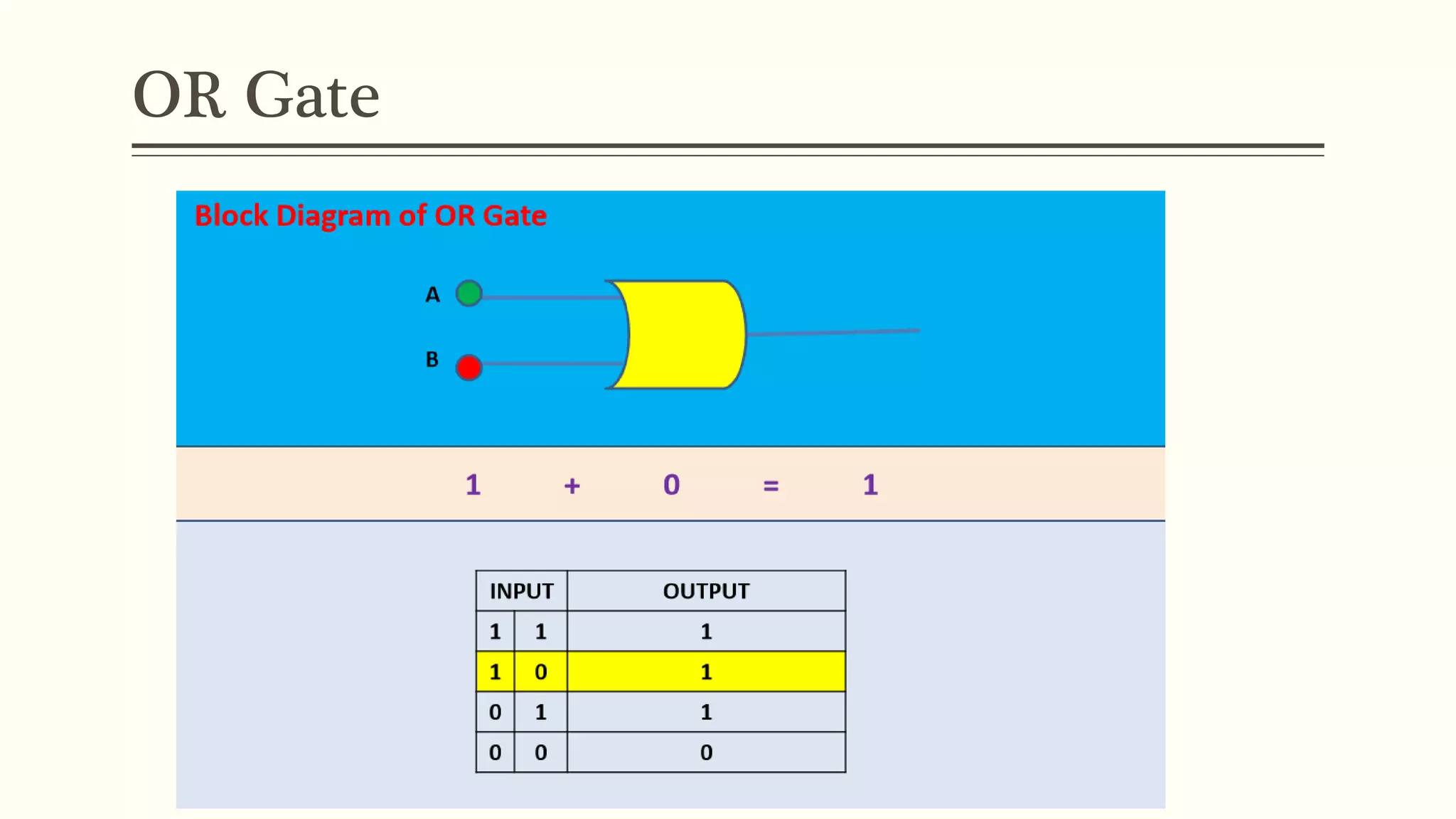
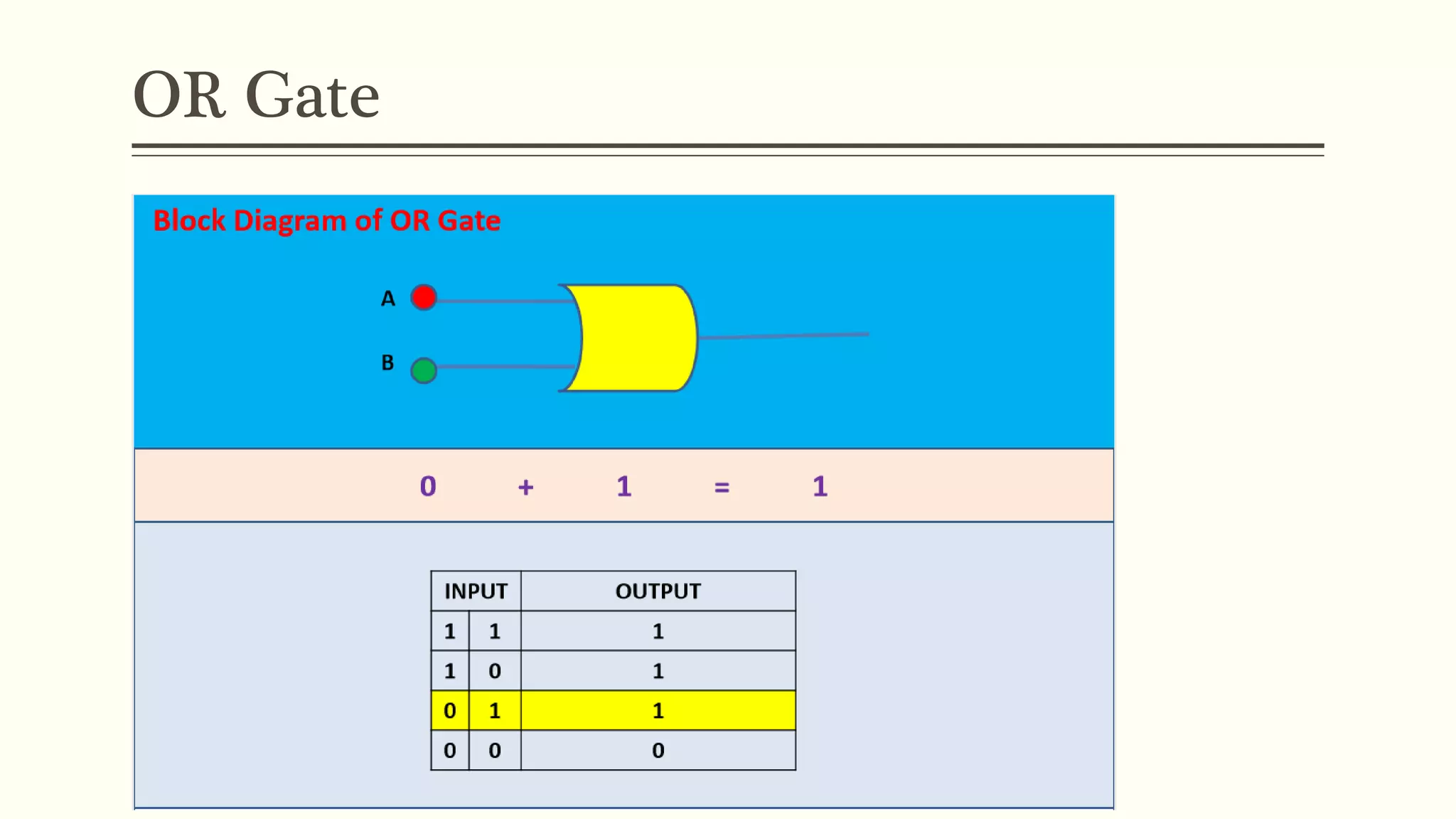
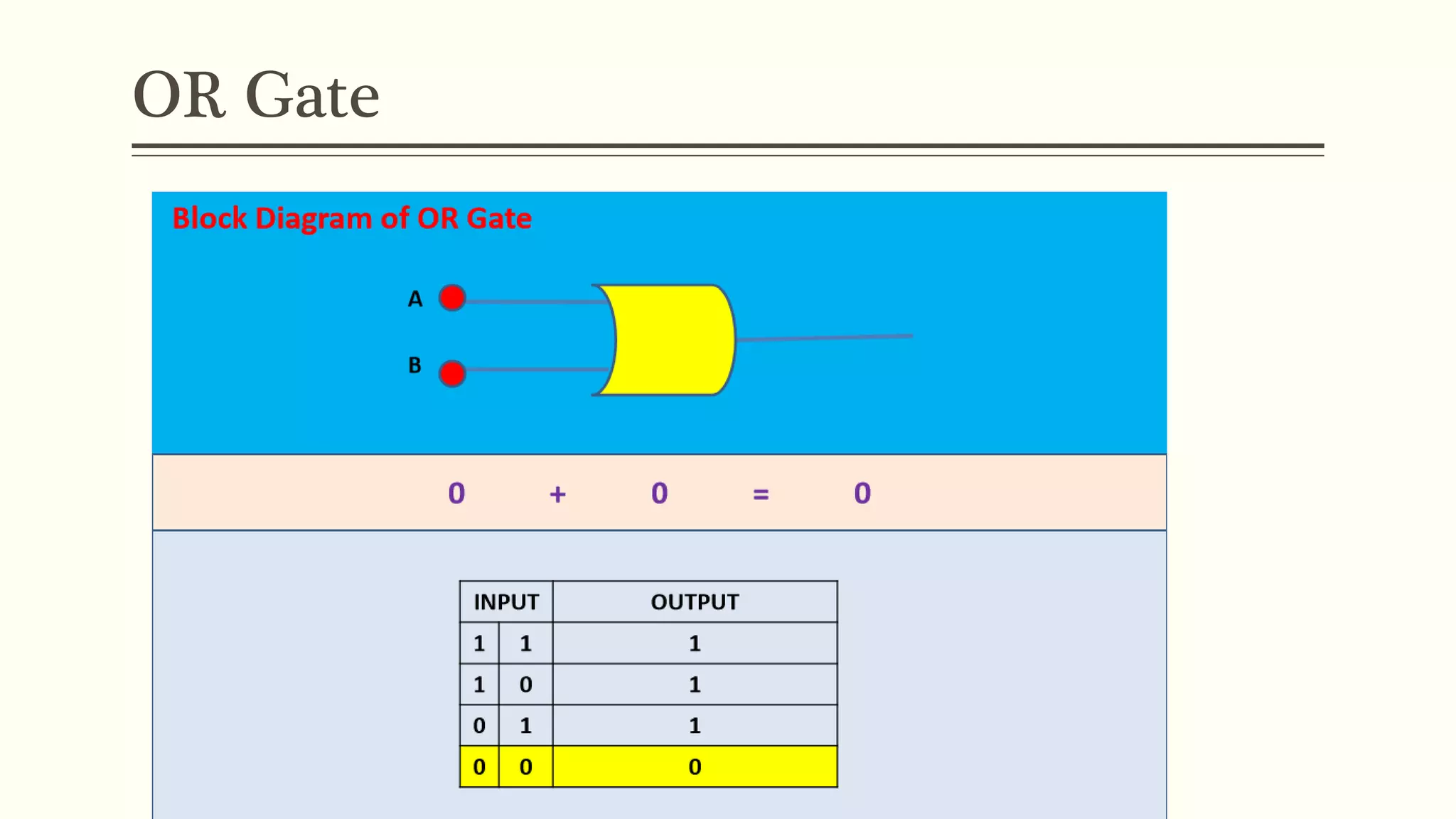
OR Gate
 It is an electronic circuit, which generates an output signal of 1, if any
of the output signals is 1
 It is the physical realization of logical OR
OR Gate
OR Gate
OR Gate
OR Gate
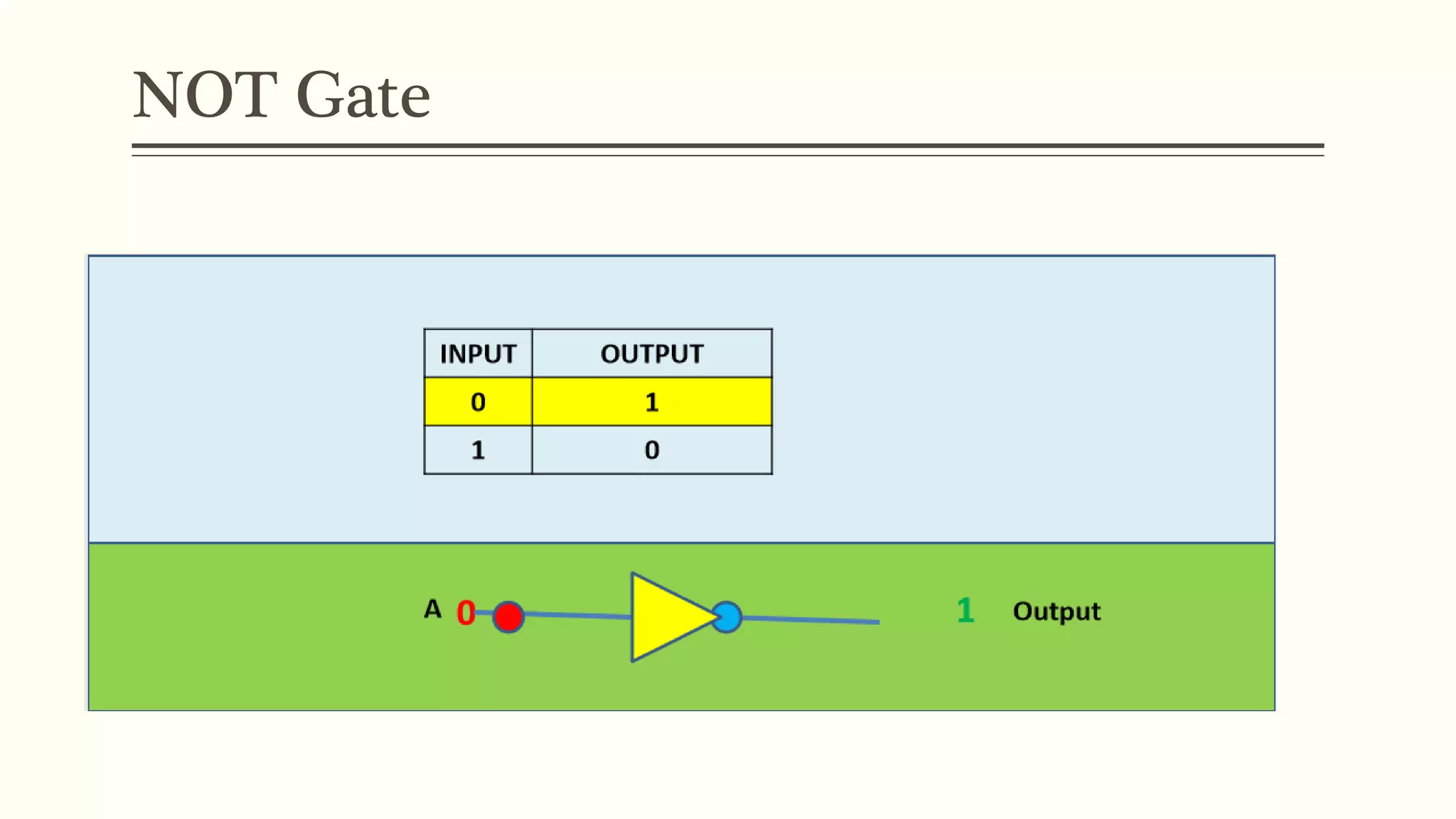
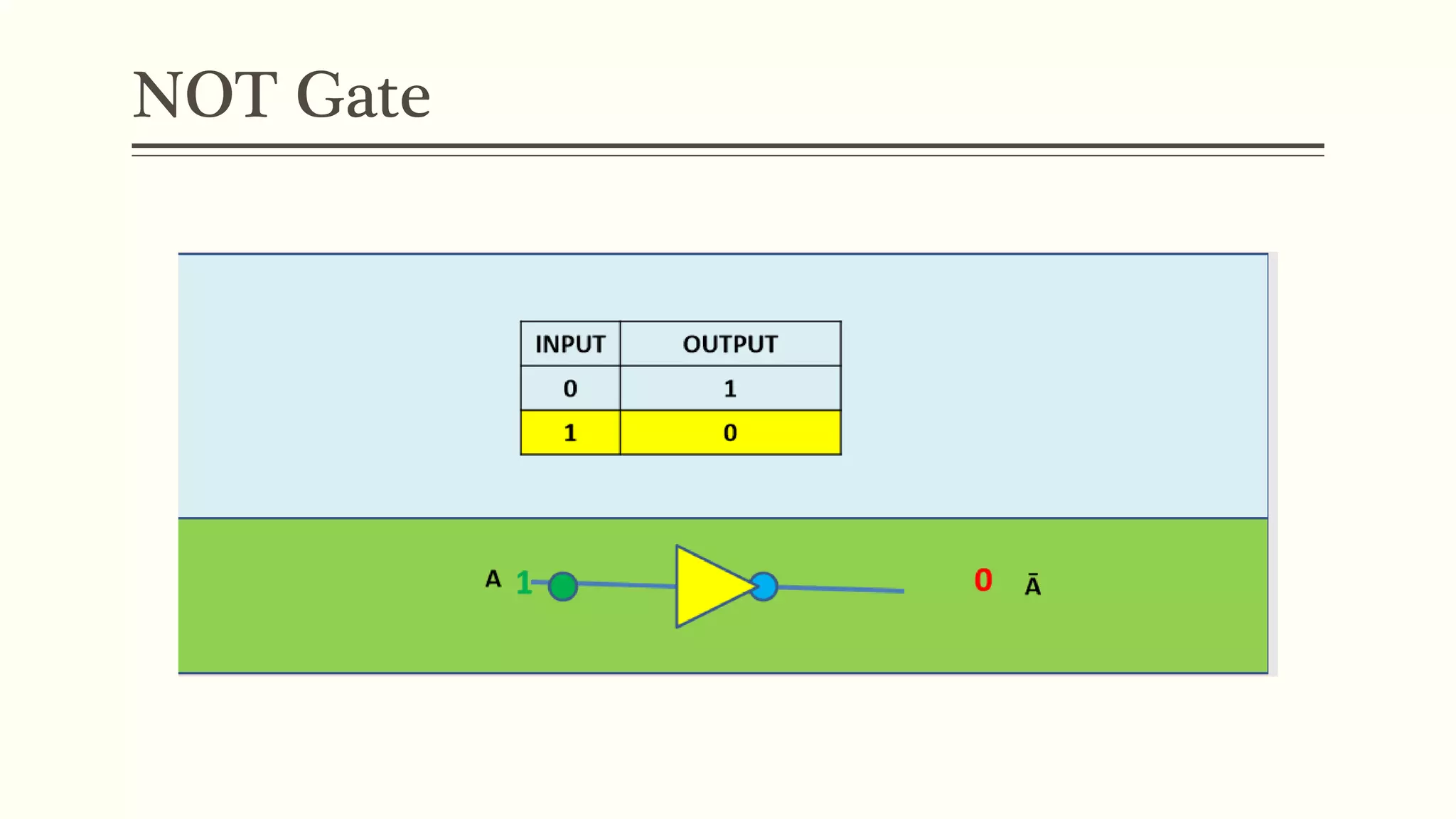
NOT Gate
 It is an electronic circuit that generates an output signal, which is
reverse of input signal
 It is the physical realization of complementation operation
 Not Gate is also called inverter because it inverts the input
NOT Gate
NOT Gate
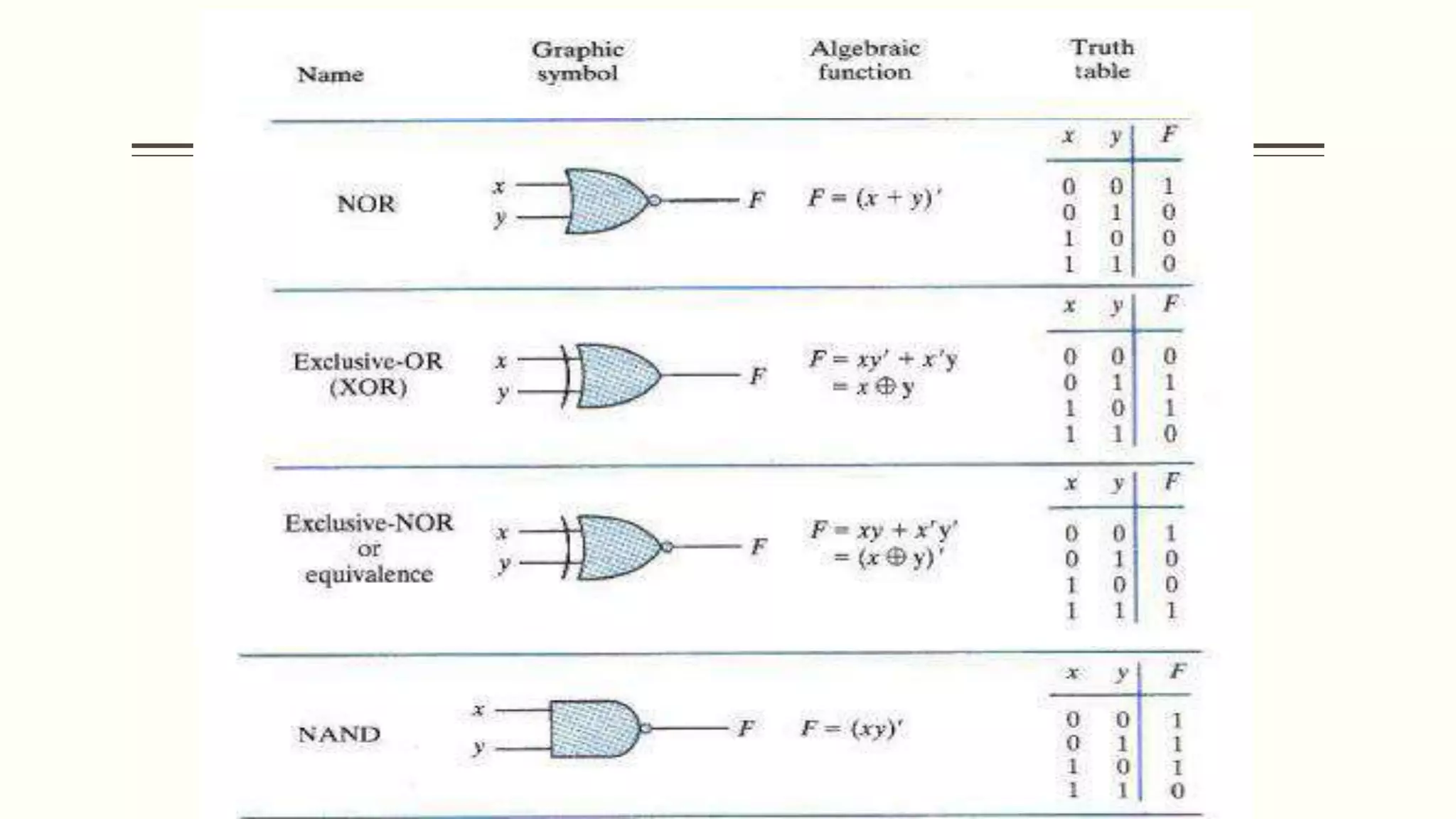
NAND Gate
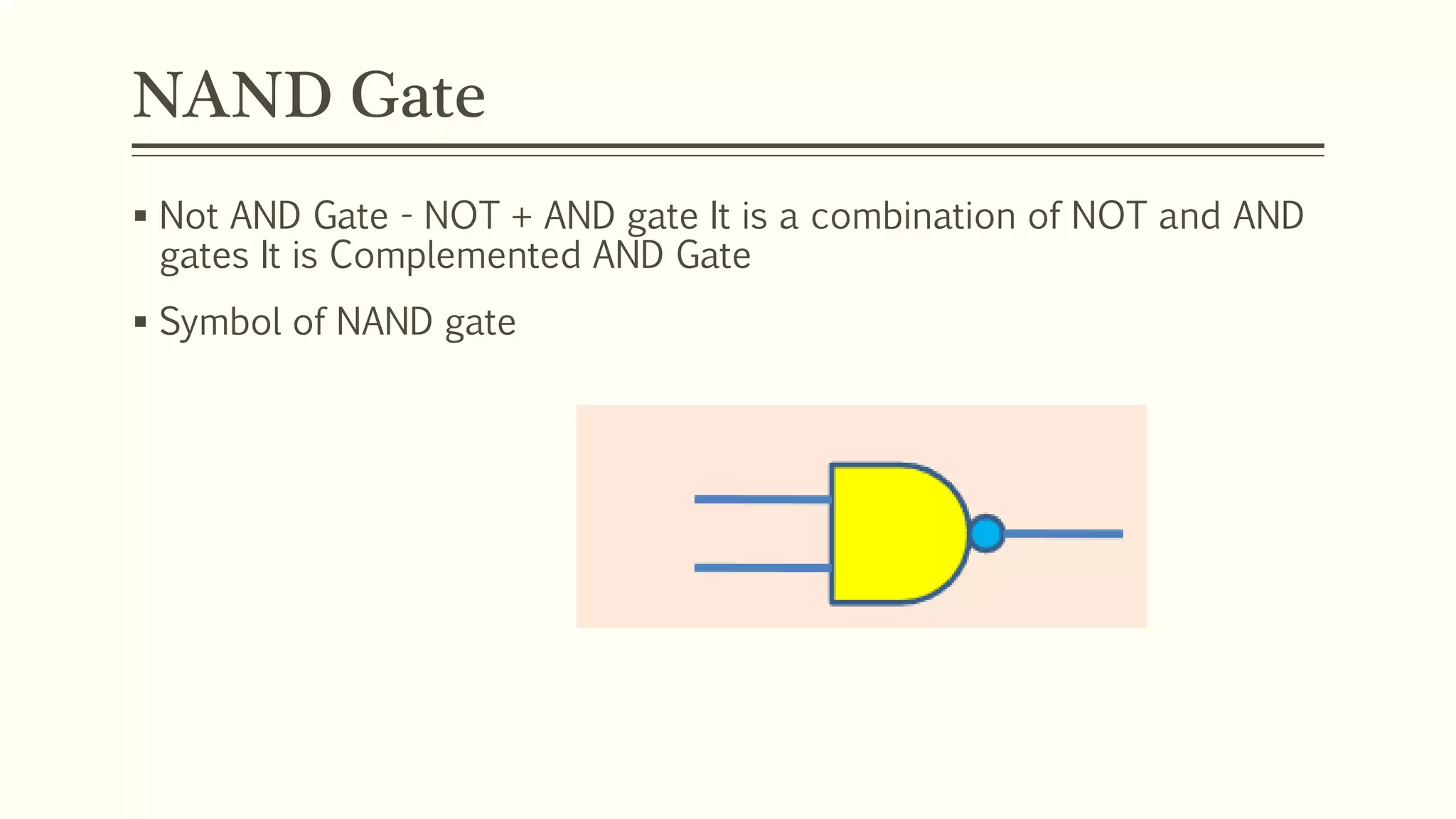
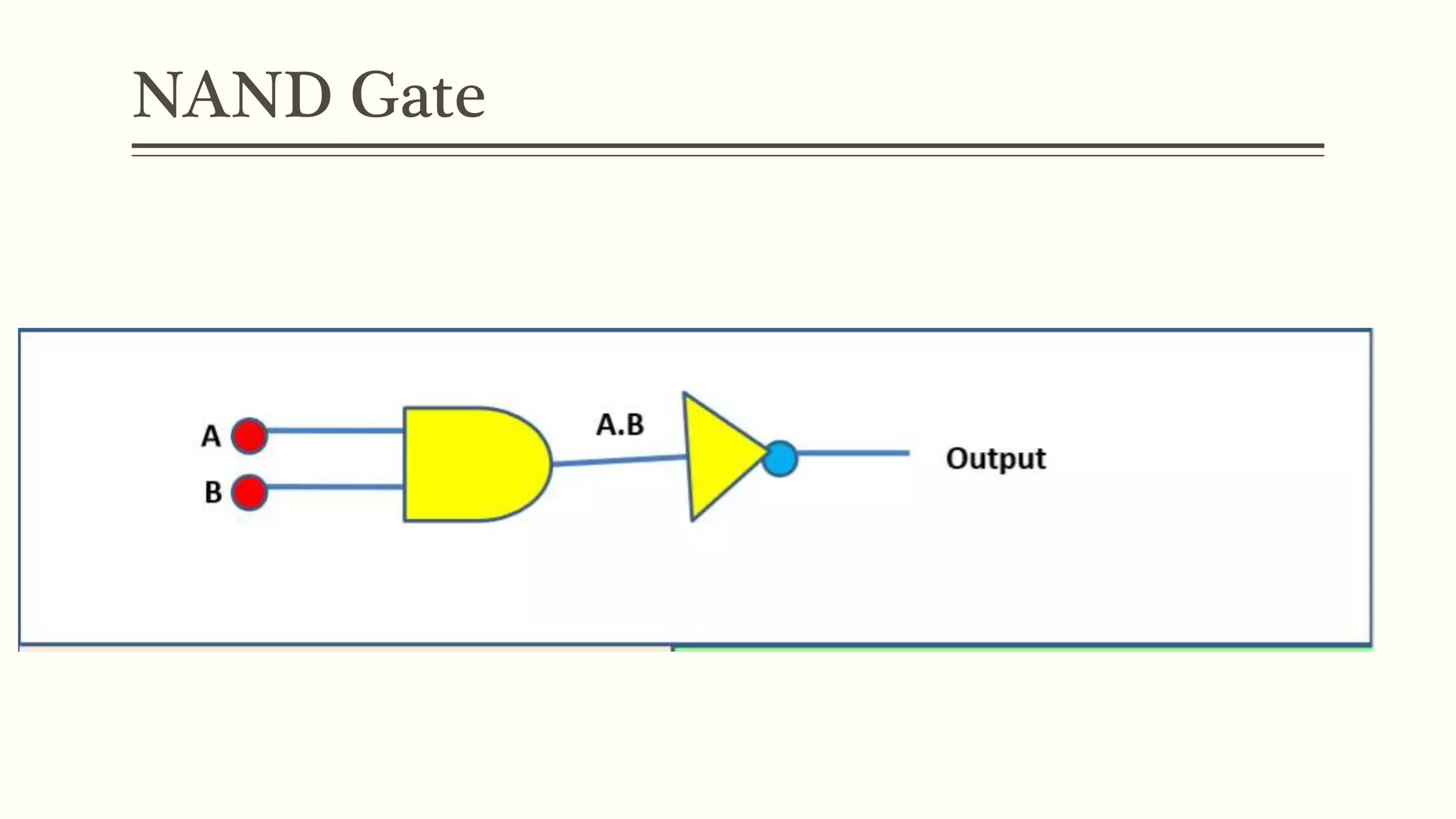
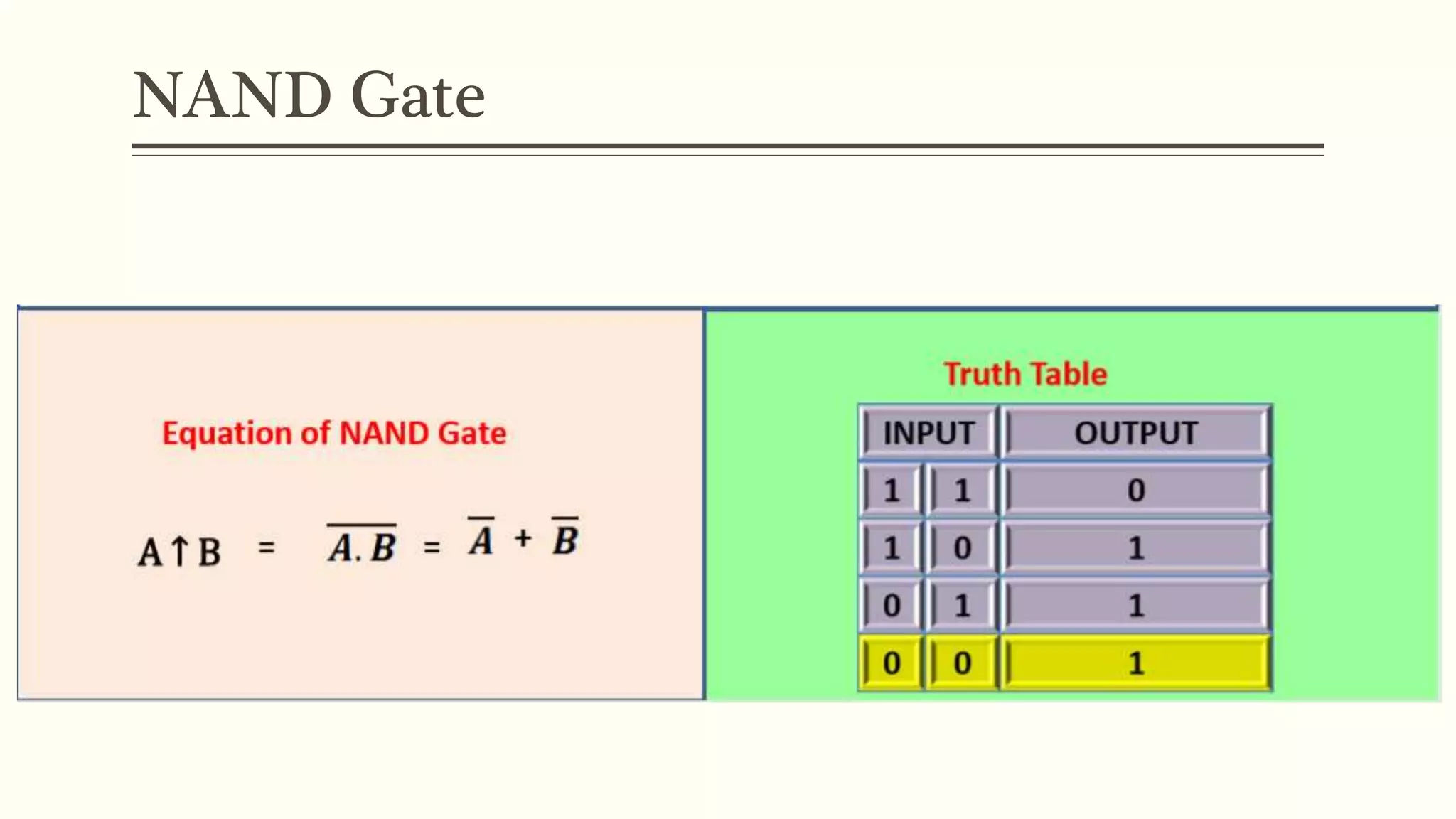
 Not AND Gate - NOT + AND gate It is a combination of NOT and AND
gates It is Complemented AND Gate
 Symbol of NAND gate
NAND Gate
NAND Gate
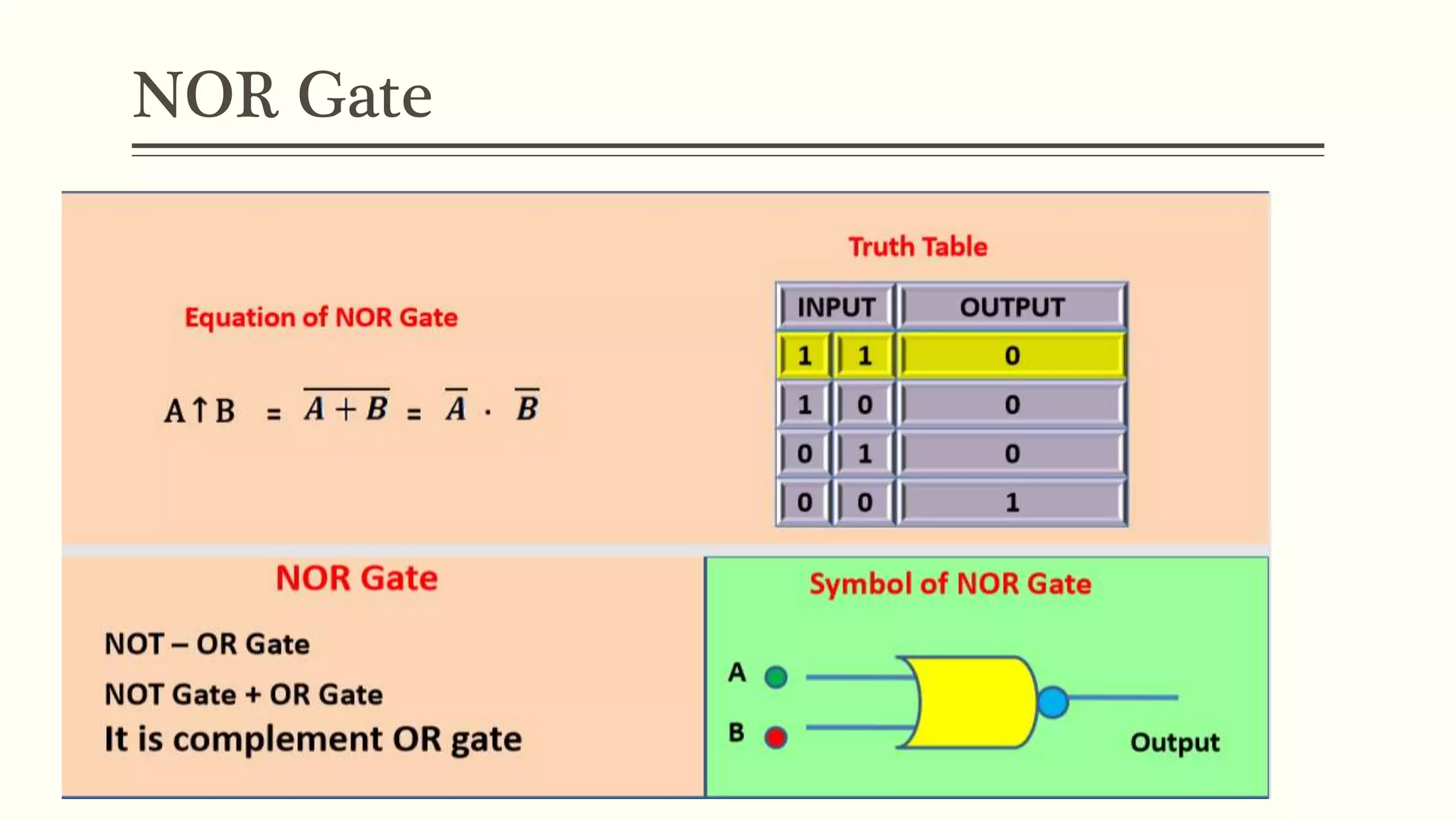
NOR Gate
NOR Gate
Universal gates
 A universal gate is a gate which can implement any Boolean function without
need to use any other gate type.
 The NAND and NOR gates are universal gates. In practice, this is
advantageous since NAND and NOR gates are economical and easier to
fabricate and are the basic gates used in all.
 NAND Gate is a Universal Gate :-To prove that any Boolean function can be
implemented using only NAND gates, we will show that the AND, OR, and
NOT operations can be performed using only these gates.
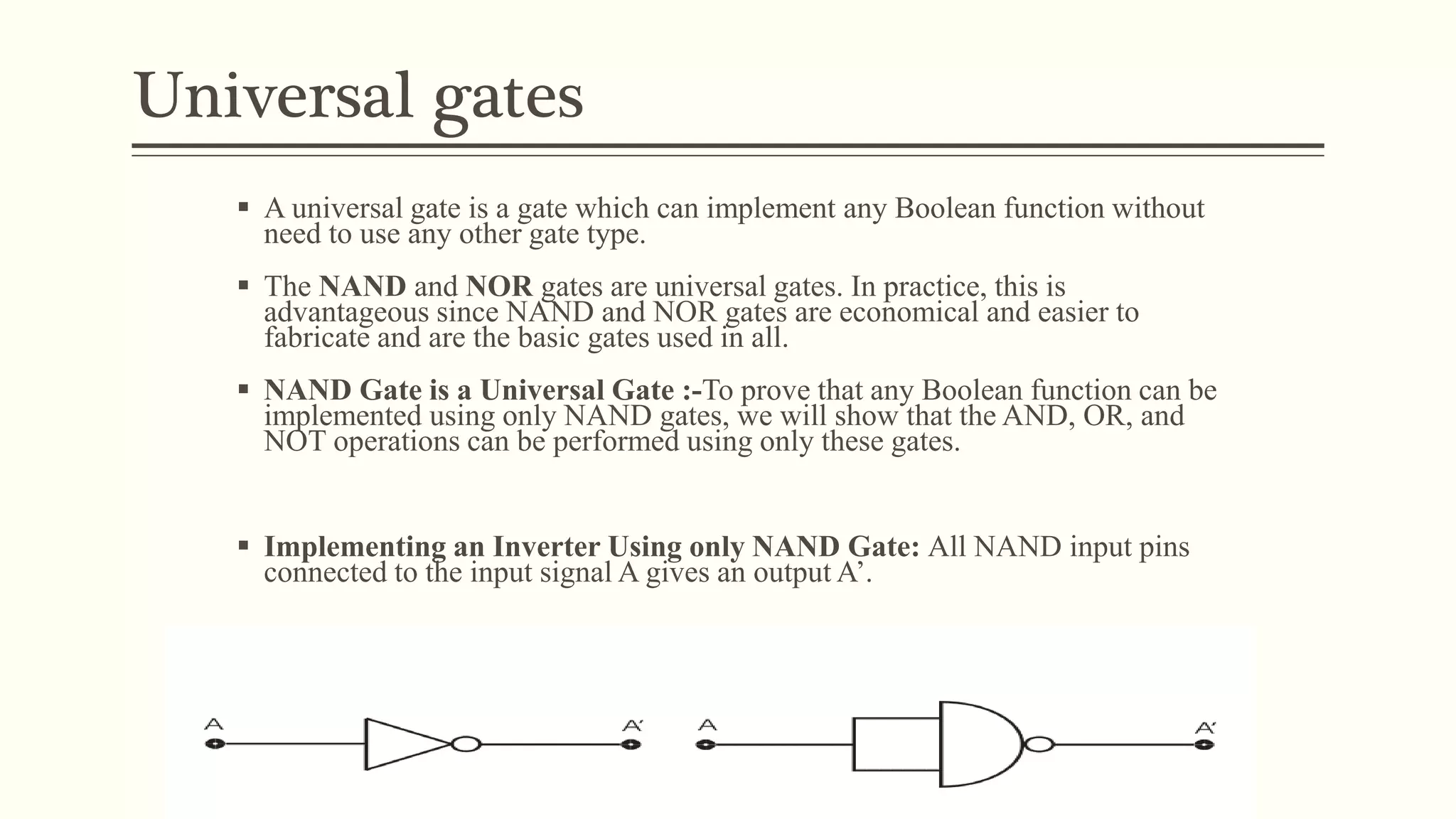
 Implementing an Inverter Using only NAND Gate: All NAND input pins
connected to the input signal A gives an output A’.
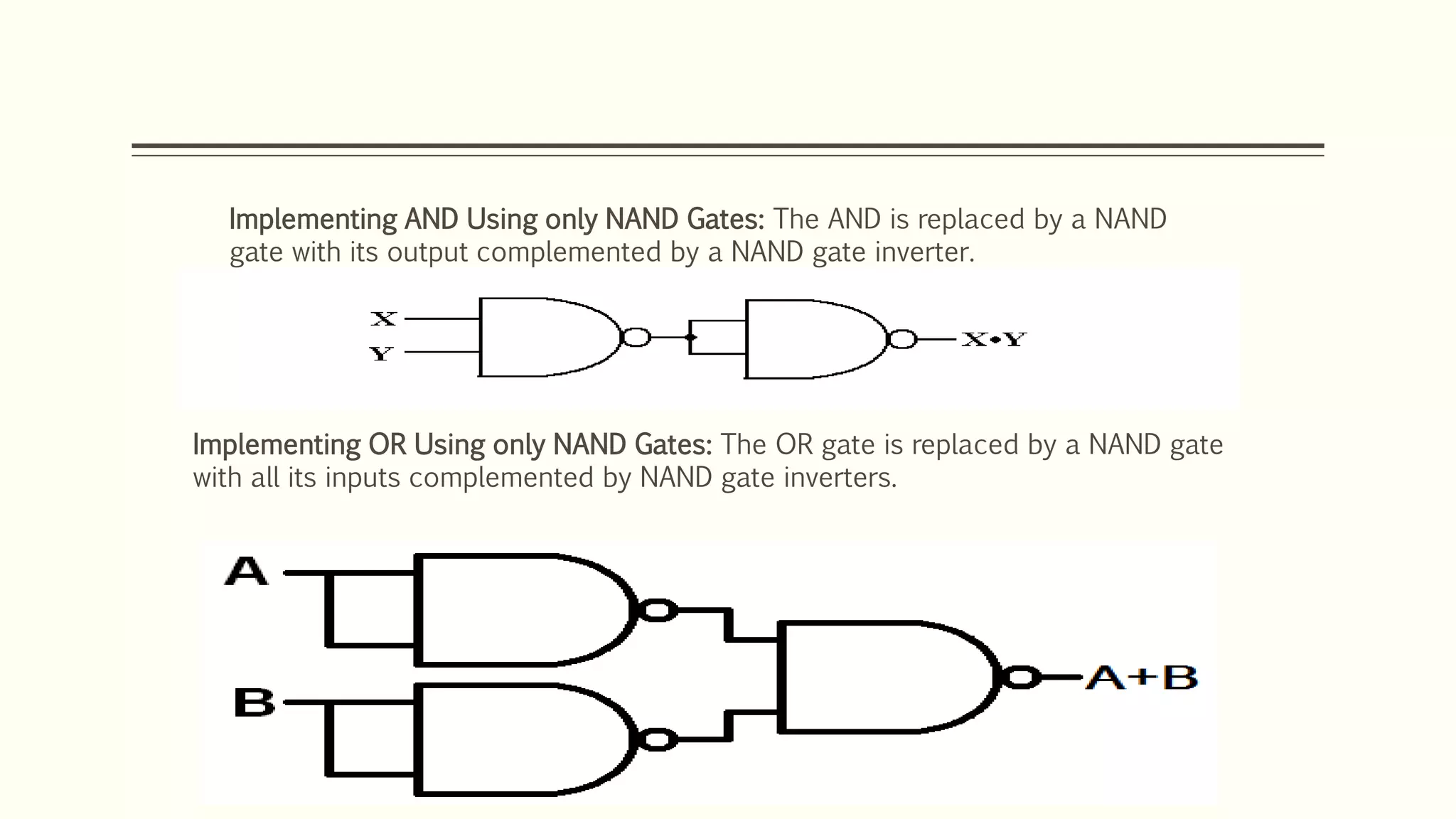
Implementing AND Using only NAND Gates: The AND is replaced by a NAND
gate with its output complemented by a NAND gate inverter.
Implementing OR Using only NAND Gates: The OR gate is replaced by a NAND gate
with all its inputs complemented by NAND gate inverters.
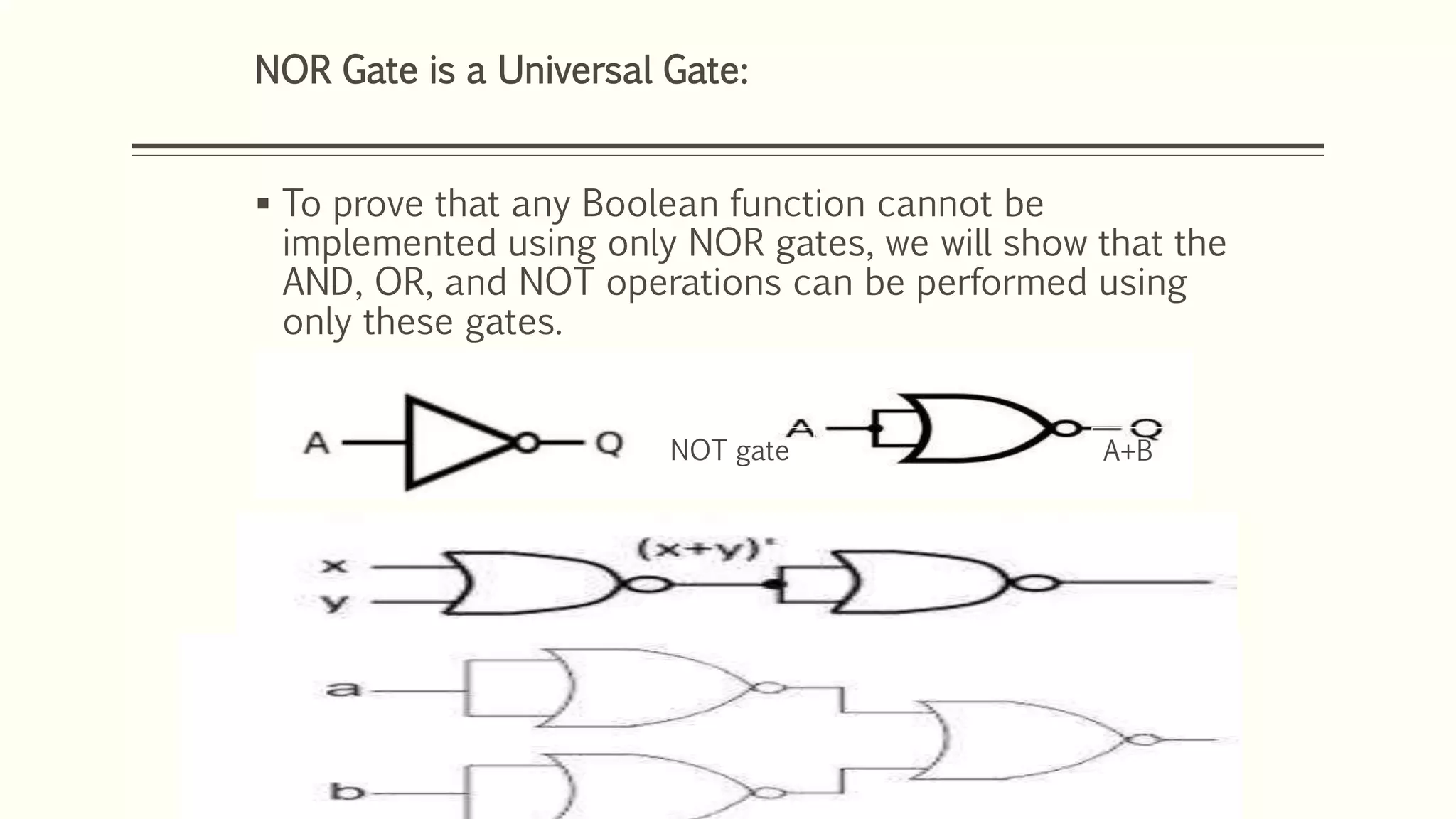
NOR Gate is a Universal Gate:
 To prove that any Boolean function cannot be
implemented using only NOR gates, we will show that the
AND, OR, and NOT operations can be performed using
only these gates.
NOT gate A+B
Complement of a function
 The complement of a function F is F' and is obtained from an interchange of 0's for 1's and
1's for 0's in the value of F.
 Two ways of getting complement of a Boolean function:
 1. Applying De-Morgan’s theorem as many times as necessary
 For example: -
 Find the complement of the function F1 and F2.
 The complement of F1 is F1’ where F1=(x'yz' + x'y'z) so
 F1 ‘=(x'yz' + x'y'z)’
 = (x'yz')'(x'y'z)'
 = (x + y' + z)(x + y + z')
 F2' = [x(y'z' + yz)]'
 = x' + (y'z' + yz)'
 = x' + (y'z')'· (yz)'
 = x' + (y + z)(y' + z')
ANY QUESTIONS?

Chapter 2: Boolean Algebra and Logic Gates

  • 1.
    Er. Nawaraj Bhandari DigitalLogic Chapter 2: Boolean algebra and Logic Gates
  • 2.
    Boolean algebra  Booleanalgebra is a mathematical system for the manipulation of variables that can have one of two values.  In formal logic, these values are “true” and “false.”  In digital systems, these values are “on” and “off,” 1 and 0, or “high” and “low.”  Boolean expressions are created by performing operations on Boolean variables.  Common Boolean operators include AND, OR, and NOT.
  • 3.
    3  A Booleanoperator can be completely described using a truth table.  The truth table for the Boolean operators AND and OR are shown at the right.  The AND operator is also known as a Boolean product. The OR operator is the Boolean sum. Boolean algebra & Truth Table
  • 4.
    4 Boolean Algebra  Thetruth table for the Boolean NOT operator is shown at the right.  The NOT operation is most often designated by an overbar. It is sometimes indicated by a prime mark ( ‘ ) or an “elbow” (). Boolean algebra
  • 5.
    5 Boolean Algebra  ABoolean function has: • At least one Boolean variable, • At least one Boolean operator, and • At least one input from the set {0,1}.  It produces an output that is also a member of the set {0,1}.
  • 6.
    Basic Theory ofBoolean Algebra  Some basic laws for Boolean Algebra A . 0 = 0 where A can be either 0 or 1. A . 1 = A where A can be either 0 or 1. A . A = A where A can be either 0 or 1. A . Ā = 0 where A can be either 0 or 1. A + 0 = A where A can be either 0 or 1. A + 1 = 1 where A can be either 0 or 1. A + Ā = 1 A + A = A A + B = B + A where A and B can be either 0 or 1. A . B = B . A where A and B can be either 0 or 1.
  • 7.
    Duality theorem Dual ofthe Boolean expression is derived by:  Replacing AND operation by OR  Replacing OR operation by AND  All 1's are changed to 0  All 0's are changed to 1  Variables and complements are left unchanged.  Example: X+Y'Z+0 = (0+X).(Y'+Z).1 XY'+XYZ+YZ' = (X+Y').(X+Y+Z).(Y+Z')
  • 8.
    Postulates (1) A +0 = A A · 1 = A identity (2) A + NOT[A] = 1 A · NOT[A] = 0 complement (3) A + B = B + A A · B = B · A commutative law (4) A + (B + C) = (A + B) + C A · (B · C) = (A · B) · C associative law (5) A + (B · C) = (A + B) · (A + C) A · (B + C) = (A · B) + (A · C) distributive law
  • 9.
    De Morgan's theorem First Theorem:  The De-Morgan's first theorem states that, "The complement of a sum equals to the product of the complements".  i.e. (A+B)'=A'.B’
  • 10.
  • 11.
    De Morgan's theorem SecondTheorem: De Morgan's second theorem states that, "The complement of a product is equal to the sum of the complements." i.e. (A.B)'=A'+B'
  • 12.
  • 13.
    Introduction to LogicGates AND Gate It is an electronic circuit, which generates an output signal of 1 if and only if all input signals are also 1 An AND gate is the physical realization of the logical multiplication ( AND operation
  • 14.
  • 15.
  • 16.
  • 17.
  • 18.
    OR Gate  Itis an electronic circuit, which generates an output signal of 1, if any of the output signals is 1  It is the physical realization of logical OR
  • 19.
  • 20.
  • 21.
  • 22.
  • 23.
    NOT Gate  Itis an electronic circuit that generates an output signal, which is reverse of input signal  It is the physical realization of complementation operation  Not Gate is also called inverter because it inverts the input
  • 24.
  • 25.
  • 26.
    NAND Gate  NotAND Gate - NOT + AND gate It is a combination of NOT and AND gates It is Complemented AND Gate  Symbol of NAND gate
  • 27.
  • 28.
  • 29.
  • 30.
  • 32.
    Universal gates  Auniversal gate is a gate which can implement any Boolean function without need to use any other gate type.  The NAND and NOR gates are universal gates. In practice, this is advantageous since NAND and NOR gates are economical and easier to fabricate and are the basic gates used in all.  NAND Gate is a Universal Gate :-To prove that any Boolean function can be implemented using only NAND gates, we will show that the AND, OR, and NOT operations can be performed using only these gates.  Implementing an Inverter Using only NAND Gate: All NAND input pins connected to the input signal A gives an output A’.
  • 33.
    Implementing AND Usingonly NAND Gates: The AND is replaced by a NAND gate with its output complemented by a NAND gate inverter. Implementing OR Using only NAND Gates: The OR gate is replaced by a NAND gate with all its inputs complemented by NAND gate inverters.
  • 34.
    NOR Gate isa Universal Gate:  To prove that any Boolean function cannot be implemented using only NOR gates, we will show that the AND, OR, and NOT operations can be performed using only these gates. NOT gate A+B
  • 35.
    Complement of afunction  The complement of a function F is F' and is obtained from an interchange of 0's for 1's and 1's for 0's in the value of F.  Two ways of getting complement of a Boolean function:  1. Applying De-Morgan’s theorem as many times as necessary  For example: -  Find the complement of the function F1 and F2.  The complement of F1 is F1’ where F1=(x'yz' + x'y'z) so  F1 ‘=(x'yz' + x'y'z)’  = (x'yz')'(x'y'z)'  = (x + y' + z)(x + y + z')  F2' = [x(y'z' + yz)]'  = x' + (y'z' + yz)'  = x' + (y'z')'· (yz)'  = x' + (y + z)(y' + z')
  • 36.