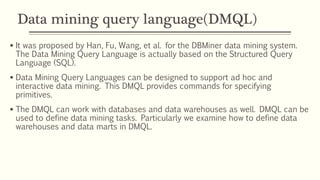
The document discusses Data Mining Query Language (DMQL), which is based on SQL and allows users to define data mining tasks. DMQL can be used to specify data mining primitives and define data warehouses and data marts. The syntax of DMQL is presented, including commands to use a database or data warehouse, specify attributes or dimensions, and filter from relations using conditions. An example DMQL query is provided to select from multiple tables and group results by date. References on data warehousing, OLAP, and data mining concepts are also listed.
![DMQL Syntax
use database database_name
or
use data warehouse data_warehouse_name
in relevance to att_or_dim_list
from relation(s)/cube(s) [where condition]
order by order_list
group by grouping_list
Example
Use database ABCompany_db
In relevance to I .name,I.price, C.income, C.age
From customer C, item I, purchases P, items_sold S
Where I.item_ID=S. item.JD and S.trans_ID =P.trans_ID and P .custJD=C.cust_ID and C. country –
“Sri Lanka” Group by p.data](https://image.slidesharecdn.com/dataminingapproachesandmethods-chapter6-190608040533/85/Data-mining-approaches-and-methods-3-320.jpg)