Er. Nawaraj Bhandari
E-Commerce
Chapter 1:
Introduction to Electronic
Commerce
Electronic Commerce
It is process of buying and selling of products and services by
business and consumers over the internet.
Electronic Commerce applies to the use of computer network to
search and retrieve information in support of human and corporate
decision making.
A large percentage of electronic commerce is conducted entirely
electronically for virtual items such as access to premium content on
a website, but most electronic commerce involves the transportation
of physical items in some ways.
Electronic Commerce
E-Commerce can be divide into :
E-tailing or virtual storefronts on web sites with online catalogs,
sometimes gathered into a “virtual mall”.
Electronic Data Interchange(EDI), the business- to business exchange
of data.
E-mail and fax and their use as media for reaching prospects and
established customers(for example, with newsletters).
Electronic Commerce that is conducted between business is referred
to as business- to-business or B2B. Eg. Alibaba, IBM
Electronic Commerce that is conducted between business and
consumers is referred to as business-to-consumers. Eg, Amazon.com
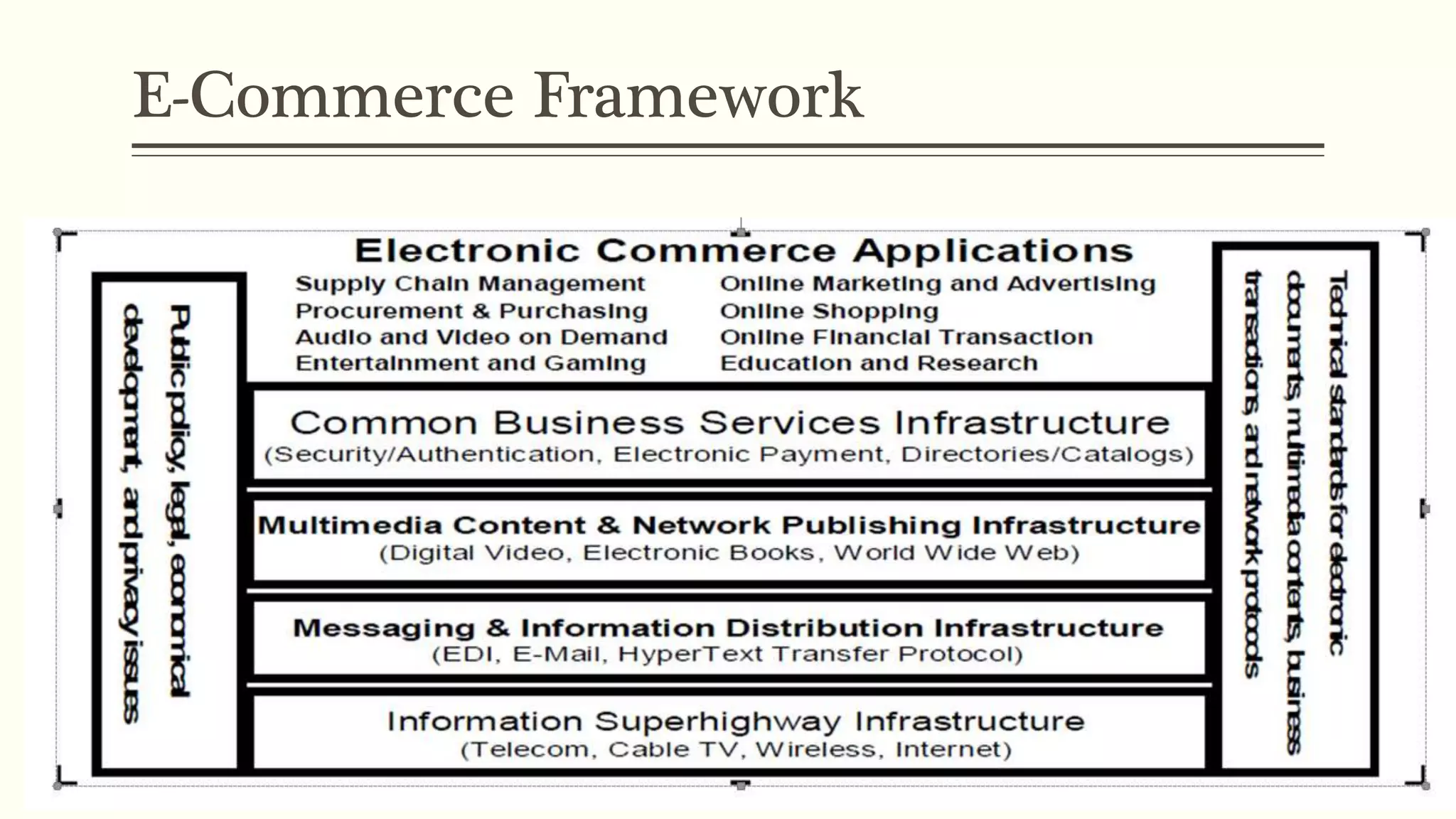
E-Commerce Framework
Electronic Commerce
Public Policy
 – to govern issues such as universal access, privacy and information
pricing.
Technical Standard
– to dictate the nature of information publishing, user interface and
transport in the interest of compatibility across the entire network
Electronic Commerce
 E-Commerce application will be built on the existing technology
infrastructure
A myriad (numerous) of computers
Communication networks
Communication software
Electronic Commerce
According to Kalakota and Whinston, the four building blocks in the
infrastructure are:
Common business services infrastructure
The messaging and information distribution infrastructure
Content and network publishing infrastructure
The information Super highway infrastructure(Internet)
Common business services infrastructure
It consists of followings different elements
Security/Authentication
Electronic Payment
Directories/Catalogs
Security/Authentication
Encryption & authentication methods to ensure
security
User level securities should maintain.
Uses of digital signatures and Encryption
methodologies.
Electronic Payment
Different types of electronic payments like credit
card, debit card, e-banking, mobile banking, SMS
banking etc.
Electronic payment schemes developed to handle
complex transactions
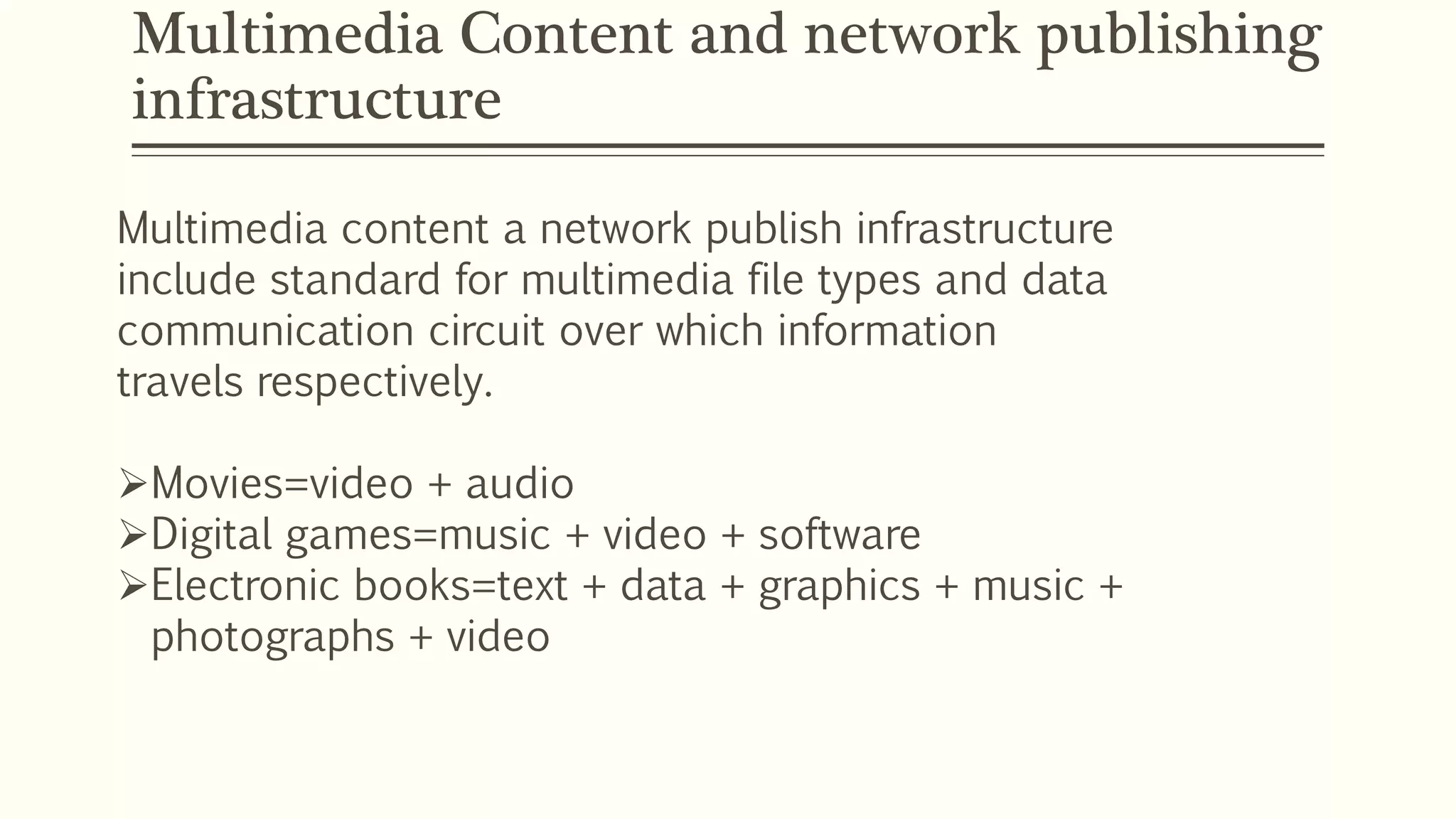
Multimedia Content and network publishing
infrastructure
Multimedia content a network publish infrastructure
include standard for multimedia file types and data
communication circuit over which information
travels respectively.
Movies=video + audio
Digital games=music + video + software
Electronic books=text + data + graphics + music +
photographs + video
Electronic commerce and media
convergence
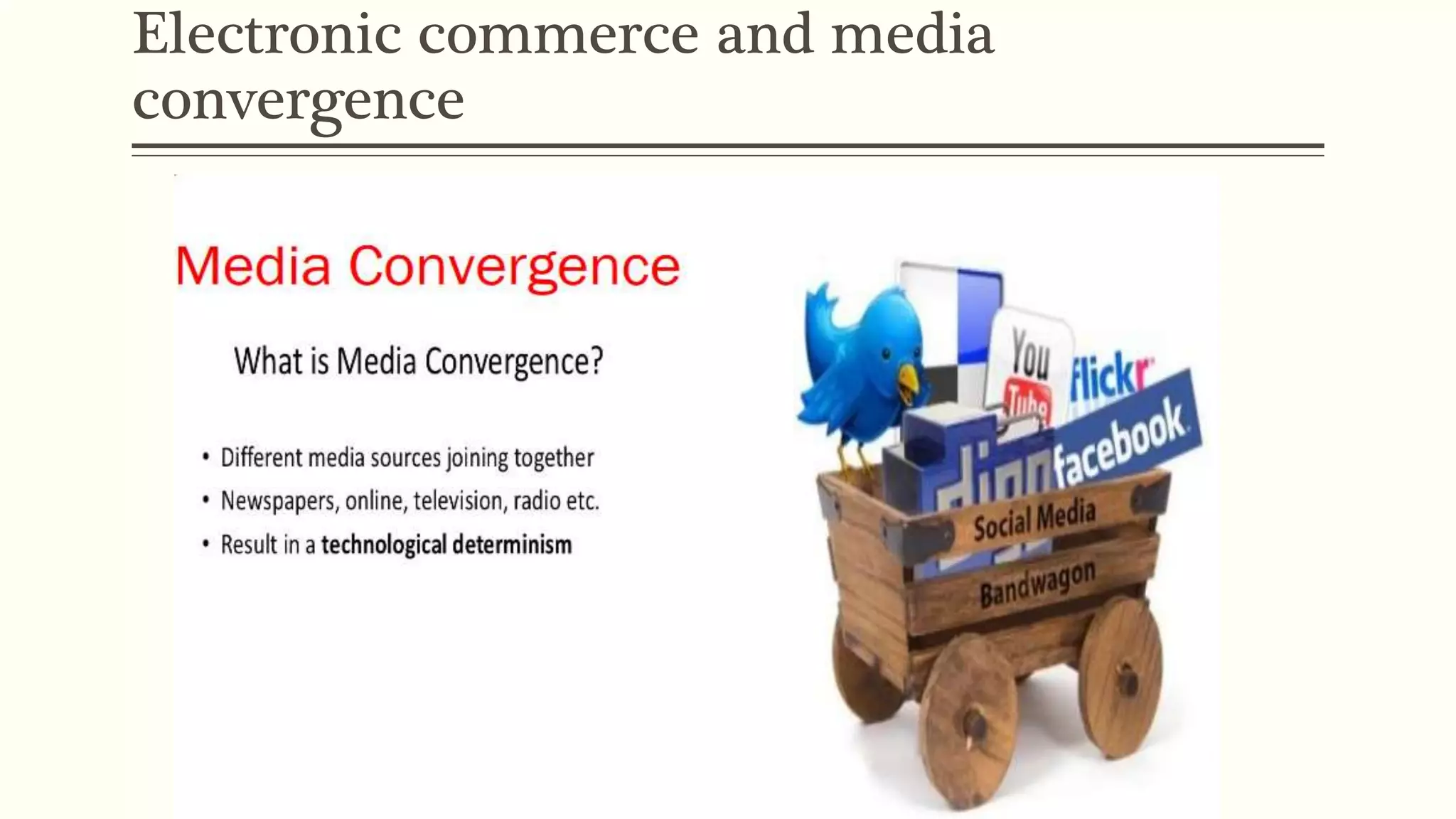
E-commerce has been repeatedly linked with the idea of
convergence (junction) of industries centered on information that
until today has been isolated content, storage, network, business
applications and consumer devices.
Multimedia convergence applies to the conversion of text, voice,
data, image, graphics and motion video into interactive digital
content whereas cross media convergence refers to the
integration of various industries – entertainment, publication, and
communication media base on multimedia content.
Electronic commerce and media
convergence
What convergence stand for
Convergence is increasingly prevalent in the IT world.
In this context the term refers to the combination of
two or more different technologies in a single device.
Taking pictures with a cell phone and surfing the Web
on a television are two of the most common examples
of this trend.
Computer-television convergence is already underway
with Web TV, which pipes the World Wide Web to a
slightly-modified TV set with a set-top box from an
ordinary phone line and provides a degree of
interactivity.
Need of Media Convergence
 Technologically rich societies have entered the digital age
 Media industries are grappling with new opportunities - and
threats - afforded by what is called
"convergence".
 Media people tend to get very excited about convergence,
because it holds so much promise.
 The melding together of different media, incorporating new
personalized services is both
impressive and overwhelming.
Electronic commerce and media
convergence
Thus convergence requires removing the barriers between the
telecommunications, broadcasting, computing, movie, electronic games and
publishing industries to facilitate interoperability.
Convergence may incorporate the following technological advances
1. Convergence of content:
2. Convergence of transmission:
3. Convergence of information access devices:
References
http://www.utdallas.edu/~chung/ecom.html
http://whatis.techtarget.com/definition/convergence
http://www.slideshare.net/Tashieka/media-convergence-4019719
http://rthk.hk/mediadigest/20030415_76_74280.htm
ANY QUESTIONS?

Introduction to Electronic Commerce

  • 1.
    Er. Nawaraj Bhandari E-Commerce Chapter1: Introduction to Electronic Commerce
  • 2.
    Electronic Commerce It isprocess of buying and selling of products and services by business and consumers over the internet. Electronic Commerce applies to the use of computer network to search and retrieve information in support of human and corporate decision making. A large percentage of electronic commerce is conducted entirely electronically for virtual items such as access to premium content on a website, but most electronic commerce involves the transportation of physical items in some ways.
  • 3.
    Electronic Commerce E-Commerce canbe divide into : E-tailing or virtual storefronts on web sites with online catalogs, sometimes gathered into a “virtual mall”. Electronic Data Interchange(EDI), the business- to business exchange of data. E-mail and fax and their use as media for reaching prospects and established customers(for example, with newsletters). Electronic Commerce that is conducted between business is referred to as business- to-business or B2B. Eg. Alibaba, IBM Electronic Commerce that is conducted between business and consumers is referred to as business-to-consumers. Eg, Amazon.com
  • 4.
  • 5.
    Electronic Commerce Public Policy – to govern issues such as universal access, privacy and information pricing. Technical Standard – to dictate the nature of information publishing, user interface and transport in the interest of compatibility across the entire network
  • 6.
    Electronic Commerce  E-Commerceapplication will be built on the existing technology infrastructure A myriad (numerous) of computers Communication networks Communication software
  • 7.
    Electronic Commerce According toKalakota and Whinston, the four building blocks in the infrastructure are: Common business services infrastructure The messaging and information distribution infrastructure Content and network publishing infrastructure The information Super highway infrastructure(Internet)
  • 8.
    Common business servicesinfrastructure It consists of followings different elements Security/Authentication Electronic Payment Directories/Catalogs
  • 9.
    Security/Authentication Encryption & authenticationmethods to ensure security User level securities should maintain. Uses of digital signatures and Encryption methodologies.
  • 10.
    Electronic Payment Different typesof electronic payments like credit card, debit card, e-banking, mobile banking, SMS banking etc. Electronic payment schemes developed to handle complex transactions
  • 11.
    Multimedia Content andnetwork publishing infrastructure Multimedia content a network publish infrastructure include standard for multimedia file types and data communication circuit over which information travels respectively. Movies=video + audio Digital games=music + video + software Electronic books=text + data + graphics + music + photographs + video
  • 12.
    Electronic commerce andmedia convergence E-commerce has been repeatedly linked with the idea of convergence (junction) of industries centered on information that until today has been isolated content, storage, network, business applications and consumer devices. Multimedia convergence applies to the conversion of text, voice, data, image, graphics and motion video into interactive digital content whereas cross media convergence refers to the integration of various industries – entertainment, publication, and communication media base on multimedia content.
  • 13.
    Electronic commerce andmedia convergence
  • 14.
    What convergence standfor Convergence is increasingly prevalent in the IT world. In this context the term refers to the combination of two or more different technologies in a single device. Taking pictures with a cell phone and surfing the Web on a television are two of the most common examples of this trend. Computer-television convergence is already underway with Web TV, which pipes the World Wide Web to a slightly-modified TV set with a set-top box from an ordinary phone line and provides a degree of interactivity.
  • 15.
    Need of MediaConvergence  Technologically rich societies have entered the digital age  Media industries are grappling with new opportunities - and threats - afforded by what is called "convergence".  Media people tend to get very excited about convergence, because it holds so much promise.  The melding together of different media, incorporating new personalized services is both impressive and overwhelming.
  • 16.
    Electronic commerce andmedia convergence Thus convergence requires removing the barriers between the telecommunications, broadcasting, computing, movie, electronic games and publishing industries to facilitate interoperability. Convergence may incorporate the following technological advances 1. Convergence of content: 2. Convergence of transmission: 3. Convergence of information access devices:
  • 17.
  • 18.

Editor's Notes

  • #5 EDI: Electronic Data Interchange Key Pillar of E-commerce is: Public policy Technical standards
  • #17 Convergence of content: Translates all types of information content including books, business documents, videos, movies, music into digital in formation. Once converted into digital format, the processing, searching, sorting, conversion, compression, encryption, transmission of information can be easily matched with today’s information processing systems. Convergence of transmission: Compresses and stores digitalized information so it can travel through the existing guided transmission media. Hence the information in clouding voice, data, image and video can be transmitted without rewiring our home. Convergence of information access devices: Have the sophistication to function as both computers and televisions. Other examples are the ubiquitous telephone, with internal fax machine, modem and video monitor.