Chemical Reactions
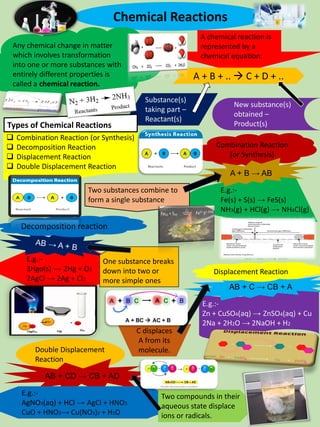
Any chemical change in matter
which involves transformation
into one or more substances with
entirely different properties is
called a chemical reaction.
A chemical reaction is
represented by a
chemical equation.
Substance(s)
taking part –
Reactant(s)
New substance(s)
obtained –
Product(s)
❑ Combination Reaction (or Synthesis)
❑ Decomposition Reaction
❑ Displacement Reaction
❑ Double Displacement Reaction
E.g.:-
Fe(s) + S(s) → FeS(s)
NH3(g) + HCl(g) → NH4Cl(g)
A + B + .. → C + D + ..
Types of Chemical Reactions
Two substances combine to
form a single substance
Combination Reaction
(or Synthesis)
A + B → AB
E.g.:-
2Hgo(s) → 2Hg + O2
2AgCl → 2Ag + Cl2
Decomposition reaction
One substance breaks
down into two or
more simple ones
E.g.:-
Zn + CuSO4(aq) → ZnSO4(aq) + Cu
2Na + 2H2O → 2NaOH + H2
AB + C → CB + A
C displaces
A from its
molecule.
Displacement Reaction
Double Displacement
Reaction
AB + CD → CB + AD
E.g.:-
AgNO3(aq) + HCl → AgCl + HNO3
CuO + HNO3→ Cu(NO3)2 + H2O
Two compounds in their
aqueous state displace
ions or radicals.
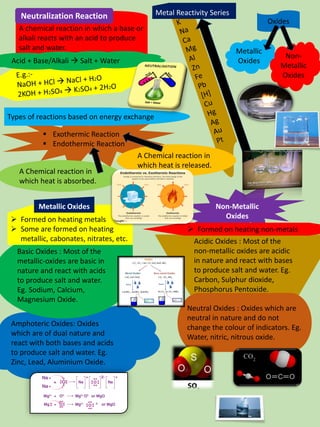
A chemical reaction in which a base or
alkali reacts with an acid to produce
salt and water.
▪ Exothermic Reaction
▪ Endothermic Reaction
A Chemical reaction in
which heat is released.
A Chemical reaction in
which heat is absorbed.
Oxides
Metallic
Oxides
Non-
Metallic
Oxides
Amphoteric Oxides: Oxides
which are of dual nature and
react with both bases and acids
to produce salt and water. Eg.
Zinc, Lead, Aluminium Oxide.
Non-Metallic
Oxides
Neutralization Reaction
Acid + Base/Alkali → Salt + Water
Metal Reactivity Series
Types of reactions based on energy exchange
Basic Oxides : Most of the
metallic-oxides are basic in
nature and react with acids
to produce salt and water.
Eg. Sodium, Calcium,
Magnesium Oxide.
➢ Formed on heating metals
➢ Some are formed on heating
metallic, cabonates, nitrates, etc.
Metallic Oxides
Acidic Oxides : Most of the
non-metallic oxides are acidic
in nature and react with bases
to produce salt and water. Eg.
Carbon, Sulphur dioxide,
Phosphorus Pentoxide.
➢ Formed on heating non-metals
Neutral Oxides : Oxides which are
neutral in nature and do not
change the colour of indicators. Eg.
Water, nitric, nitrous oxide.

Chemical reactions-poster-converted

  • 1.
    Chemical Reactions Any chemicalchange in matter which involves transformation into one or more substances with entirely different properties is called a chemical reaction. A chemical reaction is represented by a chemical equation. Substance(s) taking part – Reactant(s) New substance(s) obtained – Product(s) ❑ Combination Reaction (or Synthesis) ❑ Decomposition Reaction ❑ Displacement Reaction ❑ Double Displacement Reaction E.g.:- Fe(s) + S(s) → FeS(s) NH3(g) + HCl(g) → NH4Cl(g) A + B + .. → C + D + .. Types of Chemical Reactions Two substances combine to form a single substance Combination Reaction (or Synthesis) A + B → AB E.g.:- 2Hgo(s) → 2Hg + O2 2AgCl → 2Ag + Cl2 Decomposition reaction One substance breaks down into two or more simple ones E.g.:- Zn + CuSO4(aq) → ZnSO4(aq) + Cu 2Na + 2H2O → 2NaOH + H2 AB + C → CB + A C displaces A from its molecule. Displacement Reaction Double Displacement Reaction AB + CD → CB + AD E.g.:- AgNO3(aq) + HCl → AgCl + HNO3 CuO + HNO3→ Cu(NO3)2 + H2O Two compounds in their aqueous state displace ions or radicals.
  • 2.
    A chemical reactionin which a base or alkali reacts with an acid to produce salt and water. ▪ Exothermic Reaction ▪ Endothermic Reaction A Chemical reaction in which heat is released. A Chemical reaction in which heat is absorbed. Oxides Metallic Oxides Non- Metallic Oxides Amphoteric Oxides: Oxides which are of dual nature and react with both bases and acids to produce salt and water. Eg. Zinc, Lead, Aluminium Oxide. Non-Metallic Oxides Neutralization Reaction Acid + Base/Alkali → Salt + Water Metal Reactivity Series Types of reactions based on energy exchange Basic Oxides : Most of the metallic-oxides are basic in nature and react with acids to produce salt and water. Eg. Sodium, Calcium, Magnesium Oxide. ➢ Formed on heating metals ➢ Some are formed on heating metallic, cabonates, nitrates, etc. Metallic Oxides Acidic Oxides : Most of the non-metallic oxides are acidic in nature and react with bases to produce salt and water. Eg. Carbon, Sulphur dioxide, Phosphorus Pentoxide. ➢ Formed on heating non-metals Neutral Oxides : Oxides which are neutral in nature and do not change the colour of indicators. Eg. Water, nitric, nitrous oxide.