PREPARED BY MISS SALIHA RAIS
CLASS IX
CHEMISTRY
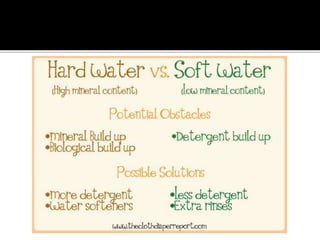
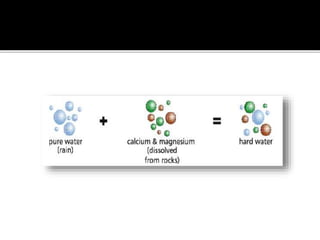
 Water containing dissolved impurities of
hydrogen carbonates, chlorides and
sulphates of calcium and magnesium is called
hard water.
 It does not give lather with soap.
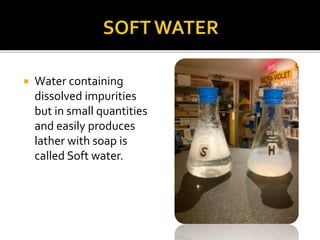
 Water containing
dissolved impurities
but in small quantities
and easily produces
lather with soap is
called Soft water.
 Hard water produces
curds with soap and
affects the cleaning
action of soap.
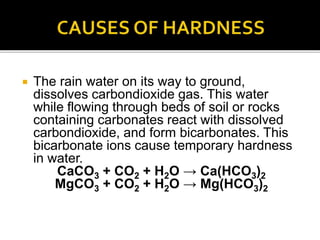
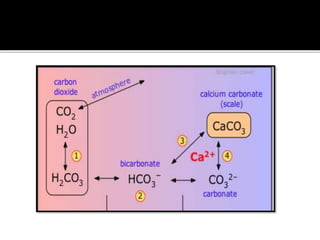
 The rain water on its way to ground,
dissolves carbondioxide gas. This water
while flowing through beds of soil or rocks
containing carbonates react with dissolved
carbondioxide, and form bicarbonates. This
bicarbonate ions cause temporary hardness
in water.
CaCO3 + CO2 + H2O → Ca(HCO3)2
MgCO3 + CO2 + H2O → Mg(HCO3)2
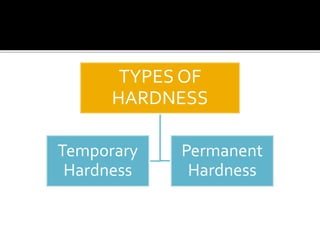
TYPES OF
HARDNESS
Temporary
Hardness
Permanent
Hardness
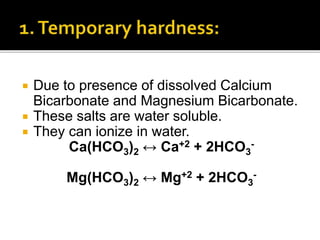
 Due to presence of dissolved Calcium
Bicarbonate and Magnesium Bicarbonate.
 These salts are water soluble.
 They can ionize in water.
Ca(HCO3)2 ↔ Ca+2 + 2HCO3
-
Mg(HCO3)2 ↔ Mg+2 + 2HCO3
-
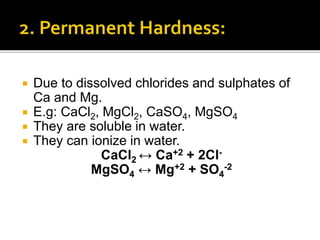
 Due to dissolved chlorides and sulphates of
Ca and Mg.
 E.g: CaCl2, MgCl2, CaSO4, MgSO4
 They are soluble in water.
 They can ionize in water.
CaCl2 ↔ Ca+2 + 2Cl-
MgSO4 ↔ Mg+2 + SO4
-2
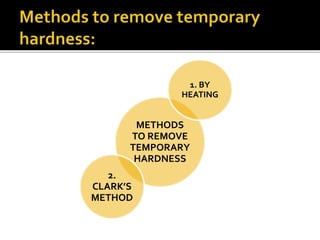
METHODS
TO REMOVE
TEMPORARY
HARDNESS
1. BY
HEATING
2.
CLARK’S
METHOD
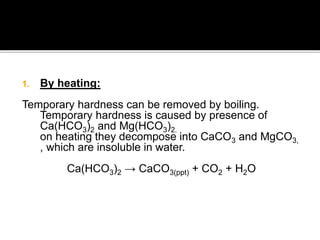
1. By heating:
Temporary hardness can be removed by boiling.
Temporary hardness is caused by presence of
Ca(HCO3)2 and Mg(HCO3)2.
on heating they decompose into CaCO3 and MgCO3,
, which are insoluble in water.
Ca(HCO3)2 → CaCO3(ppt) + CO2 + H2O
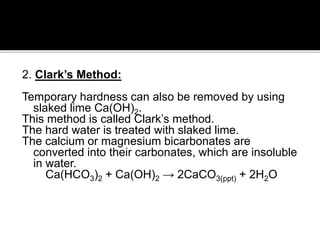
2. Clark’s Method:
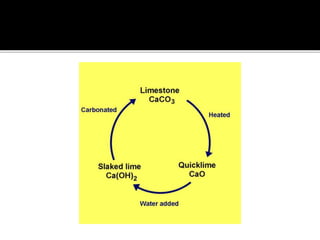
Temporary hardness can also be removed by using
slaked lime Ca(OH)2.
This method is called Clark’s method.
The hard water is treated with slaked lime.
The calcium or magnesium bicarbonates are
converted into their carbonates, which are insoluble
in water.
Ca(HCO3)2 + Ca(OH)2 → 2CaCO3(ppt) + 2H2O
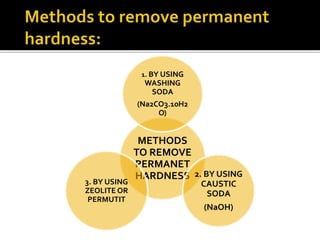
METHODS
TO REMOVE
PERMANET
HARDNESS
1. BY USING
WASHING
SODA
(Na2CO3.10H2
O)
2. BY USING
CAUSTIC
SODA
(NaOH)
3. BY USING
ZEOLITE OR
PERMUTIT
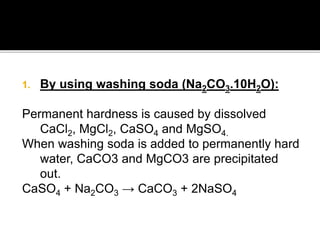
1. By using washing soda (Na2CO3.10H2O):
Permanent hardness is caused by dissolved
CaCl2, MgCl2, CaSO4 and MgSO4.
When washing soda is added to permanently hard
water, CaCO3 and MgCO3 are precipitated
out.
CaSO4 + Na2CO3 → CaCO3 + 2NaSO4
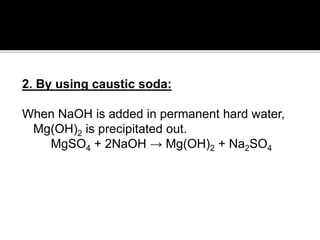
2. By using caustic soda:
When NaOH is added in permanent hard water,
Mg(OH)2 is precipitated out.
MgSO4 + 2NaOH → Mg(OH)2 + Na2SO4
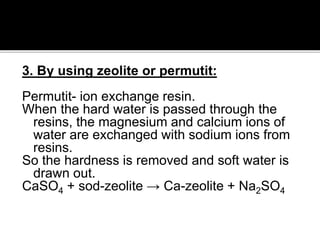
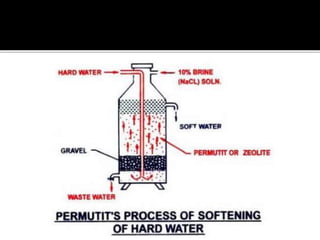
3. By using zeolite or permutit:
Permutit- ion exchange resin.
When the hard water is passed through the
resins, the magnesium and calcium ions of
water are exchanged with sodium ions from
resins.
So the hardness is removed and soft water is
drawn out.
CaSO4 + sod-zeolite → Ca-zeolite + Na2SO4
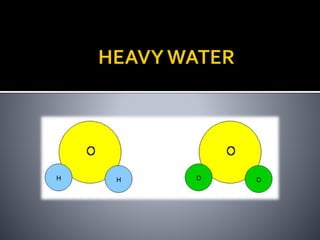
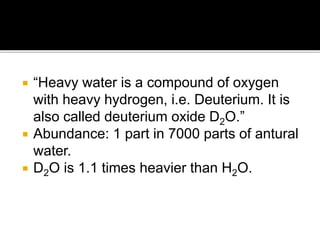
 “Heavy water is a compound of oxygen
with heavy hydrogen, i.e. Deuterium. It is
also called deuterium oxide D2O.”
 Abundance: 1 part in 7000 parts of antural
water.
 D2O is 1.1 times heavier than H2O.
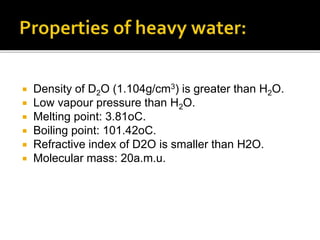
 Density of D2O (1.104g/cm3) is greater than H2O.
 Low vapour pressure than H2O.
 Melting point: 3.81oC.
 Boiling point: 101.42oC.
 Refractive index of D2O is smaller than H2O.
 Molecular mass: 20a.m.u.
 “The substances that absorb moisture on
exposure to air are called Hygroscopic
substances.”
 If the substance is a solid, it will not become
solution, but merely become sticke or moist.
 E.g. Sodium nitrate NaNO3,Copper oxide
CuO, Calcium oxide CaO.
 Uses: used as drying agent in the laboratory
since they have strong affinity to absorb
moisture.
 Deliquescent substances: they absorb large
amount of water, and eventually forms a
solution when exposed to air.
Soft, hard and heavy water, by Saliha Rais, for grade 9.

Soft, hard and heavy water, by Saliha Rais, for grade 9.

  • 1.
    PREPARED BY MISSSALIHA RAIS CLASS IX CHEMISTRY
  • 2.
     Water containingdissolved impurities of hydrogen carbonates, chlorides and sulphates of calcium and magnesium is called hard water.  It does not give lather with soap.
  • 3.
     Water containing dissolvedimpurities but in small quantities and easily produces lather with soap is called Soft water.
  • 4.
     Hard waterproduces curds with soap and affects the cleaning action of soap.
  • 6.
     The rainwater on its way to ground, dissolves carbondioxide gas. This water while flowing through beds of soil or rocks containing carbonates react with dissolved carbondioxide, and form bicarbonates. This bicarbonate ions cause temporary hardness in water. CaCO3 + CO2 + H2O → Ca(HCO3)2 MgCO3 + CO2 + H2O → Mg(HCO3)2
  • 9.
  • 10.
     Due topresence of dissolved Calcium Bicarbonate and Magnesium Bicarbonate.  These salts are water soluble.  They can ionize in water. Ca(HCO3)2 ↔ Ca+2 + 2HCO3 - Mg(HCO3)2 ↔ Mg+2 + 2HCO3 -
  • 11.
     Due todissolved chlorides and sulphates of Ca and Mg.  E.g: CaCl2, MgCl2, CaSO4, MgSO4  They are soluble in water.  They can ionize in water. CaCl2 ↔ Ca+2 + 2Cl- MgSO4 ↔ Mg+2 + SO4 -2
  • 13.
  • 14.
    1. By heating: Temporaryhardness can be removed by boiling. Temporary hardness is caused by presence of Ca(HCO3)2 and Mg(HCO3)2. on heating they decompose into CaCO3 and MgCO3, , which are insoluble in water. Ca(HCO3)2 → CaCO3(ppt) + CO2 + H2O
  • 15.
    2. Clark’s Method: Temporaryhardness can also be removed by using slaked lime Ca(OH)2. This method is called Clark’s method. The hard water is treated with slaked lime. The calcium or magnesium bicarbonates are converted into their carbonates, which are insoluble in water. Ca(HCO3)2 + Ca(OH)2 → 2CaCO3(ppt) + 2H2O
  • 17.
    METHODS TO REMOVE PERMANET HARDNESS 1. BYUSING WASHING SODA (Na2CO3.10H2 O) 2. BY USING CAUSTIC SODA (NaOH) 3. BY USING ZEOLITE OR PERMUTIT
  • 18.
    1. By usingwashing soda (Na2CO3.10H2O): Permanent hardness is caused by dissolved CaCl2, MgCl2, CaSO4 and MgSO4. When washing soda is added to permanently hard water, CaCO3 and MgCO3 are precipitated out. CaSO4 + Na2CO3 → CaCO3 + 2NaSO4
  • 19.
    2. By usingcaustic soda: When NaOH is added in permanent hard water, Mg(OH)2 is precipitated out. MgSO4 + 2NaOH → Mg(OH)2 + Na2SO4
  • 20.
    3. By usingzeolite or permutit: Permutit- ion exchange resin. When the hard water is passed through the resins, the magnesium and calcium ions of water are exchanged with sodium ions from resins. So the hardness is removed and soft water is drawn out. CaSO4 + sod-zeolite → Ca-zeolite + Na2SO4
  • 23.
     “Heavy wateris a compound of oxygen with heavy hydrogen, i.e. Deuterium. It is also called deuterium oxide D2O.”  Abundance: 1 part in 7000 parts of antural water.  D2O is 1.1 times heavier than H2O.
  • 24.
     Density ofD2O (1.104g/cm3) is greater than H2O.  Low vapour pressure than H2O.  Melting point: 3.81oC.  Boiling point: 101.42oC.  Refractive index of D2O is smaller than H2O.  Molecular mass: 20a.m.u.
  • 26.
     “The substancesthat absorb moisture on exposure to air are called Hygroscopic substances.”  If the substance is a solid, it will not become solution, but merely become sticke or moist.  E.g. Sodium nitrate NaNO3,Copper oxide CuO, Calcium oxide CaO.  Uses: used as drying agent in the laboratory since they have strong affinity to absorb moisture.
  • 27.
     Deliquescent substances:they absorb large amount of water, and eventually forms a solution when exposed to air.