HOLT, RINEHART AND WINSTON
PPSYCHOLOGYSYCHOLOGY
PRINCIPLES IN PRACTICE
1
Chapter 4
SENSATION AND PERCEPTION
Section 1: Sensation and Perception: The Basics
Section 2: Vision
Section 3: Hearing
Section 4: Other Senses
Section 5: Perception
HOLT, RINEHART AND WINSTON
PPSYCHOLOGYSYCHOLOGY
PRINCIPLES IN PRACTICE
2
Chapter 4Chapter 4
Section 1:
Sensation and Perception: The Basics
HOLT, RINEHART AND WINSTON
PPSYCHOLOGYSYCHOLOGY
PRINCIPLES IN PRACTICE
Section #1 Vocab Terms
 Sensation
 Perception
 Absolute threshold
 Difference threshold
 Signal-detection theory
 Sensory adaptation
3
Chapter 4Chapter 4
HOLT, RINEHART AND WINSTON
PPSYCHOLOGYSYCHOLOGY
PRINCIPLES IN PRACTICE
4
Chapter 4Chapter 4
Question: Do sensation and perception
contribute to an understanding of our
environment?
Answer:
YES, SENSATION AND
PERCEPTION CONTRIBUTE
IN MANY WAYS TO AN
UNDERSTANDING OF OUR
ENVIRONMENT.
HOLT, RINEHART AND WINSTON
PPSYCHOLOGYSYCHOLOGY
PRINCIPLES IN PRACTICE
5
Chapter 4Chapter 4
 Sensation provides information to the
central nervous system about the
physical environment
 Perception is the process through which
people interpret sensory stimulation
HOLT, RINEHART AND WINSTON
PPSYCHOLOGYSYCHOLOGY
PRINCIPLES IN PRACTICE
The Basics Sensation
• Process by which our senses gather information and
send it to the brain
HOLT, RINEHART AND WINSTON
PPSYCHOLOGYSYCHOLOGY
PRINCIPLES IN PRACTICE
Sensation…
• A large amount of information is being sensed at any
one time such as room temperature, brightness of
the lights, someone talking, a distant train, or the
smell of perfume.
• With all this information coming into our senses, the
majority of our world never gets recognized.
• We don't notice radio waves, x-rays, or the
microscopic parasites crawling on our skin.
7
Chapter 4Chapter 4
HOLT, RINEHART AND WINSTON
PPSYCHOLOGYSYCHOLOGY
PRINCIPLES IN PRACTICEThe Basics Perception
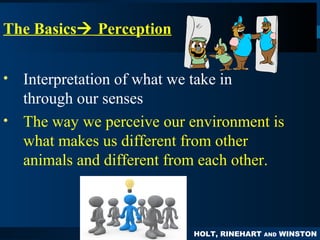
• Interpretation of what we take in
through our senses
• The way we perceive our environment is
what makes us different from other
animals and different from each other.
HOLT, RINEHART AND WINSTON
PPSYCHOLOGYSYCHOLOGY
PRINCIPLES IN PRACTICE
9
HOLT, RINEHART AND WINSTON
PPSYCHOLOGYSYCHOLOGY
PRINCIPLES IN PRACTICE
10
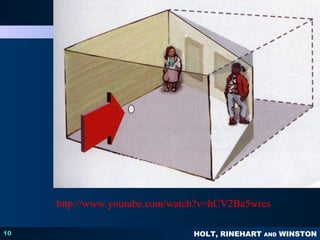
http://www.youtube.com/watch?v=hCV2Ba5wrcs
HOLT, RINEHART AND WINSTON
PPSYCHOLOGYSYCHOLOGY
PRINCIPLES IN PRACTICE
Sensation & Perception WORK TOGETHER:
1) Sensation occurs:
 a) sensory organs absorb energy from a
physical stimulus in the environment.
 b) sensory receptors convert this energy
into neural impulses and send them to the
brain.
2) Perception follows:
 a) the brain organizes the information and
translates it into something meaningful.
HOLT, RINEHART AND WINSTON
PPSYCHOLOGYSYCHOLOGY
PRINCIPLES IN PRACTICE
12
Chapter 4Chapter 4
HOLT, RINEHART AND WINSTON
PPSYCHOLOGYSYCHOLOGY
PRINCIPLES IN PRACTICE
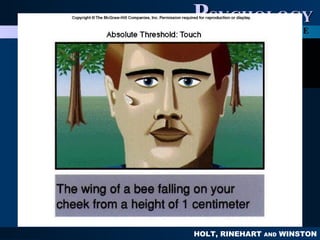
Absolute Threshold
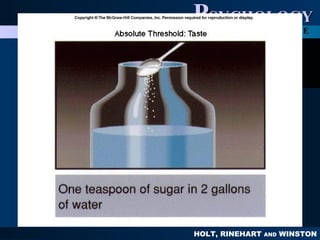
• The absolute threshold is the point where
something becomes noticeable to our
senses.
• It is the softest sound we can hear or the
slightest touch we can feel.
• Anything less than this goes unnoticed.
HOLT, RINEHART AND WINSTON
PPSYCHOLOGYSYCHOLOGY
PRINCIPLES IN PRACTICE
HOLT, RINEHART AND WINSTON
PPSYCHOLOGYSYCHOLOGY
PRINCIPLES IN PRACTICE
HOLT, RINEHART AND WINSTON
PPSYCHOLOGYSYCHOLOGY
PRINCIPLES IN PRACTICE
HOLT, RINEHART AND WINSTON
PPSYCHOLOGYSYCHOLOGY
PRINCIPLES IN PRACTICE
HOLT, RINEHART AND WINSTON
PPSYCHOLOGYSYCHOLOGY
PRINCIPLES IN PRACTICE
HOLT, RINEHART AND WINSTON
PPSYCHOLOGYSYCHOLOGY
PRINCIPLES IN PRACTICE
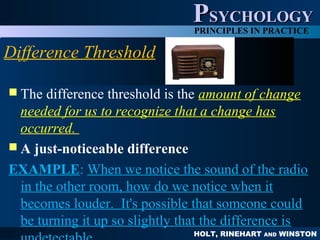
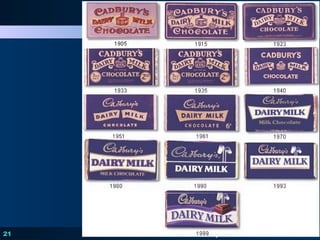
Difference Threshold
 The difference threshold is the amount of change
needed for us to recognize that a change has
occurred.
 A just-noticeable difference
EXAMPLE: When we notice the sound of the radio
in the other room, how do we notice when it
becomes louder. It's possible that someone could
be turning it up so slightly that the difference is
HOLT, RINEHART AND WINSTON
PPSYCHOLOGYSYCHOLOGY
PRINCIPLES IN PRACTICE
20
Chapter 4Chapter 4
HOLT, RINEHART AND WINSTON
PPSYCHOLOGYSYCHOLOGY
PRINCIPLES IN PRACTICE
21
HOLT, RINEHART AND WINSTON
PPSYCHOLOGYSYCHOLOGY
PRINCIPLES IN PRACTICE
Signal Detection Theory
When we attempt detect what we want to
focus on and ignore or minimize
everything else.
 We focus on what is important to us!
 Examples:
 Miss Bolinsky can hear someone cursing at the other end
of the crowded hallway.
 Mr. Straubel can smell coffee brewing three rooms down
from his.
HOLT, RINEHART AND WINSTON
PPSYCHOLOGYSYCHOLOGY
PRINCIPLES IN PRACTICE
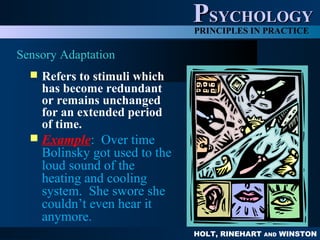
Sensory Adaptation
 Refers to stimuli which
has become redundant
or remains unchanged
for an extended period
of time.
 Example: Over time
Bolinsky got used to the
loud sound of the
heating and cooling
system. She swore she
couldn’t even hear it
anymore.
HOLT, RINEHART AND WINSTON
PPSYCHOLOGYSYCHOLOGY
PRINCIPLES IN PRACTICE
Section #2 Vision
24
Chapter 4Chapter 4
HOLT, RINEHART AND WINSTON
PPSYCHOLOGYSYCHOLOGY
PRINCIPLES IN PRACTICE
25
Chapter 4Chapter 4
HOLT, RINEHART AND WINSTON
PPSYCHOLOGYSYCHOLOGY
PRINCIPLES IN PRACTICE
26
Chapter 4Chapter 4
HOLT, RINEHART AND WINSTON
PPSYCHOLOGYSYCHOLOGY
PRINCIPLES IN PRACTICE
27
HOLT, RINEHART AND WINSTON
PPSYCHOLOGYSYCHOLOGY
PRINCIPLES IN PRACTICE
A Journey Through the Human Eye: How We See
 http://www.youtube.com/watch?
v=gvozcv8pS3c
28
Chapter 4Chapter 4
HOLT, RINEHART AND WINSTON
PPSYCHOLOGYSYCHOLOGY
PRINCIPLES IN PRACTICE
29
Chapter 4Chapter 4
Question: How does the eye enable vision?
THE EYE AND VISION
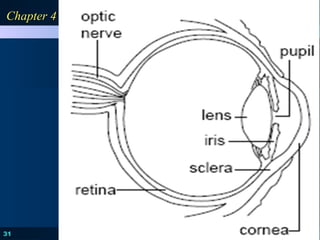
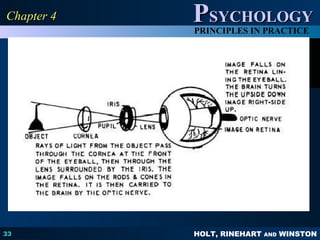
 Light enters the eye and then is projected onto a
surface
 The amount of light that enters the eye is determined
by the size of the pupil which adjusts automatically
to the amount of light entering the eye
 Once light enters the eye, it encounters the lens which
adjusts to the distance of objects by changing its
thickness
Section 2: Vision
HOLT, RINEHART AND WINSTON
PPSYCHOLOGYSYCHOLOGY
PRINCIPLES IN PRACTICE
30
Chapter 4Chapter 4
Question: How does the eye enable vision?
 These changes project a clear image of the object
onto the retina, which consists of neurons that are
sensitive to the light called photoreceptors
 Once the light hits the photoreceptors, a nerve
carries the visual input into the brain where the
information is relayed to the visual area of the
occipital lobe
Section 2: Vision
THE EYE AND VISION (continued)
HOLT, RINEHART AND WINSTON
PPSYCHOLOGYSYCHOLOGY
PRINCIPLES IN PRACTICE
31
Chapter 4Chapter 4
HOLT, RINEHART AND WINSTON
PPSYCHOLOGYSYCHOLOGY
PRINCIPLES IN PRACTICE
32
Chapter 4Chapter 4
HOLT, RINEHART AND WINSTON
PPSYCHOLOGYSYCHOLOGY
PRINCIPLES IN PRACTICE
33
Chapter 4Chapter 4
HOLT, RINEHART AND WINSTON
PPSYCHOLOGYSYCHOLOGY
PRINCIPLES IN PRACTICE
Section 3: Hearing
34
Chapter 4Chapter 4
http://www.youtube.co
m/watch?
v=2WNrx2jq184
HOLT, RINEHART AND WINSTON
PPSYCHOLOGYSYCHOLOGY
PRINCIPLES IN PRACTICE
35
Chapter 4Chapter 4
HOLT, RINEHART AND WINSTON
PPSYCHOLOGYSYCHOLOGY
PRINCIPLES IN PRACTICE
36
Chapter 4Chapter 4
HOLT, RINEHART AND WINSTON
PPSYCHOLOGYSYCHOLOGY
PRINCIPLES IN PRACTICE
How the human ear works
 http://www.youtube.com/watch?v=dCyz8-
eAs1I
37
Chapter 4Chapter 4
http://www.youtube.com/watch?v=r-c5GpoD8wI
HOLT, RINEHART AND WINSTON
PPSYCHOLOGYSYCHOLOGY
PRINCIPLES IN PRACTICE
38
Chapter 4Chapter 4
Question: How does the ear perceive sound?
HOW THE EAR PERCEIVES SOUND
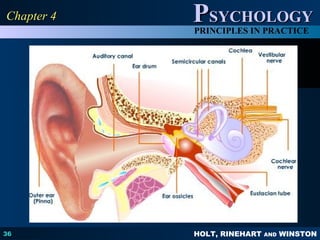
 Sound enters the outer ear and is funneled to the
eardrum
 Inside the middle ear, the hammer, anvil, and stirrup
vibrate, transmitting the sound to the inner ear
 Within the brain, auditory input is projected onto the
hearing areas of the cerebral cortex
Section 3: Hearing
HOLT, RINEHART AND WINSTON
PPSYCHOLOGYSYCHOLOGY
PRINCIPLES IN PRACTICE
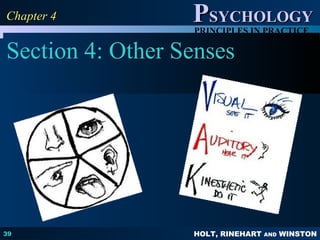
Section 4: Other Senses
39
Chapter 4Chapter 4
HOLT, RINEHART AND WINSTON
PPSYCHOLOGYSYCHOLOGY
PRINCIPLES IN PRACTICE
40
Chapter 4Chapter 4
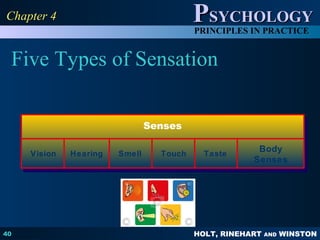
Five Types of Sensation
Senses
Vision Hearing Smell Touch Taste
Body
Senses
HOLT, RINEHART AND WINSTON
PPSYCHOLOGYSYCHOLOGY
PRINCIPLES IN PRACTICE
41
Chapter 4Chapter 4
CHEMICAL, SKIN, AND BODY SENSES
 Smell – allows a person to taste
 Taste – sweetness, sourness, saltiness, bitterness,
and umami (meaty or savory)
 Skin senses of pressure, temperature, and pain
 Vestibular and kinesthetic body senses
Section 4: Other Senses
HOLT, RINEHART AND WINSTON
PPSYCHOLOGYSYCHOLOGY
PRINCIPLES IN PRACTICE
The vestibular sense is more commonly known as a
“sense of balance”
42
Chapter 4Chapter 4
HOLT, RINEHART AND WINSTON
PPSYCHOLOGYSYCHOLOGY
PRINCIPLES IN PRACTICE
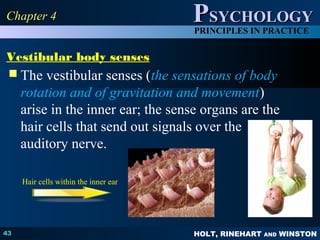
Vestibular body senses
 The vestibular senses (the sensations of body
rotation and of gravitation and movement)
arise in the inner ear; the sense organs are the
hair cells that send out signals over the
auditory nerve.
43
Chapter 4Chapter 4
Hair cells within the inner ear
HOLT, RINEHART AND WINSTON
PPSYCHOLOGYSYCHOLOGY
PRINCIPLES IN PRACTICE
Kinesthesis (Kinesthetic Sense)
 Imagine this...you drive into a parking lot,
get out of the car, and start to walk toward
your destination. You decide to cut through
a bunch of parked cars and notice that
some of them are close together, so when
you get to them, you have to turn and
adjust your body in order to get through
the tight spaces.
44
Chapter 4Chapter 4
HOLT, RINEHART AND WINSTON
PPSYCHOLOGYSYCHOLOGY
PRINCIPLES IN PRACTICE
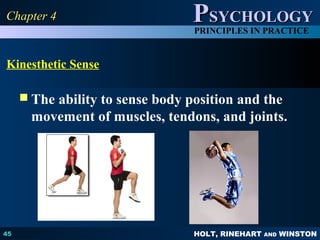
Kinesthetic Sense
 The ability to sense body position and the
movement of muscles, tendons, and joints.
45
Chapter 4Chapter 4
HOLT, RINEHART AND WINSTON
PPSYCHOLOGYSYCHOLOGY
PRINCIPLES IN PRACTICEOptical Illusions
 LAWS OF SENSORY PERCEPTION
46
Chapter 4Chapter 4
HOLT, RINEHART AND WINSTON
PPSYCHOLOGYSYCHOLOGY
PRINCIPLES IN PRACTICE
47
Chapter 4Chapter 4
HOLT, RINEHART AND WINSTON
PPSYCHOLOGYSYCHOLOGY
PRINCIPLES IN PRACTICE
48
Chapter 4Chapter 4
Question: What are the laws of sensory perception?
LAWS OF SENSORY PERCEPTION
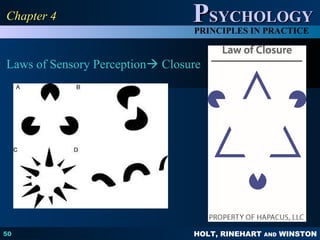
 Closure – the tendency to perceive a complete or
whole figure even when there are gaps in what
your senses tell you
 Figure-ground perception – the perception of a
figure against a background
 Proximity – the tendency to group together visual
and auditory events that are near each other
Section 5: Perception
HOLT, RINEHART AND WINSTON
PPSYCHOLOGYSYCHOLOGY
PRINCIPLES IN PRACTICE
49
Chapter 4Chapter 4
HOLT, RINEHART AND WINSTON
PPSYCHOLOGYSYCHOLOGY
PRINCIPLES IN PRACTICE
Laws of Sensory Perception Closure
50
Chapter 4Chapter 4
HOLT, RINEHART AND WINSTON
PPSYCHOLOGYSYCHOLOGY
PRINCIPLES IN PRACTICE
51
Chapter 4Chapter 4
Question: What are the laws of sensory perception?
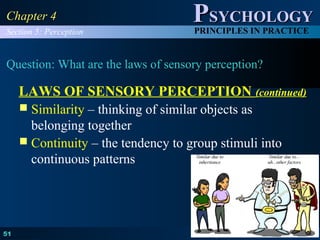
 Similarity – thinking of similar objects as
belonging together
 Continuity – the tendency to group stimuli into
continuous patterns
Section 5: Perception
LAWS OF SENSORY PERCEPTION (continued)
HOLT, RINEHART AND WINSTON
PPSYCHOLOGYSYCHOLOGY
PRINCIPLES IN PRACTICE
Laws of Sensory Perception Figure-ground Perception
52
Chapter 4Chapter 4
HOLT, RINEHART AND WINSTON
PPSYCHOLOGYSYCHOLOGY
PRINCIPLES IN PRACTICE
Laws of Sensory Perception Proximity
53
Chapter 4Chapter 4
•Are the center circles the same size?
HOLT, RINEHART AND WINSTON
PPSYCHOLOGYSYCHOLOGY
PRINCIPLES IN PRACTICE
Optical Illusions
 http://www.youtube.co
m/watch?
v=URLRdcnU6Hk
54
Chapter 4Chapter 4
HOLT, RINEHART AND WINSTON
PPSYCHOLOGYSYCHOLOGY
PRINCIPLES IN PRACTICE
Test Today!
Sections #1, #2, & #3
You need a pencil
55
Chapter 4Chapter 4
HOLT, RINEHART AND WINSTON
PPSYCHOLOGYSYCHOLOGY
PRINCIPLES IN PRACTICE
TED talk
 http://www.youtube.com/watch?v=mf5otGNbkuc
 Beau Lotto's color games puzzle your vision, but
they also spotlight what you can't normally see:
how your brain works. This fun, first-hand look
at your own versatile sense of sight reveals how
evolution tints your perception of what's really
out there.
56
Chapter 4Chapter 4

Chapter 4 notes

  • 1.
    HOLT, RINEHART ANDWINSTON PPSYCHOLOGYSYCHOLOGY PRINCIPLES IN PRACTICE 1 Chapter 4 SENSATION AND PERCEPTION Section 1: Sensation and Perception: The Basics Section 2: Vision Section 3: Hearing Section 4: Other Senses Section 5: Perception
  • 2.
    HOLT, RINEHART ANDWINSTON PPSYCHOLOGYSYCHOLOGY PRINCIPLES IN PRACTICE 2 Chapter 4Chapter 4 Section 1: Sensation and Perception: The Basics
  • 3.
    HOLT, RINEHART ANDWINSTON PPSYCHOLOGYSYCHOLOGY PRINCIPLES IN PRACTICE Section #1 Vocab Terms  Sensation  Perception  Absolute threshold  Difference threshold  Signal-detection theory  Sensory adaptation 3 Chapter 4Chapter 4
  • 4.
    HOLT, RINEHART ANDWINSTON PPSYCHOLOGYSYCHOLOGY PRINCIPLES IN PRACTICE 4 Chapter 4Chapter 4 Question: Do sensation and perception contribute to an understanding of our environment? Answer: YES, SENSATION AND PERCEPTION CONTRIBUTE IN MANY WAYS TO AN UNDERSTANDING OF OUR ENVIRONMENT.
  • 5.
    HOLT, RINEHART ANDWINSTON PPSYCHOLOGYSYCHOLOGY PRINCIPLES IN PRACTICE 5 Chapter 4Chapter 4  Sensation provides information to the central nervous system about the physical environment  Perception is the process through which people interpret sensory stimulation
  • 6.
    HOLT, RINEHART ANDWINSTON PPSYCHOLOGYSYCHOLOGY PRINCIPLES IN PRACTICE The Basics Sensation • Process by which our senses gather information and send it to the brain
  • 7.
    HOLT, RINEHART ANDWINSTON PPSYCHOLOGYSYCHOLOGY PRINCIPLES IN PRACTICE Sensation… • A large amount of information is being sensed at any one time such as room temperature, brightness of the lights, someone talking, a distant train, or the smell of perfume. • With all this information coming into our senses, the majority of our world never gets recognized. • We don't notice radio waves, x-rays, or the microscopic parasites crawling on our skin. 7 Chapter 4Chapter 4
  • 8.
    HOLT, RINEHART ANDWINSTON PPSYCHOLOGYSYCHOLOGY PRINCIPLES IN PRACTICEThe Basics Perception • Interpretation of what we take in through our senses • The way we perceive our environment is what makes us different from other animals and different from each other.
  • 9.
    HOLT, RINEHART ANDWINSTON PPSYCHOLOGYSYCHOLOGY PRINCIPLES IN PRACTICE 9
  • 10.
    HOLT, RINEHART ANDWINSTON PPSYCHOLOGYSYCHOLOGY PRINCIPLES IN PRACTICE 10 http://www.youtube.com/watch?v=hCV2Ba5wrcs
  • 11.
    HOLT, RINEHART ANDWINSTON PPSYCHOLOGYSYCHOLOGY PRINCIPLES IN PRACTICE Sensation & Perception WORK TOGETHER: 1) Sensation occurs:  a) sensory organs absorb energy from a physical stimulus in the environment.  b) sensory receptors convert this energy into neural impulses and send them to the brain. 2) Perception follows:  a) the brain organizes the information and translates it into something meaningful.
  • 12.
    HOLT, RINEHART ANDWINSTON PPSYCHOLOGYSYCHOLOGY PRINCIPLES IN PRACTICE 12 Chapter 4Chapter 4
  • 13.
    HOLT, RINEHART ANDWINSTON PPSYCHOLOGYSYCHOLOGY PRINCIPLES IN PRACTICE Absolute Threshold • The absolute threshold is the point where something becomes noticeable to our senses. • It is the softest sound we can hear or the slightest touch we can feel. • Anything less than this goes unnoticed.
  • 14.
    HOLT, RINEHART ANDWINSTON PPSYCHOLOGYSYCHOLOGY PRINCIPLES IN PRACTICE
  • 15.
    HOLT, RINEHART ANDWINSTON PPSYCHOLOGYSYCHOLOGY PRINCIPLES IN PRACTICE
  • 16.
    HOLT, RINEHART ANDWINSTON PPSYCHOLOGYSYCHOLOGY PRINCIPLES IN PRACTICE
  • 17.
    HOLT, RINEHART ANDWINSTON PPSYCHOLOGYSYCHOLOGY PRINCIPLES IN PRACTICE
  • 18.
    HOLT, RINEHART ANDWINSTON PPSYCHOLOGYSYCHOLOGY PRINCIPLES IN PRACTICE
  • 19.
    HOLT, RINEHART ANDWINSTON PPSYCHOLOGYSYCHOLOGY PRINCIPLES IN PRACTICE Difference Threshold  The difference threshold is the amount of change needed for us to recognize that a change has occurred.  A just-noticeable difference EXAMPLE: When we notice the sound of the radio in the other room, how do we notice when it becomes louder. It's possible that someone could be turning it up so slightly that the difference is
  • 20.
    HOLT, RINEHART ANDWINSTON PPSYCHOLOGYSYCHOLOGY PRINCIPLES IN PRACTICE 20 Chapter 4Chapter 4
  • 21.
    HOLT, RINEHART ANDWINSTON PPSYCHOLOGYSYCHOLOGY PRINCIPLES IN PRACTICE 21
  • 22.
    HOLT, RINEHART ANDWINSTON PPSYCHOLOGYSYCHOLOGY PRINCIPLES IN PRACTICE Signal Detection Theory When we attempt detect what we want to focus on and ignore or minimize everything else.  We focus on what is important to us!  Examples:  Miss Bolinsky can hear someone cursing at the other end of the crowded hallway.  Mr. Straubel can smell coffee brewing three rooms down from his.
  • 23.
    HOLT, RINEHART ANDWINSTON PPSYCHOLOGYSYCHOLOGY PRINCIPLES IN PRACTICE Sensory Adaptation  Refers to stimuli which has become redundant or remains unchanged for an extended period of time.  Example: Over time Bolinsky got used to the loud sound of the heating and cooling system. She swore she couldn’t even hear it anymore.
  • 24.
    HOLT, RINEHART ANDWINSTON PPSYCHOLOGYSYCHOLOGY PRINCIPLES IN PRACTICE Section #2 Vision 24 Chapter 4Chapter 4
  • 25.
    HOLT, RINEHART ANDWINSTON PPSYCHOLOGYSYCHOLOGY PRINCIPLES IN PRACTICE 25 Chapter 4Chapter 4
  • 26.
    HOLT, RINEHART ANDWINSTON PPSYCHOLOGYSYCHOLOGY PRINCIPLES IN PRACTICE 26 Chapter 4Chapter 4
  • 27.
    HOLT, RINEHART ANDWINSTON PPSYCHOLOGYSYCHOLOGY PRINCIPLES IN PRACTICE 27
  • 28.
    HOLT, RINEHART ANDWINSTON PPSYCHOLOGYSYCHOLOGY PRINCIPLES IN PRACTICE A Journey Through the Human Eye: How We See  http://www.youtube.com/watch? v=gvozcv8pS3c 28 Chapter 4Chapter 4
  • 29.
    HOLT, RINEHART ANDWINSTON PPSYCHOLOGYSYCHOLOGY PRINCIPLES IN PRACTICE 29 Chapter 4Chapter 4 Question: How does the eye enable vision? THE EYE AND VISION  Light enters the eye and then is projected onto a surface  The amount of light that enters the eye is determined by the size of the pupil which adjusts automatically to the amount of light entering the eye  Once light enters the eye, it encounters the lens which adjusts to the distance of objects by changing its thickness Section 2: Vision
  • 30.
    HOLT, RINEHART ANDWINSTON PPSYCHOLOGYSYCHOLOGY PRINCIPLES IN PRACTICE 30 Chapter 4Chapter 4 Question: How does the eye enable vision?  These changes project a clear image of the object onto the retina, which consists of neurons that are sensitive to the light called photoreceptors  Once the light hits the photoreceptors, a nerve carries the visual input into the brain where the information is relayed to the visual area of the occipital lobe Section 2: Vision THE EYE AND VISION (continued)
  • 31.
    HOLT, RINEHART ANDWINSTON PPSYCHOLOGYSYCHOLOGY PRINCIPLES IN PRACTICE 31 Chapter 4Chapter 4
  • 32.
    HOLT, RINEHART ANDWINSTON PPSYCHOLOGYSYCHOLOGY PRINCIPLES IN PRACTICE 32 Chapter 4Chapter 4
  • 33.
    HOLT, RINEHART ANDWINSTON PPSYCHOLOGYSYCHOLOGY PRINCIPLES IN PRACTICE 33 Chapter 4Chapter 4
  • 34.
    HOLT, RINEHART ANDWINSTON PPSYCHOLOGYSYCHOLOGY PRINCIPLES IN PRACTICE Section 3: Hearing 34 Chapter 4Chapter 4 http://www.youtube.co m/watch? v=2WNrx2jq184
  • 35.
    HOLT, RINEHART ANDWINSTON PPSYCHOLOGYSYCHOLOGY PRINCIPLES IN PRACTICE 35 Chapter 4Chapter 4
  • 36.
    HOLT, RINEHART ANDWINSTON PPSYCHOLOGYSYCHOLOGY PRINCIPLES IN PRACTICE 36 Chapter 4Chapter 4
  • 37.
    HOLT, RINEHART ANDWINSTON PPSYCHOLOGYSYCHOLOGY PRINCIPLES IN PRACTICE How the human ear works  http://www.youtube.com/watch?v=dCyz8- eAs1I 37 Chapter 4Chapter 4 http://www.youtube.com/watch?v=r-c5GpoD8wI
  • 38.
    HOLT, RINEHART ANDWINSTON PPSYCHOLOGYSYCHOLOGY PRINCIPLES IN PRACTICE 38 Chapter 4Chapter 4 Question: How does the ear perceive sound? HOW THE EAR PERCEIVES SOUND  Sound enters the outer ear and is funneled to the eardrum  Inside the middle ear, the hammer, anvil, and stirrup vibrate, transmitting the sound to the inner ear  Within the brain, auditory input is projected onto the hearing areas of the cerebral cortex Section 3: Hearing
  • 39.
    HOLT, RINEHART ANDWINSTON PPSYCHOLOGYSYCHOLOGY PRINCIPLES IN PRACTICE Section 4: Other Senses 39 Chapter 4Chapter 4
  • 40.
    HOLT, RINEHART ANDWINSTON PPSYCHOLOGYSYCHOLOGY PRINCIPLES IN PRACTICE 40 Chapter 4Chapter 4 Five Types of Sensation Senses Vision Hearing Smell Touch Taste Body Senses
  • 41.
    HOLT, RINEHART ANDWINSTON PPSYCHOLOGYSYCHOLOGY PRINCIPLES IN PRACTICE 41 Chapter 4Chapter 4 CHEMICAL, SKIN, AND BODY SENSES  Smell – allows a person to taste  Taste – sweetness, sourness, saltiness, bitterness, and umami (meaty or savory)  Skin senses of pressure, temperature, and pain  Vestibular and kinesthetic body senses Section 4: Other Senses
  • 42.
    HOLT, RINEHART ANDWINSTON PPSYCHOLOGYSYCHOLOGY PRINCIPLES IN PRACTICE The vestibular sense is more commonly known as a “sense of balance” 42 Chapter 4Chapter 4
  • 43.
    HOLT, RINEHART ANDWINSTON PPSYCHOLOGYSYCHOLOGY PRINCIPLES IN PRACTICE Vestibular body senses  The vestibular senses (the sensations of body rotation and of gravitation and movement) arise in the inner ear; the sense organs are the hair cells that send out signals over the auditory nerve. 43 Chapter 4Chapter 4 Hair cells within the inner ear
  • 44.
    HOLT, RINEHART ANDWINSTON PPSYCHOLOGYSYCHOLOGY PRINCIPLES IN PRACTICE Kinesthesis (Kinesthetic Sense)  Imagine this...you drive into a parking lot, get out of the car, and start to walk toward your destination. You decide to cut through a bunch of parked cars and notice that some of them are close together, so when you get to them, you have to turn and adjust your body in order to get through the tight spaces. 44 Chapter 4Chapter 4
  • 45.
    HOLT, RINEHART ANDWINSTON PPSYCHOLOGYSYCHOLOGY PRINCIPLES IN PRACTICE Kinesthetic Sense  The ability to sense body position and the movement of muscles, tendons, and joints. 45 Chapter 4Chapter 4
  • 46.
    HOLT, RINEHART ANDWINSTON PPSYCHOLOGYSYCHOLOGY PRINCIPLES IN PRACTICEOptical Illusions  LAWS OF SENSORY PERCEPTION 46 Chapter 4Chapter 4
  • 47.
    HOLT, RINEHART ANDWINSTON PPSYCHOLOGYSYCHOLOGY PRINCIPLES IN PRACTICE 47 Chapter 4Chapter 4
  • 48.
    HOLT, RINEHART ANDWINSTON PPSYCHOLOGYSYCHOLOGY PRINCIPLES IN PRACTICE 48 Chapter 4Chapter 4 Question: What are the laws of sensory perception? LAWS OF SENSORY PERCEPTION  Closure – the tendency to perceive a complete or whole figure even when there are gaps in what your senses tell you  Figure-ground perception – the perception of a figure against a background  Proximity – the tendency to group together visual and auditory events that are near each other Section 5: Perception
  • 49.
    HOLT, RINEHART ANDWINSTON PPSYCHOLOGYSYCHOLOGY PRINCIPLES IN PRACTICE 49 Chapter 4Chapter 4
  • 50.
    HOLT, RINEHART ANDWINSTON PPSYCHOLOGYSYCHOLOGY PRINCIPLES IN PRACTICE Laws of Sensory Perception Closure 50 Chapter 4Chapter 4
  • 51.
    HOLT, RINEHART ANDWINSTON PPSYCHOLOGYSYCHOLOGY PRINCIPLES IN PRACTICE 51 Chapter 4Chapter 4 Question: What are the laws of sensory perception?  Similarity – thinking of similar objects as belonging together  Continuity – the tendency to group stimuli into continuous patterns Section 5: Perception LAWS OF SENSORY PERCEPTION (continued)
  • 52.
    HOLT, RINEHART ANDWINSTON PPSYCHOLOGYSYCHOLOGY PRINCIPLES IN PRACTICE Laws of Sensory Perception Figure-ground Perception 52 Chapter 4Chapter 4
  • 53.
    HOLT, RINEHART ANDWINSTON PPSYCHOLOGYSYCHOLOGY PRINCIPLES IN PRACTICE Laws of Sensory Perception Proximity 53 Chapter 4Chapter 4 •Are the center circles the same size?
  • 54.
    HOLT, RINEHART ANDWINSTON PPSYCHOLOGYSYCHOLOGY PRINCIPLES IN PRACTICE Optical Illusions  http://www.youtube.co m/watch? v=URLRdcnU6Hk 54 Chapter 4Chapter 4
  • 55.
    HOLT, RINEHART ANDWINSTON PPSYCHOLOGYSYCHOLOGY PRINCIPLES IN PRACTICE Test Today! Sections #1, #2, & #3 You need a pencil 55 Chapter 4Chapter 4
  • 56.
    HOLT, RINEHART ANDWINSTON PPSYCHOLOGYSYCHOLOGY PRINCIPLES IN PRACTICE TED talk  http://www.youtube.com/watch?v=mf5otGNbkuc  Beau Lotto's color games puzzle your vision, but they also spotlight what you can't normally see: how your brain works. This fun, first-hand look at your own versatile sense of sight reveals how evolution tints your perception of what's really out there. 56 Chapter 4Chapter 4