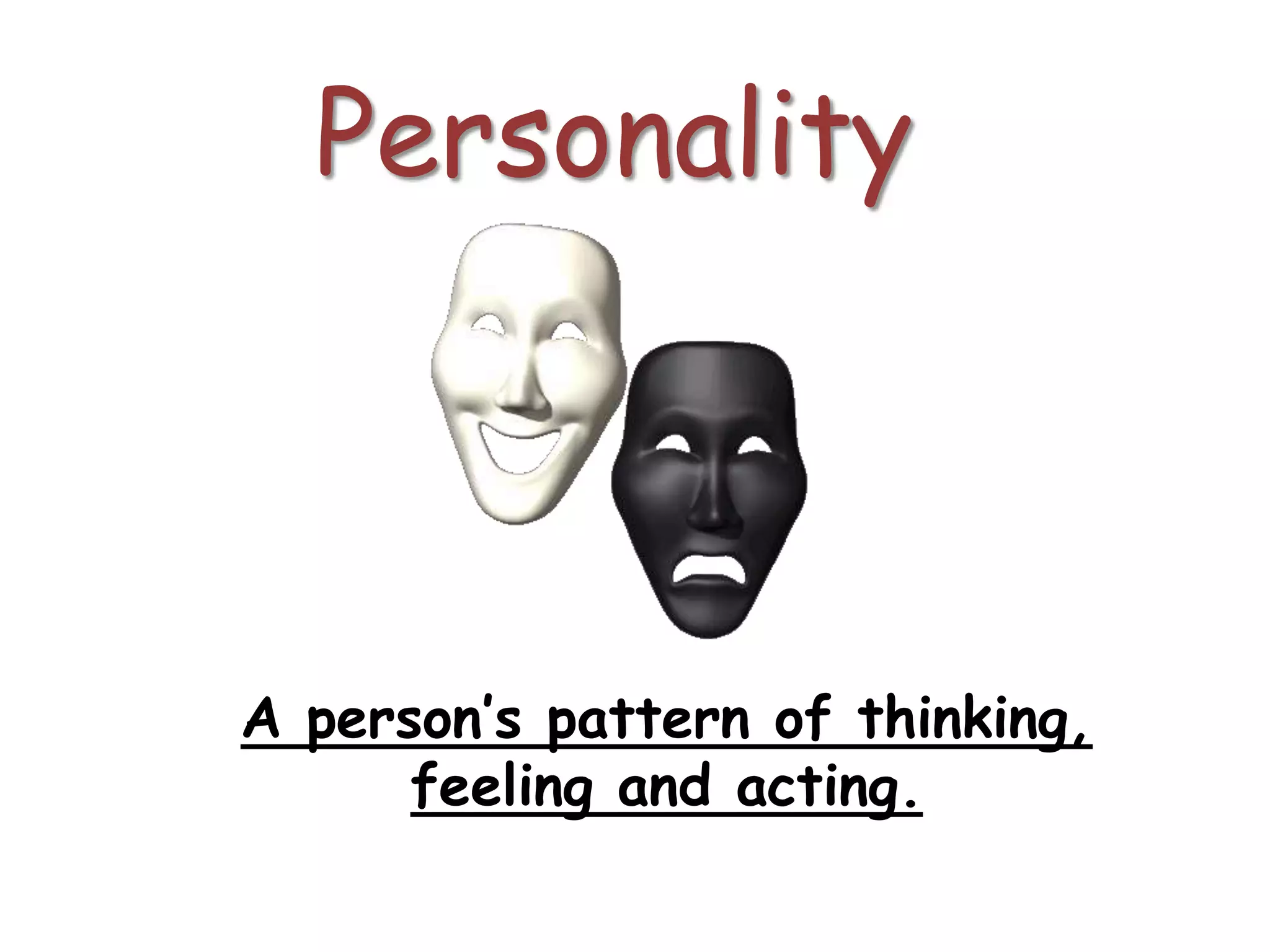
Personality
A person’s pattern of thinking,
feeling and acting.
Personality: An individual’s characteristic
patterns of thoughts, feelings, and behaviors
[persisting over time and across situations]
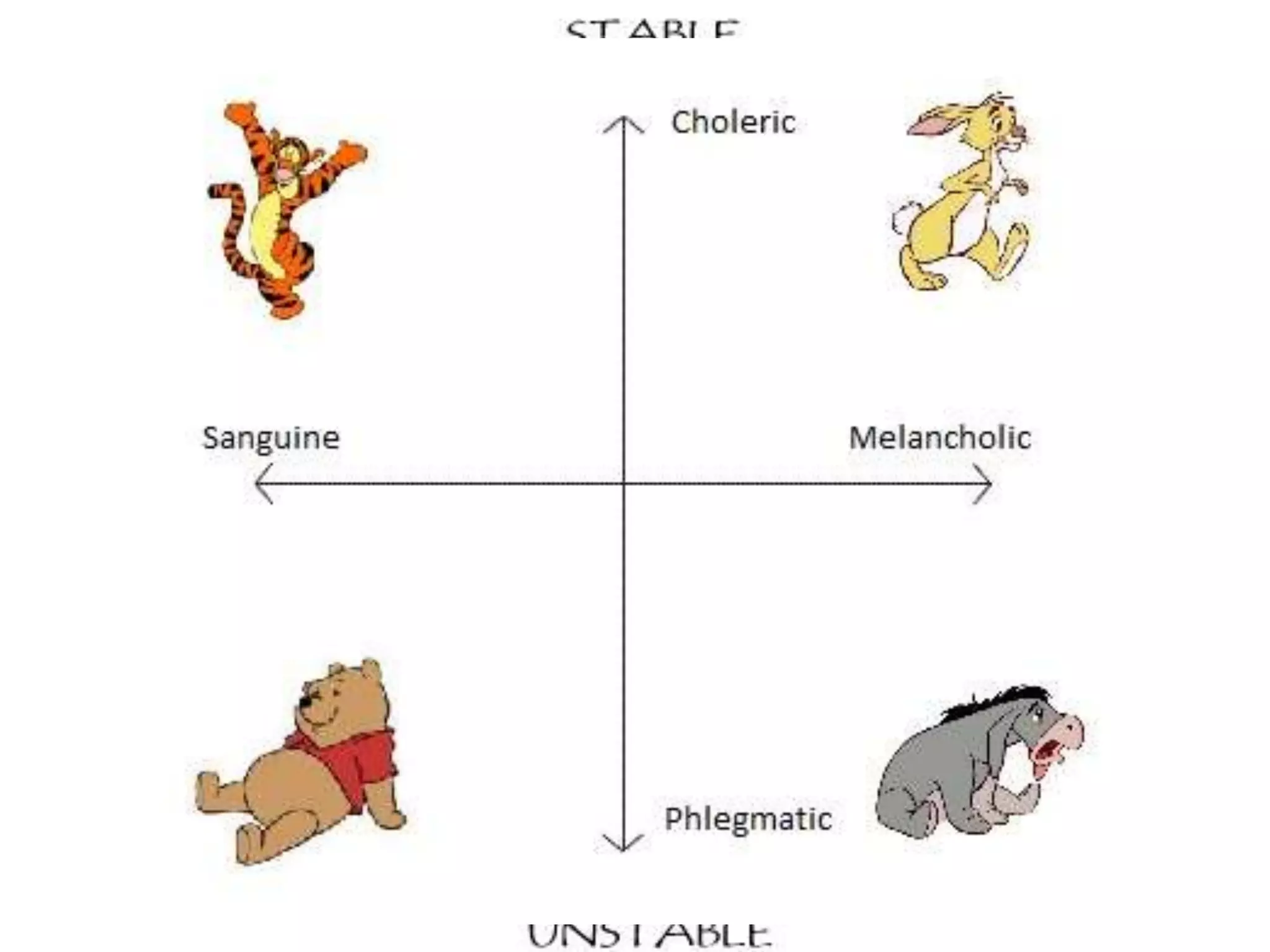
Sensitive,
Reactive
Naïve
Agreeable, Open
Introverted
Neurotically
irritable
Conscientious
Contentedly
lethargic
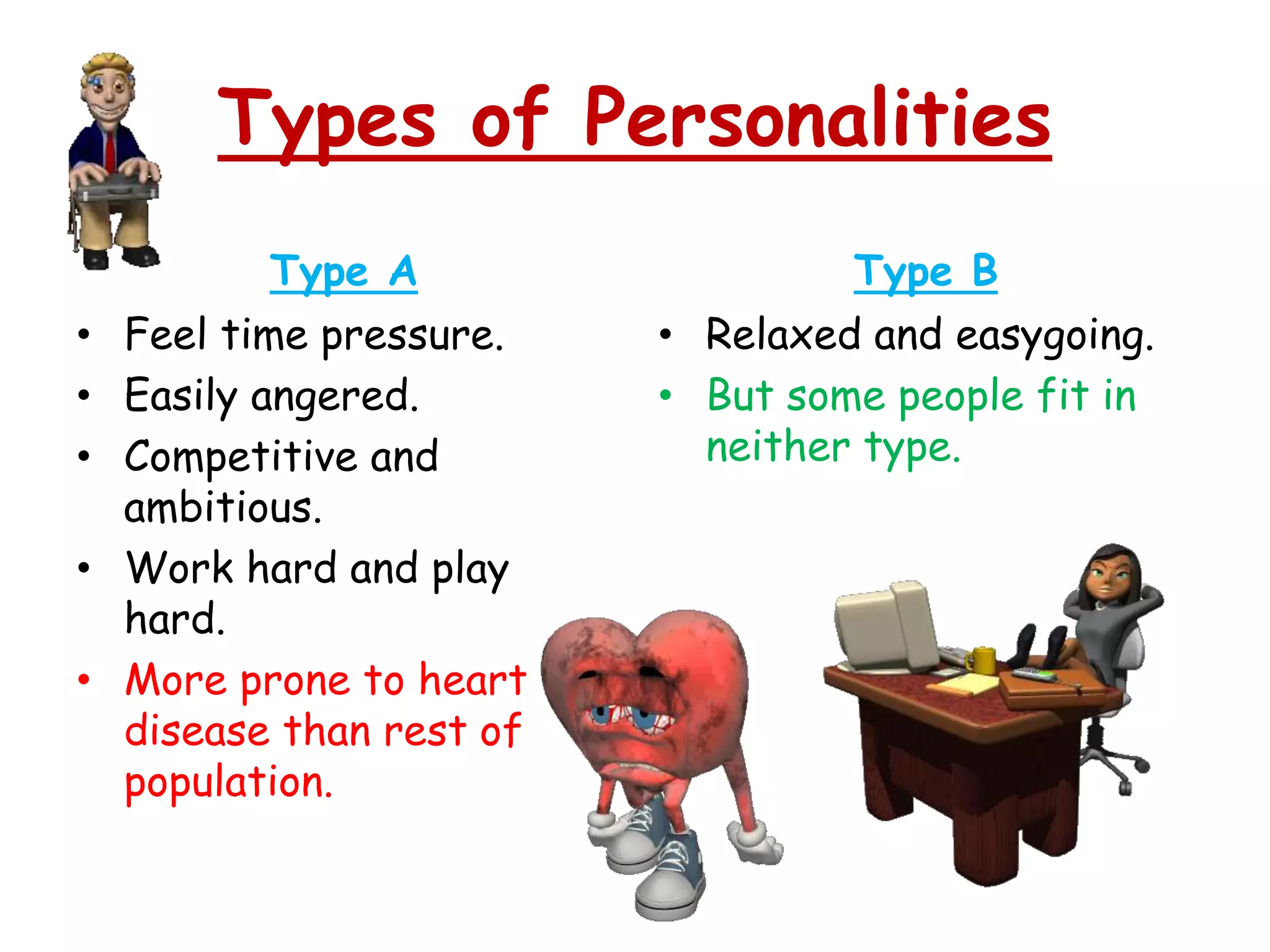
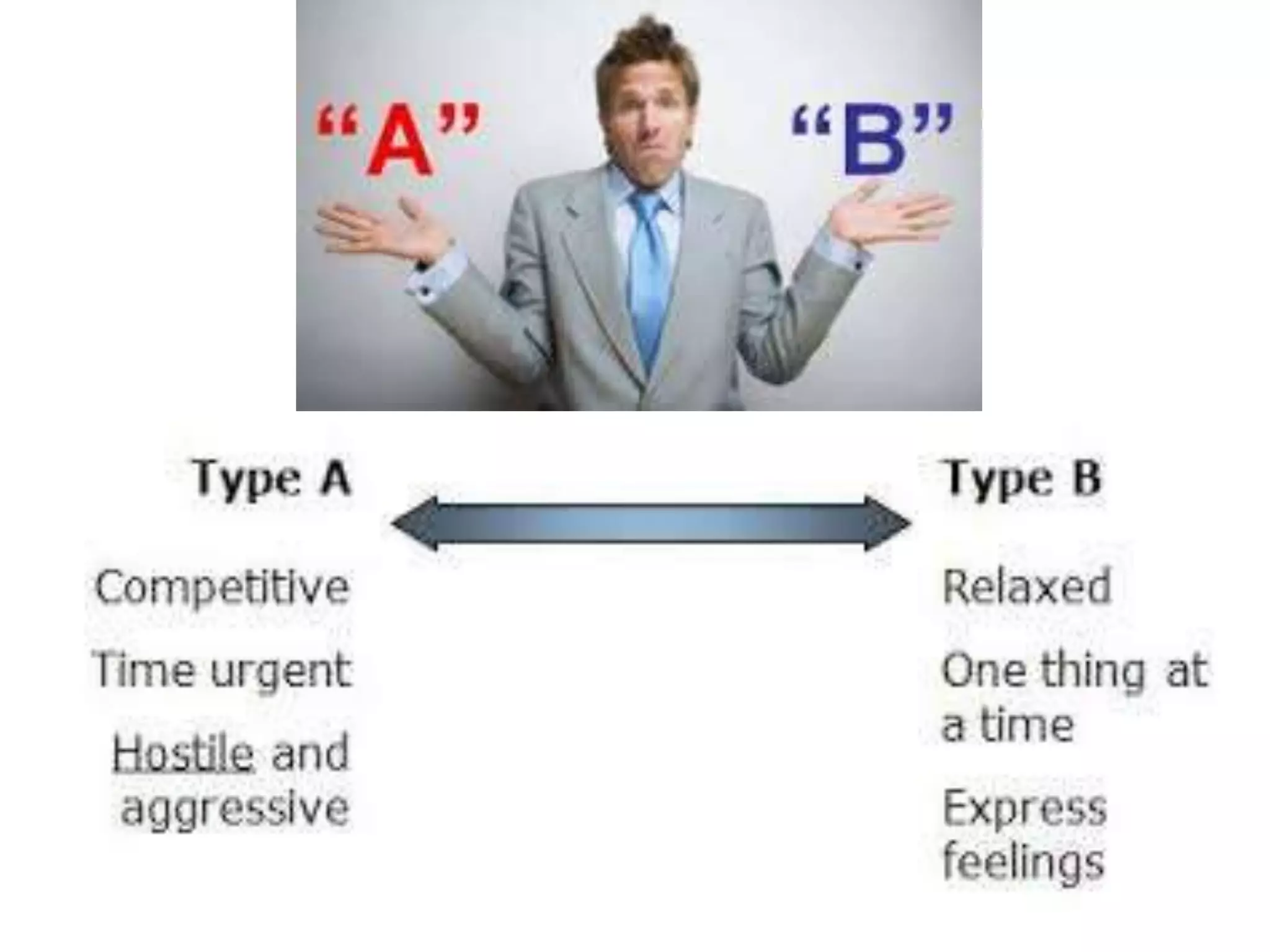
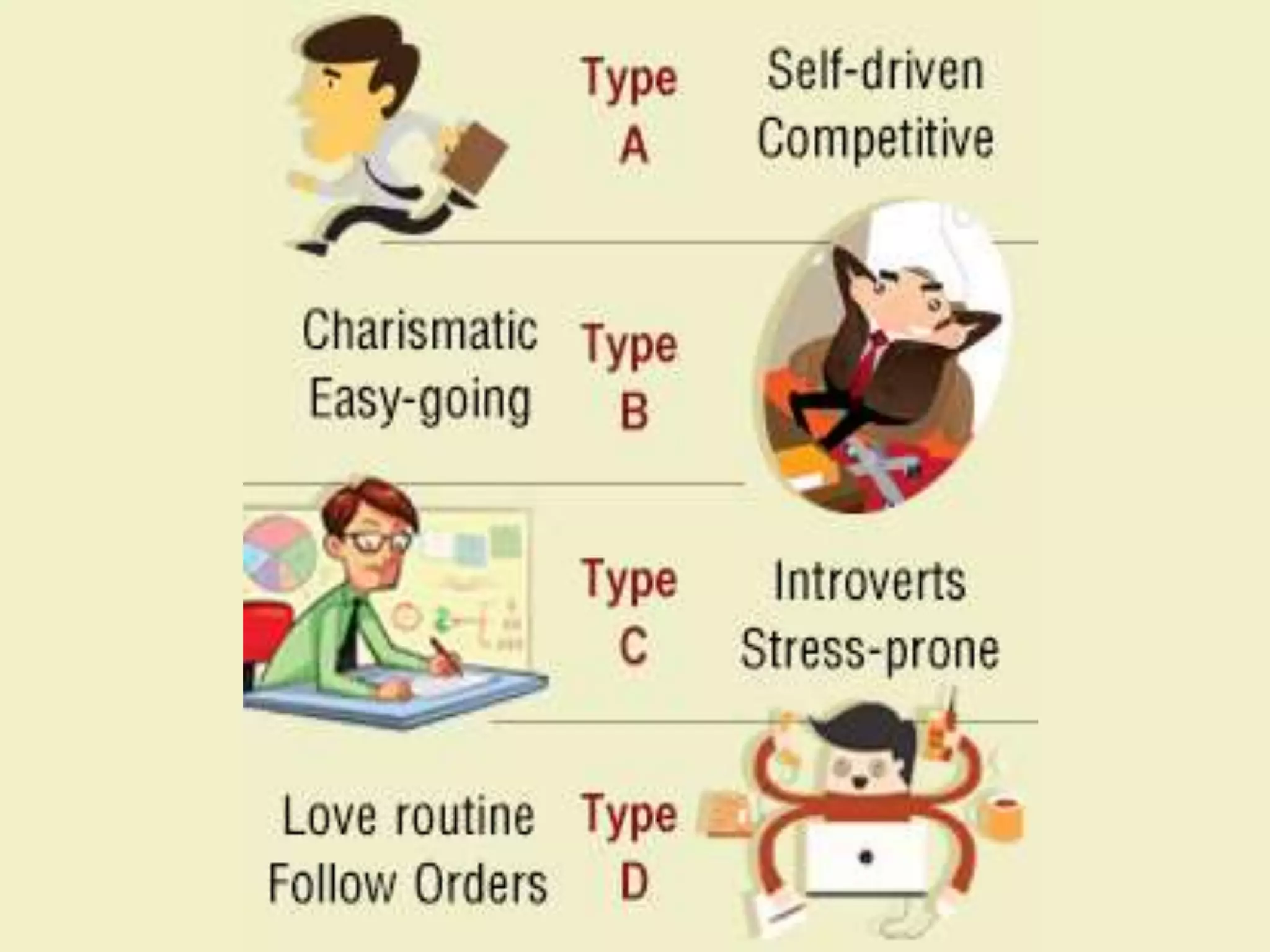
Types of Personalities
Type A
• Feel time pressure.
• Easily angered.
• Competitive and
ambitious.
• Work hard and play
hard.
• More prone to heart
disease than rest of
population.
Type B
• Relaxed and easygoing.
• But some people fit in
neither type.
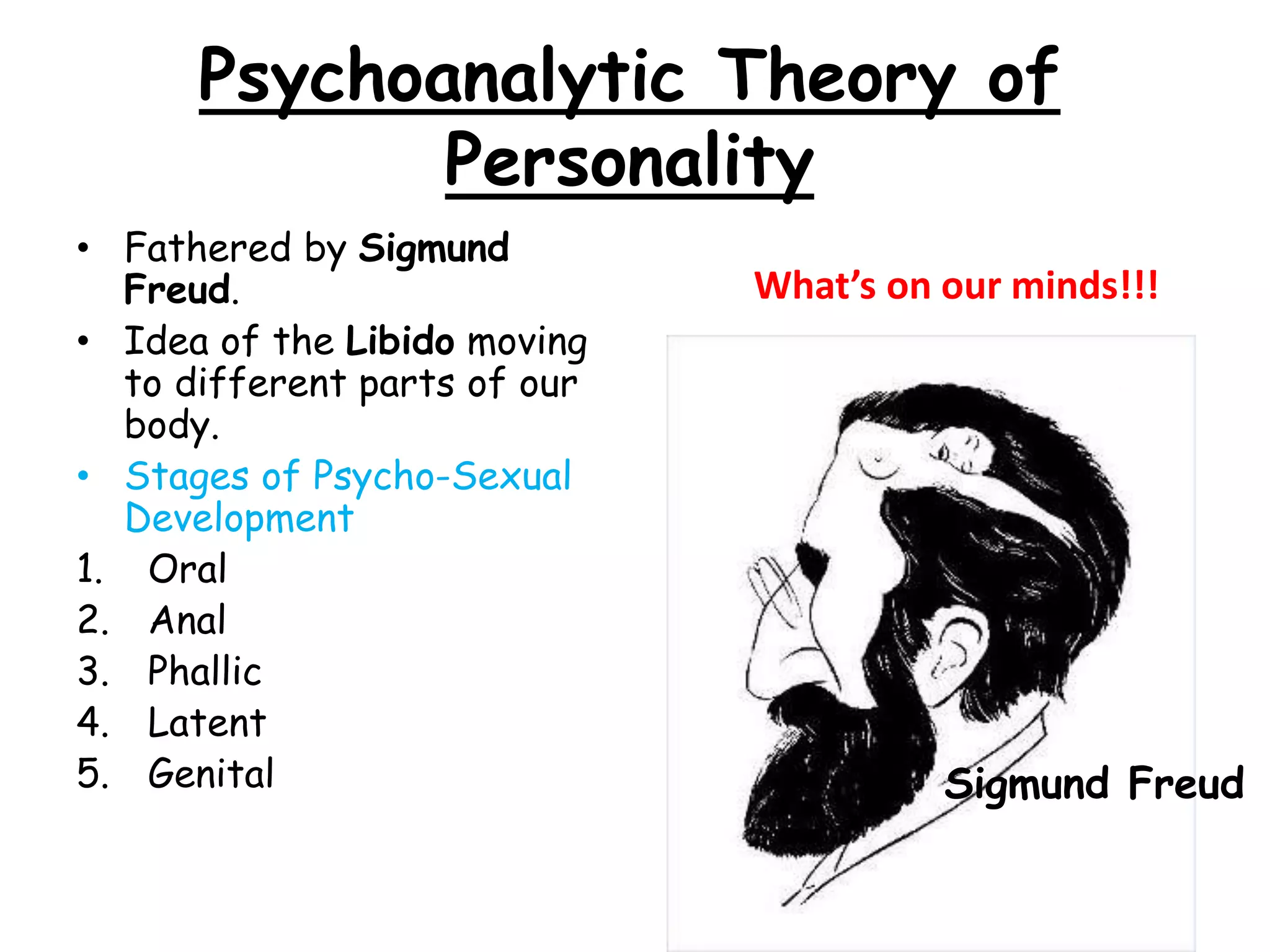
Psychoanalytic Theory of
Personality
• Fathered by Sigmund
Freud.
• Idea of the Libido moving
to different parts of our
body.
• Stages of Psycho-Sexual
Development
1. Oral
2. Anal
3. Phallic
4. Latent
5. Genital
Sigmund Freu
What’s on our minds!!!
Our Personality
• Conscious- things we are
aware of.
• Preconscious- things we
can be aware of if we
think of them.
• Unconscious- deep hidden
reservoir that holds the
true “us”. All of our
desires and fears.
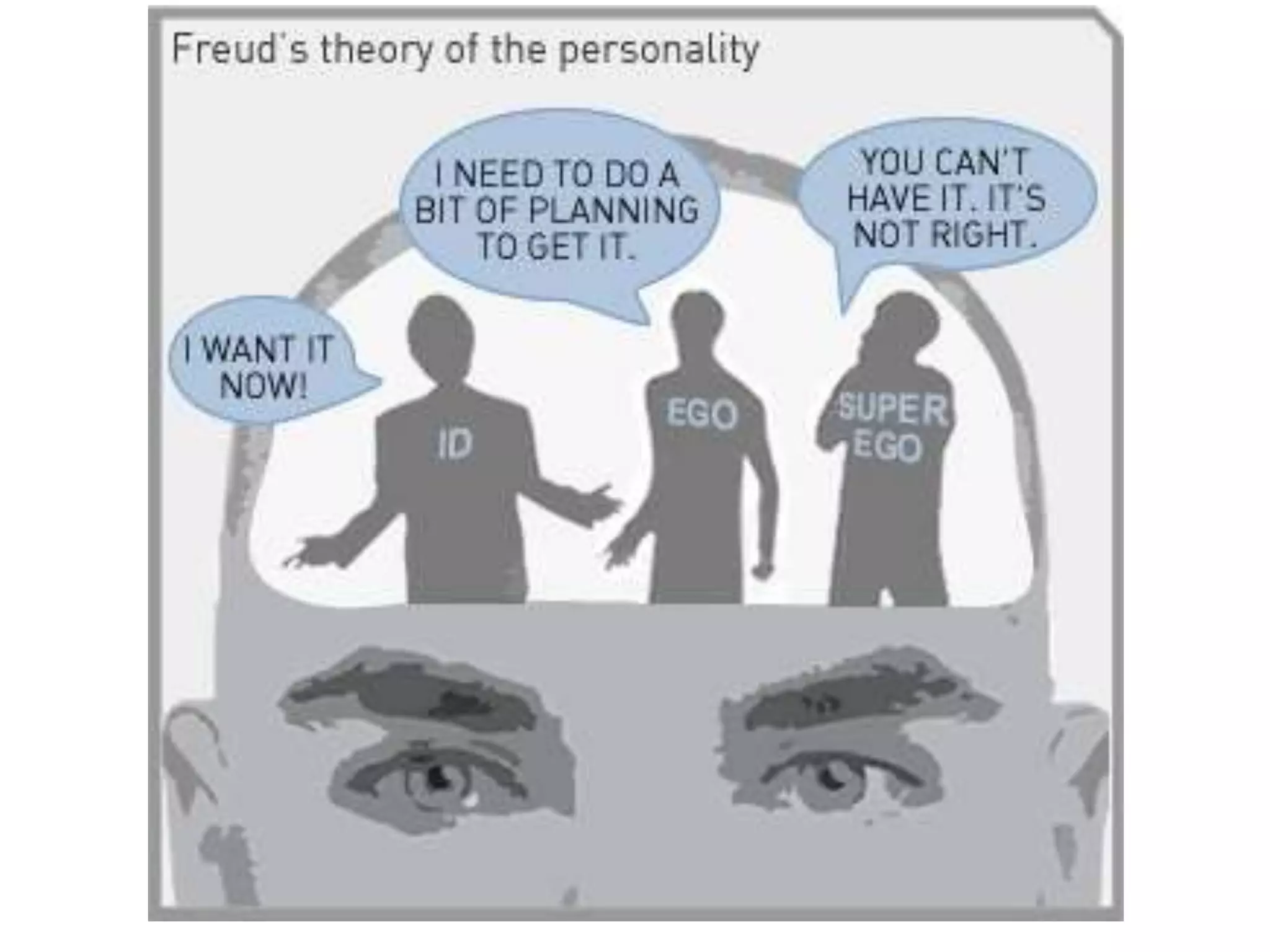
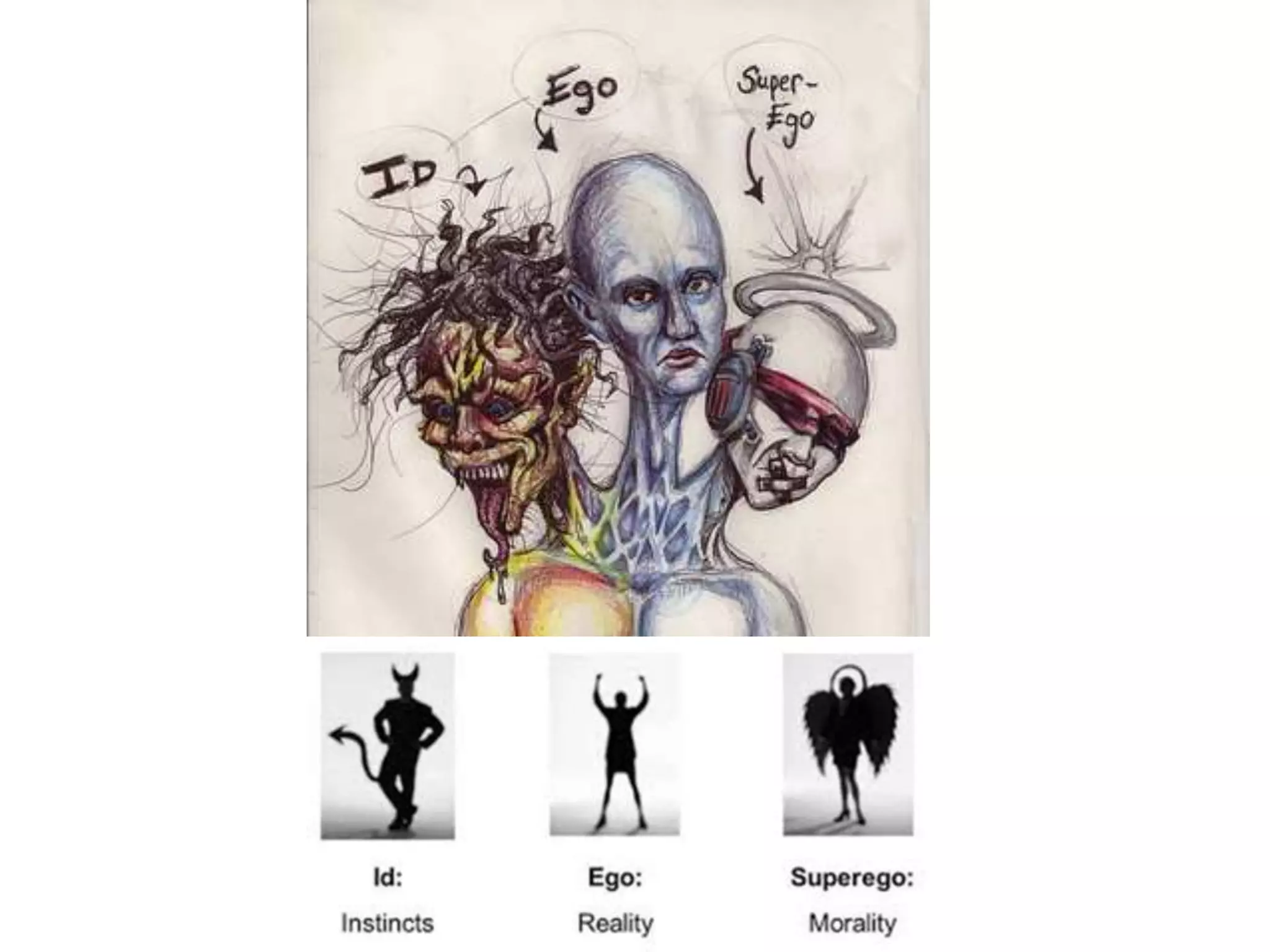
Freud’s Concept of Personality
(Psyche)
• Ego
• Superego
• Id
Id
• Exists entirely in the
unconscious (so we are
never aware of it).
• Our hidden true
animalistic wants and
desires.
• Works on the
Pleasure Principle
• Avoid Pain and receive
Instant Gratification.
Ego
• Develops after the Id
• Works on the Reality
Principle
• Negotiates between
the Id and the
environment.
• In our conscious and
unconscious minds.
• It is what everyone
sees as our
personality.
If you want to be with someone. Your id says just take
them, but your ego does not want to end up in jail. So you
ask her out and just mac it hard.
Superego
• Develops last at
about the age of 5
• It is our conscience
(what we think the
difference is
between right and
wrong)
• The Ego often
mediates between
the superego and id.
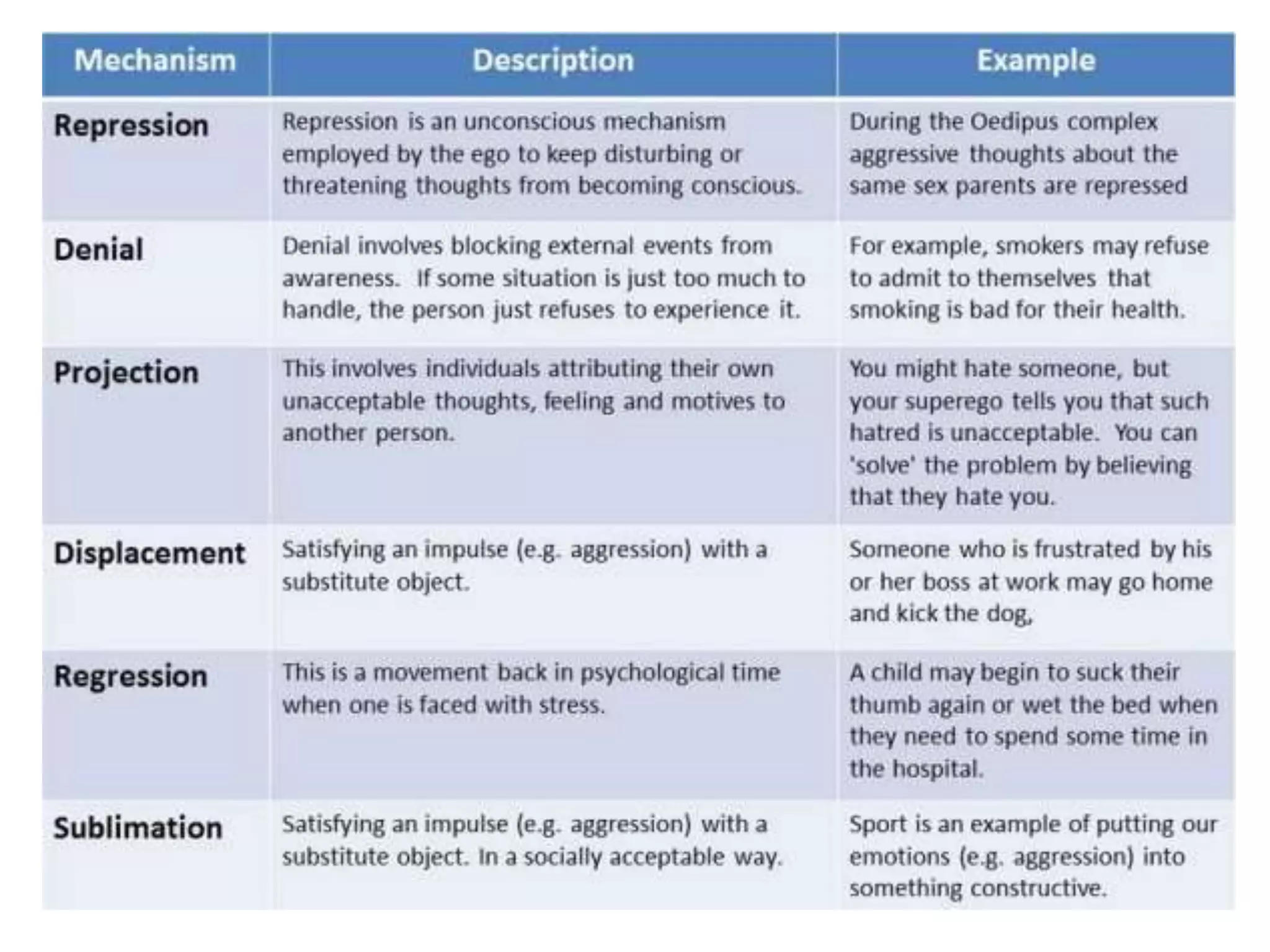
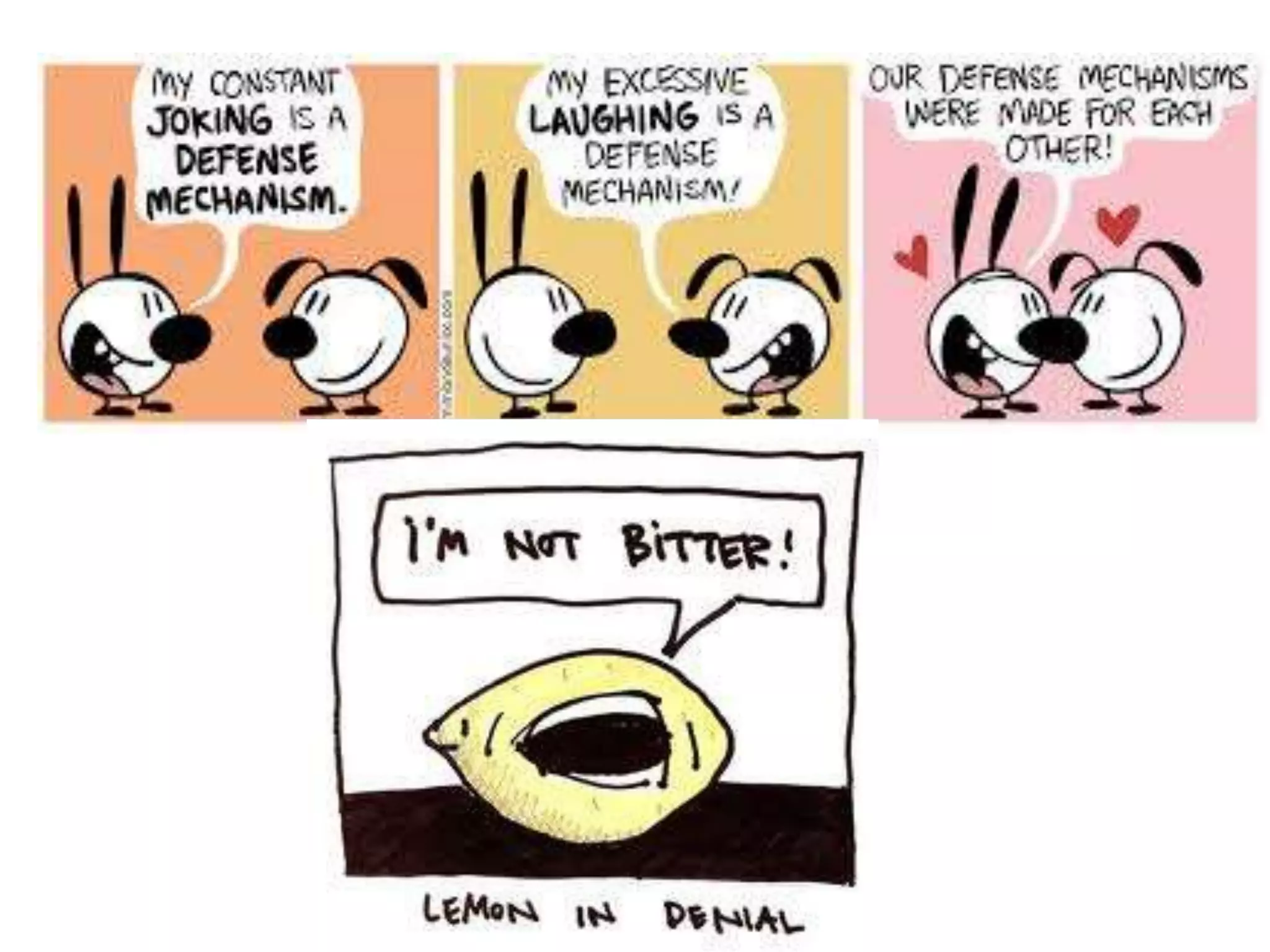
Defense Mechanisms
• The ego has a pretty
important job…and
that is to protect you
from threatening
thoughts in our
unconscious.
• One way it protects
us is through
defense mechanisms.
• You are usually
unaware that they are
even occurring.
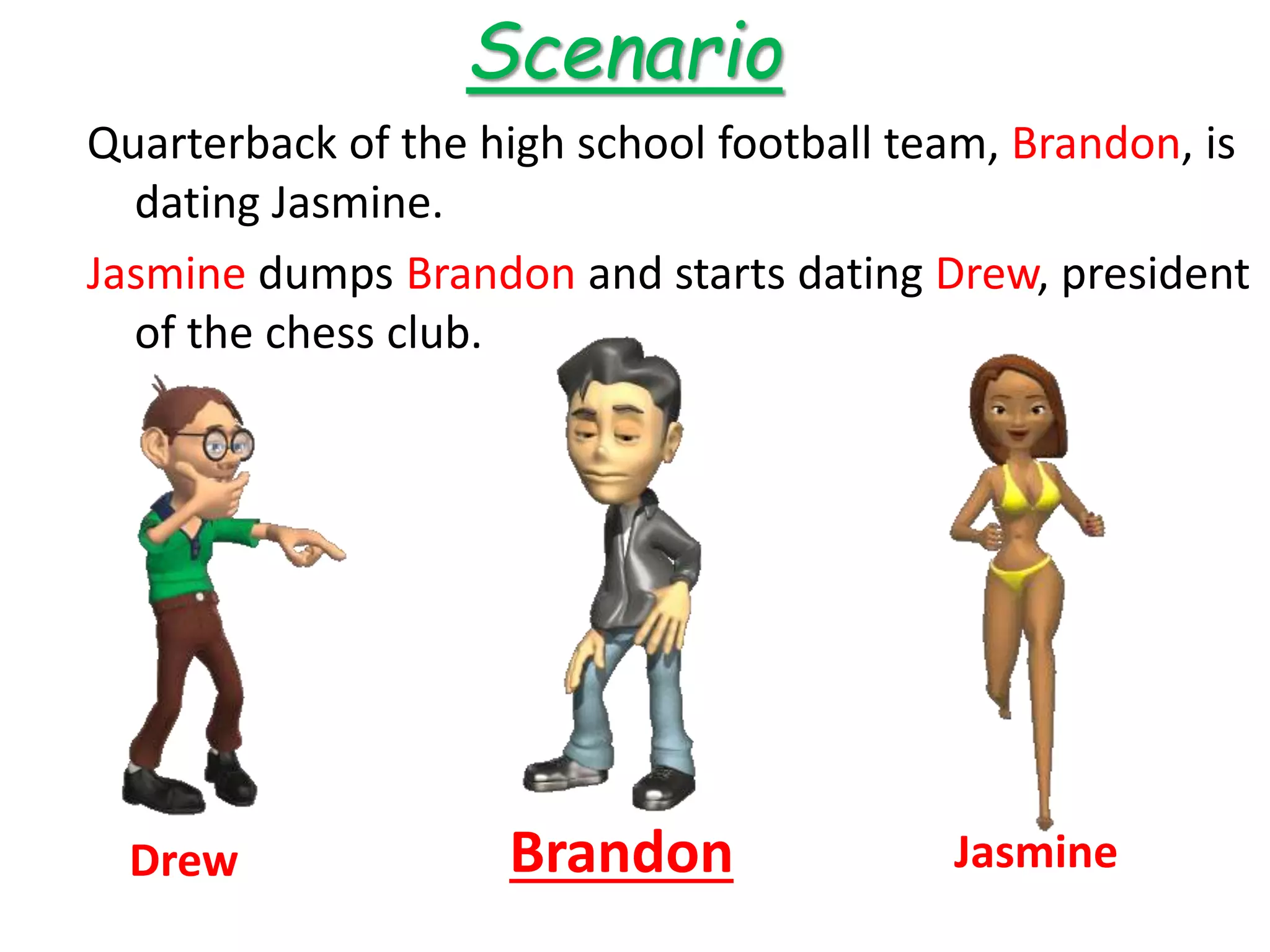
Scenario
Quarterback of the high school football team, Brandon, is
dating Jasmine.
Jasmine dumps Brandon and starts dating Drew, president
of the chess club.
Drew Brandon Jasmine
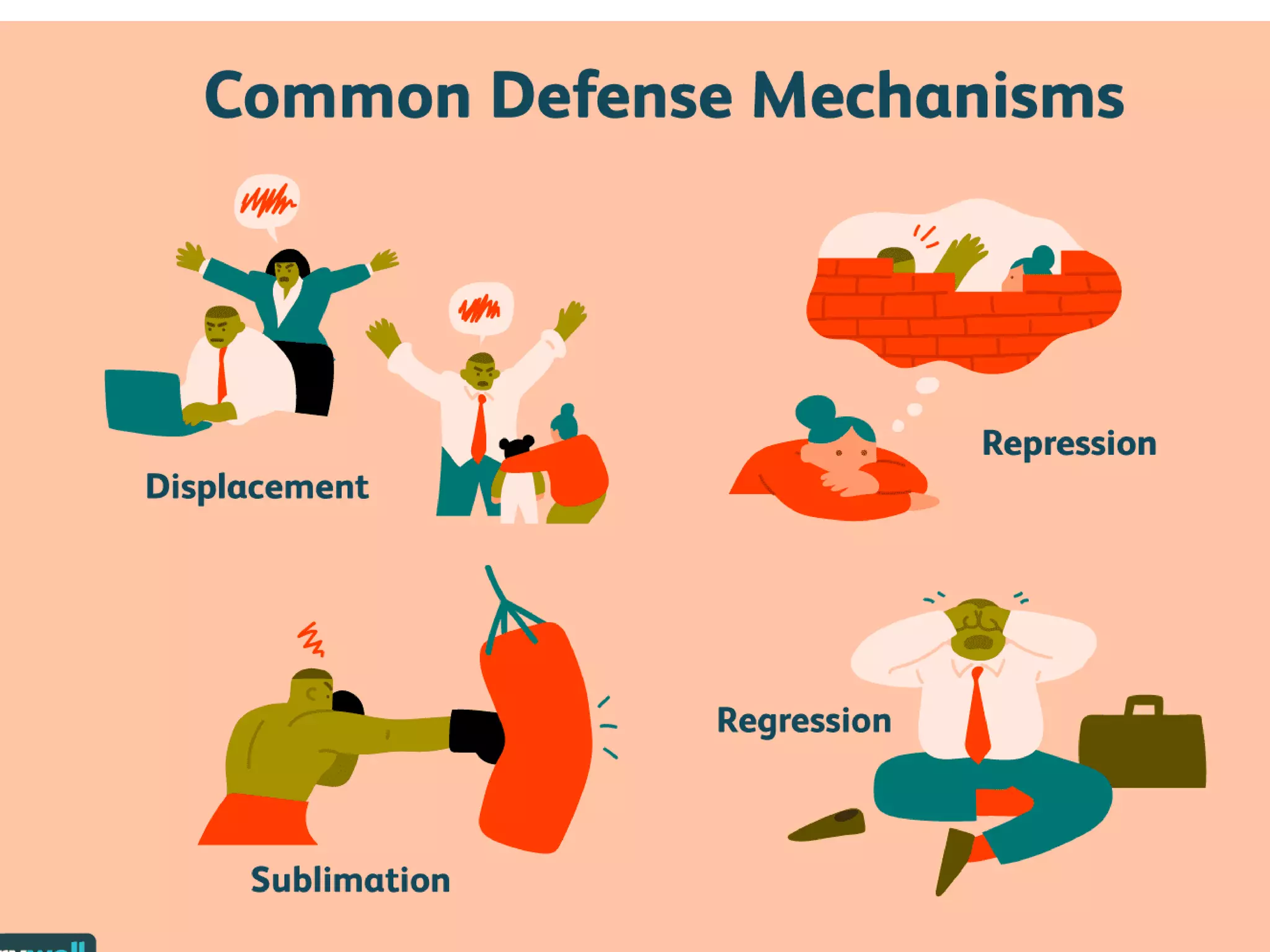
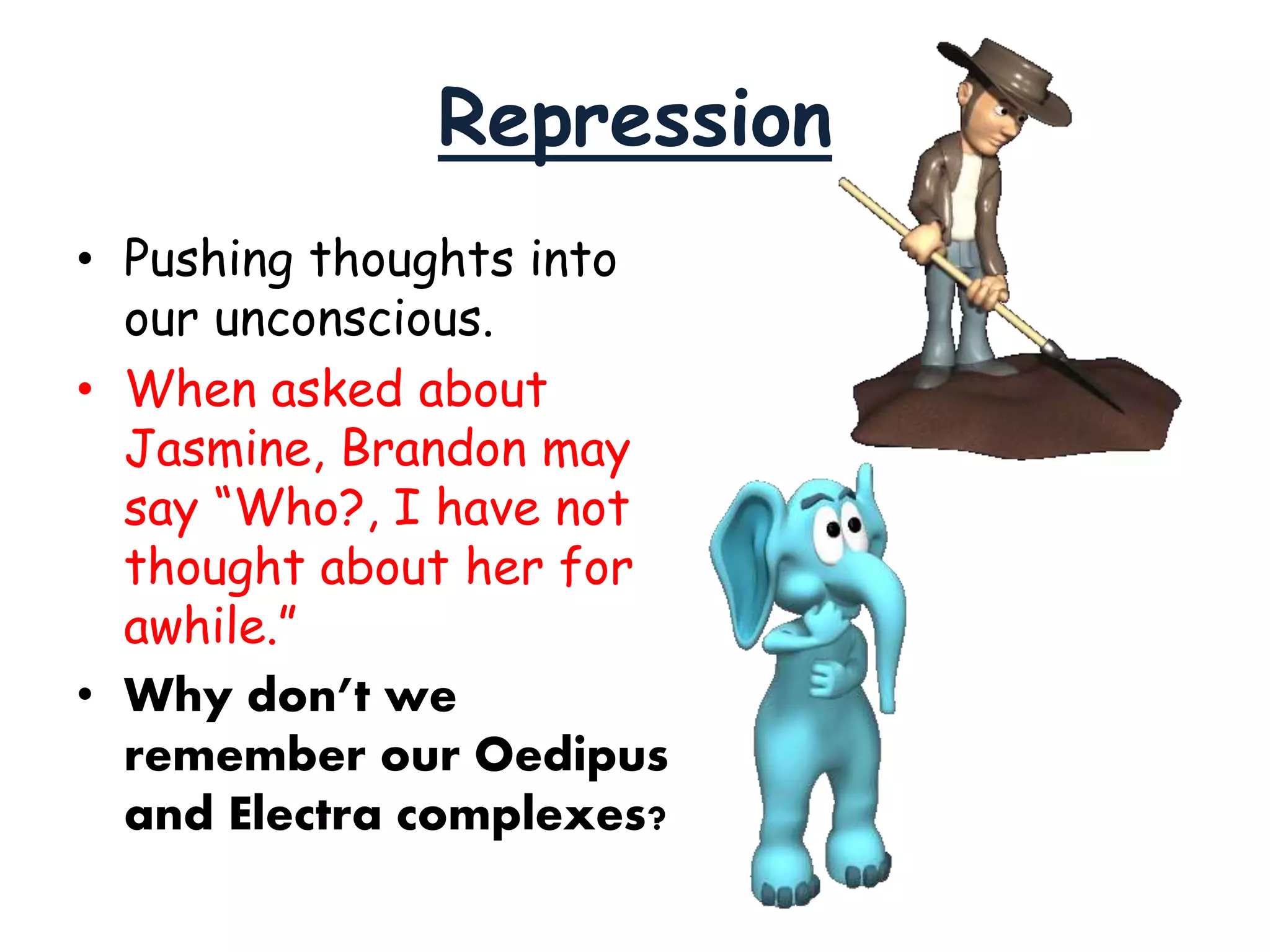
Repression
• Pushing thoughts into
our unconscious.
• When asked about
Jasmine, Brandon may
say “Who?, I have not
thought about her for
awhile.”
• Why don’t we
remember our Oedipus
and Electra complexes?
Denial
• Not accepting the
ego-threatening
truth.
• Brandon may act like
he is still together
with Jasmine. He
may hang out by her
locker and plan dates
with her.
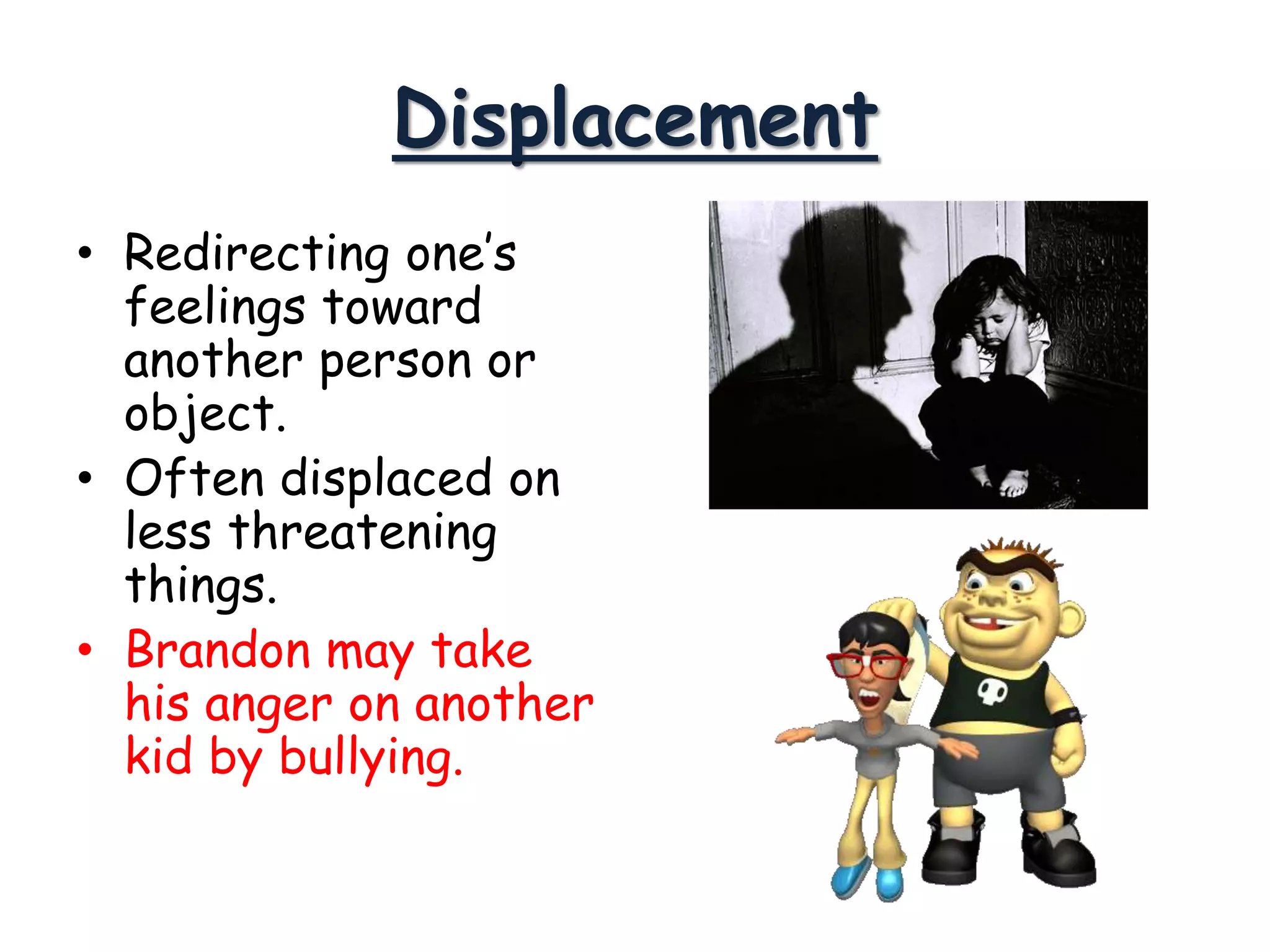
Displacement
• Redirecting one’s
feelings toward
another person or
object.
• Often displaced on
less threatening
things.
• Brandon may take
his anger on another
kid by bullying.
Projection
• Misattribution of a
person’s undesired
thoughts, feelings or
impulses onto
another person who
does not have those
thoughts, feelings or
impulses
• Brandon insists that
Jasmine still cares
for him.
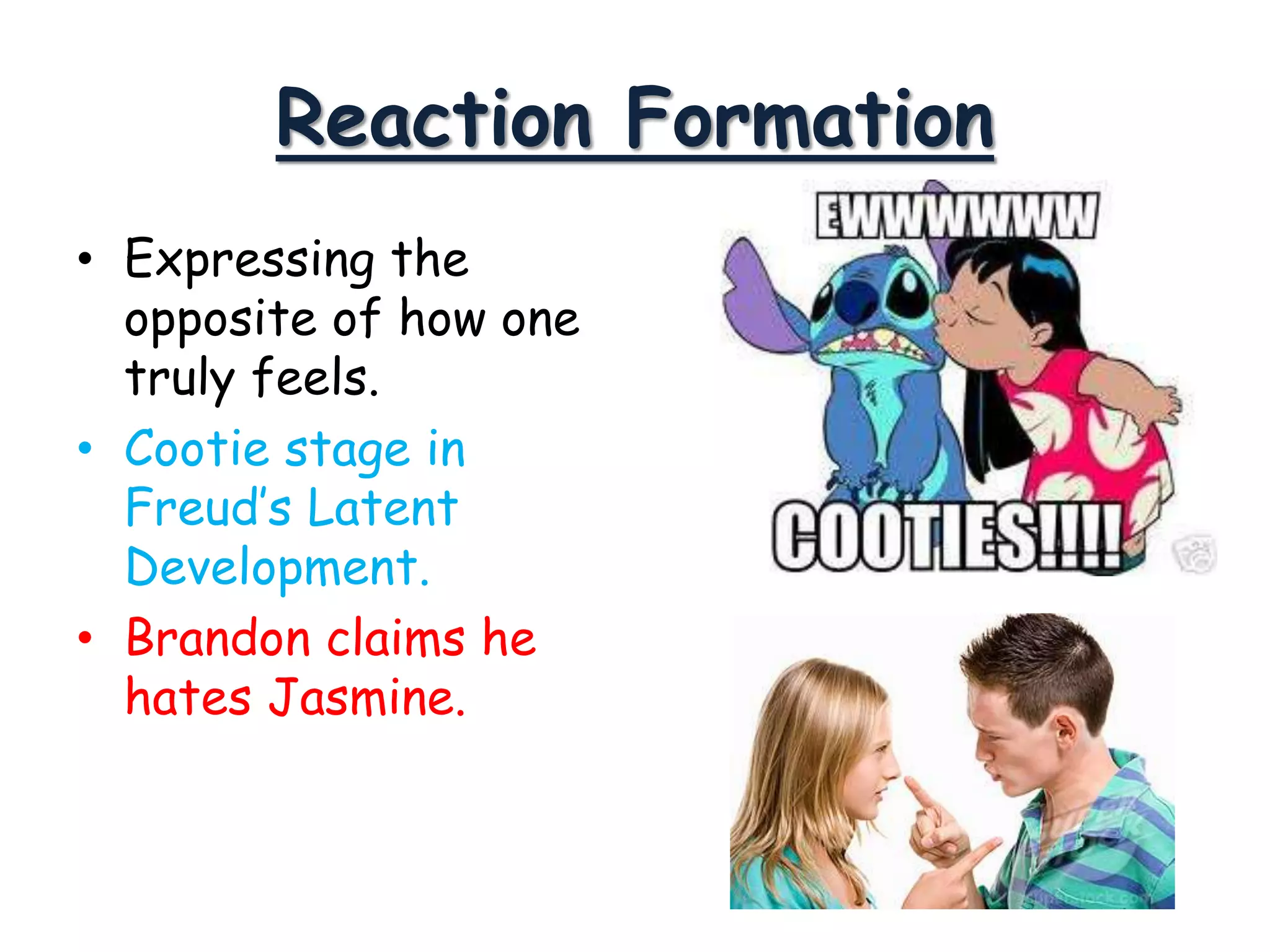
Reaction Formation
• Expressing the
opposite of how one
truly feels.
• Cootie stage in
Freud’s Latent
Development.
• Brandon claims he
hates Jasmine.
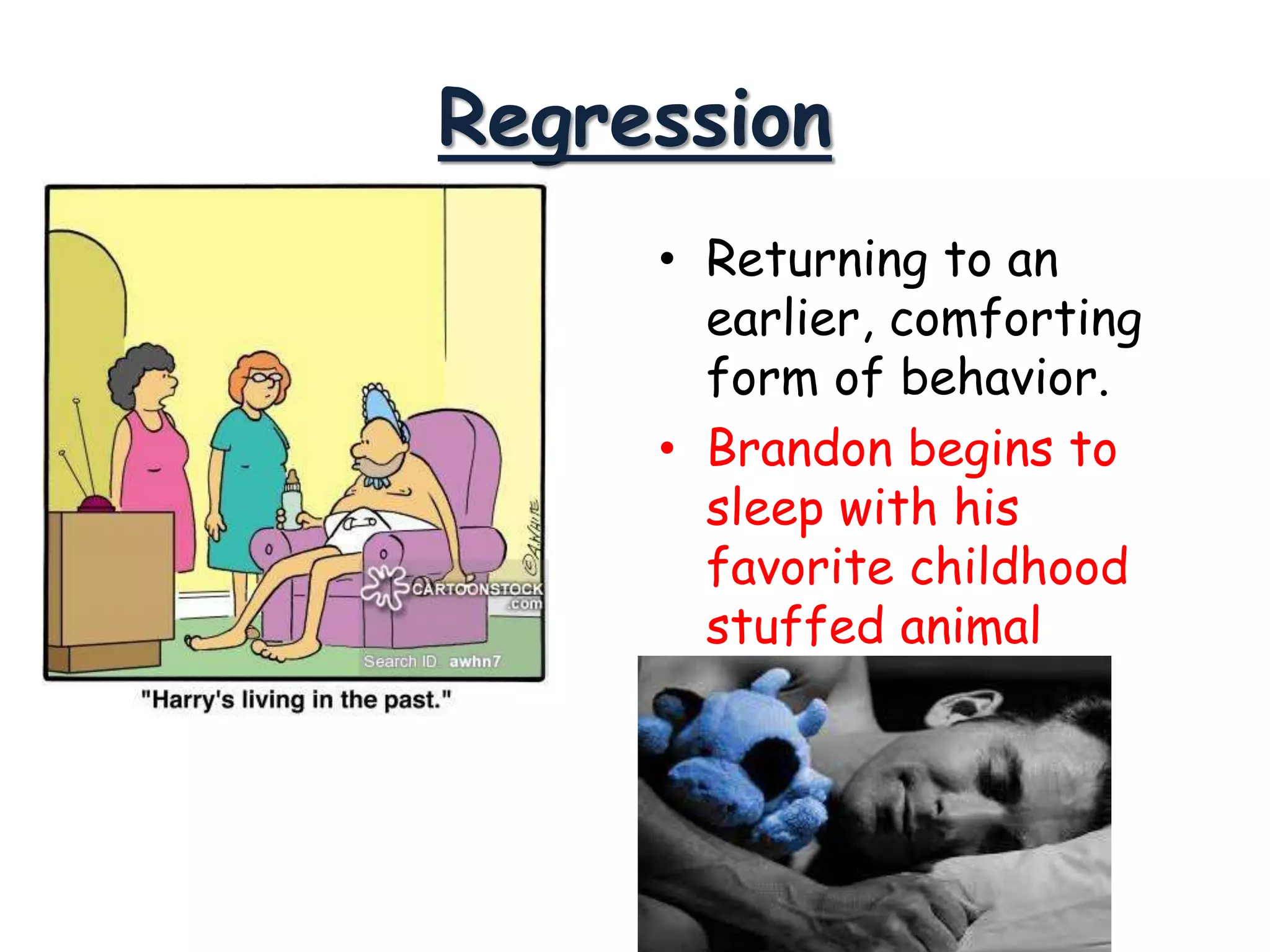
Regression
• Returning to an
earlier, comforting
form of behavior.
• Brandon begins to
sleep with his
favorite childhood
stuffed animal
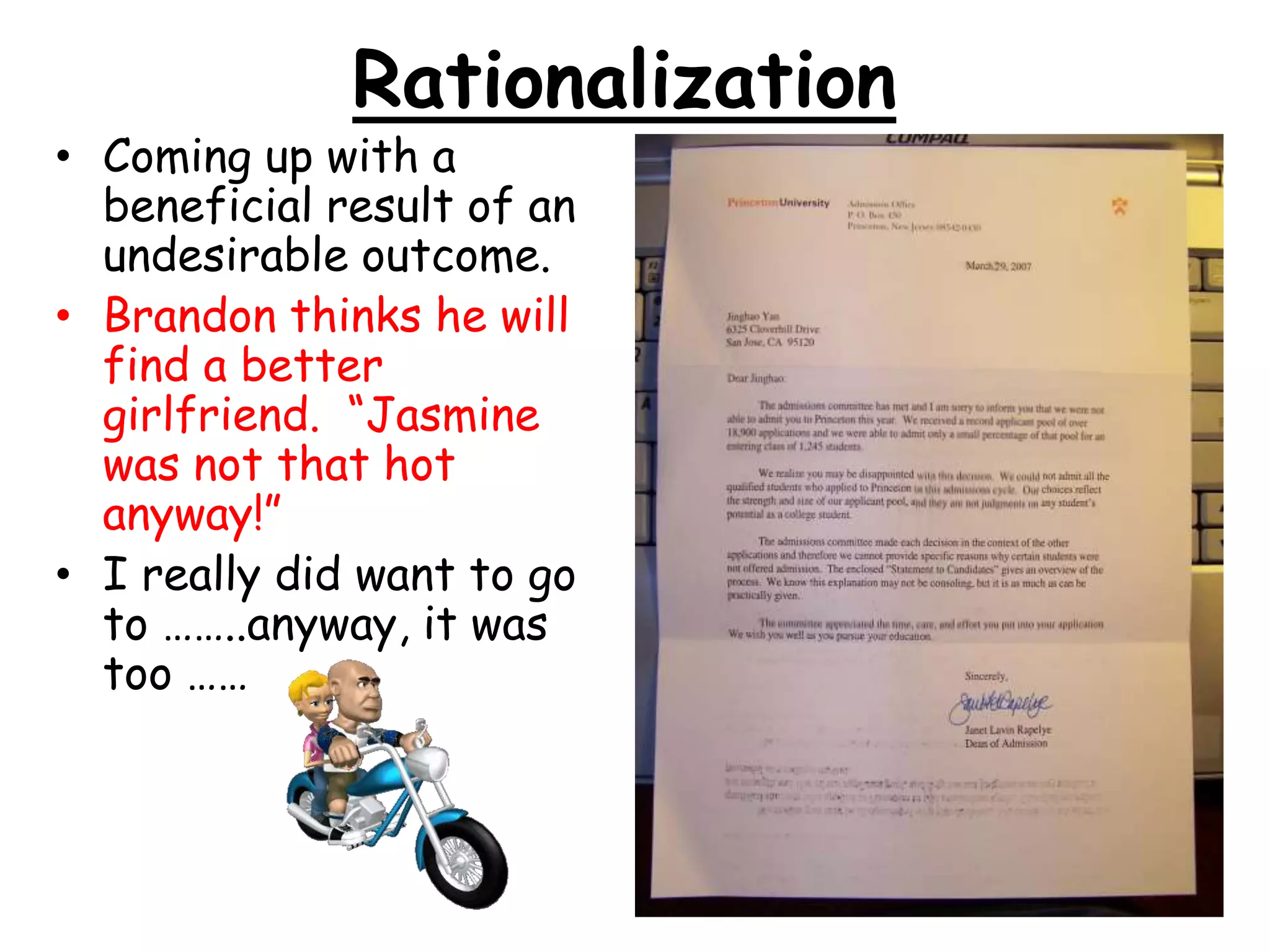
Rationalization
• Coming up with a
beneficial result of an
undesirable outcome.
• Brandon thinks he will
find a better
girlfriend. “Jasmine
was not that hot
anyway!”
• I really did want to go
to ……..anyway, it was
too ……
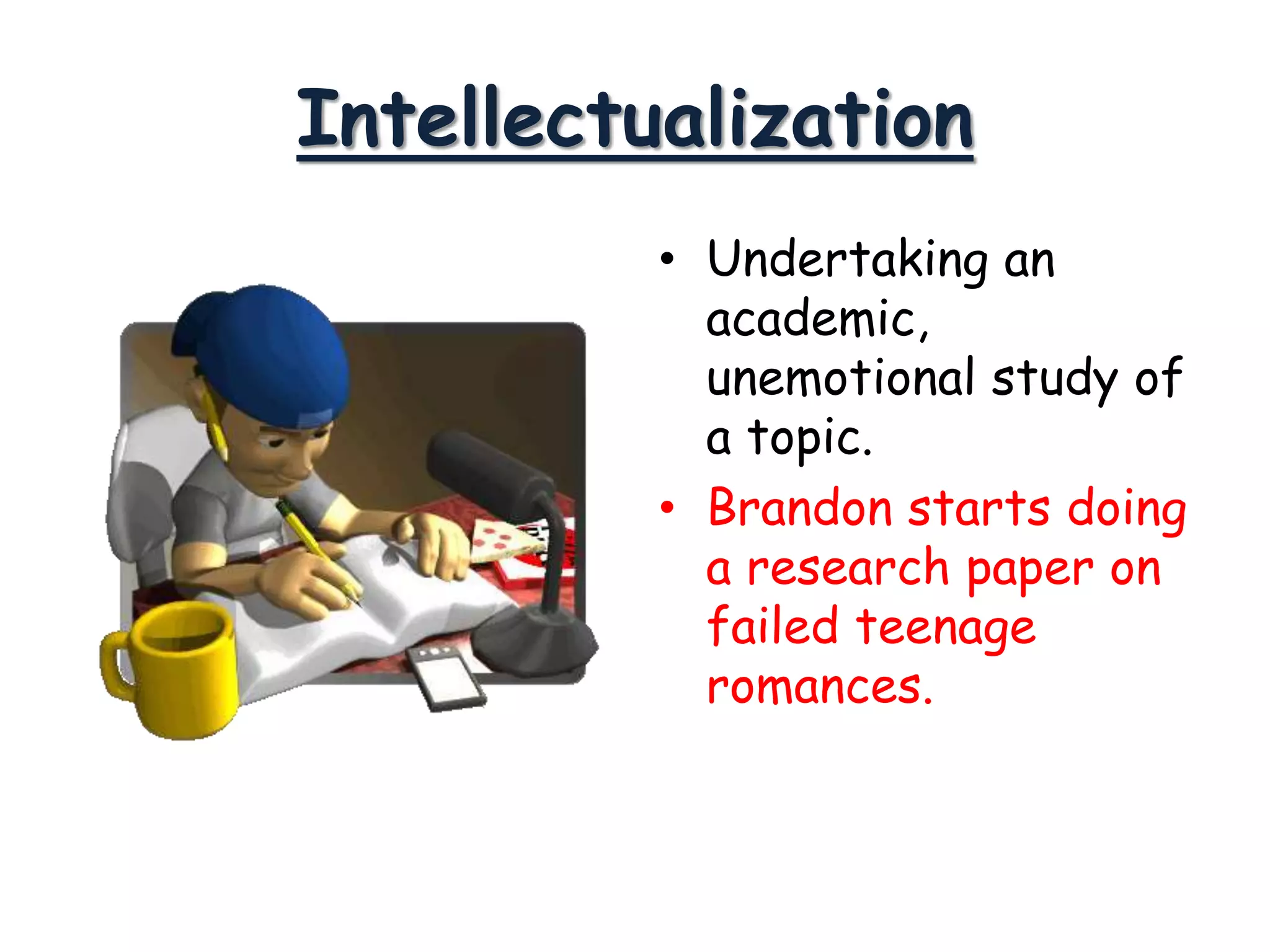
Intellectualization
• Undertaking an
academic,
unemotional study of
a topic.
• Brandon starts doing
a research paper on
failed teenage
romances.
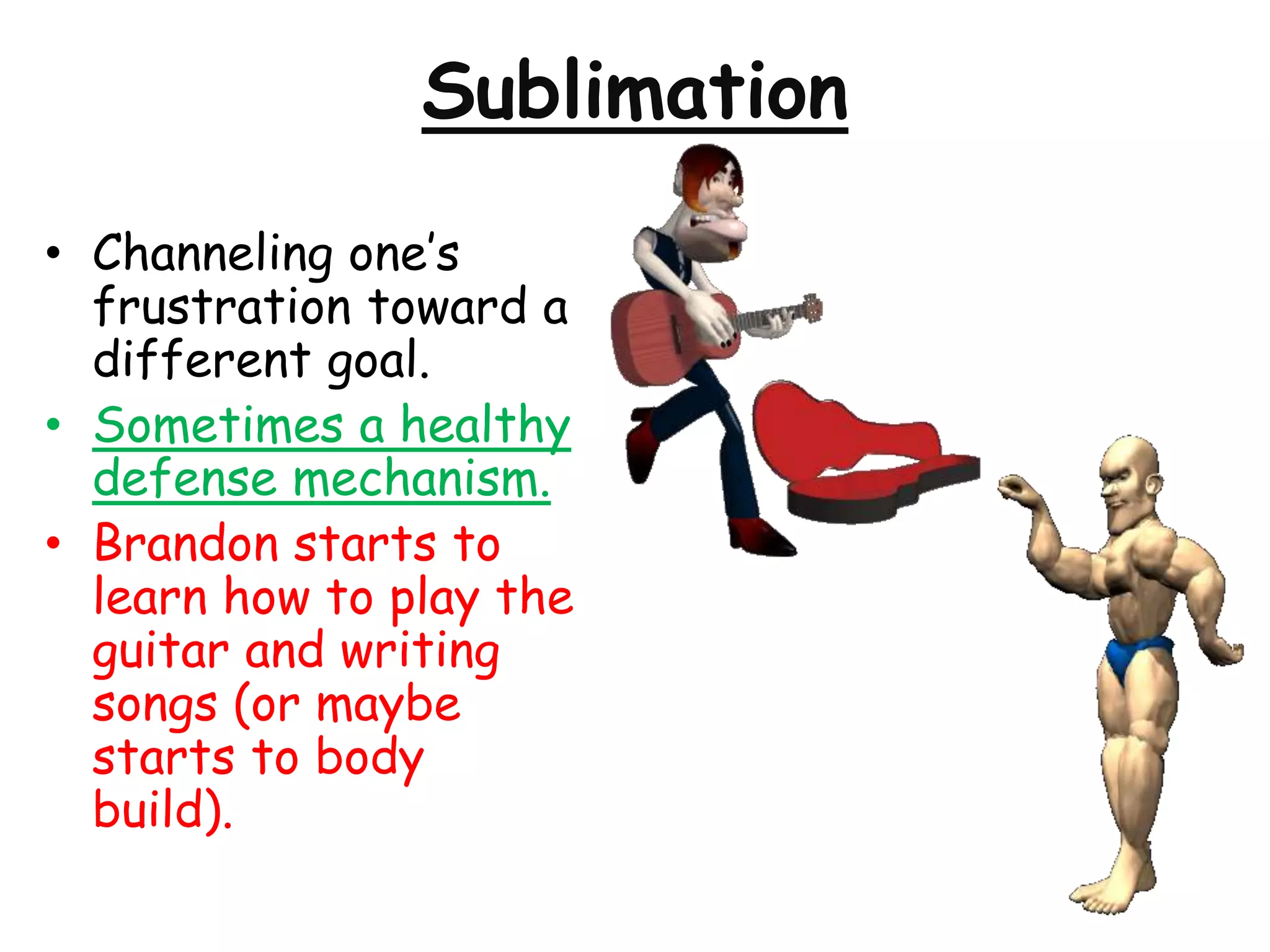
Sublimation
• Channeling one’s
frustration toward a
different goal.
• Sometimes a healthy
defense mechanism.
• Brandon starts to
learn how to play the
guitar and writing
songs (or maybe
starts to body
build).
Psychoanalytic Theory of
Personality
• Fathered by Sigmund
Freud.
• Idea of the Libido moving
to different parts of our
body.
• Stages of Psycho-Sexual
Development
1. Oral
2. Anal
3. Phallic
4. Latent
5. Genital Sigmund Freud
What’s on our minds!!!
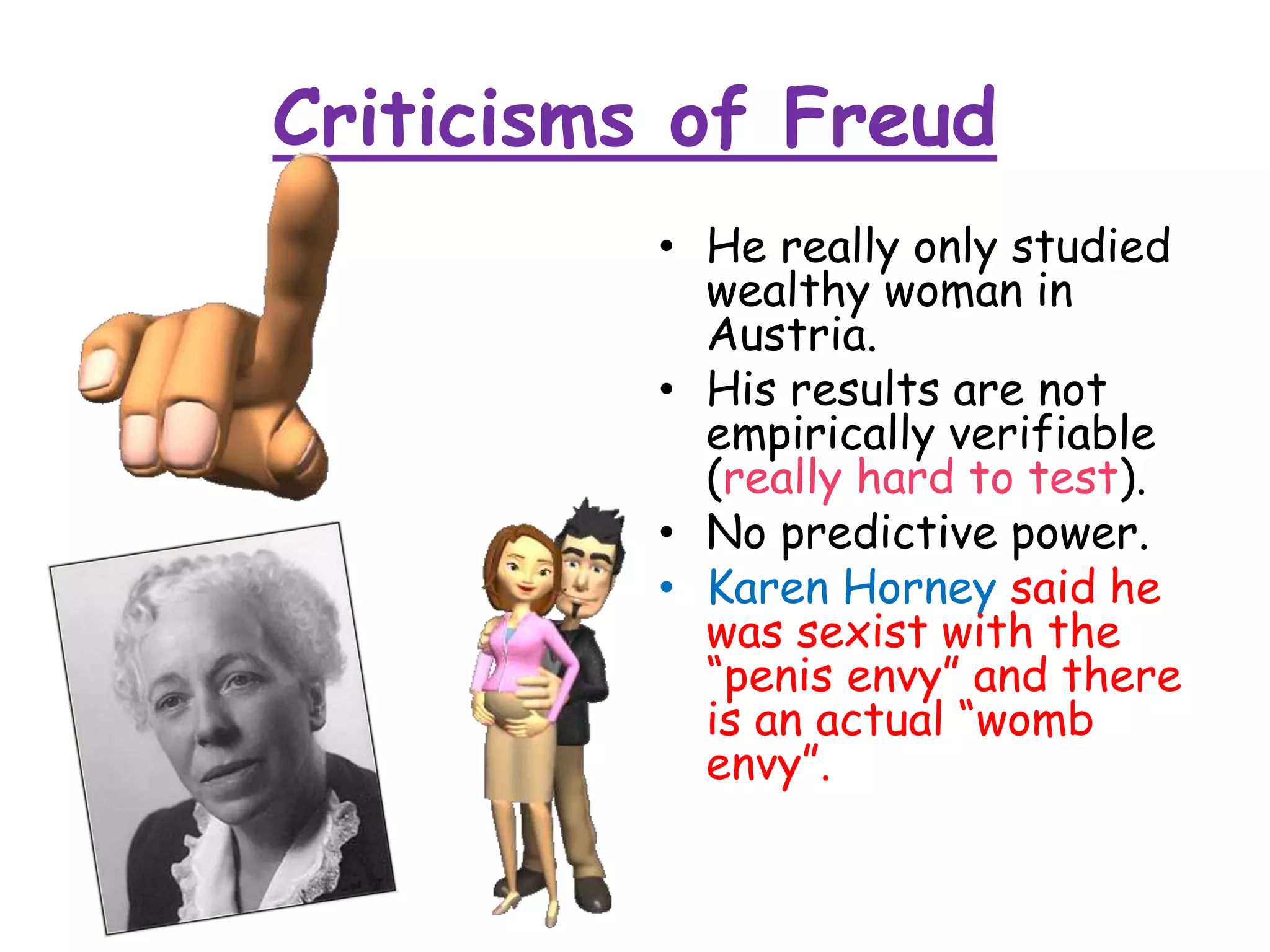
Criticisms of Freud
• He really only studied
wealthy woman in
Austria.
• His results are not
empirically verifiable
(really hard to test).
• No predictive power.
• Karen Horney said he
was sexist with the
“penis envy” and there
is an actual “womb
envy”.
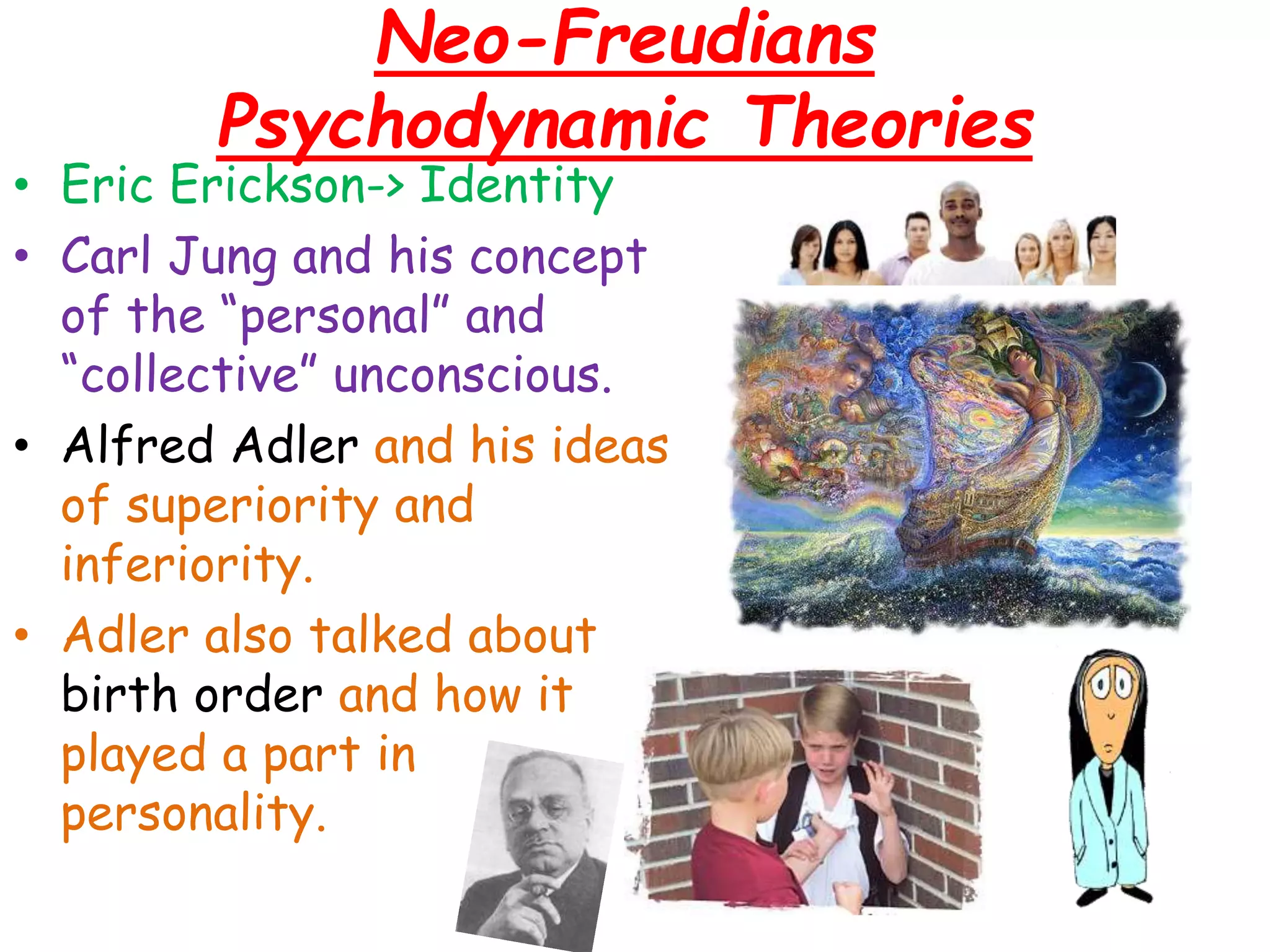
Neo-Freudians
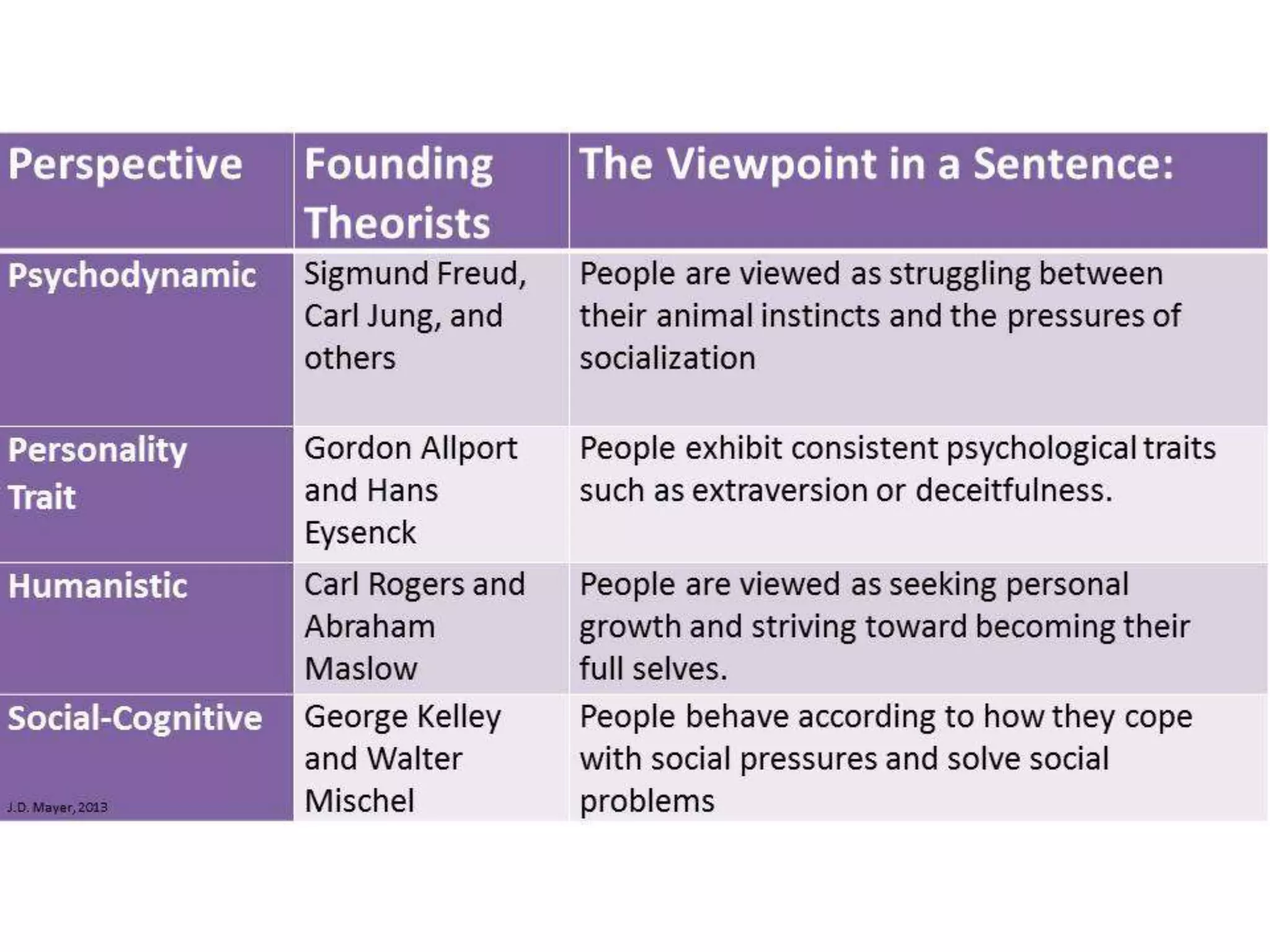
Psychodynamic Theories
• Eric Erickson-> Identity
• Carl Jung and his concept
of the “personal” and
“collective” unconscious.
• Alfred Adler and his ideas
of superiority and
inferiority.
• Adler also talked about
birth order and how it
played a part in
personality.
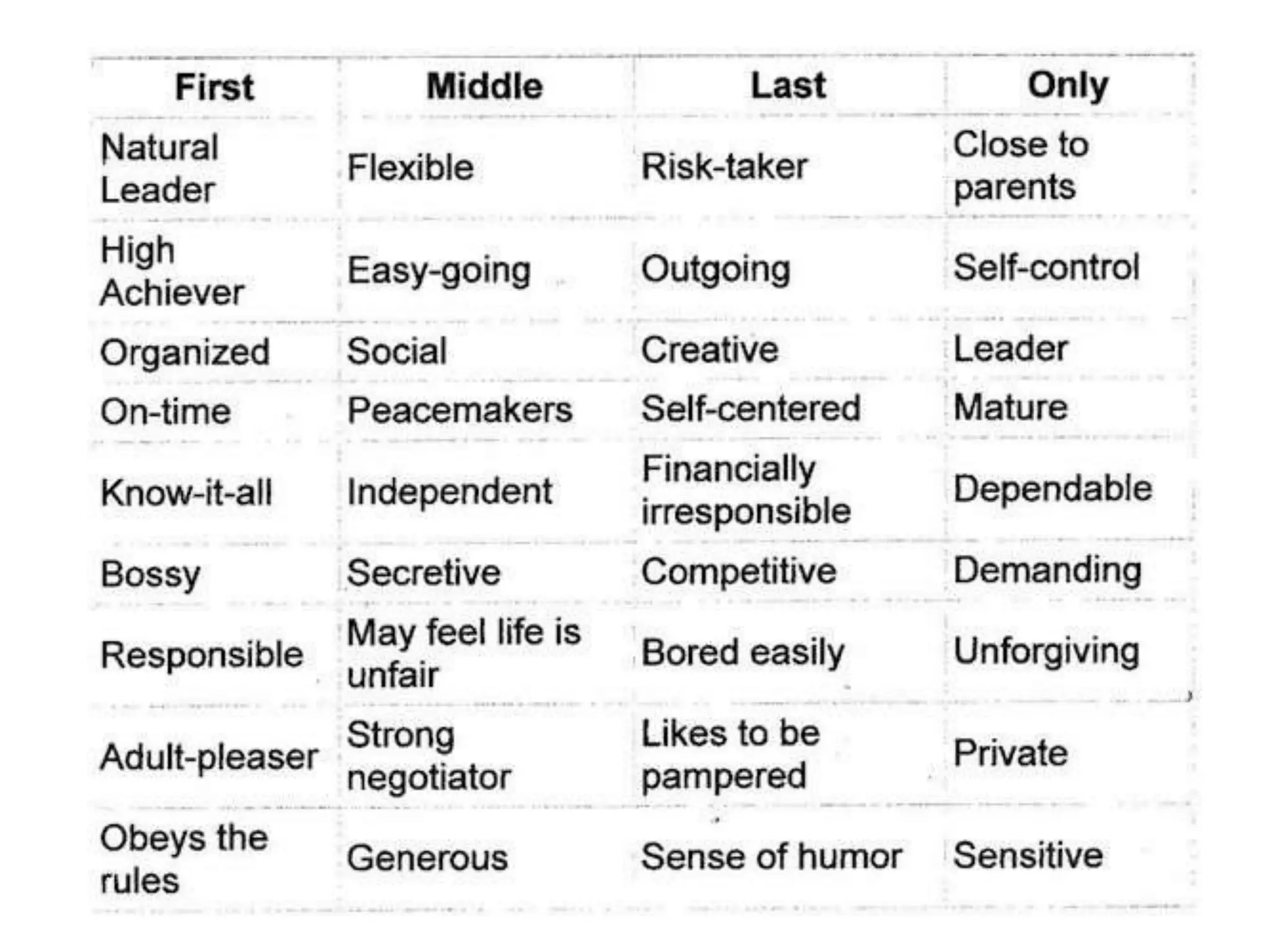
Birth Order Personality Theory
Where do you rank in
your family’s birth
order? Do you agree
with Adler’s theory?
Explain your reaction.
Psychoanalysis Today
• Couch sitting
• Transference is
likely to happen.
• The idea is to delve
into your
unconscious.
• Pull out Manifest
Content.
• Then talk about the
Latent Content.
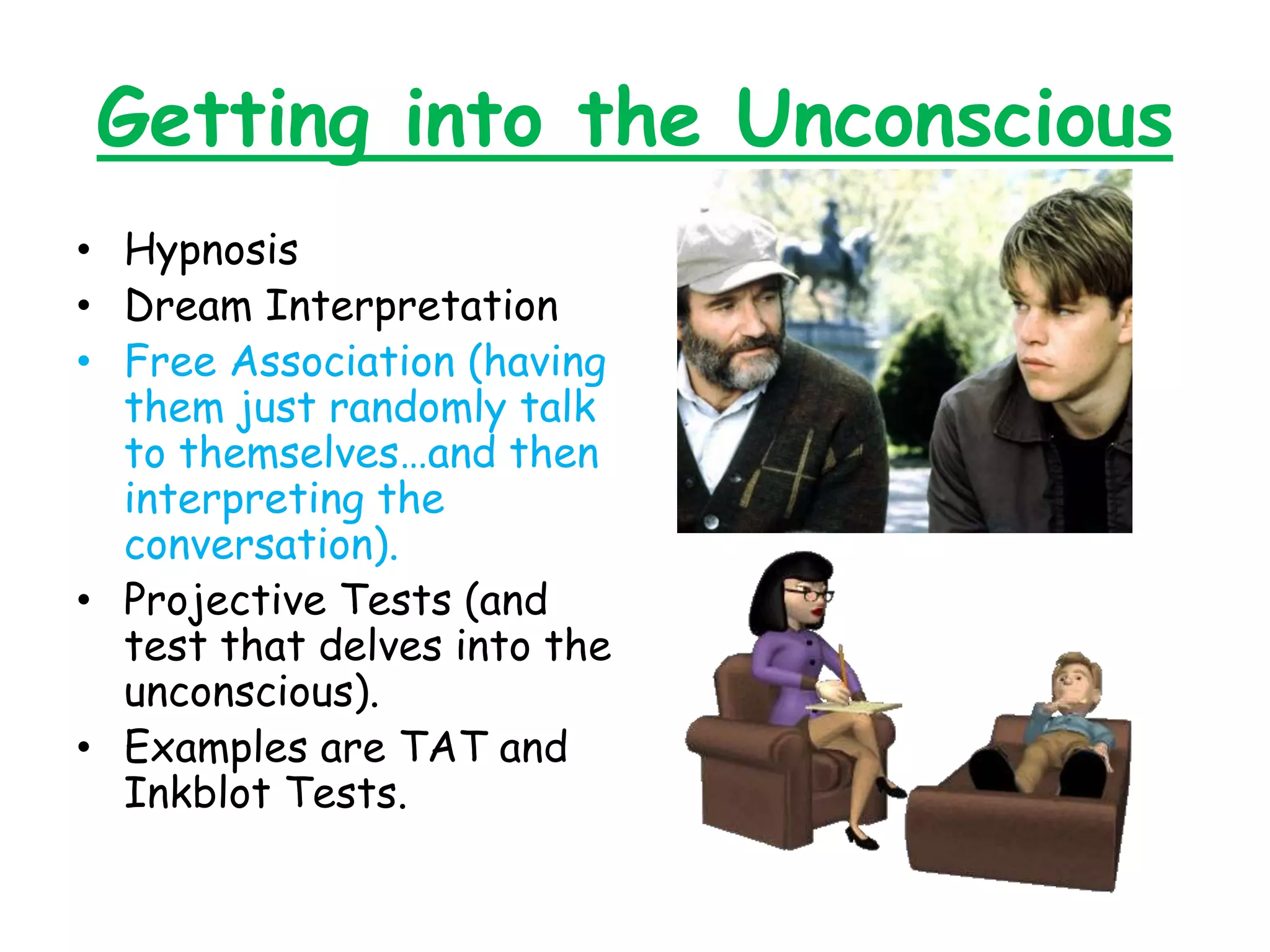
Getting into the Unconscious
• Hypnosis
• Dream Interpretation
• Free Association (having
them just randomly talk
to themselves…and then
interpreting the
conversation).
• Projective Tests (and
test that delves into the
unconscious).
• Examples are TAT and
Inkblot Tests.
TAT Test
Thematic Apperception Test
• Giving the subject a picture that is
ambiguous (can have several meanings)
and ask them what is occurring.
• Their answers reveal the manifest
content.
• They can then discover the Latent
Content.
• Number your paper #1-3
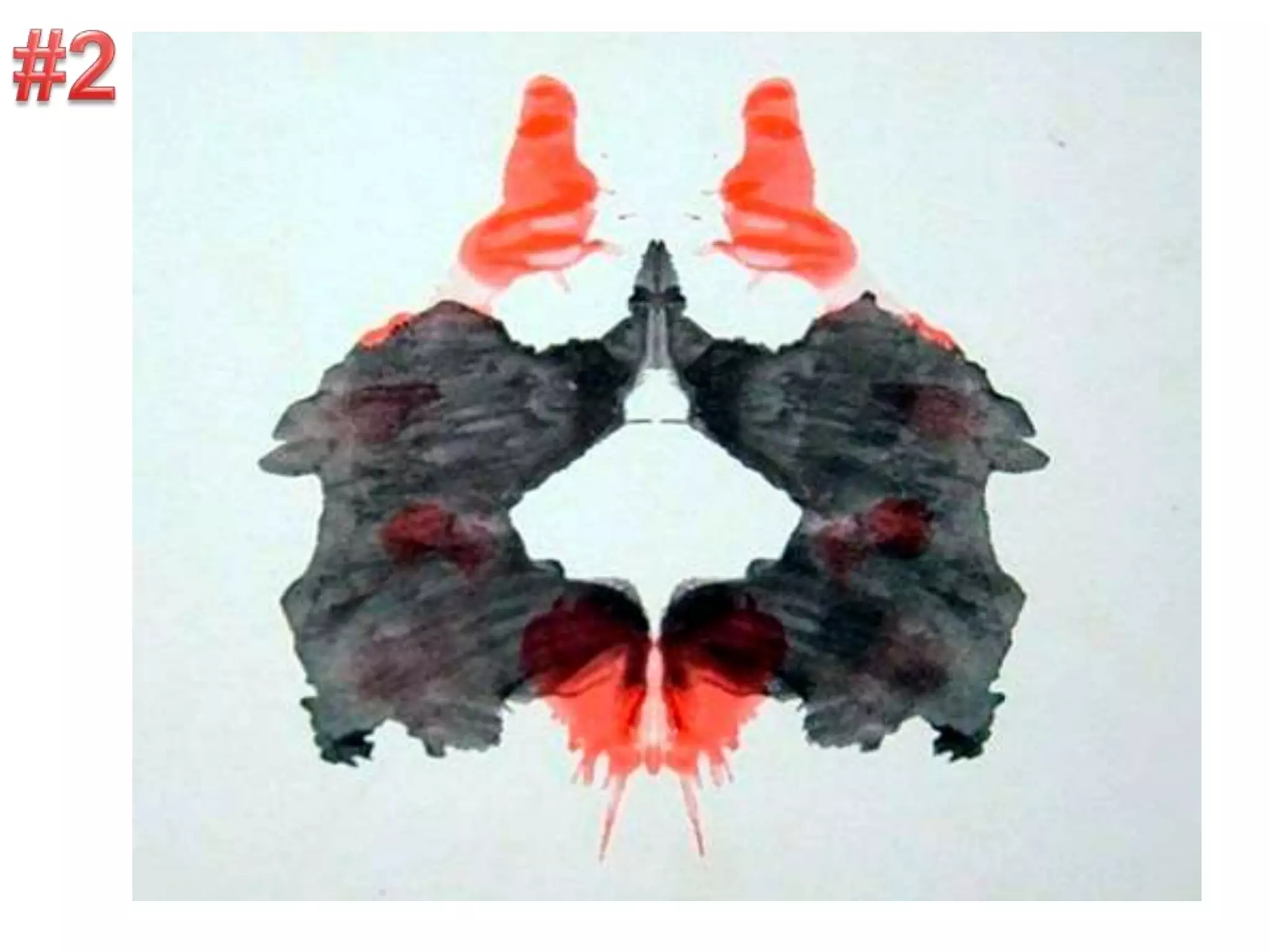
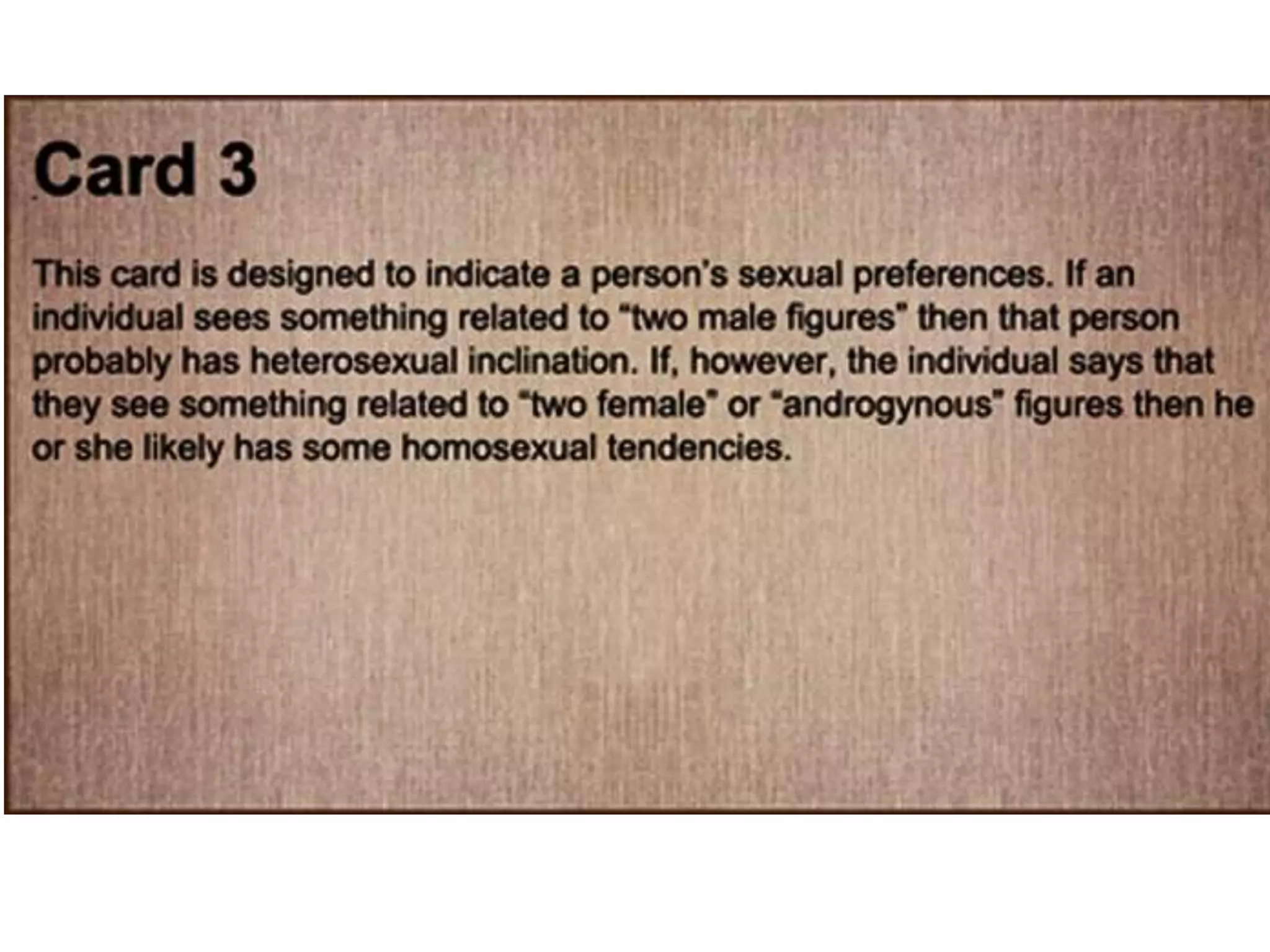
Rorschach Inkblot Test
• The most widely used projective test
• A set of ten inkblots designed to
identify people’s feelings when they are
asked to interpret what they see in the
inkblots.
Number your paper #1-4
Trait Theories of Personality
• Believe that we can
describe people’s
personalities by
specifying their main
characteristics
(traits).
• Traits like honestly,
laziness, ambition,
outgoing are thought
to be stable over the
course of your lives.
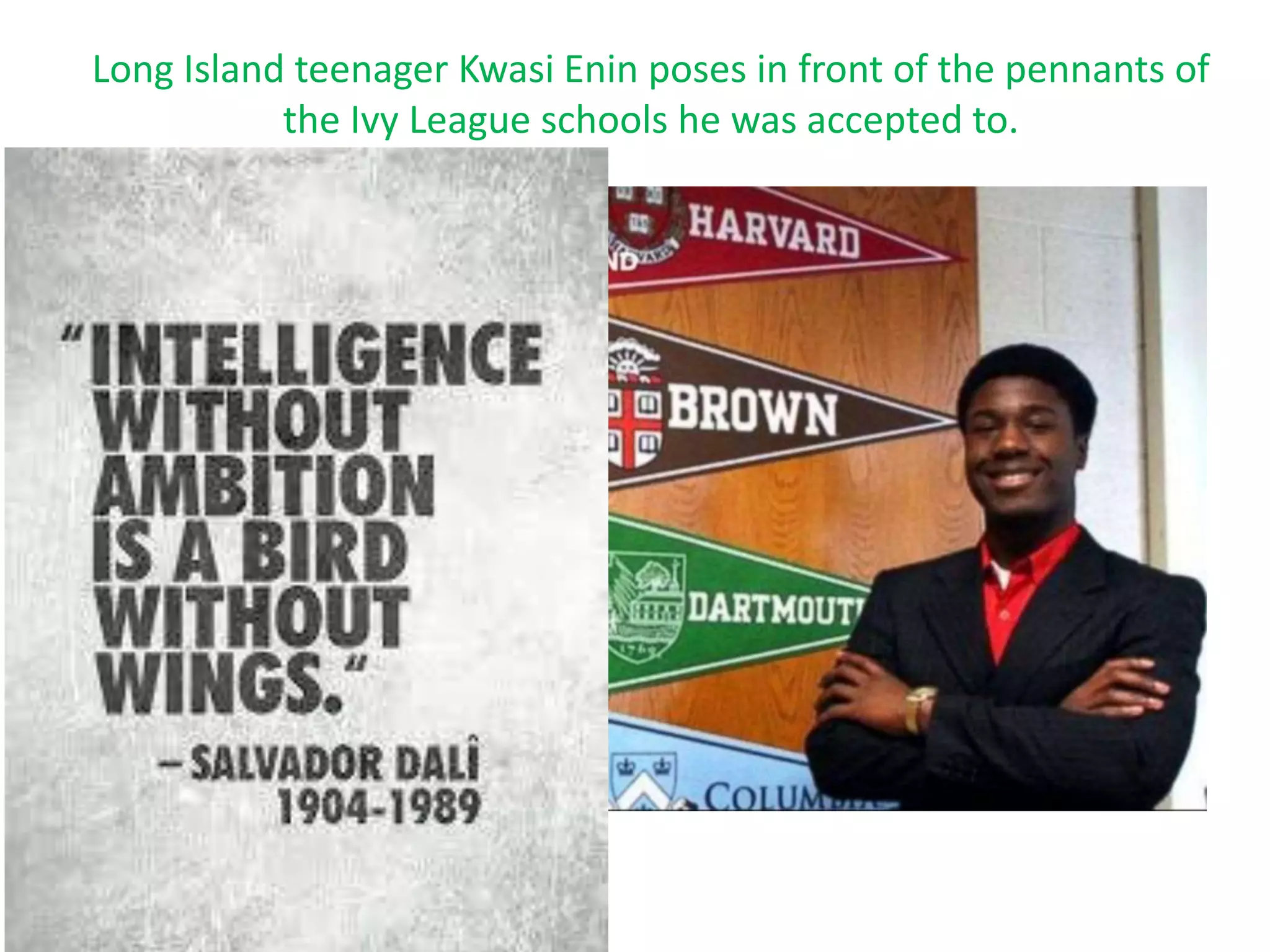
Long Island teenager Kwasi Enin poses in front of the pennants of
the Ivy League schools he was accepted to.
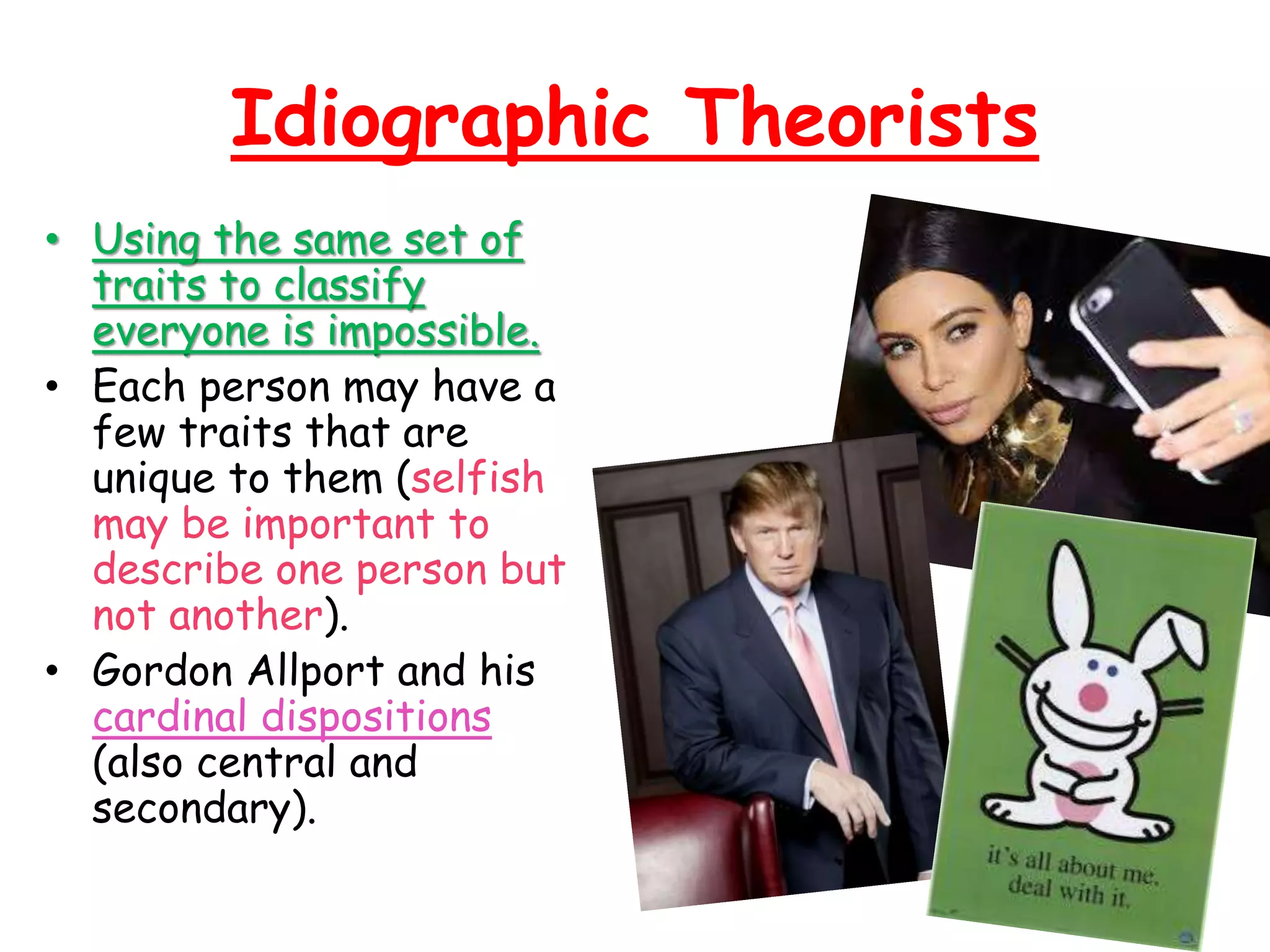
Idiographic Theorists
• Using the same set of
traits to classify
everyone is impossible.
• Each person may have a
few traits that are
unique to them (selfish
may be important to
describe one person but
not another).
• Gordon Allport and his
cardinal dispositions
(also central and
secondary).
Nomothetic Theories
• The same traits can be used to
describe all peoples personalities.
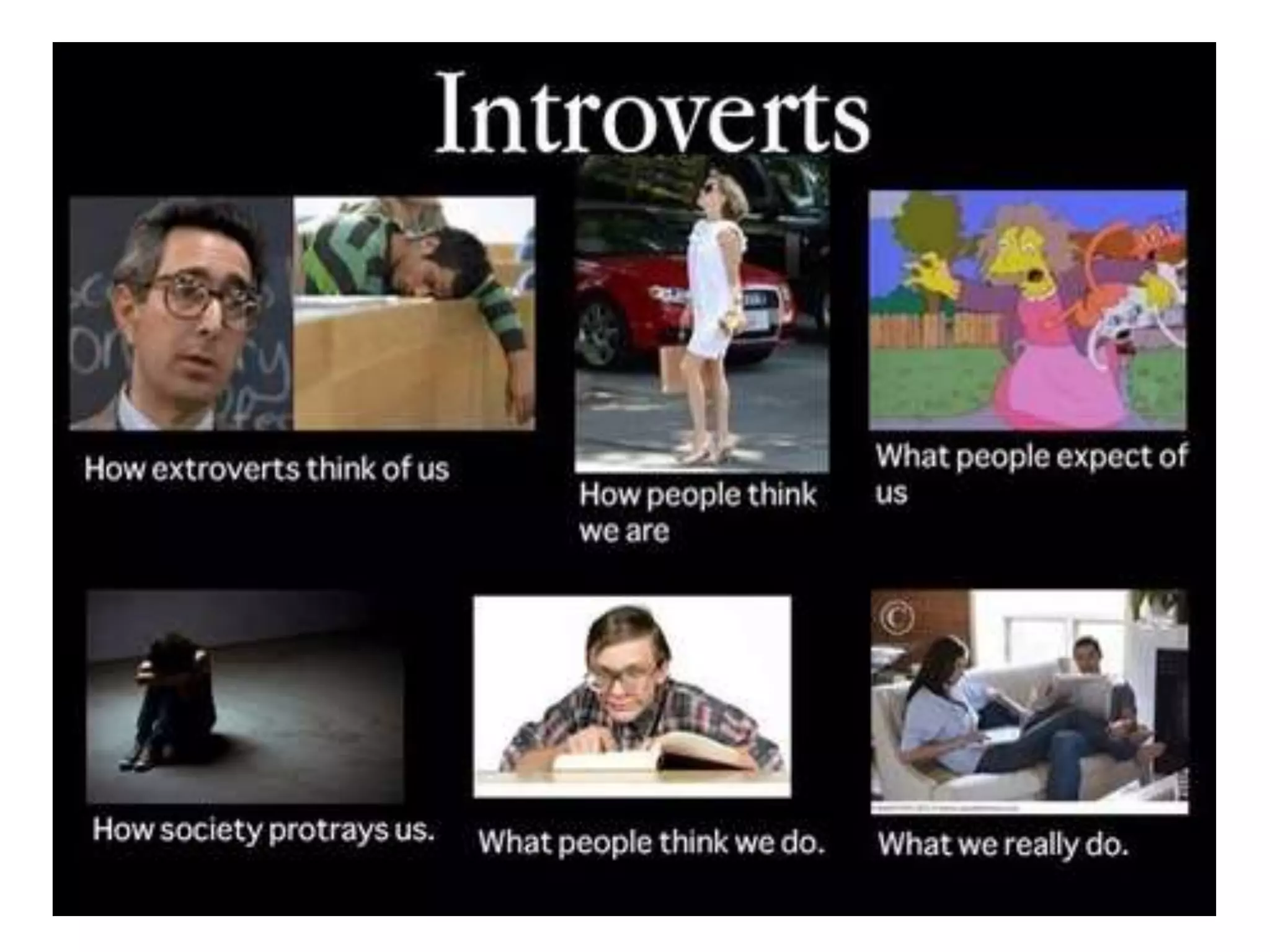
• Introversion-Extroversion scale
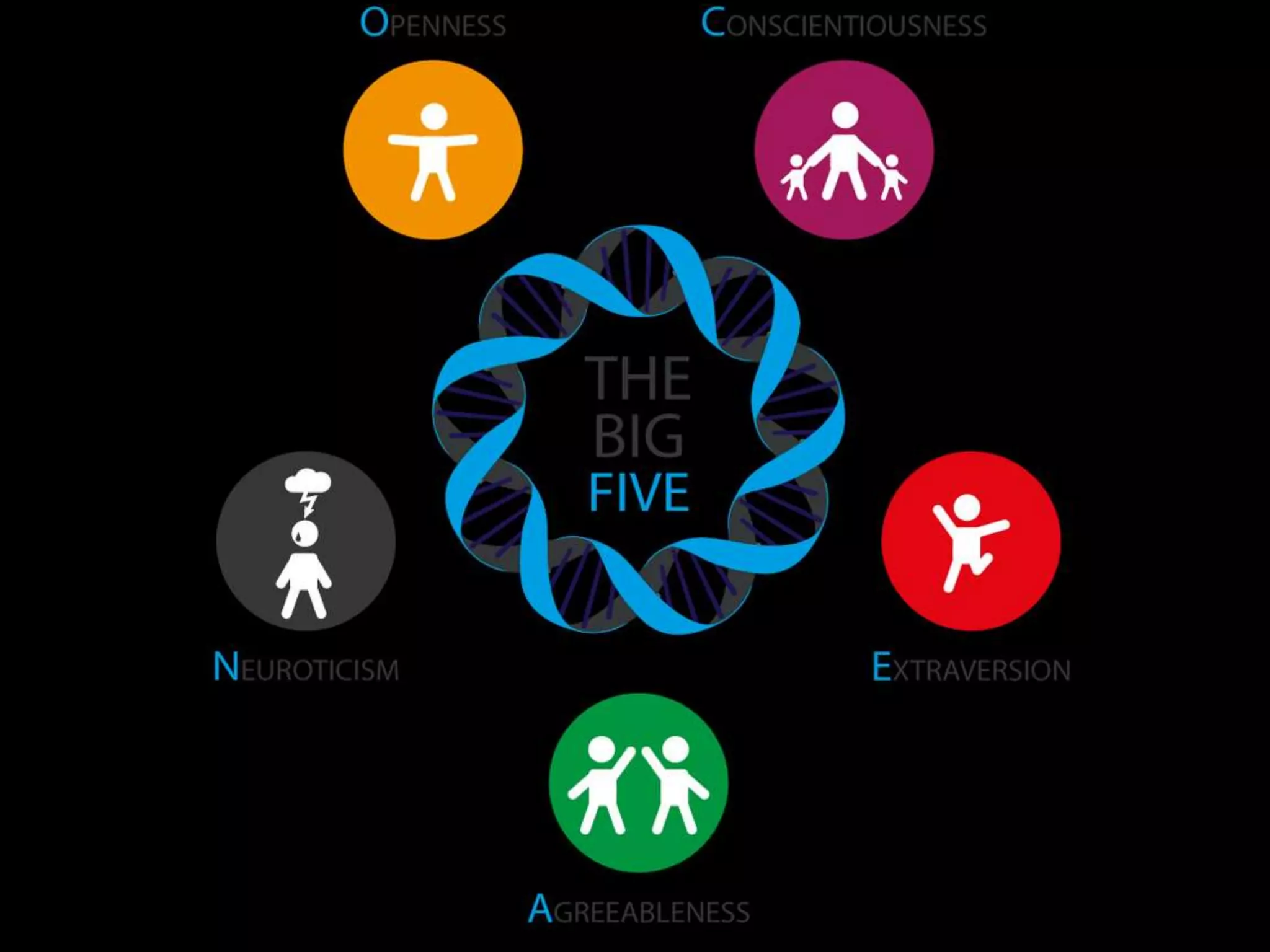
• BIG FIVE personality traits:
1. Extraversion
2. Agreeableness
3. Conscientiousness
4. Openness to experience
5. Emotional Stability
Factor Analysis is used to see the
clusters and score these tests.
Vinnie and The Situation from the Jersey
Shore provide some nice,
introvert/extrovert examples.
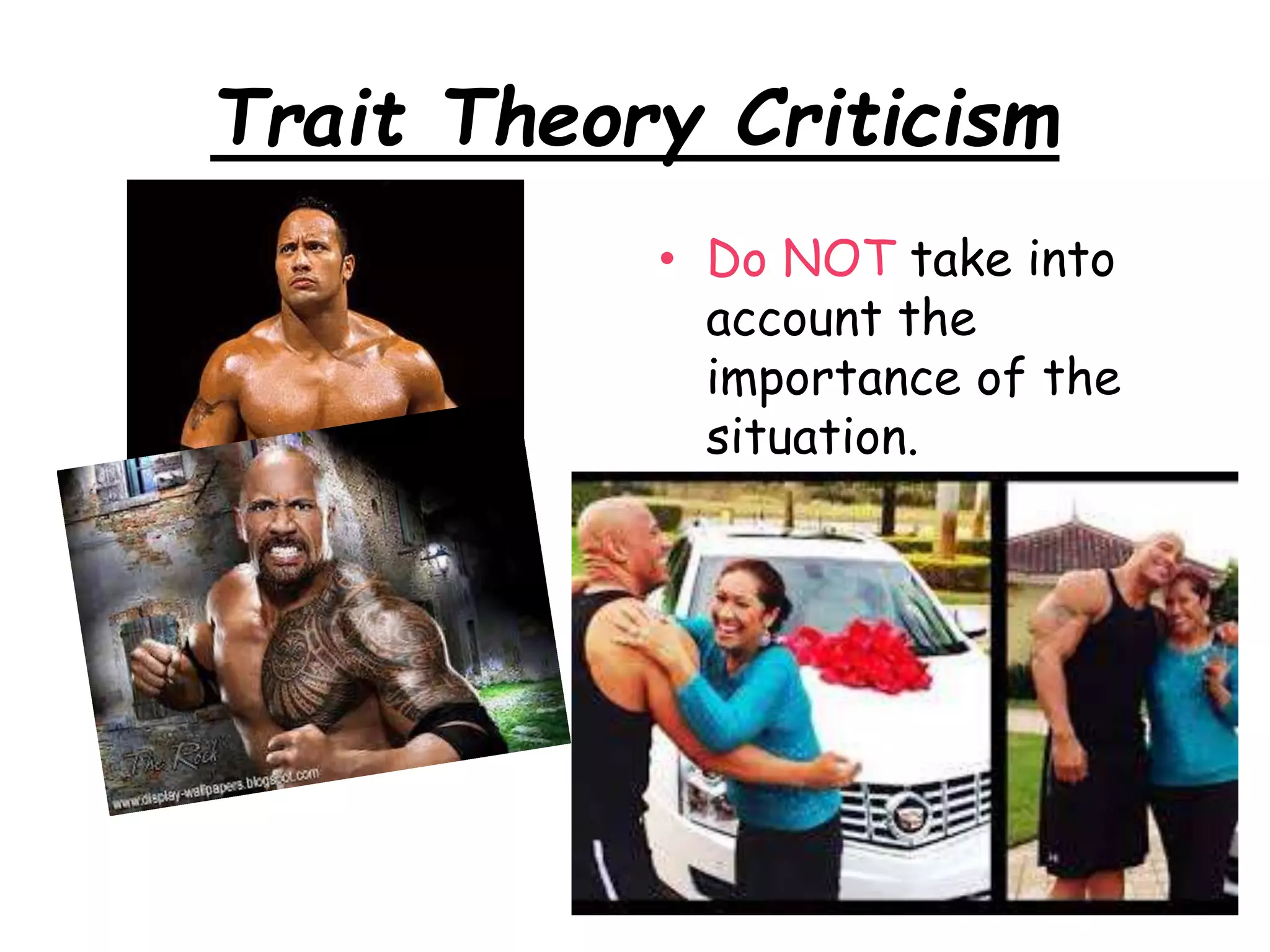
Trait Theory Criticism
• Do NOT take into
account the
importance of the
situation.
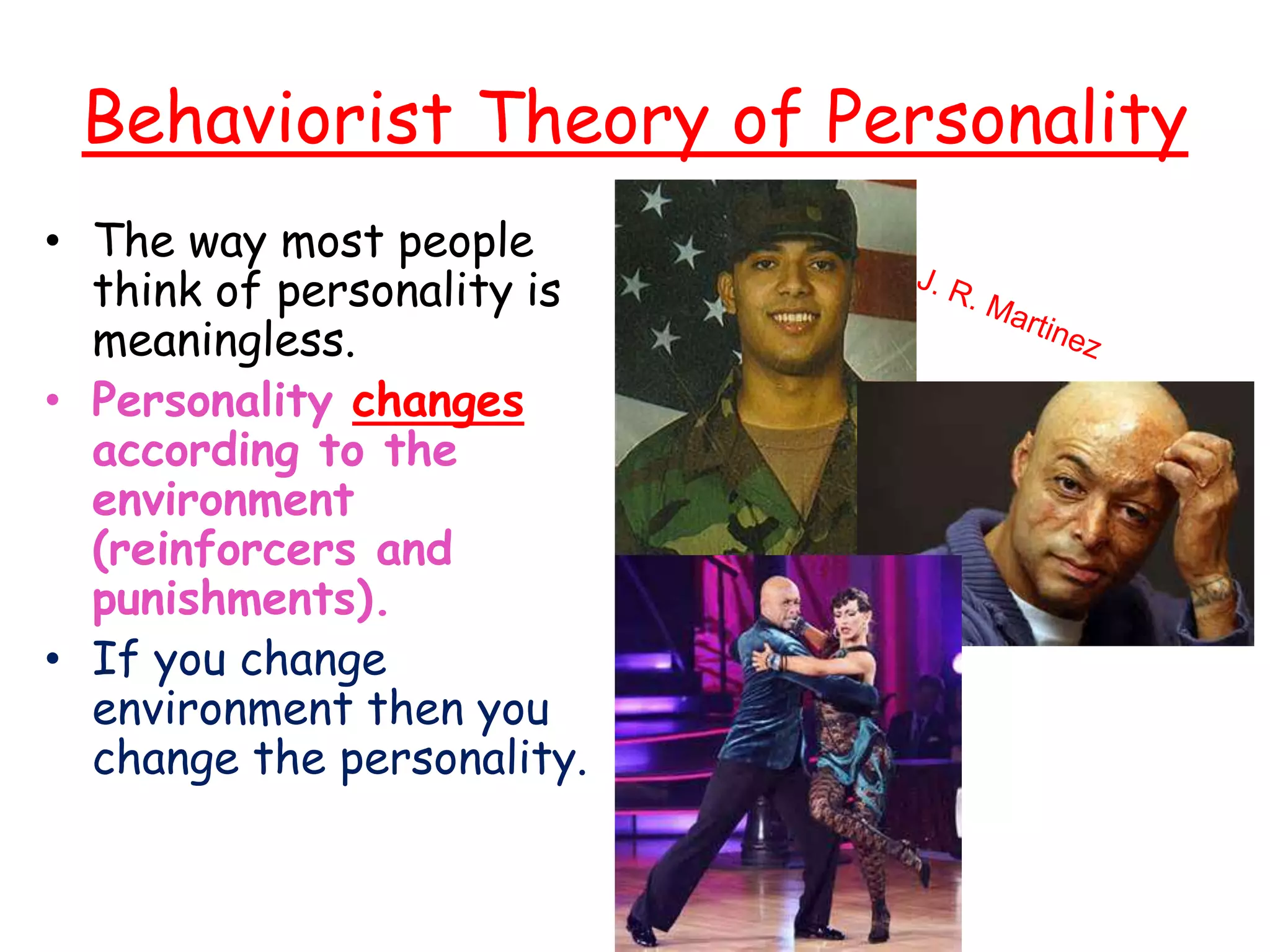
Behaviorist Theory of Personality
• The way most people
think of personality is
meaningless.
• Personality changes
according to the
environment
(reinforcers and
punishments).
• If you change
environment then you
change the personality.
Biological Theories of
Personality
• What % of
personality is
inherited –
heritability?
• We are not sure
BUT temperaments
do seem to be stable
from infants to old
age.
Somatotype Theory
• A biological Theory by
William Sheldon.
Endomorphs (Fat) tend
to be friendly and
outgoing.
Mesomorphs
(muscular) tend to be
more aggressive.
Ectomorphs (thin) tend
to be more shy and
secretive.
• Study has not been
replicated.
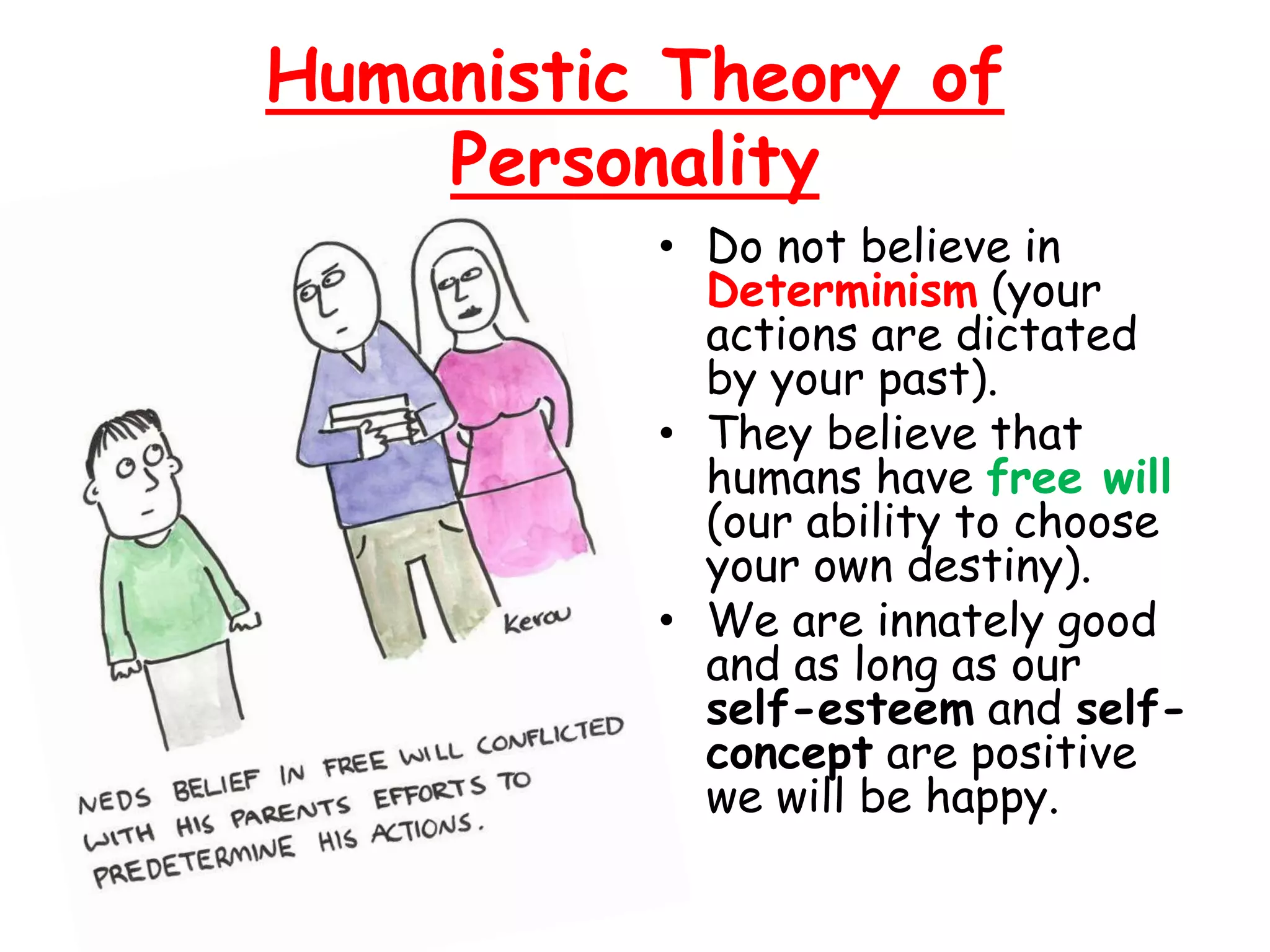
Humanistic Theory of
Personality
• Do not believe in
Determinism (your
actions are dictated
by your past).
• They believe that
humans have free will
(our ability to choose
your own destiny).
• We are innately good
and as long as our
self-esteem and self-
concept are positive
we will be happy.
Carl Rogers
The object of humans is to
become self-actualized.
• We are like Acorns
• What do Acorns need to
grow?
• Water, sun, and soil.
Except to grow into healthy
humans we need:
• Genuineness
• Acceptance (Unconditional
Positive Regard)
• Empathy
• Focus on how we
interact with our
culture and
environment
• Albert Bandura is
back!!!
• Reciprocal
Determinism (traits,
environment and
behavior all interact
and influence each
other.)
Social-Cognitive Theories on
Personality
Social-Cognitive Theories on
Personality
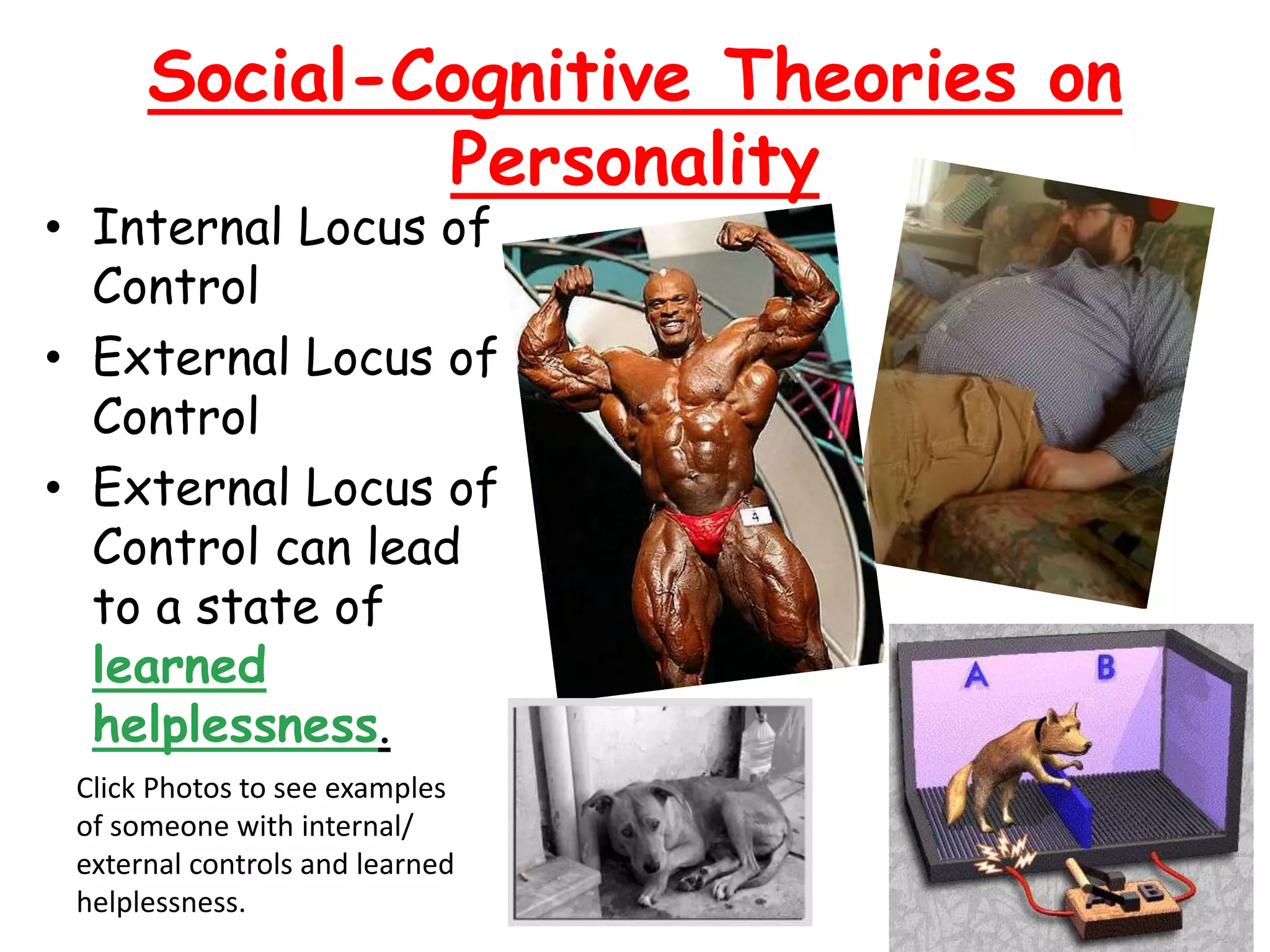
• Internal Locus of
Control
• External Locus of
Control
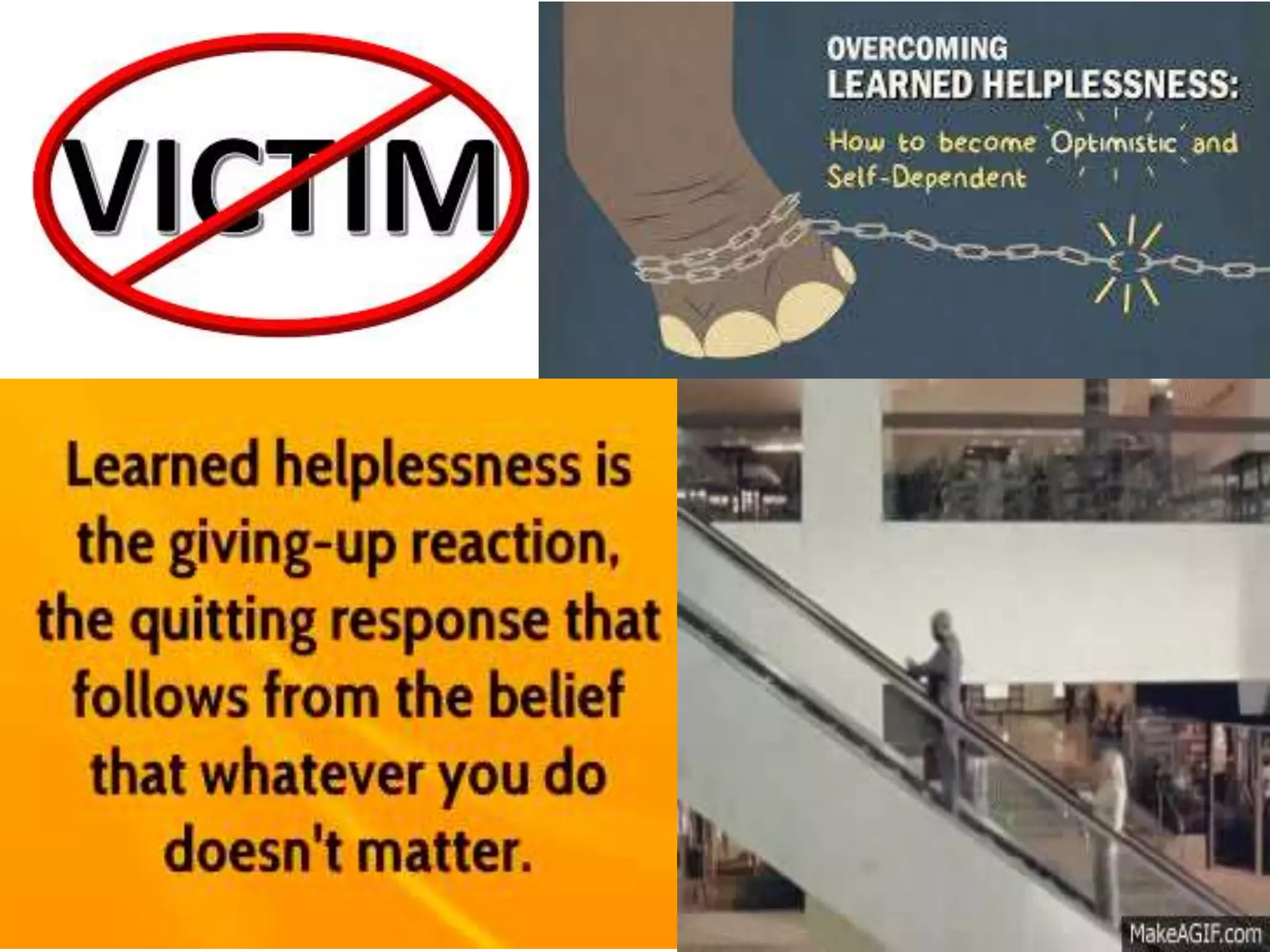
• External Locus of
Control can lead
to a state of
learned
helplessness.
Click Photos to see examples
of someone with internal/
external controls and learned
helplessness.
Assessing Personality
• Most common way is
self-report inventories.
• MMPI- Minnesota
Multiphasic Personality
Inventory
Test must be
• Reliable- does it yield
the same results over
time.
• Valid- does it measure
what it is supposed to
measure.
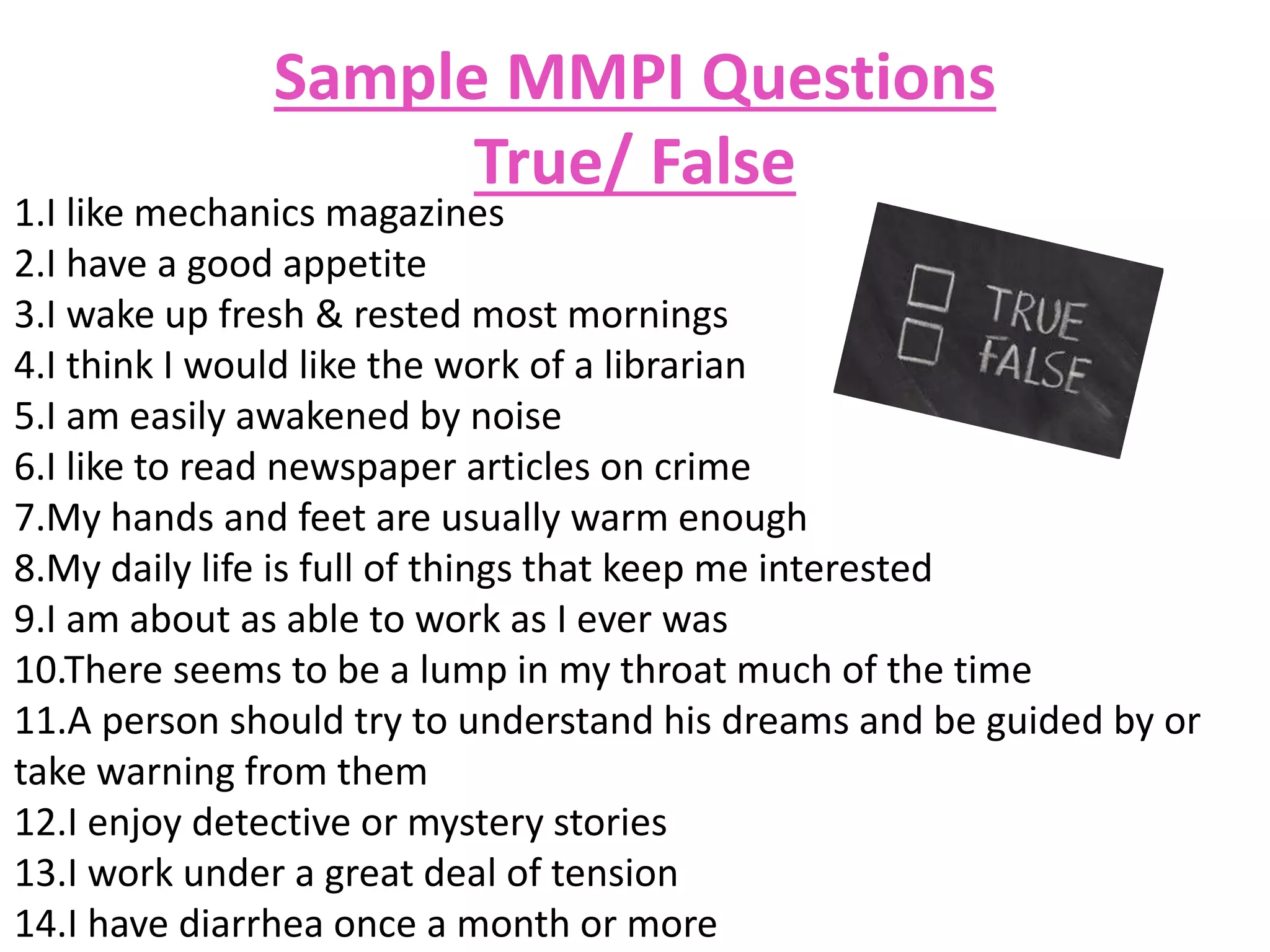
Sample MMPI Questions
True/ False
1.I like mechanics magazines
2.I have a good appetite
3.I wake up fresh & rested most mornings
4.I think I would like the work of a librarian
5.I am easily awakened by noise
6.I like to read newspaper articles on crime
7.My hands and feet are usually warm enough
8.My daily life is full of things that keep me interested
9.I am about as able to work as I ever was
10.There seems to be a lump in my throat much of the time
11.A person should try to understand his dreams and be guided by or
take warning from them
12.I enjoy detective or mystery stories
13.I work under a great deal of tension
14.I have diarrhea once a month or more
Be careful of the Barnum Effect!!!
• People have the
tendency to see
themselves in vague,
stock descriptions
of personality.
• Horoscopes,
astrologers, and
psychics all use this
concept.
Ch. 13 personality lecture notes

Ch. 13 personality lecture notes

  • 1.
    Personality A person’s patternof thinking, feeling and acting.
  • 3.
    Personality: An individual’scharacteristic patterns of thoughts, feelings, and behaviors [persisting over time and across situations] Sensitive, Reactive Naïve Agreeable, Open Introverted Neurotically irritable Conscientious Contentedly lethargic
  • 6.
    Types of Personalities TypeA • Feel time pressure. • Easily angered. • Competitive and ambitious. • Work hard and play hard. • More prone to heart disease than rest of population. Type B • Relaxed and easygoing. • But some people fit in neither type.
  • 10.
    Psychoanalytic Theory of Personality •Fathered by Sigmund Freud. • Idea of the Libido moving to different parts of our body. • Stages of Psycho-Sexual Development 1. Oral 2. Anal 3. Phallic 4. Latent 5. Genital Sigmund Freu What’s on our minds!!!
  • 13.
    Our Personality • Conscious-things we are aware of. • Preconscious- things we can be aware of if we think of them. • Unconscious- deep hidden reservoir that holds the true “us”. All of our desires and fears.
  • 16.
    Freud’s Concept ofPersonality (Psyche) • Ego • Superego • Id
  • 20.
    Id • Exists entirelyin the unconscious (so we are never aware of it). • Our hidden true animalistic wants and desires. • Works on the Pleasure Principle • Avoid Pain and receive Instant Gratification.
  • 21.
    Ego • Develops afterthe Id • Works on the Reality Principle • Negotiates between the Id and the environment. • In our conscious and unconscious minds. • It is what everyone sees as our personality. If you want to be with someone. Your id says just take them, but your ego does not want to end up in jail. So you ask her out and just mac it hard.
  • 22.
    Superego • Develops lastat about the age of 5 • It is our conscience (what we think the difference is between right and wrong) • The Ego often mediates between the superego and id.
  • 25.
    Defense Mechanisms • Theego has a pretty important job…and that is to protect you from threatening thoughts in our unconscious. • One way it protects us is through defense mechanisms. • You are usually unaware that they are even occurring.
  • 30.
    Scenario Quarterback of thehigh school football team, Brandon, is dating Jasmine. Jasmine dumps Brandon and starts dating Drew, president of the chess club. Drew Brandon Jasmine
  • 31.
    Repression • Pushing thoughtsinto our unconscious. • When asked about Jasmine, Brandon may say “Who?, I have not thought about her for awhile.” • Why don’t we remember our Oedipus and Electra complexes?
  • 33.
    Denial • Not acceptingthe ego-threatening truth. • Brandon may act like he is still together with Jasmine. He may hang out by her locker and plan dates with her.
  • 34.
    Displacement • Redirecting one’s feelingstoward another person or object. • Often displaced on less threatening things. • Brandon may take his anger on another kid by bullying.
  • 35.
    Projection • Misattribution ofa person’s undesired thoughts, feelings or impulses onto another person who does not have those thoughts, feelings or impulses • Brandon insists that Jasmine still cares for him.
  • 36.
    Reaction Formation • Expressingthe opposite of how one truly feels. • Cootie stage in Freud’s Latent Development. • Brandon claims he hates Jasmine.
  • 37.
    Regression • Returning toan earlier, comforting form of behavior. • Brandon begins to sleep with his favorite childhood stuffed animal
  • 38.
    Rationalization • Coming upwith a beneficial result of an undesirable outcome. • Brandon thinks he will find a better girlfriend. “Jasmine was not that hot anyway!” • I really did want to go to ……..anyway, it was too ……
  • 39.
    Intellectualization • Undertaking an academic, unemotionalstudy of a topic. • Brandon starts doing a research paper on failed teenage romances.
  • 40.
    Sublimation • Channeling one’s frustrationtoward a different goal. • Sometimes a healthy defense mechanism. • Brandon starts to learn how to play the guitar and writing songs (or maybe starts to body build).
  • 41.
    Psychoanalytic Theory of Personality •Fathered by Sigmund Freud. • Idea of the Libido moving to different parts of our body. • Stages of Psycho-Sexual Development 1. Oral 2. Anal 3. Phallic 4. Latent 5. Genital Sigmund Freud What’s on our minds!!!
  • 42.
    Criticisms of Freud •He really only studied wealthy woman in Austria. • His results are not empirically verifiable (really hard to test). • No predictive power. • Karen Horney said he was sexist with the “penis envy” and there is an actual “womb envy”.
  • 43.
    Neo-Freudians Psychodynamic Theories • EricErickson-> Identity • Carl Jung and his concept of the “personal” and “collective” unconscious. • Alfred Adler and his ideas of superiority and inferiority. • Adler also talked about birth order and how it played a part in personality.
  • 44.
    Birth Order PersonalityTheory Where do you rank in your family’s birth order? Do you agree with Adler’s theory? Explain your reaction.
  • 46.
    Psychoanalysis Today • Couchsitting • Transference is likely to happen. • The idea is to delve into your unconscious. • Pull out Manifest Content. • Then talk about the Latent Content.
  • 47.
    Getting into theUnconscious • Hypnosis • Dream Interpretation • Free Association (having them just randomly talk to themselves…and then interpreting the conversation). • Projective Tests (and test that delves into the unconscious). • Examples are TAT and Inkblot Tests.
  • 48.
    TAT Test Thematic ApperceptionTest • Giving the subject a picture that is ambiguous (can have several meanings) and ask them what is occurring. • Their answers reveal the manifest content. • They can then discover the Latent Content. • Number your paper #1-3
  • 52.
    Rorschach Inkblot Test •The most widely used projective test • A set of ten inkblots designed to identify people’s feelings when they are asked to interpret what they see in the inkblots.
  • 53.
  • 62.
    Trait Theories ofPersonality • Believe that we can describe people’s personalities by specifying their main characteristics (traits). • Traits like honestly, laziness, ambition, outgoing are thought to be stable over the course of your lives.
  • 63.
    Long Island teenagerKwasi Enin poses in front of the pennants of the Ivy League schools he was accepted to.
  • 65.
    Idiographic Theorists • Usingthe same set of traits to classify everyone is impossible. • Each person may have a few traits that are unique to them (selfish may be important to describe one person but not another). • Gordon Allport and his cardinal dispositions (also central and secondary).
  • 66.
    Nomothetic Theories • Thesame traits can be used to describe all peoples personalities. • Introversion-Extroversion scale • BIG FIVE personality traits: 1. Extraversion 2. Agreeableness 3. Conscientiousness 4. Openness to experience 5. Emotional Stability Factor Analysis is used to see the clusters and score these tests. Vinnie and The Situation from the Jersey Shore provide some nice, introvert/extrovert examples.
  • 70.
    Trait Theory Criticism •Do NOT take into account the importance of the situation.
  • 73.
    Behaviorist Theory ofPersonality • The way most people think of personality is meaningless. • Personality changes according to the environment (reinforcers and punishments). • If you change environment then you change the personality.
  • 74.
    Biological Theories of Personality •What % of personality is inherited – heritability? • We are not sure BUT temperaments do seem to be stable from infants to old age.
  • 76.
    Somatotype Theory • Abiological Theory by William Sheldon. Endomorphs (Fat) tend to be friendly and outgoing. Mesomorphs (muscular) tend to be more aggressive. Ectomorphs (thin) tend to be more shy and secretive. • Study has not been replicated.
  • 78.
    Humanistic Theory of Personality •Do not believe in Determinism (your actions are dictated by your past). • They believe that humans have free will (our ability to choose your own destiny). • We are innately good and as long as our self-esteem and self- concept are positive we will be happy.
  • 79.
    Carl Rogers The objectof humans is to become self-actualized. • We are like Acorns • What do Acorns need to grow? • Water, sun, and soil. Except to grow into healthy humans we need: • Genuineness • Acceptance (Unconditional Positive Regard) • Empathy
  • 80.
    • Focus onhow we interact with our culture and environment • Albert Bandura is back!!! • Reciprocal Determinism (traits, environment and behavior all interact and influence each other.) Social-Cognitive Theories on Personality
  • 81.
    Social-Cognitive Theories on Personality •Internal Locus of Control • External Locus of Control • External Locus of Control can lead to a state of learned helplessness. Click Photos to see examples of someone with internal/ external controls and learned helplessness.
  • 82.
    Assessing Personality • Mostcommon way is self-report inventories. • MMPI- Minnesota Multiphasic Personality Inventory Test must be • Reliable- does it yield the same results over time. • Valid- does it measure what it is supposed to measure.
  • 83.
    Sample MMPI Questions True/False 1.I like mechanics magazines 2.I have a good appetite 3.I wake up fresh & rested most mornings 4.I think I would like the work of a librarian 5.I am easily awakened by noise 6.I like to read newspaper articles on crime 7.My hands and feet are usually warm enough 8.My daily life is full of things that keep me interested 9.I am about as able to work as I ever was 10.There seems to be a lump in my throat much of the time 11.A person should try to understand his dreams and be guided by or take warning from them 12.I enjoy detective or mystery stories 13.I work under a great deal of tension 14.I have diarrhea once a month or more
  • 84.
    Be careful ofthe Barnum Effect!!! • People have the tendency to see themselves in vague, stock descriptions of personality. • Horoscopes, astrologers, and psychics all use this concept.