HOLT, RINEHART AND WINSTON
PPSYCHOLOGYSYCHOLOGY
PRINCIPLES IN PRACTICE
1
Chapter 3
BIOLOGY AND BEHAVIOR
Section 1: The Nervous System
Section 2: The Brain: Our Control Center
Section 3: The Endocrine System
Section 4: Heredity: Our Genetic Background
HOLT, RINEHART AND WINSTON
PPSYCHOLOGYSYCHOLOGY
PRINCIPLES IN PRACTICE
HOLT, RINEHART AND WINSTON
PPSYCHOLOGYSYCHOLOGY
PRINCIPLES IN PRACTICE
https://www.youtube.com/watch?v=6BgfKqc3
HOLT, RINEHART AND WINSTON
PPSYCHOLOGYSYCHOLOGY
PRINCIPLES IN PRACTICE
4
Chapter 3Chapter 3
HOLT, RINEHART AND WINSTON
PPSYCHOLOGYSYCHOLOGY
PRINCIPLES IN PRACTICE
HOLT, RINEHART AND WINSTON
PPSYCHOLOGYSYCHOLOGY
PRINCIPLES IN PRACTICE
The Nervous System
 A complex network of nerves and cells that carry
messages to and from the brain and spinal cord to
various parts of the body
 Includes both the Central nervous system and
Peripheral nervous system
 The Central nervous system is made up of the
brain and spinal cord
 The Peripheral nervous system is made up of the
Somatic and the Autonomic nervous systems.
HOLT, RINEHART AND WINSTON
PPSYCHOLOGYSYCHOLOGY
PRINCIPLES IN PRACTICE
7
Chapter 3Chapter 3
FUNCTIONS OF THE PERIPHERAL NERVOUS SYSTEM
 Responsible for transmitting messages between the
central nervous system & all parts of the body
 made up of the somatic and autonomic nervous
systems
• The somatic nervous system transmits sensory
messages to the central nervous system
• The autonomic nervous system regulates the body’s
vital functions such as heartbeat and breathing
Section 1: The Nervous System
HOLT, RINEHART AND WINSTON
PPSYCHOLOGYSYCHOLOGY
PRINCIPLES IN PRACTICE
HOLT, RINEHART AND WINSTON
PPSYCHOLOGYSYCHOLOGY
PRINCIPLES IN PRACTICE
9
Chapter 3Chapter 3
HOLT, RINEHART AND WINSTON
PPSYCHOLOGYSYCHOLOGY
PRINCIPLES IN PRACTICE
10
Chapter 3Chapter 3
HOLT, RINEHART AND WINSTON
PPSYCHOLOGYSYCHOLOGY
PRINCIPLES IN PRACTICE
11
Chapter 3Chapter 3
spinal cord neuron
axon endings
HOLT, RINEHART AND WINSTON
PPSYCHOLOGYSYCHOLOGY
PRINCIPLES IN PRACTICE
12
MESSAGE TRANSMISSION VIA NEURONS
1) Messages are sent from the axon terminals of
one neuron to the dendrites of other neurons
2) Messages travel in one direction and are
received by the dendrites and travel through
the cell body and the axon to the axon
terminals.
3) From there messages cross synapses to the
dendrites of other neurons
HOLT, RINEHART AND WINSTON
PPSYCHOLOGYSYCHOLOGY
PRINCIPLES IN PRACTICE
http://www.youtube.com/watch?v=FZ3401XVYww
HOLT, RINEHART AND WINSTON
PPSYCHOLOGYSYCHOLOGY
PRINCIPLES IN PRACTICE
14
Chapter 3Chapter 3
HOLT, RINEHART AND WINSTON
PPSYCHOLOGYSYCHOLOGY
PRINCIPLES IN PRACTICE
 http://www.youtube.com/watch?v=4OS2C4NemJI
 How do drugs or alcohol affect neurons in the
body?
15
Chapter 3Chapter 3
HOLT, RINEHART AND WINSTON
PPSYCHOLOGYSYCHOLOGY
PRINCIPLES IN PRACTICE
16
Chapter 3Chapter 3
HOLT, RINEHART AND WINSTON
PPSYCHOLOGYSYCHOLOGY
PRINCIPLES IN PRACTICE
17
Chapter 3Chapter 3
Section 2:
The Brain Our
Control Center
HOLT, RINEHART AND WINSTON
PPSYCHOLOGYSYCHOLOGY
PRINCIPLES IN PRACTICE
Brain Facts
The adult human brain weighs about 3 pounds
The human brain has about 100,000,000,000
(100 billion) neurons
Some neurosurgeons describe the texture of a
living brain as that of toothpaste or tofu
The brain is made up of about 75% water.
There are no pain receptors in the brain, so the
brain can feel no pain.18
Chapter 3Chapter 3
HOLT, RINEHART AND WINSTON
PPSYCHOLOGYSYCHOLOGY
PRINCIPLES IN PRACTICE
Psychology of the Brain
You can’t tickle yourself because your brain
distinguished between unexpected external touch and
your own touch.
Every time you recall a memory or have a new
thought, you are creating a new connection in your
brain.
Each time we blink, our brain kicks in and keeps
things illuminated so the whole world doesn’t go dark
each time we blink (about 20,000 times a day).
19
Chapter 3Chapter 3
HOLT, RINEHART AND WINSTON
PPSYCHOLOGYSYCHOLOGY
PRINCIPLES IN PRACTICE
Parts of the Brain
20
Chapter 3Chapter 3
HOLT, RINEHART AND WINSTON
PPSYCHOLOGYSYCHOLOGY
PRINCIPLES IN PRACTICE
Brain Size
 http://faculty.washington.edu/chudler/brainsize.htm
21
Chapter 3Chapter 3
HOLT, RINEHART AND WINSTON
PPSYCHOLOGYSYCHOLOGY
PRINCIPLES IN PRACTICE
22
Chapter 3Chapter 3
Section 2: The Brain: Our Control Center
MAJOR STRUCTURES
AND FUNCTIONS OF THE BRAIN
 Hindbrain – lower part of the brain involved in
many vital functions such as heart rate,
respiration and balance
 Midbrain – includes areas that are involved in
vision and hearing
 Forebrain – front area of the brain involved in
complex functions such as thought and emotion
HOLT, RINEHART AND WINSTON
PPSYCHOLOGYSYCHOLOGY
PRINCIPLES IN PRACTICE
23
Chapter 3Chapter 3
HOLT, RINEHART AND WINSTON
PPSYCHOLOGYSYCHOLOGY
PRINCIPLES IN PRACTICE
24
Chapter 3Chapter 3
HOLT, RINEHART AND WINSTON
PPSYCHOLOGYSYCHOLOGY
PRINCIPLES IN PRACTICE
25
Chapter 3Chapter 3
Parts of the Brain
•The cerebral cortex is the
outer layer of the cerebrum.
•The cerebrum consists of 2
sides (hemispheres)
•Each hemisphere of the
brain contains different
functions, the two sides are
interdependent.
HOLT, RINEHART AND WINSTON
PPSYCHOLOGYSYCHOLOGY
PRINCIPLES IN PRACTICE
26
Chapter 3Chapter 3
HOLT, RINEHART AND WINSTON
PPSYCHOLOGYSYCHOLOGY
PRINCIPLES IN PRACTICE
27
Chapter 3Chapter 3
HOLT, RINEHART AND WINSTON
PPSYCHOLOGYSYCHOLOGY
PRINCIPLES IN PRACTICE
28
Chapter 3Chapter 3
http://www.youtube.com/watch?v=I8SEoUJk_7M&feature=share&list=UU
Shows the control the frontal
lobe has over the limbic system.
The limbic system is the set of brain structures that forms the inner border
of the cortex. involved in many of our emotions and motivations,
particularly those that are related to survival. Such emotions include fear,
anger, and emotions related to sexual behavior.
HOLT, RINEHART AND WINSTON
PPSYCHOLOGYSYCHOLOGY
PRINCIPLES IN PRACTICE
29
Chapter 3Chapter 3
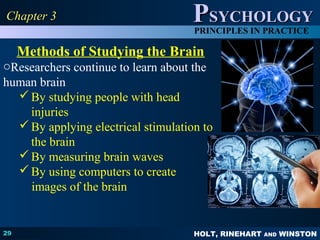
Methods of Studying the Brain
oResearchers continue to learn about the
human brain
By studying people with head
injuries
By applying electrical stimulation to
the brain
By measuring brain waves
By using computers to create
images of the brain
HOLT, RINEHART AND WINSTON
PPSYCHOLOGYSYCHOLOGY
PRINCIPLES IN PRACTICE
30
Chapter 3Chapter 3
HOLT, RINEHART AND WINSTON
PPSYCHOLOGYSYCHOLOGY
PRINCIPLES IN PRACTICE
31
Chapter 3Chapter 3
HOLT, RINEHART AND WINSTON
PPSYCHOLOGYSYCHOLOGY
PRINCIPLES IN PRACTICE
32
Chapter 3Chapter 3
HOLT, RINEHART AND WINSTON
PPSYCHOLOGYSYCHOLOGY
PRINCIPLES IN PRACTICE
33
Chapter 3Chapter 3
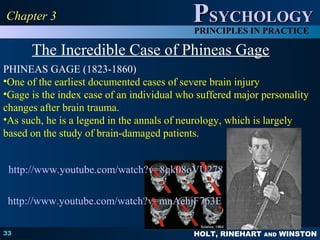
The Incredible Case of Phineas Gage
PHINEAS GAGE (1823-1860)
•One of the earliest documented cases of severe brain injury
•Gage is the index case of an individual who suffered major personality
changes after brain trauma.
•As such, he is a legend in the annals of neurology, which is largely
based on the study of brain-damaged patients.
http://www.youtube.com/watch?v=8qk08oVU278
http://www.youtube.com/watch?v=mnAehjF7p3E
HOLT, RINEHART AND WINSTON
PPSYCHOLOGYSYCHOLOGY
PRINCIPLES IN PRACTICE
34
Chapter 3Chapter 3
http://www.youtube.com/watch?v=Xd1gywPOibg
HOLT, RINEHART AND WINSTON
PPSYCHOLOGYSYCHOLOGY
PRINCIPLES IN PRACTICE
35
Chapter 3Chapter 3
http://www.youtube.com/watch?v=QzcSbP3VsAI
The Human Spark : Brain Matters
HOLT, RINEHART AND WINSTON
PPSYCHOLOGYSYCHOLOGY
PRINCIPLES IN PRACTICE
36
Chapter 3Chapter 3
Section 3:
The Endocrine System
HOLT, RINEHART AND WINSTON
PPSYCHOLOGYSYCHOLOGY
PRINCIPLES IN PRACTICE
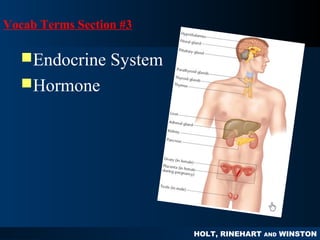
Vocab Terms Section #3
Endocrine System
Hormone
Endocrine System
• System of glands
that secrete
hormones.
• Controlled by the
hypothalamus.
• Ovaries and Testes.
• Adrenal Gland
HOLT, RINEHART AND WINSTON
PPSYCHOLOGYSYCHOLOGY
PRINCIPLES IN PRACTICE
The Endocrine System
 A system of glands
 Gland: group of cells that produces and secretes,
or gives off, chemicals
 These chemicals regulate the body
 The endocrine system is an information signal
system like the nervous system.
HOLT, RINEHART AND WINSTON
PPSYCHOLOGYSYCHOLOGY
PRINCIPLES IN PRACTICE
HOLT, RINEHART AND WINSTON
PPSYCHOLOGYSYCHOLOGY
PRINCIPLES IN PRACTICE
41
Chapter 3Chapter 3
HORMONES AND EFFECT ON THE BODY
Testes and Ovaries – produce the hormones
testosterone, estrogen, and progesterone
 TheseThese hormoneshormones play an important role inplay an important role in
development, development of primary and secondarydevelopment, development of primary and secondary
sex characteristics and have psychological as well assex characteristics and have psychological as well as
biological effectsbiological effects
Section 3: The Endocrine System
HOLT, RINEHART AND WINSTON
PPSYCHOLOGYSYCHOLOGY
PRINCIPLES IN PRACTICE
42
Chapter 3Chapter 3
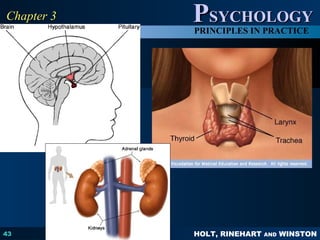
HORMONES AND EFFECT ON THE BODY
 Pituitary Gland – responsible for the secretion of
many different hormones that affect various aspects
of behavior such as the growth hormone
 Thyroid Gland – produces thyroxin which affects
the body’s metabolism
 Adrenal Gland – the outer layer of the adrenal gland,
or cortex, secretes cortical steroids which increase
resistance to stress and promote muscle development
Section 3: The Endocrine System
HOLT, RINEHART AND WINSTON
PPSYCHOLOGYSYCHOLOGY
PRINCIPLES IN PRACTICE
43
Chapter 3Chapter 3
HOLT, RINEHART AND WINSTON
PPSYCHOLOGYSYCHOLOGY
PRINCIPLES IN PRACTICE
44
Chapter 3Chapter 3
HOLT, RINEHART AND WINSTON
PPSYCHOLOGYSYCHOLOGY
PRINCIPLES IN PRACTICE
45
Chapter 3Chapter 3
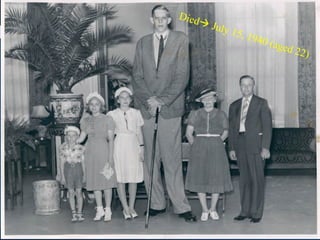
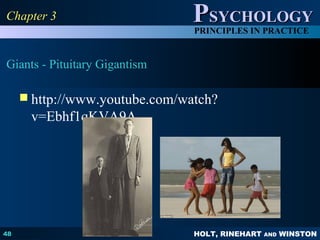
Robert Wadlow, the tallest man known to have
lived (8 feet 11 inches) with his father, Harold
Wadlow (6 feet 0 inches)
Died July 15, 1940 (aged 22)
HOLT, RINEHART AND WINSTON
PPSYCHOLOGYSYCHOLOGY
PRINCIPLES IN PRACTICE
Sandy Allen
 U.S. woman recognized as one of the tallest
women to ever live according to Guinness
World Records.
 She was 7'7" in height
 DiedAugust 13, 2008 (aged 53)
46
Chapter 3Chapter 3
HOLT, RINEHART AND WINSTON
PPSYCHOLOGYSYCHOLOGY
PRINCIPLES IN PRACTICE
47
Chapter 3Chapter 3
HOLT, RINEHART AND WINSTON
PPSYCHOLOGYSYCHOLOGY
PRINCIPLES IN PRACTICE
Giants - Pituitary Gigantism
 http://www.youtube.com/watch?
v=Ebhf1qKVA9A
48
Chapter 3Chapter 3
HOLT, RINEHART AND WINSTON
PPSYCHOLOGYSYCHOLOGY
PRINCIPLES IN PRACTICE
Cushing's syndrome
 http://www.youtube.com/watch?
v=vxSAhLyKVqw&feature=fvsr
49
Chapter 3Chapter 3
Disorder that occurs when your
body is exposed to high levels of
the hormone cortisol.
HOLT, RINEHART AND WINSTON
PPSYCHOLOGYSYCHOLOGY
PRINCIPLES IN PRACTICE
50
Chapter 3Chapter 3
Section 4: Heredity Our Genetic Background
HOLT, RINEHART AND WINSTON
PPSYCHOLOGYSYCHOLOGY
PRINCIPLES IN PRACTICE
51
Chapter 3Chapter 3
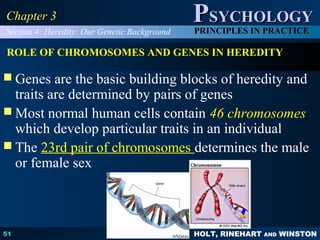
ROLE OF CHROMOSOMES AND GENES IN HEREDITY
 Genes are the basic building blocks of heredity and
traits are determined by pairs of genes
 Most normal human cells contain 46 chromosomes
which develop particular traits in an individual
 The 23rd pair of chromosomes determines the male
or female sex
Section 4: Heredity: Our Genetic Background
HOLT, RINEHART AND WINSTON
PPSYCHOLOGYSYCHOLOGY
PRINCIPLES IN PRACTICE
52
Chapter 3Chapter 3
THE STUDY OF THE ROLE OF HEREDITY
Role of heredity in studies through various types of
kinship research such as:
 A. Twin Studies – a useful way to learn about nature and
nurture
 B. Adoptee Studies – provide ways of sorting out the effects
of nature and nurture
 C. Twins Reared Apart – a way of finding out that twins
reared apart share many of the same mannerisms despite their
separation
Section 4: Heredity: Our Genetic Background
Nature
Identical Twins Raised Apart
-Even though the nurture
(environment) was different
…what remained the same
because of their genes?
Nurture
Feral-Wild Children
-Even though these girls were
born healthy (nature) how
did their environment
(nurture) change them?
#1: Oxana Malaya
#2: Danielle Lierow
HOLT, RINEHART AND WINSTON
PPSYCHOLOGYSYCHOLOGY
PRINCIPLES IN PRACTICE
Twins: Is it All in the Genes?
 http://www.youtube.com/watch?v=Wd5Y3-
F79LY&feature=related
55
Chapter 3Chapter 3
HOLT, RINEHART AND WINSTON
PPSYCHOLOGYSYCHOLOGY
PRINCIPLES IN PRACTICE
Feral Children
 http://www.youtube.com/watch?v=STn3bpTTU6c
56
Chapter 3Chapter 3
A human child who has lived isolated
from human contact from a very young
age, and has no (or little) experience of
human care, loving or social behavior,
and, crucially, of human language.
HOLT, RINEHART AND WINSTON
PPSYCHOLOGYSYCHOLOGY
PRINCIPLES IN PRACTICE
57
Chapter 3Chapter 3
Nervous
System
Environment Heredity
Endocrine
System
Question: What major areas do biological psychologists
study?
Major Areas of
Study for
Biological
Psychologists

Ch. 3 Notes

  • 1.
    HOLT, RINEHART ANDWINSTON PPSYCHOLOGYSYCHOLOGY PRINCIPLES IN PRACTICE 1 Chapter 3 BIOLOGY AND BEHAVIOR Section 1: The Nervous System Section 2: The Brain: Our Control Center Section 3: The Endocrine System Section 4: Heredity: Our Genetic Background
  • 2.
    HOLT, RINEHART ANDWINSTON PPSYCHOLOGYSYCHOLOGY PRINCIPLES IN PRACTICE
  • 3.
    HOLT, RINEHART ANDWINSTON PPSYCHOLOGYSYCHOLOGY PRINCIPLES IN PRACTICE https://www.youtube.com/watch?v=6BgfKqc3
  • 4.
    HOLT, RINEHART ANDWINSTON PPSYCHOLOGYSYCHOLOGY PRINCIPLES IN PRACTICE 4 Chapter 3Chapter 3
  • 5.
    HOLT, RINEHART ANDWINSTON PPSYCHOLOGYSYCHOLOGY PRINCIPLES IN PRACTICE
  • 6.
    HOLT, RINEHART ANDWINSTON PPSYCHOLOGYSYCHOLOGY PRINCIPLES IN PRACTICE The Nervous System  A complex network of nerves and cells that carry messages to and from the brain and spinal cord to various parts of the body  Includes both the Central nervous system and Peripheral nervous system  The Central nervous system is made up of the brain and spinal cord  The Peripheral nervous system is made up of the Somatic and the Autonomic nervous systems.
  • 7.
    HOLT, RINEHART ANDWINSTON PPSYCHOLOGYSYCHOLOGY PRINCIPLES IN PRACTICE 7 Chapter 3Chapter 3 FUNCTIONS OF THE PERIPHERAL NERVOUS SYSTEM  Responsible for transmitting messages between the central nervous system & all parts of the body  made up of the somatic and autonomic nervous systems • The somatic nervous system transmits sensory messages to the central nervous system • The autonomic nervous system regulates the body’s vital functions such as heartbeat and breathing Section 1: The Nervous System
  • 8.
    HOLT, RINEHART ANDWINSTON PPSYCHOLOGYSYCHOLOGY PRINCIPLES IN PRACTICE
  • 9.
    HOLT, RINEHART ANDWINSTON PPSYCHOLOGYSYCHOLOGY PRINCIPLES IN PRACTICE 9 Chapter 3Chapter 3
  • 10.
    HOLT, RINEHART ANDWINSTON PPSYCHOLOGYSYCHOLOGY PRINCIPLES IN PRACTICE 10 Chapter 3Chapter 3
  • 11.
    HOLT, RINEHART ANDWINSTON PPSYCHOLOGYSYCHOLOGY PRINCIPLES IN PRACTICE 11 Chapter 3Chapter 3 spinal cord neuron axon endings
  • 12.
    HOLT, RINEHART ANDWINSTON PPSYCHOLOGYSYCHOLOGY PRINCIPLES IN PRACTICE 12 MESSAGE TRANSMISSION VIA NEURONS 1) Messages are sent from the axon terminals of one neuron to the dendrites of other neurons 2) Messages travel in one direction and are received by the dendrites and travel through the cell body and the axon to the axon terminals. 3) From there messages cross synapses to the dendrites of other neurons
  • 13.
    HOLT, RINEHART ANDWINSTON PPSYCHOLOGYSYCHOLOGY PRINCIPLES IN PRACTICE http://www.youtube.com/watch?v=FZ3401XVYww
  • 14.
    HOLT, RINEHART ANDWINSTON PPSYCHOLOGYSYCHOLOGY PRINCIPLES IN PRACTICE 14 Chapter 3Chapter 3
  • 15.
    HOLT, RINEHART ANDWINSTON PPSYCHOLOGYSYCHOLOGY PRINCIPLES IN PRACTICE  http://www.youtube.com/watch?v=4OS2C4NemJI  How do drugs or alcohol affect neurons in the body? 15 Chapter 3Chapter 3
  • 16.
    HOLT, RINEHART ANDWINSTON PPSYCHOLOGYSYCHOLOGY PRINCIPLES IN PRACTICE 16 Chapter 3Chapter 3
  • 17.
    HOLT, RINEHART ANDWINSTON PPSYCHOLOGYSYCHOLOGY PRINCIPLES IN PRACTICE 17 Chapter 3Chapter 3 Section 2: The Brain Our Control Center
  • 18.
    HOLT, RINEHART ANDWINSTON PPSYCHOLOGYSYCHOLOGY PRINCIPLES IN PRACTICE Brain Facts The adult human brain weighs about 3 pounds The human brain has about 100,000,000,000 (100 billion) neurons Some neurosurgeons describe the texture of a living brain as that of toothpaste or tofu The brain is made up of about 75% water. There are no pain receptors in the brain, so the brain can feel no pain.18 Chapter 3Chapter 3
  • 19.
    HOLT, RINEHART ANDWINSTON PPSYCHOLOGYSYCHOLOGY PRINCIPLES IN PRACTICE Psychology of the Brain You can’t tickle yourself because your brain distinguished between unexpected external touch and your own touch. Every time you recall a memory or have a new thought, you are creating a new connection in your brain. Each time we blink, our brain kicks in and keeps things illuminated so the whole world doesn’t go dark each time we blink (about 20,000 times a day). 19 Chapter 3Chapter 3
  • 20.
    HOLT, RINEHART ANDWINSTON PPSYCHOLOGYSYCHOLOGY PRINCIPLES IN PRACTICE Parts of the Brain 20 Chapter 3Chapter 3
  • 21.
    HOLT, RINEHART ANDWINSTON PPSYCHOLOGYSYCHOLOGY PRINCIPLES IN PRACTICE Brain Size  http://faculty.washington.edu/chudler/brainsize.htm 21 Chapter 3Chapter 3
  • 22.
    HOLT, RINEHART ANDWINSTON PPSYCHOLOGYSYCHOLOGY PRINCIPLES IN PRACTICE 22 Chapter 3Chapter 3 Section 2: The Brain: Our Control Center MAJOR STRUCTURES AND FUNCTIONS OF THE BRAIN  Hindbrain – lower part of the brain involved in many vital functions such as heart rate, respiration and balance  Midbrain – includes areas that are involved in vision and hearing  Forebrain – front area of the brain involved in complex functions such as thought and emotion
  • 23.
    HOLT, RINEHART ANDWINSTON PPSYCHOLOGYSYCHOLOGY PRINCIPLES IN PRACTICE 23 Chapter 3Chapter 3
  • 24.
    HOLT, RINEHART ANDWINSTON PPSYCHOLOGYSYCHOLOGY PRINCIPLES IN PRACTICE 24 Chapter 3Chapter 3
  • 25.
    HOLT, RINEHART ANDWINSTON PPSYCHOLOGYSYCHOLOGY PRINCIPLES IN PRACTICE 25 Chapter 3Chapter 3 Parts of the Brain •The cerebral cortex is the outer layer of the cerebrum. •The cerebrum consists of 2 sides (hemispheres) •Each hemisphere of the brain contains different functions, the two sides are interdependent.
  • 26.
    HOLT, RINEHART ANDWINSTON PPSYCHOLOGYSYCHOLOGY PRINCIPLES IN PRACTICE 26 Chapter 3Chapter 3
  • 27.
    HOLT, RINEHART ANDWINSTON PPSYCHOLOGYSYCHOLOGY PRINCIPLES IN PRACTICE 27 Chapter 3Chapter 3
  • 28.
    HOLT, RINEHART ANDWINSTON PPSYCHOLOGYSYCHOLOGY PRINCIPLES IN PRACTICE 28 Chapter 3Chapter 3 http://www.youtube.com/watch?v=I8SEoUJk_7M&feature=share&list=UU Shows the control the frontal lobe has over the limbic system. The limbic system is the set of brain structures that forms the inner border of the cortex. involved in many of our emotions and motivations, particularly those that are related to survival. Such emotions include fear, anger, and emotions related to sexual behavior.
  • 29.
    HOLT, RINEHART ANDWINSTON PPSYCHOLOGYSYCHOLOGY PRINCIPLES IN PRACTICE 29 Chapter 3Chapter 3 Methods of Studying the Brain oResearchers continue to learn about the human brain By studying people with head injuries By applying electrical stimulation to the brain By measuring brain waves By using computers to create images of the brain
  • 30.
    HOLT, RINEHART ANDWINSTON PPSYCHOLOGYSYCHOLOGY PRINCIPLES IN PRACTICE 30 Chapter 3Chapter 3
  • 31.
    HOLT, RINEHART ANDWINSTON PPSYCHOLOGYSYCHOLOGY PRINCIPLES IN PRACTICE 31 Chapter 3Chapter 3
  • 32.
    HOLT, RINEHART ANDWINSTON PPSYCHOLOGYSYCHOLOGY PRINCIPLES IN PRACTICE 32 Chapter 3Chapter 3
  • 33.
    HOLT, RINEHART ANDWINSTON PPSYCHOLOGYSYCHOLOGY PRINCIPLES IN PRACTICE 33 Chapter 3Chapter 3 The Incredible Case of Phineas Gage PHINEAS GAGE (1823-1860) •One of the earliest documented cases of severe brain injury •Gage is the index case of an individual who suffered major personality changes after brain trauma. •As such, he is a legend in the annals of neurology, which is largely based on the study of brain-damaged patients. http://www.youtube.com/watch?v=8qk08oVU278 http://www.youtube.com/watch?v=mnAehjF7p3E
  • 34.
    HOLT, RINEHART ANDWINSTON PPSYCHOLOGYSYCHOLOGY PRINCIPLES IN PRACTICE 34 Chapter 3Chapter 3 http://www.youtube.com/watch?v=Xd1gywPOibg
  • 35.
    HOLT, RINEHART ANDWINSTON PPSYCHOLOGYSYCHOLOGY PRINCIPLES IN PRACTICE 35 Chapter 3Chapter 3 http://www.youtube.com/watch?v=QzcSbP3VsAI The Human Spark : Brain Matters
  • 36.
    HOLT, RINEHART ANDWINSTON PPSYCHOLOGYSYCHOLOGY PRINCIPLES IN PRACTICE 36 Chapter 3Chapter 3 Section 3: The Endocrine System
  • 37.
    HOLT, RINEHART ANDWINSTON PPSYCHOLOGYSYCHOLOGY PRINCIPLES IN PRACTICE Vocab Terms Section #3 Endocrine System Hormone
  • 38.
    Endocrine System • Systemof glands that secrete hormones. • Controlled by the hypothalamus. • Ovaries and Testes. • Adrenal Gland
  • 39.
    HOLT, RINEHART ANDWINSTON PPSYCHOLOGYSYCHOLOGY PRINCIPLES IN PRACTICE The Endocrine System  A system of glands  Gland: group of cells that produces and secretes, or gives off, chemicals  These chemicals regulate the body  The endocrine system is an information signal system like the nervous system.
  • 40.
    HOLT, RINEHART ANDWINSTON PPSYCHOLOGYSYCHOLOGY PRINCIPLES IN PRACTICE
  • 41.
    HOLT, RINEHART ANDWINSTON PPSYCHOLOGYSYCHOLOGY PRINCIPLES IN PRACTICE 41 Chapter 3Chapter 3 HORMONES AND EFFECT ON THE BODY Testes and Ovaries – produce the hormones testosterone, estrogen, and progesterone  TheseThese hormoneshormones play an important role inplay an important role in development, development of primary and secondarydevelopment, development of primary and secondary sex characteristics and have psychological as well assex characteristics and have psychological as well as biological effectsbiological effects Section 3: The Endocrine System
  • 42.
    HOLT, RINEHART ANDWINSTON PPSYCHOLOGYSYCHOLOGY PRINCIPLES IN PRACTICE 42 Chapter 3Chapter 3 HORMONES AND EFFECT ON THE BODY  Pituitary Gland – responsible for the secretion of many different hormones that affect various aspects of behavior such as the growth hormone  Thyroid Gland – produces thyroxin which affects the body’s metabolism  Adrenal Gland – the outer layer of the adrenal gland, or cortex, secretes cortical steroids which increase resistance to stress and promote muscle development Section 3: The Endocrine System
  • 43.
    HOLT, RINEHART ANDWINSTON PPSYCHOLOGYSYCHOLOGY PRINCIPLES IN PRACTICE 43 Chapter 3Chapter 3
  • 44.
    HOLT, RINEHART ANDWINSTON PPSYCHOLOGYSYCHOLOGY PRINCIPLES IN PRACTICE 44 Chapter 3Chapter 3
  • 45.
    HOLT, RINEHART ANDWINSTON PPSYCHOLOGYSYCHOLOGY PRINCIPLES IN PRACTICE 45 Chapter 3Chapter 3 Robert Wadlow, the tallest man known to have lived (8 feet 11 inches) with his father, Harold Wadlow (6 feet 0 inches) Died July 15, 1940 (aged 22)
  • 46.
    HOLT, RINEHART ANDWINSTON PPSYCHOLOGYSYCHOLOGY PRINCIPLES IN PRACTICE Sandy Allen  U.S. woman recognized as one of the tallest women to ever live according to Guinness World Records.  She was 7'7" in height  DiedAugust 13, 2008 (aged 53) 46 Chapter 3Chapter 3
  • 47.
    HOLT, RINEHART ANDWINSTON PPSYCHOLOGYSYCHOLOGY PRINCIPLES IN PRACTICE 47 Chapter 3Chapter 3
  • 48.
    HOLT, RINEHART ANDWINSTON PPSYCHOLOGYSYCHOLOGY PRINCIPLES IN PRACTICE Giants - Pituitary Gigantism  http://www.youtube.com/watch? v=Ebhf1qKVA9A 48 Chapter 3Chapter 3
  • 49.
    HOLT, RINEHART ANDWINSTON PPSYCHOLOGYSYCHOLOGY PRINCIPLES IN PRACTICE Cushing's syndrome  http://www.youtube.com/watch? v=vxSAhLyKVqw&feature=fvsr 49 Chapter 3Chapter 3 Disorder that occurs when your body is exposed to high levels of the hormone cortisol.
  • 50.
    HOLT, RINEHART ANDWINSTON PPSYCHOLOGYSYCHOLOGY PRINCIPLES IN PRACTICE 50 Chapter 3Chapter 3 Section 4: Heredity Our Genetic Background
  • 51.
    HOLT, RINEHART ANDWINSTON PPSYCHOLOGYSYCHOLOGY PRINCIPLES IN PRACTICE 51 Chapter 3Chapter 3 ROLE OF CHROMOSOMES AND GENES IN HEREDITY  Genes are the basic building blocks of heredity and traits are determined by pairs of genes  Most normal human cells contain 46 chromosomes which develop particular traits in an individual  The 23rd pair of chromosomes determines the male or female sex Section 4: Heredity: Our Genetic Background
  • 52.
    HOLT, RINEHART ANDWINSTON PPSYCHOLOGYSYCHOLOGY PRINCIPLES IN PRACTICE 52 Chapter 3Chapter 3 THE STUDY OF THE ROLE OF HEREDITY Role of heredity in studies through various types of kinship research such as:  A. Twin Studies – a useful way to learn about nature and nurture  B. Adoptee Studies – provide ways of sorting out the effects of nature and nurture  C. Twins Reared Apart – a way of finding out that twins reared apart share many of the same mannerisms despite their separation Section 4: Heredity: Our Genetic Background
  • 53.
    Nature Identical Twins RaisedApart -Even though the nurture (environment) was different …what remained the same because of their genes? Nurture Feral-Wild Children -Even though these girls were born healthy (nature) how did their environment (nurture) change them? #1: Oxana Malaya #2: Danielle Lierow
  • 55.
    HOLT, RINEHART ANDWINSTON PPSYCHOLOGYSYCHOLOGY PRINCIPLES IN PRACTICE Twins: Is it All in the Genes?  http://www.youtube.com/watch?v=Wd5Y3- F79LY&feature=related 55 Chapter 3Chapter 3
  • 56.
    HOLT, RINEHART ANDWINSTON PPSYCHOLOGYSYCHOLOGY PRINCIPLES IN PRACTICE Feral Children  http://www.youtube.com/watch?v=STn3bpTTU6c 56 Chapter 3Chapter 3 A human child who has lived isolated from human contact from a very young age, and has no (or little) experience of human care, loving or social behavior, and, crucially, of human language.
  • 57.
    HOLT, RINEHART ANDWINSTON PPSYCHOLOGYSYCHOLOGY PRINCIPLES IN PRACTICE 57 Chapter 3Chapter 3 Nervous System Environment Heredity Endocrine System Question: What major areas do biological psychologists study? Major Areas of Study for Biological Psychologists