Motivation
and
Work
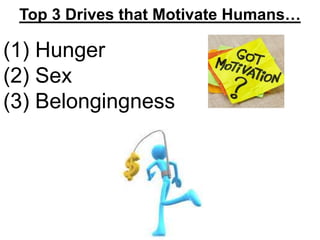
Top 3 Drives that Motivate Humans…
(1) Hunger
(2) Sex
(3) Belongingness
Motivation
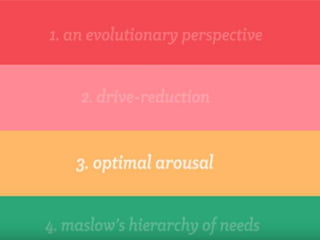
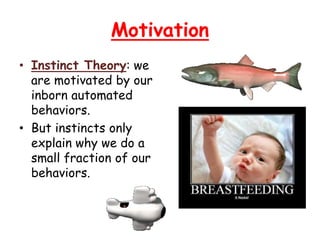
• Instinct Theory: we
are motivated by our
inborn automated
behaviors.
• But instincts only
explain why we do a
small fraction of our
behaviors.
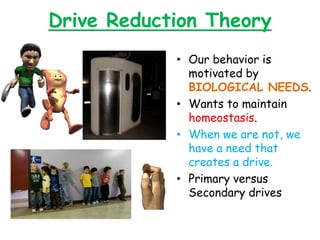
Drive Reduction Theory
• Our behavior is
motivated by
BIOLOGICAL NEEDS.
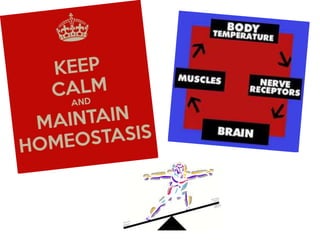
• Wants to maintain
homeostasis.
• When we are not, we
have a need that
creates a drive.
• Primary versus
Secondary drives
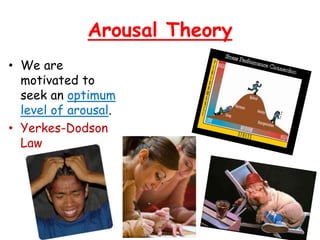
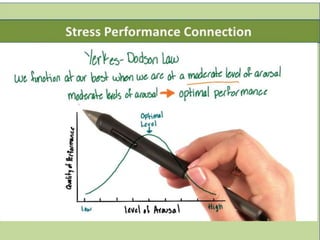
Arousal Theory
• We are
motivated to
seek an optimum
level of arousal.
• Yerkes-Dodson
Law
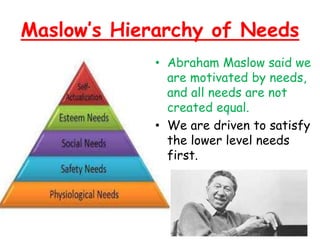
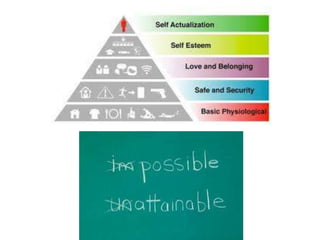
Maslow’s Hierarchy of Needs
• Abraham Maslow said we
are motivated by needs,
and all needs are not
created equal.
• We are driven to satisfy
the lower level needs
first.
Motivation of HUNGER
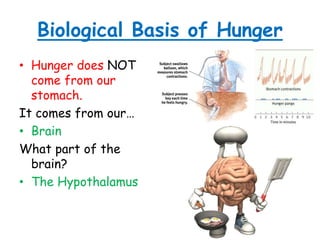
Biological Basis of Hunger
• Hunger does NOT
come from our
stomach.
It comes from our…
• Brain
What part of the
brain?
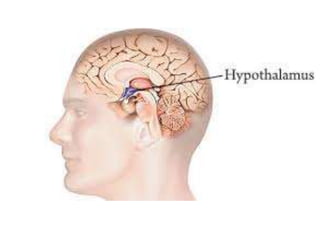
• The Hypothalamus
Hypothalamus
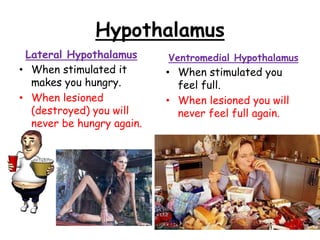
Lateral Hypothalamus
• When stimulated it
makes you hungry.
• When lesioned
(destroyed) you will
never be hungry again.
Ventromedial Hypothalamus
• When stimulated you
feel full.
• When lesioned you will
never feel full again.
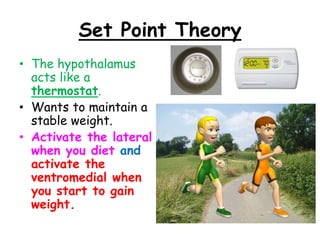
Set Point Theory
• The hypothalamus
acts like a
thermostat.
• Wants to maintain a
stable weight.
• Activate the lateral
when you diet and
activate the
ventromedial when
you start to gain
weight.
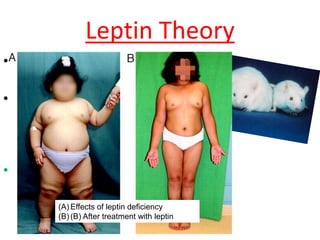
Leptin Theory
• 1970s study-hormone
removal
• Leptin is a hormone that
targets the hypothalamus to
regulate food intake and body
weight.
• Obesity is no longer thought
to be the result of a lack of
will power, but rather a
hormonal imbalance.
(A) Effects of leptin deficiency
(B) (B) After treatment with leptin
Body Chemistry
• Glucose
• The hormone insulin
converts glucose to
fat.
• When glucose levels
drop- hunger
increases.
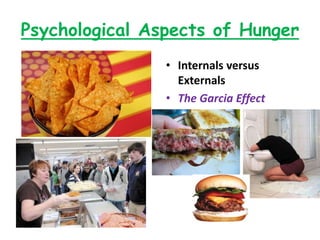
Psychological Aspects of Hunger
• Internals versus
Externals
• The Garcia Effect
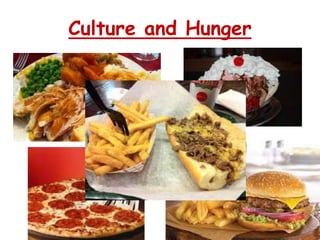
Culture and Hunger
Criadillas- bull testicles.
Mice Wine
Dog
Fried Frog Legs
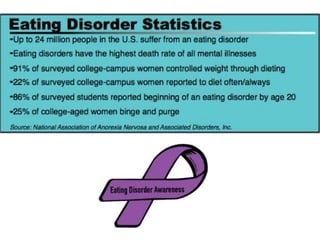
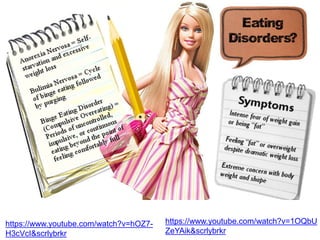
Eating Disorders
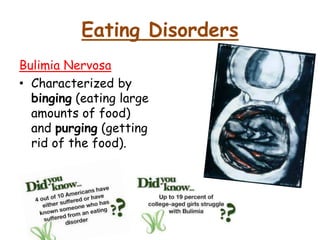
Bulimia Nervosa
• Characterized by
binging (eating large
amounts of food)
and purging (getting
rid of the food).
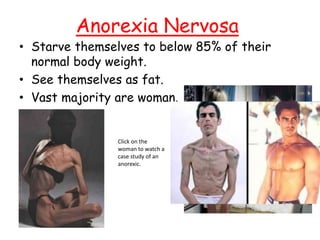
Anorexia Nervosa
• Starve themselves to below 85% of their
normal body weight.
• See themselves as fat.
• Vast majority are woman.
Click on the
woman to watch a
case study of an
anorexic.
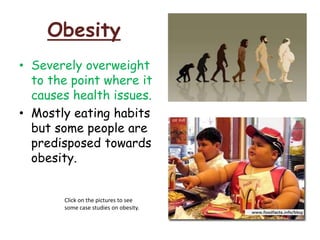
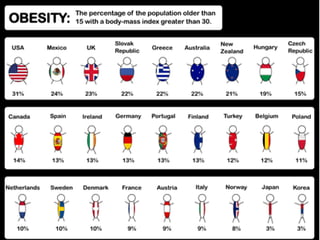
Obesity
• Severely overweight
to the point where it
causes health issues.
• Mostly eating habits
but some people are
predisposed towards
obesity.
Click on the pictures to see
some case studies on obesity.
https://www.youtube.com/watch?v=hOZ7-
H3cVcI&scrlybrkr
https://www.youtube.com/watch?v=1OQbU
ZeYAik&scrlybrkr
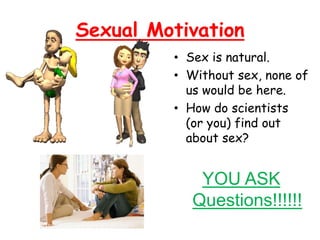
Sexual Motivation
• Sex is natural.
• Without sex, none of
us would be here.
• How do scientists
(or you) find out
about sex?
YOU ASK
Questions!!!!!!
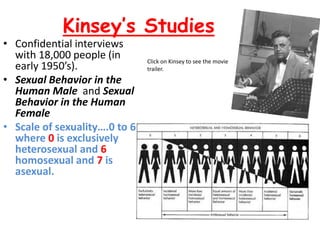
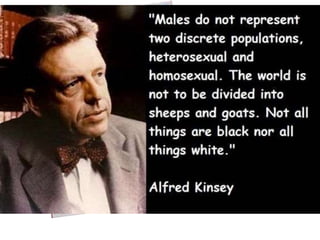
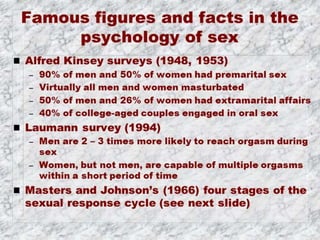
Kinsey’s Studies
• Confidential interviews
with 18,000 people (in
early 1950’s).
• Sexual Behavior in the
Human Male and Sexual
Behavior in the Human
Female
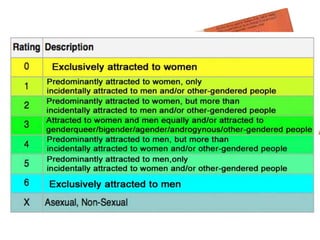
• Scale of sexuality….0 to 6
where 0 is exclusively
heterosexual and 6
homosexual and 7 is
asexual.
Click on Kinsey to see the movie
trailer.
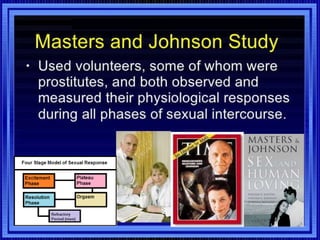
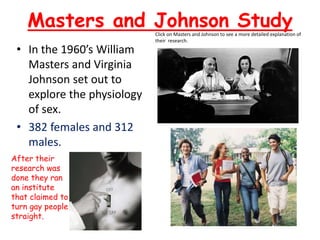
Masters and Johnson Study
• In the 1960’s William
Masters and Virginia
Johnson set out to
explore the physiology
of sex.
• 382 females and 312
males.
After their
research was
done they ran
an institute
that claimed to
turn gay people
straight.
Click on Masters and Johnson to see a more detailed explanation of
their research.
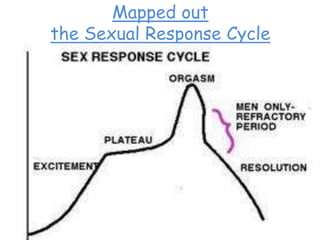
Mapped out
the Sexual Response Cycle
• Initial Excitement
• Plateau Phase
• Orgasm
• Resolution Phase
(with refractory
period).
Psychological Factors in Sexual
Motivation
• Only some people are
extrinsic when it
comes to hunger- but
we are all extrinsic
when it comes to sex.
• Heiman 4 tape study:
• People can find
sexually explicit
images either pleasing
or disturbing- but
they are none the less
biologically arousing.
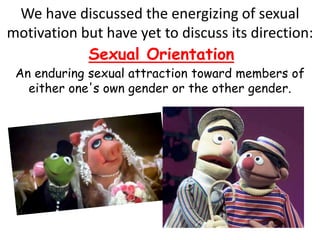
We have discussed the energizing of sexual
motivation but have yet to discuss its direction:
Sexual Orientation
An enduring sexual attraction toward members of
either one's own gender or the other gender.
How is Sexual Orientation
Determined
• There has been NO
evidence that sexuality is
socially determined.
• Kids raised by gay
parents are no more
likely to be gay that if
they were raised by
hetero parents.
• Likely biologically
determined.
The Brain
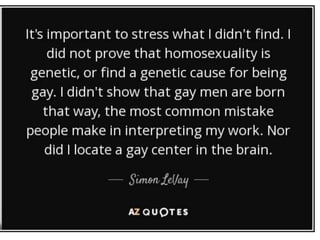
• Simon LeVay
discovered that there is
a cluster of cells in the
hypothalamus that is
larger in heterosexual
men than in heterosexual
women or homosexual
men.
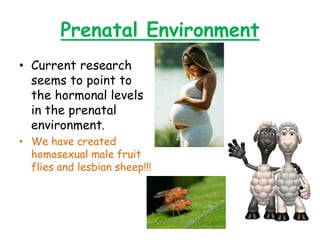
Prenatal Environment
• Current research
seems to point to
the hormonal levels
in the prenatal
environment.
• We have created
homosexual male fruit
flies and lesbian sheep!!!
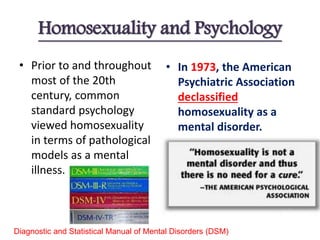
Homosexuality and Psychology
• Prior to and throughout
most of the 20th
century, common
standard psychology
viewed homosexuality
in terms of pathological
models as a mental
illness.
• In 1973, the American
Psychiatric Association
declassified
homosexuality as a
mental disorder.
Diagnostic and Statistical Manual of Mental Disorders (DSM)
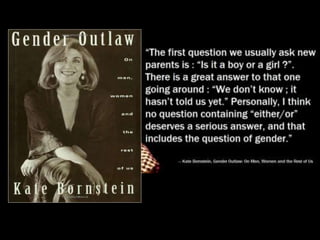
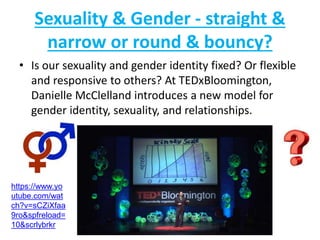
Sexuality & Gender - straight &
narrow or round & bouncy?
• Is our sexuality and gender identity fixed? Or flexible
and responsive to others? At TEDxBloomington,
Danielle McClelland introduces a new model for
gender identity, sexuality, and relationships.
https://www.yo
utube.com/wat
ch?v=sCZiXfaa
9ro&spfreload=
10&scrlybrkr
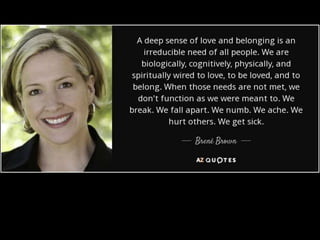
Another Motivation: “To Belong”
What do people need
besides food and sex?
Aristotle: friends
Alfred Adler: community
In Middle English, to be
wretched [wrecche] means
to “be without kin nearby”
Roy Baumeister, Mark
Leary, and Abraham
Maslow:
“To Belong.” Belonging refers to being
connected to others; part of
a group or family or
community.
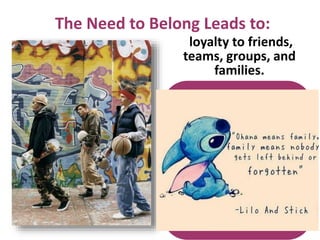
The Need to Belong Leads to:
loyalty to friends,
teams, groups, and
families.
However, the need to
belong also leads to:
• changing our
appearance to win
acceptance.
• staying in abusive
relationships.
• joining gangs,
nationalist groups, and
violent organizations.
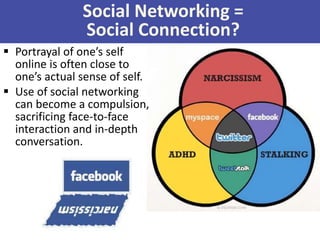
Social Networking =
Social Connection?
 Portrayal of one’s self
online is often close to
one’s actual sense of self.
 Use of social networking
can become a compulsion,
sacrificing face-to-face
interaction and in-depth
conversation.
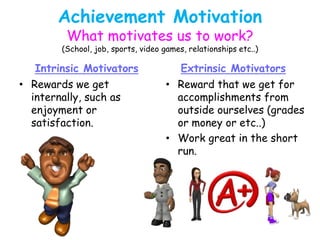
Achievement Motivation
What motivates us to work?
(School, job, sports, video games, relationships etc..)
Intrinsic Motivators
• Rewards we get
internally, such as
enjoyment or
satisfaction.
Extrinsic Motivators
• Reward that we get for
accomplishments from
outside ourselves (grades
or money or etc..)
• Work great in the short
run.
The Psychology of the
Workplace:
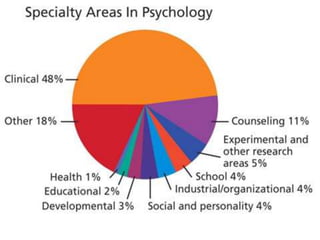
Industrial-
Organizational
[I/O]Psychology
I/O psychology includes three
different areas of focus
Personnel psychology:
hiring and evaluating
Organizational
psychology:
management,
supervision, leadership,
and teamwork
Human factors
psychology:
how workers interface
with machines and the
environment
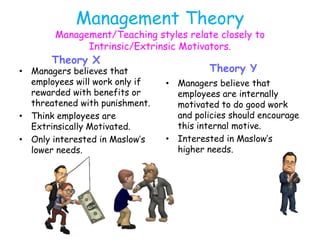
Management Theory
Management/Teaching styles relate closely to
Intrinsic/Extrinsic Motivators.
Theory X
• Managers believes that
employees will work only if
rewarded with benefits or
threatened with punishment.
• Think employees are
Extrinsically Motivated.
• Only interested in Maslow’s
lower needs.
Theory Y
• Managers believe that
employees are internally
motivated to do good work
and policies should encourage
this internal motive.
• Interested in Maslow’s
higher needs.
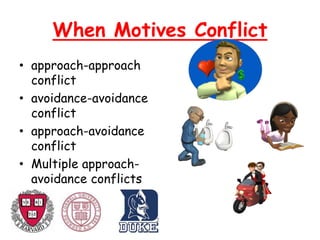
When Motives Conflict
• approach-approach
conflict
• avoidance-avoidance
conflict
• approach-avoidance
conflict
• Multiple approach-
avoidance conflicts
Motivation

Motivation

  • 1.
  • 8.
    Top 3 Drivesthat Motivate Humans… (1) Hunger (2) Sex (3) Belongingness
  • 10.
    Motivation • Instinct Theory:we are motivated by our inborn automated behaviors. • But instincts only explain why we do a small fraction of our behaviors.
  • 13.
    Drive Reduction Theory •Our behavior is motivated by BIOLOGICAL NEEDS. • Wants to maintain homeostasis. • When we are not, we have a need that creates a drive. • Primary versus Secondary drives
  • 15.
    Arousal Theory • Weare motivated to seek an optimum level of arousal. • Yerkes-Dodson Law
  • 18.
    Maslow’s Hierarchy ofNeeds • Abraham Maslow said we are motivated by needs, and all needs are not created equal. • We are driven to satisfy the lower level needs first.
  • 19.
  • 20.
    Biological Basis ofHunger • Hunger does NOT come from our stomach. It comes from our… • Brain What part of the brain? • The Hypothalamus
  • 22.
    Hypothalamus Lateral Hypothalamus • Whenstimulated it makes you hungry. • When lesioned (destroyed) you will never be hungry again. Ventromedial Hypothalamus • When stimulated you feel full. • When lesioned you will never feel full again.
  • 23.
    Set Point Theory •The hypothalamus acts like a thermostat. • Wants to maintain a stable weight. • Activate the lateral when you diet and activate the ventromedial when you start to gain weight.
  • 24.
    Leptin Theory • 1970sstudy-hormone removal • Leptin is a hormone that targets the hypothalamus to regulate food intake and body weight. • Obesity is no longer thought to be the result of a lack of will power, but rather a hormonal imbalance. (A) Effects of leptin deficiency (B) (B) After treatment with leptin
  • 25.
    Body Chemistry • Glucose •The hormone insulin converts glucose to fat. • When glucose levels drop- hunger increases.
  • 26.
    Psychological Aspects ofHunger • Internals versus Externals • The Garcia Effect
  • 27.
  • 28.
    Criadillas- bull testicles. MiceWine Dog Fried Frog Legs
  • 31.
    Eating Disorders Bulimia Nervosa •Characterized by binging (eating large amounts of food) and purging (getting rid of the food).
  • 32.
    Anorexia Nervosa • Starvethemselves to below 85% of their normal body weight. • See themselves as fat. • Vast majority are woman. Click on the woman to watch a case study of an anorexic.
  • 33.
    Obesity • Severely overweight tothe point where it causes health issues. • Mostly eating habits but some people are predisposed towards obesity. Click on the pictures to see some case studies on obesity.
  • 37.
  • 41.
    Sexual Motivation • Sexis natural. • Without sex, none of us would be here. • How do scientists (or you) find out about sex? YOU ASK Questions!!!!!!
  • 42.
    Kinsey’s Studies • Confidentialinterviews with 18,000 people (in early 1950’s). • Sexual Behavior in the Human Male and Sexual Behavior in the Human Female • Scale of sexuality….0 to 6 where 0 is exclusively heterosexual and 6 homosexual and 7 is asexual. Click on Kinsey to see the movie trailer.
  • 47.
    Masters and JohnsonStudy • In the 1960’s William Masters and Virginia Johnson set out to explore the physiology of sex. • 382 females and 312 males. After their research was done they ran an institute that claimed to turn gay people straight. Click on Masters and Johnson to see a more detailed explanation of their research.
  • 48.
    Mapped out the SexualResponse Cycle • Initial Excitement • Plateau Phase • Orgasm • Resolution Phase (with refractory period).
  • 49.
    Psychological Factors inSexual Motivation • Only some people are extrinsic when it comes to hunger- but we are all extrinsic when it comes to sex. • Heiman 4 tape study: • People can find sexually explicit images either pleasing or disturbing- but they are none the less biologically arousing.
  • 50.
    We have discussedthe energizing of sexual motivation but have yet to discuss its direction: Sexual Orientation An enduring sexual attraction toward members of either one's own gender or the other gender.
  • 51.
    How is SexualOrientation Determined • There has been NO evidence that sexuality is socially determined. • Kids raised by gay parents are no more likely to be gay that if they were raised by hetero parents. • Likely biologically determined.
  • 52.
    The Brain • SimonLeVay discovered that there is a cluster of cells in the hypothalamus that is larger in heterosexual men than in heterosexual women or homosexual men.
  • 53.
    Prenatal Environment • Currentresearch seems to point to the hormonal levels in the prenatal environment. • We have created homosexual male fruit flies and lesbian sheep!!!
  • 54.
    Homosexuality and Psychology •Prior to and throughout most of the 20th century, common standard psychology viewed homosexuality in terms of pathological models as a mental illness. • In 1973, the American Psychiatric Association declassified homosexuality as a mental disorder. Diagnostic and Statistical Manual of Mental Disorders (DSM)
  • 56.
    Sexuality & Gender- straight & narrow or round & bouncy? • Is our sexuality and gender identity fixed? Or flexible and responsive to others? At TEDxBloomington, Danielle McClelland introduces a new model for gender identity, sexuality, and relationships. https://www.yo utube.com/wat ch?v=sCZiXfaa 9ro&spfreload= 10&scrlybrkr
  • 58.

    Another Motivation: “ToBelong” What do people need besides food and sex? Aristotle: friends Alfred Adler: community In Middle English, to be wretched [wrecche] means to “be without kin nearby” Roy Baumeister, Mark Leary, and Abraham Maslow: “To Belong.” Belonging refers to being connected to others; part of a group or family or community.
  • 59.
    The Need toBelong Leads to: loyalty to friends, teams, groups, and families. However, the need to belong also leads to: • changing our appearance to win acceptance. • staying in abusive relationships. • joining gangs, nationalist groups, and violent organizations.
  • 60.
    Social Networking = SocialConnection?  Portrayal of one’s self online is often close to one’s actual sense of self.  Use of social networking can become a compulsion, sacrificing face-to-face interaction and in-depth conversation.
  • 61.
    Achievement Motivation What motivatesus to work? (School, job, sports, video games, relationships etc..) Intrinsic Motivators • Rewards we get internally, such as enjoyment or satisfaction. Extrinsic Motivators • Reward that we get for accomplishments from outside ourselves (grades or money or etc..) • Work great in the short run.
  • 63.
    The Psychology ofthe Workplace: Industrial- Organizational [I/O]Psychology I/O psychology includes three different areas of focus Personnel psychology: hiring and evaluating Organizational psychology: management, supervision, leadership, and teamwork Human factors psychology: how workers interface with machines and the environment
  • 64.
    Management Theory Management/Teaching stylesrelate closely to Intrinsic/Extrinsic Motivators. Theory X • Managers believes that employees will work only if rewarded with benefits or threatened with punishment. • Think employees are Extrinsically Motivated. • Only interested in Maslow’s lower needs. Theory Y • Managers believe that employees are internally motivated to do good work and policies should encourage this internal motive. • Interested in Maslow’s higher needs.
  • 65.
    When Motives Conflict •approach-approach conflict • avoidance-avoidance conflict • approach-avoidance conflict • Multiple approach- avoidance conflicts

Editor's Notes

  • #59 Click to reveal bullets and definition.
  • #60 Click to reveal text box. Abusive relationships typically undermine our autonomy and our sense of self-efficacy/competence. Ironically, this makes us less likely to leave an abusive relationship.
  • #61 Click to reveal bullets. Regarding the face-to-face interaction: I suggest pointing out here that something called “Facebook” may have reduced our exposure to both faces and books.
  • #64 No animation.