Introduction to Psychology
Naveed Siddiqui
PhD. M.B.E. PgDip Information Technology
Founder & CEO – Naveed Media Academy
www.facebook.com/NaveedAhmedSiddiqui33
www.linkedin.com/in/dr-naveed-siddiqui-191a4b2b
www.youtube.com/user/nvd30
www.youtube.com/user/NaveedAhmedSiddiqui3
nasiddiqui333@gmail.com
00971 56 237 4597
Sensation and Perception
How you see the world
THE ABCs of SENSATION
• SENSATION
Process by which
information from the
outside world enters
the brain
• related to the activation of receptors in the various
sense organs
• detected by sensory receptors
• sometimes "ignored" through sensory adaptation or
cognitive habituation
• related to changes in physical stimuli
Sensory Thresholds
• Ernst Weber (1795–1878) did studies trying to determine the smallest
difference between two weights that could be detected. His
research led to the formulation known as Weber’s law of just
noticeable differences (jnd, or the difference threshold).
• Gustav Fechner (1801–1887) expanded on Weber’s work by studying
something he called the absolute threshold (Fechner, 1860). An
absolute threshold is the lowest level of stimulation that a person can
consciously detect 50 percent of the time the stimulation is present
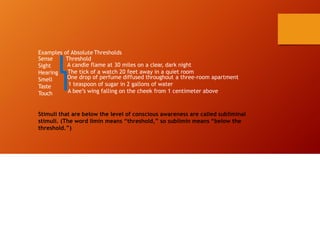
Examples of Absolute Thresholds
Threshold
A candle flame at 30 miles on a clear, dark night
The tick of a watch 20 feet away in a quiet room
Sense
Sight
Hearing
Smell
Taste
Touch
One drop of perfume diffused throughout a three-room apartment
1 teaspoon of sugar in 2 gallons of water
A bee’s wing falling on the cheek from 1 centimeter above
Stimuli that are below the level of conscious awareness are called subliminal
stimuli. (The word limin means “threshold,” so sublimin means “below the
threshold.”)
Habituation and Sensory Adaptation
• Some of the lower centers of the brain filter sensory stimulation and
“ignore” or prevent conscious attention to stimuli that do not
change.
• The brain is primarily interested in changes in information. That’s
why people don’t really “hear” the noise of the air conditioner unless
it suddenly cuts off, or the noise made in some classrooms, unless it
gets very quiet or someone else directs their attention toward it.
• Although they actually are hearing it, they aren’t paying attention to
it. This is called habituation, and it is the way the brain deals with
unchanging information from the environment.
Habituation and Sensory Adaptation
• Although different from habituation, sensory adaptation is another
process by which constant, unchanging information from the sensory
receptors is effectively ignored.
• In habituation, the sensory receptors are still responding to
stimulation but the lower centers of the brain are not sending the
signals from those receptors to the cortex.
• The process of sensory adaptation differs because the receptor
cells themselves become less responsive to an unchanging
stimulus—garbage odors included—and the receptors no longer
send signals to the brain.
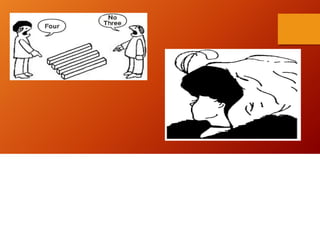
The ABCs of Perception
• Perception is the method by which the brain takes all the sensations
a person experiences at any given moment and allows them to be
interpreted in some meaningful fashion.
• Perception has some individuality to it. For example, two people
might be looking at a cloud and while one thinks it’s shaped like a
horse, the other thinks it’s more like a cow. They both see the same
cloud, but they perceive that cloud differently
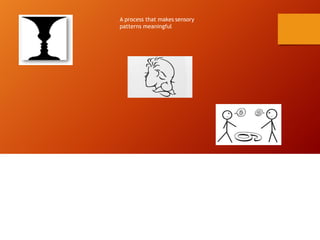
A process that makes sensory
patterns meaningful
Perceptual Constancies
• One form of perceptual constancy* is size constancy, the
tendency to interpret an object as always being the same size,
regardless of its distance from the viewer.
• Another perceptual constancy is the tendency to interpret the
shape of an object as constant, even when it changes on the
retina.
• A third form of perceptual constancy is brightness constancy, the
tendency to perceive the apparent brightness of an object as the
same even when the light conditions change.
The Gestalt Principles
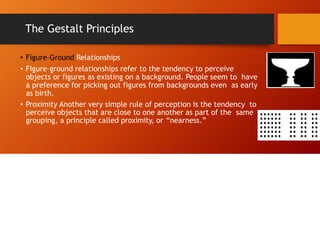
• Figure–Ground Relationships
• Figure–ground relationships refer to the tendency to perceive
objects or figures as existing on a background. People seem to have
a preference for picking out figures from backgrounds even as early
as birth.
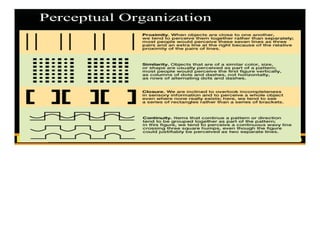
• Proximity Another very simple rule of perception is the tendency to
perceive objects that are close to one another as part of the same
grouping, a principle called proximity, or “nearness.”
The Gestalt Principles
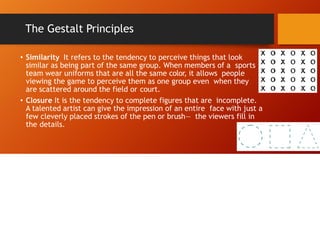
• Similarity It refers to the tendency to perceive things that look
similar as being part of the same group. When members of a sports
team wear uniforms that are all the same color, it allows people
viewing the game to perceive them as one group even when they
are scattered around the field or court.
• Closure It is the tendency to complete figures that are incomplete.
A talented artist can give the impression of an entire face with just a
few cleverly placed strokes of the pen or brush— the viewers fill in
the details.
The Gestalt Principles
• Continuity It refers to the tendency to perceive things as simply as
possible with a continuous pattern rather than with a complex,
broken-up pattern.
Depth Perception
• What is depth perception and what kind of cues are important
for it to occur?
• The capability to see the world in three dimensions is called depth
perception. It’s a handy ability because without it you would have a
hard time judging how far away objects are.
• Various cues exist for perceiving depth in the world. Some require the
use of only one eye (monocular cues) and some are a result of
the slightly different visual patterns that exist when the visual
fields** of both eyes are used (binocular cues).
**visual field: the
entire area of space
visible at a given
instant without
moving the eyes.
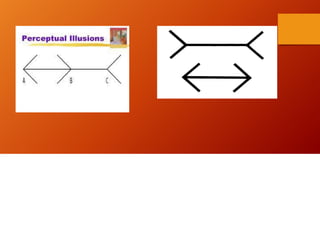
Perceptual Illusions
• What are visual illusions and how can they and other factors
influence and alter perception?
• An illusion is a perception that does not correspond to reality:
People think they see something when the reality is quite different.
Another way of thinking of illusions is as visual stimuli that “fool”
the eye.
Extrasensory Perception (ESP)
• Coined by renowned psychologist J.B. Rhine, the term was used to
refer to psychic abilities and temporal operations.
• ESP is commonly called sixth sense, a fairly popularized topic in
media and related industries.
• The four types of extrasensory perception include clairvoyance,
psychokinesis, telepathy and precognition.
ESP
• TELEPATHY thought transference from one person to another.
• CLAIRVOYANCE similar to telepathy except that the source of
information is an object or event rather than another mind.
• PRECOGNITION perception of a future event.
• PSYCHOKINESIS mind over matter
SUBLIMINIAL PERCEPTION
•Subliminal perception is supposed to occur when a stimulus is too
weak to be perceived yet a person is influenced by it.
• An organization's marketing is effective when it delivers a message
that sticks in consumers' minds and influences them to buy.
• Consumers experience subliminal perception from marketing
messages that influence them without their conscious knowledge.
• Marketing with subliminal messages aims to encourage the
purchase of the product through subtle effects that are not
normally visible to the naked eye.
• t’s not only the images that are used to get into your head; sounds
and other techniques are also used to help the message sink into your
subconscious.
Perception

Perception

  • 1.
    Introduction to Psychology NaveedSiddiqui PhD. M.B.E. PgDip Information Technology Founder & CEO – Naveed Media Academy www.facebook.com/NaveedAhmedSiddiqui33 www.linkedin.com/in/dr-naveed-siddiqui-191a4b2b www.youtube.com/user/nvd30 www.youtube.com/user/NaveedAhmedSiddiqui3 nasiddiqui333@gmail.com 00971 56 237 4597
  • 2.
  • 3.
    THE ABCs ofSENSATION • SENSATION Process by which information from the outside world enters the brain • related to the activation of receptors in the various sense organs • detected by sensory receptors • sometimes "ignored" through sensory adaptation or cognitive habituation • related to changes in physical stimuli
  • 4.
    Sensory Thresholds • ErnstWeber (1795–1878) did studies trying to determine the smallest difference between two weights that could be detected. His research led to the formulation known as Weber’s law of just noticeable differences (jnd, or the difference threshold). • Gustav Fechner (1801–1887) expanded on Weber’s work by studying something he called the absolute threshold (Fechner, 1860). An absolute threshold is the lowest level of stimulation that a person can consciously detect 50 percent of the time the stimulation is present
  • 5.
    Examples of AbsoluteThresholds Threshold A candle flame at 30 miles on a clear, dark night The tick of a watch 20 feet away in a quiet room Sense Sight Hearing Smell Taste Touch One drop of perfume diffused throughout a three-room apartment 1 teaspoon of sugar in 2 gallons of water A bee’s wing falling on the cheek from 1 centimeter above Stimuli that are below the level of conscious awareness are called subliminal stimuli. (The word limin means “threshold,” so sublimin means “below the threshold.”)
  • 6.
    Habituation and SensoryAdaptation • Some of the lower centers of the brain filter sensory stimulation and “ignore” or prevent conscious attention to stimuli that do not change. • The brain is primarily interested in changes in information. That’s why people don’t really “hear” the noise of the air conditioner unless it suddenly cuts off, or the noise made in some classrooms, unless it gets very quiet or someone else directs their attention toward it. • Although they actually are hearing it, they aren’t paying attention to it. This is called habituation, and it is the way the brain deals with unchanging information from the environment.
  • 7.
    Habituation and SensoryAdaptation • Although different from habituation, sensory adaptation is another process by which constant, unchanging information from the sensory receptors is effectively ignored. • In habituation, the sensory receptors are still responding to stimulation but the lower centers of the brain are not sending the signals from those receptors to the cortex. • The process of sensory adaptation differs because the receptor cells themselves become less responsive to an unchanging stimulus—garbage odors included—and the receptors no longer send signals to the brain.
  • 8.
    The ABCs ofPerception • Perception is the method by which the brain takes all the sensations a person experiences at any given moment and allows them to be interpreted in some meaningful fashion. • Perception has some individuality to it. For example, two people might be looking at a cloud and while one thinks it’s shaped like a horse, the other thinks it’s more like a cow. They both see the same cloud, but they perceive that cloud differently
  • 10.
    A process thatmakes sensory patterns meaningful
  • 11.
    Perceptual Constancies • Oneform of perceptual constancy* is size constancy, the tendency to interpret an object as always being the same size, regardless of its distance from the viewer. • Another perceptual constancy is the tendency to interpret the shape of an object as constant, even when it changes on the retina. • A third form of perceptual constancy is brightness constancy, the tendency to perceive the apparent brightness of an object as the same even when the light conditions change.
  • 12.
    The Gestalt Principles •Figure–Ground Relationships • Figure–ground relationships refer to the tendency to perceive objects or figures as existing on a background. People seem to have a preference for picking out figures from backgrounds even as early as birth. • Proximity Another very simple rule of perception is the tendency to perceive objects that are close to one another as part of the same grouping, a principle called proximity, or “nearness.”
  • 13.
    The Gestalt Principles •Similarity It refers to the tendency to perceive things that look similar as being part of the same group. When members of a sports team wear uniforms that are all the same color, it allows people viewing the game to perceive them as one group even when they are scattered around the field or court. • Closure It is the tendency to complete figures that are incomplete. A talented artist can give the impression of an entire face with just a few cleverly placed strokes of the pen or brush— the viewers fill in the details.
  • 14.
    The Gestalt Principles •Continuity It refers to the tendency to perceive things as simply as possible with a continuous pattern rather than with a complex, broken-up pattern.
  • 16.
    Depth Perception • Whatis depth perception and what kind of cues are important for it to occur? • The capability to see the world in three dimensions is called depth perception. It’s a handy ability because without it you would have a hard time judging how far away objects are. • Various cues exist for perceiving depth in the world. Some require the use of only one eye (monocular cues) and some are a result of the slightly different visual patterns that exist when the visual fields** of both eyes are used (binocular cues). **visual field: the entire area of space visible at a given instant without moving the eyes.
  • 17.
    Perceptual Illusions • Whatare visual illusions and how can they and other factors influence and alter perception? • An illusion is a perception that does not correspond to reality: People think they see something when the reality is quite different. Another way of thinking of illusions is as visual stimuli that “fool” the eye.
  • 21.
    Extrasensory Perception (ESP) •Coined by renowned psychologist J.B. Rhine, the term was used to refer to psychic abilities and temporal operations. • ESP is commonly called sixth sense, a fairly popularized topic in media and related industries. • The four types of extrasensory perception include clairvoyance, psychokinesis, telepathy and precognition.
  • 22.
    ESP • TELEPATHY thoughttransference from one person to another. • CLAIRVOYANCE similar to telepathy except that the source of information is an object or event rather than another mind. • PRECOGNITION perception of a future event. • PSYCHOKINESIS mind over matter
  • 23.
    SUBLIMINIAL PERCEPTION •Subliminal perceptionis supposed to occur when a stimulus is too weak to be perceived yet a person is influenced by it. • An organization's marketing is effective when it delivers a message that sticks in consumers' minds and influences them to buy. • Consumers experience subliminal perception from marketing messages that influence them without their conscious knowledge.
  • 24.
    • Marketing withsubliminal messages aims to encourage the purchase of the product through subtle effects that are not normally visible to the naked eye. • t’s not only the images that are used to get into your head; sounds and other techniques are also used to help the message sink into your subconscious.