Table of Contents Section 1   The History of Cell Biology Section 2   Introduction to Cells Section 3   Cell Organelles and Features Section 4   Unique Features of Plant Cells Cell Structure and Function
Objectives Name   the scientists who first observed living and nonliving cells. Summarize   the research that led to the development of the cell theory. State   the three principles of the cell theory. Explain   why the cell is considered to be the basic unit of life. Section 1  The History of Cell Biology
The Discovery of Cells All living things are made up of one or more cells. A  cell  is the smallest unit that can carry on all of the processes of life. Section 1  The History of Cell Biology
The Discovery of Cells,  continued Hooke Robert Hooke discovered cells in slices of cork. Leeuwenhoek Anton van Leeuwenhoek was the first to observe living cells in microorganisms.   Section 1  The History of Cell Biology
The Cell Theory The  cell theory  states that all living organisms are made of one or more cells, cells are the basic units of structure and function, and cells come only from pre-existing cells. Section 1  The History of Cell Biology
Click below to watch the Visual Concept. Visual Concept Cell Theory Section 1  The History of Cell Biology
The Cell Theory,  continued Cellular Basis of Life All living things are made of organized parts, obtain energy from their surroundings, perform chemical reactions, change with time, respond to their environment, and reproduce. Section 1  The History of Cell Biology
Section 2  Introduction to Cells Objectives Explain  the relationship between cell shape and cell function. Identify  the factor that limits cell size. Describe   the three basic parts of a cell. Compare   prokaryotic cells and eukaryotic cells. Analyze   the relationship among cells, tissues, organs, organ systems, and organisms.
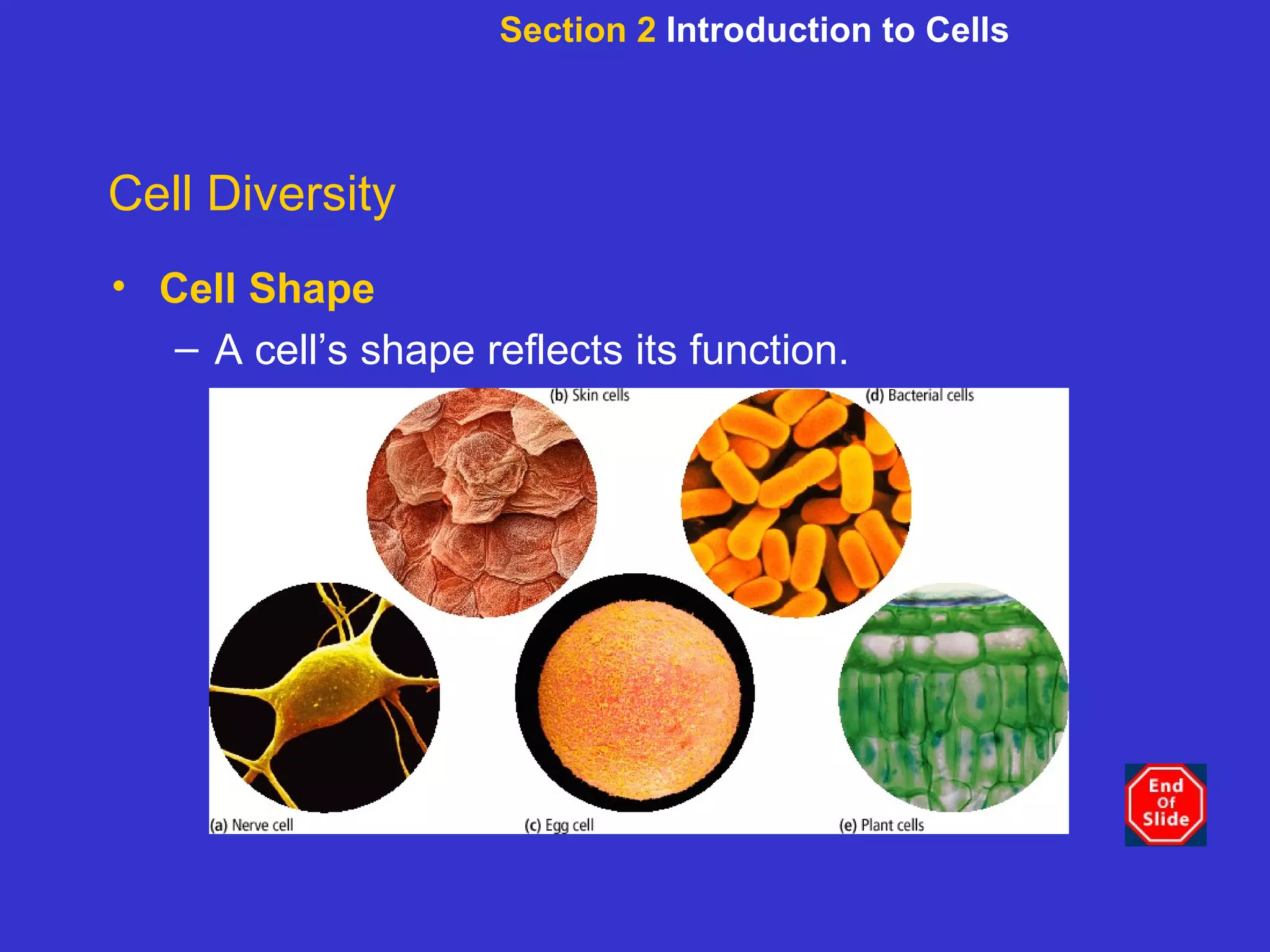
Section 2  Introduction to Cells Cell Diversity Cell Shape A cell’s shape reflects its function.
Section 2  Introduction to Cells Cell Diversity,  Continued Cell Size Cell size is limited by a cell’s surface area–to-volume ratio.
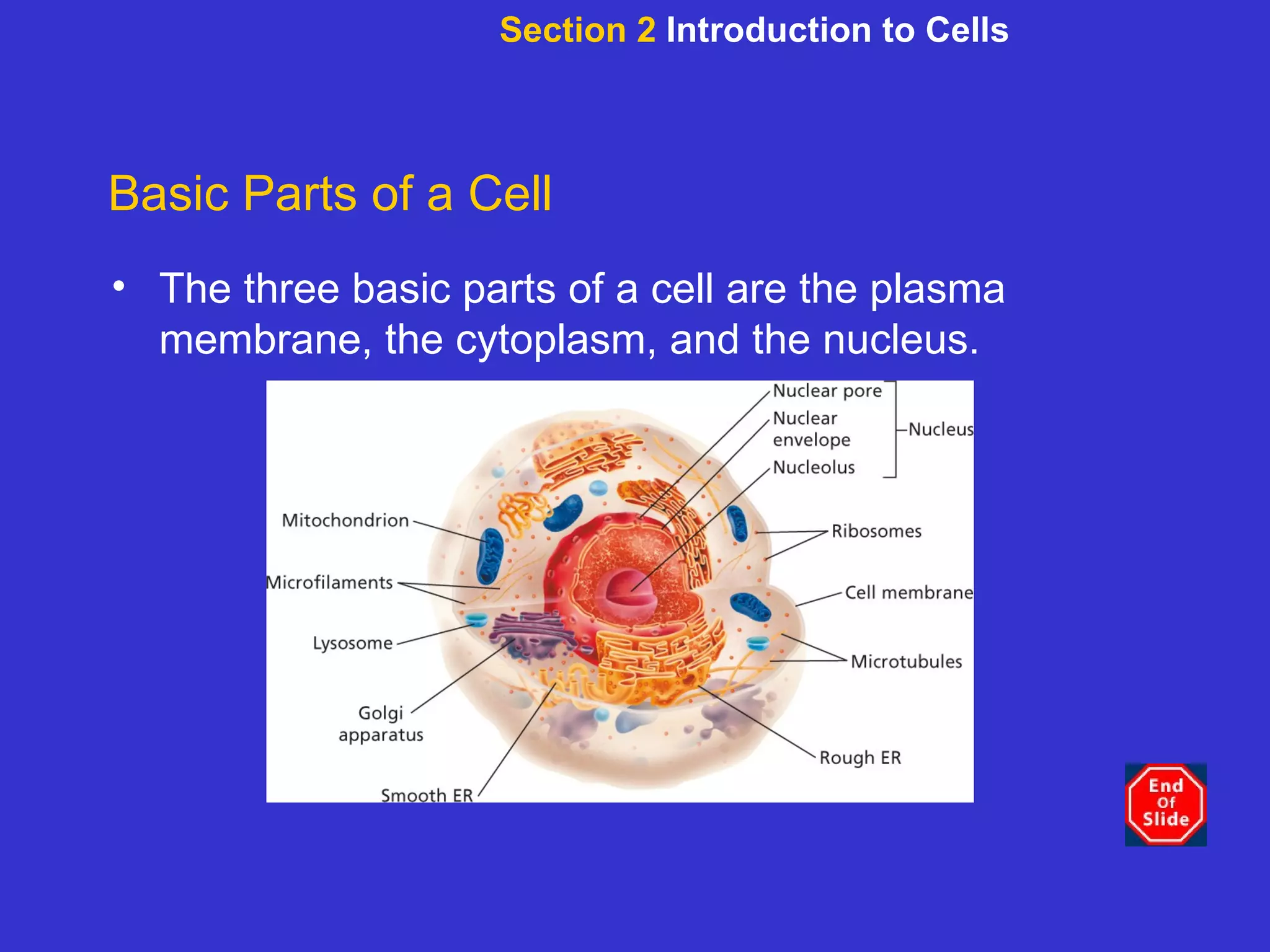
Section 2  Introduction to Cells Basic Parts of a Cell The three basic parts of a cell are the plasma membrane, the cytoplasm, and the nucleus.
Click below to watch the Visual Concept. Visual Concept Internal Organization of a Cell Section 2  Introduction to Cells
Section 2  Introduction to Cells Basic Parts of a Cell,  continued Plasma Membrane The cell’s outer boundary, called the   plasma membrane   (or the cell membrane), covers a cell’s surface and acts as a barrier between the inside and the outside of a cell.
Section 2  Introduction to Cells Basic Parts of a Cell,  continued Cytoplasm The region of the cell that is within the plasma membrane and that includes the fluid, the cytoskeleton, and all of the organelles except the nucleus is called the   cytoplasm .
Section 2  Introduction to Cells Basic Parts of a Cell,  continued Nucleus The  nucleus  is a membrane-bound organelle that contains a cell’s DNA.
Section 2  Introduction to Cells Two Basic Types of Cells Prokaryotes Prokaryote cells   lack a nucleus and membrane-bound organelles.
Section 2  Introduction to Cells Two Basic Types of Cells,  continued Eukaryotes Eukaryote cells  have a nucleus and membrane-bound organelles.
Click below to watch the Visual Concept. Visual Concept Comparing Prokaryotes and Eukaryotes Section 2  Introduction to Cells
Section 2  Introduction to Cells Cellular Organization In multicellular eukaryotes, cells organize into tissues, organs, organ systems, and finally organisms.
Objectives Describe   the structure and function of a cell’s plasma membrane. Summarize  the role of the nucleus. List   the major organelles found in the cytosol, and describe their roles. Identify   the characteristics of mitochondria. Describe  the structure and function of the cytoskeleton. Section 3  Cell Organelles and Features
Plasma Membrane Membrane Lipids Cell membranes consist of a   phospholipid bilayer . Section 3  Cell Organelles and Features
Structure of Lipid Bilayer Section 3  Cell Organelles and Features
Plasma Membrane,  continued Membrane Proteins Cell membranes often contain proteins embedded within the phospholipid bilayer. Section 3  Cell Organelles and Features
Plasma Membrane,  continued Fluid Mosaic Model The   fluid mosaic model   states that the phospholipid bilayer behaves like a fluid more than it behaves like a solid.   Section 3  Cell Organelles and Features
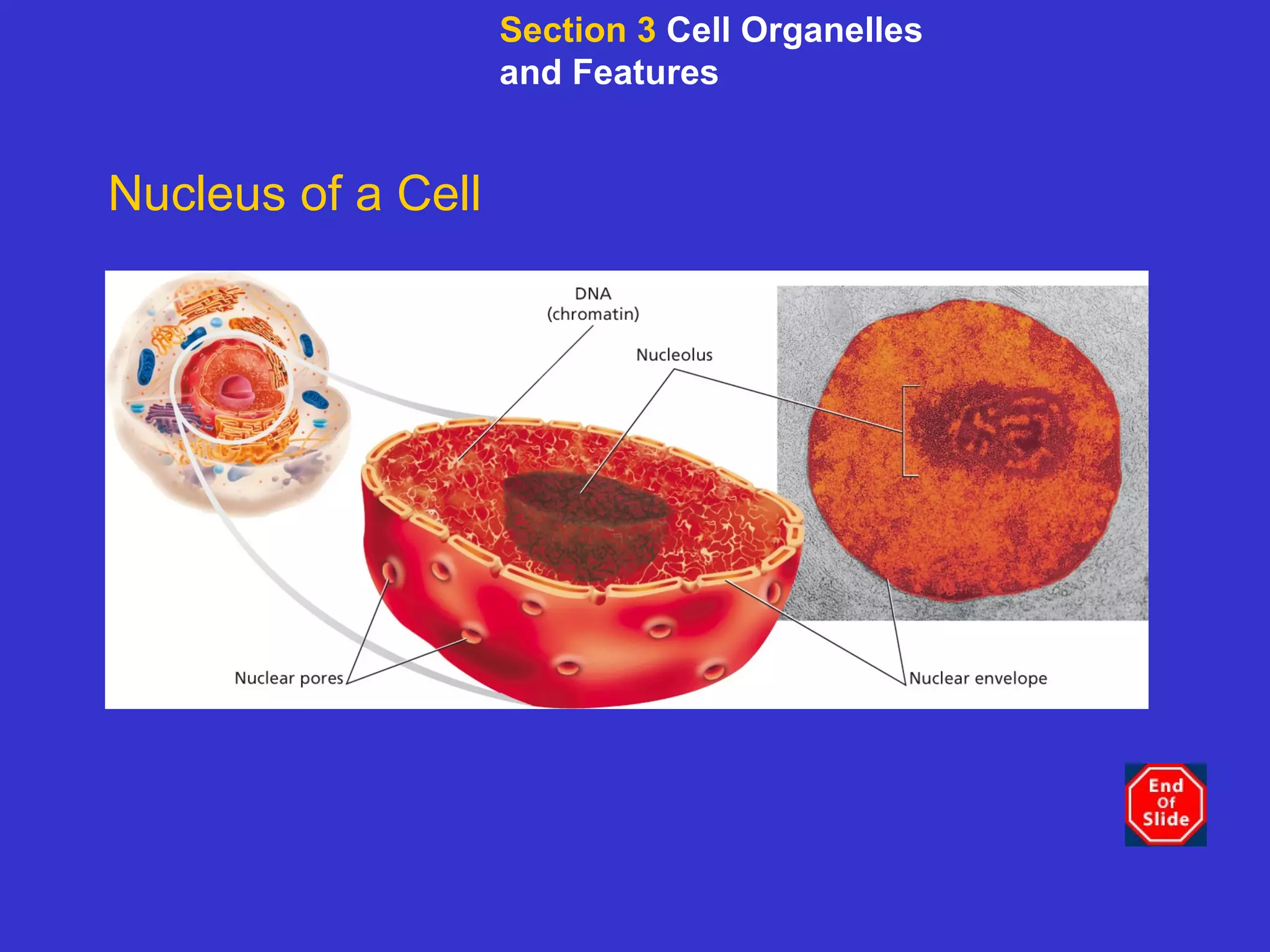
Nucleus The  nucleus   directs the cell’s activities and stores DNA. Section 3  Cell Organelles and Features
Nucleus of a Cell Section 3  Cell Organelles and Features
Nucleus,  continued Nuclear Envelope The nucleus is surrounded by a double membrane called the  nuclear envelope. Section 3  Cell Organelles and Features
Nucleus,  continued Nucleolus The  nucleolus  is the place where DNA is concentrated when it is in the process of making ribosomal RNA. Section 3  Cell Organelles and Features
Mitochondria Mitochondria   harvest energy from organic compounds and transfer it to ATP. Section 3  Cell Organelles and Features
Ribosomes Ribosomes   are either free or attached to the rough ER and play a role in protein synthesis. Section 3  Cell Organelles and Features
Click below to watch the Visual Concept. Visual Concept Ribosomes Section 3  Cell Organelles and Features
Endoplasmic Reticulum The rough ER prepares proteins for export or insertion into the cell membrane.   Section 3  Cell Organelles and Features
Endoplasmic Reticulum,  continued The smooth ER builds lipids and participates in detoxification of toxins. Section 3  Cell Organelles and Features
Click below to watch the Visual Concept. Visual Concept Endoplasmic Reticulum (ER) and Ribosomes Section 3  Cell Organelles and Features
Golgi Apparatus The   Golgi apparatus   processes and packages proteins. Section 3  Cell Organelles and Features
Vesicles Vesicles, including  lysosomes  (digestive enzymes) and  peroxisomes  (detoxification enzymes), are classified by their contents. Section 3  Cell Organelles and Features
Vesicles,  continued Protein Synthesis The rough ER, Golgi apparatus, and vesicles work together to transport proteins to their destinations inside and outside the cell. Section 3  Cell Organelles and Features
Processing of Proteins Section 3  Cell Organelles and Features
Cytoskeleton The  cytoskeleton  is made of protein fibers that help cells move and maintain their shape. The cytoskeleton includes  microtubules ,  microfilaments , and  intermediate filaments . Section 3  Cell Organelles and Features
Click below to watch the Visual Concept. Visual Concept Cytoskeleton Section 3  Cell Organelles and Features
Cytoskeleton,  continued Cilia and Flagella Cilia   and   flagella   are hairlike structures that extend from the surface of the cell, where they assist in movement. Section 3  Cell Organelles and Features
Click below to watch the Visual Concept. Visual Concept Structure of Cilia and Flagella Section 3  Cell Organelles and Features
Cytoskeleton,  continued Centrioles Centrioles   consist of two short cylinders of microtubules at right angles to each other and are involved in cell division.   Section 3  Cell Organelles and Features
Objectives List   three structures that are present in plant cells but not in animal cells. Compare   the plasma membrane,the primary cell wall, and the secondary cell wall. Explain   the role of the central vacuole. Describe   the roles of plastids in the life of a plant. Identify   features that distinguish prokaryotes, eukaryotes,  plant cells, and animal cells. Section 4  Unique Features of Plant Cells
Plant Cells Plant cells have cell walls, central vacuoles, and plastids. Section 4  Unique Features of Plant Cells
Cell Wall In plant cells, a rigid   cell wall   covers the cell membrane and provides support and protection. Section 4  Unique Features of Plant Cells
Click below to watch the Visual Concept. Visual Concept Parts of a Cell Wall Section 4  Unique Features of Plant Cells
Central Vacuole Large   central vacuoles   store water, enzymes, and waste products and provide support for plant tissue. Section 4  Unique Features of Plant Cells
Plastids Plastids   store starch and pigments.  The  chloroplast  converts light energy into chemical energy by photosynthesis. Section 4  Unique Features of Plant Cells
Comparing Cells Prokaryotes, animal cells, and plant cells can be distinguished from each other by their unique features. Section 4  Unique Features of Plant Cells
Comparing Plant and Animal Cells Section 4  Unique Features of Plant Cells

Cell

  • 1.
    Table of ContentsSection 1 The History of Cell Biology Section 2 Introduction to Cells Section 3 Cell Organelles and Features Section 4 Unique Features of Plant Cells Cell Structure and Function
  • 2.
    Objectives Name the scientists who first observed living and nonliving cells. Summarize the research that led to the development of the cell theory. State the three principles of the cell theory. Explain why the cell is considered to be the basic unit of life. Section 1 The History of Cell Biology
  • 3.
    The Discovery ofCells All living things are made up of one or more cells. A cell is the smallest unit that can carry on all of the processes of life. Section 1 The History of Cell Biology
  • 4.
    The Discovery ofCells, continued Hooke Robert Hooke discovered cells in slices of cork. Leeuwenhoek Anton van Leeuwenhoek was the first to observe living cells in microorganisms. Section 1 The History of Cell Biology
  • 5.
    The Cell TheoryThe cell theory states that all living organisms are made of one or more cells, cells are the basic units of structure and function, and cells come only from pre-existing cells. Section 1 The History of Cell Biology
  • 6.
    Click below towatch the Visual Concept. Visual Concept Cell Theory Section 1 The History of Cell Biology
  • 7.
    The Cell Theory, continued Cellular Basis of Life All living things are made of organized parts, obtain energy from their surroundings, perform chemical reactions, change with time, respond to their environment, and reproduce. Section 1 The History of Cell Biology
  • 8.
    Section 2 Introduction to Cells Objectives Explain the relationship between cell shape and cell function. Identify the factor that limits cell size. Describe the three basic parts of a cell. Compare prokaryotic cells and eukaryotic cells. Analyze the relationship among cells, tissues, organs, organ systems, and organisms.
  • 9.
    Section 2 Introduction to Cells Cell Diversity Cell Shape A cell’s shape reflects its function.
  • 10.
    Section 2 Introduction to Cells Cell Diversity, Continued Cell Size Cell size is limited by a cell’s surface area–to-volume ratio.
  • 11.
    Section 2 Introduction to Cells Basic Parts of a Cell The three basic parts of a cell are the plasma membrane, the cytoplasm, and the nucleus.
  • 12.
    Click below towatch the Visual Concept. Visual Concept Internal Organization of a Cell Section 2 Introduction to Cells
  • 13.
    Section 2 Introduction to Cells Basic Parts of a Cell, continued Plasma Membrane The cell’s outer boundary, called the plasma membrane (or the cell membrane), covers a cell’s surface and acts as a barrier between the inside and the outside of a cell.
  • 14.
    Section 2 Introduction to Cells Basic Parts of a Cell, continued Cytoplasm The region of the cell that is within the plasma membrane and that includes the fluid, the cytoskeleton, and all of the organelles except the nucleus is called the cytoplasm .
  • 15.
    Section 2 Introduction to Cells Basic Parts of a Cell, continued Nucleus The nucleus is a membrane-bound organelle that contains a cell’s DNA.
  • 16.
    Section 2 Introduction to Cells Two Basic Types of Cells Prokaryotes Prokaryote cells lack a nucleus and membrane-bound organelles.
  • 17.
    Section 2 Introduction to Cells Two Basic Types of Cells, continued Eukaryotes Eukaryote cells have a nucleus and membrane-bound organelles.
  • 18.
    Click below towatch the Visual Concept. Visual Concept Comparing Prokaryotes and Eukaryotes Section 2 Introduction to Cells
  • 19.
    Section 2 Introduction to Cells Cellular Organization In multicellular eukaryotes, cells organize into tissues, organs, organ systems, and finally organisms.
  • 20.
    Objectives Describe the structure and function of a cell’s plasma membrane. Summarize the role of the nucleus. List the major organelles found in the cytosol, and describe their roles. Identify the characteristics of mitochondria. Describe the structure and function of the cytoskeleton. Section 3 Cell Organelles and Features
  • 21.
    Plasma Membrane MembraneLipids Cell membranes consist of a phospholipid bilayer . Section 3 Cell Organelles and Features
  • 22.
    Structure of LipidBilayer Section 3 Cell Organelles and Features
  • 23.
    Plasma Membrane, continued Membrane Proteins Cell membranes often contain proteins embedded within the phospholipid bilayer. Section 3 Cell Organelles and Features
  • 24.
    Plasma Membrane, continued Fluid Mosaic Model The fluid mosaic model states that the phospholipid bilayer behaves like a fluid more than it behaves like a solid. Section 3 Cell Organelles and Features
  • 25.
    Nucleus The nucleus directs the cell’s activities and stores DNA. Section 3 Cell Organelles and Features
  • 26.
    Nucleus of aCell Section 3 Cell Organelles and Features
  • 27.
    Nucleus, continuedNuclear Envelope The nucleus is surrounded by a double membrane called the nuclear envelope. Section 3 Cell Organelles and Features
  • 28.
    Nucleus, continuedNucleolus The nucleolus is the place where DNA is concentrated when it is in the process of making ribosomal RNA. Section 3 Cell Organelles and Features
  • 29.
    Mitochondria Mitochondria harvest energy from organic compounds and transfer it to ATP. Section 3 Cell Organelles and Features
  • 30.
    Ribosomes Ribosomes are either free or attached to the rough ER and play a role in protein synthesis. Section 3 Cell Organelles and Features
  • 31.
    Click below towatch the Visual Concept. Visual Concept Ribosomes Section 3 Cell Organelles and Features
  • 32.
    Endoplasmic Reticulum Therough ER prepares proteins for export or insertion into the cell membrane. Section 3 Cell Organelles and Features
  • 33.
    Endoplasmic Reticulum, continued The smooth ER builds lipids and participates in detoxification of toxins. Section 3 Cell Organelles and Features
  • 34.
    Click below towatch the Visual Concept. Visual Concept Endoplasmic Reticulum (ER) and Ribosomes Section 3 Cell Organelles and Features
  • 35.
    Golgi Apparatus The Golgi apparatus processes and packages proteins. Section 3 Cell Organelles and Features
  • 36.
    Vesicles Vesicles, including lysosomes (digestive enzymes) and peroxisomes (detoxification enzymes), are classified by their contents. Section 3 Cell Organelles and Features
  • 37.
    Vesicles, continuedProtein Synthesis The rough ER, Golgi apparatus, and vesicles work together to transport proteins to their destinations inside and outside the cell. Section 3 Cell Organelles and Features
  • 38.
    Processing of ProteinsSection 3 Cell Organelles and Features
  • 39.
    Cytoskeleton The cytoskeleton is made of protein fibers that help cells move and maintain their shape. The cytoskeleton includes microtubules , microfilaments , and intermediate filaments . Section 3 Cell Organelles and Features
  • 40.
    Click below towatch the Visual Concept. Visual Concept Cytoskeleton Section 3 Cell Organelles and Features
  • 41.
    Cytoskeleton, continuedCilia and Flagella Cilia and flagella are hairlike structures that extend from the surface of the cell, where they assist in movement. Section 3 Cell Organelles and Features
  • 42.
    Click below towatch the Visual Concept. Visual Concept Structure of Cilia and Flagella Section 3 Cell Organelles and Features
  • 43.
    Cytoskeleton, continuedCentrioles Centrioles consist of two short cylinders of microtubules at right angles to each other and are involved in cell division. Section 3 Cell Organelles and Features
  • 44.
    Objectives List three structures that are present in plant cells but not in animal cells. Compare the plasma membrane,the primary cell wall, and the secondary cell wall. Explain the role of the central vacuole. Describe the roles of plastids in the life of a plant. Identify features that distinguish prokaryotes, eukaryotes, plant cells, and animal cells. Section 4 Unique Features of Plant Cells
  • 45.
    Plant Cells Plantcells have cell walls, central vacuoles, and plastids. Section 4 Unique Features of Plant Cells
  • 46.
    Cell Wall Inplant cells, a rigid cell wall covers the cell membrane and provides support and protection. Section 4 Unique Features of Plant Cells
  • 47.
    Click below towatch the Visual Concept. Visual Concept Parts of a Cell Wall Section 4 Unique Features of Plant Cells
  • 48.
    Central Vacuole Large central vacuoles store water, enzymes, and waste products and provide support for plant tissue. Section 4 Unique Features of Plant Cells
  • 49.
    Plastids Plastids store starch and pigments. The chloroplast converts light energy into chemical energy by photosynthesis. Section 4 Unique Features of Plant Cells
  • 50.
    Comparing Cells Prokaryotes,animal cells, and plant cells can be distinguished from each other by their unique features. Section 4 Unique Features of Plant Cells
  • 51.
    Comparing Plant andAnimal Cells Section 4 Unique Features of Plant Cells