Table of Contents Section 1   Species Interactions Section 2   Patterns in Communities Community Ecology
Objectives Identify   two types of predator adaptations and two types of prey adaptations. Identify   possible causes and results of interspecific competition. Compare   parasitism, mutualism, and commensalism, and give one example of each. Section 1  Species Interactions
Predation Predation   is an interaction in which one organism (the predator) captures and eats all or part of another individual organism (the prey). Section 1  Species Interactions
Predation Click below to watch the Visual Concept. Visual Concept Section 1  Species Interactions
Predation,  continued Predator Adaptations Predators have adaptations to efficiently capture prey, whereas prey species have adaptations to avoid capture.  Section 1  Species Interactions
Predation,  continued Adaptations in Animal Prey Mimicry  is an adaptation in which a species gains an advantage by resembling another species or object. Section 1  Species Interactions
Predation,  continued Adaptations in Plant Prey Many plants produce  secondary compounds  as a chemical defense. Section 1  Species Interactions
Competition Click below to watch the Visual Concept. Visual Concept Section 1  Species Interactions
Competition Competitive Exclusion Competition   may cause competitive exclusion, the elimination of one species in a community.  Section 1  Species Interactions
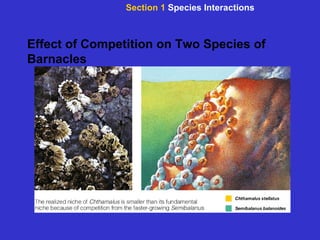
Effect of Competition on Two Species of Barnacles Section 1  Species Interactions
Niche Click below to watch the Visual Concept. Visual Concept Section 1  Species Interactions
Competition,  continued Character Displacement Competition may drive the evolution of niche differences among competitors. This evolution of differences in a characteristic due to competition is called  character displacement.   Section 1  Species Interactions
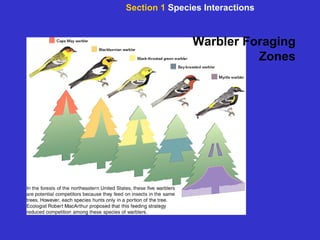
Competition,  continued Resource Partitioning Differential resource use to avoid competition is called   resource partitioning.   Section 1  Species Interactions
Warbler Foraging Zones Section 1  Species Interactions
Symbiosis Parasitism In  parasitism ,  one species (the parasite) feeds on, but does not always kill, another species (the host). Section 1  Species Interactions
Symbiosis Click below to watch the Visual Concept. Visual Concept Section 1  Species Interactions
Symbiosis,  continued Mutualism In  mutualism , both interacting species benefit. Section 1  Species Interactions
Symbiosis,  continued Commensalism In  commensalism ,  one species benefits, and the other is not affected. Section 1  Species Interactions
Objectives Describe   the factors that affect species richness in a community. Explain   how disturbances affect community stability. Distinguish   between types of succession, and explain why succession may not be predictable. Section 2  Patterns in Communities
Species Richness Species   richness   is the number of species in a community. Species   evenness   is the relative abundance of each species. Section 2  Patterns in Communities
Species Richness,  continued Latitude and Species Richness In general, species richness is greatest near the equator, and larger areas support more species.  Section 2  Patterns in Communities
Species Richness,  continued Species Interactions and Species Richness Species interactions such as predation can promote species richness. Section 2  Patterns in Communities
Species Richness,  continued Community Stability and Species Richness Disturbances   can alter a community by eliminating or removing organisms or altering resource availability. Species richness may improve a community’s stability. Areas of low species richness may be less stable in the event of an ecological disturbance. Section 2  Patterns in Communities
Successional Changes in Communities Ecological succession  is a change in the species composition of a community over time.  Section 2  Patterns in Communities
Pioneer Species Click below to watch the Visual Concept. Visual Concept Section 2  Patterns in Communities
Successional Changes in Communities,  continued Primary Succession Primary succession  is the assembly of a community on newly created habitat.  Primary succession occurs in areas that have been recently exposed to the elements and lack soil.  Section 2  Patterns in Communities
Successional Changes in Communities,  continued Secondary Succession Secondary succession  is the change in an existing community following a disturbance. Secondary succession occurs in areas where the original ecosystem has been cleared by a disturbance.  Section 2  Patterns in Communities
The Complexity of Succession The traditional description of succession is that the community proceeds through a predictable series of stages until it reaches a stable end point, called the   climax community.   Primary succession typically proceeds from lichens and mosses to a climax community. Secondary succession typically proceeds from weeds to a climax community. Section 2  Patterns in Communities
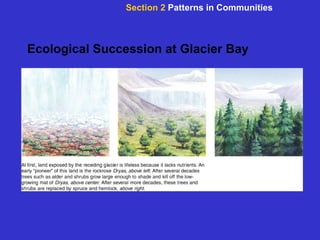
Ecological Succession at Glacier Bay Section 2  Patterns in Communities

Community Ecology

  • 1.
    Table of ContentsSection 1 Species Interactions Section 2 Patterns in Communities Community Ecology
  • 2.
    Objectives Identify two types of predator adaptations and two types of prey adaptations. Identify possible causes and results of interspecific competition. Compare parasitism, mutualism, and commensalism, and give one example of each. Section 1 Species Interactions
  • 3.
    Predation Predation is an interaction in which one organism (the predator) captures and eats all or part of another individual organism (the prey). Section 1 Species Interactions
  • 4.
    Predation Click belowto watch the Visual Concept. Visual Concept Section 1 Species Interactions
  • 5.
    Predation, continuedPredator Adaptations Predators have adaptations to efficiently capture prey, whereas prey species have adaptations to avoid capture. Section 1 Species Interactions
  • 6.
    Predation, continuedAdaptations in Animal Prey Mimicry is an adaptation in which a species gains an advantage by resembling another species or object. Section 1 Species Interactions
  • 7.
    Predation, continuedAdaptations in Plant Prey Many plants produce secondary compounds as a chemical defense. Section 1 Species Interactions
  • 8.
    Competition Click belowto watch the Visual Concept. Visual Concept Section 1 Species Interactions
  • 9.
    Competition Competitive ExclusionCompetition may cause competitive exclusion, the elimination of one species in a community. Section 1 Species Interactions
  • 10.
    Effect of Competitionon Two Species of Barnacles Section 1 Species Interactions
  • 11.
    Niche Click belowto watch the Visual Concept. Visual Concept Section 1 Species Interactions
  • 12.
    Competition, continuedCharacter Displacement Competition may drive the evolution of niche differences among competitors. This evolution of differences in a characteristic due to competition is called character displacement. Section 1 Species Interactions
  • 13.
    Competition, continuedResource Partitioning Differential resource use to avoid competition is called resource partitioning. Section 1 Species Interactions
  • 14.
    Warbler Foraging ZonesSection 1 Species Interactions
  • 15.
    Symbiosis Parasitism In parasitism , one species (the parasite) feeds on, but does not always kill, another species (the host). Section 1 Species Interactions
  • 16.
    Symbiosis Click belowto watch the Visual Concept. Visual Concept Section 1 Species Interactions
  • 17.
    Symbiosis, continuedMutualism In mutualism , both interacting species benefit. Section 1 Species Interactions
  • 18.
    Symbiosis, continuedCommensalism In commensalism , one species benefits, and the other is not affected. Section 1 Species Interactions
  • 19.
    Objectives Describe the factors that affect species richness in a community. Explain how disturbances affect community stability. Distinguish between types of succession, and explain why succession may not be predictable. Section 2 Patterns in Communities
  • 20.
    Species Richness Species richness is the number of species in a community. Species evenness is the relative abundance of each species. Section 2 Patterns in Communities
  • 21.
    Species Richness, continued Latitude and Species Richness In general, species richness is greatest near the equator, and larger areas support more species. Section 2 Patterns in Communities
  • 22.
    Species Richness, continued Species Interactions and Species Richness Species interactions such as predation can promote species richness. Section 2 Patterns in Communities
  • 23.
    Species Richness, continued Community Stability and Species Richness Disturbances can alter a community by eliminating or removing organisms or altering resource availability. Species richness may improve a community’s stability. Areas of low species richness may be less stable in the event of an ecological disturbance. Section 2 Patterns in Communities
  • 24.
    Successional Changes inCommunities Ecological succession is a change in the species composition of a community over time. Section 2 Patterns in Communities
  • 25.
    Pioneer Species Clickbelow to watch the Visual Concept. Visual Concept Section 2 Patterns in Communities
  • 26.
    Successional Changes inCommunities, continued Primary Succession Primary succession is the assembly of a community on newly created habitat. Primary succession occurs in areas that have been recently exposed to the elements and lack soil. Section 2 Patterns in Communities
  • 27.
    Successional Changes inCommunities, continued Secondary Succession Secondary succession is the change in an existing community following a disturbance. Secondary succession occurs in areas where the original ecosystem has been cleared by a disturbance. Section 2 Patterns in Communities
  • 28.
    The Complexity ofSuccession The traditional description of succession is that the community proceeds through a predictable series of stages until it reaches a stable end point, called the climax community. Primary succession typically proceeds from lichens and mosses to a climax community. Secondary succession typically proceeds from weeds to a climax community. Section 2 Patterns in Communities
  • 29.
    Ecological Succession atGlacier Bay Section 2 Patterns in Communities