Transduction
• Transforming signals
into neural impulses.
• Information goes
from the senses to
the thalamus , then
to the various areas
in the brain.
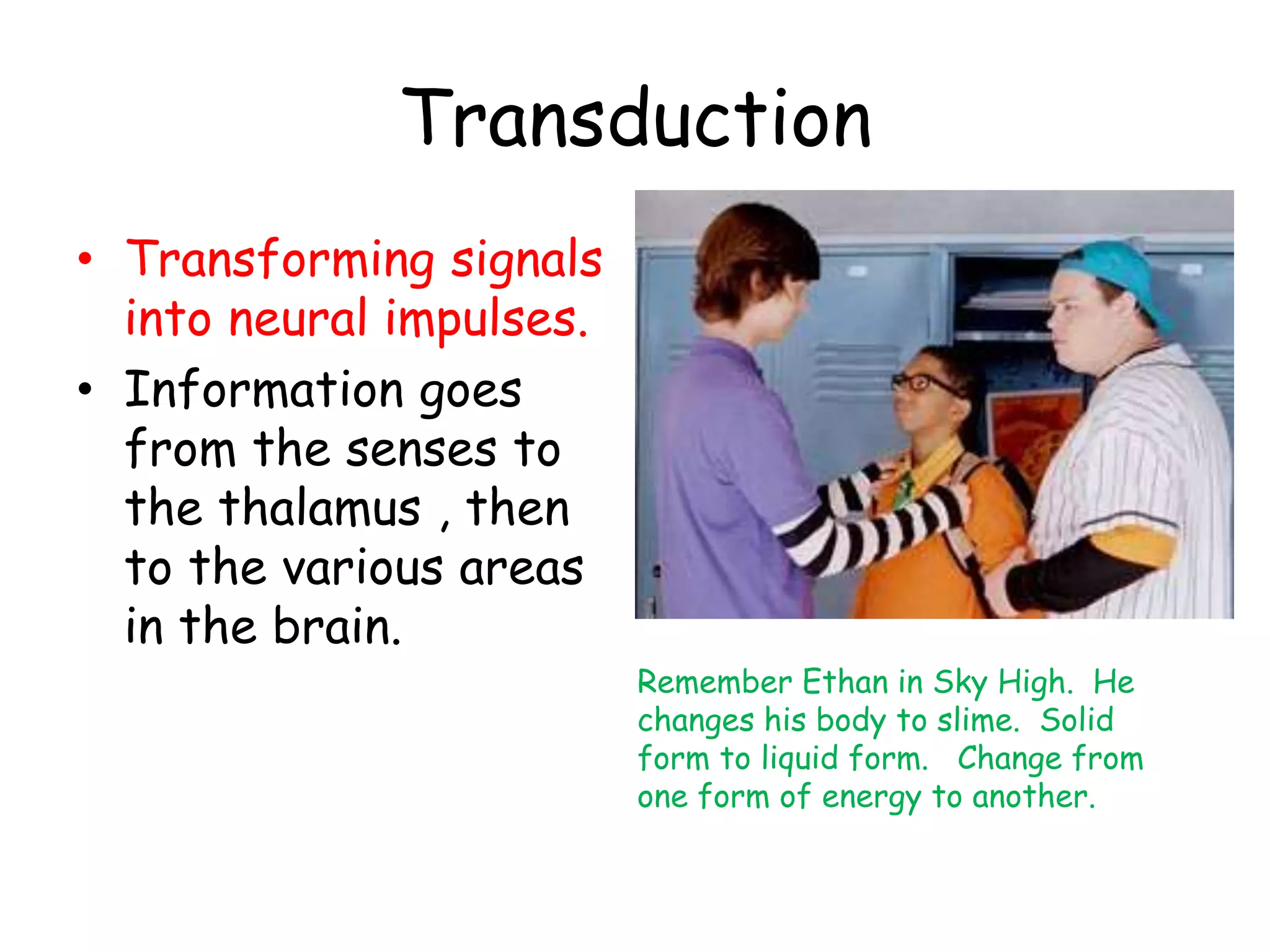
Remember Ethan in Sky High. He
changes his body to slime. Solid
form to liquid form. Change from
one form of energy to another.
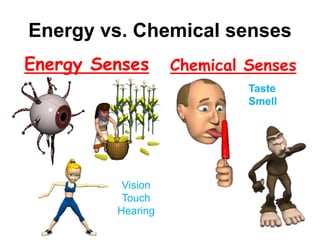
Energy vs. Chemical senses
Energy Senses Chemical Senses
Vision
Touch
Hearing
Taste
Smell
Vision
• Our most dominating
sense.
• Visual Capture
4 Chapter 4
http://www.youtube.com/watch?v=yh6FE8vVMrk
Chapter 4
6 Chapter 4
Chapter 4
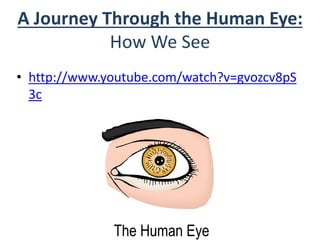
A Journey Through the Human Eye:
How We See
• http://www.youtube.com/watch?v=gvozcv8pS
3c
THE EYE AND VISION
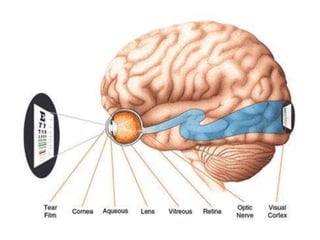
• Light enters the eye and then is projected
onto a surface
• The amount of light that enters the eye is
determined by the size of the pupil which
adjusts automatically to the amount of
light entering the eye
• Once light enters the eye, it encounters
the lens which adjusts to the distance of
objects by changing its thickness
Question: How does the eye enable
vision?
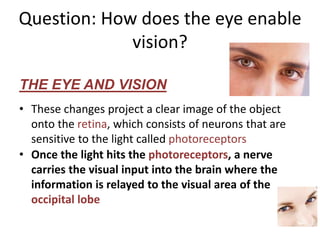
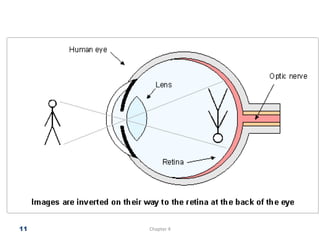
• These changes project a clear image of the object
onto the retina, which consists of neurons that are
sensitive to the light called photoreceptors
• Once the light hits the photoreceptors, a nerve
carries the visual input into the brain where the
information is relayed to the visual area of the
occipital lobe
THE EYE AND VISION
11 Chapter 4
Phase One: Gathering Light
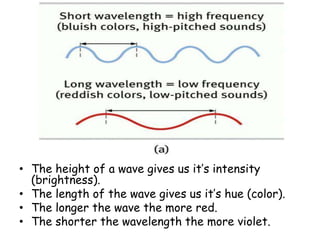
• The height of a wave gives us it’s intensity
(brightness).
• The length of the wave gives us it’s hue (color).
• The longer the wave the more red.
• The shorter the wavelength the more violet.
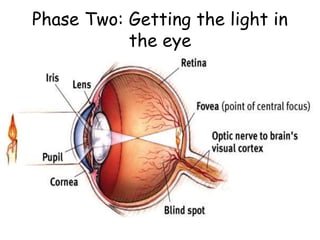
Phase Two: Getting the light in
the eye
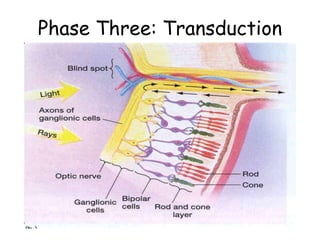
Phase Three: Transduction
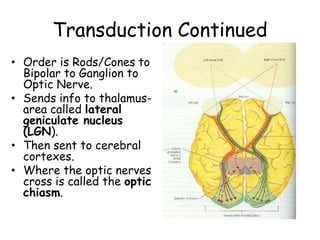
Transduction Continued
• Order is Rods/Cones to
Bipolar to Ganglion to
Optic Nerve.
• Sends info to thalamus-
area called lateral
geniculate nucleus
(LGN).
• Then sent to cerebral
cortexes.
• Where the optic nerves
cross is called the optic
chiasm.
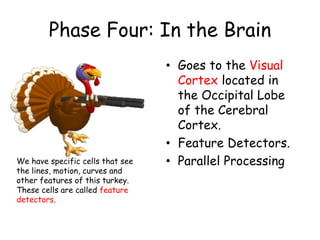
Phase Four: In the Brain
• Goes to the Visual
Cortex located in
the Occipital Lobe
of the Cerebral
Cortex.
• Feature Detectors.
• Parallel ProcessingWe have specific cells that see
the lines, motion, curves and
other features of this turkey.
These cells are called feature
detectors.
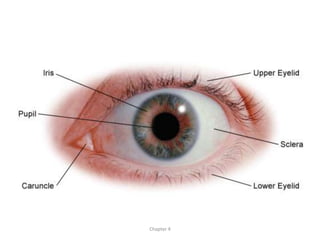
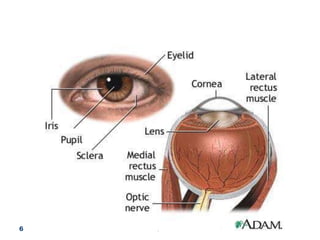
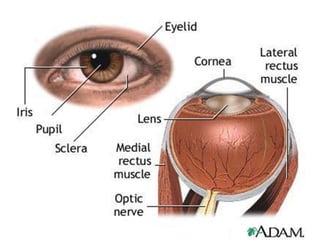
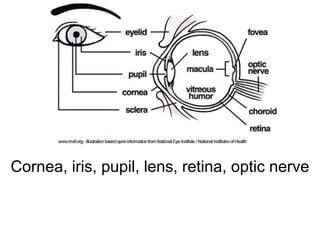
Cornea, iris, pupil, lens, retina, optic nerve

Notes on vision

  • 1.
    Transduction • Transforming signals intoneural impulses. • Information goes from the senses to the thalamus , then to the various areas in the brain. Remember Ethan in Sky High. He changes his body to slime. Solid form to liquid form. Change from one form of energy to another.
  • 2.
    Energy vs. Chemicalsenses Energy Senses Chemical Senses Vision Touch Hearing Taste Smell
  • 3.
    Vision • Our mostdominating sense. • Visual Capture
  • 4.
  • 5.
  • 6.
  • 7.
  • 8.
    A Journey Throughthe Human Eye: How We See • http://www.youtube.com/watch?v=gvozcv8pS 3c
  • 9.
    THE EYE ANDVISION • Light enters the eye and then is projected onto a surface • The amount of light that enters the eye is determined by the size of the pupil which adjusts automatically to the amount of light entering the eye • Once light enters the eye, it encounters the lens which adjusts to the distance of objects by changing its thickness
  • 10.
    Question: How doesthe eye enable vision? • These changes project a clear image of the object onto the retina, which consists of neurons that are sensitive to the light called photoreceptors • Once the light hits the photoreceptors, a nerve carries the visual input into the brain where the information is relayed to the visual area of the occipital lobe THE EYE AND VISION
  • 11.
  • 13.
    Phase One: GatheringLight • The height of a wave gives us it’s intensity (brightness). • The length of the wave gives us it’s hue (color). • The longer the wave the more red. • The shorter the wavelength the more violet.
  • 14.
    Phase Two: Gettingthe light in the eye
  • 15.
  • 16.
    Transduction Continued • Orderis Rods/Cones to Bipolar to Ganglion to Optic Nerve. • Sends info to thalamus- area called lateral geniculate nucleus (LGN). • Then sent to cerebral cortexes. • Where the optic nerves cross is called the optic chiasm.
  • 18.
    Phase Four: Inthe Brain • Goes to the Visual Cortex located in the Occipital Lobe of the Cerebral Cortex. • Feature Detectors. • Parallel ProcessingWe have specific cells that see the lines, motion, curves and other features of this turkey. These cells are called feature detectors.
  • 19.
    Cornea, iris, pupil,lens, retina, optic nerve