Table of Contents Section 1   Understanding Populations Section 2   Measuring Populations Section 3   Human Population Growth Populations
Objectives Describe   the main properties that scientists measure when they study populations. Compare   the three general patterns of population dispersion. Identify   the measurements used to describe changing populations. Compare   the three general types of survivorship curves. Section 1  Understanding Populations
Properties of Populations A   population   is a group of organisms that belong to the same species and live in a particular place at the same time. Populations can be measured in terms of size, density, dispersion, growth rate, age structure, and survivorship. Section 1  Understanding Populations
Population Click below to watch the Visual Concept. Visual Concept Section 1  Understanding Populations
Properties of Populations,  continued Population  Size A population’s size is the number of individuals that the population contains.  Section 1  Understanding Populations
Properties of Populations,  continued Population  Density Density is a measure of how crowded the population is. Section 1  Understanding Populations
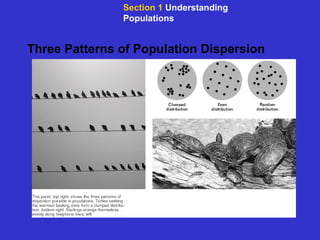
Properties of Populations,  continued Dispersion Dispersion   describes the distribution of individuals within the population and may be random, uniform, or clumped. Section 1  Understanding Populations
Three Patterns of Population Dispersion Section 1  Understanding Populations
Characteristics of Populations Click below to watch the Visual Concept. Visual Concept Section 1  Understanding Populations
Population Dynamics Age Structure A population’s  age structure  indicates the percentage of individuals at each age. Section 1  Understanding Populations
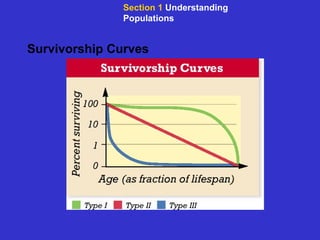
Population Dynamics,  continued Patterns of Mortality Populations show three patterns of mortality or  survivorship curves :  Type I (low mortality until late in life)  Type II (constant mortality throughout life) Type III (high mortality early in life followed by low mortality for the remaining life span). Section 1  Understanding Populations
Survivorship Curves Section 1  Understanding Populations
Objectives Identify   the four processes that determine population growth. Compare   the exponential model and the logistic model of population growth. Differentiate   between density-dependent and density-independent regulation of populations. Explain   why small populations are more vulnerable to extinction. Section 2  Measuring Populations
Population Growth Rate Demographers, scientists who study population dynamics, define the   growth rate   of a population as the amount by which a population’s size changes in a given time. Section 2  Measuring Populations
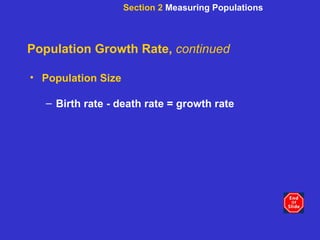
Population Growth Rate,  continued Population Size Birth rate - death rate = growth rate Section 2  Measuring Populations
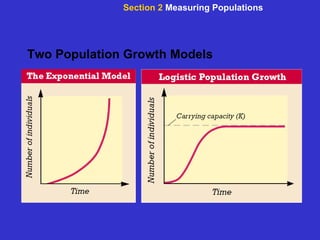
The Exponential Model The  exponential model  describes perpetual growth at a steady rate in a population.  The model assumes constant birth and death rates and no immigration or emigration. Section 2  Measuring Populations
Exponential Growth Click below to watch the Visual Concept. Visual Concept Section 2  Measuring Populations
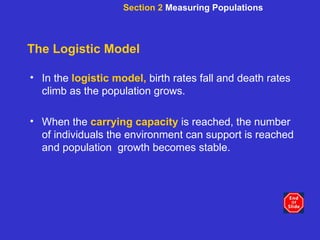
The Logistic Model In the   logistic model,   birth rates fall and death rates climb as the population grows. When the  carrying capacity  is reached, the number of individuals the environment can support is reached and population  growth becomes stable. Section 2  Measuring Populations
Logistic Model Click below to watch the Visual Concept. Section 2  Measuring Populations Visual Concept
Two Population Growth Models Section 2  Measuring Populations
Population Regulation Population-limiting factors, such as competition, are   density-dependent   because the effect on each individual depends on the number of other individuals present in the same area. Section 2  Measuring Populations
Population Regulation, continued Population-limiting factors, such as bad weather and fires, are   density-independent   because the effect on each individual does not depend on the number of other individuals present in the same area. Section 2  Measuring Populations
Comparing Density-Dependent and Density-Independent Factors Click below to watch the Visual Concept. Visual Concept Section 2  Measuring Populations
Population Regulation,  continued Population Fluctuations All populations fluctuate in size. Section 2  Measuring Populations
Population Regulation,  continued Perils of Small Populations Small populations have low genetic diversity and are subject to inbreeding, so they are less likely to adapt to environmental changes. Section 2  Measuring Populations
Objectives Explain   how the development of agriculture changed the pattern of human population growth. Describe   changes in human population size in the past 10,000 years. Compare   observed patterns of population growth in developed and developing countries. Section 3  Human Population Growth
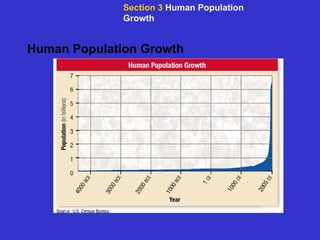
History of Human Population Growth The Development of Agriculture About 10,000 to 12,000 years ago, the development of agriculture increased the growth rate of the human population. Section 3  Human Population Growth
History of Human Population Growth,  continued The Population Explosion Around 1650, improvements in hygiene, diet, and economic conditions further accelerated population growth. After World War II, the human population grew at the fastest rate in history, largely because of better sanitation and medical care in poorer countries. Section 3  Human Population Growth
History of Human Population Growth,  continued Population Growth Today Today, developing countries have faster human population growth and lower standards of living than developed countries do. Section 3  Human Population Growth
Human Population Growth Section 3  Human Population Growth
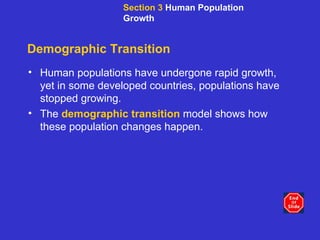
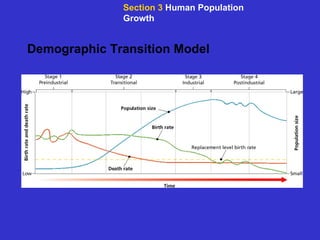
Demographic Transition Human populations have undergone rapid growth, yet in some developed countries, populations have stopped growing. The   demographic transition   model shows how these population changes happen.   Section 3  Human Population Growth
Demographic Transition Model Section 3  Human Population Growth

Populations

  • 1.
    Table of ContentsSection 1 Understanding Populations Section 2 Measuring Populations Section 3 Human Population Growth Populations
  • 2.
    Objectives Describe the main properties that scientists measure when they study populations. Compare the three general patterns of population dispersion. Identify the measurements used to describe changing populations. Compare the three general types of survivorship curves. Section 1 Understanding Populations
  • 3.
    Properties of PopulationsA population is a group of organisms that belong to the same species and live in a particular place at the same time. Populations can be measured in terms of size, density, dispersion, growth rate, age structure, and survivorship. Section 1 Understanding Populations
  • 4.
    Population Click belowto watch the Visual Concept. Visual Concept Section 1 Understanding Populations
  • 5.
    Properties of Populations, continued Population Size A population’s size is the number of individuals that the population contains. Section 1 Understanding Populations
  • 6.
    Properties of Populations, continued Population Density Density is a measure of how crowded the population is. Section 1 Understanding Populations
  • 7.
    Properties of Populations, continued Dispersion Dispersion describes the distribution of individuals within the population and may be random, uniform, or clumped. Section 1 Understanding Populations
  • 8.
    Three Patterns ofPopulation Dispersion Section 1 Understanding Populations
  • 9.
    Characteristics of PopulationsClick below to watch the Visual Concept. Visual Concept Section 1 Understanding Populations
  • 10.
    Population Dynamics AgeStructure A population’s age structure indicates the percentage of individuals at each age. Section 1 Understanding Populations
  • 11.
    Population Dynamics, continued Patterns of Mortality Populations show three patterns of mortality or survivorship curves : Type I (low mortality until late in life) Type II (constant mortality throughout life) Type III (high mortality early in life followed by low mortality for the remaining life span). Section 1 Understanding Populations
  • 12.
    Survivorship Curves Section1 Understanding Populations
  • 13.
    Objectives Identify the four processes that determine population growth. Compare the exponential model and the logistic model of population growth. Differentiate between density-dependent and density-independent regulation of populations. Explain why small populations are more vulnerable to extinction. Section 2 Measuring Populations
  • 14.
    Population Growth RateDemographers, scientists who study population dynamics, define the growth rate of a population as the amount by which a population’s size changes in a given time. Section 2 Measuring Populations
  • 15.
    Population Growth Rate, continued Population Size Birth rate - death rate = growth rate Section 2 Measuring Populations
  • 16.
    The Exponential ModelThe exponential model describes perpetual growth at a steady rate in a population. The model assumes constant birth and death rates and no immigration or emigration. Section 2 Measuring Populations
  • 17.
    Exponential Growth Clickbelow to watch the Visual Concept. Visual Concept Section 2 Measuring Populations
  • 18.
    The Logistic ModelIn the logistic model, birth rates fall and death rates climb as the population grows. When the carrying capacity is reached, the number of individuals the environment can support is reached and population growth becomes stable. Section 2 Measuring Populations
  • 19.
    Logistic Model Clickbelow to watch the Visual Concept. Section 2 Measuring Populations Visual Concept
  • 20.
    Two Population GrowthModels Section 2 Measuring Populations
  • 21.
    Population Regulation Population-limitingfactors, such as competition, are density-dependent because the effect on each individual depends on the number of other individuals present in the same area. Section 2 Measuring Populations
  • 22.
    Population Regulation, continuedPopulation-limiting factors, such as bad weather and fires, are density-independent because the effect on each individual does not depend on the number of other individuals present in the same area. Section 2 Measuring Populations
  • 23.
    Comparing Density-Dependent andDensity-Independent Factors Click below to watch the Visual Concept. Visual Concept Section 2 Measuring Populations
  • 24.
    Population Regulation, continued Population Fluctuations All populations fluctuate in size. Section 2 Measuring Populations
  • 25.
    Population Regulation, continued Perils of Small Populations Small populations have low genetic diversity and are subject to inbreeding, so they are less likely to adapt to environmental changes. Section 2 Measuring Populations
  • 26.
    Objectives Explain how the development of agriculture changed the pattern of human population growth. Describe changes in human population size in the past 10,000 years. Compare observed patterns of population growth in developed and developing countries. Section 3 Human Population Growth
  • 27.
    History of HumanPopulation Growth The Development of Agriculture About 10,000 to 12,000 years ago, the development of agriculture increased the growth rate of the human population. Section 3 Human Population Growth
  • 28.
    History of HumanPopulation Growth, continued The Population Explosion Around 1650, improvements in hygiene, diet, and economic conditions further accelerated population growth. After World War II, the human population grew at the fastest rate in history, largely because of better sanitation and medical care in poorer countries. Section 3 Human Population Growth
  • 29.
    History of HumanPopulation Growth, continued Population Growth Today Today, developing countries have faster human population growth and lower standards of living than developed countries do. Section 3 Human Population Growth
  • 30.
    Human Population GrowthSection 3 Human Population Growth
  • 31.
    Demographic Transition Humanpopulations have undergone rapid growth, yet in some developed countries, populations have stopped growing. The demographic transition model shows how these population changes happen. Section 3 Human Population Growth
  • 32.
    Demographic Transition ModelSection 3 Human Population Growth