SENSATION AND  PERCEPTION
Sensation: Receiving Messages About the World Sense organs See, hear, taste, smell, touch, balance, and experience the world Sensory receptor cells  transmit  sensation   Perception  – interpreting information and forming images Stimulus Sensation and Perception
Translating Messages for the Brain Transduction  – translates one form of energy (incoming stimuli) into another (sensory information) Receptor cells  to  neural impulses Sensation and Perception
Sensory Limits: How Strong Must Messages Be? Threshold  – lower limits Absolute threshold  – smallest to be detected Difference threshold  – smallest difference between 2 stimuli to be detected 50% of time Sensory adaptation  – one’s sensitivity to a stimulus varies from time to time Fatigue, inattention, repeated exposure Sensation and Perception
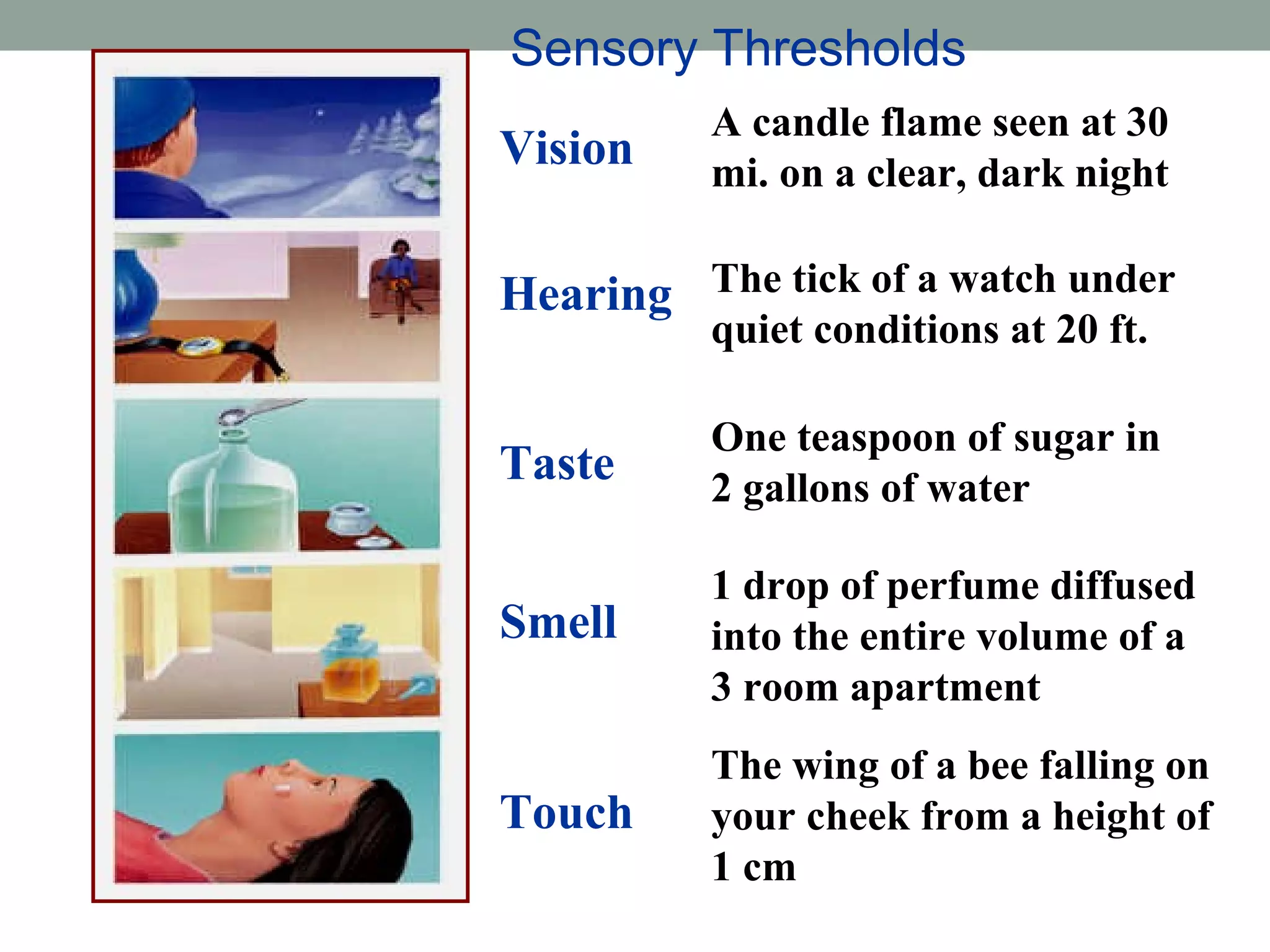
Sensory Thresholds Vision A candle flame seen at 30 mi. on a clear, dark night Hearing The tick of a watch under quiet conditions at 20 ft. Taste One teaspoon of sugar in 2 gallons of water Smell 1 drop of perfume diffused into the entire volume of a 3 room apartment Touch The wing of a bee falling on your cheek from a height of 1 cm
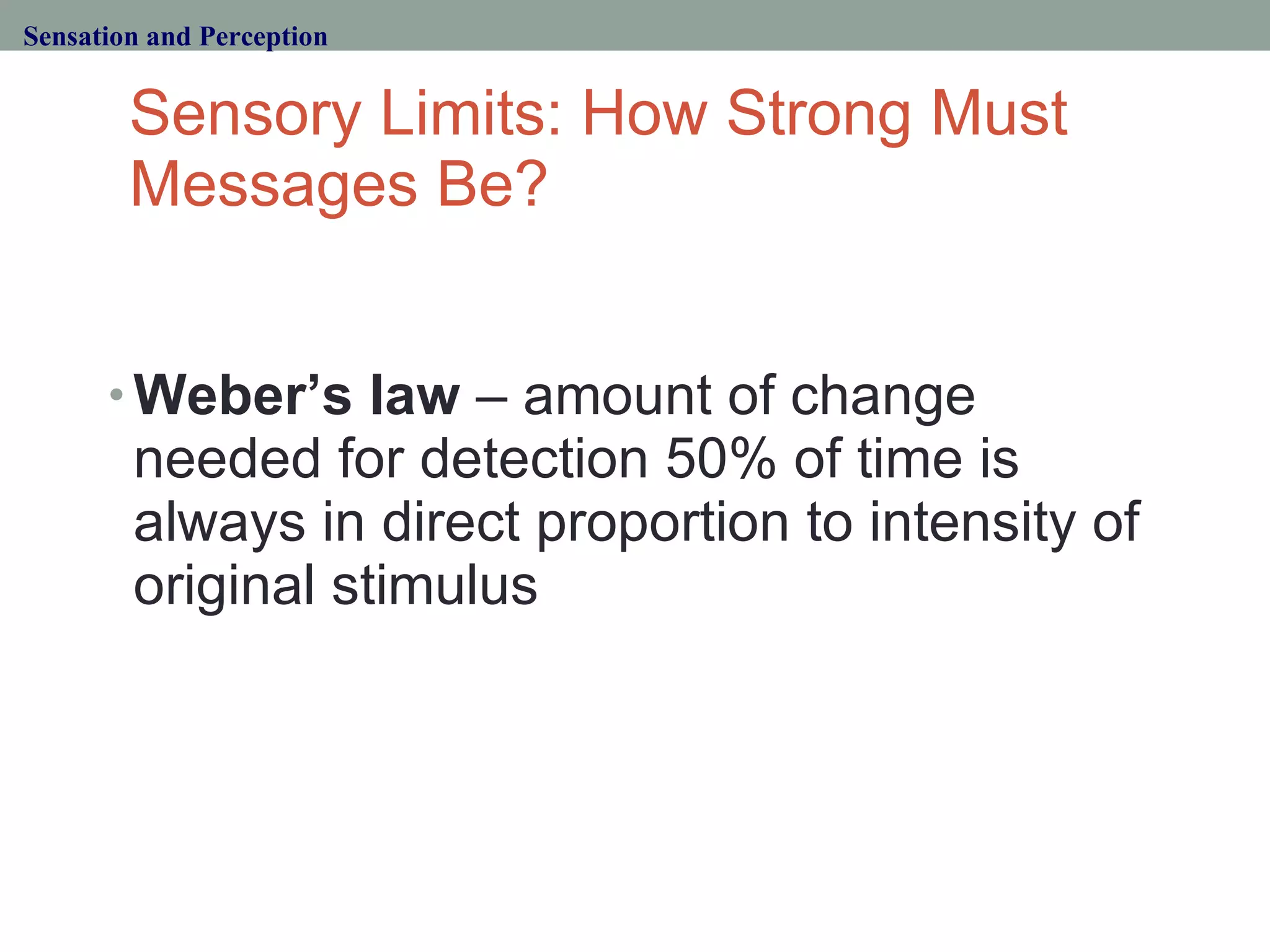
Sensory Limits: How Strong Must Messages Be? Weber’s law  – amount of change needed for detection 50% of time is always in direct proportion to intensity of original stimulus Sensation and Perception
Stimulus  – any from of energy capable of exiting the nervous system like light waves, sound waves, and the chemical energy that causes the sensation taste and smell. Receptor  – is a specialized nerve ending capable of responding to energy. Senses  – mechanisms which convert stimulus energy into neutral energy.
*Five Human Senses* 1.VISION The organ for vision is the eye.  It is stimulated by light waves that strike the retina where the photo-sensitive cells- the rod and the cones- are located.  The rods and cones are the receptor for vision.
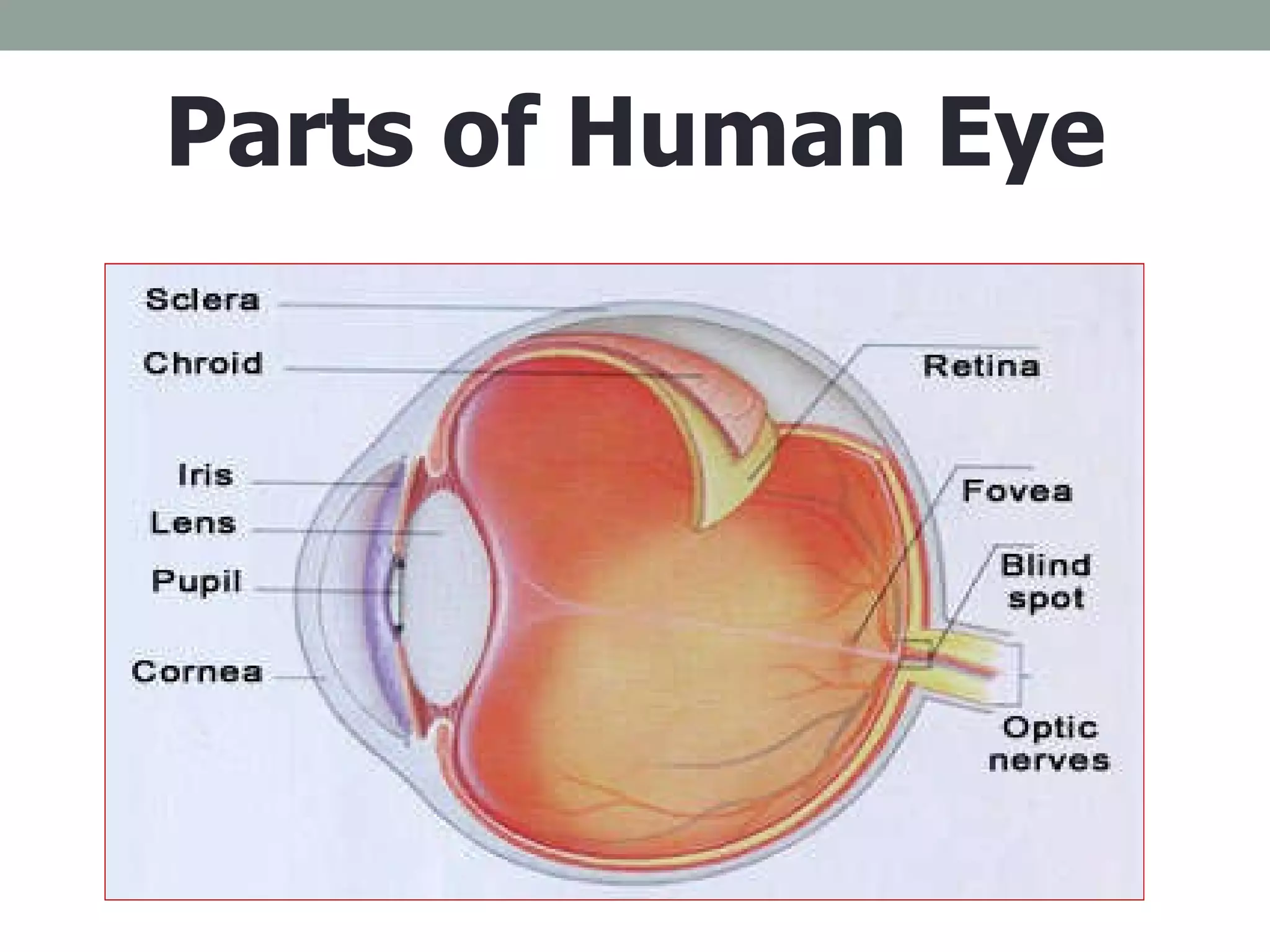
Parts of Human Eye
Structure Globe  - shaped and has a diameter of approximately one inch. Composed of three coats: Sclera  - the outer layer, a tough opaque layer of connective tissue used to protect the inner structures of the eye. Helps maintain the shape of the eyeball, in front, this layer becomes the cornea which is thin and transparent.
Choroid Coat  - the middle layer, a pigmented layer.  It contains some of the blood vessels that supply the eye with blood.  It also absorbs imperfectly focused light rays.  In the front part of the eye, it becomes modified to from the iris and the cilliary blood.  Pupil  – the central opening of the iris
Iris  – a circular arrangement of muscles that contract and expand to change the size of the pupil depending upon the intensity of illumination called  light or dark adaptation.  The color of the eye is due to the pigment in the iris Accommodation  – the process when the lens become thinner to bring faraway objects into focus and thickens to focus on nearly objects.
Vision: Sensing Light Light  Electromagnetic radiation Waves -  frequency Wavelength  – determines hues seen Intensity  – brightness The more wavelengths in light, the less  saturated  or pure its hue is Sensation and Perception
The Eye: How Does It Work? Light passes through  cornea Iris  regulates light through  pupil  into  lens Lens held in place by  ciliary muscle Retina  has  rods  and  cones  for receptors  Fovea  – center of retina Visual acuity  – clarity and sharpness Sensation and Perception
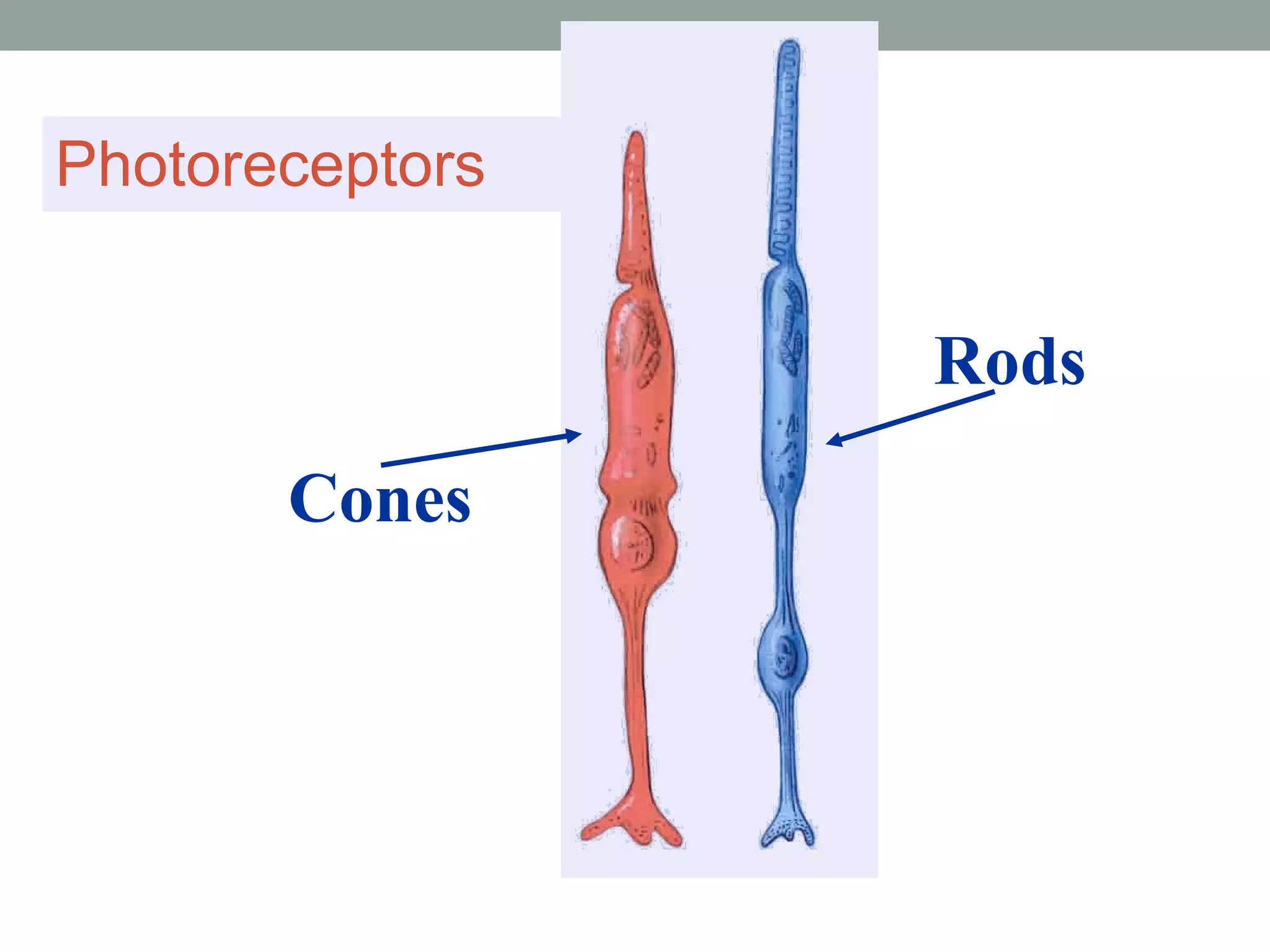
Photoreceptors Cones   Rods
The Eye Rods Not located in fovea Responsible for peripheral vision Hundreds of times more sensitive to light than cones Produce images perceived with less visual acuity than cones Do not detect color Sensation and Perception
The Eye Cones Give brain more precise information Code information about color Respond only in bright light Optic nerve  – has no cones or rods Blind spot  – no visual reception in optic nerve Optic chiasm   Sensation and Perception
Dark and Light Adaptation Dark adaptation   Receptors receive new supply of chemicals After 30 minutes in the dark - level of sensitivity about 100,000 times greater than in bright light Light adaptation Rods and cones highly responsive –  overload Bleaching out of receptor chemicals occurs Sensation and Perception
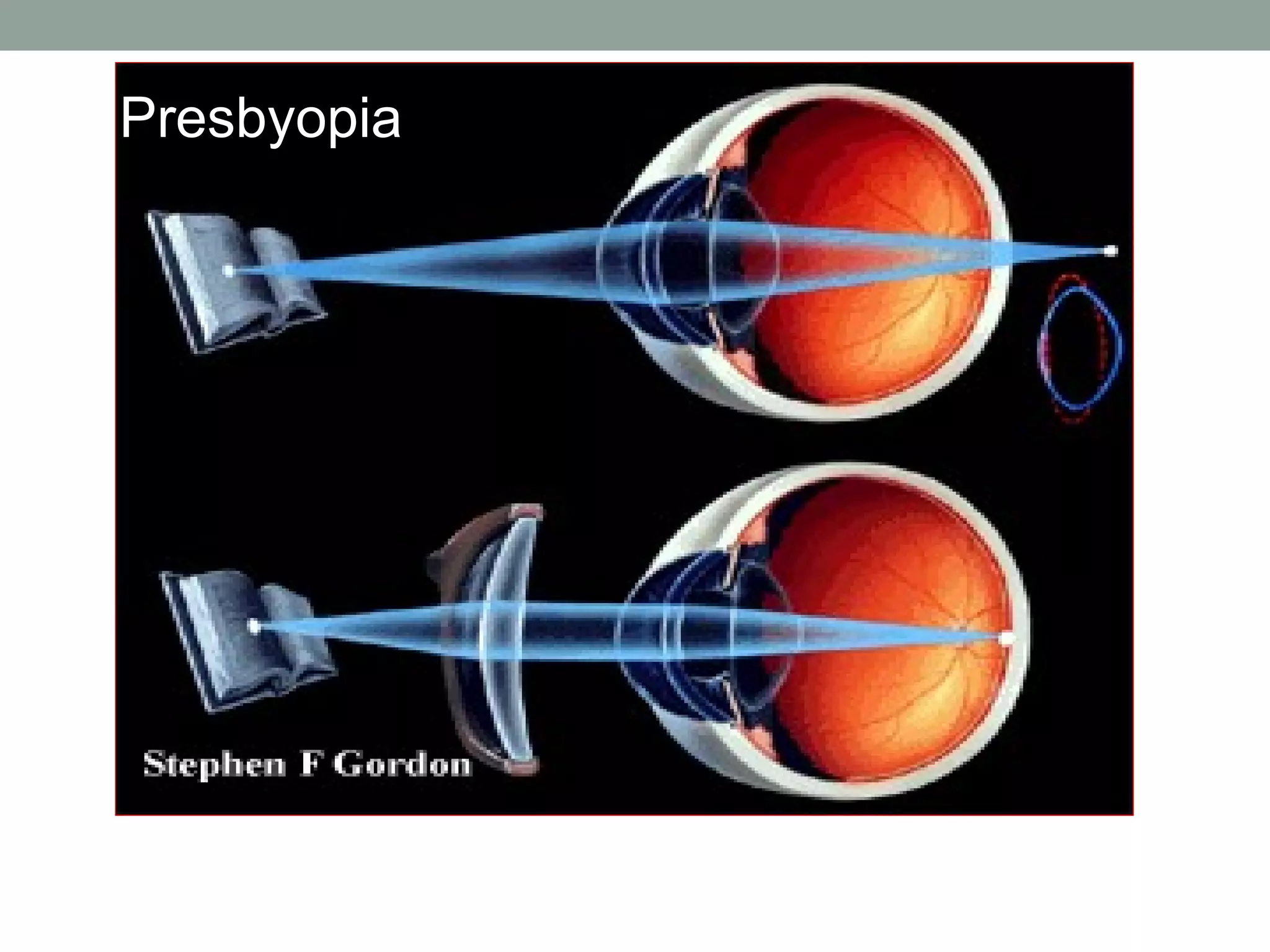
Defects of Vision Presbyopia –  a special form of farsightedness which occurs with advancing age.  The presbyopic person cannot focus clearly on near objects.
Presbyopia
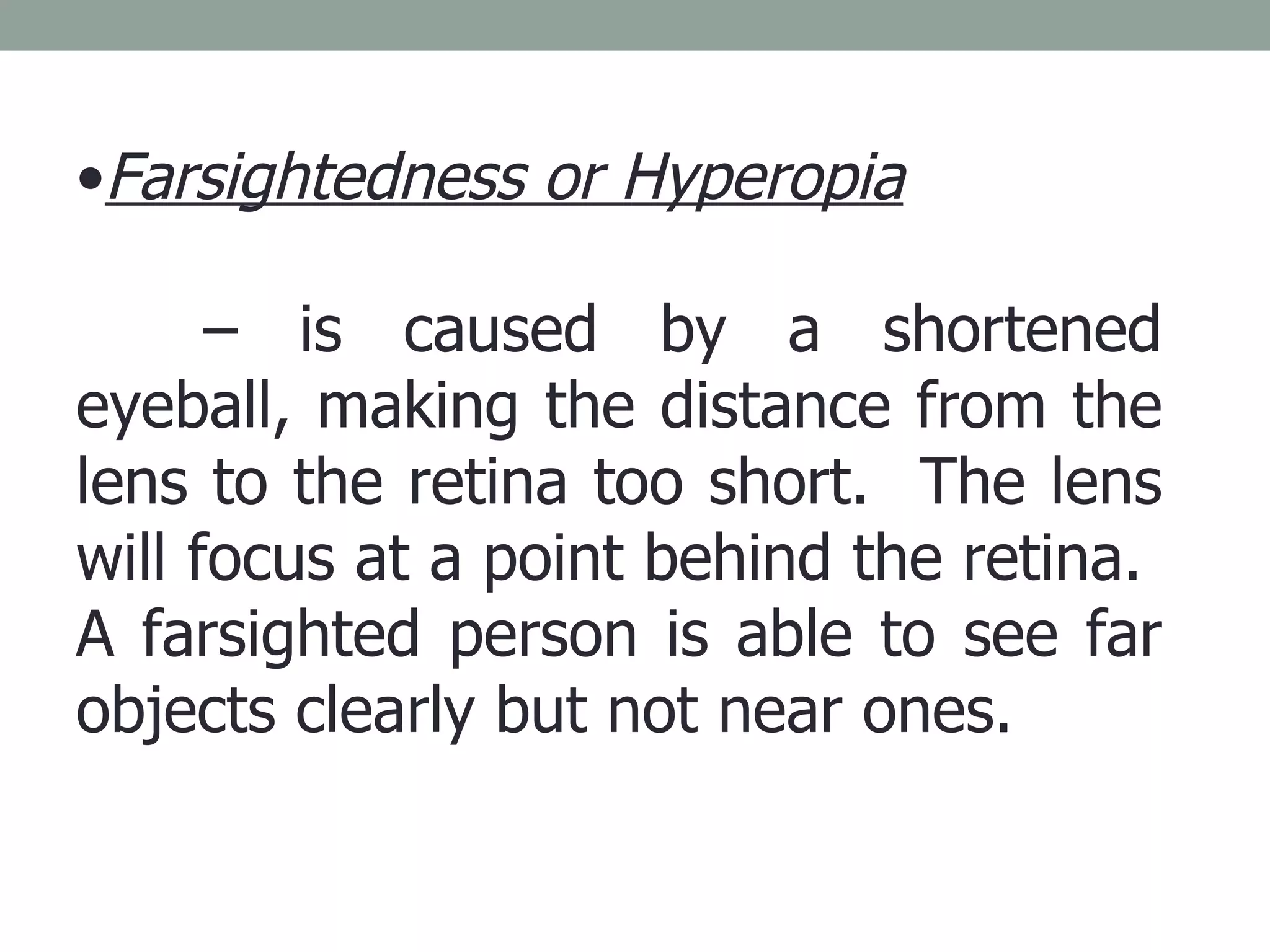
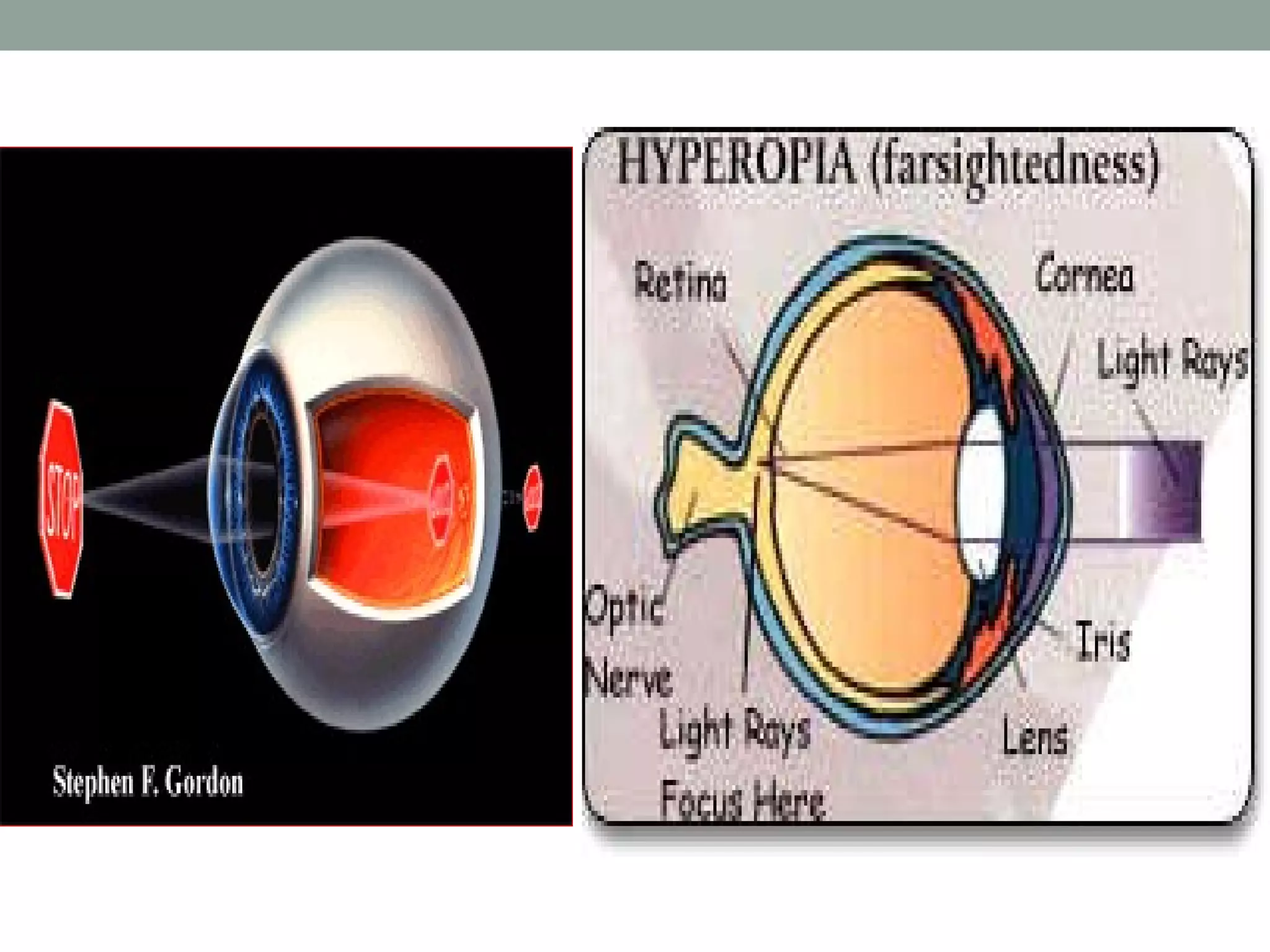
Farsightedness or Hyperopia   –  is caused by a shortened eyeball, making the distance from the lens to the retina too short.  The lens will focus at a point behind the retina.  A farsighted person is able to see far objects clearly but not near ones.
 
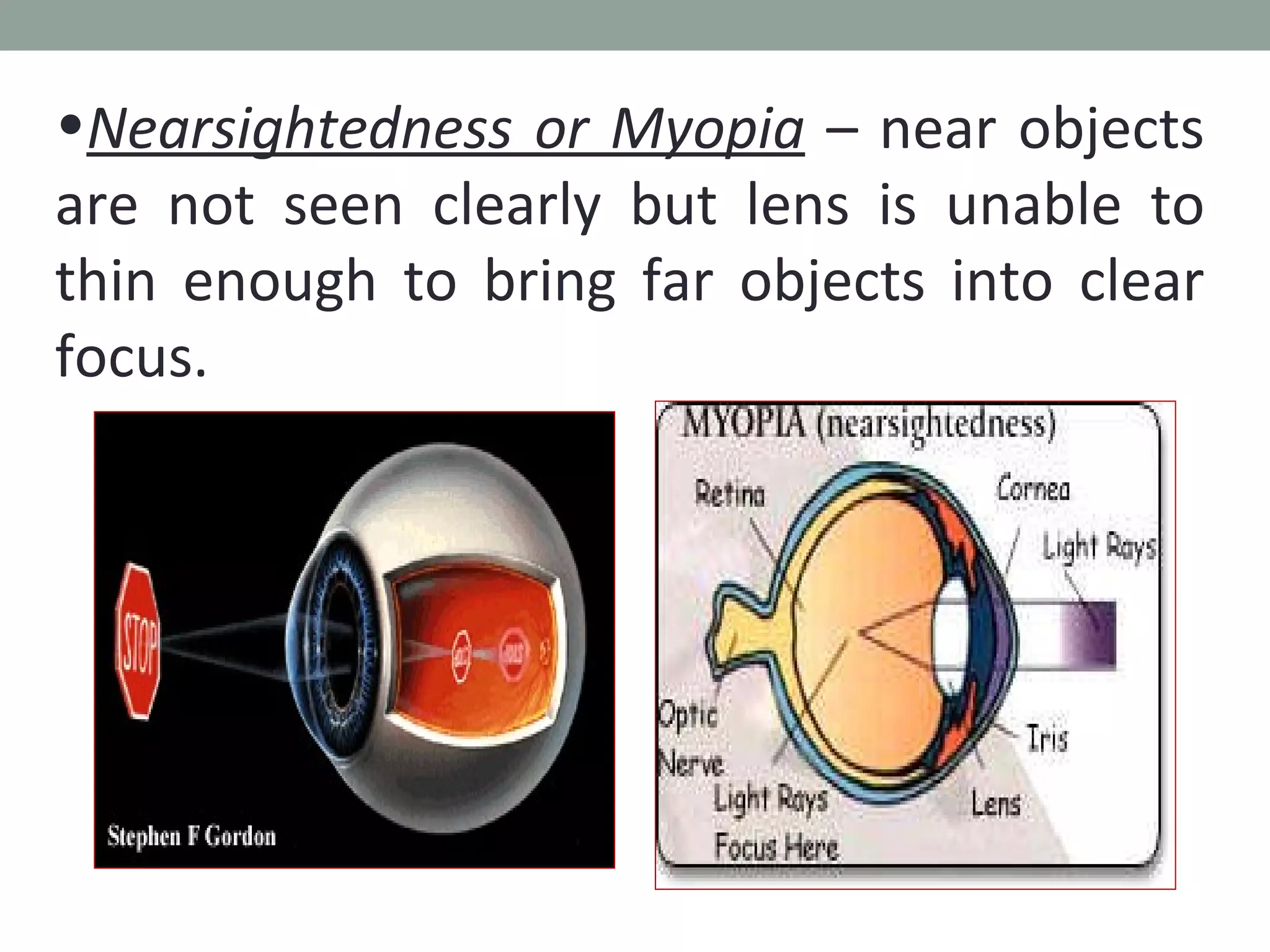
Nearsightedness or Myopia  – near objects are not seen clearly but lens is unable to thin enough to bring far objects into clear focus.
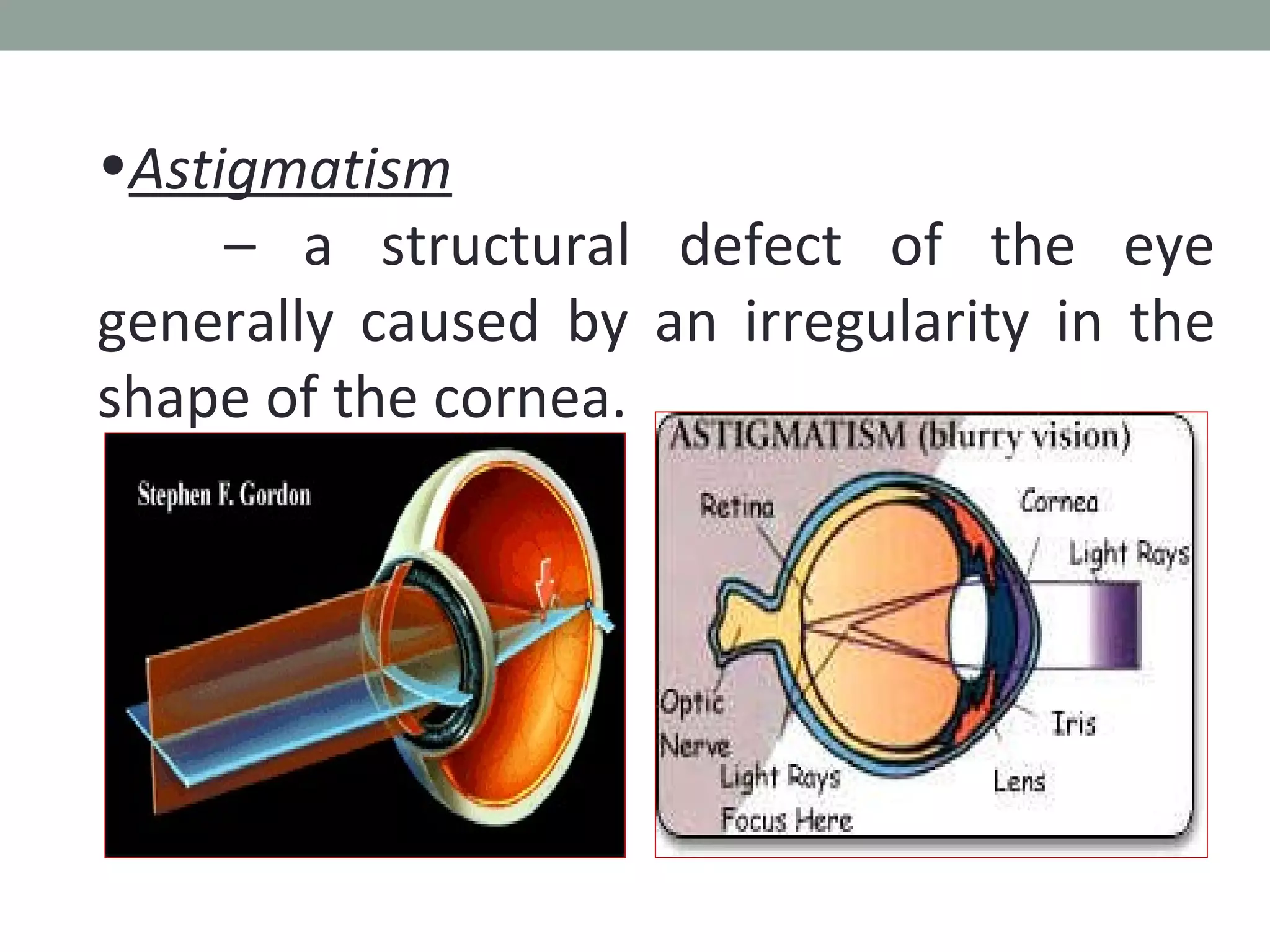
Astigmatism   –  a structural defect of the eye generally caused by an irregularity in the shape of the cornea.
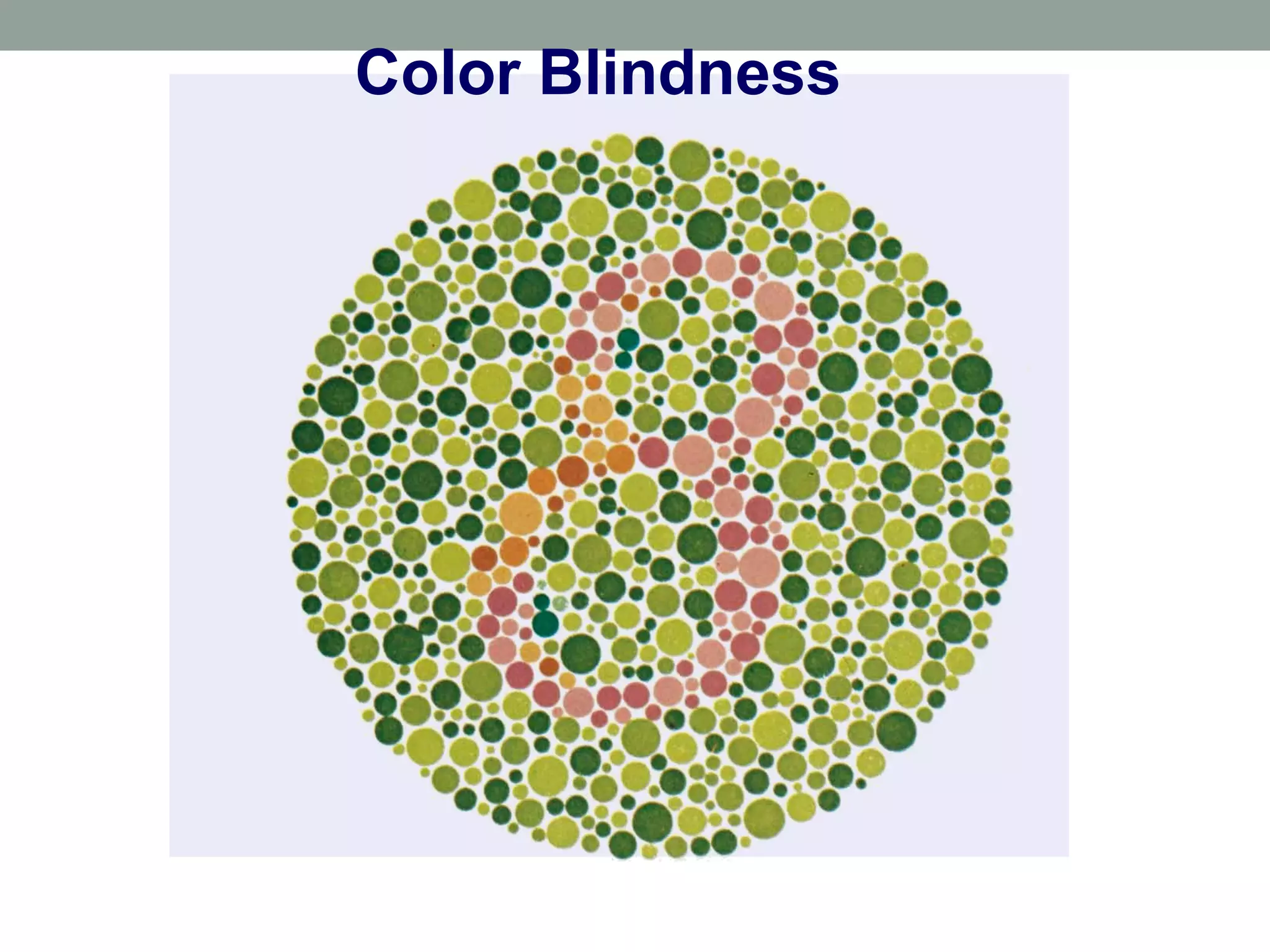
Color Blindness Affects about 8% of males, 1% of females Partial color blindness – difficulty distinguishing between two colors Red-green blindness due to genetic defect Yellow-blue blindness due to absence of blue pigment in cones Sensation and Perception
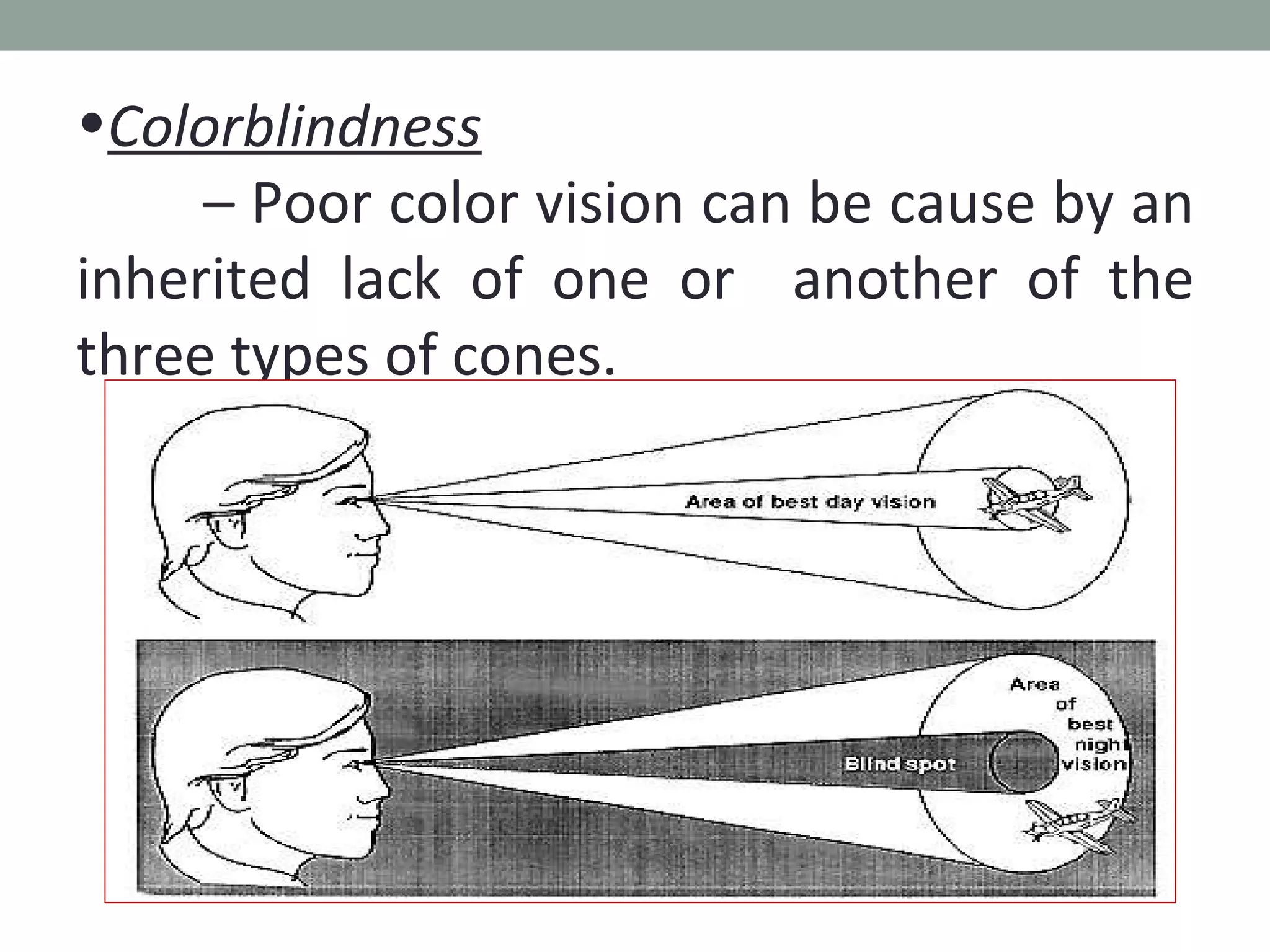
Colorblindness   –  Poor color vision can be cause by an inherited lack of one or  another of the three types of cones.
Color Blindness
2. HEARING It is the most vital channel of interaction with the environment. The stimuli fro hearing are soundwaves. Three dimensions describing the sound stimulus are : Intensity  Frequency Complexity
 
Hearing: Sensing Sound Waves A udition  - detection of  sound waves Frequency of cycles Compression  – increased density of waves Rarefaction  – reduced density of waves Determines  pitch  of sound Intensity measured in  decibel (db)  units Prolonged exposure to over 85 db causes hearing loss Timbre  – quality of sound Sensation and Perception
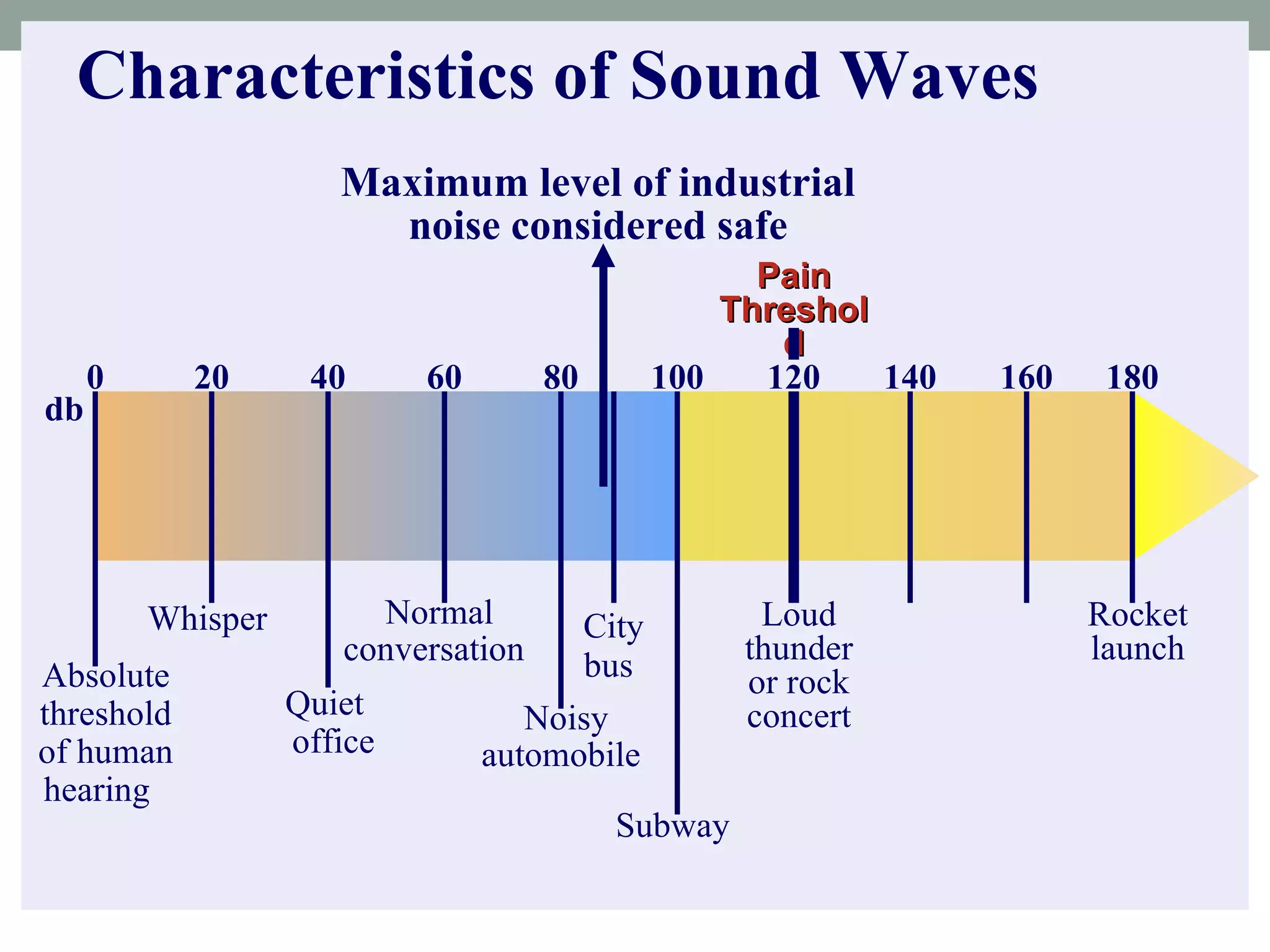
Maximum level of industrial  noise considered safe Characteristics of Sound Waves 20 40 60 80 100 160 0 120 180 140 Loud thunder or rock concert Pain Threshold City bus   Normal conversation   Subway  db  Noisy automobile   Absolute threshold of human hearing  Quiet  office Whisper  Rocket launch
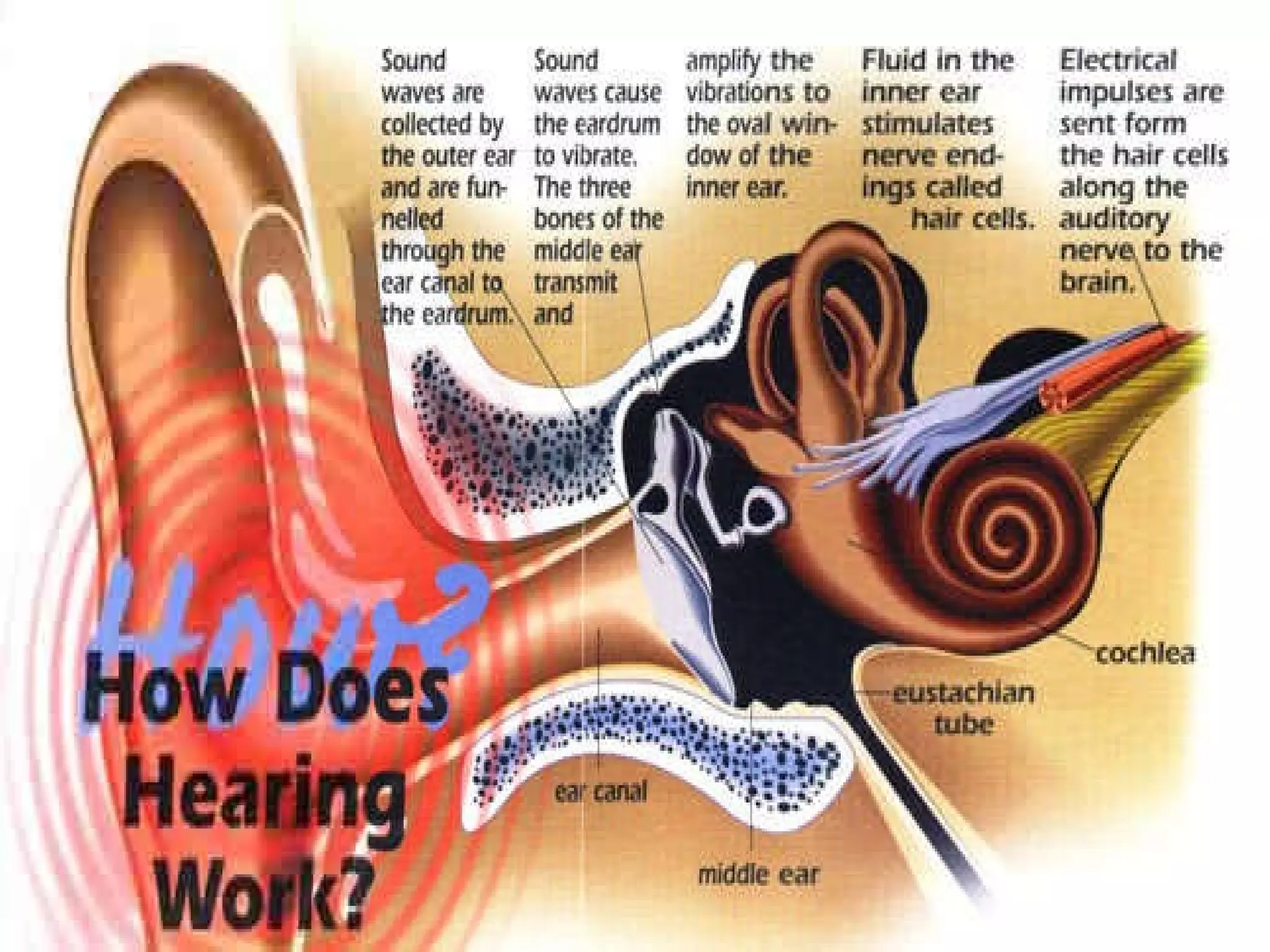
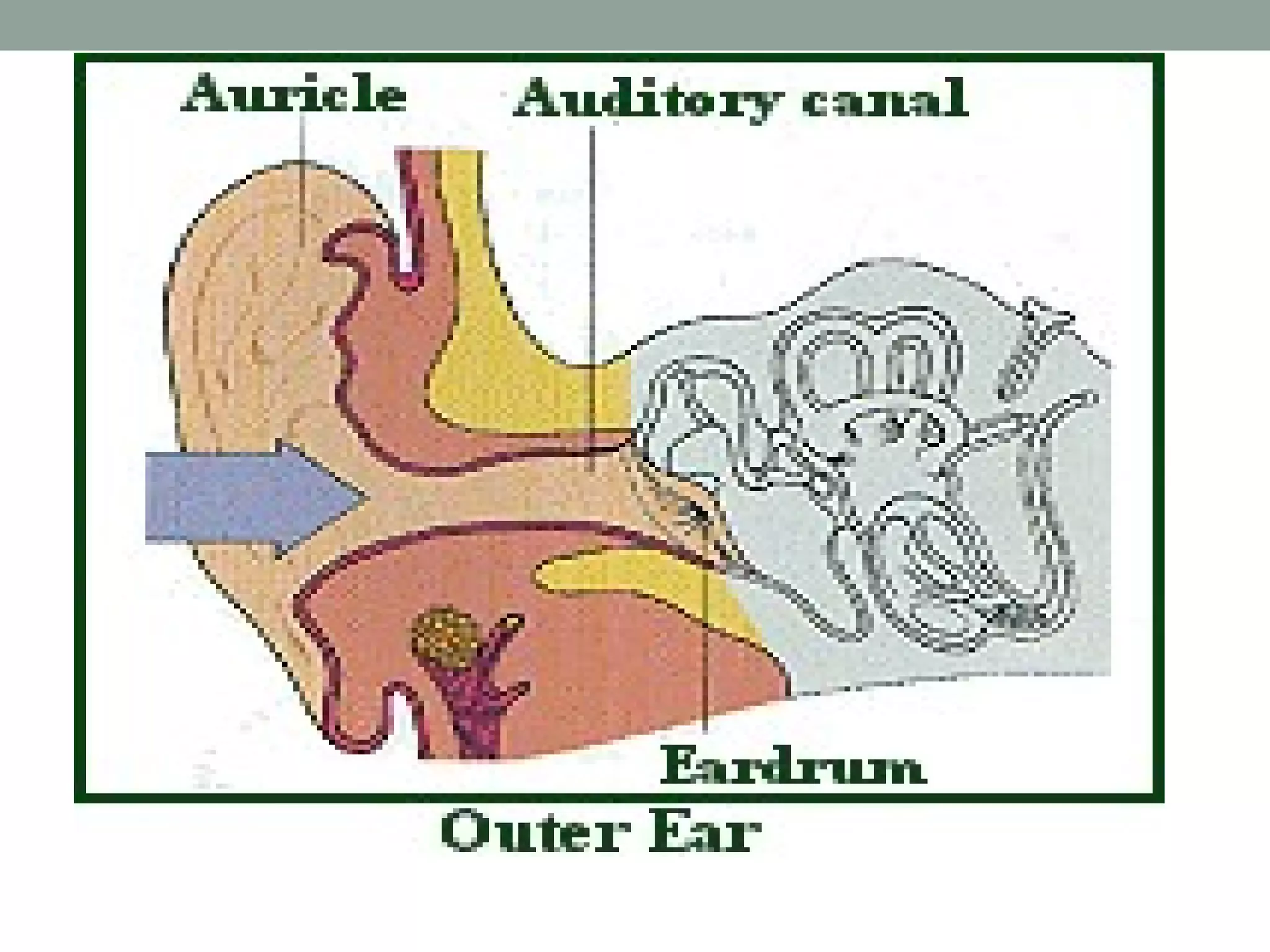
Structure of the ear. The ear is divided into three parts: The  outer ear - it is the visible part of the ear, composed of the pinna, the auditory canal, and the tympanic membrane commonly called eardrum.
 
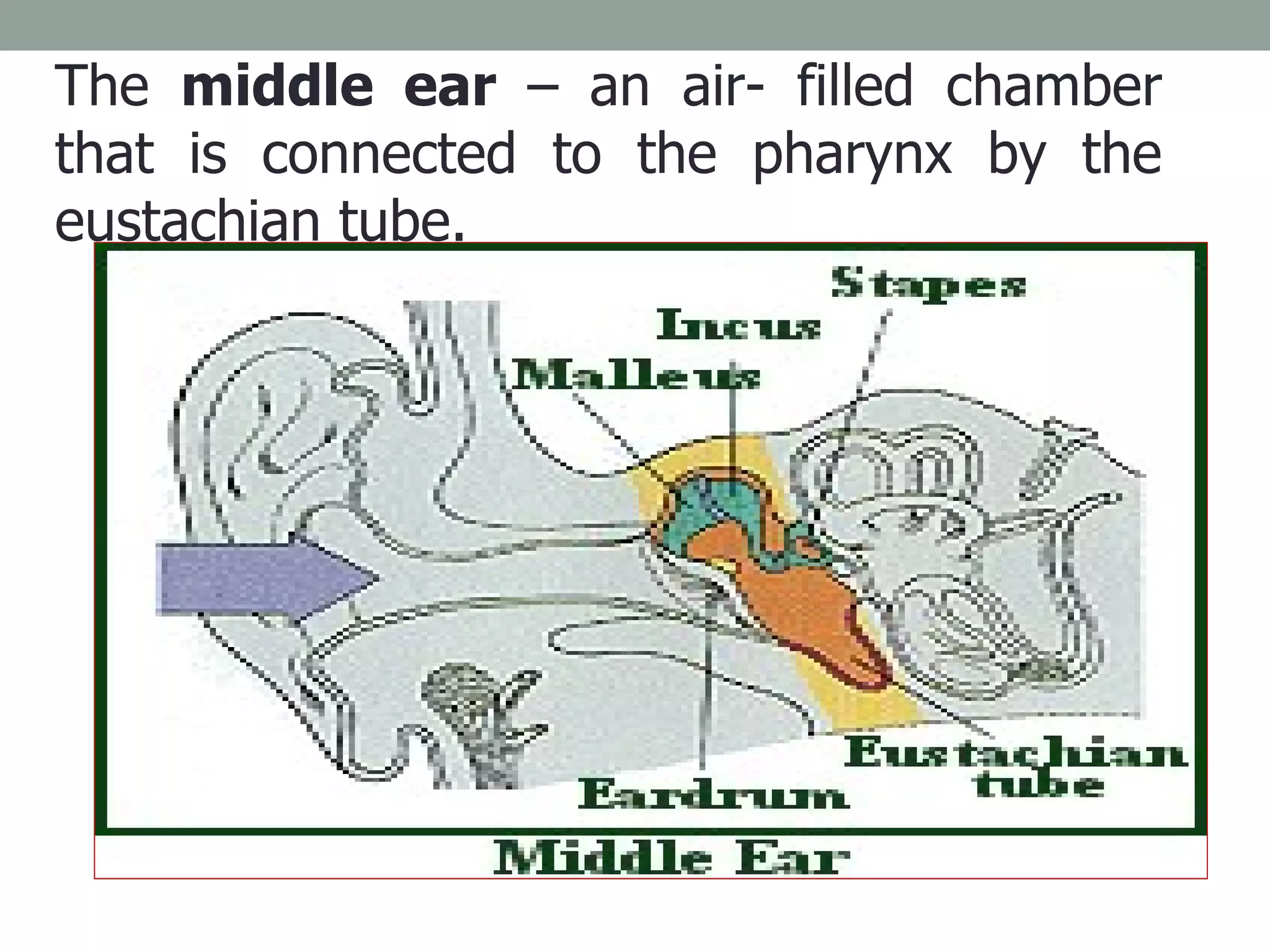
The  middle ear  – an air- filled chamber that is connected to the pharynx by the eustachian tube.
This connection of the middle ear to the pharynx serves to equalize the pressure on the two sides of the eardrum.  The middle ear structure is composed of tree small bones or ossicles: the mallleus (hammer), the incus (anvil), and the stapes (stirrup).  These bones are hanging into the system of levers, so that the movement of the eardrum is transmitted to a membrane called the oval window.
The  inner ear  – can find a cochlea which is a fluid- filled bony structure shaped like a snail shell.  It is the organ of hearing.  There are three canals in the cochlea–the cochlear canal, the tympanic canal, and the vestibular canal.
 
The Ear: How Does It Work? Outer ear Pinna  – external part of ear that collects sound External auditory canal  – connects outer and middle ear Middle ear Cardum – tympanic membrane; 1st structure Eardrum  - outermost structure of middle ear Passes vibration to interconnected bones ( hammer ,  anvil , and  stirrup ) Sensation and Perception
The Ear: How Does It Work? Inner ear Oval window  – eardrumlike structure at end of  cochlea Round window  – eardrumlike structure at other end of  cochlea Basilar membrane  – forms floor for ear’s sensory receptors Organ of Corti  – contains hairlike receptor cells  Sensation and Perception
Hearing Defects Conduction Deafness  – deafness due to inability to transmit vibrations through the external and middle ear. Nerve Deafness  – this kind of deafness results from damage to the nerves themselves or to the delicate parts of the cochlea.
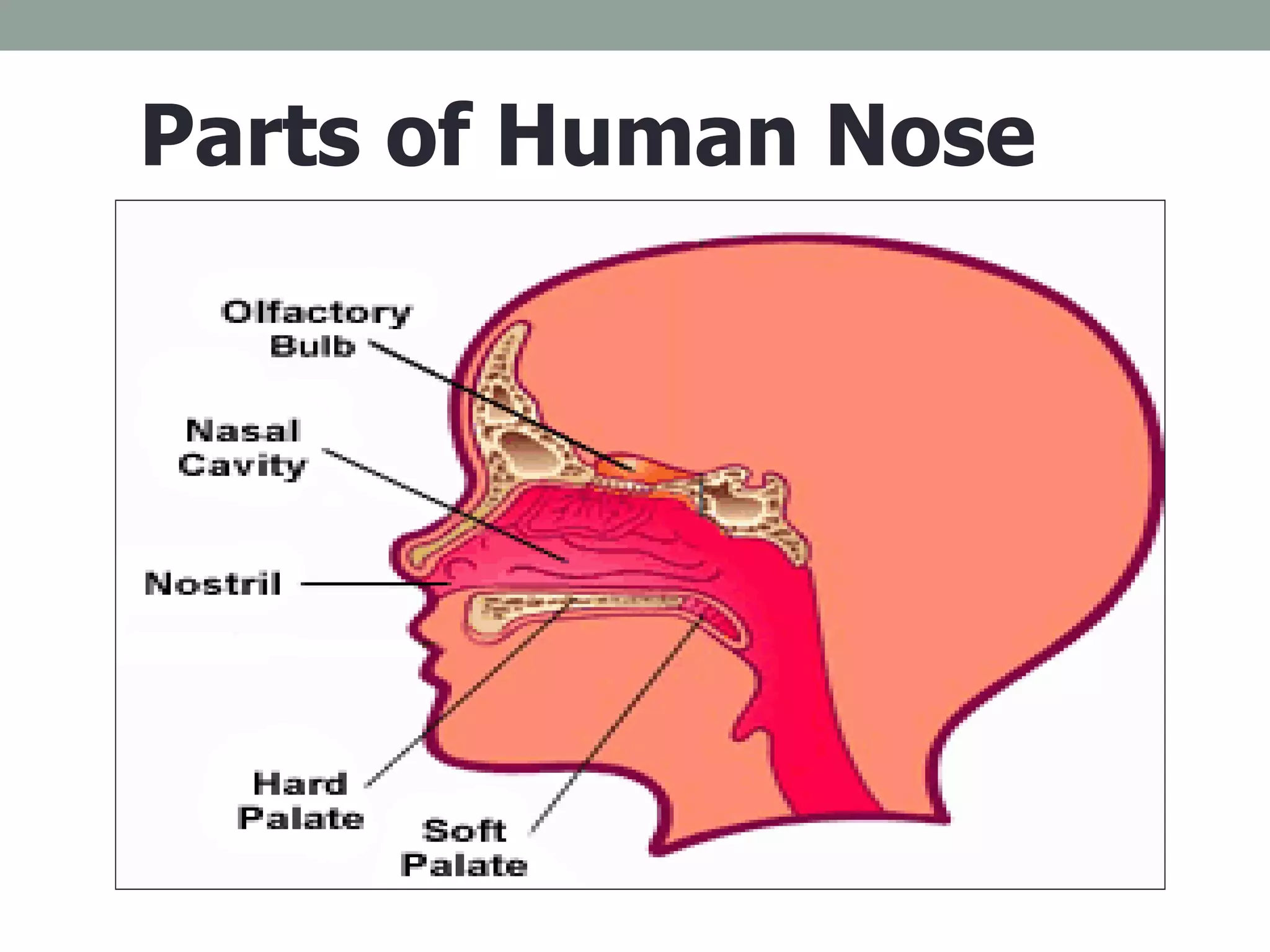
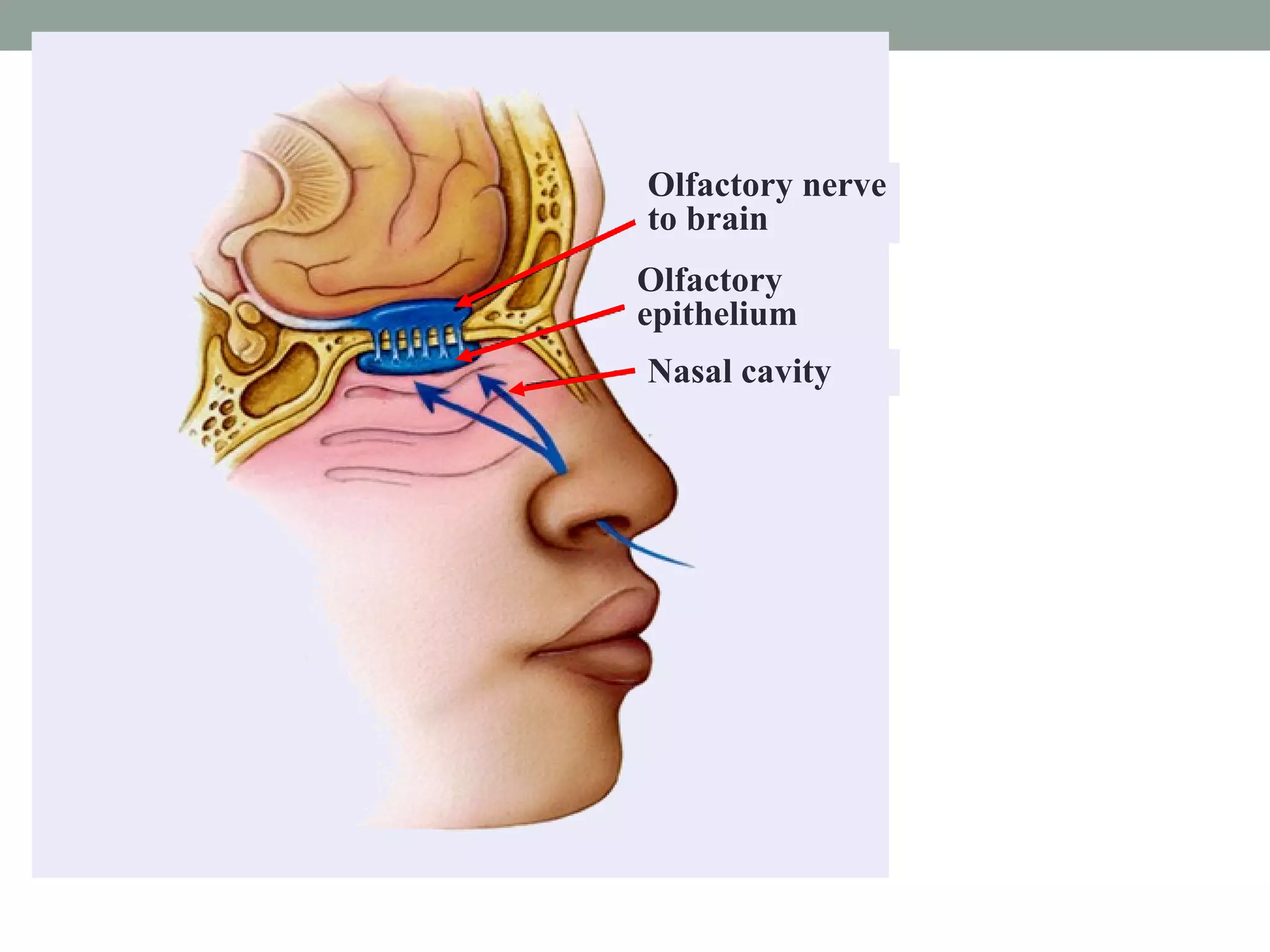
3. SMELL - The receptors for smell are found at the olfactory epithelium located at the very top of the nasal passages.  -They are sensitive only to gases and to volatile substances that have been dissolved in the air.
Parts of Human Nose
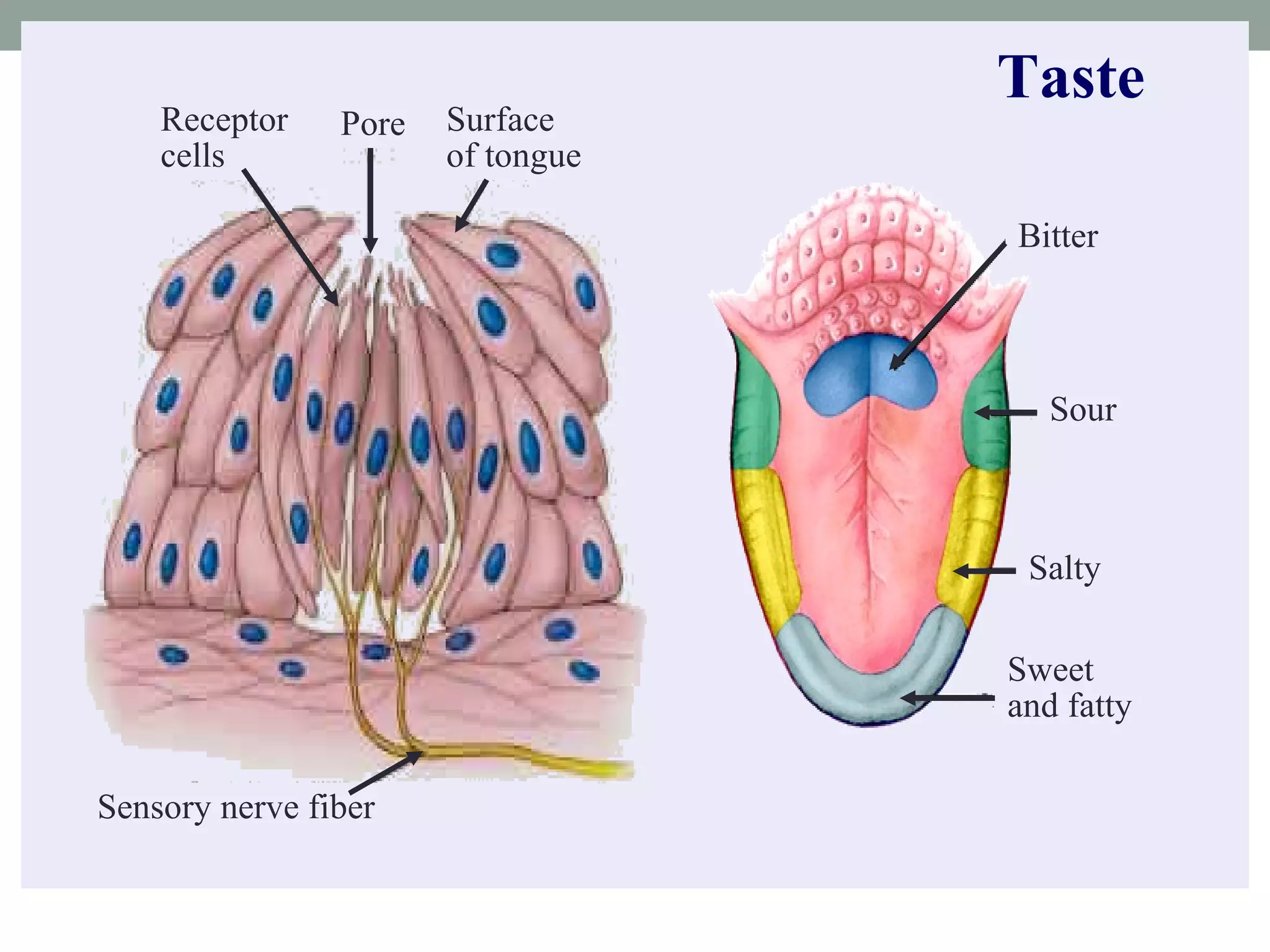
4. TASTE Much of the sensation depends on other factors-on warmth, coldness, the mild irritation caused by certain spices, and above all, on smell.  When our nostrils are stuffed because  of  colds. Food seems almost tasteless. The tastebuds are the receptors for taste.  They respond to four qualities of taste: sweet, sour, salty, and bitter.
Chemical Senses:  The Flavors and Aromas of Life Senses of  gustation  (taste) and  olfaction  (smell) differ from all other senses Taste cells  and  papillae on tongue Taste buds detect Sensation and Perception Sweetness   -  mostly sugars  Sourness   -  mostly acids Saltiness   -  mostly salts Bitterness   -  toxins, chemicals Fattiness   -  fats
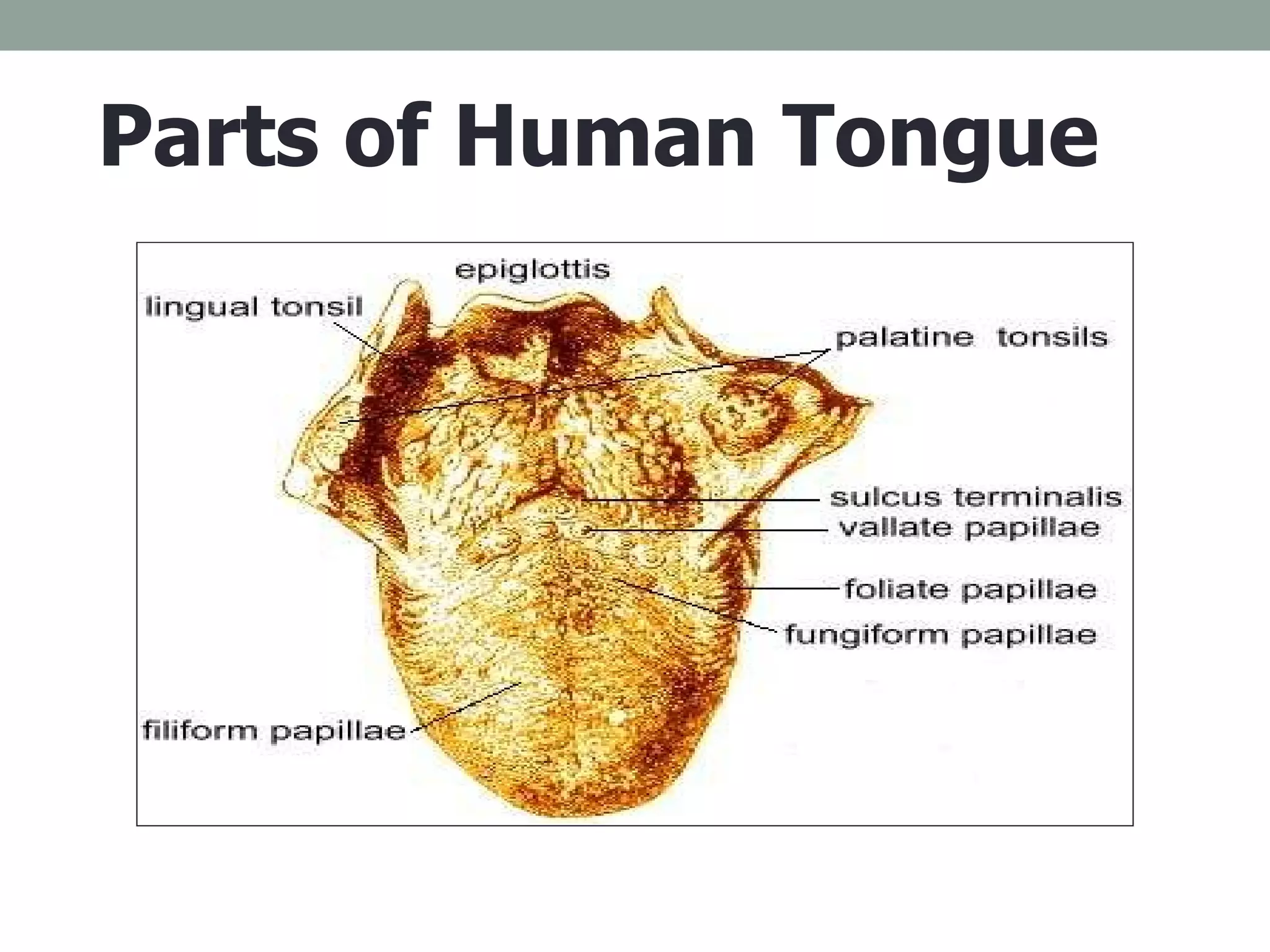
Parts of Human Tongue
Taste Surface of tongue Receptor cells Pore Bitter  Sour Salty Sweet  and fatty Sensory nerve fiber
Chemical Senses:  The Flavors and Aromas of Life Olfaction Olfactory epithelium  – top of nasal cavity  Pheromone detection  of sweat and urine Vomeronasal organ Influence human female reproductive cycles Inhalation of male sex hormone and mood changes Males may respond to sex hormones  Sensation and Perception
Olfactory nerve to brain Olfactory epithelium Nasal cavity
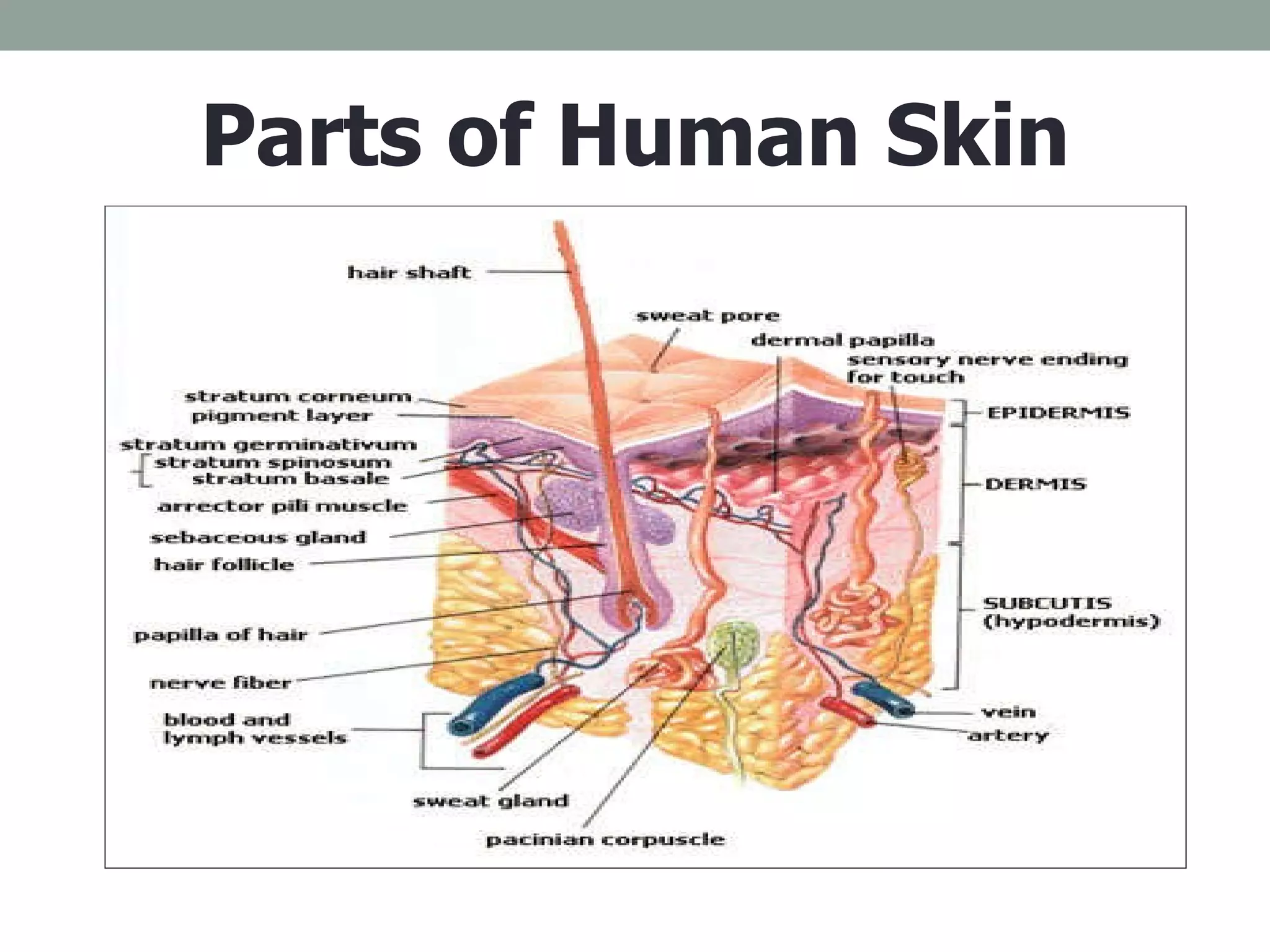
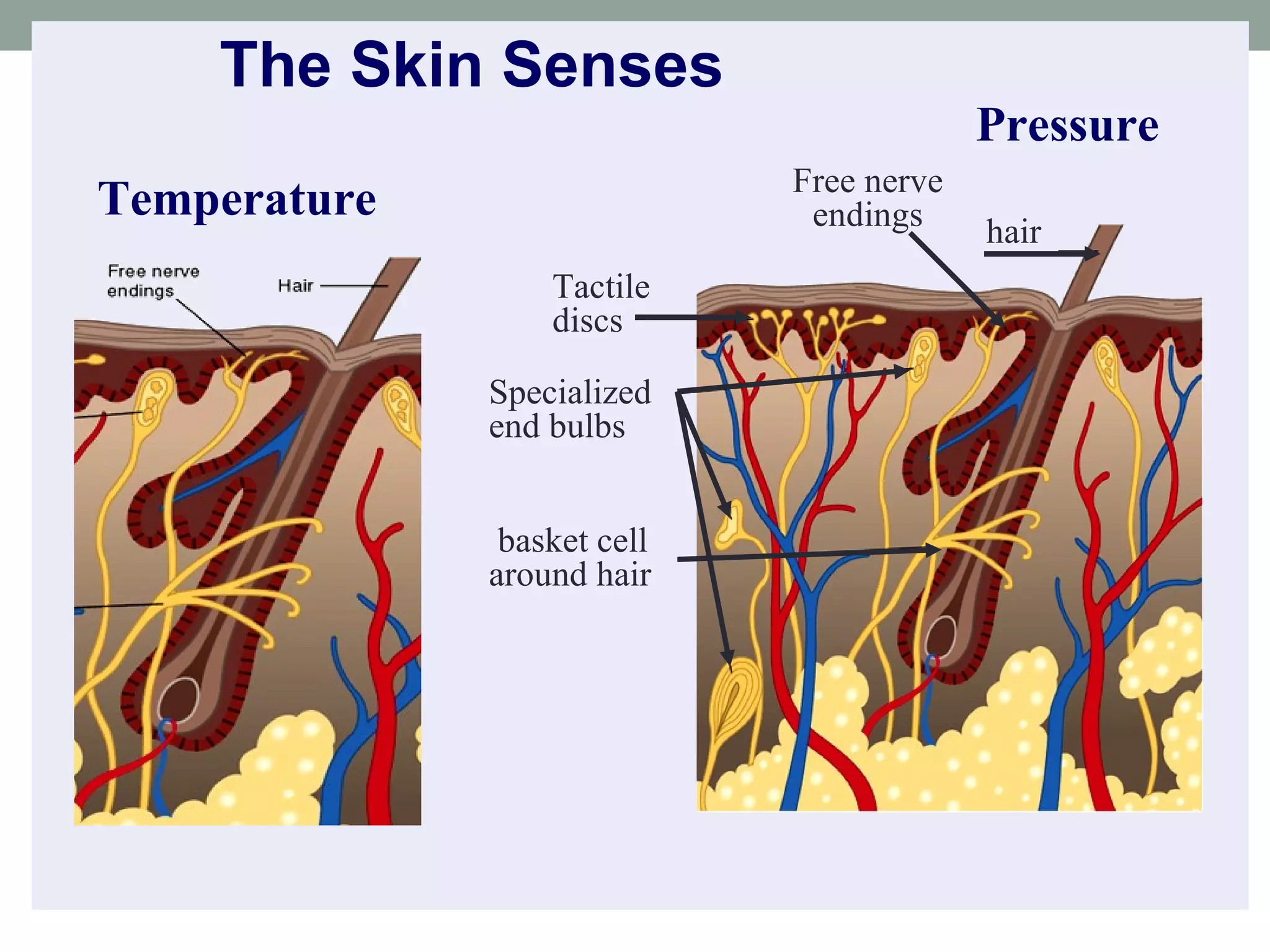
5. THE SKIN SENSES The skin has four separate senses: pain, pressure, cold, and warmth.  The receptors fro the skin senses are nerve endings which come in four general forms: free nerve endings, globular bulbs, egg- shaped corpuscles, and “baskets” surrounding root hairs.
Parts of Human Skin
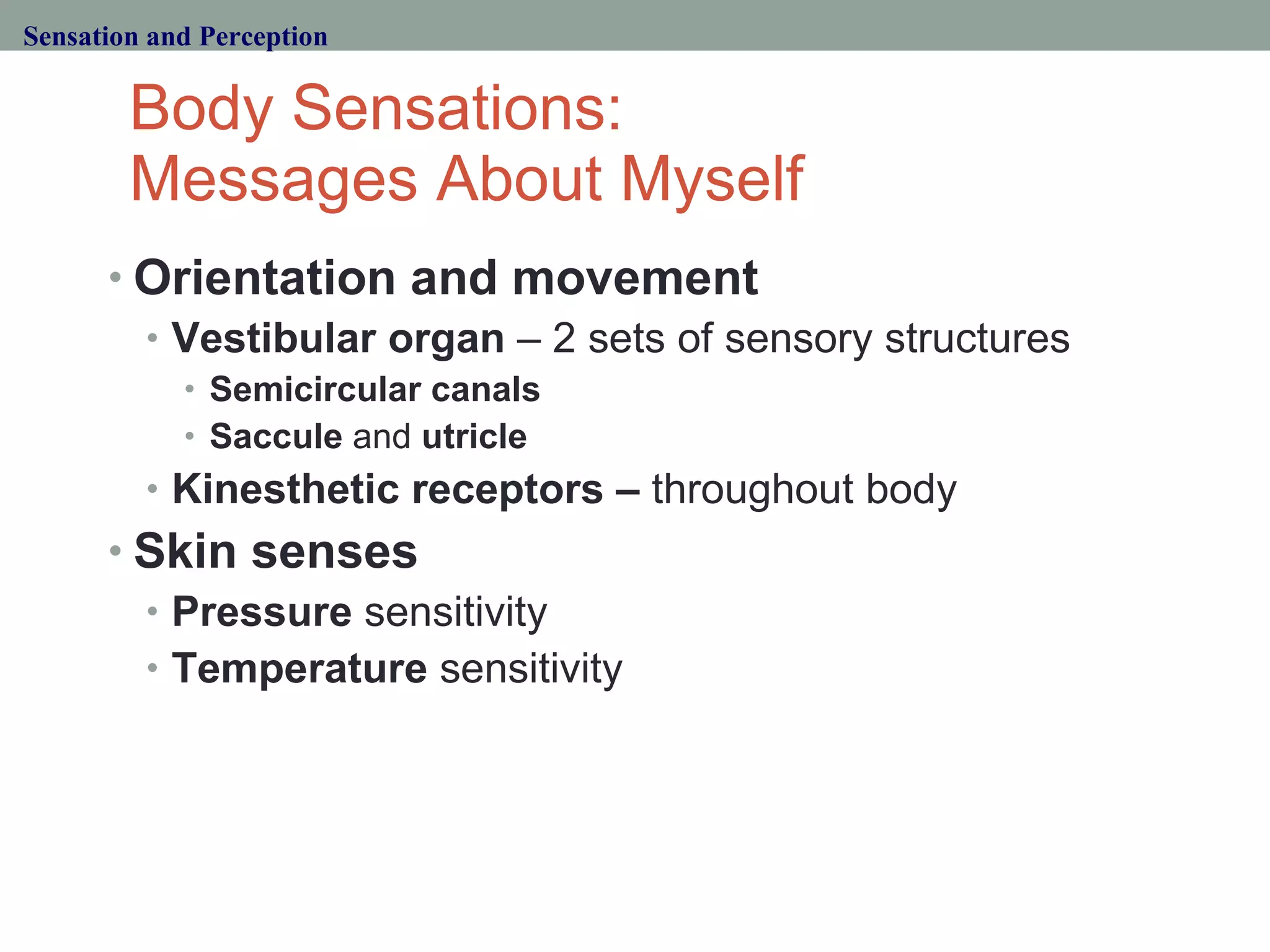
Body Sensations:  Messages About Myself Orientation and movement Vestibular organ  – 2 sets of sensory structures Semicircular canals Saccule  and  utricle Kinesthetic receptors –  throughout body Skin senses Pressure  sensitivity Temperature  sensitivity Sensation and Perception
The Skin Senses   Pressure Free nerve endings Tactile discs hair Specialized end bulbs basket cell around hair Temperature
Pain Nerve endings in body act as  nocioceptors Neural messages transmitted along two distinct pathways Rapid – detects  first  pain sensation Slow – detects  second  long-lasting pain Endorphins  and  endogenous morphine Sensation and Perception
Pain Nerve endings in body act as  nocioceptors Pain gates regulate pain signals in 3 areas Brain stem  –  gate-control theory of pain Spinal cord   Peripheral regulation of pain Phantom limbs Up tp 70% of amputees experience this Sensation and Perception
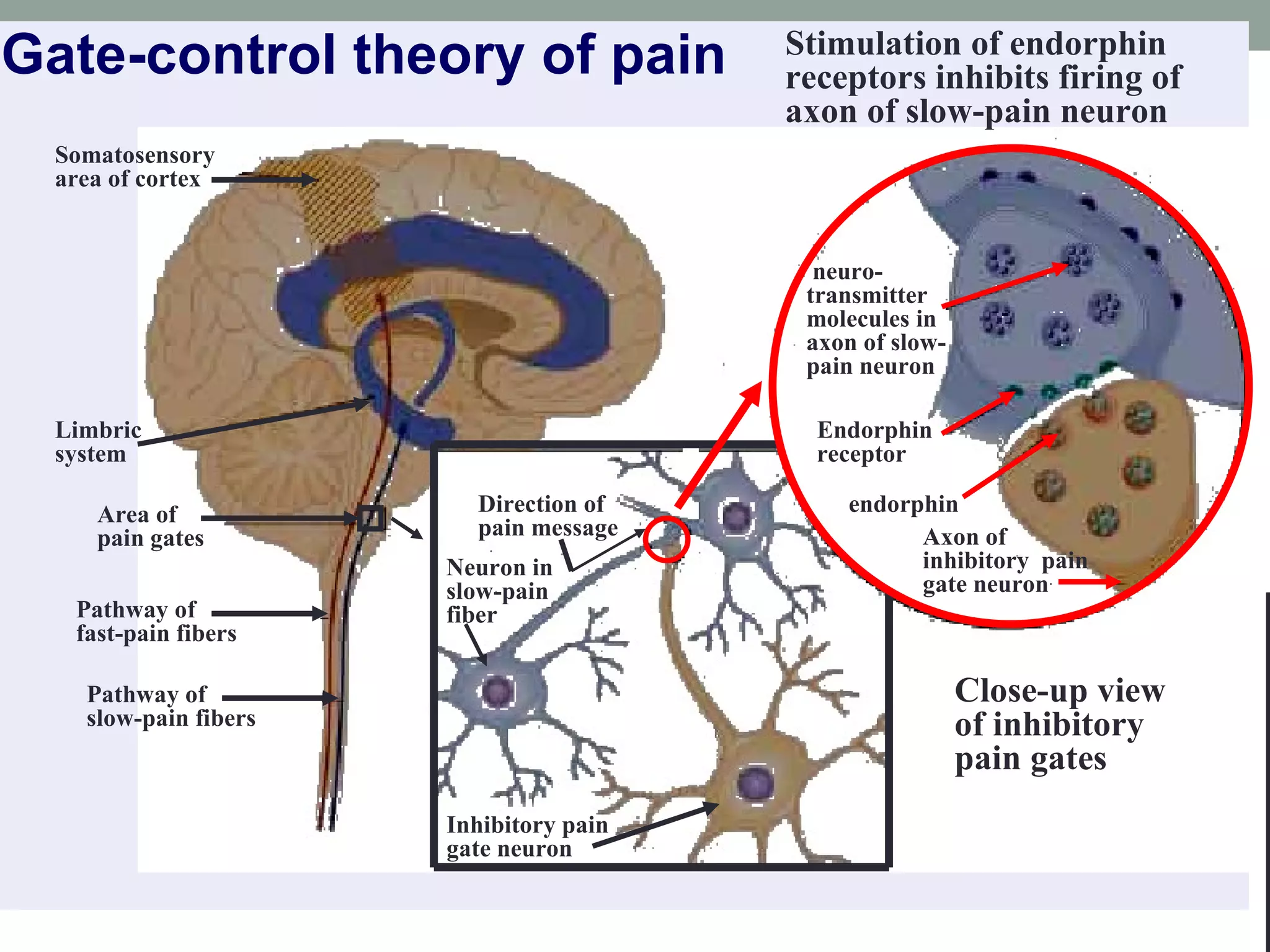
Gate-control theory of pain Direction of pain message neuro-transmitter molecules in axon of slow-pain neuron Endorphin receptor Axon of inhibitory  pain gate neuron endorphin Neuron in slow-pain fiber Inhibitory pain gate neuron Stimulation of endorphin receptors inhibits firing of axon of slow-pain neuron Close-up view of inhibitory pain gates Somatosensory area of cortex Limbric system Area of pain gates Pathway of fast-pain fibers Pathway of slow-pain fibers
KINESTHESIS This is the sense of bodily movements.  Its receptors are nerve endings found in muscles, tendons, and linings of joints. EQUILIBRIUM This is also called as the Static Sense.  Two kinds of receptors give information about movements of the head and permit a sense of balance of the body.
These are in the semicircular canals and the vestibular canal.  Both are located in the inner ear next to cochlea.  THE ORGANIC SENSE This give s the result of the sensitivity of the visceral and other internal organs oft he body.  Among the visceral organs are the stomach, intestines, sex structure, throat, hear and lungs.
PERCEPTION Chaplin defines perception as the process of knowing objects and objective events by means of senses.  This sensory input consists of nerve impulses.  They carry a sort of raw, undigested information about the environment.  The individual must convert it into a meaningful information.  Perception, then, is the organization of sensory input into meaningful experiences.
PERCEPTUAL CONSTANCY The perception of an object and all of its properties as constant and unchanging in spite of the continuously changing sensations of these properties outline the scope of object constancies.  Our perceptual organization remains relatively stable even though some aspects of the pattern within the optical array undergo great changes.
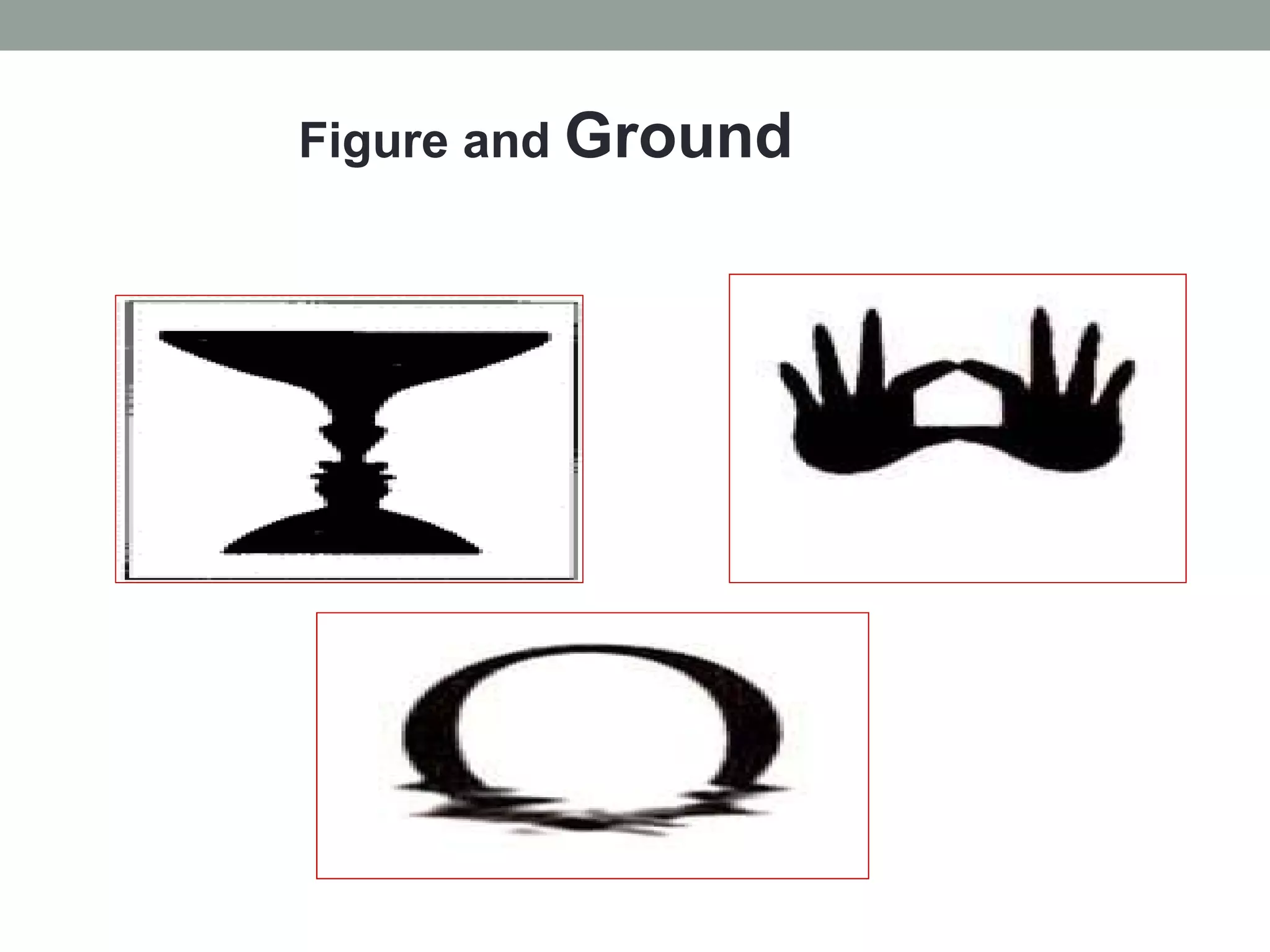
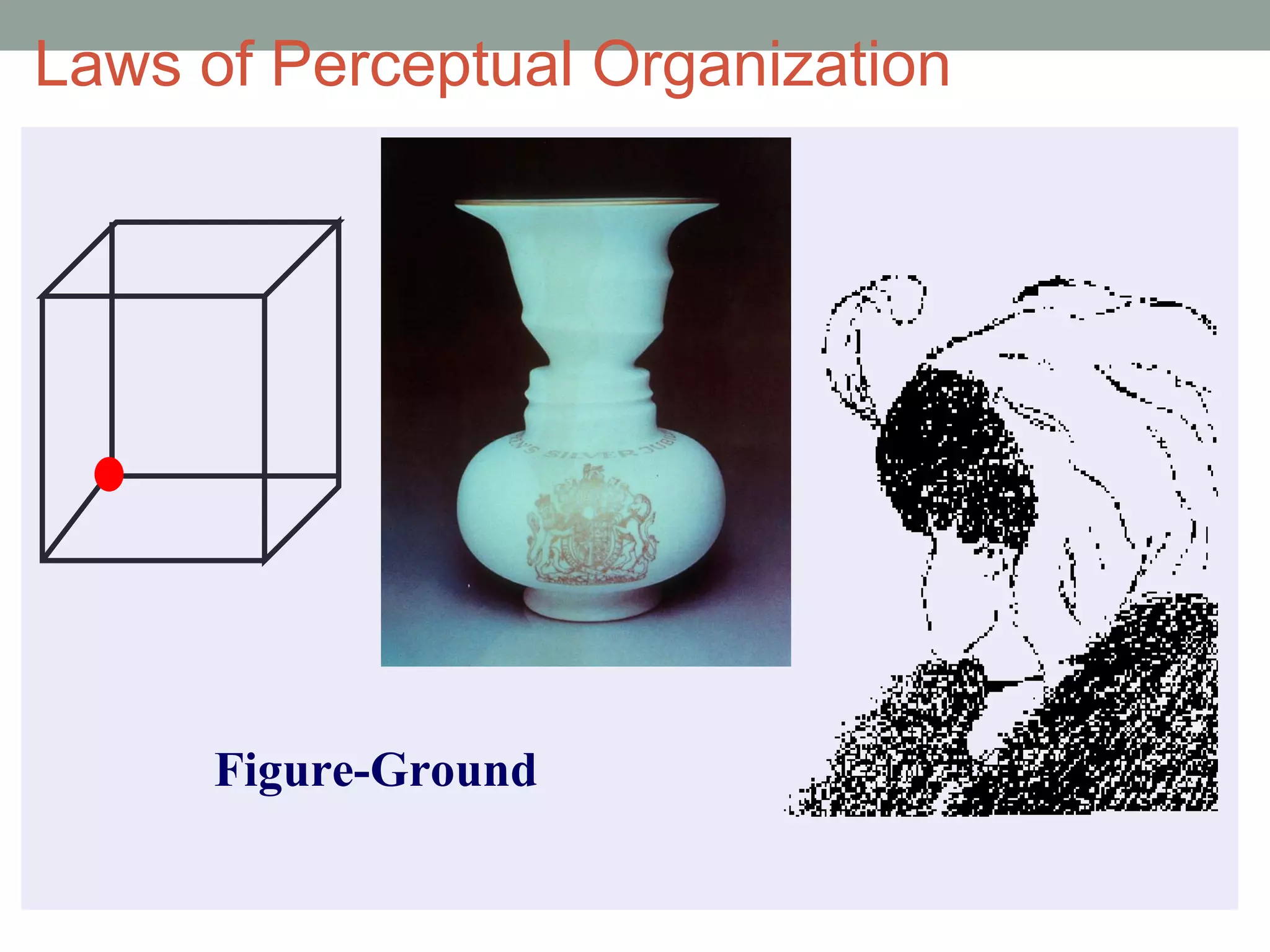
ORGANIZATION IN PERCEPTION Figure and ground  – when we perceive an object, usually one part tends to stand out while the rest seems to remain in the background.  The part which stands out is called the figure and the rest of the stimulus pattern is called the ground.
Figure and  Ground
Laws of Perceptual Organization Figure-Ground
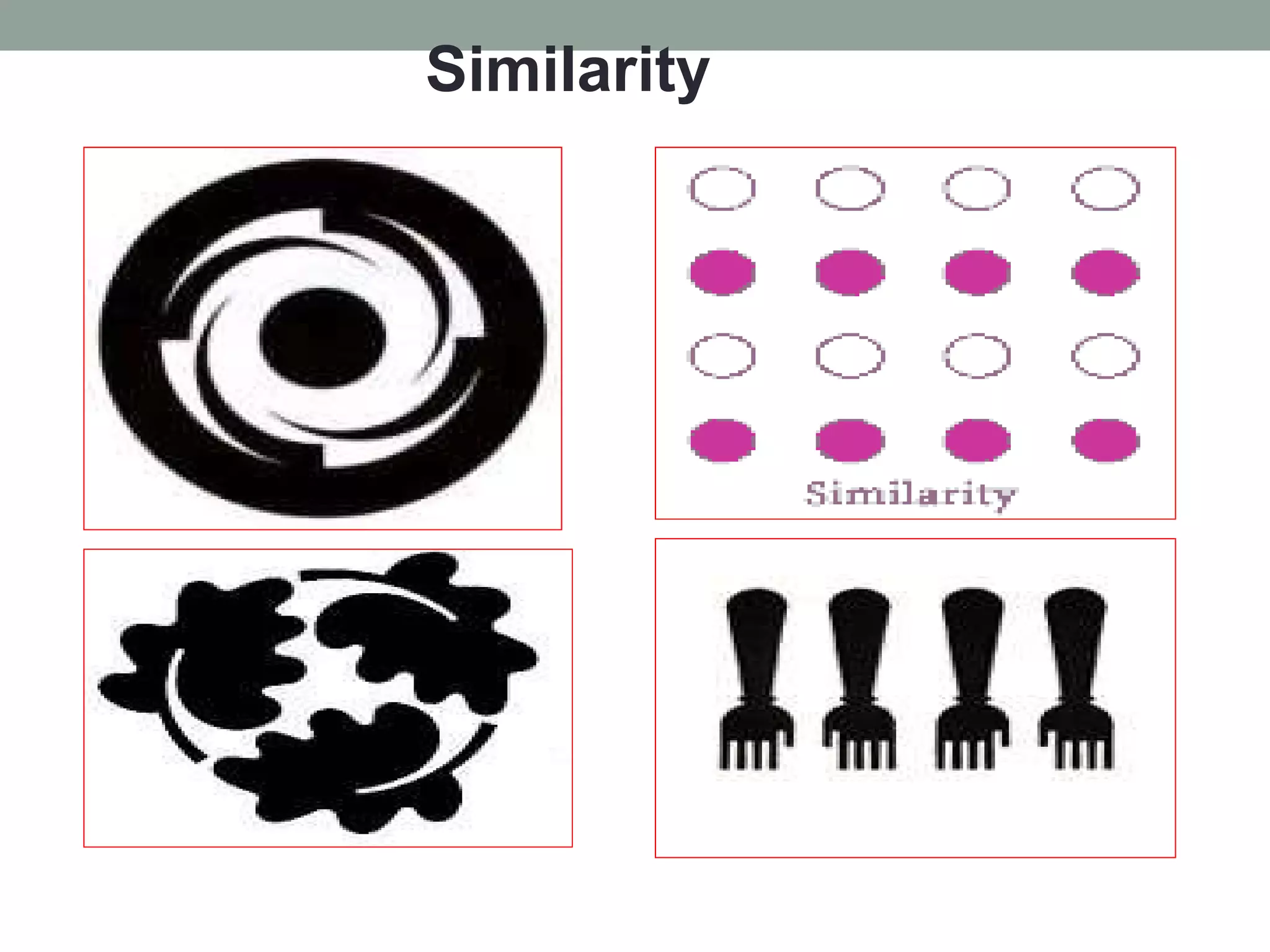
Grouping  – we are concerned more with the figure than with the ground. * The principles of similarity  – stimuli which are similar tend to be perceived as forming a group.
Similarity
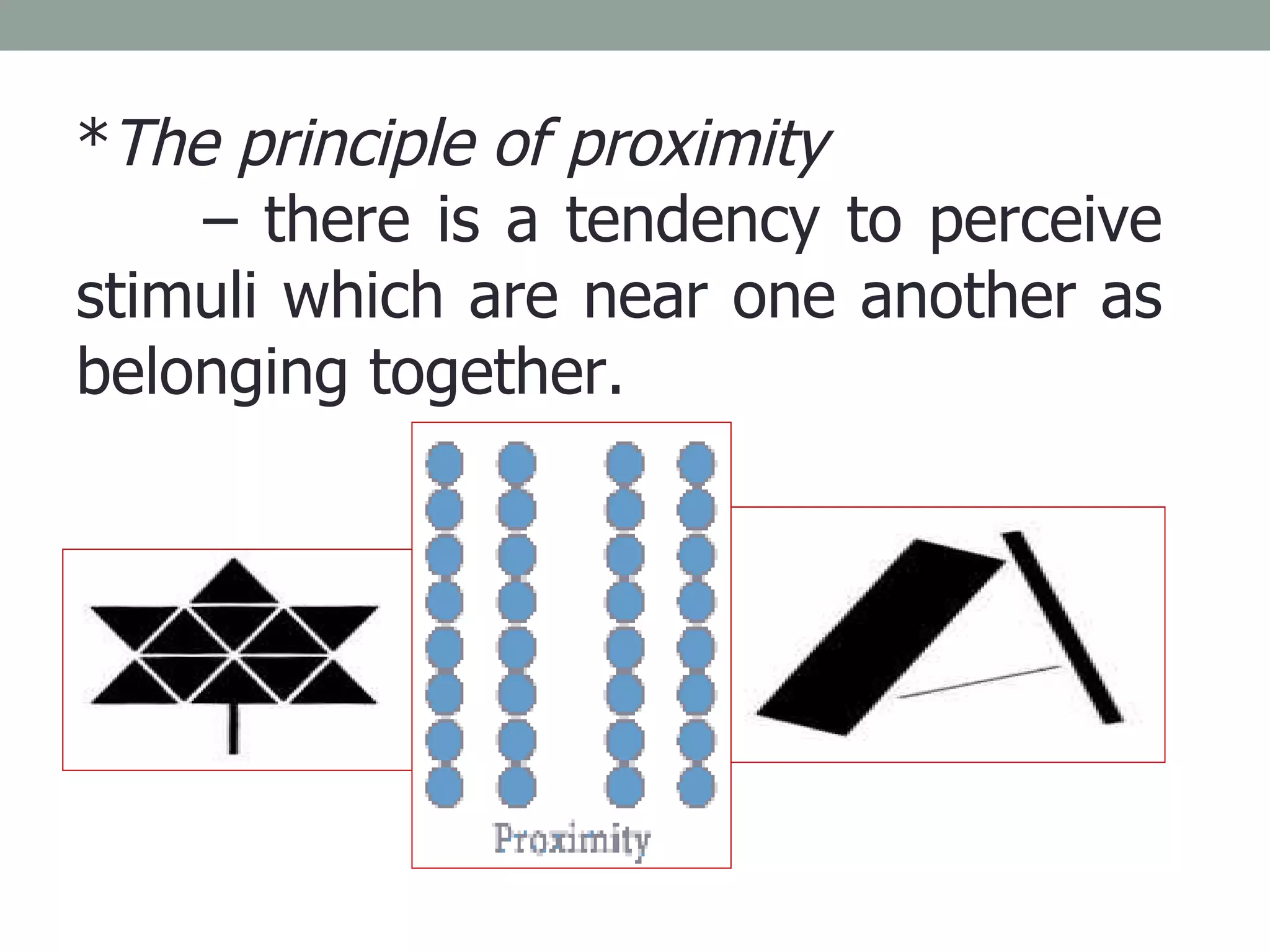
* The principle of proximity   –  there is a tendency to perceive stimuli which are near one another as belonging together.
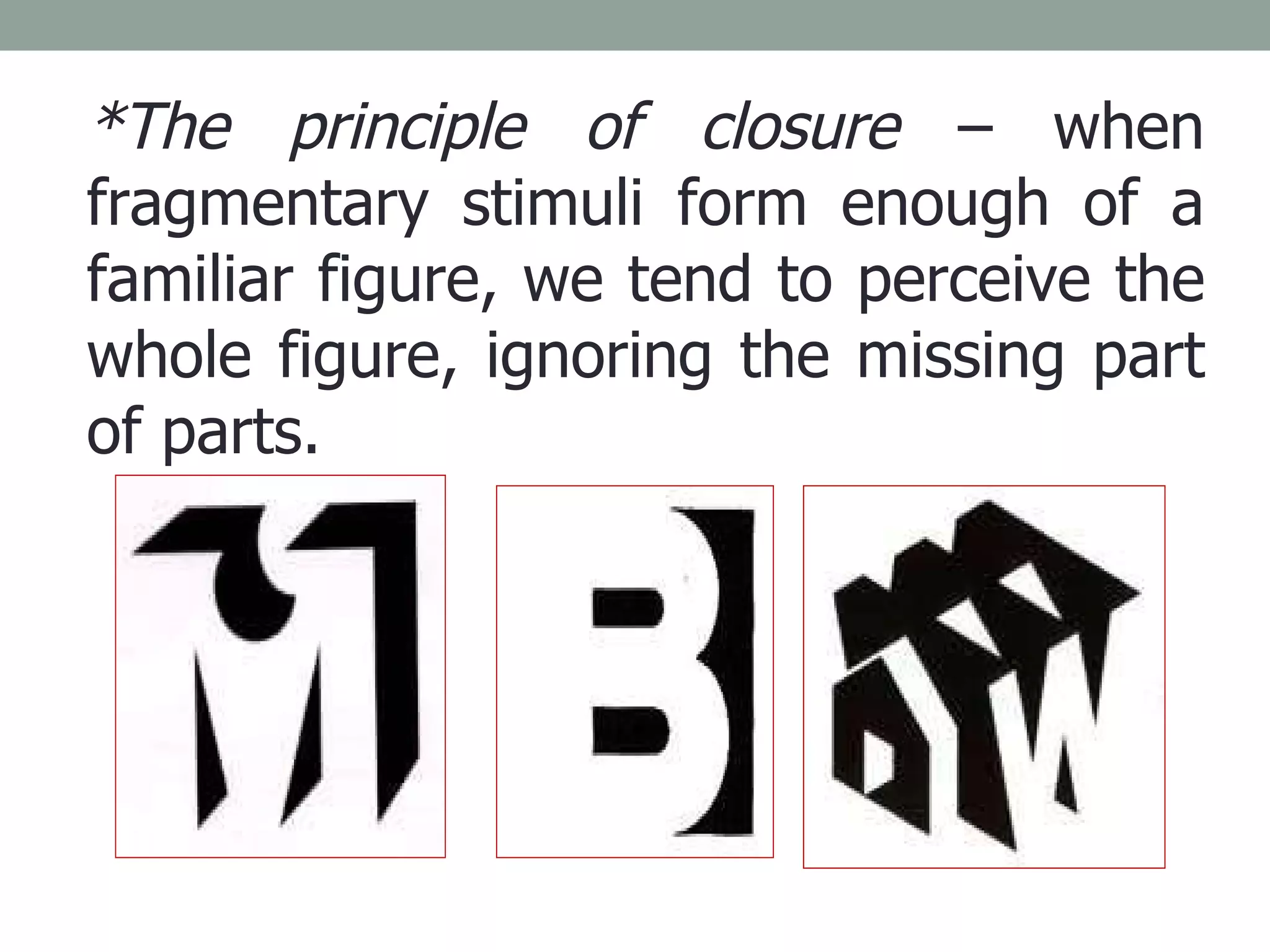
*The principle of closure  – when fragmentary stimuli form enough of a familiar figure, we tend to perceive the whole figure, ignoring the missing part of parts.
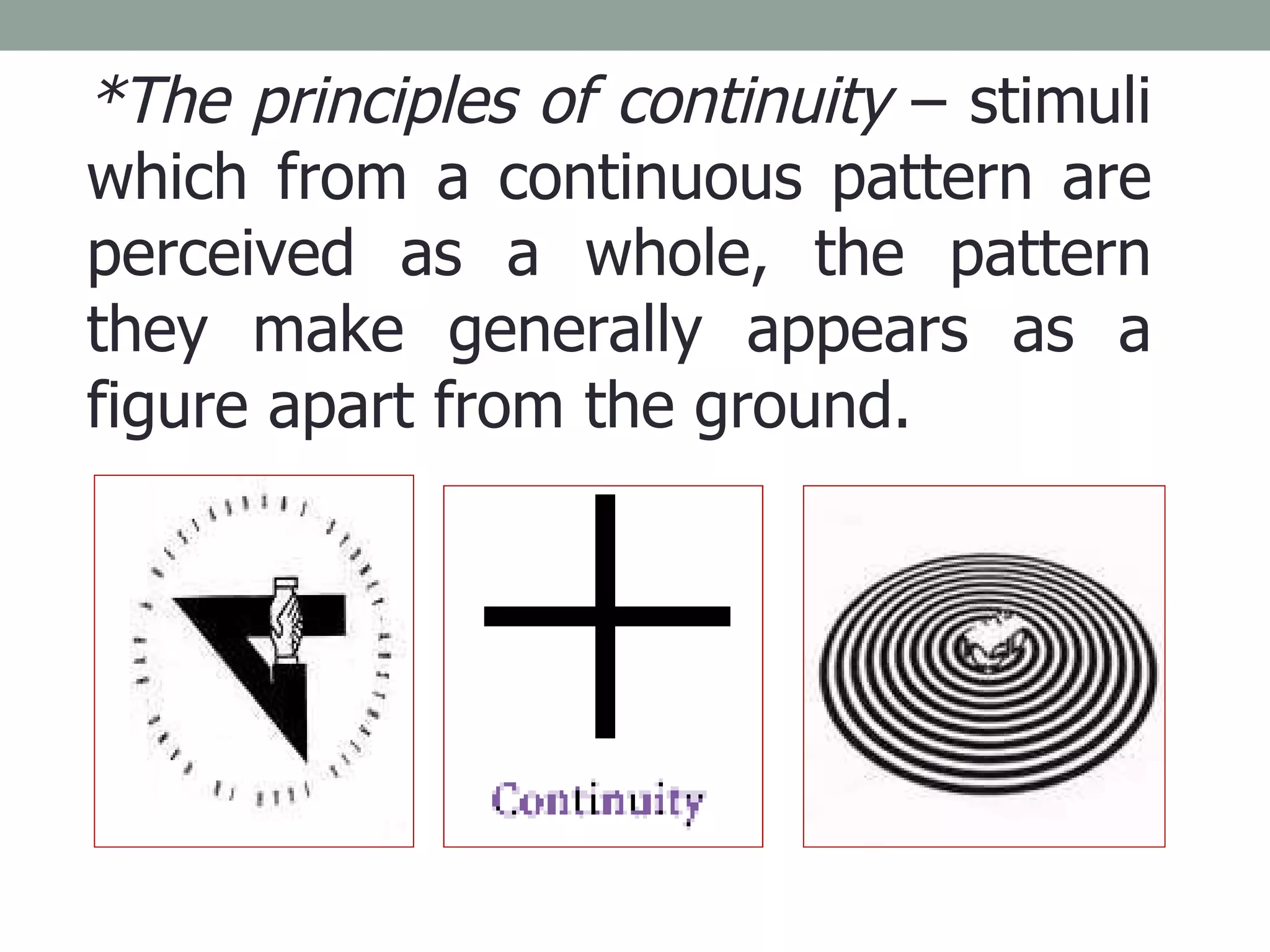
*The principles of continuity  – stimuli which from a continuous pattern are perceived as a whole, the pattern they make generally appears as a figure apart from the ground.
ATTENTION AND PERCEPTION   Perception is selective.  The direction of perception toward selected objects is called attention.  A number of stimulus conditions help determine the direction of attention
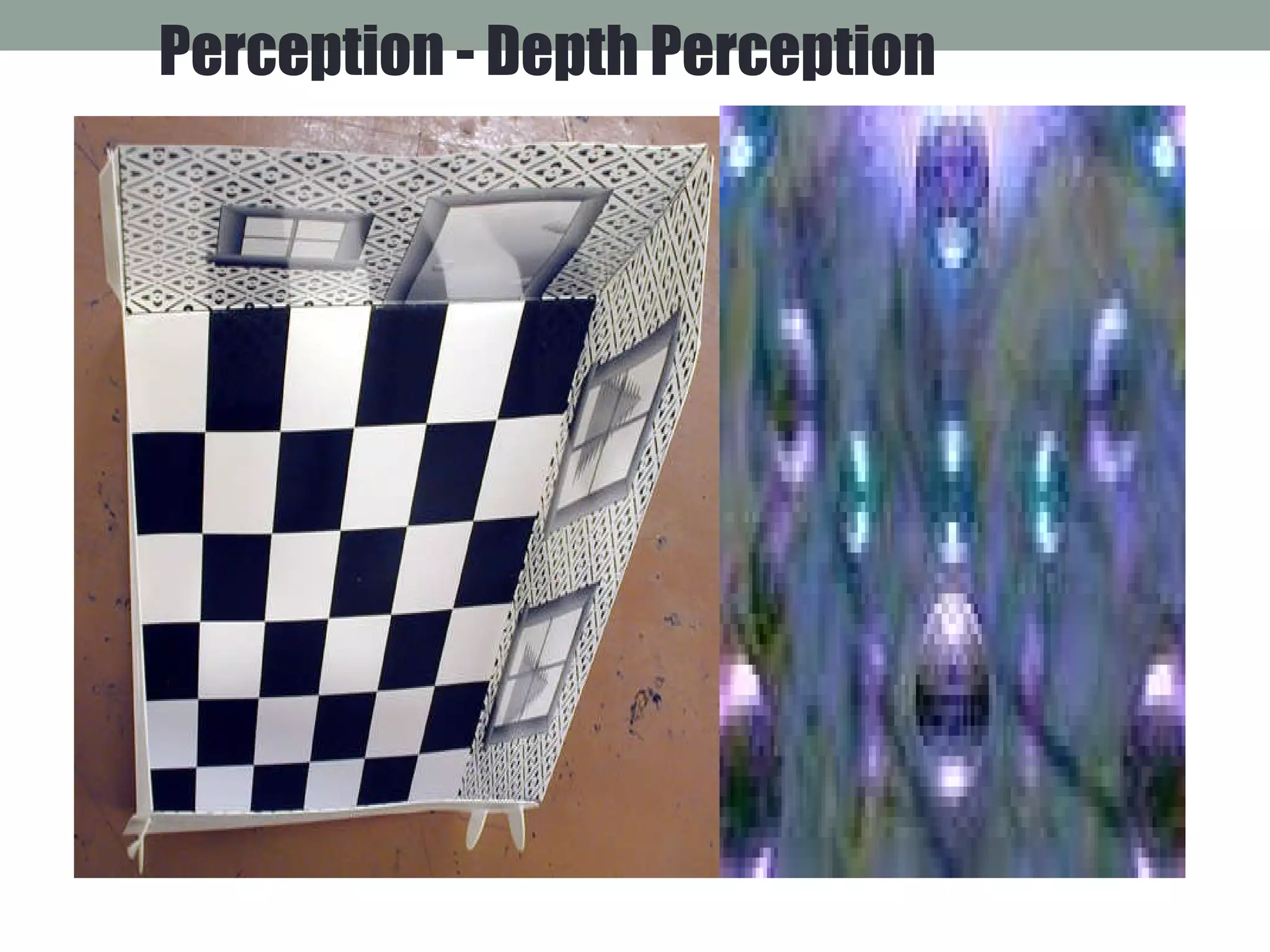
DEPTH PERCEPTION This is the ability to see three- dimensional space and accurately judge distances.  A study of perception would be incomplete without considering perceiving the third dimension- distance and depth.
Depth Perception Retina has two-dimensional surface Monocular cues  – perception of one eye Texture gradient Linear perspective Superposition Shadowing Sensation and Perception Speed of movement Aerial perspective Accommodation Vertical position
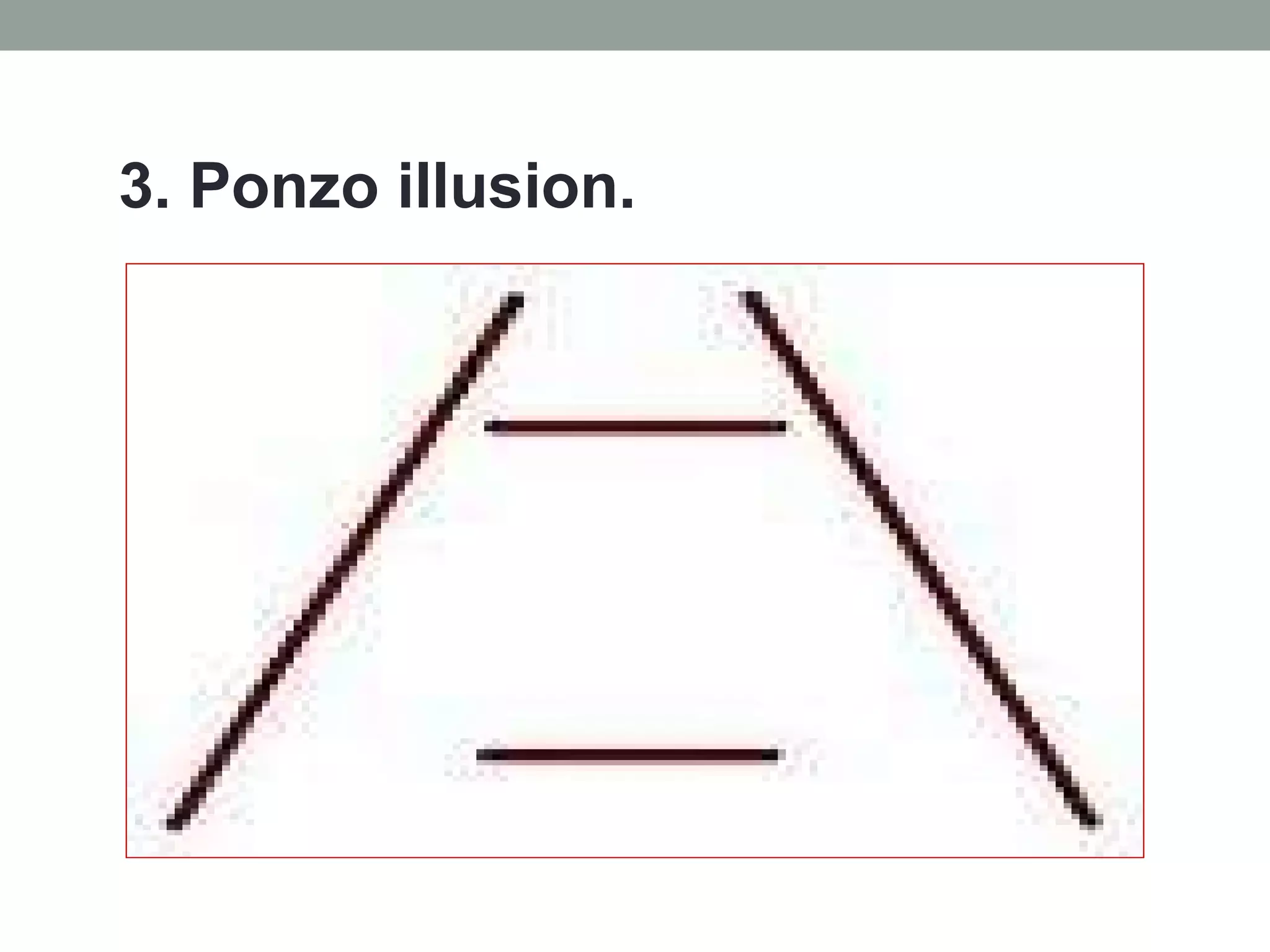
Depth Perception Binocular cues  – perception with two eyes Convergence Retinal disparity Visual Illusions Ponzo illusion Vertical-horizontal  illusion Color perception Sensation and Perception Zollner illusion Moon illusion Poggendorf illusion
Perception - Depth Perception
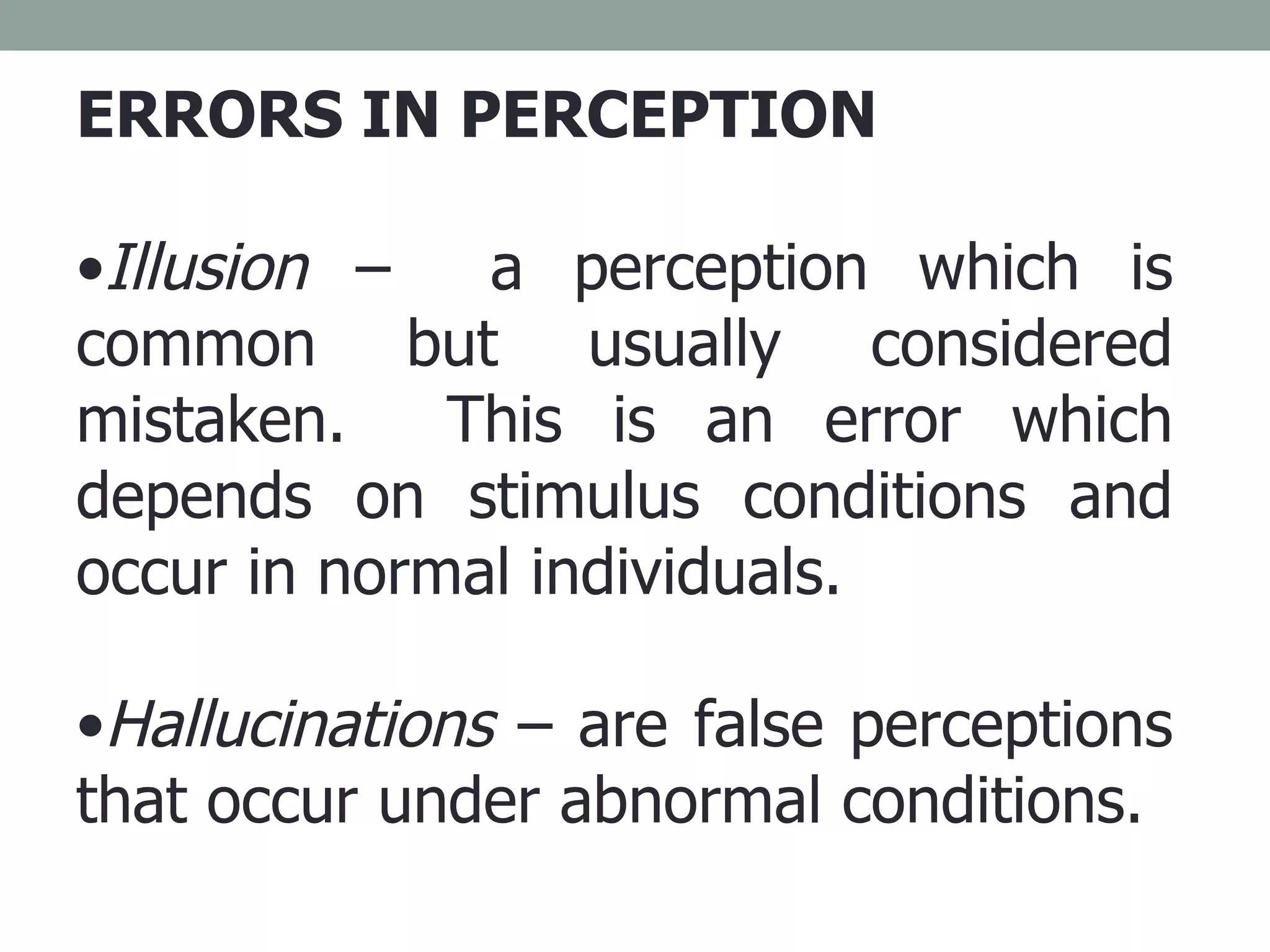
PERSONAL FACTORS IN PERCEPTION Motives Emotions Attitudes Frames of reference
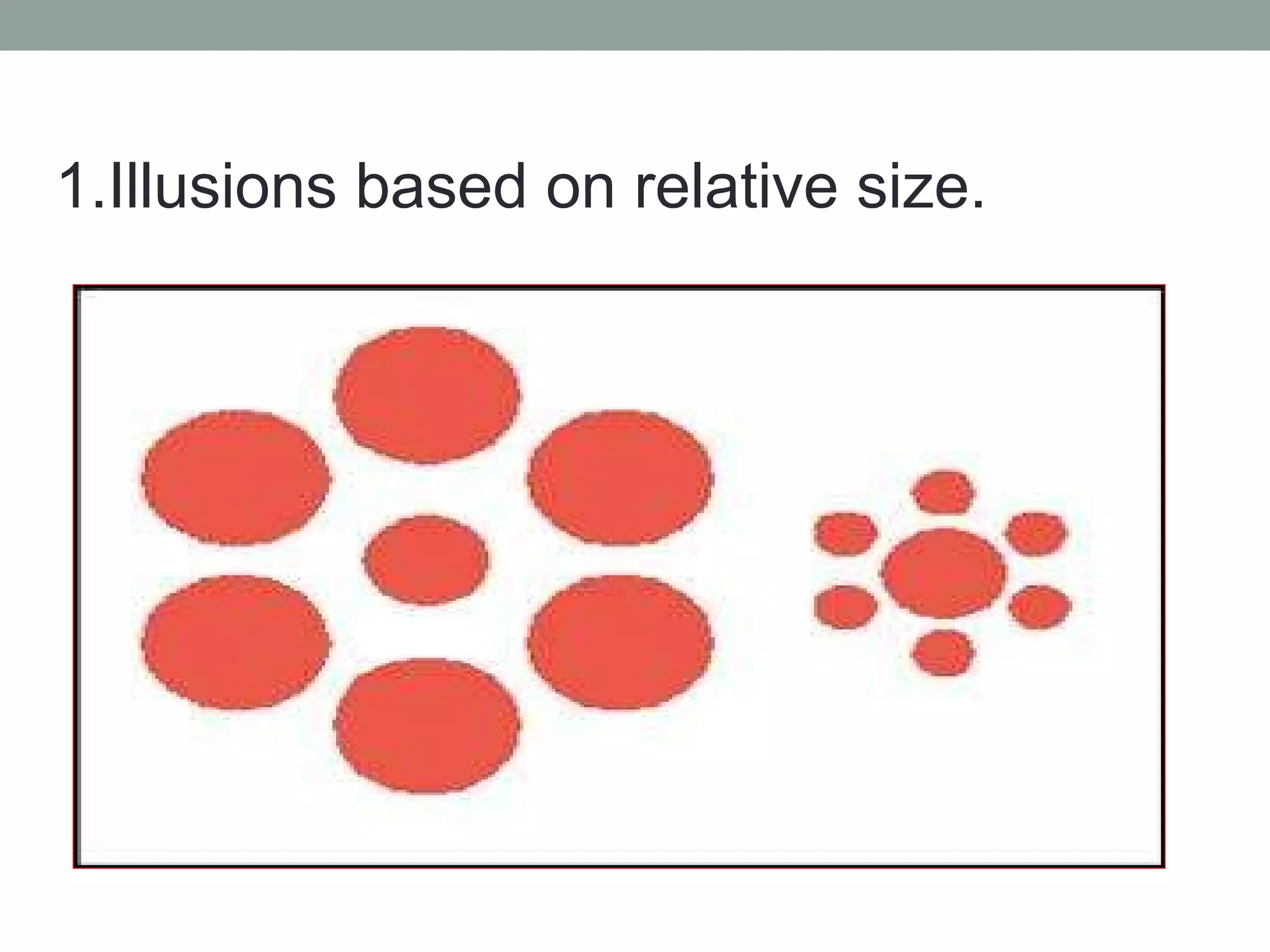
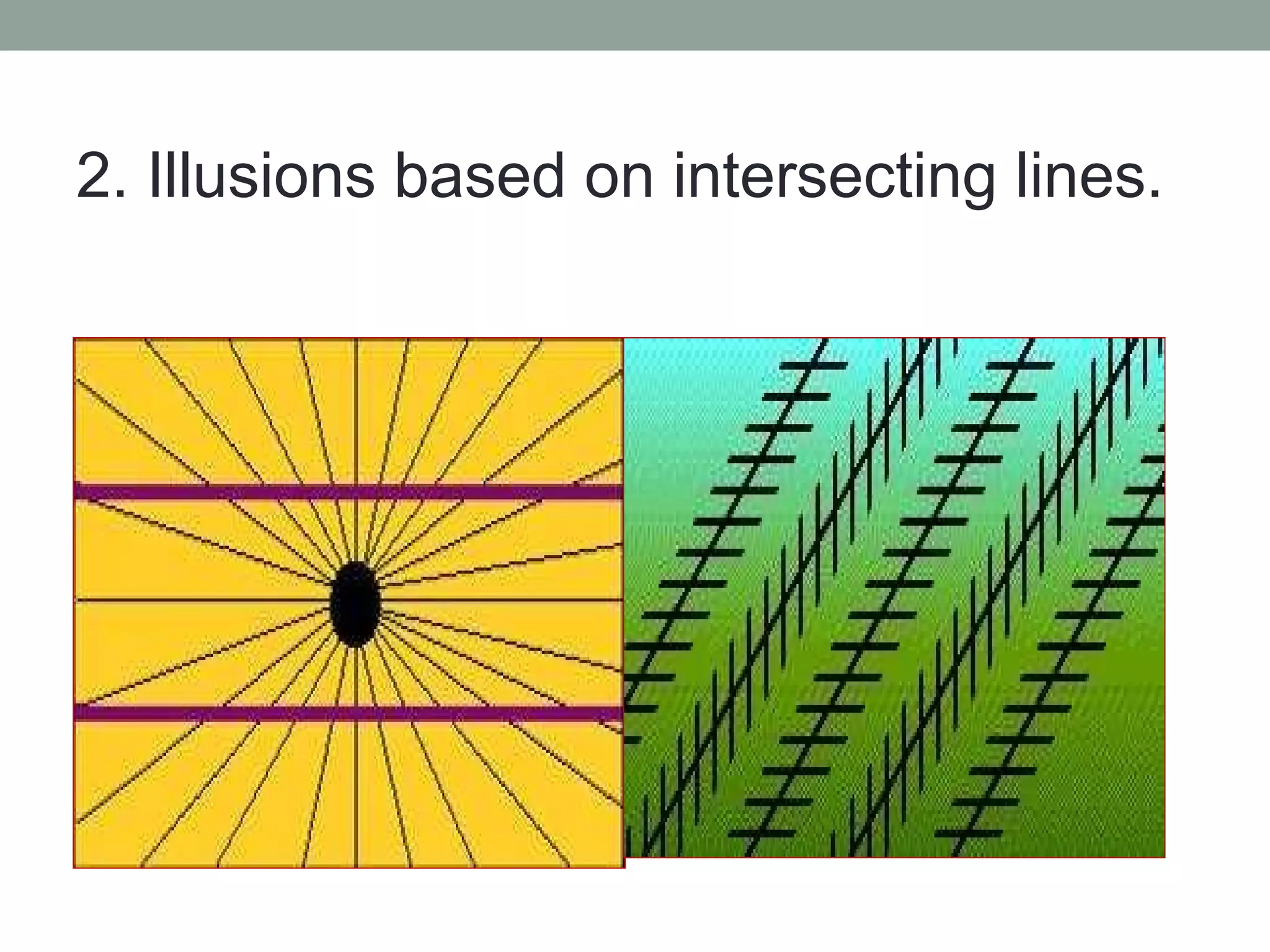
ERRORS IN PERCEPTION Illusion  –  a perception which is common but usually considered mistaken.  This is an error which depends on stimulus conditions and occur in normal individuals. Hallucinations  – are false perceptions that occur under abnormal conditions.
1.Illusions based on relative size.
2. Illusions based on intersecting lines.
3. Ponzo illusion.
Multisensory Integration Integrate and interpret information from multiple senses simultaneously Limited ability and accident occurrence Motivation, Emotion, and Perception Motivation  and emotions influence perception Past experiences influence all perceptions Sensation and Perception
THE END Sensation and Perception

Perception and sensation

  • 1.
    SENSATION AND PERCEPTION
  • 2.
    Sensation: Receiving MessagesAbout the World Sense organs See, hear, taste, smell, touch, balance, and experience the world Sensory receptor cells transmit sensation Perception – interpreting information and forming images Stimulus Sensation and Perception
  • 3.
    Translating Messages forthe Brain Transduction – translates one form of energy (incoming stimuli) into another (sensory information) Receptor cells to neural impulses Sensation and Perception
  • 4.
    Sensory Limits: HowStrong Must Messages Be? Threshold – lower limits Absolute threshold – smallest to be detected Difference threshold – smallest difference between 2 stimuli to be detected 50% of time Sensory adaptation – one’s sensitivity to a stimulus varies from time to time Fatigue, inattention, repeated exposure Sensation and Perception
  • 5.
    Sensory Thresholds VisionA candle flame seen at 30 mi. on a clear, dark night Hearing The tick of a watch under quiet conditions at 20 ft. Taste One teaspoon of sugar in 2 gallons of water Smell 1 drop of perfume diffused into the entire volume of a 3 room apartment Touch The wing of a bee falling on your cheek from a height of 1 cm
  • 6.
    Sensory Limits: HowStrong Must Messages Be? Weber’s law – amount of change needed for detection 50% of time is always in direct proportion to intensity of original stimulus Sensation and Perception
  • 7.
    Stimulus –any from of energy capable of exiting the nervous system like light waves, sound waves, and the chemical energy that causes the sensation taste and smell. Receptor – is a specialized nerve ending capable of responding to energy. Senses – mechanisms which convert stimulus energy into neutral energy.
  • 8.
    *Five Human Senses*1.VISION The organ for vision is the eye. It is stimulated by light waves that strike the retina where the photo-sensitive cells- the rod and the cones- are located. The rods and cones are the receptor for vision.
  • 9.
  • 10.
    Structure Globe - shaped and has a diameter of approximately one inch. Composed of three coats: Sclera - the outer layer, a tough opaque layer of connective tissue used to protect the inner structures of the eye. Helps maintain the shape of the eyeball, in front, this layer becomes the cornea which is thin and transparent.
  • 11.
    Choroid Coat - the middle layer, a pigmented layer. It contains some of the blood vessels that supply the eye with blood. It also absorbs imperfectly focused light rays. In the front part of the eye, it becomes modified to from the iris and the cilliary blood. Pupil – the central opening of the iris
  • 12.
    Iris –a circular arrangement of muscles that contract and expand to change the size of the pupil depending upon the intensity of illumination called light or dark adaptation. The color of the eye is due to the pigment in the iris Accommodation – the process when the lens become thinner to bring faraway objects into focus and thickens to focus on nearly objects.
  • 13.
    Vision: Sensing LightLight Electromagnetic radiation Waves - frequency Wavelength – determines hues seen Intensity – brightness The more wavelengths in light, the less saturated or pure its hue is Sensation and Perception
  • 14.
    The Eye: HowDoes It Work? Light passes through cornea Iris regulates light through pupil into lens Lens held in place by ciliary muscle Retina has rods and cones for receptors Fovea – center of retina Visual acuity – clarity and sharpness Sensation and Perception
  • 15.
  • 16.
    The Eye RodsNot located in fovea Responsible for peripheral vision Hundreds of times more sensitive to light than cones Produce images perceived with less visual acuity than cones Do not detect color Sensation and Perception
  • 17.
    The Eye ConesGive brain more precise information Code information about color Respond only in bright light Optic nerve – has no cones or rods Blind spot – no visual reception in optic nerve Optic chiasm Sensation and Perception
  • 18.
    Dark and LightAdaptation Dark adaptation Receptors receive new supply of chemicals After 30 minutes in the dark - level of sensitivity about 100,000 times greater than in bright light Light adaptation Rods and cones highly responsive – overload Bleaching out of receptor chemicals occurs Sensation and Perception
  • 19.
    Defects of VisionPresbyopia – a special form of farsightedness which occurs with advancing age. The presbyopic person cannot focus clearly on near objects.
  • 20.
  • 21.
    Farsightedness or Hyperopia – is caused by a shortened eyeball, making the distance from the lens to the retina too short. The lens will focus at a point behind the retina. A farsighted person is able to see far objects clearly but not near ones.
  • 22.
  • 23.
    Nearsightedness or Myopia – near objects are not seen clearly but lens is unable to thin enough to bring far objects into clear focus.
  • 24.
    Astigmatism – a structural defect of the eye generally caused by an irregularity in the shape of the cornea.
  • 25.
    Color Blindness Affectsabout 8% of males, 1% of females Partial color blindness – difficulty distinguishing between two colors Red-green blindness due to genetic defect Yellow-blue blindness due to absence of blue pigment in cones Sensation and Perception
  • 26.
    Colorblindness – Poor color vision can be cause by an inherited lack of one or another of the three types of cones.
  • 27.
  • 28.
    2. HEARING Itis the most vital channel of interaction with the environment. The stimuli fro hearing are soundwaves. Three dimensions describing the sound stimulus are : Intensity Frequency Complexity
  • 29.
  • 30.
    Hearing: Sensing SoundWaves A udition - detection of sound waves Frequency of cycles Compression – increased density of waves Rarefaction – reduced density of waves Determines pitch of sound Intensity measured in decibel (db) units Prolonged exposure to over 85 db causes hearing loss Timbre – quality of sound Sensation and Perception
  • 31.
    Maximum level ofindustrial noise considered safe Characteristics of Sound Waves 20 40 60 80 100 160 0 120 180 140 Loud thunder or rock concert Pain Threshold City bus Normal conversation Subway db Noisy automobile Absolute threshold of human hearing Quiet office Whisper Rocket launch
  • 32.
    Structure of theear. The ear is divided into three parts: The outer ear - it is the visible part of the ear, composed of the pinna, the auditory canal, and the tympanic membrane commonly called eardrum.
  • 33.
  • 34.
    The middleear – an air- filled chamber that is connected to the pharynx by the eustachian tube.
  • 35.
    This connection ofthe middle ear to the pharynx serves to equalize the pressure on the two sides of the eardrum. The middle ear structure is composed of tree small bones or ossicles: the mallleus (hammer), the incus (anvil), and the stapes (stirrup). These bones are hanging into the system of levers, so that the movement of the eardrum is transmitted to a membrane called the oval window.
  • 36.
    The innerear – can find a cochlea which is a fluid- filled bony structure shaped like a snail shell. It is the organ of hearing. There are three canals in the cochlea–the cochlear canal, the tympanic canal, and the vestibular canal.
  • 37.
  • 38.
    The Ear: HowDoes It Work? Outer ear Pinna – external part of ear that collects sound External auditory canal – connects outer and middle ear Middle ear Cardum – tympanic membrane; 1st structure Eardrum - outermost structure of middle ear Passes vibration to interconnected bones ( hammer , anvil , and stirrup ) Sensation and Perception
  • 39.
    The Ear: HowDoes It Work? Inner ear Oval window – eardrumlike structure at end of cochlea Round window – eardrumlike structure at other end of cochlea Basilar membrane – forms floor for ear’s sensory receptors Organ of Corti – contains hairlike receptor cells Sensation and Perception
  • 40.
    Hearing Defects ConductionDeafness – deafness due to inability to transmit vibrations through the external and middle ear. Nerve Deafness – this kind of deafness results from damage to the nerves themselves or to the delicate parts of the cochlea.
  • 41.
    3. SMELL -The receptors for smell are found at the olfactory epithelium located at the very top of the nasal passages. -They are sensitive only to gases and to volatile substances that have been dissolved in the air.
  • 42.
  • 43.
    4. TASTE Muchof the sensation depends on other factors-on warmth, coldness, the mild irritation caused by certain spices, and above all, on smell. When our nostrils are stuffed because of colds. Food seems almost tasteless. The tastebuds are the receptors for taste. They respond to four qualities of taste: sweet, sour, salty, and bitter.
  • 44.
    Chemical Senses: The Flavors and Aromas of Life Senses of gustation (taste) and olfaction (smell) differ from all other senses Taste cells and papillae on tongue Taste buds detect Sensation and Perception Sweetness - mostly sugars Sourness - mostly acids Saltiness - mostly salts Bitterness - toxins, chemicals Fattiness - fats
  • 45.
  • 46.
    Taste Surface oftongue Receptor cells Pore Bitter Sour Salty Sweet and fatty Sensory nerve fiber
  • 47.
    Chemical Senses: The Flavors and Aromas of Life Olfaction Olfactory epithelium – top of nasal cavity Pheromone detection of sweat and urine Vomeronasal organ Influence human female reproductive cycles Inhalation of male sex hormone and mood changes Males may respond to sex hormones Sensation and Perception
  • 48.
    Olfactory nerve tobrain Olfactory epithelium Nasal cavity
  • 49.
    5. THE SKINSENSES The skin has four separate senses: pain, pressure, cold, and warmth. The receptors fro the skin senses are nerve endings which come in four general forms: free nerve endings, globular bulbs, egg- shaped corpuscles, and “baskets” surrounding root hairs.
  • 50.
  • 51.
    Body Sensations: Messages About Myself Orientation and movement Vestibular organ – 2 sets of sensory structures Semicircular canals Saccule and utricle Kinesthetic receptors – throughout body Skin senses Pressure sensitivity Temperature sensitivity Sensation and Perception
  • 52.
    The Skin Senses Pressure Free nerve endings Tactile discs hair Specialized end bulbs basket cell around hair Temperature
  • 53.
    Pain Nerve endingsin body act as nocioceptors Neural messages transmitted along two distinct pathways Rapid – detects first pain sensation Slow – detects second long-lasting pain Endorphins and endogenous morphine Sensation and Perception
  • 54.
    Pain Nerve endingsin body act as nocioceptors Pain gates regulate pain signals in 3 areas Brain stem – gate-control theory of pain Spinal cord Peripheral regulation of pain Phantom limbs Up tp 70% of amputees experience this Sensation and Perception
  • 55.
    Gate-control theory ofpain Direction of pain message neuro-transmitter molecules in axon of slow-pain neuron Endorphin receptor Axon of inhibitory pain gate neuron endorphin Neuron in slow-pain fiber Inhibitory pain gate neuron Stimulation of endorphin receptors inhibits firing of axon of slow-pain neuron Close-up view of inhibitory pain gates Somatosensory area of cortex Limbric system Area of pain gates Pathway of fast-pain fibers Pathway of slow-pain fibers
  • 56.
    KINESTHESIS This isthe sense of bodily movements. Its receptors are nerve endings found in muscles, tendons, and linings of joints. EQUILIBRIUM This is also called as the Static Sense. Two kinds of receptors give information about movements of the head and permit a sense of balance of the body.
  • 57.
    These are inthe semicircular canals and the vestibular canal. Both are located in the inner ear next to cochlea. THE ORGANIC SENSE This give s the result of the sensitivity of the visceral and other internal organs oft he body. Among the visceral organs are the stomach, intestines, sex structure, throat, hear and lungs.
  • 58.
    PERCEPTION Chaplin definesperception as the process of knowing objects and objective events by means of senses. This sensory input consists of nerve impulses. They carry a sort of raw, undigested information about the environment. The individual must convert it into a meaningful information. Perception, then, is the organization of sensory input into meaningful experiences.
  • 59.
    PERCEPTUAL CONSTANCY Theperception of an object and all of its properties as constant and unchanging in spite of the continuously changing sensations of these properties outline the scope of object constancies. Our perceptual organization remains relatively stable even though some aspects of the pattern within the optical array undergo great changes.
  • 60.
    ORGANIZATION IN PERCEPTIONFigure and ground – when we perceive an object, usually one part tends to stand out while the rest seems to remain in the background. The part which stands out is called the figure and the rest of the stimulus pattern is called the ground.
  • 61.
  • 62.
    Laws of PerceptualOrganization Figure-Ground
  • 63.
    Grouping –we are concerned more with the figure than with the ground. * The principles of similarity – stimuli which are similar tend to be perceived as forming a group.
  • 64.
  • 65.
    * The principleof proximity – there is a tendency to perceive stimuli which are near one another as belonging together.
  • 66.
    *The principle ofclosure – when fragmentary stimuli form enough of a familiar figure, we tend to perceive the whole figure, ignoring the missing part of parts.
  • 67.
    *The principles ofcontinuity – stimuli which from a continuous pattern are perceived as a whole, the pattern they make generally appears as a figure apart from the ground.
  • 68.
    ATTENTION AND PERCEPTION Perception is selective. The direction of perception toward selected objects is called attention. A number of stimulus conditions help determine the direction of attention
  • 69.
    DEPTH PERCEPTION Thisis the ability to see three- dimensional space and accurately judge distances. A study of perception would be incomplete without considering perceiving the third dimension- distance and depth.
  • 70.
    Depth Perception Retinahas two-dimensional surface Monocular cues – perception of one eye Texture gradient Linear perspective Superposition Shadowing Sensation and Perception Speed of movement Aerial perspective Accommodation Vertical position
  • 71.
    Depth Perception Binocularcues – perception with two eyes Convergence Retinal disparity Visual Illusions Ponzo illusion Vertical-horizontal illusion Color perception Sensation and Perception Zollner illusion Moon illusion Poggendorf illusion
  • 72.
  • 73.
    PERSONAL FACTORS INPERCEPTION Motives Emotions Attitudes Frames of reference
  • 74.
    ERRORS IN PERCEPTIONIllusion – a perception which is common but usually considered mistaken. This is an error which depends on stimulus conditions and occur in normal individuals. Hallucinations – are false perceptions that occur under abnormal conditions.
  • 75.
    1.Illusions based onrelative size.
  • 76.
    2. Illusions basedon intersecting lines.
  • 77.
  • 78.
    Multisensory Integration Integrateand interpret information from multiple senses simultaneously Limited ability and accident occurrence Motivation, Emotion, and Perception Motivation and emotions influence perception Past experiences influence all perceptions Sensation and Perception
  • 79.
    THE END Sensationand Perception

Editor's Notes

  • #16 There are approximately 125 million rods located outside the fovea which code information about light and dark. There are approximately 6 million cones, mostly located in the fovea, which code information about light, dark, and color. Role of rods and cones differ. 1. Rods are largely responsible for peripheral vision because of their location. 2. Rods are hundreds of times more sensitive to light, therefore, they play a more important role in vision in dim light. 3. Rods produce images that are perceived with less visual acuity than do cones. 4. Rods do not detect color as do cones.