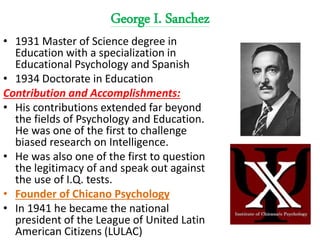
George I. Sanchez
• 1931 Master of Science degree in
Education with a specialization in
Educational Psychology and Spanish
• 1934 Doctorate in Education
Contribution and Accomplishments:
• His contributions extended far beyond
the fields of Psychology and Education.
He was one of the first to challenge
biased research on Intelligence.
• He was also one of the first to question
the legitimacy of and speak out against
the use of I.Q. tests.
• Founder of Chicano Psychology
• In 1941 he became the national
president of the League of United Latin
American Citizens (LULAC)
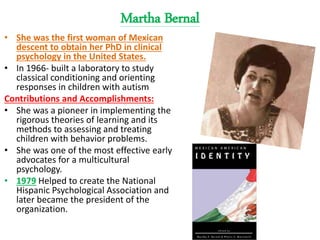
Martha Bernal
• She was the first woman of Mexican
descent to obtain her PhD in clinical
psychology in the United States.
• In 1966- built a laboratory to study
classical conditioning and orienting
responses in children with autism
Contributions and Accomplishments:
• She was a pioneer in implementing the
rigorous theories of learning and its
methods to assessing and treating
children with behavior problems.
• She was one of the most effective early
advocates for a multicultural
psychology.
• 1979 Helped to create the National
Hispanic Psychological Association and
later became the president of the
organization.
John Garcia
• Born a farm worker to Spanish immigrants.
• Used his G.I. Bill money to pay for college.
• 1965 received his Master’s degree and his PhD
from UC Berkeley
• Conducted research on radiation and brain
research, and finds that rats could detect and
avoid low doses of radiation.
Contributions and Accomplishments:
• After the mass deaths of sheep living downwind
from nuclear test sites, he and his lab find the
cause to be radiation poisoning.
• He accompanies JFK and MLK to Vienna to meet
with the Russians, and he testifies against nuclear
testing.
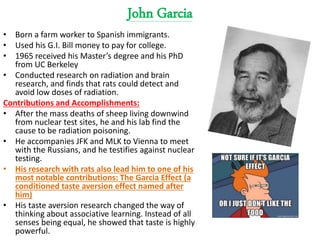
• His research with rats also lead him to one of his
most notable contributions: The Garcia Effect (a
conditioned taste aversion effect named after
him)
• His taste aversion research changed the way of
thinking about associative learning. Instead of all
senses being equal, he showed that taste is highly
powerful.
Melba Vasquez
• In 1978, she completed her doctoral
studies in counseling psychology at the
University of Texas in Austin.
• She taught in the counseling psychology
doctoral program at Colorado State
University.
• Contributions and Accomplishments:
• She was one of the first recipients of the
APA’s minority fellowship.
• She co-founded the APA Division 45 (the
society for the psychological study of
ethnic minorities)
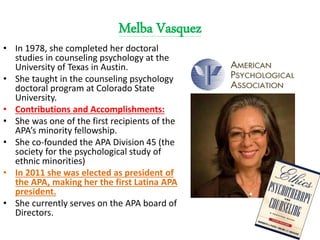
• In 2011 she was elected as president of
the APA, making her the first Latina APA
president.
• She currently serves on the APA board of
Directors.

Hispanic Heritage month psychologists

  • 3.
    George I. Sanchez •1931 Master of Science degree in Education with a specialization in Educational Psychology and Spanish • 1934 Doctorate in Education Contribution and Accomplishments: • His contributions extended far beyond the fields of Psychology and Education. He was one of the first to challenge biased research on Intelligence. • He was also one of the first to question the legitimacy of and speak out against the use of I.Q. tests. • Founder of Chicano Psychology • In 1941 he became the national president of the League of United Latin American Citizens (LULAC)
  • 4.
    Martha Bernal • Shewas the first woman of Mexican descent to obtain her PhD in clinical psychology in the United States. • In 1966- built a laboratory to study classical conditioning and orienting responses in children with autism Contributions and Accomplishments: • She was a pioneer in implementing the rigorous theories of learning and its methods to assessing and treating children with behavior problems. • She was one of the most effective early advocates for a multicultural psychology. • 1979 Helped to create the National Hispanic Psychological Association and later became the president of the organization.
  • 5.
    John Garcia • Borna farm worker to Spanish immigrants. • Used his G.I. Bill money to pay for college. • 1965 received his Master’s degree and his PhD from UC Berkeley • Conducted research on radiation and brain research, and finds that rats could detect and avoid low doses of radiation. Contributions and Accomplishments: • After the mass deaths of sheep living downwind from nuclear test sites, he and his lab find the cause to be radiation poisoning. • He accompanies JFK and MLK to Vienna to meet with the Russians, and he testifies against nuclear testing. • His research with rats also lead him to one of his most notable contributions: The Garcia Effect (a conditioned taste aversion effect named after him) • His taste aversion research changed the way of thinking about associative learning. Instead of all senses being equal, he showed that taste is highly powerful.
  • 6.
    Melba Vasquez • In1978, she completed her doctoral studies in counseling psychology at the University of Texas in Austin. • She taught in the counseling psychology doctoral program at Colorado State University. • Contributions and Accomplishments: • She was one of the first recipients of the APA’s minority fellowship. • She co-founded the APA Division 45 (the society for the psychological study of ethnic minorities) • In 2011 she was elected as president of the APA, making her the first Latina APA president. • She currently serves on the APA board of Directors.