Chapter 3Chapter 3
BuildingBuilding
LeadershipLeadership
“The very essence of leadership is that you
have a vision.” – Theodore Hesburgh
What is meant byWhat is meant by
Leadership?Leadership?
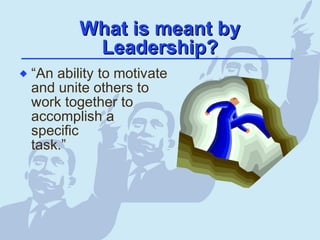
 “An ability to motivate
and unite others to
work together to
accomplish a
specific
task.”
What is a Leader?What is a Leader?
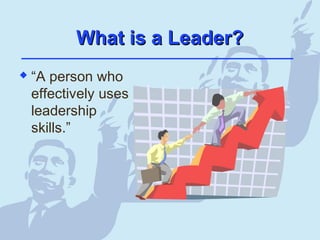
 “A person who
effectively uses
leadership
skills.”
Is there a sure-fire way toIs there a sure-fire way to
motivate people?motivate people?
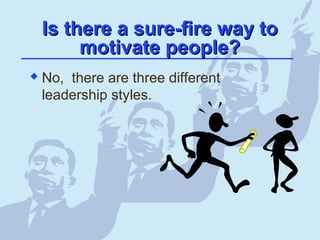
 No, there are three different
leadership styles.
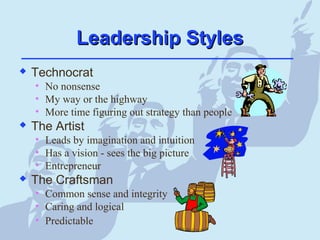
Leadership StylesLeadership Styles
 Technocrat
• No nonsense
• My way or the highway
• More time figuring out strategy than people
 The Artist
• Leads by imagination and intuition
• Has a vision - sees the big picture
• Entrepreneur
 The Craftsman
• Common sense and integrity
• Caring and logical
• Predictable
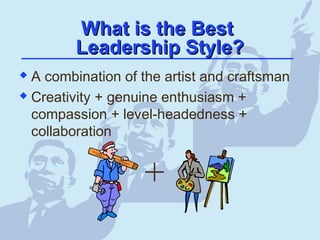
What is the BestWhat is the Best
Leadership Style?Leadership Style?
 A combination of the artist and craftsman
 Creativity + genuine enthusiasm +
compassion + level-headedness +
collaboration
+
What is vision?What is vision?
 The ability to see more than the obvious
What kind of leader do youWhat kind of leader do you
think these people are?think these people are?
 Colin Powell
 Steven Jobs
 Bill Gates
 Oprah Winfrey
 George W. Bush
What is a learning style?What is a learning style?
 “One of the different
ways in which
people learn
most effectively”
What are the FourWhat are the Four
Learning Styles?Learning Styles?
 Discussion
• Active involvement in communication
 Logic
• Just the facts
 Design
• Clear picture of relationships
 Emotion
• Hands-on
Six Planks ofSix Planks of
LeadershipLeadership
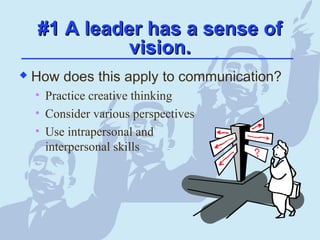
#1 A leader has a sense of#1 A leader has a sense of
vision.vision.
 How does this apply to communication?
#1 A leader has a sense of#1 A leader has a sense of
vision.vision.
 How does this apply to communication?
• Practice creative thinking
• Consider various perspectives
• Use intrapersonal and
interpersonal skills
#2 A leader is willing to act.#2 A leader is willing to act.
 What does this mean in communication?
#2 A leader is willing to act.#2 A leader is willing to act.
 What does this mean in communication?
• Take charge in a group
• Guide the group tasks
 This is what needs to be
done…
 Let’s assign jobs…
 Here is the time
schedule
#3 A Leader Makes#3 A Leader Makes
Good Decisions.Good Decisions.
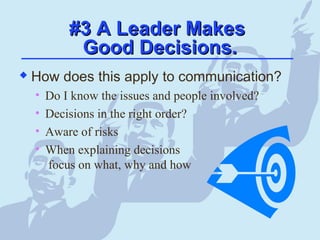
 How does this apply to communication?
#3 A Leader Makes#3 A Leader Makes
Good Decisions.Good Decisions.
 How does this apply to communication?
• Do I know the issues and people involved?
• Decisions in the right order?
• Aware of risks
• When explaining decisions
focus on what, why and how
#4 A leader can handle#4 A leader can handle
conflict.conflict.
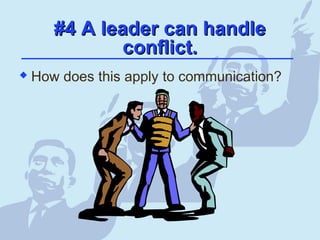
 How does this apply to communication?
#4 A leader can handle#4 A leader can handle
conflict.conflict.
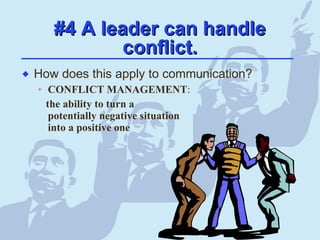
 How does this apply to communication?
• CONFLICT MANAGEMENT:
the ability to turn a
potentially negative situation
into a positive one
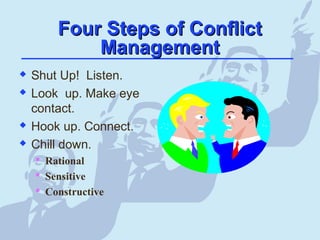
Four Steps of ConflictFour Steps of Conflict
ManagementManagement
 Shut Up! Listen.
 Look up. Make eye
contact.
 Hook up. Connect.
 Chill down.
 Rational
 Sensitive
 Constructive
#5 A Leader Works to#5 A Leader Works to
Avoid Pitfalls.Avoid Pitfalls.
 How does this apply to communications?
#5 A Leader Works to#5 A Leader Works to
Avoid Pitfalls.Avoid Pitfalls.
 How does this apply to communications?
• Four Pitfalls:
 Being Afraid to Fail
 Not Paying Attention
to Details
 Forgetting People and
the Original Objectives
 Not Listening to Others
#6 A leader knows how to#6 A leader knows how to
motivate.motivate.
How does this apply to communication?
#6 A leader knows how to#6 A leader knows how to
motivate.motivate.
 How does this apply to communication?
• Inspire yourself
and others
 Integrity
 Work ethic
 Logic
 Master plan
 Emotion
 Creativity
 Confidence
 Decisiveness
VocabularyVocabulary
 leadership
 leader
 vision
 conflict management
Speech terms on Page 55

Chapter 3 Leadership

  • 1.
    Chapter 3Chapter 3 BuildingBuilding LeadershipLeadership “Thevery essence of leadership is that you have a vision.” – Theodore Hesburgh
  • 2.
    What is meantbyWhat is meant by Leadership?Leadership?  “An ability to motivate and unite others to work together to accomplish a specific task.”
  • 3.
    What is aLeader?What is a Leader?  “A person who effectively uses leadership skills.”
  • 4.
    Is there asure-fire way toIs there a sure-fire way to motivate people?motivate people?  No, there are three different leadership styles.
  • 5.
    Leadership StylesLeadership Styles Technocrat • No nonsense • My way or the highway • More time figuring out strategy than people  The Artist • Leads by imagination and intuition • Has a vision - sees the big picture • Entrepreneur  The Craftsman • Common sense and integrity • Caring and logical • Predictable
  • 6.
    What is theBestWhat is the Best Leadership Style?Leadership Style?  A combination of the artist and craftsman  Creativity + genuine enthusiasm + compassion + level-headedness + collaboration +
  • 7.
    What is vision?Whatis vision?  The ability to see more than the obvious
  • 8.
    What kind ofleader do youWhat kind of leader do you think these people are?think these people are?  Colin Powell  Steven Jobs  Bill Gates  Oprah Winfrey  George W. Bush
  • 9.
    What is alearning style?What is a learning style?  “One of the different ways in which people learn most effectively”
  • 10.
    What are theFourWhat are the Four Learning Styles?Learning Styles?  Discussion • Active involvement in communication  Logic • Just the facts  Design • Clear picture of relationships  Emotion • Hands-on
  • 11.
    Six Planks ofSixPlanks of LeadershipLeadership
  • 12.
    #1 A leaderhas a sense of#1 A leader has a sense of vision.vision.  How does this apply to communication?
  • 13.
    #1 A leaderhas a sense of#1 A leader has a sense of vision.vision.  How does this apply to communication? • Practice creative thinking • Consider various perspectives • Use intrapersonal and interpersonal skills
  • 14.
    #2 A leaderis willing to act.#2 A leader is willing to act.  What does this mean in communication?
  • 15.
    #2 A leaderis willing to act.#2 A leader is willing to act.  What does this mean in communication? • Take charge in a group • Guide the group tasks  This is what needs to be done…  Let’s assign jobs…  Here is the time schedule
  • 16.
    #3 A LeaderMakes#3 A Leader Makes Good Decisions.Good Decisions.  How does this apply to communication?
  • 17.
    #3 A LeaderMakes#3 A Leader Makes Good Decisions.Good Decisions.  How does this apply to communication? • Do I know the issues and people involved? • Decisions in the right order? • Aware of risks • When explaining decisions focus on what, why and how
  • 18.
    #4 A leadercan handle#4 A leader can handle conflict.conflict.  How does this apply to communication?
  • 19.
    #4 A leadercan handle#4 A leader can handle conflict.conflict.  How does this apply to communication? • CONFLICT MANAGEMENT: the ability to turn a potentially negative situation into a positive one
  • 20.
    Four Steps ofConflictFour Steps of Conflict ManagementManagement  Shut Up! Listen.  Look up. Make eye contact.  Hook up. Connect.  Chill down.  Rational  Sensitive  Constructive
  • 21.
    #5 A LeaderWorks to#5 A Leader Works to Avoid Pitfalls.Avoid Pitfalls.  How does this apply to communications?
  • 22.
    #5 A LeaderWorks to#5 A Leader Works to Avoid Pitfalls.Avoid Pitfalls.  How does this apply to communications? • Four Pitfalls:  Being Afraid to Fail  Not Paying Attention to Details  Forgetting People and the Original Objectives  Not Listening to Others
  • 23.
    #6 A leaderknows how to#6 A leader knows how to motivate.motivate. How does this apply to communication?
  • 24.
    #6 A leaderknows how to#6 A leader knows how to motivate.motivate.  How does this apply to communication? • Inspire yourself and others  Integrity  Work ethic  Logic  Master plan  Emotion  Creativity  Confidence  Decisiveness
  • 25.
    VocabularyVocabulary  leadership  leader vision  conflict management Speech terms on Page 55