Leadership Is Developed through Education and Experience “ Leadership and learning are indispensable to each other.” ~John F. Kennedy Chapter 3
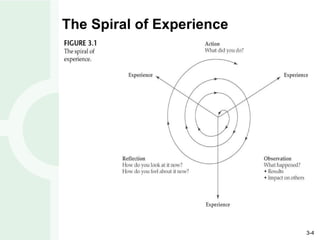
The Action-Observation-Reflection Model Making the most of experience is key to developing one’s leadership ability. The theory shows that leadership development is enhanced when the experience involves three different processes: Action Observation Reflection Spiral of experience: Colin Powell’s example.
The Spiral of Experience
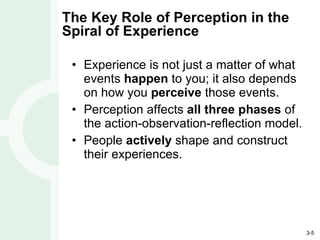
The Key Role of Perception in the Spiral of Experience Experience is not just a matter of what events  happen  to you; it also depends on how you  perceive  those events. Perception affects  all three phases  of the action-observation-reflection model. People  actively  shape and construct their experiences.
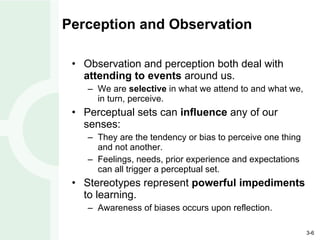
Perception and Observation Observation and perception both deal with  attending to events  around us. We are  selective  in what we attend to and what we, in turn, perceive. Perceptual sets can  influence  any of our senses: They are the tendency or bias to perceive one thing and not another. Feelings, needs, prior experience and expectations can all trigger a perceptual set. Stereotypes represent  powerful impediments  to learning. Awareness of biases occurs upon reflection.
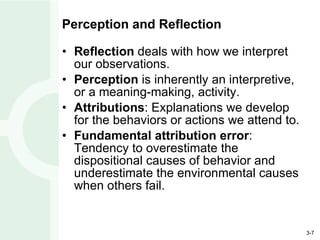
Perception and Reflection Reflection  deals with how we interpret our observations. Perception  is inherently an interpretive, or a meaning-making, activity. Attributions : Explanations we develop for the behaviors or actions we attend to. Fundamental attribution error : Tendency to overestimate the dispositional causes of behavior and underestimate the environmental causes when others fail.
Perception and Reflection (continued) Self-serving bias : Tendency to make external attributions for one’s own failures, yet make internal attributions for one’s successes. Actor/observer difference : Refers to the fact that people who are observing an action are much more likely than the actor to make the fundamental attribution error. Reflection also involves higher functions like  evaluation  and  judgment , not just perception and attribution.
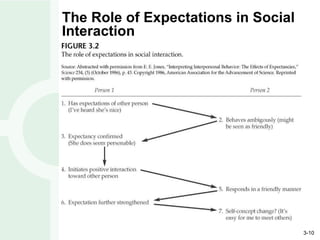
Perception and Action Research found that perceptions and biases affect supervisors’ actions towards poorly performing subordinates. Self-fulfilling prophecy : Occurs when our expectations or predictions play a causal role in bringing about the events we predict. Research has shown that  having expectations  about others can subtly influence our  actions . These actions can, in turn, affect the way others  behave .
The Role of Expectations in Social Interaction
Reflection and Leadership Development Reflection provides leaders with insights into several ways of  framing problems ,  multiple perspectives , or  better understanding . Leaders tend to ignore reflection due to lack of time or lack of awareness of its  value . Intentional reflection  might prompt one to see potential  benefits  in experience not initially considered relevant.
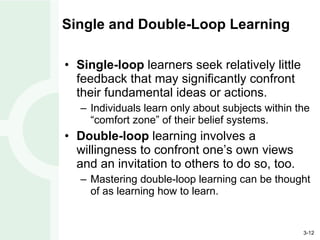
Single and Double-Loop Learning Single-loop  learners seek relatively little feedback that may significantly confront their fundamental ideas or actions. Individuals learn only about subjects within the “comfort zone” of their belief systems. Double-loop  learning involves a willingness to confront one’s own views and an invitation to others to do so, too. Mastering double-loop learning can be thought of as learning how to learn.
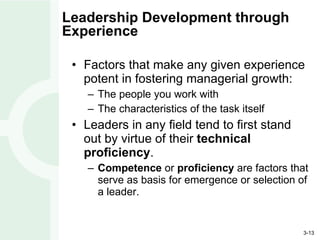
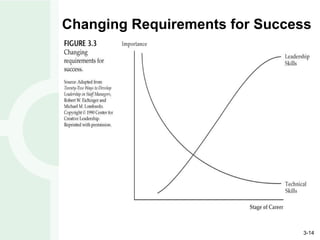
Leadership Development through Experience Factors that make any given experience potent in fostering managerial growth: The people you work with The characteristics of the task itself Leaders in any field tend to first stand out by virtue of their  technical proficiency . Competence  or  proficiency  are factors that serve as basis for emergence or selection of a leader.
Changing Requirements for Success
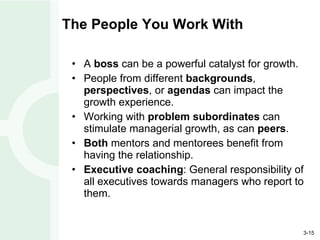
The People You Work With A  boss  can be a powerful catalyst for growth. People from different  backgrounds ,  perspectives , or  agendas  can impact the growth experience. Working with  problem subordinates  can stimulate managerial growth, as can  peers . Both  mentors and mentorees benefit from having the relationship. Executive coaching : General responsibility of all executives towards managers who report to them.
Developmental Tasks Leadership development can be enhanced in a  changing ,  dynamic ,  uncontrollable , and  unpredictable  environment. Strategic planning  and  projections  can contribute to a leader’s development. Opportunities that  stretch individuals  and allow them to test themselves provide learning. The  risk of possible failure  is a strong incentive for managers to learn. Organizations may not provide the  same  development opportunities for  all  their members.
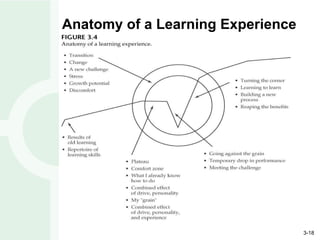
Making the Most of Your Leadership Experiences: Learning to Learn from Experience The learning events and developmental experiences that punctuate one’s life are usually  stressful . A flat learning curve can result due to an inability to move against one’s grain of personal success and tolerate a dip in performance results. To be successful,  learning must continue  throughout life, beyond the completion of one’s formal education.
Anatomy of a Learning Experience
Leadership Development through Education and Training Research has shown that: Education level  or academic performance in college was positively related to future managerial success. Educational programs  generally have a positive effect on leadership development. Formal education  and training programs can help one become a better leader. The content of different leadership programs varies considerably, depending on the target audience. Leadership education is a component of leadership development.
University Courses in Leadership Leadership training programs can include formal courses or extracurricular leadership activities. The pedagogy used to impart different leadership concepts vary greatly. Many courses use the standard lecture methods, or provide individualized feedback through: Case studies Role Playing Simulations Games
Leadership Training Programs Programs aimed particularly at industry and public service leaders and supervisors use: Lectures Case studies Role-playing exercises Programs for midlevel managers often focus on: Individualized feedback, case studies, presentations Role playing, simulations In-basket exercises Leaderless group discussions
Leadership Training Programs (continued) Conger offers that a multi-tiered approach is effective. Leadership development in the 21st century must occur in more  lifelike  situations and contexts. Leadership programs for senior executives and CEOs focus on  strategic planning ,  PR , and  interpersonal skills . No matter the type of program chosen, a  systematic approach  guarantees its usefulness.
Building Your Leadership Self-Image Leadership develops through  experience  and  formal education . Not everyone  wants to be a leader or believes he/she can be. Avoid  selling yourself short . Understand the  importance  of leadership, keep an  open mind . Avoid  self-defeating  generalizations. Experiment  and  take a few risks  with different leadership roles.
Summary One way to add value to your leadership courses and experiences is by applying the  action-observation-reflection  model. Be aware of the role  perception  plays in leadership development. Education  and  experience  can contribute to your development as a leader. To become a better leader, one must  seek   challenges  and try to make the  best of  any  leadership opportunity .

Ppt Ch 3

  • 1.
  • 2.
    Leadership Is Developedthrough Education and Experience “ Leadership and learning are indispensable to each other.” ~John F. Kennedy Chapter 3
  • 3.
    The Action-Observation-Reflection ModelMaking the most of experience is key to developing one’s leadership ability. The theory shows that leadership development is enhanced when the experience involves three different processes: Action Observation Reflection Spiral of experience: Colin Powell’s example.
  • 4.
    The Spiral ofExperience
  • 5.
    The Key Roleof Perception in the Spiral of Experience Experience is not just a matter of what events happen to you; it also depends on how you perceive those events. Perception affects all three phases of the action-observation-reflection model. People actively shape and construct their experiences.
  • 6.
    Perception and ObservationObservation and perception both deal with attending to events around us. We are selective in what we attend to and what we, in turn, perceive. Perceptual sets can influence any of our senses: They are the tendency or bias to perceive one thing and not another. Feelings, needs, prior experience and expectations can all trigger a perceptual set. Stereotypes represent powerful impediments to learning. Awareness of biases occurs upon reflection.
  • 7.
    Perception and ReflectionReflection deals with how we interpret our observations. Perception is inherently an interpretive, or a meaning-making, activity. Attributions : Explanations we develop for the behaviors or actions we attend to. Fundamental attribution error : Tendency to overestimate the dispositional causes of behavior and underestimate the environmental causes when others fail.
  • 8.
    Perception and Reflection(continued) Self-serving bias : Tendency to make external attributions for one’s own failures, yet make internal attributions for one’s successes. Actor/observer difference : Refers to the fact that people who are observing an action are much more likely than the actor to make the fundamental attribution error. Reflection also involves higher functions like evaluation and judgment , not just perception and attribution.
  • 9.
    Perception and ActionResearch found that perceptions and biases affect supervisors’ actions towards poorly performing subordinates. Self-fulfilling prophecy : Occurs when our expectations or predictions play a causal role in bringing about the events we predict. Research has shown that having expectations about others can subtly influence our actions . These actions can, in turn, affect the way others behave .
  • 10.
    The Role ofExpectations in Social Interaction
  • 11.
    Reflection and LeadershipDevelopment Reflection provides leaders with insights into several ways of framing problems , multiple perspectives , or better understanding . Leaders tend to ignore reflection due to lack of time or lack of awareness of its value . Intentional reflection might prompt one to see potential benefits in experience not initially considered relevant.
  • 12.
    Single and Double-LoopLearning Single-loop learners seek relatively little feedback that may significantly confront their fundamental ideas or actions. Individuals learn only about subjects within the “comfort zone” of their belief systems. Double-loop learning involves a willingness to confront one’s own views and an invitation to others to do so, too. Mastering double-loop learning can be thought of as learning how to learn.
  • 13.
    Leadership Development throughExperience Factors that make any given experience potent in fostering managerial growth: The people you work with The characteristics of the task itself Leaders in any field tend to first stand out by virtue of their technical proficiency . Competence or proficiency are factors that serve as basis for emergence or selection of a leader.
  • 14.
  • 15.
    The People YouWork With A boss can be a powerful catalyst for growth. People from different backgrounds , perspectives , or agendas can impact the growth experience. Working with problem subordinates can stimulate managerial growth, as can peers . Both mentors and mentorees benefit from having the relationship. Executive coaching : General responsibility of all executives towards managers who report to them.
  • 16.
    Developmental Tasks Leadershipdevelopment can be enhanced in a changing , dynamic , uncontrollable , and unpredictable environment. Strategic planning and projections can contribute to a leader’s development. Opportunities that stretch individuals and allow them to test themselves provide learning. The risk of possible failure is a strong incentive for managers to learn. Organizations may not provide the same development opportunities for all their members.
  • 17.
    Making the Mostof Your Leadership Experiences: Learning to Learn from Experience The learning events and developmental experiences that punctuate one’s life are usually stressful . A flat learning curve can result due to an inability to move against one’s grain of personal success and tolerate a dip in performance results. To be successful, learning must continue throughout life, beyond the completion of one’s formal education.
  • 18.
    Anatomy of aLearning Experience
  • 19.
    Leadership Development throughEducation and Training Research has shown that: Education level or academic performance in college was positively related to future managerial success. Educational programs generally have a positive effect on leadership development. Formal education and training programs can help one become a better leader. The content of different leadership programs varies considerably, depending on the target audience. Leadership education is a component of leadership development.
  • 20.
    University Courses inLeadership Leadership training programs can include formal courses or extracurricular leadership activities. The pedagogy used to impart different leadership concepts vary greatly. Many courses use the standard lecture methods, or provide individualized feedback through: Case studies Role Playing Simulations Games
  • 21.
    Leadership Training ProgramsPrograms aimed particularly at industry and public service leaders and supervisors use: Lectures Case studies Role-playing exercises Programs for midlevel managers often focus on: Individualized feedback, case studies, presentations Role playing, simulations In-basket exercises Leaderless group discussions
  • 22.
    Leadership Training Programs(continued) Conger offers that a multi-tiered approach is effective. Leadership development in the 21st century must occur in more lifelike situations and contexts. Leadership programs for senior executives and CEOs focus on strategic planning , PR , and interpersonal skills . No matter the type of program chosen, a systematic approach guarantees its usefulness.
  • 23.
    Building Your LeadershipSelf-Image Leadership develops through experience and formal education . Not everyone wants to be a leader or believes he/she can be. Avoid selling yourself short . Understand the importance of leadership, keep an open mind . Avoid self-defeating generalizations. Experiment and take a few risks with different leadership roles.
  • 24.
    Summary One wayto add value to your leadership courses and experiences is by applying the action-observation-reflection model. Be aware of the role perception plays in leadership development. Education and experience can contribute to your development as a leader. To become a better leader, one must seek challenges and try to make the best of any leadership opportunity .