Tim Valton II
Resident Director, Hill Houses
#RISDRA Fall 2014 Training
#risdra
Be open to new ideas and concepts
Challenge yourself
Think about how you can improve your
leadership style within your community
Contribute to conversation by developing
preexisting discussion points
Have big fun…Have BIG fun!
#risdra
 Leadership Traits as a #RISDRA
• “Brain Dump” Activity
 Transformative Leadership and You
• Large Group Discussion
 Ethical Leadership and Others
• Large Group Discussion
 Mentoring 101
• Large Group Discussion
• Small Group Activity (Divided by staff)
#risdra
You’ll notice words hung around the room
Take some time and visit each of the
words and reflect on it’s meaning to you
Jot down some additional words or
phrases you think of when reading it
Feel free to express yourself visually
Activity Time: 5 minutes
#risdra
Why do you think we started with this?
What were some of the words, phrases, or
pictures you drew on the paper?
Which of these words do you think you are
the strongest in? Why?
Which of these words do you think you are
the weakest in? Why?
#risdra
Think back to your first year as an RA,
which of these words wasn’t in your
vocabulary as an RA? Which one’s were?
What facilitated that change?
#risdra
How does a leader institute change?
Transformational leadership fits the needs
of today’s work groups
Process that changes and transforms
Concerned with emotions, values, ethics,
standards, and long-term goals
Motivates people to do more than
expected through four factors.
#risdra Source: P. Northouse (2010) Leadership: Theory and Practice.
Act as strong role
models for followers;
followers identify with
these leaders and want
to emulate them
High level of charisma
#risdra Source: P. Northouse (2010) Leadership: Theory and Practice.
 Communicate high
expectations for
followers, inspiring them
through motivation to
become committed to
and a part of the shared
vision of the organization
#risdra Source: P. Northouse (2010) Leadership: Theory and Practice.
 Leadership that
stimulates followers to
be creative an innovative
and to challenge their
own beliefs and values
as well as those of the
leader and the
organization
#risdra Source: P. Northouse (2010) Leadership: Theory and Practice.
 Representative of
leaders who provide a
supportive climate in
which they listen
carefully to the individual
needs of others within
the organziation
#risdra Source: P. Northouse (2010) Leadership: Theory and Practice.
#risdra
Why is role modeling important as a
returning RA?
How do expectations and goals play into the
success of the RA position?
How are you creative or innovative within
the RA position?
How are you meeting the needs of your
residents and fellow staff members?
An individual's personal ethical
system is determined by their
own personal belief system but
is still formed around the
organization they belong to
What does being ethical
mean to you?
#risdra
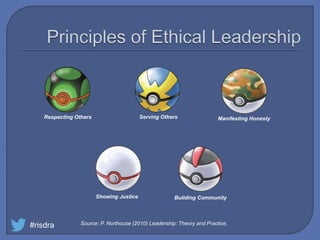
#risdra Source: P. Northouse (2010) Leadership: Theory and Practice.
Serving OthersRespecting Others
Showing Justice
Manifesting Honesty
Building Community
What is a mentor?
#risdra
Mentors…
• Listen.
• Guide.
• Are Practical.
• Educate.
• Provide Insight
• Are accessible.
• Criticize
constructively.
• Are supportive.
• Are specific.
• Care.
• Succeed.
• Are admirable.
Break off into staffs
Look at the roster provided to you and
divide the first years evenly amongst you
Since there are more returning RAs, each
first year should receive 2 or more
Feel free to express yourself visually
Personalize them!
Activity Time: 5 minutes
#risdra

The emt student leader

  • 1.
    Tim Valton II ResidentDirector, Hill Houses #RISDRA Fall 2014 Training #risdra
  • 2.
    Be open tonew ideas and concepts Challenge yourself Think about how you can improve your leadership style within your community Contribute to conversation by developing preexisting discussion points Have big fun…Have BIG fun! #risdra
  • 3.
     Leadership Traitsas a #RISDRA • “Brain Dump” Activity  Transformative Leadership and You • Large Group Discussion  Ethical Leadership and Others • Large Group Discussion  Mentoring 101 • Large Group Discussion • Small Group Activity (Divided by staff) #risdra
  • 4.
    You’ll notice wordshung around the room Take some time and visit each of the words and reflect on it’s meaning to you Jot down some additional words or phrases you think of when reading it Feel free to express yourself visually Activity Time: 5 minutes #risdra
  • 5.
    Why do youthink we started with this? What were some of the words, phrases, or pictures you drew on the paper?
  • 6.
    Which of thesewords do you think you are the strongest in? Why? Which of these words do you think you are the weakest in? Why? #risdra
  • 7.
    Think back toyour first year as an RA, which of these words wasn’t in your vocabulary as an RA? Which one’s were? What facilitated that change? #risdra
  • 8.
    How does aleader institute change? Transformational leadership fits the needs of today’s work groups Process that changes and transforms Concerned with emotions, values, ethics, standards, and long-term goals Motivates people to do more than expected through four factors. #risdra Source: P. Northouse (2010) Leadership: Theory and Practice.
  • 9.
    Act as strongrole models for followers; followers identify with these leaders and want to emulate them High level of charisma #risdra Source: P. Northouse (2010) Leadership: Theory and Practice.
  • 10.
     Communicate high expectationsfor followers, inspiring them through motivation to become committed to and a part of the shared vision of the organization #risdra Source: P. Northouse (2010) Leadership: Theory and Practice.
  • 11.
     Leadership that stimulatesfollowers to be creative an innovative and to challenge their own beliefs and values as well as those of the leader and the organization #risdra Source: P. Northouse (2010) Leadership: Theory and Practice.
  • 12.
     Representative of leaderswho provide a supportive climate in which they listen carefully to the individual needs of others within the organziation #risdra Source: P. Northouse (2010) Leadership: Theory and Practice.
  • 13.
    #risdra Why is rolemodeling important as a returning RA? How do expectations and goals play into the success of the RA position? How are you creative or innovative within the RA position? How are you meeting the needs of your residents and fellow staff members?
  • 14.
    An individual's personalethical system is determined by their own personal belief system but is still formed around the organization they belong to What does being ethical mean to you? #risdra
  • 15.
    #risdra Source: P.Northouse (2010) Leadership: Theory and Practice. Serving OthersRespecting Others Showing Justice Manifesting Honesty Building Community
  • 16.
    What is amentor? #risdra Mentors… • Listen. • Guide. • Are Practical. • Educate. • Provide Insight • Are accessible. • Criticize constructively. • Are supportive. • Are specific. • Care. • Succeed. • Are admirable.
  • 17.
    Break off intostaffs Look at the roster provided to you and divide the first years evenly amongst you Since there are more returning RAs, each first year should receive 2 or more Feel free to express yourself visually Personalize them! Activity Time: 5 minutes #risdra