
Hackman, M. Z., & Johnson, C. E. (2013). Leadership: A communication
perspective. Waveland Press.
LEADERSHIP:
A COMMUNICATION
PERSPECTIVE
CHAPTER 1: LEADERSHIP &
COMMUNICATION
CHAPTER 2: LEADERSHIP AND
FOLLOWERSHIP COMMUNICATION STYLES
Leadership &
Chapter 1
Defining Leadership:
At the Core of Human Experience
 Leadership is all around us
 Integral part of human life – linked to what it means
to be human
 Ability to manipulate symbols
 Where society exists, leadership exists
 More than academic, leadership is practical
 Distinct Patterns of leadership
 Success often varies significantly
The Nature of the Human
Communication
 Frank Dance – Symbols are abstract, arbitrary
representations of reality agreed upon by human
users
 Meaning is created through communication, which
is based on the transfer of symbols
Symbolic communication is purposive and goal
driven
 Human leadership v. Animal leadership
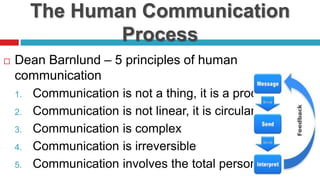
The Human Communication
Process
 Dean Barnlund – 5 principles of human
communication
1. Communication is not a thing, it is a process
2. Communication is not linear, it is circular
3. Communication is complex
4. Communication is irreversible
5. Communication involves the total personality
Leadership: A Special Form of
Human Communication
 Joseph Rost – 221 definition
between 1900-1990
 Leadership is about who you
are
 Leadership is about how you
act
 Leadership is about what you
do
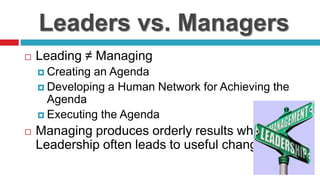
Leaders vs. Managers
 Leading ≠ Managing
 Creating an Agenda
 Developing a Human Network for Achieving the
Agenda
 Executing the Agenda
 Managing produces orderly results while
Leadership often leads to useful changes
The Question of “Bad”
Leadership
 Leaders should be ethical and serve the common
good
 Bad leadership is ineffective and/or unethical
 Destructive leadership – Dark side of human nature
 Selfishness – Self-centeredness
 Narcissistic
 Machiavellianism
 Cognitive Errors
“Bad” Leadership…
 Incompetent
 No desire or skill or
both
 Rigid
 Unyielding
 Intemperate
 Lack of self-control
 Callous
 Uncaring and/or
 Corrupt
 Lie, cheat, and/or
steal
 Insular
 Minimize or
disregard the
welfare of others
outside the group
 Evil
 Physical/Psychologi
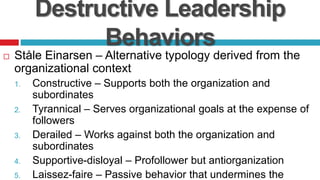
Destructive Leadership
Behaviors
 Ståle Einarsen – Alternative typology derived from the
organizational context
1. Constructive – Supports both the organization and
subordinates
2. Tyrannical – Serves organizational goals at the expense of
followers
3. Derailed – Works against both the organization and
subordinates
4. Supportive-disloyal – Profollower but antiorganization
5. Laissez-faire – Passive behavior that undermines the
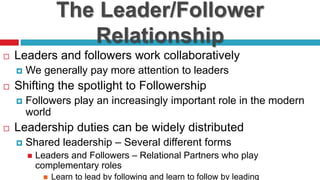
The Leader/Follower
Relationship
 Leaders and followers work collaboratively
 We generally pay more attention to leaders
 Shifting the spotlight to Followership
 Followers play an increasingly important role in the modern
world
 Leadership duties can be widely distributed
 Shared leadership – Several different forms
 Leaders and Followers – Relational Partners who play
complementary roles
 Learn to lead by following and learn to follow by leading
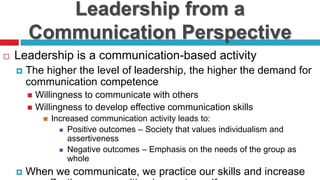
Leadership from a
Communication Perspective
 Leadership is a communication-based activity
 The higher the level of leadership, the higher the demand for
communication competence
 Willingness to communicate with others
 Willingness to develop effective communication skills
 Increased communication activity leads to:
 Positive outcomes – Society that values individualism and
assertiveness
 Negative outcomes – Emphasis on the needs of the group as
whole
 When we communicate, we practice our skills and increase
Storytelling as
Leadership Michael Harvey
 “Leaders frame stories and events to help [followers] understand
the world, themselves, and other groups, as well as to identify or
solve problems”
 Stephen Denning
 “Leadership is an “interactive” endeavor largely shaped by
narrative”
 Abstract Reasoning and Analysis are supplemented by
Storytelling
 Informal and Formal Contexts – Connect with others
Denning 8 General Categories of
Stories
1. Sparking Action
2. Communicating Who You Are
3. Communicating the Brand
4. Transmitting Values
5. Fostering Collaboration
6. Taming the Grapevine
7. Sharing Knowledge
8. Leading People into the Future
Emotional Communication
Competencies
 Multilevel Model of Emotion in Organizations (MMEO)
 Neal Ashkanasy and Peter Jordan – Effective leaders are
also skilled at sharing and responding to emotions at the five
levels of the organization:
1. Level 1 is within the Person
2. Level 2 is between Persons
3. Level 3 is the Interpersonal Level
4. Level 4 describes the Group
5. Level 5 is the Organizational Level
Logic and Emotion: Essential to
Leadership
 Skillfully blending feeling and thinking requires:
1. Perception, appraisal, and expression of emotion
2. Attending to the emotions of others
3. Emotional facilitation of thinking
4. Understanding and analyzing emotional information
and employing emotional knowledge
5. Regulation of emotion
Playing to a Packed House:
Leaders as Impression Managers
 We increase our leadership competence as we
increase our communication skills
 Dramaturgical Approach to human interaction
 Impression Management – Creation of meaning and influence
on others to achieve goals through performances
 Creates discomfort – True feelings and beliefs might be hidden
 Research says the people use it to project an image congruent
with their self-concepts – Often we have no choice to play
many roles
 Leaders can manipulate impressions to mislead the group
 Impression management should be judged by its end products
Beneficial Impression
Management
1. Promotes positive interpersonal relationships and
increases cooperation with both those inside and
outside the organization
2. Accurately portrays positive persons, events, or
products to insiders and outsiders
3. Facilitates decision making, helping management
and consumers make the right choices
Detrimental or Dysfunctional
Impression Management
1. Blocks or underestimates relationships with those
who work with or do business with the organization
2. Incorrectly casts people, events, or products in a
negative light to insiders and outsiders
3. Distorts information that results in managers and
consumers reaching wrong conclusions and/or
decisions
Don’t forget to turn in your Socrative Exit Ticket!
QUESTIONS
Leadership and Followership
Communication Styles
Chapter 2
The Dimensions of Leadership
Communication Style
 Communication styles contribute to variation in
leader effectiveness or failure to exert influence
 May reflect a philosophical belief or a strategy
 Two primary models of communication:
 Compares authoritarian, democratic and laissez-faire
styles
 Contrasts task and interpersonal leadership
communication
Authoritarian Leadership
 Maintains strict control by directly regulating policy,
procedures and behaviors
 Emphasis on role distinctions – Distance between leaders
and followers
 Followers would not function effectively without direct supervision
 Best suited for highly structured, or simple tasks, when a leader is
much more knowledgeable than the group, when the group is
extremely large, and when decision making time is limited
 Leaders can expect high productivity; increased hostility,
aggression, and discontent; and decreased commitment,
Democratic Leadership
 Engage in supportive communication that facilitates
interaction between leaders and followers
 Encourages follower involvement and participation in the
determination of goals and procedures
 Followers are capable of making informed decisions – Contributions
of others improve the overall quality of decision making
 Time consuming and cumbersome with larger groups – Best suited for
tasks that require participation and involvement, creativity and
commitment to a decision
 Leader can expect relatively high productivity, increased
Laissez-Faire Leadership
 “Leave them alone” – Nonleadership
 Abdication of responsibility on the part of the leader
 Leaders withdraw and offer little guidance or support – innovation,
productivity, cohesiveness and satisfaction often suffers
 Leader can be accused of leadership avoidance resulting in decreased
productivity and less satisfaction
 Guided Freedom
 Affords a high degree of autonomy and self-rule whole offering
guidance and support when asked
 Effective with groups of motivated and knowledgeable
experts
Six Generalizations
1. Laissez-faire and democratic leadership styles are
not the same
2. Although groups headed by authoritarian leaders
are often most efficient, democratic leaders also
achieve high efficiency
3. Groups with authoritarian leadership experience
more hostility and aggression than groups under
the other styles
Six Generalizations
4. Authoritarian-led groups may experience discontent
that is not evident on the surface
5. Followers exhibit more dependence and less
individuality under authoritarian leaders
6. Followers exhibit more commitment and
cohesiveness under democratic leaders
Task & Interpersonal
Leadership
 Leadership boils down to two primary ingredients:
 Work that needs to be done and the people who do the
work
 Task-oriented communication – Concern for
production
 Concerned with the successful completion of task
assignments
 Interpersonal-oriented communication – Concerned
for people
The Michigan Leadership
Studies
 Studies conducted shortly after WWII to discover
leadership practices that contributed to effective group
performance
 Production-oriented – Focus on task
 Emphasis on technical procedures, planning and organization
 Employee-oriented – Focus on relationships
 Interested in motivating and training followers, as well as in their
well-being, on and off work
 One-dimensional view – Opposing sets of communicative
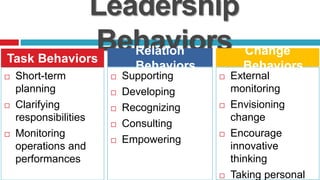
Leadership
Behaviors
 Short-term
planning
 Clarifying
responsibilities
 Monitoring
operations and
performances
 Supporting
 Developing
 Recognizing
 Consulting
 Empowering
Task Behaviors
Relation
Behaviors
 External
monitoring
 Envisioning
change
 Encourage
innovative
thinking
 Taking personal
Change
Behaviors
McGregor’s Theory X &
Theory Y
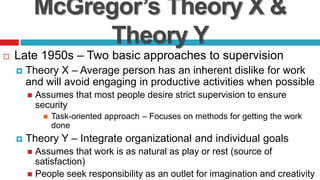
 Late 1950s – Two basic approaches to supervision
 Theory X – Average person has an inherent dislike for work
and will avoid engaging in productive activities when possible
 Assumes that most people desire strict supervision to ensure
security
 Task-oriented approach – Focuses on methods for getting the work
done
 Theory Y – Integrate organizational and individual goals
 Assumes that work is as natural as play or rest (source of
satisfaction)
 People seek responsibility as an outlet for imagination and creativity
Blake & McCanse’s Leadership
Grid
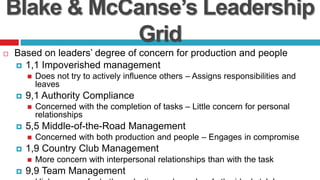
 Based on leaders’ degree of concern for production and people
 1,1 Impoverished management
 Does not try to actively influence others – Assigns responsibilities and
leaves
 9,1 Authority Compliance
 Concerned with the completion of tasks – Little concern for personal
relationships
 5,5 Middle-of-the-Road Management
 Concerned with both production and people – Engages in compromise
 1,9 Country Club Management
 More concern with interpersonal relationships than with the task
 9,9 Team Management
Follower Communication
Style
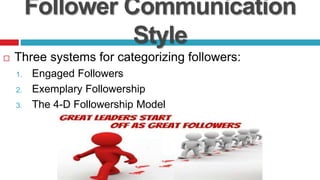
 Three systems for categorizing followers:
1. Engaged Followers
2. Exemplary Followership
3. The 4-D Followership Model
Engaged Followers
 Continuum based on how willing followers are to
engage with their leaders and their fellow followers
 Isolates – Least engaged – By not caring empower
others to decide for them
 Bystanders – Observe but do not actively participate –
Allow the status quo to continue
 Participants – Moderately engaged
 Activists – Motivated by strong feelings about their
leader
Exemplary Followership
 Followers differ in two dimensions:
 Independent/Critical Thinking
 Active Engagement
 Followers fall into one of five categories:
1. Alienated followers – Highly independent
2. Conformists – Express few thoughts of their own
3. Pragmatists – Moderately independent and engaged
4. Passive followers – Little original thought and commitment
5. Exemplary followers – Highly critical thinkers and engaged
The 4-D Followership
Model Categorizes employees according to their degree of job
satisfaction, their productivity, and turnover
 Quadrant I Disciple Followers – Focused on serving the needs of
others
 Quadrant II Doer Followers – Productive “go-getters” focused on
meeting their personal needs
 Quadrant III Disengaged Followers – Passive approach when
under stress – Detached and in state of inertia
 Quadrant IV Disgruntled Followers – Respond actively to stress –
Vocal, aggressive, and combative
 Employees are either disciples or doers and stress push them
into the disengaged or disgruntled quadrant
Communication Styles &
Information Processing
 Three concepts are crucial to understanding the
information-processing perspective:
1. The basic building blocks of knowledge are symbols (generally
words) and categories of symbols that are stored in long-term
memory and allow us to engage in conceptual thinking
2. These symbolic bits of knowledge form interconnected networks
call schemas or schemata, which assists us in interpreting and
making sense of the world
3. Schemas must be activated in order to influence perception,
attitudes, and behavior – Only a small subset of schemas can be
activated at a given time
Communication Styles &
Information Processing
 The impact of a leader’s style rest on how
subordinates interpret his/her actions
 Leaders can’t utilize an alternative style unless they have established
a schemata for the beliefs, attitudes, and behaviors of that style
 New symbolic networks can be created through training programs, books, and
videos
 Leaders must make sense of their followers through categorization
 Categorization extends to attributions about the causes for the followers’
behaviors
 To be effective, leaders must both tailor their communication styles to
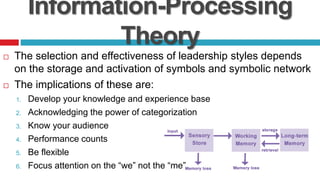
Information-Processing
Theory
 The selection and effectiveness of leadership styles depends
on the storage and activation of symbols and symbolic network
 The implications of these are:
1. Develop your knowledge and experience base
2. Acknowledging the power of categorization
3. Know your audience
4. Performance counts
5. Be flexible
6. Focus attention on the “we” not the “me”
Don’t forget to turn in your Socrative Exit Ticket!
QUESTIONS

Leadership: A communication perspective (Part I)

  • 1.
    Hackman, M. Z.,& Johnson, C. E. (2013). Leadership: A communication perspective. Waveland Press. LEADERSHIP: A COMMUNICATION PERSPECTIVE CHAPTER 1: LEADERSHIP & COMMUNICATION CHAPTER 2: LEADERSHIP AND FOLLOWERSHIP COMMUNICATION STYLES
  • 2.
  • 4.
    Defining Leadership: At theCore of Human Experience  Leadership is all around us  Integral part of human life – linked to what it means to be human  Ability to manipulate symbols  Where society exists, leadership exists  More than academic, leadership is practical  Distinct Patterns of leadership  Success often varies significantly
  • 5.
    The Nature ofthe Human Communication  Frank Dance – Symbols are abstract, arbitrary representations of reality agreed upon by human users  Meaning is created through communication, which is based on the transfer of symbols Symbolic communication is purposive and goal driven  Human leadership v. Animal leadership
  • 7.
    The Human Communication Process Dean Barnlund – 5 principles of human communication 1. Communication is not a thing, it is a process 2. Communication is not linear, it is circular 3. Communication is complex 4. Communication is irreversible 5. Communication involves the total personality
  • 8.
    Leadership: A SpecialForm of Human Communication  Joseph Rost – 221 definition between 1900-1990  Leadership is about who you are  Leadership is about how you act  Leadership is about what you do
  • 9.
    Leaders vs. Managers Leading ≠ Managing  Creating an Agenda  Developing a Human Network for Achieving the Agenda  Executing the Agenda  Managing produces orderly results while Leadership often leads to useful changes
  • 10.
    The Question of“Bad” Leadership  Leaders should be ethical and serve the common good  Bad leadership is ineffective and/or unethical  Destructive leadership – Dark side of human nature  Selfishness – Self-centeredness  Narcissistic  Machiavellianism  Cognitive Errors
  • 11.
    “Bad” Leadership…  Incompetent No desire or skill or both  Rigid  Unyielding  Intemperate  Lack of self-control  Callous  Uncaring and/or  Corrupt  Lie, cheat, and/or steal  Insular  Minimize or disregard the welfare of others outside the group  Evil  Physical/Psychologi
  • 12.
    Destructive Leadership Behaviors  StåleEinarsen – Alternative typology derived from the organizational context 1. Constructive – Supports both the organization and subordinates 2. Tyrannical – Serves organizational goals at the expense of followers 3. Derailed – Works against both the organization and subordinates 4. Supportive-disloyal – Profollower but antiorganization 5. Laissez-faire – Passive behavior that undermines the
  • 13.
    The Leader/Follower Relationship  Leadersand followers work collaboratively  We generally pay more attention to leaders  Shifting the spotlight to Followership  Followers play an increasingly important role in the modern world  Leadership duties can be widely distributed  Shared leadership – Several different forms  Leaders and Followers – Relational Partners who play complementary roles  Learn to lead by following and learn to follow by leading
  • 14.
    Leadership from a CommunicationPerspective  Leadership is a communication-based activity  The higher the level of leadership, the higher the demand for communication competence  Willingness to communicate with others  Willingness to develop effective communication skills  Increased communication activity leads to:  Positive outcomes – Society that values individualism and assertiveness  Negative outcomes – Emphasis on the needs of the group as whole  When we communicate, we practice our skills and increase
  • 15.
    Storytelling as Leadership MichaelHarvey  “Leaders frame stories and events to help [followers] understand the world, themselves, and other groups, as well as to identify or solve problems”  Stephen Denning  “Leadership is an “interactive” endeavor largely shaped by narrative”  Abstract Reasoning and Analysis are supplemented by Storytelling  Informal and Formal Contexts – Connect with others
  • 16.
    Denning 8 GeneralCategories of Stories 1. Sparking Action 2. Communicating Who You Are 3. Communicating the Brand 4. Transmitting Values 5. Fostering Collaboration 6. Taming the Grapevine 7. Sharing Knowledge 8. Leading People into the Future
  • 17.
    Emotional Communication Competencies  MultilevelModel of Emotion in Organizations (MMEO)  Neal Ashkanasy and Peter Jordan – Effective leaders are also skilled at sharing and responding to emotions at the five levels of the organization: 1. Level 1 is within the Person 2. Level 2 is between Persons 3. Level 3 is the Interpersonal Level 4. Level 4 describes the Group 5. Level 5 is the Organizational Level
  • 18.
    Logic and Emotion:Essential to Leadership  Skillfully blending feeling and thinking requires: 1. Perception, appraisal, and expression of emotion 2. Attending to the emotions of others 3. Emotional facilitation of thinking 4. Understanding and analyzing emotional information and employing emotional knowledge 5. Regulation of emotion
  • 19.
    Playing to aPacked House: Leaders as Impression Managers  We increase our leadership competence as we increase our communication skills  Dramaturgical Approach to human interaction  Impression Management – Creation of meaning and influence on others to achieve goals through performances  Creates discomfort – True feelings and beliefs might be hidden  Research says the people use it to project an image congruent with their self-concepts – Often we have no choice to play many roles  Leaders can manipulate impressions to mislead the group  Impression management should be judged by its end products
  • 20.
    Beneficial Impression Management 1. Promotespositive interpersonal relationships and increases cooperation with both those inside and outside the organization 2. Accurately portrays positive persons, events, or products to insiders and outsiders 3. Facilitates decision making, helping management and consumers make the right choices
  • 21.
    Detrimental or Dysfunctional ImpressionManagement 1. Blocks or underestimates relationships with those who work with or do business with the organization 2. Incorrectly casts people, events, or products in a negative light to insiders and outsiders 3. Distorts information that results in managers and consumers reaching wrong conclusions and/or decisions
  • 22.
    Don’t forget toturn in your Socrative Exit Ticket! QUESTIONS
  • 23.
  • 24.
    The Dimensions ofLeadership Communication Style  Communication styles contribute to variation in leader effectiveness or failure to exert influence  May reflect a philosophical belief or a strategy  Two primary models of communication:  Compares authoritarian, democratic and laissez-faire styles  Contrasts task and interpersonal leadership communication
  • 26.
    Authoritarian Leadership  Maintainsstrict control by directly regulating policy, procedures and behaviors  Emphasis on role distinctions – Distance between leaders and followers  Followers would not function effectively without direct supervision  Best suited for highly structured, or simple tasks, when a leader is much more knowledgeable than the group, when the group is extremely large, and when decision making time is limited  Leaders can expect high productivity; increased hostility, aggression, and discontent; and decreased commitment,
  • 27.
    Democratic Leadership  Engagein supportive communication that facilitates interaction between leaders and followers  Encourages follower involvement and participation in the determination of goals and procedures  Followers are capable of making informed decisions – Contributions of others improve the overall quality of decision making  Time consuming and cumbersome with larger groups – Best suited for tasks that require participation and involvement, creativity and commitment to a decision  Leader can expect relatively high productivity, increased
  • 28.
    Laissez-Faire Leadership  “Leavethem alone” – Nonleadership  Abdication of responsibility on the part of the leader  Leaders withdraw and offer little guidance or support – innovation, productivity, cohesiveness and satisfaction often suffers  Leader can be accused of leadership avoidance resulting in decreased productivity and less satisfaction  Guided Freedom  Affords a high degree of autonomy and self-rule whole offering guidance and support when asked  Effective with groups of motivated and knowledgeable experts
  • 30.
    Six Generalizations 1. Laissez-faireand democratic leadership styles are not the same 2. Although groups headed by authoritarian leaders are often most efficient, democratic leaders also achieve high efficiency 3. Groups with authoritarian leadership experience more hostility and aggression than groups under the other styles
  • 31.
    Six Generalizations 4. Authoritarian-ledgroups may experience discontent that is not evident on the surface 5. Followers exhibit more dependence and less individuality under authoritarian leaders 6. Followers exhibit more commitment and cohesiveness under democratic leaders
  • 32.
    Task & Interpersonal Leadership Leadership boils down to two primary ingredients:  Work that needs to be done and the people who do the work  Task-oriented communication – Concern for production  Concerned with the successful completion of task assignments  Interpersonal-oriented communication – Concerned for people
  • 33.
    The Michigan Leadership Studies Studies conducted shortly after WWII to discover leadership practices that contributed to effective group performance  Production-oriented – Focus on task  Emphasis on technical procedures, planning and organization  Employee-oriented – Focus on relationships  Interested in motivating and training followers, as well as in their well-being, on and off work  One-dimensional view – Opposing sets of communicative
  • 34.
    Leadership Behaviors  Short-term planning  Clarifying responsibilities Monitoring operations and performances  Supporting  Developing  Recognizing  Consulting  Empowering Task Behaviors Relation Behaviors  External monitoring  Envisioning change  Encourage innovative thinking  Taking personal Change Behaviors
  • 35.
    McGregor’s Theory X& Theory Y  Late 1950s – Two basic approaches to supervision  Theory X – Average person has an inherent dislike for work and will avoid engaging in productive activities when possible  Assumes that most people desire strict supervision to ensure security  Task-oriented approach – Focuses on methods for getting the work done  Theory Y – Integrate organizational and individual goals  Assumes that work is as natural as play or rest (source of satisfaction)  People seek responsibility as an outlet for imagination and creativity
  • 36.
    Blake & McCanse’sLeadership Grid  Based on leaders’ degree of concern for production and people  1,1 Impoverished management  Does not try to actively influence others – Assigns responsibilities and leaves  9,1 Authority Compliance  Concerned with the completion of tasks – Little concern for personal relationships  5,5 Middle-of-the-Road Management  Concerned with both production and people – Engages in compromise  1,9 Country Club Management  More concern with interpersonal relationships than with the task  9,9 Team Management
  • 37.
    Follower Communication Style  Threesystems for categorizing followers: 1. Engaged Followers 2. Exemplary Followership 3. The 4-D Followership Model
  • 38.
    Engaged Followers  Continuumbased on how willing followers are to engage with their leaders and their fellow followers  Isolates – Least engaged – By not caring empower others to decide for them  Bystanders – Observe but do not actively participate – Allow the status quo to continue  Participants – Moderately engaged  Activists – Motivated by strong feelings about their leader
  • 39.
    Exemplary Followership  Followersdiffer in two dimensions:  Independent/Critical Thinking  Active Engagement  Followers fall into one of five categories: 1. Alienated followers – Highly independent 2. Conformists – Express few thoughts of their own 3. Pragmatists – Moderately independent and engaged 4. Passive followers – Little original thought and commitment 5. Exemplary followers – Highly critical thinkers and engaged
  • 40.
    The 4-D Followership ModelCategorizes employees according to their degree of job satisfaction, their productivity, and turnover  Quadrant I Disciple Followers – Focused on serving the needs of others  Quadrant II Doer Followers – Productive “go-getters” focused on meeting their personal needs  Quadrant III Disengaged Followers – Passive approach when under stress – Detached and in state of inertia  Quadrant IV Disgruntled Followers – Respond actively to stress – Vocal, aggressive, and combative  Employees are either disciples or doers and stress push them into the disengaged or disgruntled quadrant
  • 41.
    Communication Styles & InformationProcessing  Three concepts are crucial to understanding the information-processing perspective: 1. The basic building blocks of knowledge are symbols (generally words) and categories of symbols that are stored in long-term memory and allow us to engage in conceptual thinking 2. These symbolic bits of knowledge form interconnected networks call schemas or schemata, which assists us in interpreting and making sense of the world 3. Schemas must be activated in order to influence perception, attitudes, and behavior – Only a small subset of schemas can be activated at a given time
  • 42.
    Communication Styles & InformationProcessing  The impact of a leader’s style rest on how subordinates interpret his/her actions  Leaders can’t utilize an alternative style unless they have established a schemata for the beliefs, attitudes, and behaviors of that style  New symbolic networks can be created through training programs, books, and videos  Leaders must make sense of their followers through categorization  Categorization extends to attributions about the causes for the followers’ behaviors  To be effective, leaders must both tailor their communication styles to
  • 43.
    Information-Processing Theory  The selectionand effectiveness of leadership styles depends on the storage and activation of symbols and symbolic network  The implications of these are: 1. Develop your knowledge and experience base 2. Acknowledging the power of categorization 3. Know your audience 4. Performance counts 5. Be flexible 6. Focus attention on the “we” not the “me”
  • 44.
    Don’t forget toturn in your Socrative Exit Ticket! QUESTIONS

Editor's Notes

  • #7  Poll Title: Give one characteristic of a leader? https://www.polleverywhere.com/free_text_polls/RY1ZlNjCtuFolbO
  • #30  Poll Title: Give an example of a Leader and its Leadership Style https://www.polleverywhere.com/free_text_polls/OJygGpsUGlts8ut
  • #39 What two elements make a good follower? Engagement and Motivation
  • #40 What are the three sets of skills and values that characterize exemplary followers? p. 59