“I know that you believe that you understand
what you think I said, but I’m not sure you
realize that what you heard is not what I meant.”
- Richard Nixon
Chapter 13Chapter 13
Effective LanguageEffective Language
What does this mean?What does this mean?
I was on my way to the doctor with rear
end problems when my universal joint
gave way, causing me to have an
accident.
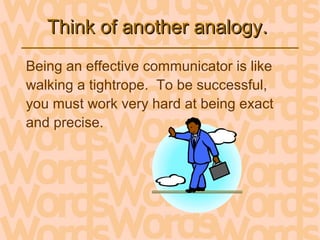
Think of another analogy.Think of another analogy.
Being an effective communicator is like
walking a tightrope. To be successful,
you must work very hard at being exact
and precise.
What are advantages of the written word?What are advantages of the written word?
 You have time to
consider what it
means
 Punctuation clarifies
 But 90% of
communication is
not written
The average person has a vocabulary
of approximately how many words?
Average VocabularyAverage Vocabulary
 10,000 words
 If you want to be effective, choose the
right ones.
 Be accurate!
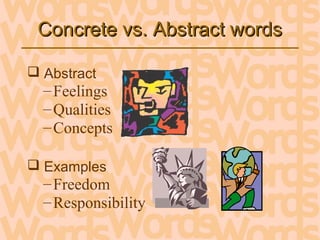
Concrete vs. Abstract wordsConcrete vs. Abstract words
 Abstract
–Feelings
–Qualities
–Concepts
 Examples
–Freedom
–Responsibility
Concrete vs. Abstract wordsConcrete vs. Abstract words
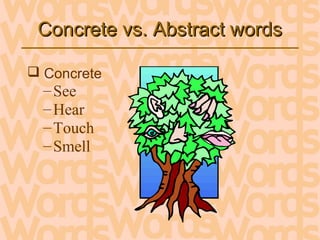
 Concrete
–See
–Hear
–Touch
–Smell
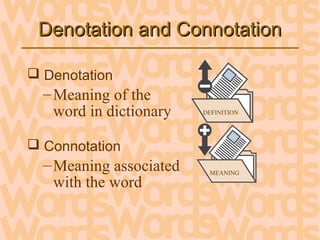
Denotation and ConnotationDenotation and Connotation
 Denotation
–Meaning of the
word in dictionary
 Connotation
–Meaning associated
with the word
MEANING
DEFINITION
What are associations with …What are associations with …
 Mother
 Success
Choose the Right WordChoose the Right Word
 Have “economy of language”
 What does that mean to you?
WORDS
Rewrite these statementsRewrite these statements
 At the beginning of the day, before I
have my breakfast, I always work to
keep my blood circulating and my body
fit.
Rewrite these statementsRewrite these statements
 Because of the way you look and
because we have had so much fun
together, you and I might not find it a
bad thing to talk and do stuff together.
ImageryImagery
 Language that creates pictures
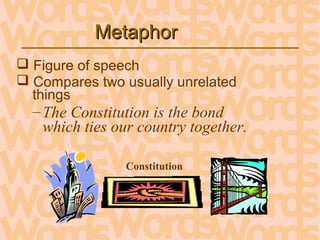
MetaphorMetaphor
 Figure of speech
 Compares two usually unrelated
things
–The Constitution is the bond
which ties our country together.
Constitution
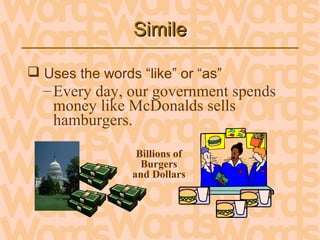
SimileSimile
 Uses the words “like” or “as”
–Every day, our government spends
money like McDonalds sells
hamburgers.
Billions of
Burgers
and Dollars
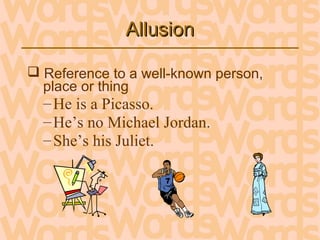
AllusionAllusion
 Reference to a well-known person,
place or thing
–He is a Picasso.
–He’s no Michael Jordan.
–She’s his Juliet.
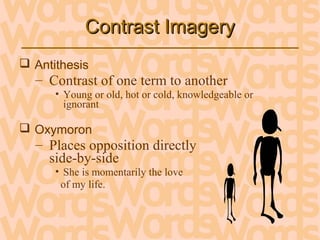
Contrast ImageryContrast Imagery
 Antithesis
– Contrast of one term to another
• Young or old, hot or cold, knowledgeable or
ignorant
 Oxymoron
– Places opposition directly
side-by-side
• She is momentarily the love
of my life.
Contrast ImageryContrast Imagery
 Irony
–Things that imply the opposite of
what they seem to say on the surface
• Reporting on a lawsuit against the Motley
Crue by someone who attended a 1992
concert, for damage to his hearing, the
reporter said, ‘Yes, you certainly wouldn’t
go to a rock concert expecting to hear loud
music, now would you?”
Exaggeration ImageryExaggeration Imagery
 Hyperbole
–Exaggeration of the truth
–“I am so hungry I could eat a horse.”
 Understatement
–Opposite of hyperbole
–“Michael Jordan is a fairly decent
basketball player.”
Exaggeration ImageryExaggeration Imagery
 Personification
–Giving human characteristics to non-
human things
• The eyes of profit are deceiving.
• Don’t allow dishonesty to sneak up on you.
Music with Words–Music with Words–
Sound DevicesSound Devices
 Repeating individual sounds
–Alliteration: repeat initial sounds
• A corporation must care about the consumer.
–Assonance: repeat vowel sounds
• We believe that peace means a chance for all the
oppressed people of the world. (long e sound)
Music with Words –Music with Words –
Sound DevicesSound Devices
 Repeating individual sounds
–Consonance: repeat consonants
 Repeating Words or Groups of Words
– Do not ask what our country can do for
you; ask what you can do for your country.
– Treat your car with care and your car will
take care of you.
“CCCCCCCCC”
Repeating Word GroupsRepeating Word Groups
 Parallelism
– Using the same grammatical
form to express ideas that
should be treated equally
 Gettysburg Address
– “We cannot dedicate–we
cannot consecrate–we
cannot hallow this ground.”
– This is a driving cadence
Language to AvoidLanguage to Avoid
 Jargon
–Used in a line of work
 Slang
–Associated with groups
 Euphemism
–Words we substitute for harsh or
distasteful words
 Sexist, shocking or obscene language
Recalling the FactsRecalling the Facts
 What is like walking a tightrope?
 What are the advantages of the written word?
 Along with accuracy of language what helps
create a positive speaking impression?
 What is the difference between concrete and
abstract words?
 What is the difference between the connotation
and the denotation of a word?
 What are the three types of imagery?
 What, in addition to imagery, is important for
effective speaking?
 Name the types of repetition in language.
 What types of language should be avoided?
Look Back on Page 366 of textbook
VocabularyVocabulary
concrete word
abstract word
denotation
connotation
metaphor
imagery
simile
allusion
antithesis
oxymoron
irony
understatement
hyperbole
euphemism
alliteration
assonance
consonance
parallelism
jargon
slang
List on Page 339 of textbook

Chp 13 language

  • 1.
    “I know thatyou believe that you understand what you think I said, but I’m not sure you realize that what you heard is not what I meant.” - Richard Nixon Chapter 13Chapter 13 Effective LanguageEffective Language
  • 2.
    What does thismean?What does this mean? I was on my way to the doctor with rear end problems when my universal joint gave way, causing me to have an accident.
  • 3.
    Think of anotheranalogy.Think of another analogy. Being an effective communicator is like walking a tightrope. To be successful, you must work very hard at being exact and precise.
  • 4.
    What are advantagesof the written word?What are advantages of the written word?  You have time to consider what it means  Punctuation clarifies  But 90% of communication is not written
  • 5.
    The average personhas a vocabulary of approximately how many words?
  • 6.
    Average VocabularyAverage Vocabulary 10,000 words  If you want to be effective, choose the right ones.  Be accurate!
  • 7.
    Concrete vs. AbstractwordsConcrete vs. Abstract words  Abstract –Feelings –Qualities –Concepts  Examples –Freedom –Responsibility
  • 8.
    Concrete vs. AbstractwordsConcrete vs. Abstract words  Concrete –See –Hear –Touch –Smell
  • 9.
    Denotation and ConnotationDenotationand Connotation  Denotation –Meaning of the word in dictionary  Connotation –Meaning associated with the word MEANING DEFINITION
  • 10.
    What are associationswith …What are associations with …  Mother  Success
  • 11.
    Choose the RightWordChoose the Right Word  Have “economy of language”  What does that mean to you? WORDS
  • 12.
    Rewrite these statementsRewritethese statements  At the beginning of the day, before I have my breakfast, I always work to keep my blood circulating and my body fit.
  • 13.
    Rewrite these statementsRewritethese statements  Because of the way you look and because we have had so much fun together, you and I might not find it a bad thing to talk and do stuff together.
  • 14.
  • 15.
    MetaphorMetaphor  Figure ofspeech  Compares two usually unrelated things –The Constitution is the bond which ties our country together. Constitution
  • 16.
    SimileSimile  Uses thewords “like” or “as” –Every day, our government spends money like McDonalds sells hamburgers. Billions of Burgers and Dollars
  • 17.
    AllusionAllusion  Reference toa well-known person, place or thing –He is a Picasso. –He’s no Michael Jordan. –She’s his Juliet.
  • 18.
    Contrast ImageryContrast Imagery Antithesis – Contrast of one term to another • Young or old, hot or cold, knowledgeable or ignorant  Oxymoron – Places opposition directly side-by-side • She is momentarily the love of my life.
  • 19.
    Contrast ImageryContrast Imagery Irony –Things that imply the opposite of what they seem to say on the surface • Reporting on a lawsuit against the Motley Crue by someone who attended a 1992 concert, for damage to his hearing, the reporter said, ‘Yes, you certainly wouldn’t go to a rock concert expecting to hear loud music, now would you?”
  • 20.
    Exaggeration ImageryExaggeration Imagery Hyperbole –Exaggeration of the truth –“I am so hungry I could eat a horse.”  Understatement –Opposite of hyperbole –“Michael Jordan is a fairly decent basketball player.”
  • 21.
    Exaggeration ImageryExaggeration Imagery Personification –Giving human characteristics to non- human things • The eyes of profit are deceiving. • Don’t allow dishonesty to sneak up on you.
  • 22.
    Music with Words–Musicwith Words– Sound DevicesSound Devices  Repeating individual sounds –Alliteration: repeat initial sounds • A corporation must care about the consumer. –Assonance: repeat vowel sounds • We believe that peace means a chance for all the oppressed people of the world. (long e sound)
  • 23.
    Music with Words–Music with Words – Sound DevicesSound Devices  Repeating individual sounds –Consonance: repeat consonants  Repeating Words or Groups of Words – Do not ask what our country can do for you; ask what you can do for your country. – Treat your car with care and your car will take care of you. “CCCCCCCCC”
  • 24.
    Repeating Word GroupsRepeatingWord Groups  Parallelism – Using the same grammatical form to express ideas that should be treated equally  Gettysburg Address – “We cannot dedicate–we cannot consecrate–we cannot hallow this ground.” – This is a driving cadence
  • 25.
    Language to AvoidLanguageto Avoid  Jargon –Used in a line of work  Slang –Associated with groups  Euphemism –Words we substitute for harsh or distasteful words  Sexist, shocking or obscene language
  • 26.
    Recalling the FactsRecallingthe Facts  What is like walking a tightrope?  What are the advantages of the written word?  Along with accuracy of language what helps create a positive speaking impression?  What is the difference between concrete and abstract words?  What is the difference between the connotation and the denotation of a word?  What are the three types of imagery?  What, in addition to imagery, is important for effective speaking?  Name the types of repetition in language.  What types of language should be avoided? Look Back on Page 366 of textbook
  • 27.