LEADERSHIP
Leadership is one of the most observed
and least understood phenomena on earth
Influence, vision, mission and goals are
usually present in the definition of
leadership.
Difference of a manager and a leader:
To manage means to bring about, to accomplish,
to have charge of or responsibility for to conduct,
while to lead means to influence, guide direction,
course, action, opinion.
Manager- needed to ensure that the organization
operates well on a day-to-day basis.
Leader- Light the way to the future and to inspire
people to achieve excellence
Major role of a Leader:
1. A leader must exercise power wisely and
efficiently.
A leader must be temperate and fair, must be
objective and see that they are carried out, and
must make good decisions.
2. Each leader must, through actions,
appearance and articulated values, present a
model that others will want to emulate.
Trait approach to the study of leadership:
Leaders were born not made
Only those who possess leadership traits
could be a leader.
Many traits studies were conducted, and traits
that were said to be associated with leadership,
such as energy, aggressiveness, persistence,
initiative, appearance and height were identified.
Fifty years of study have failed to produce one
personality trait or set of qualities that can be
used to discriminate between leaders and non-
leaders.
Ohio state and University of Michigan
Studies:
This research examined the behavior of
leaders: what they do, what they
emphasize, and how they relate to
subordinates.
“ To be an effective leader, you don’t have to be a hero
with all the answers, and you don’t have to be a cop
overseeing clones, instead, imagine that your job is to
create an environment where your people take on the
responsibility to work productively in self-managed, self-
starting teams that identify and solve complex problems
on their own. If you concentrate on doing this, you’ll find
your people will need you only for periodic guidance
and inspiration which frees you to spend your time
confronting big picture, common fate sorts of strategic
organizational issues.”
-Oren Harani-
Likert Theory of management:
Management primary responsibility is to assure
the best use of the organization’s resources,
including its human resources.
Strong centralized control of employees is not
the best way to achieve operational efficiency or
sustained productivity.
Four prevailing management styles:
1. System 1 management: exploitative-
authoritative
Management has no trust or confidence in
subordinates
Managers are autocratic, and almost all decisions
are made at the top of the organizations.
Four prevailing management styles:
2. System 2 management is benevolent-
authoritative:
Management is condescending to employees who
are expected to be loyal, compliant and subservient.
3. System 3 is consultative:
Management has substantial but not total trust in
subordinates.
Top management still makes most of the major
decisions, but often solicits ideas from subordinates.
Four prevailing management styles:
4. System 4 participative:
Managers have complete trust in subordinates, and
much of the decision making is accomplished by
group participation.
The leadership grid:
In 1914, Robert R. Blake and Jane S. Mouton
published “ The Management Grid”
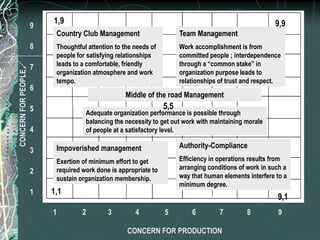
This theory involve two primary concerns of the
organization: concern for production and
concern for people.
Using this grid, managers at any level should be
able to identify their level of concern for people
and for productivity.
Country Club Management
Thoughtful attention to the needs of
people for satisfying relationships
leads to a comfortable, friendly
organization atmosphere and work
tempo.
Team Management
Work accomplishment is from
committed people ; interdependence
through a “common stake” in
organization purpose leads to
relationships of trust and respect.
9
8
7
6
5
4
3
2
1
1 2 3 4 5 6 7 8 9
Middle of the road Management
1,9 9,9
1,1
9,1
Adequate organization performance is possible through
balancing the necessity to get out work with maintaining morale
of people at a satisfactory level.
Impoverished management
Exertion of minimum effort to get
required work done is appropriate to
sustain organization membership.
Authority-Compliance
Efficiency in operations results from
arranging conditions of work in such a
way that human elements interfere to a
minimum degree.
5,5
CONCERN FOR PRODUCTION
CONCERNFORPEOPLE
Transformational leadership:
Two types of leadership style:
1. Transformational leaders
Skilled at getting subordinates to transform their
own self- interest into the interest of the larger
group.
Brings out the best in their subordinates.
Transformational leadership:
Two types of leadership style:
2. Win-win situation
States that an organization with an effective leader,
one whose vision is accepted by the followers, will
empower the employees and make them feel
significant, engage in learning and feel competent,
feel part of a team and feel work is exciting,
challenging, fascinating and fun.
Fiedler’s Leadership Contingency Model:
There is no single ideal type of leader but,
instead, a number of leadership styles may
be appropriate, depending on the situation.
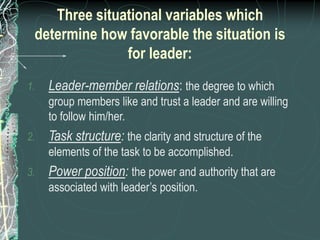
Three situational variables which
determine how favorable the situation is
for leader:
1. Leader-member relations: the degree to which
group members like and trust a leader and are willing
to follow him/her.
2. Task structure: the clarity and structure of the
elements of the task to be accomplished.
3. Power position: the power and authority that are
associated with leader’s position.
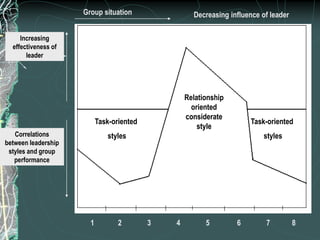
1 2 3 4 5 6 7 8
Increasing
effectiveness of
leader
Correlations
between leadership
styles and group
performance
Task-oriented
styles
Task-oriented
styles
Relationship
oriented
considerate
style
Group situation Decreasing influence of leader
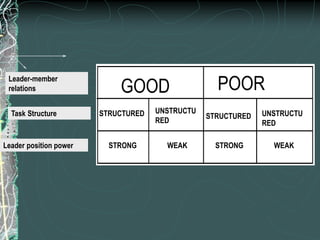
GOOD POOR
STRUCTURED UNSTRUCTU
RED
STRUCTURED UNSTRUCTU
RED
STRONG WEAK STRONG WEAK
Leader-member
relations
Task Structure
Leader position power
“ In very favorable conditions, where the leader has
power, informal backing, and a relatively well-
structured task, the group is ready to be directed
on how to go about its task. Under a very
favorable condition, however, the group will fall
apart unless the leader’s active intervention and
control can keep the members on the job. In
moderately favorable conditions…a relationship-
oriented, nondirective, permissive attitude may
reduce member anxiety or intra-group conflict,
and this enables the group to operate more
effectively.”
The leadership challenge:
Society is suffering from a leadership crisis.
People are dissatisfied with their leaders and
confused about the type of leadership they want.
The present is basically an anti-authoritarian
age, it is not surprising that it is easier to
diagnose the need for more effective leadership
than to effect the cure.
COMMUNICATION
The process of creating and exchanging
message with in a network of interdependent
relationships to cope with environmental
uncertainty.
The means by which people are linked together
in an organization in order to achieve a central
purpose.
The process that makes it possible to unify
organizational activity
Life-blood of organizations
Communication models includes:
Source
Sender of the message. The source has some
thought, need or information to communicate.
Message
The source has to encode the message in some
form that can be understood by both sender and
receiver.
Communication models includes:
The channel
The link between the source and the receiver. The
message is transmitted over the channel.
Receiver
Recipient of the message. The receiver has to
decode the message for it to be understood.
Noise
Anything that hinders communication
Communication models includes:
Feedback
After the receiver receives and decodes the
message, the receiver can become a source and
provide feedback by encoding and sending a
message through same channel back to the original
source.
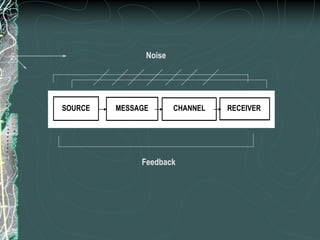
Noise
Feedback
SOURCE MESSAGE CHANNEL RECEIVER
Types of communication:
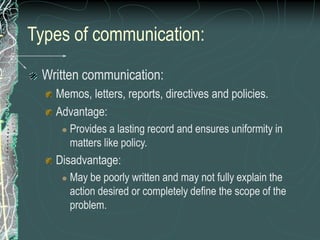
Written communication:
Memos, letters, reports, directives and policies.
Advantage:
 Provides a lasting record and ensures uniformity in
matters like policy.
Disadvantage:
 May be poorly written and may not fully explain the
action desired or completely define the scope of the
problem.
Types of communication:
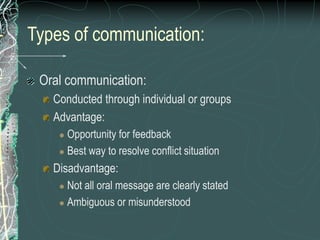
Oral communication:
Conducted through individual or groups
Advantage:
 Opportunity for feedback
 Best way to resolve conflict situation
Disadvantage:
 Not all oral message are clearly stated
 Ambiguous or misunderstood
Types of communication:
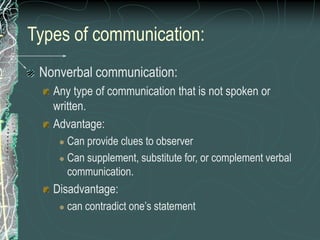
Nonverbal communication:
Any type of communication that is not spoken or
written.
Advantage:
 Can provide clues to observer
 Can supplement, substitute for, or complement verbal
communication.
Disadvantage:
 can contradict one’s statement
Communication flows:
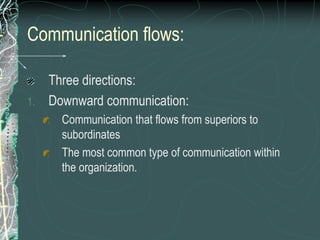
Three directions:
1. Downward communication:
Communication that flows from superiors to
subordinates
The most common type of communication within
the organization.
Five types of downward communication:
Specific job directives or job instruction
Job rationale- information designed to produce
understanding of the task and the relationship to
other organizational tasks.
Information about organizational procedures and
practices
Feedback to the subordinates about
performance
Five types of downward communication:
Information and ideological character to
inculcate a sense of mission, or indoctrination of
goals.
Communication flows:
Three directions:
2. Upward communication:
Consists of messages that flow from subordinates to
superiors.
3. Horizontal communication:
The lateral exchange of information within an
organization.
Fulfills the following purposes:
 Task coordination
 Problem solving
 Information sharing
 Conflict resolution
Informal organizational communication
Commonly known as the “grapevine”
Not as predictable nor as neatly designed as
those of the formal communication structure,
they are remarkably efficient at moving
information.
Essential human need for information.
Manager’s task is to make grapevine contribute
to the accomplishment of the organization’s
objectives.
Conflict
A state of open, often prolonged fighting
A state of disharmony between incompatible or
antithetical persons, ideas, or interests
One of the most common results of poor
communication.
Conflict is usually characterized as being either
interpersonal or intergroup.
Interpersonal conflict:
Conflict of two people, is often the result of
incompatible personalities or different values or
points or view.
Intergroup conflict:
conflict between groups of employees, often arises
because of competition over scarce resources.
Five types of handling conflict:
Avoiding
Compromisers: try to split differences down the
middle
Competing: enjoy conflict
Accommodators: almost always give in to
opposition
Collaborators: try to work to find a satisfactory
outcome for all parties.
Kind of outcome Negotiators seek:
Win-Lose Negotiators:
Want to take home the bacon. Their minds are totally
fixed on victory.
Lose-Win Negotiators:
Gain what they want by losing.
Passive negotiators
Kind of outcome Negotiators seek:
Lose-Lose Negotiators:
Can’t stand the thought of the other person’s
winning, but they don’t want to win, either.
Win-Win Negotiators:
Want both parties to the negotiation to walk away
with enough to show for his efforts for him to still be
friends and partners.
Negative effect:
Brings stress and diverts employees attention
The morale of employees suffer, as well as their
motivation to perform well.
Conflict between departments can cause groups
to close ranks and hamper cooperation.
Positive effect:
Can bring previously hidden problems to light so
that solutions may be sought.
Essential to innovation; innovation takes place
when different ideas, perceptions, and ways of
processing and judging information collide.”
New methods of directing in Modern
Organizations:
Modern managers have taken the three major
elements of directing—motivating, leading and
communicating– and have used them as the
foundations to help reshape modern
organization.
Participative management:
Participative management is both philosophy
and method for managing resources in an
environment in which employees are respected
and their contributions valued and utilized.
Centers on the belief that people at all levels of
an organization can develop genuine interest in
its success and can do more than merely
perform their assigned duties.
Elements of a “well managed” systems:
From Rosabeth Moss Kanters
A clearly assigned structure and involvement of
the appropriate line people
Assignment of meaningful and manageable
tasks with clear boundaries and parameters
A time frame, a set of accountability and
reporting relationships and standards that
groups must meet.
Elements of a “well managed” systems:
Information and training for participation
A mechanism for involving all those with a stake
in the issue, to avoid in the problems of power
and to ensure that those who have input or
interest a chance to get involved
A mechanism for providing visibility, recognition,
and rewards for team effort
Elements of a “well managed” systems:
Clearly understood processes for the information
of participative group ending and the transfer of
the learning from them.
Japanese management
Japanese enjoyed long term security
Great emphasis was placed on seniority
Japanese employers tended to treat their
employees in a paternalistic manner, showing
concern fro employees both off and on the job.
Imbuing employees with values, including
importance of teamwork, loyalty, and a sense of
family. Decision making was based on the
concept that change and new ideas should come
primarily from below.
Quality Circles:
Quality circle concept were originally designed to
deal with problems to product quality.
A quality circle is a group of employees (usually 7 to
15 people) from the same work area who meet
regularly and voluntarily to identify, solve, and
implement solutions to work-related problems.
The QC leader usually is a supervisor who is trained
by some one experienced in the QC process. The
leader trains the circle member
Quality Circles:
Ouchi’s Theory Z:
Job security and opportunity for advancement within
the organization to produce strong employee
commitment to organizational goals and purposes.
The use of group dynamics, particularly the quality
circle approach to high-quality products
Shrewd world market penetration
The adaptation of management principles and
techniques to the national culture
“ The basic philosophy underlying quality circles is
that quality awareness through participative
management can not only identify the problem
situations but can also assist management in
solving them. As Theory Y discipline, the quality
circle concept recognizes that people know their
jobs best and want to contribute to the success
of their company, if given the chance to do so.

Leadership

  • 1.
  • 2.
    Leadership is oneof the most observed and least understood phenomena on earth Influence, vision, mission and goals are usually present in the definition of leadership.
  • 3.
    Difference of amanager and a leader: To manage means to bring about, to accomplish, to have charge of or responsibility for to conduct, while to lead means to influence, guide direction, course, action, opinion. Manager- needed to ensure that the organization operates well on a day-to-day basis. Leader- Light the way to the future and to inspire people to achieve excellence
  • 4.
    Major role ofa Leader: 1. A leader must exercise power wisely and efficiently. A leader must be temperate and fair, must be objective and see that they are carried out, and must make good decisions. 2. Each leader must, through actions, appearance and articulated values, present a model that others will want to emulate.
  • 5.
    Trait approach tothe study of leadership: Leaders were born not made Only those who possess leadership traits could be a leader.
  • 6.
    Many traits studieswere conducted, and traits that were said to be associated with leadership, such as energy, aggressiveness, persistence, initiative, appearance and height were identified. Fifty years of study have failed to produce one personality trait or set of qualities that can be used to discriminate between leaders and non- leaders.
  • 7.
    Ohio state andUniversity of Michigan Studies: This research examined the behavior of leaders: what they do, what they emphasize, and how they relate to subordinates.
  • 8.
    “ To bean effective leader, you don’t have to be a hero with all the answers, and you don’t have to be a cop overseeing clones, instead, imagine that your job is to create an environment where your people take on the responsibility to work productively in self-managed, self- starting teams that identify and solve complex problems on their own. If you concentrate on doing this, you’ll find your people will need you only for periodic guidance and inspiration which frees you to spend your time confronting big picture, common fate sorts of strategic organizational issues.” -Oren Harani-
  • 9.
    Likert Theory ofmanagement: Management primary responsibility is to assure the best use of the organization’s resources, including its human resources. Strong centralized control of employees is not the best way to achieve operational efficiency or sustained productivity.
  • 10.
    Four prevailing managementstyles: 1. System 1 management: exploitative- authoritative Management has no trust or confidence in subordinates Managers are autocratic, and almost all decisions are made at the top of the organizations.
  • 11.
    Four prevailing managementstyles: 2. System 2 management is benevolent- authoritative: Management is condescending to employees who are expected to be loyal, compliant and subservient. 3. System 3 is consultative: Management has substantial but not total trust in subordinates. Top management still makes most of the major decisions, but often solicits ideas from subordinates.
  • 12.
    Four prevailing managementstyles: 4. System 4 participative: Managers have complete trust in subordinates, and much of the decision making is accomplished by group participation.
  • 13.
    The leadership grid: In1914, Robert R. Blake and Jane S. Mouton published “ The Management Grid” This theory involve two primary concerns of the organization: concern for production and concern for people. Using this grid, managers at any level should be able to identify their level of concern for people and for productivity.
  • 14.
    Country Club Management Thoughtfulattention to the needs of people for satisfying relationships leads to a comfortable, friendly organization atmosphere and work tempo. Team Management Work accomplishment is from committed people ; interdependence through a “common stake” in organization purpose leads to relationships of trust and respect. 9 8 7 6 5 4 3 2 1 1 2 3 4 5 6 7 8 9 Middle of the road Management 1,9 9,9 1,1 9,1 Adequate organization performance is possible through balancing the necessity to get out work with maintaining morale of people at a satisfactory level. Impoverished management Exertion of minimum effort to get required work done is appropriate to sustain organization membership. Authority-Compliance Efficiency in operations results from arranging conditions of work in such a way that human elements interfere to a minimum degree. 5,5 CONCERN FOR PRODUCTION CONCERNFORPEOPLE
  • 15.
    Transformational leadership: Two typesof leadership style: 1. Transformational leaders Skilled at getting subordinates to transform their own self- interest into the interest of the larger group. Brings out the best in their subordinates.
  • 16.
    Transformational leadership: Two typesof leadership style: 2. Win-win situation States that an organization with an effective leader, one whose vision is accepted by the followers, will empower the employees and make them feel significant, engage in learning and feel competent, feel part of a team and feel work is exciting, challenging, fascinating and fun.
  • 17.
    Fiedler’s Leadership ContingencyModel: There is no single ideal type of leader but, instead, a number of leadership styles may be appropriate, depending on the situation.
  • 18.
    Three situational variableswhich determine how favorable the situation is for leader: 1. Leader-member relations: the degree to which group members like and trust a leader and are willing to follow him/her. 2. Task structure: the clarity and structure of the elements of the task to be accomplished. 3. Power position: the power and authority that are associated with leader’s position.
  • 19.
    1 2 34 5 6 7 8 Increasing effectiveness of leader Correlations between leadership styles and group performance Task-oriented styles Task-oriented styles Relationship oriented considerate style Group situation Decreasing influence of leader
  • 20.
    GOOD POOR STRUCTURED UNSTRUCTU RED STRUCTUREDUNSTRUCTU RED STRONG WEAK STRONG WEAK Leader-member relations Task Structure Leader position power
  • 21.
    “ In veryfavorable conditions, where the leader has power, informal backing, and a relatively well- structured task, the group is ready to be directed on how to go about its task. Under a very favorable condition, however, the group will fall apart unless the leader’s active intervention and control can keep the members on the job. In moderately favorable conditions…a relationship- oriented, nondirective, permissive attitude may reduce member anxiety or intra-group conflict, and this enables the group to operate more effectively.”
  • 22.
    The leadership challenge: Societyis suffering from a leadership crisis. People are dissatisfied with their leaders and confused about the type of leadership they want. The present is basically an anti-authoritarian age, it is not surprising that it is easier to diagnose the need for more effective leadership than to effect the cure.
  • 23.
  • 24.
    The process ofcreating and exchanging message with in a network of interdependent relationships to cope with environmental uncertainty. The means by which people are linked together in an organization in order to achieve a central purpose. The process that makes it possible to unify organizational activity Life-blood of organizations
  • 25.
    Communication models includes: Source Senderof the message. The source has some thought, need or information to communicate. Message The source has to encode the message in some form that can be understood by both sender and receiver.
  • 26.
    Communication models includes: Thechannel The link between the source and the receiver. The message is transmitted over the channel. Receiver Recipient of the message. The receiver has to decode the message for it to be understood. Noise Anything that hinders communication
  • 27.
    Communication models includes: Feedback Afterthe receiver receives and decodes the message, the receiver can become a source and provide feedback by encoding and sending a message through same channel back to the original source.
  • 28.
  • 29.
    Types of communication: Writtencommunication: Memos, letters, reports, directives and policies. Advantage:  Provides a lasting record and ensures uniformity in matters like policy. Disadvantage:  May be poorly written and may not fully explain the action desired or completely define the scope of the problem.
  • 30.
    Types of communication: Oralcommunication: Conducted through individual or groups Advantage:  Opportunity for feedback  Best way to resolve conflict situation Disadvantage:  Not all oral message are clearly stated  Ambiguous or misunderstood
  • 31.
    Types of communication: Nonverbalcommunication: Any type of communication that is not spoken or written. Advantage:  Can provide clues to observer  Can supplement, substitute for, or complement verbal communication. Disadvantage:  can contradict one’s statement
  • 32.
    Communication flows: Three directions: 1.Downward communication: Communication that flows from superiors to subordinates The most common type of communication within the organization.
  • 33.
    Five types ofdownward communication: Specific job directives or job instruction Job rationale- information designed to produce understanding of the task and the relationship to other organizational tasks. Information about organizational procedures and practices Feedback to the subordinates about performance
  • 34.
    Five types ofdownward communication: Information and ideological character to inculcate a sense of mission, or indoctrination of goals.
  • 35.
    Communication flows: Three directions: 2.Upward communication: Consists of messages that flow from subordinates to superiors. 3. Horizontal communication: The lateral exchange of information within an organization.
  • 36.
    Fulfills the followingpurposes:  Task coordination  Problem solving  Information sharing  Conflict resolution
  • 37.
    Informal organizational communication Commonlyknown as the “grapevine” Not as predictable nor as neatly designed as those of the formal communication structure, they are remarkably efficient at moving information. Essential human need for information. Manager’s task is to make grapevine contribute to the accomplishment of the organization’s objectives.
  • 38.
    Conflict A state ofopen, often prolonged fighting A state of disharmony between incompatible or antithetical persons, ideas, or interests One of the most common results of poor communication. Conflict is usually characterized as being either interpersonal or intergroup.
  • 39.
    Interpersonal conflict: Conflict oftwo people, is often the result of incompatible personalities or different values or points or view. Intergroup conflict: conflict between groups of employees, often arises because of competition over scarce resources.
  • 40.
    Five types ofhandling conflict: Avoiding Compromisers: try to split differences down the middle Competing: enjoy conflict Accommodators: almost always give in to opposition Collaborators: try to work to find a satisfactory outcome for all parties.
  • 41.
    Kind of outcomeNegotiators seek: Win-Lose Negotiators: Want to take home the bacon. Their minds are totally fixed on victory. Lose-Win Negotiators: Gain what they want by losing. Passive negotiators
  • 42.
    Kind of outcomeNegotiators seek: Lose-Lose Negotiators: Can’t stand the thought of the other person’s winning, but they don’t want to win, either. Win-Win Negotiators: Want both parties to the negotiation to walk away with enough to show for his efforts for him to still be friends and partners.
  • 43.
    Negative effect: Brings stressand diverts employees attention The morale of employees suffer, as well as their motivation to perform well. Conflict between departments can cause groups to close ranks and hamper cooperation.
  • 44.
    Positive effect: Can bringpreviously hidden problems to light so that solutions may be sought. Essential to innovation; innovation takes place when different ideas, perceptions, and ways of processing and judging information collide.”
  • 45.
    New methods ofdirecting in Modern Organizations: Modern managers have taken the three major elements of directing—motivating, leading and communicating– and have used them as the foundations to help reshape modern organization.
  • 46.
    Participative management: Participative managementis both philosophy and method for managing resources in an environment in which employees are respected and their contributions valued and utilized. Centers on the belief that people at all levels of an organization can develop genuine interest in its success and can do more than merely perform their assigned duties.
  • 47.
    Elements of a“well managed” systems: From Rosabeth Moss Kanters A clearly assigned structure and involvement of the appropriate line people Assignment of meaningful and manageable tasks with clear boundaries and parameters A time frame, a set of accountability and reporting relationships and standards that groups must meet.
  • 48.
    Elements of a“well managed” systems: Information and training for participation A mechanism for involving all those with a stake in the issue, to avoid in the problems of power and to ensure that those who have input or interest a chance to get involved A mechanism for providing visibility, recognition, and rewards for team effort
  • 49.
    Elements of a“well managed” systems: Clearly understood processes for the information of participative group ending and the transfer of the learning from them.
  • 50.
    Japanese management Japanese enjoyedlong term security Great emphasis was placed on seniority Japanese employers tended to treat their employees in a paternalistic manner, showing concern fro employees both off and on the job. Imbuing employees with values, including importance of teamwork, loyalty, and a sense of family. Decision making was based on the concept that change and new ideas should come primarily from below.
  • 51.
    Quality Circles: Quality circleconcept were originally designed to deal with problems to product quality. A quality circle is a group of employees (usually 7 to 15 people) from the same work area who meet regularly and voluntarily to identify, solve, and implement solutions to work-related problems. The QC leader usually is a supervisor who is trained by some one experienced in the QC process. The leader trains the circle member
  • 52.
    Quality Circles: Ouchi’s TheoryZ: Job security and opportunity for advancement within the organization to produce strong employee commitment to organizational goals and purposes. The use of group dynamics, particularly the quality circle approach to high-quality products Shrewd world market penetration The adaptation of management principles and techniques to the national culture
  • 53.
    “ The basicphilosophy underlying quality circles is that quality awareness through participative management can not only identify the problem situations but can also assist management in solving them. As Theory Y discipline, the quality circle concept recognizes that people know their jobs best and want to contribute to the success of their company, if given the chance to do so.