The “What, Why, and How”
of Leadership Development
Summer Schlesinger
January 10, 2017
Lesson Objectives
By the end of the lesson, students should be
able to…
1) Develop their own definition of leadership
2) Recognize their own personal leadership
style
3) Recognize effective leadership traits in
others
4) Understand the process involved in
developing leadership in organizational
settings
Section One:
What is a leader?
What is leadership?
The American Heritage
Dictionary defines a leader as:
1) One that leads or guides
2) One who is in charge or in command of
others
3) One who heads a political party or
organization
4) One who has influence or power,
especially of a political nature
The American Heritage Dictionary
defines leadership as:
1) The position or office of a leader
2) Capacity or ability to lead
3) A group of leaders
4) Guidance; direction
Common Definitions of
Leadership/Leader
“ A process whereby an individual
influences a group of individuals to achieve
a common goal” (Northouse, 2001, pg 3)
“ Motivates, empowers, inspires,
collaborates with, and encourages others.
Develops a culture where employees feel
ownership in what they do and continually
improve the business” (Berger, pg 8)
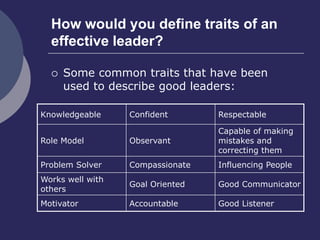
How would you define traits of an
effective leader?
 Some common traits that have been
used to describe good leaders:
Knowledgeable Confident Respectable
Role Model Observant
Capable of making
mistakes and
correcting them
Problem Solver Compassionate Influencing People
Works well with
others
Goal Oriented Good Communicator
Motivator Accountable Good Listener
Leadership Skills
 Once you have developed your definition
of leadership, the next step is to figure
out the skills that are needed in order to
develop a leader
 In studying leadership, there are
numerous ideas, theories, and models.
However, these skills usually fall into
three distinct categories…
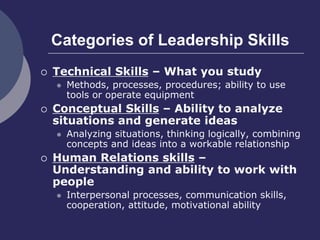
Categories of Leadership Skills
 Technical Skills – What you study
 Methods, processes, procedures; ability to use
tools or operate equipment
 Conceptual Skills – Ability to analyze
situations and generate ideas
 Analyzing situations, thinking logically, combining
concepts and ideas into a workable relationship
 Human Relations skills –
Understanding and ability to work with
people
 Interpersonal processes, communication skills,
cooperation, attitude, motivational ability
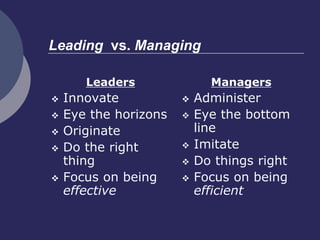
Leading vs. Managing
Leaders
 Innovate
 Eye the horizons
 Originate
 Do the right
thing
 Focus on being
effective
Managers
 Administer
 Eye the bottom
line
 Imitate
 Do things right
 Focus on being
efficient
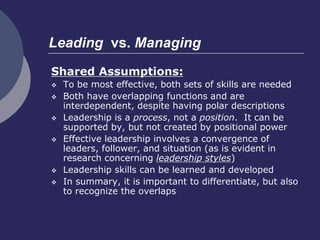
Leading vs. Managing
Shared Assumptions:
 To be most effective, both sets of skills are needed
 Both have overlapping functions and are
interdependent, despite having polar descriptions
 Leadership is a process, not a position. It can be
supported by, but not created by positional power
 Effective leadership involves a convergence of
leaders, follower, and situation (as is evident in
research concerning leadership styles)
 Leadership skills can be learned and developed
 In summary, it is important to differentiate, but also
to recognize the overlaps
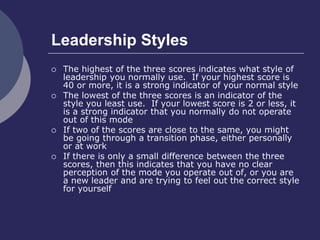
Leadership Styles
 The highest of the three scores indicates what style of
leadership you normally use. If your highest score is
40 or more, it is a strong indicator of your normal style
 The lowest of the three scores is an indicator of the
style you least use. If your lowest score is 2 or less, it
is a strong indicator that you normally do not operate
out of this mode
 If two of the scores are close to the same, you might
be going through a transition phase, either personally
or at work
 If there is only a small difference between the three
scores, then this indicates that you have no clear
perception of the mode you operate out of, or you are
a new leader and are trying to feel out the correct style
for yourself
Leadership Styles
 ENTER LEADERSHIP STYLES TABLE
 Authoritarian (autocratic)
 First column
 Participative (democratic)
 Second column
 Delegative (free reign)
 Third Column
Authoritarian Style (autocratic)
 Management has most of the knowledge and skills
 Should normally be used on rare occasions
 Used when the leader tells his/her employees
what he/she wants done, and how it is to be done,
without getting the advice of his/her followers
 Some of the appropriate conditions to use it is
when you have all the information to solve the
problem, you are short on time, and your
employees are well motivated
 Not to be confused with “bossing around”
Participative Style (democratic)
 Involves the leader including one or more
employees in on the decision making process
(determining what to do and how to do it).
 However, the leader maintains the final decision
making authority
 Normally used when you have part of the
information, and your employees have other parts.
Note that the leader is not expected to know
everything. This is why it is important to hire
knowledgeable and skillful employees
 Allows employees to become part of the team and
allows the leader to make better decisions
Delegative Style (free reign)
 Employees have the needed knowledge and skills
 The leader allows the employees to make the
decision
 However, the leader is still responsible for
decisions that are made
 Used when employees are able to analyze the
situation and determine what needs to be done
and how to do it. The leader is not expected to
do everything.
 This is a style to be used when you have full trust
and confidence in the people below you, however,
use it wisely!
Leadership Styles
 A good leader uses all three styles, depending on
what forces are involved between the followers,
the leader, and the situation
 Forces that influence what style should be used
include:
 How much time is available?
 Are relationships based on respect and trust, or on
disrespect?
 Who has the information? You, your employees, or
both?
 How well are your employees trained and how well
do you know the task?
 What is the type of task? Structured, unstructured,
complicated, or simple?
 Also dependent on laws or established procedures
Section Two:
Why is Leadership
Development
Important?
Leadership Development
 Evaluates current leadership and
management styles for effectiveness
based on the organization’s needs and
desired culture
 Identifies through formal assessments,
job analysis, and observation, the
strengths and weaknesses of leadership
styles
 Works to implement a development plan
and coaches an individual for skill
enhancement
Leadership Development
 Who Can Benefit?
 Recently promoted managers/leaders
 Successful leaders/managers who want to
enhance their skills
 Technical managers who want to strengthen their
interpersonal skills
 Valuable executives looking to resolve current
issues or pursue skill development in order to
more efficiently meet current or changing job
expectations
 Succession planning of targeted leaders
 In summary, the entire organization, on multiple
levels, can benefit from leadership development
Leadership Development
 “Continued learning and personal growth
are essential for the evolution of world-
class leaders” – Mark X. Feck, head of Corporate Human Resources
for Rohm & Haas (Berger, pg 42)
 Helps to create a culture of leadership
 In a survey of 150 Fortune 500 companies,
a majority of the companies expect at least
a 33% turnover at the executive level in
the next five years, and one third of the
companies felt that they would not be able
to find suitable replacements (Berger, pg 40)
Core Competencies
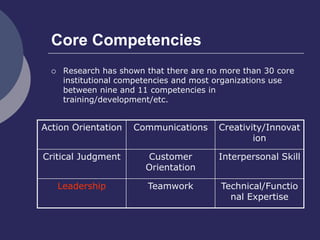
 Research has shown that there are no more than 30 core
institutional competencies and most organizations use
between nine and 11 competencies in
training/development/etc.
Action Orientation Communications Creativity/Innovat
ion
Critical Judgment Customer
Orientation
Interpersonal Skill
Leadership Teamwork Technical/Functio
nal Expertise
Section Three:
How do I Develop
Leadership in My
Organization?
External Leadership Consultants
 Impact Leadership Consultants, Inc.
 Provides a number of workshops,
presentations, and seminars (30 minutes to
full days)
 Management and Supervision
 Conflict Resolution, Management Styles, How
to Conduct Effective Meetings, Motivating
yourself and Others to Succeed
 Organizational Dynamics
 Organizational Change, Diversity Training,
Team Building, Effective Customer Service
 Personal Growth and Development
 Assertiveness Training, How to be an Effective
Communicator, Dealing with Difficult People
Benefits of Leadership Development
 Increased Profits
 Organize company objectives/identify activities that
are value-added, and those that yield minimal
results
 People Management Skills
 Help to foster commitment in teams/increase
customer service
 Clearer and More Focused Vision
 Create clear, challenging, yet achievable goals for
themselves and the organization
 Awareness of Potential Pitfalls
 Learn how to keep the yourself and others,
avoiding pitfalls such as lack of planning,
responsibility diffusion, lack of commitment, and
procrastination
Common Leadership Concepts
 Leadership
Styles
 Group Processes
 Power
 Goals/Visioning
 Ethics/Character
 Motivation
 Time
Management
 Conflict
Resolution
 Communications
 Diversity
Implementing Your Own Leadership
Development Program
 Three methods management groups can use to build a model of
competencies that they agree should drive leadership or key roles in the
organization
 Agree on which characteristics are most important in the company
 Which ones would have the most devastating impact if missing?
 Not too specific, not too broad
 What would leadership look like? How would you know if someone was
showing leadership?
 Decide on key requirements for the role
 What attributes/skills will enable this person to perform these roles in an
outstanding manner?
 Linkage Charts
 Think concretely about whom they see as top performers in these key
roles and then keep a picture of them in mind
 What are top performers doing differently than average/bottom performers?
 What motivates them? What makes them outstanding?
Leadership Greatness
 From The Stuff of Heroes: The Eight
Universal Laws of Leadership (Michael A.
Cohen)
1) Maintain your integrity 100% of the time
2) Know your stuff and be able to prove it
3) Declare your vision and know the vision
of your organization/business
4) Show commitment to your organization
or business
Leadership Greatness (continued)
5) Expect positive results from
yourself and others and look for
those opportunities
6) Take care of your people
7) Put duty before self
8) Stand out in whatever you do
Resources/Reading List
 21 Irrefutable Laws of Leadership: Follow
Them and People Will Follow You (John C.
Maxwell)
 Leadership for the Twenty-First Century
(Joseph C. Rost)
 Leading Change (John P. Kotter)
 The Leadership Challenge (James M.
Kouzes, Barry Z. Posner)
 The Tipping Point (Malcolm Gladwell)

Leadership_Development in organizations.

  • 1.
    The “What, Why,and How” of Leadership Development Summer Schlesinger January 10, 2017
  • 2.
    Lesson Objectives By theend of the lesson, students should be able to… 1) Develop their own definition of leadership 2) Recognize their own personal leadership style 3) Recognize effective leadership traits in others 4) Understand the process involved in developing leadership in organizational settings
  • 3.
    Section One: What isa leader? What is leadership?
  • 4.
    The American Heritage Dictionarydefines a leader as: 1) One that leads or guides 2) One who is in charge or in command of others 3) One who heads a political party or organization 4) One who has influence or power, especially of a political nature
  • 5.
    The American HeritageDictionary defines leadership as: 1) The position or office of a leader 2) Capacity or ability to lead 3) A group of leaders 4) Guidance; direction
  • 6.
    Common Definitions of Leadership/Leader “A process whereby an individual influences a group of individuals to achieve a common goal” (Northouse, 2001, pg 3) “ Motivates, empowers, inspires, collaborates with, and encourages others. Develops a culture where employees feel ownership in what they do and continually improve the business” (Berger, pg 8)
  • 7.
    How would youdefine traits of an effective leader?  Some common traits that have been used to describe good leaders: Knowledgeable Confident Respectable Role Model Observant Capable of making mistakes and correcting them Problem Solver Compassionate Influencing People Works well with others Goal Oriented Good Communicator Motivator Accountable Good Listener
  • 8.
    Leadership Skills  Onceyou have developed your definition of leadership, the next step is to figure out the skills that are needed in order to develop a leader  In studying leadership, there are numerous ideas, theories, and models. However, these skills usually fall into three distinct categories…
  • 9.
    Categories of LeadershipSkills  Technical Skills – What you study  Methods, processes, procedures; ability to use tools or operate equipment  Conceptual Skills – Ability to analyze situations and generate ideas  Analyzing situations, thinking logically, combining concepts and ideas into a workable relationship  Human Relations skills – Understanding and ability to work with people  Interpersonal processes, communication skills, cooperation, attitude, motivational ability
  • 10.
    Leading vs. Managing Leaders Innovate  Eye the horizons  Originate  Do the right thing  Focus on being effective Managers  Administer  Eye the bottom line  Imitate  Do things right  Focus on being efficient
  • 11.
    Leading vs. Managing SharedAssumptions:  To be most effective, both sets of skills are needed  Both have overlapping functions and are interdependent, despite having polar descriptions  Leadership is a process, not a position. It can be supported by, but not created by positional power  Effective leadership involves a convergence of leaders, follower, and situation (as is evident in research concerning leadership styles)  Leadership skills can be learned and developed  In summary, it is important to differentiate, but also to recognize the overlaps
  • 12.
    Leadership Styles  Thehighest of the three scores indicates what style of leadership you normally use. If your highest score is 40 or more, it is a strong indicator of your normal style  The lowest of the three scores is an indicator of the style you least use. If your lowest score is 2 or less, it is a strong indicator that you normally do not operate out of this mode  If two of the scores are close to the same, you might be going through a transition phase, either personally or at work  If there is only a small difference between the three scores, then this indicates that you have no clear perception of the mode you operate out of, or you are a new leader and are trying to feel out the correct style for yourself
  • 13.
    Leadership Styles  ENTERLEADERSHIP STYLES TABLE  Authoritarian (autocratic)  First column  Participative (democratic)  Second column  Delegative (free reign)  Third Column
  • 14.
    Authoritarian Style (autocratic) Management has most of the knowledge and skills  Should normally be used on rare occasions  Used when the leader tells his/her employees what he/she wants done, and how it is to be done, without getting the advice of his/her followers  Some of the appropriate conditions to use it is when you have all the information to solve the problem, you are short on time, and your employees are well motivated  Not to be confused with “bossing around”
  • 15.
    Participative Style (democratic) Involves the leader including one or more employees in on the decision making process (determining what to do and how to do it).  However, the leader maintains the final decision making authority  Normally used when you have part of the information, and your employees have other parts. Note that the leader is not expected to know everything. This is why it is important to hire knowledgeable and skillful employees  Allows employees to become part of the team and allows the leader to make better decisions
  • 16.
    Delegative Style (freereign)  Employees have the needed knowledge and skills  The leader allows the employees to make the decision  However, the leader is still responsible for decisions that are made  Used when employees are able to analyze the situation and determine what needs to be done and how to do it. The leader is not expected to do everything.  This is a style to be used when you have full trust and confidence in the people below you, however, use it wisely!
  • 17.
    Leadership Styles  Agood leader uses all three styles, depending on what forces are involved between the followers, the leader, and the situation  Forces that influence what style should be used include:  How much time is available?  Are relationships based on respect and trust, or on disrespect?  Who has the information? You, your employees, or both?  How well are your employees trained and how well do you know the task?  What is the type of task? Structured, unstructured, complicated, or simple?  Also dependent on laws or established procedures
  • 18.
    Section Two: Why isLeadership Development Important?
  • 19.
    Leadership Development  Evaluatescurrent leadership and management styles for effectiveness based on the organization’s needs and desired culture  Identifies through formal assessments, job analysis, and observation, the strengths and weaknesses of leadership styles  Works to implement a development plan and coaches an individual for skill enhancement
  • 20.
    Leadership Development  WhoCan Benefit?  Recently promoted managers/leaders  Successful leaders/managers who want to enhance their skills  Technical managers who want to strengthen their interpersonal skills  Valuable executives looking to resolve current issues or pursue skill development in order to more efficiently meet current or changing job expectations  Succession planning of targeted leaders  In summary, the entire organization, on multiple levels, can benefit from leadership development
  • 21.
    Leadership Development  “Continuedlearning and personal growth are essential for the evolution of world- class leaders” – Mark X. Feck, head of Corporate Human Resources for Rohm & Haas (Berger, pg 42)  Helps to create a culture of leadership  In a survey of 150 Fortune 500 companies, a majority of the companies expect at least a 33% turnover at the executive level in the next five years, and one third of the companies felt that they would not be able to find suitable replacements (Berger, pg 40)
  • 22.
    Core Competencies  Researchhas shown that there are no more than 30 core institutional competencies and most organizations use between nine and 11 competencies in training/development/etc. Action Orientation Communications Creativity/Innovat ion Critical Judgment Customer Orientation Interpersonal Skill Leadership Teamwork Technical/Functio nal Expertise
  • 23.
    Section Three: How doI Develop Leadership in My Organization?
  • 24.
    External Leadership Consultants Impact Leadership Consultants, Inc.  Provides a number of workshops, presentations, and seminars (30 minutes to full days)  Management and Supervision  Conflict Resolution, Management Styles, How to Conduct Effective Meetings, Motivating yourself and Others to Succeed  Organizational Dynamics  Organizational Change, Diversity Training, Team Building, Effective Customer Service  Personal Growth and Development  Assertiveness Training, How to be an Effective Communicator, Dealing with Difficult People
  • 25.
    Benefits of LeadershipDevelopment  Increased Profits  Organize company objectives/identify activities that are value-added, and those that yield minimal results  People Management Skills  Help to foster commitment in teams/increase customer service  Clearer and More Focused Vision  Create clear, challenging, yet achievable goals for themselves and the organization  Awareness of Potential Pitfalls  Learn how to keep the yourself and others, avoiding pitfalls such as lack of planning, responsibility diffusion, lack of commitment, and procrastination
  • 26.
    Common Leadership Concepts Leadership Styles  Group Processes  Power  Goals/Visioning  Ethics/Character  Motivation  Time Management  Conflict Resolution  Communications  Diversity
  • 27.
    Implementing Your OwnLeadership Development Program  Three methods management groups can use to build a model of competencies that they agree should drive leadership or key roles in the organization  Agree on which characteristics are most important in the company  Which ones would have the most devastating impact if missing?  Not too specific, not too broad  What would leadership look like? How would you know if someone was showing leadership?  Decide on key requirements for the role  What attributes/skills will enable this person to perform these roles in an outstanding manner?  Linkage Charts  Think concretely about whom they see as top performers in these key roles and then keep a picture of them in mind  What are top performers doing differently than average/bottom performers?  What motivates them? What makes them outstanding?
  • 28.
    Leadership Greatness  FromThe Stuff of Heroes: The Eight Universal Laws of Leadership (Michael A. Cohen) 1) Maintain your integrity 100% of the time 2) Know your stuff and be able to prove it 3) Declare your vision and know the vision of your organization/business 4) Show commitment to your organization or business
  • 29.
    Leadership Greatness (continued) 5)Expect positive results from yourself and others and look for those opportunities 6) Take care of your people 7) Put duty before self 8) Stand out in whatever you do
  • 30.
    Resources/Reading List  21Irrefutable Laws of Leadership: Follow Them and People Will Follow You (John C. Maxwell)  Leadership for the Twenty-First Century (Joseph C. Rost)  Leading Change (John P. Kotter)  The Leadership Challenge (James M. Kouzes, Barry Z. Posner)  The Tipping Point (Malcolm Gladwell)