Chapter 1Chapter 1
CommunicationCommunication
OverviewOverview
Introduction to Communications
Applications
““Few things can help anFew things can help an
individual more than toindividual more than to
place responsibility on him,place responsibility on him,
and to let him know that youand to let him know that you
trust him."trust him."
--Booker T. WashingtonBooker T. Washington
BuildingBuilding
ResponsibilityResponsibility
Build responsible communication skills
by using ethical, clear messages
Both verbal and non-verbal communications
have impact
What are Ethics?What are Ethics?
"Ethics: A person's"Ethics: A person's
sense of right andsense of right and
wrong."wrong."
The Foundation for GoodThe Foundation for Good
Communication - ValuesCommunication - Values
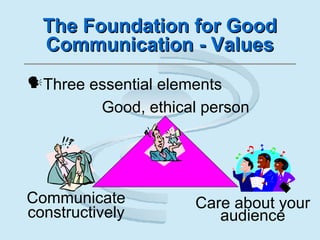
Three essential elements
Good, ethical person
Communicate
constructively
Care about your
audience
What is theWhat is the
Communication Process?Communication Process?
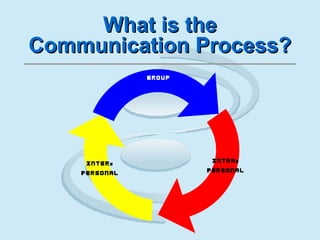
Group
Inter-
Personal
Intra-
Personal
Major Parts ofMajor Parts of
Communication ProcessCommunication Process
The four major parts of
communication are:
 Sender
 Message
 Receiver
 Feedback
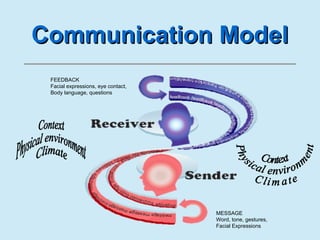
The CommunicationThe Communication
ModelModel
Sender (transmits message)
 Message (words, body language
and symbols that convey an ideas)
Receiver (interprets message)
 transmits feedback through words,
body language and symbols
Communication ModelCommunication Model
MESSAGE
Word, tone, gestures,
Facial Expressions
FEEDBACK
Facial expressions, eye contact,
Body language, questions
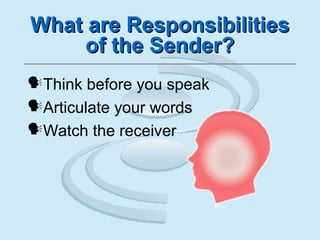
What are ResponsibilitiesWhat are Responsibilities
of the Sender?of the Sender?
Think before you speak
Articulate your words
Watch the receiver
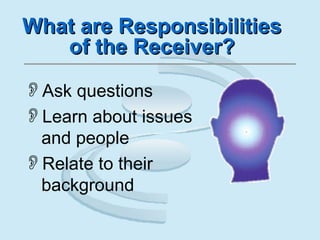
What are ResponsibilitiesWhat are Responsibilities
of the Receiver?of the Receiver?
Ask questions
Learn about issues
and people
Relate to their
background
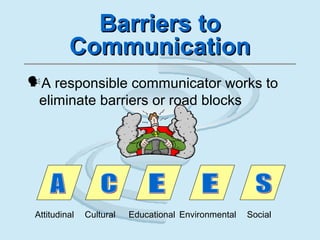
Barriers toBarriers to
CommunicationCommunication
A responsible communicator works to
eliminate barriers or road blocks
Attitudinal Cultural Educational Environmental Social
StereotypingStereotyping
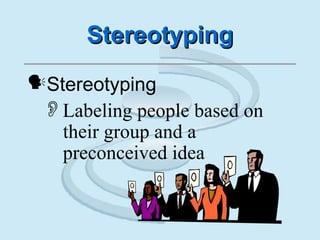
Stereotyping
Labeling people based on
their group and a
preconceived idea
Forms ofForms of
CommunicationCommunication
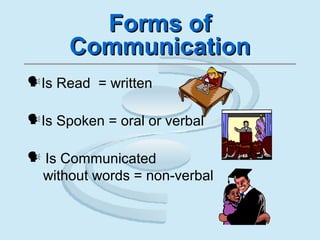
Is Read = written
Is Spoken = oral or verbal
 Is Communicated
without words = non-verbal
Non-VerbalNon-Verbal
CommunicationCommunication
 Body Language
 Facial Expressions
 Symbols
A symbol is anythingA symbol is anything
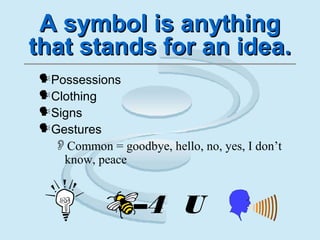
that stands for an idea.that stands for an idea.
Possessions
Clothing
Signs
Gestures
Common = goodbye, hello, no, yes, I don’t
know, peace
–4 U
Forms ofForms of
CommunicationCommunication
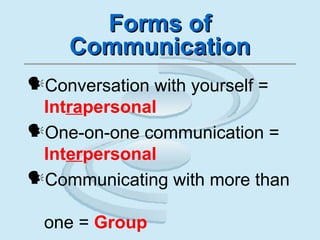
Conversation with yourself =
Intrapersonal
One-on-one communication =
Interpersonal
Communicating with more than
one = Group
Forms ofForms of
CommunicationCommunication
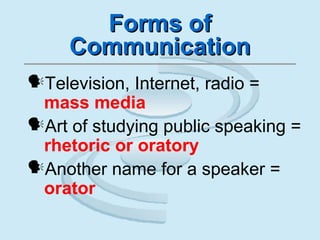
Television, Internet, radio =
mass media
Art of studying public speaking =
rhetoric or oratory
Another name for a speaker =
orator
Aristotle’s Three TypesAristotle’s Three Types
of Appealsof Appeals
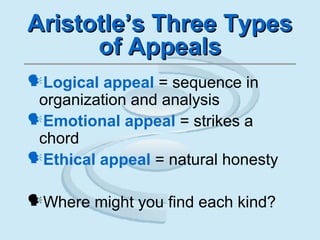
Logical appeal = sequence in
organization and analysis
Emotional appeal = strikes a
chord
Ethical appeal = natural honesty
Where might you find each kind?
Building The ProperBuilding The Proper
MotivationMotivation
Motivation should be…
The desire to treat both
people and situations fairly,
the desire to set a good
example.
Recalling the FactsRecalling the Facts
 What is the obligation of the speaker?
 What are the four parts of the communication process?
 What does a speaker attempt to tear down?
 What is communication that is spoken?
 Nonverbal communication includes….?
 What are symbols?
 What is the foundation for effective oral communication?
 What did Aristotle state were the three types of appeals?
 What is interpersonal communication?
 What is intrapersonal communication?
 What must people believe to believe what you have to say?
Look Back on Page 22
VocabularyVocabulary
 ethics
 communication
 sender
 message
 receiver
 feedback
 communication barrier
 written communication
 oral or Verbal communication
 nonverbal communication
 symbol
 interpersonal communication
 intrapersonal communication
 oratory/rhetoric
 orator
 logical appeal
 emotional appeal
 ethical appeal
 dialogue
 motivation
 stereotyping
List on Page 5 of textbook

Chp 1 intro