UNIT-4
LEADERSHIP AND CONTROL
Dr. R.THANGASUNDARI
ASST.PROFESSOR & RESEARCH ADVISOR
DEPARTMENT OF MANAGEMENT STUDIES
BON SECOURS COLLEGE FOR WOMEN, THANJAVUR (AUTONOMOUS)
THANJAVUR
WHAT IS LEADERSHIP ?
The art of managing the employees and extracting the best out of them refers to leadership.
Employees should not treat their work as a burden for them to deliver their level best at the
workplace.
Leadership and Control
Leadership" and "Control" are key aspects of management and governance, often intertwined but distinct in their
approaches and purposes.
LEADERSHIP:
Leadership refers to the process of guiding, inspiring, and influencing individuals or groups to achieve common goals.
Leaders motivate people, create vision, foster teamwork, and encourage growth. Leadership is often associated with
personal qualities like charisma, empathy, and the ability to rally people around a cause. Leaders focus more on
influencing rather than imposing authority.
•Key Characteristics of Leadership:
• Inspiration: Leaders inspire and motivate others.
• Vision: Leaders set a clear direction or goal for the group to follow.
• Empathy: Understanding and considering the needs and emotions of others.
• Influence: The ability to persuade others to align with the vision or purpose.
• Innovation: Leaders often embrace change and encourage new ways of thinking.
•Styles of Leadership:
• Transformational Leadership: Inspiring change by creating a vision and encouraging innovation.
• Transactional Leadership: Focused on rewards and punishments to achieve results.
• Servant Leadership: Prioritizing the needs of others and leading by example.
CONTROL:
Control, on the other hand, refers to the management process of monitoring, regulating, and ensuring
that organizational goals are being met. It involves setting standards, measuring performance, and
correcting deviations to maintain order and efficiency. Control is often more formal, structured, and
focuses on rules, policies, and procedures.
•Key Characteristics of Control:
• Standardization: Setting standards and benchmarks for performance.
• Monitoring: Continuously tracking activities and outcomes.
• Corrective Action: Taking action to correct deviations from desired outcomes.
• Authority: Exercising authority to ensure adherence to rules and procedures.
• Risk Management: Ensuring that risks are minimized and objectives are met efficiently.
•Methods of Control:
• Administrative Control: Relying on rules, regulations, and procedures.
• Market Control: Using market mechanisms like competition to influence behavior.
• Clan Control: Influencing behavior through shared values, norms, and culture.
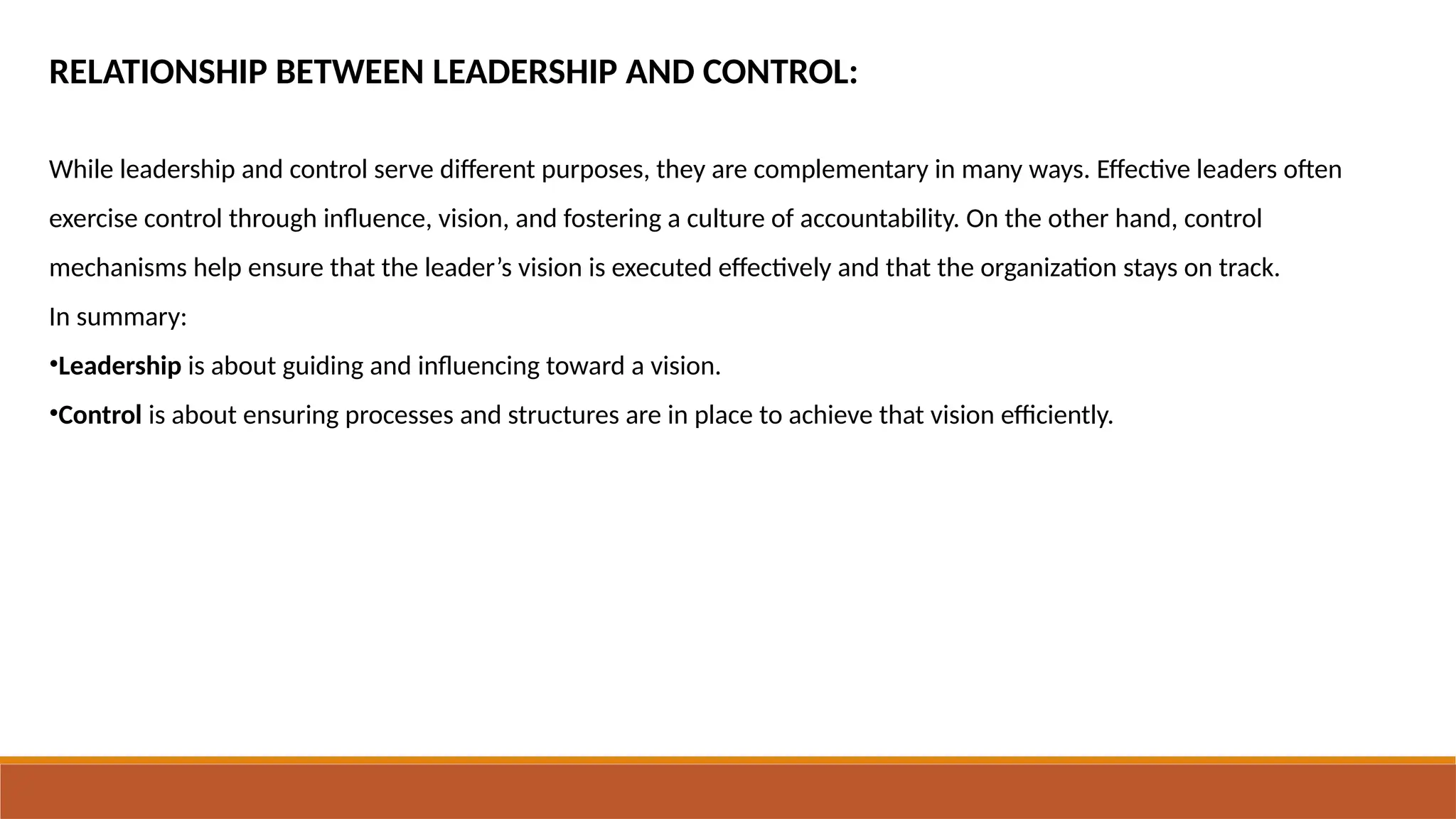
RELATIONSHIP BETWEEN LEADERSHIP AND CONTROL:
While leadership and control serve different purposes, they are complementary in many ways. Effective leaders often
exercise control through influence, vision, and fostering a culture of accountability. On the other hand, control
mechanisms help ensure that the leader’s vision is executed effectively and that the organization stays on track.
In summary:
•Leadership is about guiding and influencing toward a vision.
•Control is about ensuring processes and structures are in place to achieve that vision efficiently.
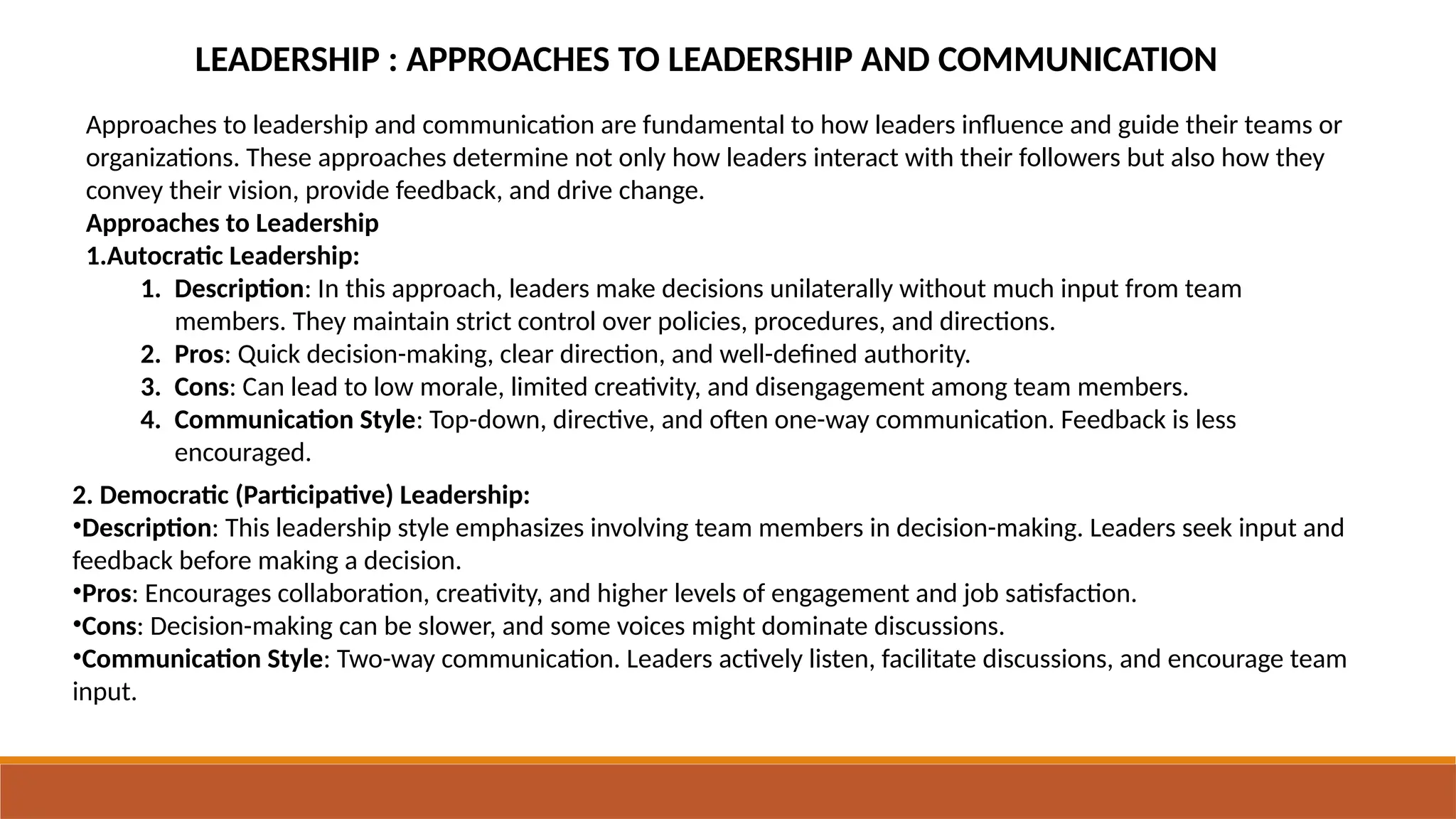
LEADERSHIP : APPROACHES TO LEADERSHIP AND COMMUNICATION
Approaches to leadership and communication are fundamental to how leaders influence and guide their teams or
organizations. These approaches determine not only how leaders interact with their followers but also how they
convey their vision, provide feedback, and drive change.
Approaches to Leadership
1.Autocratic Leadership:
1. Description: In this approach, leaders make decisions unilaterally without much input from team
members. They maintain strict control over policies, procedures, and directions.
2. Pros: Quick decision-making, clear direction, and well-defined authority.
3. Cons: Can lead to low morale, limited creativity, and disengagement among team members.
4. Communication Style: Top-down, directive, and often one-way communication. Feedback is less
encouraged.
2. Democratic (Participative) Leadership:
•Description: This leadership style emphasizes involving team members in decision-making. Leaders seek input and
feedback before making a decision.
•Pros: Encourages collaboration, creativity, and higher levels of engagement and job satisfaction.
•Cons: Decision-making can be slower, and some voices might dominate discussions.
•Communication Style: Two-way communication. Leaders actively listen, facilitate discussions, and encourage team
input.
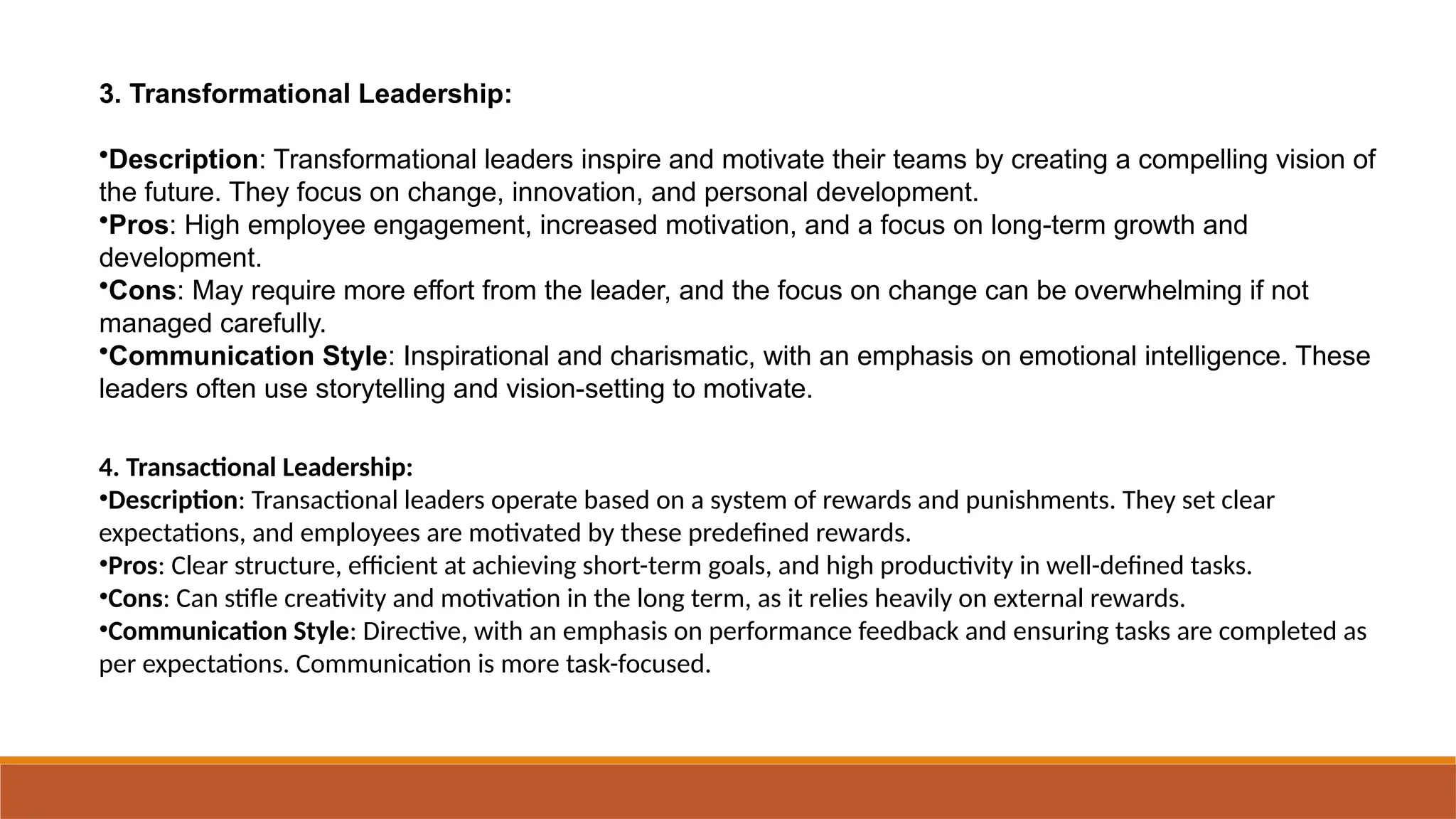
3. Transformational Leadership:
•Description: Transformational leaders inspire and motivate their teams by creating a compelling vision of
the future. They focus on change, innovation, and personal development.
•Pros: High employee engagement, increased motivation, and a focus on long-term growth and
development.
•Cons: May require more effort from the leader, and the focus on change can be overwhelming if not
managed carefully.
•Communication Style: Inspirational and charismatic, with an emphasis on emotional intelligence. These
leaders often use storytelling and vision-setting to motivate.
4. Transactional Leadership:
•Description: Transactional leaders operate based on a system of rewards and punishments. They set clear
expectations, and employees are motivated by these predefined rewards.
•Pros: Clear structure, efficient at achieving short-term goals, and high productivity in well-defined tasks.
•Cons: Can stifle creativity and motivation in the long term, as it relies heavily on external rewards.
•Communication Style: Directive, with an emphasis on performance feedback and ensuring tasks are completed as
per expectations. Communication is more task-focused.
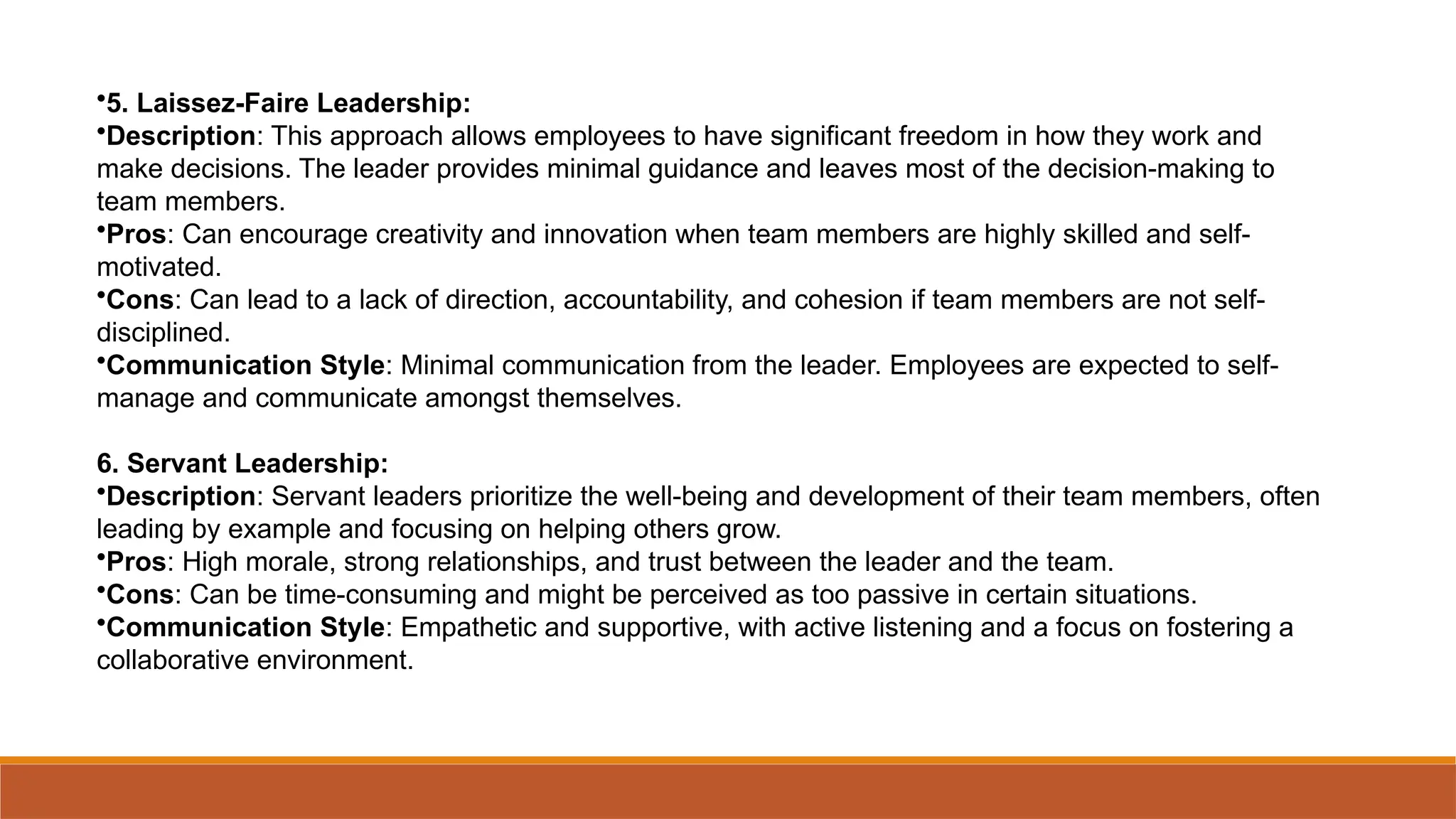
•5. Laissez-Faire Leadership:
•Description: This approach allows employees to have significant freedom in how they work and
make decisions. The leader provides minimal guidance and leaves most of the decision-making to
team members.
•Pros: Can encourage creativity and innovation when team members are highly skilled and self-
motivated.
•Cons: Can lead to a lack of direction, accountability, and cohesion if team members are not self-
disciplined.
•Communication Style: Minimal communication from the leader. Employees are expected to self-
manage and communicate amongst themselves.
6. Servant Leadership:
•Description: Servant leaders prioritize the well-being and development of their team members, often
leading by example and focusing on helping others grow.
•Pros: High morale, strong relationships, and trust between the leader and the team.
•Cons: Can be time-consuming and might be perceived as too passive in certain situations.
•Communication Style: Empathetic and supportive, with active listening and a focus on fostering a
collaborative environment.
7. Charismatic Leadership:
•Description: Charismatic leaders use their personal charm, energy, and enthusiasm to inspire others. They
often have a strong vision and are able to rally people around them.
•Pros: High levels of team motivation, often leading to loyalty and dedication.
•Cons: The organization can become dependent on the leader’s personality, and there can be risks if the
leader leaves.
•Communication Style: Highly expressive and emotional, often relying on persuasive rhetoric and inspiring
messages.
APPROACHES TO LEADERSHIP COMMUNICATION
Communication is the lifeblood of leadership, and different leadership approaches often use distinct communication
strategies to achieve their goals.
Here are some common communication styles associated with leadership:
1.Direct and Authoritative Communication:
1. Used by: Autocratic and Transactional leaders.
2. Style: Clear, concise, and commanding. This style focuses on providing specific instructions and expecting
compliance.
3. Purpose: To ensure tasks are executed exactly as directed and to maintain control over the process.
2.Collaborative and Participative Communication:
1. Used by: Democratic and Transformational leaders.
2. Style: Open-ended, inviting feedback, and focusing on dialogue. It encourages the sharing of ideas,
brainstorming, and collective problem-solving.
3. Purpose: To foster collaboration, inclusion, and ownership of outcomes by team members.
3. Inspiring and Visionary Communication:
•Used by: Transformational and Charismatic leaders.
•Style: Storytelling, motivational, often focused on a compelling future vision. This approach appeals to emotions
and shared values.
•Purpose: To inspire individuals to work toward a larger purpose or vision and to encourage innovation and
personal growth.
4. Empathetic and Supportive Communication:
•Used by: Servant and Democratic leaders.
•Style: Active listening, expressing concern for individual well-being, and offering support. It emphasizes personal
connections and team development.
•Purpose: To create a safe and trusting environment where team members feel valued and motivated to
contribute.
5. Delegative Communication:
•Used by: Laissez-Faire leaders.
•Style: Minimal guidance with an expectation that team members will self-direct. Communication is often reactive,
addressing issues as they arise rather than preemptively.
•Purpose: To foster autonomy, innovation, and personal accountability among team members.
EFFECTIVE LEADERSHIP COMMUNICATION TECHNIQUES
Regardless of the leadership style, effective communication is key to success. Here are some techniques
leaders can use:
•Active Listening: Truly understanding team members' concerns, suggestions, and emotions by being fully
engaged in conversations.
•Clarity and Consistency: Ensuring that messages are clear, consistent, and aligned with organizational goals
and values.
•Feedback: Providing constructive feedback regularly and being open to receiving feedback from others.
•Adaptability: Tailoring communication style to suit the audience or situation, whether it’s addressing a large
group or having one-on-one conversations.
•Non-verbal Communication: Using body language, eye contact, and tone of voice to convey confidence,
empathy, or support.
CONTROL
The term control broadly refers to the power or authority to manage, direct, or regulate behavior, systems, or processes to
achieve a desired outcome.
The concept applies in various contexts:
1.Psychological Control: The belief in one's ability to influence their own life or outcomes (e.g., internal vs. external locus of
control).
2.System Control (Engineering): Regulating mechanical or electronic systems (e.g., using feedback loops in control theory).
3.Social Control: Mechanisms to ensure conformity to social norms (laws, peer pressure).
4.Political Control: Governing or maintaining authority over a group or system.
5.Business Control: Managing resources and processes to achieve organizational goals (e.g., financial control, quality
control).
6.Scientific Control: An unaltered element in experiments, used for comparison with variable elements.
7.Philosophical Control: Concepts related to free will and autonomy.
8.Emotional and Behavioral Control: Regulating one's emotions or impulses for stability and well-being.
9.Technological Control: Managing systems like cybersecurity or automated processes in AI.
Control refers to the power or ability to direct, manage, or influence the behavior, actions, or events, ensuring that a
particular desired outcome is achieved. The concept of control spans various fields and contexts, each with its nuances.
HERE ARE SOME BROAD CATEGORIES WHERE "CONTROL" IS APPLIED:
1. Personal Control (Psychological)
•Definition: In psychology, personal control refers to an individual's belief in their ability to
influence events and outcomes in their own life. This is closely related to concepts like locus of
control—whether people believe outcomes are within their control (internal locus) or governed by
external forces (external locus).
•Importance: A sense of control is crucial for well-being, motivation, and reducing anxiety. Feeling
in control contributes to self-efficacy and agency.
2. Control in Systems and Engineering
•Definition: In systems and engineering, control refers to methods used to regulate or manipulate
the behavior of systems (mechanical, electrical, biological, etc.) to achieve a desired output.
Control theory is a mathematical approach to managing dynamic systems.
•Types:
• Open-loop control: Acts without feedback. Once the control action is initiated, no further
adjustment is made based on outcomes.
• Closed-loop control: Uses feedback to continually adjust actions to meet desired
outcomes. For example, a thermostat controlling room temperature.
3. Social Control (Sociology)
•Definition: Social control refers to mechanisms, strategies, and institutions (such as laws, norms, or cultural values)
that regulate individual and group behavior in society to conform to social expectations or maintain order.
•Types:
• Formal social control: Laws, regulations, and institutional rules.
• Informal social control: Norms, traditions, and peer pressure.
4. Political Control
•Definition: In politics, control refers to the ability of a governing body or authority to maintain power over a
population, territory, or system. It involves enforcement of laws, military power, policy decisions, and maintaining
political influence.
•Forms:
• Authoritarian control: Centralized, often through suppression of dissent.
• Democratic control: Power is distributed through elected representatives and checks and balances.
5. Control in Business and Management
•Definition: In business, control involves managing resources, employees, and processes to ensure that an
organization’s objectives are achieved. This can include financial control, operational control, and performance
management.
•Tools:
• Budgets: Controlling financial resources.
• Performance evaluations: Ensuring tasks are performed effectively.
• Quality control: Ensuring products meet desired standards.
6. Scientific Control (Experimental)
•Definition: In scientific experiments, a control is an element that remains unchanged or unaffected by variables, serving
as a benchmark to measure the effect of other variables.
•Example: In a drug trial, a placebo group serves as a control to compare against the group receiving the actual
medication.
7. Control in Philosophy
•Definition: Philosophically, control can be discussed in terms of free will, autonomy, and determinism. Do humans have
control over their actions, or are they governed by external forces, biology, or fate?
•Key Concepts:
• Free will: The ability to make choices independent of external influence.
• Determinism: The view that every event is determined by preceding events or natural laws, limiting control.
8. Emotional and Behavioral Control
•Definition: In terms of individual behavior, control refers to the ability to regulate emotions, impulses, or reactions.
Emotional control, for instance, is crucial for maintaining healthy relationships and personal well-being.
•Applications:
• Self-control: The ability to delay gratification and resist short-term temptations in favor of long-term goals.
• Anger management: Techniques used to control emotional outbursts.
9. Technological and Cyber Control
•Definition: Control in a technological context often refers to regulating or commanding technological systems, such
as computer networks, machines, or artificial intelligence systems.
•Examples:
• Cybersecurity: Controlling access to information systems to prevent unauthorized use.
• AI and robotics control: Managing machine learning algorithms, robots, or automation processes.
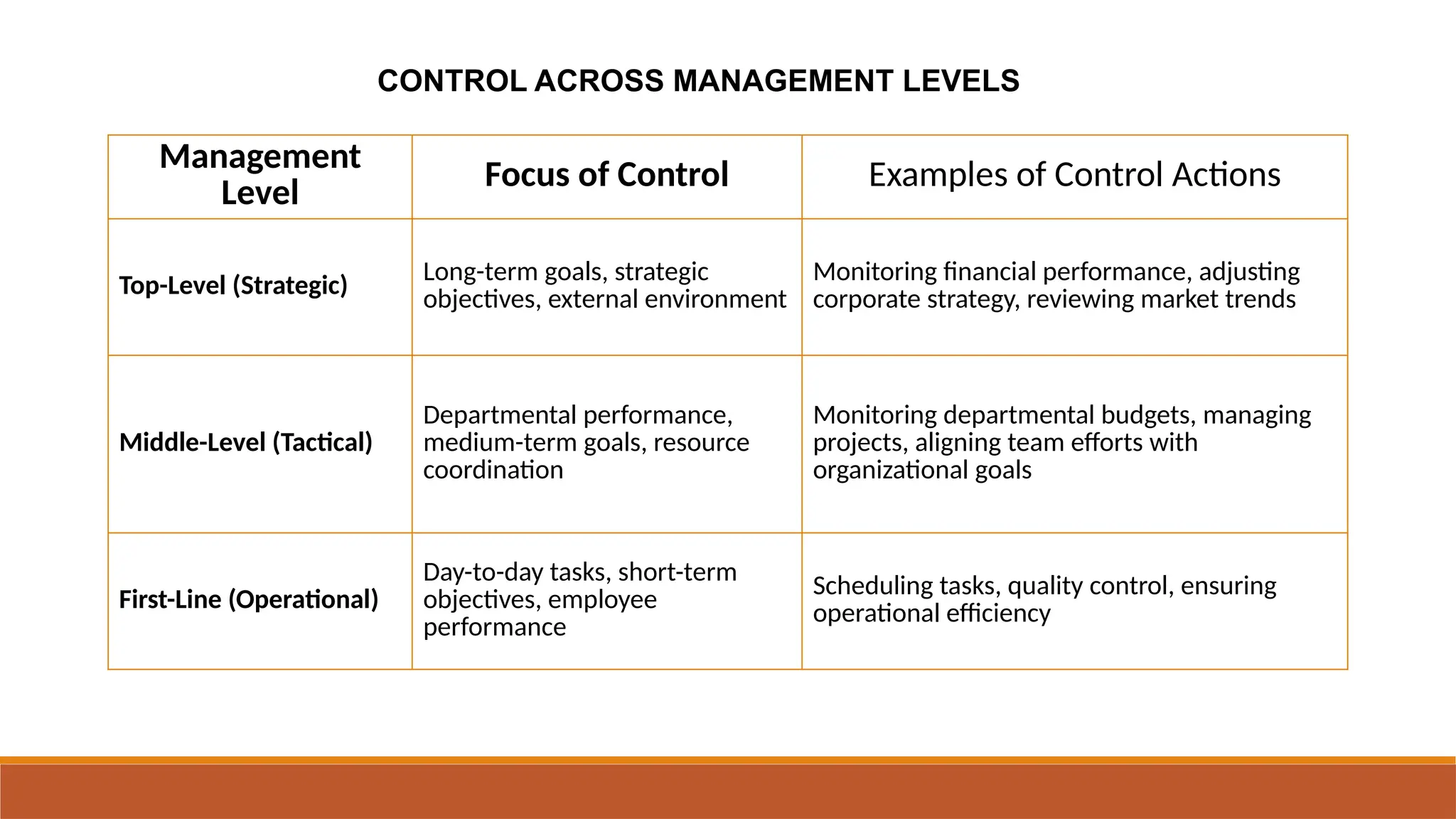
APPLICATION OF THE PROCESS OF CONTROL AT DIFFERENT LEVELS OF MANAGEMENT
(TOP, MIDDLE AND FIRST LINE).
The process of control is essential at every level of management—top, middle, and first-line—though its application
varies depending on the level of authority and responsibility. Here's how the process of control is applied at different
levels of management:
1. Top-Level Management (Strategic Control)
Top-level management is responsible for the overall direction and long-term goals of the organization. Their control activities
focus on broad, strategic decisions that shape the future of the company.
•Focus: Strategic objectives, long-term vision, corporate policies, and overall organizational performance.
•Examples of Control:
• Setting strategic goals: Ensuring the organization is moving in line with its mission and vision.
• Monitoring market conditions: Evaluating external factors (competition, regulations, economic trends) that can impact
the organization's strategy.
• Financial control: Overseeing the allocation of resources and ensuring that the company's financial health aligns with its
growth objectives.
• Performance evaluations of divisions or business units: Comparing actual results with strategic goals and making
adjustments as necessary.
• Key Performance Indicators (KPIs): Using KPIs like profitability, market share, and return on investment (ROI) to assess
the overall effectiveness of corporate strategies.
Example: The CEO reviews annual financial reports and market trends, assesses whether the company is on track to meet its
five-year growth target, and makes necessary adjustments in the strategy.
2. Middle-Level Management (Tactical Control)
Middle management focuses on translating the strategic goals set by top management into actionable plans and
coordinating resources to ensure the efficient execution of these plans. Their control process is more detailed and covers
departmental or functional areas.
•Focus: Departmental performance, resource allocation, short- to medium-term objectives, and ensuring the alignment
of team efforts with organizational goals.
•Examples of Control:
• Budget management: Controlling departmental budgets to ensure that expenses do not exceed what is
allocated.
• Project progress: Monitoring the status of specific projects to ensure they are on track, on budget, and meeting
deadlines.
• Performance reviews: Evaluating the performance of teams, units, or departments to ensure they meet tactical
objectives.
• Resource allocation: Ensuring that resources (staff, equipment, finances) are efficiently utilized to achieve
departmental goals.
• Feedback loops: Providing reports to top management on the progress of tactical goals and adjusting
departmental plans accordingly.
Example: A department manager monitors the performance of a new product launch campaign, checking if sales targets
are being met and making adjustments in marketing strategies if necessary.
3. First-Line Management (Operational Control)
First-line managers or supervisors are responsible for the day-to-day operations of the organization. Their focus is on
controlling processes at the operational level, ensuring that tasks are completed efficiently and according to established
standards.
•Focus: Short-term objectives, efficiency in operations, employee performance, and adherence to procedures.
•Examples of Control:
• Work scheduling and task assignments: Ensuring that employees are completing their tasks on time and according
to the plan.
• Quality control: Monitoring the quality of work or products, ensuring that they meet set standards.
• Performance tracking: Directly overseeing the performance of employees, providing real-time feedback and
corrective action if necessary.
• Adherence to safety protocols: Ensuring that employees follow safety and operational guidelines.
• Inventory control: Managing stock levels to ensure that production can continue without interruption.
Example: A shift supervisor in a factory monitors production lines, ensures that workers are meeting daily production
quotas, and checks the quality of the products before they are shipped.
Management
Level Focus of Control Examples of Control Actions
Top-Level (Strategic)
Long-term goals, strategic
objectives, external environment
Monitoring financial performance, adjusting
corporate strategy, reviewing market trends
Middle-Level (Tactical)
Departmental performance,
medium-term goals, resource
coordination
Monitoring departmental budgets, managing
projects, aligning team efforts with
organizational goals
First-Line (Operational)
Day-to-day tasks, short-term
objectives, employee
performance
Scheduling tasks, quality control, ensuring
operational efficiency
CONTROL ACROSS MANAGEMENT LEVELS
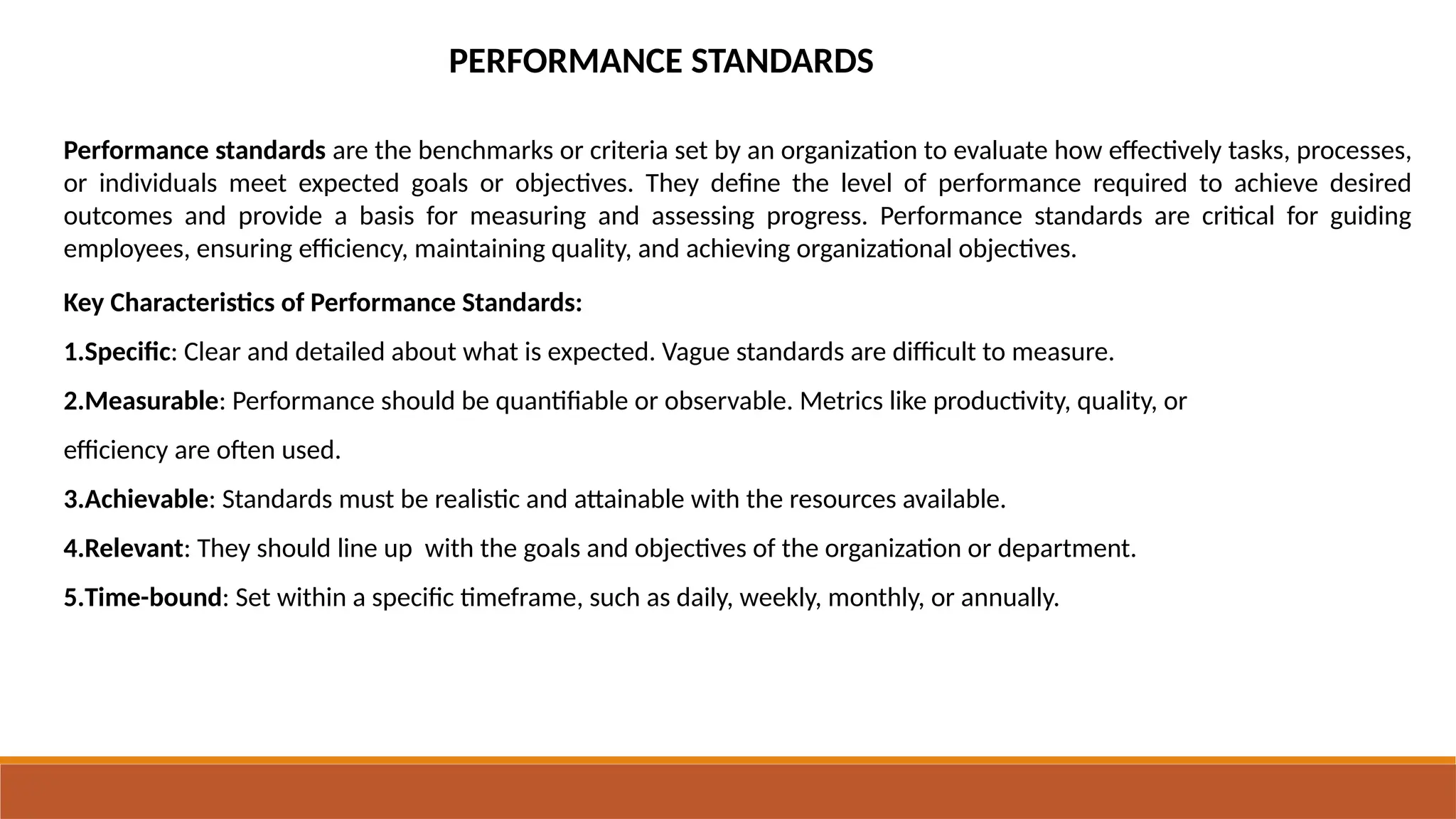
PERFORMANCE STANDARDS
Performance standards are the benchmarks or criteria set by an organization to evaluate how effectively tasks, processes,
or individuals meet expected goals or objectives. They define the level of performance required to achieve desired
outcomes and provide a basis for measuring and assessing progress. Performance standards are critical for guiding
employees, ensuring efficiency, maintaining quality, and achieving organizational objectives.
Key Characteristics of Performance Standards:
1.Specific: Clear and detailed about what is expected. Vague standards are difficult to measure.
2.Measurable: Performance should be quantifiable or observable. Metrics like productivity, quality, or
efficiency are often used.
3.Achievable: Standards must be realistic and attainable with the resources available.
4.Relevant: They should line up with the goals and objectives of the organization or department.
5.Time-bound: Set within a specific timeframe, such as daily, weekly, monthly, or annually.
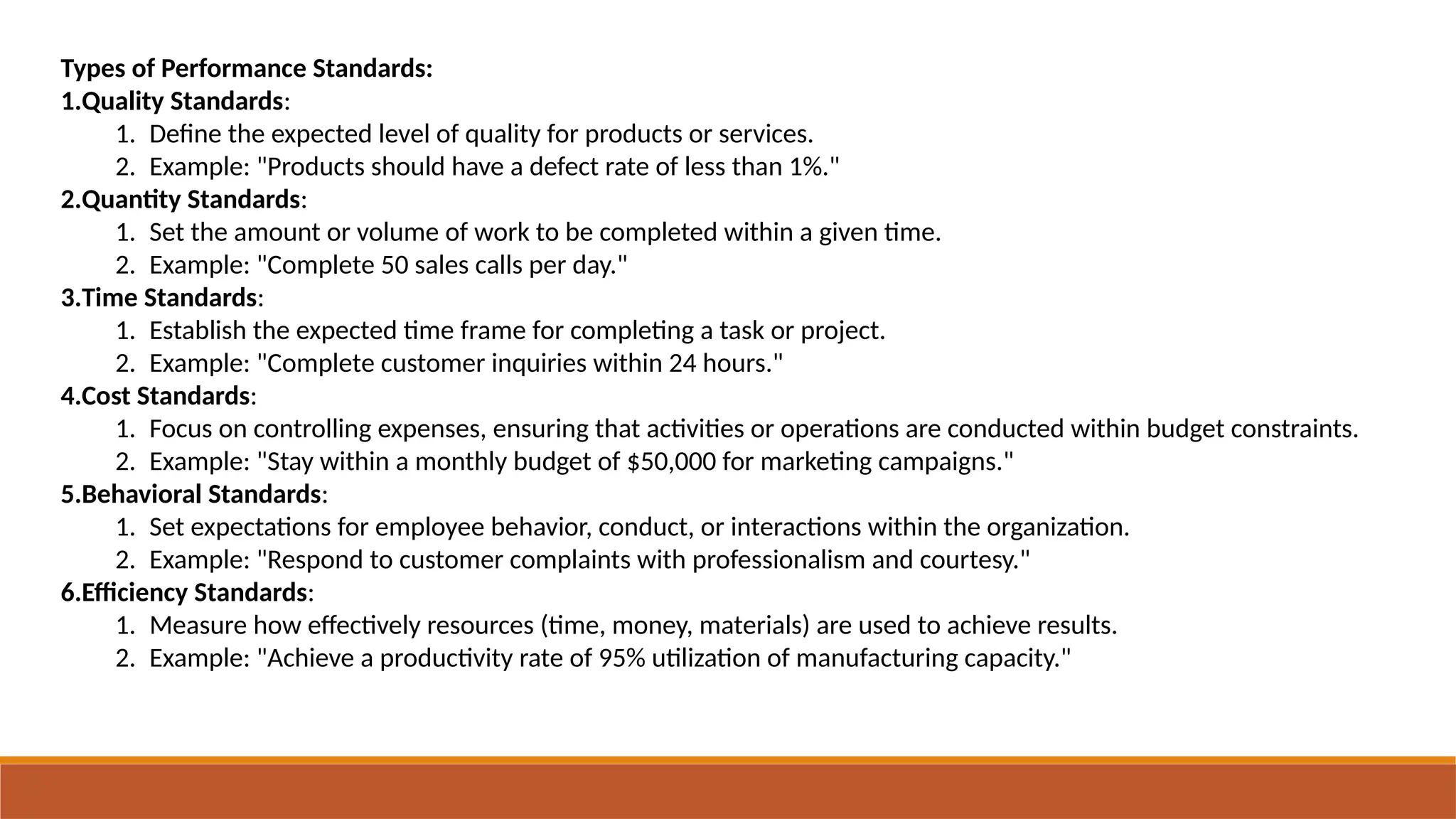
Types of Performance Standards:
1.Quality Standards:
1. Define the expected level of quality for products or services.
2. Example: "Products should have a defect rate of less than 1%."
2.Quantity Standards:
1. Set the amount or volume of work to be completed within a given time.
2. Example: "Complete 50 sales calls per day."
3.Time Standards:
1. Establish the expected time frame for completing a task or project.
2. Example: "Complete customer inquiries within 24 hours."
4.Cost Standards:
1. Focus on controlling expenses, ensuring that activities or operations are conducted within budget constraints.
2. Example: "Stay within a monthly budget of $50,000 for marketing campaigns."
5.Behavioral Standards:
1. Set expectations for employee behavior, conduct, or interactions within the organization.
2. Example: "Respond to customer complaints with professionalism and courtesy."
6.Efficiency Standards:
1. Measure how effectively resources (time, money, materials) are used to achieve results.
2. Example: "Achieve a productivity rate of 95% utilization of manufacturing capacity."
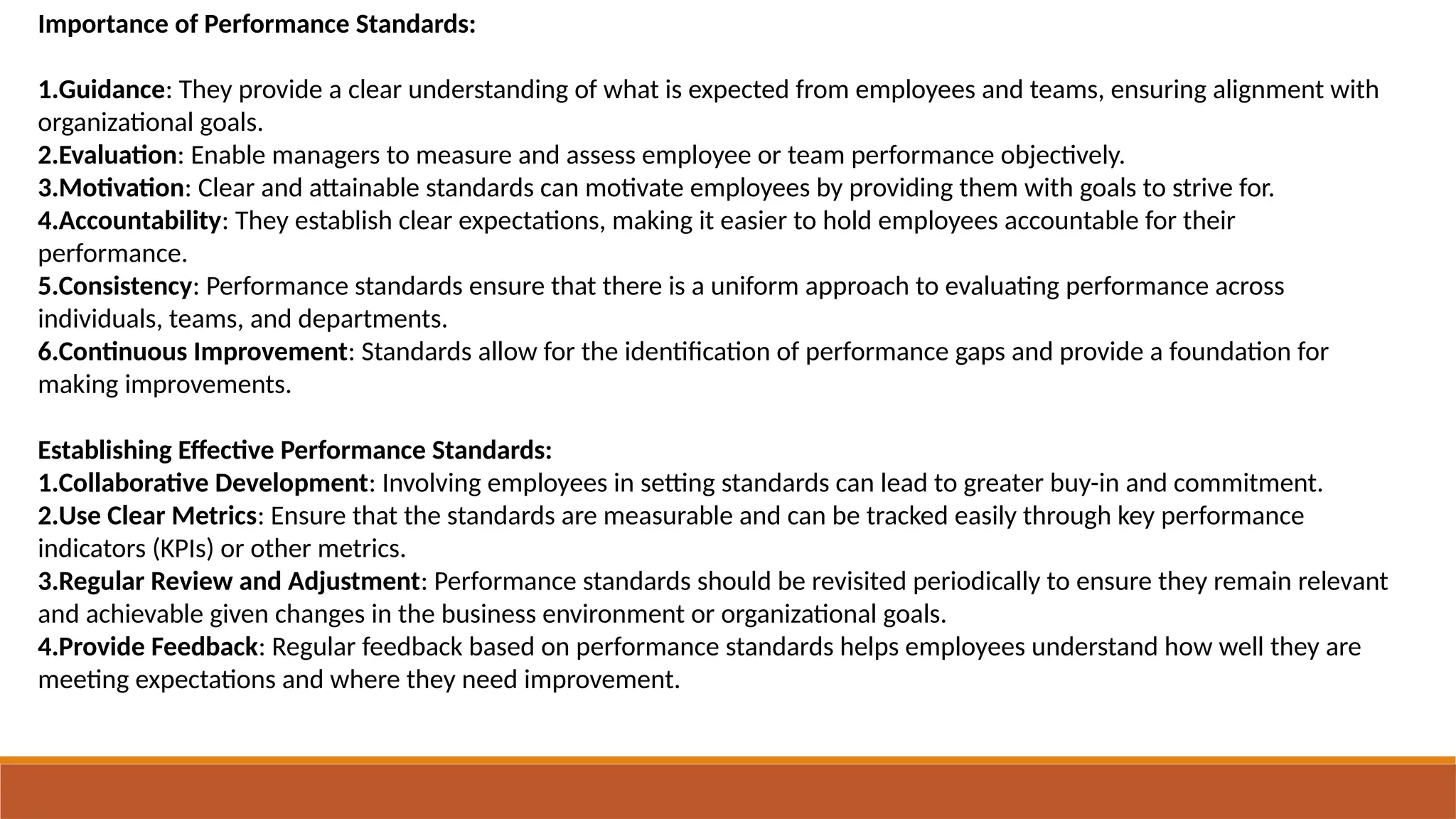
Importance of Performance Standards:
1.Guidance: They provide a clear understanding of what is expected from employees and teams, ensuring alignment with
organizational goals.
2.Evaluation: Enable managers to measure and assess employee or team performance objectively.
3.Motivation: Clear and attainable standards can motivate employees by providing them with goals to strive for.
4.Accountability: They establish clear expectations, making it easier to hold employees accountable for their
performance.
5.Consistency: Performance standards ensure that there is a uniform approach to evaluating performance across
individuals, teams, and departments.
6.Continuous Improvement: Standards allow for the identification of performance gaps and provide a foundation for
making improvements.
Establishing Effective Performance Standards:
1.Collaborative Development: Involving employees in setting standards can lead to greater buy-in and commitment.
2.Use Clear Metrics: Ensure that the standards are measurable and can be tracked easily through key performance
indicators (KPIs) or other metrics.
3.Regular Review and Adjustment: Performance standards should be revisited periodically to ensure they remain relevant
and achievable given changes in the business environment or organizational goals.
4.Provide Feedback: Regular feedback based on performance standards helps employees understand how well they are
meeting expectations and where they need improvement.
Example of Performance Standards in a Business Context:
1.Sales Team:
1. Quality Standard: "Achieve a 90% customer satisfaction rate on sales interactions."
2. Quantity Standard: "Close at least 20 new sales per month."
3. Time Standard: "Respond to new leads within 2 hours of inquiry."
2.Customer Service Team:
1. Quality Standard: "Maintain a 95% positive customer feedback score."
2. Time Standard: "Resolve customer complaints within 48 hours."
3. Efficiency Standard: "Handle at least 30 calls per shift while maintaining quality service."
3.Manufacturing Department:
1. Quality Standard: "Ensure less than 0.5% product defects in the final inspection."
2. Efficiency Standard: "Increase production efficiency by 10% within the next quarter."
MEASUREMENTS OF PERFORMANCE
Measurements of performance involve assessing how well individuals, teams, or entire organizations meet set goals
and objectives. These measurements are essential for evaluating efficiency, effectiveness, quality, and overall success.
The choice of measurement tools or methods depends on the type of performance being measured, whether it’s
operational, financial, employee-related, or customer-related.
Types of Performance Measurements:
1. Financial Performance Measurements
These measurements focus on evaluating the financial health and profitability of an organization.
•Revenue: Total income generated from sales of products or services.
•Profitability Ratios:
• Gross Profit Margin: (Gross Profit ÷ Revenue) × 100
• Net Profit Margin: (Net Profit ÷ Revenue) × 100
• Return on Investment (ROI): (Net Profit ÷ Total Investment) × 100
•Cost Efficiency: Evaluates how well resources are used to minimize costs while maximizing output.
•Cash Flow: Measures the amount of cash generated or used by a company over a specific period.
2. Operational Performance Measurements
Operational metrics assess the efficiency and productivity of the processes or systems within an organization.
•Productivity: Output produced per unit of input (e.g., units produced per hour).
•Cycle Time: The time it takes to complete one cycle of a process from start to finish.
•Capacity Utilization: The percentage of an organization’s potential output that is being achieved.
•Downtime: Time when a machine or system is not operational, often due to maintenance or errors.
•Waste Reduction: Measures efficiency in resource use by tracking how much waste is produced.
3. Employee Performance Measurements
These measurements assess individual and team performance in terms of contribution to organizational goals.
•Key Performance Indicators (KPIs): Specific, measurable targets set for employees, such as sales quotas or productivity
levels.
•Performance Appraisals: Formal evaluations of an employee’s job performance, typically based on criteria like work quality,
punctuality, and communication.
•Attendance and Punctuality: Measures how reliably employees show up for work and on time.
•Task Completion Rate: Percentage of tasks completed on time relative to the total assigned tasks.
•Skills Assessment: Evaluating employee competencies, including technical skills, leadership, and problem-solving.
4. Quality Performance Measurements
These metrics focus on the quality of products, services, or processes and customer satisfaction.
•Defect Rate: The number of defective products or errors as a percentage of the total production.
•Customer Satisfaction Scores (CSAT): A metric to measure how satisfied customers are with a product or service,
typically collected via surveys.
•Net Promoter Score (NPS): Measures customer loyalty and satisfaction based on their likelihood to recommend a
product or service (scale from 1-10).
•First Pass Yield (FPY): Percentage of products or processes that pass quality checks without needing rework.
•Customer Complaints: The number and nature of complaints received from customers over a given period.
5. Customer-Related Performance Measurements
These metrics assess how well an organization is meeting customer needs and expectations.
•Customer Retention Rate: The percentage of customers who continue to do business with the company over a given time.
•Customer Acquisition Cost (CAC): The cost of acquiring a new customer, calculated by dividing total marketing costs by the
number of new customers.
•Customer Lifetime Value (CLTV): The total revenue a business can reasonably expect from a single customer throughout
the business relationship.
•Customer Churn Rate: The percentage of customers who stop using the service or product over a specific period.
•Customer Feedback: Surveys or reviews from customers about their experience with the product, service, or brand.
6. Innovation and Growth Measurements
These metrics track how well an organization is innovating and growing over time.
•Research and Development (R&D) Expenditure: The amount spent on innovation and development as a percentage of
total revenue.
•Number of New Products Launched: A measure of product innovation within a certain period.
•Market Share Growth: The percentage increase or decrease in a company’s market share over time.
•Revenue from New Products/Services: The portion of the revenue generated from newly launched offerings.
7. Employee Engagement and Satisfaction Measurements
These metrics focus on the internal culture of the organization and the morale of its workforce.
•Employee Satisfaction Surveys: Collected data about employees’ happiness and contentment with their job and work
environment.
•Employee Turnover Rate: The percentage of employees who leave the organization over a given period.
•Absenteeism Rate: Measures how frequently employees miss work.
•Employee Net Promoter Score (eNPS): Employees’ willingness to recommend the company as a good place to work.
Best Practices for Measuring Performance:
1.Align with Goals: Ensure that the performance metrics align with the organization’s overall
strategic objectives.
2.Use Quantifiable Data: Where possible, use measurable and objective data to ensure
accurate assessments.
3.Provide Context: Performance measurements should take into account the context, such as
market conditions or resource constraints, so that numbers don’t tell an incomplete story.
4.Regular Review and Adjustment: Regularly review and refine performance metrics to ensure
they remain relevant to the organization’s evolving needs.
5.Use Balanced Scorecards: Consider a balanced scorecard approach that combines financial,
operational, and customer-related measurements for a holistic view of performance.
REMEDIAL ACTION
Remedial action refers to the steps or corrective measures taken to resolve or rectify a problem, deficiency, or
underperformance in a process, system, or individual behavior. The goal of remedial actions is to bring performance back
in line with established standards, improve efficiency, and prevent future issues.
ELEMENTS OF REMEDIAL ACTION:
1.Identification of the Problem: Clearly recognizing and defining the specific issue or underperformance that needs
correction.
2.Root Cause Analysis: Investigating the underlying cause of the problem to prevent reoccurrence. This could involve
evaluating processes, tools, management, training, or other contributing factors.
3.Corrective Steps: Implementing specific actions or strategies to address the problem and bring performance up to the
desired level.
4.Monitoring and Follow-Up: Continuously monitoring the situation to ensure that the corrective actions are working
effectively, and performance has improved.
5.Preventive Measures: Putting systems or guidelines in place to avoid the recurrence of the issue in the future.
TYPES OF REMEDIAL ACTIONS:
1.Operational Remedial Actions:
1. Focus on fixing issues related to production, processes, or workflow inefficiencies.
2. Examples:
1. Adjusting production schedules to meet deadlines.
2. Reallocating resources to overcome bottlenecks in the workflow.
2.Employee Remedial Actions:
1. Addressing issues related to employee performance, behavior, or skill gaps.
2. Examples:
1. Providing additional training or mentorship to employees who are underperforming.
2. Issuing performance improvement plans (PIPs) with clear expectations and timelines.
3. Counseling or disciplinary actions for behavioral issues.
3.Quality Remedial Actions:
1. Corrective steps taken to improve the quality of products or services.
2. Examples:
1. Reworking defective products.
2. Implementing new quality control procedures to catch defects early in the production process.
4.Financial Remedial Actions:
1. Correcting financial mismanagement or addressing cost overruns.
2. Examples:
1. Cutting unnecessary expenses or reallocating budget resources.
2. Revising financial plans to ensure profitability or manage cash flow issues.
5. Customer-Related Remedial Actions:
•Addressing customer complaints or dissatisfaction.
•Examples:
•Offering refunds, discounts, or replacements for defective products.
•Revising customer service procedures to reduce response times and improve satisfaction.
6.Compliance Remedial Actions:
•Ensuring that processes adhere to legal, regulatory, or industry standards.
•Examples:
•Implementing stricter compliance audits.
•Revising policies and procedures to comply with new regulations.
STEPS TO IMPLEMENT REMEDIAL ACTION:
1.Assess the Situation:
1. Gather data, performance reports, and feedback to fully understand the problem and its impact on the
organization or team.
2.Analyze the Root Cause:
To identify the root cause of the problem, not just the symptoms.
3.Develop a Remedial Action Plan:
1. Outline the specific steps needed to correct the problem, along with timelines and responsibilities.
2. Ensure that the action plan is achievable and clearly communicated to those involved.
4.Execute the Plan:
1. Implement the corrective measures promptly. Ensure that all involved parties understand their roles and
responsibilities in the process.
5.Monitor Progress:
•Track the results of the remedial action to see if the desired improvement is being achieved. This can
include regular follow-up meetings or performance reviews.
6.Evaluate and Adjust:
•If the initial corrective measures do not produce the desired results, adjust the plan as necessary.
Continuous improvement might be required until the problem is fully resolved.
7.Document the Process:
•Keep detailed records of the remedial actions taken, the results, and any changes made to ensure
transparency and a basis for future improvements.
REMEDIAL ACTION IN DIFFERENT CONTEXTS:
1.Manufacturing:
1. Problem: High product defect rate in the assembly line.
2. Remedial Action: Implementing stricter quality control checks at each stage of the process and providing
additional training to workers on assembly procedures. Introducing automated error detection systems to
reduce human error.
2.Sales:
1. Problem: Sales team consistently fails to meet targets.
2. Remedial Action: Analyzing the sales process to identify inefficiencies, providing additional sales training to
the team, and adjusting incentive structures to motivate better performance.
3.Customer Service:
1. Problem: Increase in customer complaints about slow response times.
2. Remedial Action: Hiring more customer service representatives, upgrading customer relationship
management (CRM) software, and introducing new guidelines for response time standards.
4.Employee Performance:
1. Problem: An employee consistently misses deadlines and performs below expectations.
2. Remedial Action: Setting up a performance improvement plan (PIP), offering mentorship, and scheduling
regular progress meetings to review improvement.
BENEFITS OF REMEDIAL ACTIONS:
•Improved Performance: Corrective measures help improve overall performance by addressing and eliminating the cause of
underperformance.
•Efficiency: Processes become more streamlined and efficient as issues are corrected.
•Employee Development: Remedial actions provide opportunities for employee growth through additional training and
support.
•Customer Satisfaction: Addressing issues in customer service or product quality leads to better customer experiences and
loyalty.
•Compliance: Ensures that the organization adheres to legal and regulatory standards, avoiding fines and penalties.
AN INTEGRATED CONTROL SYSTEM IN AN ORGANIZATION
An Integrated Control System (ICS) in an organization refers to a centralized framework or platform that
manages and controls various processes, systems, and operations across the organization. It typically
integrates various technological, operational, and management controls to ensure optimal efficiency,
coordination, and compliance.
Components of an Integrated Control System
1.Automation and Monitoring:
ICS often includes automation tools that monitor and control operational processes in real-time, reducing human
error and increasing operational efficiency.
2.Data Collection and Analysis:
A crucial part of ICS is gathering data from different sources (sensors, machines, software systems) and analyzing it
to optimize decision-making.
3.Integration of Disparate Systems:
It brings together different organizational systems such as finance, HR, production, supply chain, etc., allowing
them to communicate and function seamlessly together.
4. Security and Access Control:
ICS usually implements stringent security controls to safeguard critical systems and data. This includes
access control, intrusion detection, and security event management.
5. Compliance and Risk Management:
It ensures that all operations meet regulatory standards and helps in identifying and mitigating risks
proactively through continuous monitoring.
6. User Interface and Control Dashboards:
ICS provides user-friendly interfaces, often in the form of dashboards, where operators and managers
can view system statuses, alarms, and performance metrics in real-time.
7. Reporting and Auditing:
An ICS often includes reporting functions that can be used for compliance audits, performance reviews,
and operational optimization.
BENEFITS OF AN INTEGRATED CONTROL SYSTEM
•Improved Efficiency: Integration of multiple processes and systems streamlines operations, reducing
redundancy and manual intervention.
•Enhanced Decision Making: Real-time data and analytics provide actionable insights that help managers and
operators make informed decisions.
•Cost Savings: Automation and streamlined processes reduce operational costs and improve resource allocation.
•Risk Reduction: By integrating risk management controls, an ICS helps in proactively identifying and addressing
potential risks and compliance issues.
•Scalability: An ICS can scale with organizational growth, allowing new systems, processes, or technologies to be
integrated seamlessly.
MANAGEMENT BY EXCEPTION
Management by Exception (MBE) is a management principle where managers focus their attention on significant
deviations from standard performance or outcomes, rather than on routine tasks. This approach allows management
to prioritize their time and resources on resolving important issues or anomalies that deviate from set benchmarks,
leaving day-to-day operations to run without constant intervention.
CONCEPTS OF MANAGEMENT BY EXCEPTION
1.Focus on Deviations:
Managers intervene only when performance or outcomes deviate significantly from the established standards, targets,
or expectations. For instance, a sales manager may only take action if sales fall below a certain threshold, while routine
sales performance requires no immediate attention.
2.Predefined Performance Standards:
Organizations using MBE establish specific benchmarks, key performance indicators (KPIs), or performance criteria. If
actual performance stays within acceptable limits, no management intervention is required.
3.Threshold for Action:
A key part of MBE is defining what constitutes an "exception" — this threshold or tolerance level must be clearly
established. For example, an exception might be defined as a 10% deviation from the budget or a project deadline
missed by more than a week.
4. Efficient Use of Time:
By focusing only on significant issues, managers can allocate their time and effort where it is most needed, rather
than being distracted by routine matters.
5. Delegation and Empowerment:
Routine decisions and tasks are often delegated to lower-level employees, empowering them to manage daily
activities, while higher-level management focuses on more strategic, exceptional situations.
COMPONENTS OF MANAGEMENT BY EXCEPTION
1.Measurement: It involves knowing the value of past and present performances to recognize any
exception.
2.Projection: You will need to forecast the relevant business processes and ensure that they meet the
organization’s objectives. It is a strategy to know about future expectations.
3.Selection: They are the parameters that the management uses to know about the company’s
objectives.
4.Observation: Helps in measuring all the business performances to know about all the organization's
operations.
5.Comparison: This concept is used in management by exception to know about the actual and planned
performances. It offers managers the exceptions to take action and report any variances.
6.Decision-making: A decision is made to ensure that all the action taken helps with business
performance. With adjustments to the expectations, it will represent changes in business conditions.
The management by exception principle needs to comply with delegation and authority. It means that
there should be some level of delegation in the organization to execute this principle. This principle
dictates that any non-recurring or unusual nature should be reported to the senior managers. It helps
BENEFITS OF MANAGEMENT BY EXCEPTION
1. Time and Resource Efficiency: Managers are not bogged down with routine tasks and can devote their attention
to strategic matters.
2. Reduced Micromanagement: Employees are empowered to handle everyday tasks, fostering autonomy and
accountability.
3. Clear Focus on Problem Areas: Managers can target significant issues, optimizing organizational performance.
4. Timely Decision-Making: Critical issues are identified early, allowing timely intervention before they escalate.
LIMITATIONS OF MANAGEMENT BY EXCEPTION
1. Reactive Approach: MBE focuses on addressing issues after they have occurred rather than proactively preventing
them.
2. Dependency on Accurate Data: The success of MBE depends on having accurate performance monitoring systems
to detect deviations.
3. Risk of Overlooking Minor Issues: By focusing only on significant deviations, smaller problems that may accumulate
over time could be missed until they become more severe.
APPLICATIONS OF MANAGEMENT BY EXCEPTION
1. Manufacturing: Managers may only intervene if production levels fall below a certain threshold or if there is a
major quality issue.
2. Financial Management: In budgeting and financial analysis, MBE is used to address major variances in spending
or revenue.
3. Project Management: Project managers may step in only when a project falls behind schedule or exceeds budget
significantly, otherwise leaving teams to work independently.
REMOTE WORK AND HYBRID TEAMS MANAGEMENT
Remote work and hybrid teams management involves overseeing employees who are working in various locations,
either fully remote or in a mix of office and remote environments. With the rise of technology and changing work
dynamics, managing these types of teams has become a critical skill for modern organizations. It requires adapting
traditional management practices to ensure productivity, communication, collaboration, and a sense of community,
regardless of where employees are located
CHALLENGES IN MANAGING REMOTE AND HYBRID TEAMS
1.Communication and Collaboration:
Remote work can make communication more challenging, especially in hybrid teams where some members are in-office
and others are remote. Ensuring that all team members are on the same page and fostering collaboration across different
locations is critical.
2.Maintaining Engagement and Team Morale:
Remote and hybrid work can sometimes lead to feelings of isolation. It’s important for managers to find ways to keep
remote employees engaged and connected with the broader team.
3. Productivity Monitoring:
Managers must ensure that work is being done effectively without micromanaging. In a remote or hybrid
environment, it can be challenging to monitor productivity and ensure accountability.
4. Access to Resources:
Remote workers might not have the same immediate access to resources as those in the office, which can
lead to delays or challenges in completing tasks.
5. Work-Life Balance:
Remote workers may struggle to maintain a healthy work-life balance since the boundaries between personal
life and work are more blurred.
STRATEGIES FOR EFFECTIVE REMOTE AND HYBRID TEAMS MANAGEMENT
1.Clear Communication Protocols:
Establish clear communication guidelines, including the use of specific tools for different types of communication (e.g.,
Slack or Microsoft Teams for chats, Zoom for meetings, and email for formal correspondence). Set expectations for
response times, availability, and meeting etiquette to ensure inclusivity and equal participation from both remote and in-
office team members.
2. Use of Collaboration Tools:
Leverage collaborative tools like Google Workspace, Microsoft Teams, Asana, or Trello to help teams work
together effectively. These tools can centralize work, track tasks, and ensure transparency in progress.
Encourage real-time collaboration through cloud-based systems and shared document platforms.
3. Flexible and Results-Oriented Management:
Adopt a results-based approach rather than focusing on hours worked. Trust employees to manage their own
schedules and deliver results. This flexibility is crucial for remote teams, where schedules may vary across time
zones or personal circumstances.
4. Frequent Check-ins and Feedback:
Regular one-on-one check-ins and team meetings are essential to stay aligned on goals and performance. Use these
sessions to provide feedback, offer support, and discuss any challenges that team members might be facing.
5. Foster Team Engagement:
Encourage team bonding through virtual social events, recognition programs, or even casual "water cooler" chats
online. In hybrid settings, make sure remote employees are included in office events and team-building activities to
prevent feelings of exclusion.
6. Set Clear Goals and Expectations:
Clear and measurable goals should be established to guide team efforts. Make sure everyone understands their
roles, responsibilities, and how their work contributes to the overall objectives of the organization. This reduces
ambiguity and improves accountability.
7. Support Work-Life Balance:
Encourage remote workers to set boundaries between their work and personal lives. Provide resources, such as
flexible work schedules or wellness programs, that help employees manage stress and avoid burnout.
8. Inclusive Decision-Making:
Ensure that both in-office and remote team members are included in decision-making processes and that their
input is valued equally. Avoid a bias toward the more visible, in-office employees when it comes to promotions,
recognition, or new opportunities.
9. Provide the Right Tools and Technology:
Invest in the technology and tools that allow seamless work from anywhere. This includes providing access to reliable
video conferencing, project management software, and cybersecurity tools to ensure data protection and smooth
workflows.
10. Offer Training and Development:
Remote and hybrid work often require different skills, such as time management and digital collaboration. Providing
training on these aspects can help employees adapt better to their new work environments.
BEST PRACTICES FOR MANAGING HYBRID TEAMS
1. Set Office Hours for Collaboration: For hybrid teams, having specific "core hours" where all employees are available for
synchronous collaboration can help bridge the gap between office and remote workers.
2. Rotate Office Attendance: If possible, rotate team members' office attendance so that everyone gets equal in-person
time, fostering stronger team cohesion.
3. Remote-First Approach: When making decisions or setting up meetings, adopt a "remote-first" mindset, where remote
team members are prioritized in communication and inclusion.
4. Adapt to Different Time Zones: For geographically dispersed teams, make sure to plan meetings and deadlines that take
different time zones into account to avoid burdening specific team members.
CHALLENGES TO ADDRESS
1. Equity and Inclusion: Ensure that remote employees do not feel like second-class citizens compared to their in-office
peers. Hybrid models, in particular, require careful balancing to ensure fair treatment and opportunities for all.
2. Cybersecurity: With remote work, companies need to invest in strong cybersecurity protocols to protect sensitive
data that is being accessed from various locations and devices.
BENEFITS OF REMOTE AND HYBRID WORK MODELS
1. Increased Flexibility and Work-Life Balance: Employees can design their work schedules to suit their personal
lives, resulting in increased job satisfaction.
2. Access to a Wider Talent Pool: Organizations can hire talent from anywhere, without geographical
restrictions, allowing them to find the best candidates for the job.
3. Cost Savings: Reduced need for office space and utilities can lead to significant cost savings for organizations,
while employees save on commuting.
4. Enhanced Productivity: Many studies have shown that employees working remotely or in hybrid setups can
be more productive due to fewer office distractions and the ability to create a more personalized work
environment.

Leadership and Control.pptxConcept of Control – Application of the Process of Control at Different Levels of Management

  • 1.
    UNIT-4 LEADERSHIP AND CONTROL Dr.R.THANGASUNDARI ASST.PROFESSOR & RESEARCH ADVISOR DEPARTMENT OF MANAGEMENT STUDIES BON SECOURS COLLEGE FOR WOMEN, THANJAVUR (AUTONOMOUS) THANJAVUR
  • 2.
    WHAT IS LEADERSHIP? The art of managing the employees and extracting the best out of them refers to leadership. Employees should not treat their work as a burden for them to deliver their level best at the workplace. Leadership and Control Leadership" and "Control" are key aspects of management and governance, often intertwined but distinct in their approaches and purposes.
  • 3.
    LEADERSHIP: Leadership refers tothe process of guiding, inspiring, and influencing individuals or groups to achieve common goals. Leaders motivate people, create vision, foster teamwork, and encourage growth. Leadership is often associated with personal qualities like charisma, empathy, and the ability to rally people around a cause. Leaders focus more on influencing rather than imposing authority. •Key Characteristics of Leadership: • Inspiration: Leaders inspire and motivate others. • Vision: Leaders set a clear direction or goal for the group to follow. • Empathy: Understanding and considering the needs and emotions of others. • Influence: The ability to persuade others to align with the vision or purpose. • Innovation: Leaders often embrace change and encourage new ways of thinking. •Styles of Leadership: • Transformational Leadership: Inspiring change by creating a vision and encouraging innovation. • Transactional Leadership: Focused on rewards and punishments to achieve results. • Servant Leadership: Prioritizing the needs of others and leading by example.
  • 4.
    CONTROL: Control, on theother hand, refers to the management process of monitoring, regulating, and ensuring that organizational goals are being met. It involves setting standards, measuring performance, and correcting deviations to maintain order and efficiency. Control is often more formal, structured, and focuses on rules, policies, and procedures. •Key Characteristics of Control: • Standardization: Setting standards and benchmarks for performance. • Monitoring: Continuously tracking activities and outcomes. • Corrective Action: Taking action to correct deviations from desired outcomes. • Authority: Exercising authority to ensure adherence to rules and procedures. • Risk Management: Ensuring that risks are minimized and objectives are met efficiently. •Methods of Control: • Administrative Control: Relying on rules, regulations, and procedures. • Market Control: Using market mechanisms like competition to influence behavior. • Clan Control: Influencing behavior through shared values, norms, and culture.
  • 5.
    RELATIONSHIP BETWEEN LEADERSHIPAND CONTROL: While leadership and control serve different purposes, they are complementary in many ways. Effective leaders often exercise control through influence, vision, and fostering a culture of accountability. On the other hand, control mechanisms help ensure that the leader’s vision is executed effectively and that the organization stays on track. In summary: •Leadership is about guiding and influencing toward a vision. •Control is about ensuring processes and structures are in place to achieve that vision efficiently.
  • 6.
    LEADERSHIP : APPROACHESTO LEADERSHIP AND COMMUNICATION Approaches to leadership and communication are fundamental to how leaders influence and guide their teams or organizations. These approaches determine not only how leaders interact with their followers but also how they convey their vision, provide feedback, and drive change. Approaches to Leadership 1.Autocratic Leadership: 1. Description: In this approach, leaders make decisions unilaterally without much input from team members. They maintain strict control over policies, procedures, and directions. 2. Pros: Quick decision-making, clear direction, and well-defined authority. 3. Cons: Can lead to low morale, limited creativity, and disengagement among team members. 4. Communication Style: Top-down, directive, and often one-way communication. Feedback is less encouraged. 2. Democratic (Participative) Leadership: •Description: This leadership style emphasizes involving team members in decision-making. Leaders seek input and feedback before making a decision. •Pros: Encourages collaboration, creativity, and higher levels of engagement and job satisfaction. •Cons: Decision-making can be slower, and some voices might dominate discussions. •Communication Style: Two-way communication. Leaders actively listen, facilitate discussions, and encourage team input.
  • 7.
    3. Transformational Leadership: •Description:Transformational leaders inspire and motivate their teams by creating a compelling vision of the future. They focus on change, innovation, and personal development. •Pros: High employee engagement, increased motivation, and a focus on long-term growth and development. •Cons: May require more effort from the leader, and the focus on change can be overwhelming if not managed carefully. •Communication Style: Inspirational and charismatic, with an emphasis on emotional intelligence. These leaders often use storytelling and vision-setting to motivate. 4. Transactional Leadership: •Description: Transactional leaders operate based on a system of rewards and punishments. They set clear expectations, and employees are motivated by these predefined rewards. •Pros: Clear structure, efficient at achieving short-term goals, and high productivity in well-defined tasks. •Cons: Can stifle creativity and motivation in the long term, as it relies heavily on external rewards. •Communication Style: Directive, with an emphasis on performance feedback and ensuring tasks are completed as per expectations. Communication is more task-focused.
  • 8.
    •5. Laissez-Faire Leadership: •Description:This approach allows employees to have significant freedom in how they work and make decisions. The leader provides minimal guidance and leaves most of the decision-making to team members. •Pros: Can encourage creativity and innovation when team members are highly skilled and self- motivated. •Cons: Can lead to a lack of direction, accountability, and cohesion if team members are not self- disciplined. •Communication Style: Minimal communication from the leader. Employees are expected to self- manage and communicate amongst themselves. 6. Servant Leadership: •Description: Servant leaders prioritize the well-being and development of their team members, often leading by example and focusing on helping others grow. •Pros: High morale, strong relationships, and trust between the leader and the team. •Cons: Can be time-consuming and might be perceived as too passive in certain situations. •Communication Style: Empathetic and supportive, with active listening and a focus on fostering a collaborative environment.
  • 9.
    7. Charismatic Leadership: •Description:Charismatic leaders use their personal charm, energy, and enthusiasm to inspire others. They often have a strong vision and are able to rally people around them. •Pros: High levels of team motivation, often leading to loyalty and dedication. •Cons: The organization can become dependent on the leader’s personality, and there can be risks if the leader leaves. •Communication Style: Highly expressive and emotional, often relying on persuasive rhetoric and inspiring messages.
  • 10.
    APPROACHES TO LEADERSHIPCOMMUNICATION Communication is the lifeblood of leadership, and different leadership approaches often use distinct communication strategies to achieve their goals. Here are some common communication styles associated with leadership: 1.Direct and Authoritative Communication: 1. Used by: Autocratic and Transactional leaders. 2. Style: Clear, concise, and commanding. This style focuses on providing specific instructions and expecting compliance. 3. Purpose: To ensure tasks are executed exactly as directed and to maintain control over the process. 2.Collaborative and Participative Communication: 1. Used by: Democratic and Transformational leaders. 2. Style: Open-ended, inviting feedback, and focusing on dialogue. It encourages the sharing of ideas, brainstorming, and collective problem-solving. 3. Purpose: To foster collaboration, inclusion, and ownership of outcomes by team members.
  • 11.
    3. Inspiring andVisionary Communication: •Used by: Transformational and Charismatic leaders. •Style: Storytelling, motivational, often focused on a compelling future vision. This approach appeals to emotions and shared values. •Purpose: To inspire individuals to work toward a larger purpose or vision and to encourage innovation and personal growth. 4. Empathetic and Supportive Communication: •Used by: Servant and Democratic leaders. •Style: Active listening, expressing concern for individual well-being, and offering support. It emphasizes personal connections and team development. •Purpose: To create a safe and trusting environment where team members feel valued and motivated to contribute. 5. Delegative Communication: •Used by: Laissez-Faire leaders. •Style: Minimal guidance with an expectation that team members will self-direct. Communication is often reactive, addressing issues as they arise rather than preemptively. •Purpose: To foster autonomy, innovation, and personal accountability among team members.
  • 12.
    EFFECTIVE LEADERSHIP COMMUNICATIONTECHNIQUES Regardless of the leadership style, effective communication is key to success. Here are some techniques leaders can use: •Active Listening: Truly understanding team members' concerns, suggestions, and emotions by being fully engaged in conversations. •Clarity and Consistency: Ensuring that messages are clear, consistent, and aligned with organizational goals and values. •Feedback: Providing constructive feedback regularly and being open to receiving feedback from others. •Adaptability: Tailoring communication style to suit the audience or situation, whether it’s addressing a large group or having one-on-one conversations. •Non-verbal Communication: Using body language, eye contact, and tone of voice to convey confidence, empathy, or support.
  • 13.
    CONTROL The term controlbroadly refers to the power or authority to manage, direct, or regulate behavior, systems, or processes to achieve a desired outcome. The concept applies in various contexts: 1.Psychological Control: The belief in one's ability to influence their own life or outcomes (e.g., internal vs. external locus of control). 2.System Control (Engineering): Regulating mechanical or electronic systems (e.g., using feedback loops in control theory). 3.Social Control: Mechanisms to ensure conformity to social norms (laws, peer pressure). 4.Political Control: Governing or maintaining authority over a group or system. 5.Business Control: Managing resources and processes to achieve organizational goals (e.g., financial control, quality control). 6.Scientific Control: An unaltered element in experiments, used for comparison with variable elements. 7.Philosophical Control: Concepts related to free will and autonomy. 8.Emotional and Behavioral Control: Regulating one's emotions or impulses for stability and well-being. 9.Technological Control: Managing systems like cybersecurity or automated processes in AI. Control refers to the power or ability to direct, manage, or influence the behavior, actions, or events, ensuring that a particular desired outcome is achieved. The concept of control spans various fields and contexts, each with its nuances.
  • 14.
    HERE ARE SOMEBROAD CATEGORIES WHERE "CONTROL" IS APPLIED: 1. Personal Control (Psychological) •Definition: In psychology, personal control refers to an individual's belief in their ability to influence events and outcomes in their own life. This is closely related to concepts like locus of control—whether people believe outcomes are within their control (internal locus) or governed by external forces (external locus). •Importance: A sense of control is crucial for well-being, motivation, and reducing anxiety. Feeling in control contributes to self-efficacy and agency. 2. Control in Systems and Engineering •Definition: In systems and engineering, control refers to methods used to regulate or manipulate the behavior of systems (mechanical, electrical, biological, etc.) to achieve a desired output. Control theory is a mathematical approach to managing dynamic systems. •Types: • Open-loop control: Acts without feedback. Once the control action is initiated, no further adjustment is made based on outcomes. • Closed-loop control: Uses feedback to continually adjust actions to meet desired outcomes. For example, a thermostat controlling room temperature.
  • 15.
    3. Social Control(Sociology) •Definition: Social control refers to mechanisms, strategies, and institutions (such as laws, norms, or cultural values) that regulate individual and group behavior in society to conform to social expectations or maintain order. •Types: • Formal social control: Laws, regulations, and institutional rules. • Informal social control: Norms, traditions, and peer pressure. 4. Political Control •Definition: In politics, control refers to the ability of a governing body or authority to maintain power over a population, territory, or system. It involves enforcement of laws, military power, policy decisions, and maintaining political influence. •Forms: • Authoritarian control: Centralized, often through suppression of dissent. • Democratic control: Power is distributed through elected representatives and checks and balances. 5. Control in Business and Management •Definition: In business, control involves managing resources, employees, and processes to ensure that an organization’s objectives are achieved. This can include financial control, operational control, and performance management. •Tools: • Budgets: Controlling financial resources. • Performance evaluations: Ensuring tasks are performed effectively. • Quality control: Ensuring products meet desired standards.
  • 16.
    6. Scientific Control(Experimental) •Definition: In scientific experiments, a control is an element that remains unchanged or unaffected by variables, serving as a benchmark to measure the effect of other variables. •Example: In a drug trial, a placebo group serves as a control to compare against the group receiving the actual medication. 7. Control in Philosophy •Definition: Philosophically, control can be discussed in terms of free will, autonomy, and determinism. Do humans have control over their actions, or are they governed by external forces, biology, or fate? •Key Concepts: • Free will: The ability to make choices independent of external influence. • Determinism: The view that every event is determined by preceding events or natural laws, limiting control. 8. Emotional and Behavioral Control •Definition: In terms of individual behavior, control refers to the ability to regulate emotions, impulses, or reactions. Emotional control, for instance, is crucial for maintaining healthy relationships and personal well-being. •Applications: • Self-control: The ability to delay gratification and resist short-term temptations in favor of long-term goals. • Anger management: Techniques used to control emotional outbursts.
  • 17.
    9. Technological andCyber Control •Definition: Control in a technological context often refers to regulating or commanding technological systems, such as computer networks, machines, or artificial intelligence systems. •Examples: • Cybersecurity: Controlling access to information systems to prevent unauthorized use. • AI and robotics control: Managing machine learning algorithms, robots, or automation processes.
  • 18.
    APPLICATION OF THEPROCESS OF CONTROL AT DIFFERENT LEVELS OF MANAGEMENT (TOP, MIDDLE AND FIRST LINE). The process of control is essential at every level of management—top, middle, and first-line—though its application varies depending on the level of authority and responsibility. Here's how the process of control is applied at different levels of management: 1. Top-Level Management (Strategic Control) Top-level management is responsible for the overall direction and long-term goals of the organization. Their control activities focus on broad, strategic decisions that shape the future of the company. •Focus: Strategic objectives, long-term vision, corporate policies, and overall organizational performance. •Examples of Control: • Setting strategic goals: Ensuring the organization is moving in line with its mission and vision. • Monitoring market conditions: Evaluating external factors (competition, regulations, economic trends) that can impact the organization's strategy. • Financial control: Overseeing the allocation of resources and ensuring that the company's financial health aligns with its growth objectives. • Performance evaluations of divisions or business units: Comparing actual results with strategic goals and making adjustments as necessary. • Key Performance Indicators (KPIs): Using KPIs like profitability, market share, and return on investment (ROI) to assess the overall effectiveness of corporate strategies. Example: The CEO reviews annual financial reports and market trends, assesses whether the company is on track to meet its five-year growth target, and makes necessary adjustments in the strategy.
  • 19.
    2. Middle-Level Management(Tactical Control) Middle management focuses on translating the strategic goals set by top management into actionable plans and coordinating resources to ensure the efficient execution of these plans. Their control process is more detailed and covers departmental or functional areas. •Focus: Departmental performance, resource allocation, short- to medium-term objectives, and ensuring the alignment of team efforts with organizational goals. •Examples of Control: • Budget management: Controlling departmental budgets to ensure that expenses do not exceed what is allocated. • Project progress: Monitoring the status of specific projects to ensure they are on track, on budget, and meeting deadlines. • Performance reviews: Evaluating the performance of teams, units, or departments to ensure they meet tactical objectives. • Resource allocation: Ensuring that resources (staff, equipment, finances) are efficiently utilized to achieve departmental goals. • Feedback loops: Providing reports to top management on the progress of tactical goals and adjusting departmental plans accordingly. Example: A department manager monitors the performance of a new product launch campaign, checking if sales targets are being met and making adjustments in marketing strategies if necessary.
  • 20.
    3. First-Line Management(Operational Control) First-line managers or supervisors are responsible for the day-to-day operations of the organization. Their focus is on controlling processes at the operational level, ensuring that tasks are completed efficiently and according to established standards. •Focus: Short-term objectives, efficiency in operations, employee performance, and adherence to procedures. •Examples of Control: • Work scheduling and task assignments: Ensuring that employees are completing their tasks on time and according to the plan. • Quality control: Monitoring the quality of work or products, ensuring that they meet set standards. • Performance tracking: Directly overseeing the performance of employees, providing real-time feedback and corrective action if necessary. • Adherence to safety protocols: Ensuring that employees follow safety and operational guidelines. • Inventory control: Managing stock levels to ensure that production can continue without interruption. Example: A shift supervisor in a factory monitors production lines, ensures that workers are meeting daily production quotas, and checks the quality of the products before they are shipped.
  • 21.
    Management Level Focus ofControl Examples of Control Actions Top-Level (Strategic) Long-term goals, strategic objectives, external environment Monitoring financial performance, adjusting corporate strategy, reviewing market trends Middle-Level (Tactical) Departmental performance, medium-term goals, resource coordination Monitoring departmental budgets, managing projects, aligning team efforts with organizational goals First-Line (Operational) Day-to-day tasks, short-term objectives, employee performance Scheduling tasks, quality control, ensuring operational efficiency CONTROL ACROSS MANAGEMENT LEVELS
  • 22.
    PERFORMANCE STANDARDS Performance standardsare the benchmarks or criteria set by an organization to evaluate how effectively tasks, processes, or individuals meet expected goals or objectives. They define the level of performance required to achieve desired outcomes and provide a basis for measuring and assessing progress. Performance standards are critical for guiding employees, ensuring efficiency, maintaining quality, and achieving organizational objectives. Key Characteristics of Performance Standards: 1.Specific: Clear and detailed about what is expected. Vague standards are difficult to measure. 2.Measurable: Performance should be quantifiable or observable. Metrics like productivity, quality, or efficiency are often used. 3.Achievable: Standards must be realistic and attainable with the resources available. 4.Relevant: They should line up with the goals and objectives of the organization or department. 5.Time-bound: Set within a specific timeframe, such as daily, weekly, monthly, or annually.
  • 23.
    Types of PerformanceStandards: 1.Quality Standards: 1. Define the expected level of quality for products or services. 2. Example: "Products should have a defect rate of less than 1%." 2.Quantity Standards: 1. Set the amount or volume of work to be completed within a given time. 2. Example: "Complete 50 sales calls per day." 3.Time Standards: 1. Establish the expected time frame for completing a task or project. 2. Example: "Complete customer inquiries within 24 hours." 4.Cost Standards: 1. Focus on controlling expenses, ensuring that activities or operations are conducted within budget constraints. 2. Example: "Stay within a monthly budget of $50,000 for marketing campaigns." 5.Behavioral Standards: 1. Set expectations for employee behavior, conduct, or interactions within the organization. 2. Example: "Respond to customer complaints with professionalism and courtesy." 6.Efficiency Standards: 1. Measure how effectively resources (time, money, materials) are used to achieve results. 2. Example: "Achieve a productivity rate of 95% utilization of manufacturing capacity."
  • 24.
    Importance of PerformanceStandards: 1.Guidance: They provide a clear understanding of what is expected from employees and teams, ensuring alignment with organizational goals. 2.Evaluation: Enable managers to measure and assess employee or team performance objectively. 3.Motivation: Clear and attainable standards can motivate employees by providing them with goals to strive for. 4.Accountability: They establish clear expectations, making it easier to hold employees accountable for their performance. 5.Consistency: Performance standards ensure that there is a uniform approach to evaluating performance across individuals, teams, and departments. 6.Continuous Improvement: Standards allow for the identification of performance gaps and provide a foundation for making improvements. Establishing Effective Performance Standards: 1.Collaborative Development: Involving employees in setting standards can lead to greater buy-in and commitment. 2.Use Clear Metrics: Ensure that the standards are measurable and can be tracked easily through key performance indicators (KPIs) or other metrics. 3.Regular Review and Adjustment: Performance standards should be revisited periodically to ensure they remain relevant and achievable given changes in the business environment or organizational goals. 4.Provide Feedback: Regular feedback based on performance standards helps employees understand how well they are meeting expectations and where they need improvement.
  • 25.
    Example of PerformanceStandards in a Business Context: 1.Sales Team: 1. Quality Standard: "Achieve a 90% customer satisfaction rate on sales interactions." 2. Quantity Standard: "Close at least 20 new sales per month." 3. Time Standard: "Respond to new leads within 2 hours of inquiry." 2.Customer Service Team: 1. Quality Standard: "Maintain a 95% positive customer feedback score." 2. Time Standard: "Resolve customer complaints within 48 hours." 3. Efficiency Standard: "Handle at least 30 calls per shift while maintaining quality service." 3.Manufacturing Department: 1. Quality Standard: "Ensure less than 0.5% product defects in the final inspection." 2. Efficiency Standard: "Increase production efficiency by 10% within the next quarter."
  • 26.
    MEASUREMENTS OF PERFORMANCE Measurementsof performance involve assessing how well individuals, teams, or entire organizations meet set goals and objectives. These measurements are essential for evaluating efficiency, effectiveness, quality, and overall success. The choice of measurement tools or methods depends on the type of performance being measured, whether it’s operational, financial, employee-related, or customer-related. Types of Performance Measurements: 1. Financial Performance Measurements These measurements focus on evaluating the financial health and profitability of an organization. •Revenue: Total income generated from sales of products or services. •Profitability Ratios: • Gross Profit Margin: (Gross Profit ÷ Revenue) × 100 • Net Profit Margin: (Net Profit ÷ Revenue) × 100 • Return on Investment (ROI): (Net Profit ÷ Total Investment) × 100 •Cost Efficiency: Evaluates how well resources are used to minimize costs while maximizing output. •Cash Flow: Measures the amount of cash generated or used by a company over a specific period.
  • 27.
    2. Operational PerformanceMeasurements Operational metrics assess the efficiency and productivity of the processes or systems within an organization. •Productivity: Output produced per unit of input (e.g., units produced per hour). •Cycle Time: The time it takes to complete one cycle of a process from start to finish. •Capacity Utilization: The percentage of an organization’s potential output that is being achieved. •Downtime: Time when a machine or system is not operational, often due to maintenance or errors. •Waste Reduction: Measures efficiency in resource use by tracking how much waste is produced. 3. Employee Performance Measurements These measurements assess individual and team performance in terms of contribution to organizational goals. •Key Performance Indicators (KPIs): Specific, measurable targets set for employees, such as sales quotas or productivity levels. •Performance Appraisals: Formal evaluations of an employee’s job performance, typically based on criteria like work quality, punctuality, and communication. •Attendance and Punctuality: Measures how reliably employees show up for work and on time. •Task Completion Rate: Percentage of tasks completed on time relative to the total assigned tasks. •Skills Assessment: Evaluating employee competencies, including technical skills, leadership, and problem-solving.
  • 28.
    4. Quality PerformanceMeasurements These metrics focus on the quality of products, services, or processes and customer satisfaction. •Defect Rate: The number of defective products or errors as a percentage of the total production. •Customer Satisfaction Scores (CSAT): A metric to measure how satisfied customers are with a product or service, typically collected via surveys. •Net Promoter Score (NPS): Measures customer loyalty and satisfaction based on their likelihood to recommend a product or service (scale from 1-10). •First Pass Yield (FPY): Percentage of products or processes that pass quality checks without needing rework. •Customer Complaints: The number and nature of complaints received from customers over a given period. 5. Customer-Related Performance Measurements These metrics assess how well an organization is meeting customer needs and expectations. •Customer Retention Rate: The percentage of customers who continue to do business with the company over a given time. •Customer Acquisition Cost (CAC): The cost of acquiring a new customer, calculated by dividing total marketing costs by the number of new customers. •Customer Lifetime Value (CLTV): The total revenue a business can reasonably expect from a single customer throughout the business relationship. •Customer Churn Rate: The percentage of customers who stop using the service or product over a specific period. •Customer Feedback: Surveys or reviews from customers about their experience with the product, service, or brand.
  • 29.
    6. Innovation andGrowth Measurements These metrics track how well an organization is innovating and growing over time. •Research and Development (R&D) Expenditure: The amount spent on innovation and development as a percentage of total revenue. •Number of New Products Launched: A measure of product innovation within a certain period. •Market Share Growth: The percentage increase or decrease in a company’s market share over time. •Revenue from New Products/Services: The portion of the revenue generated from newly launched offerings. 7. Employee Engagement and Satisfaction Measurements These metrics focus on the internal culture of the organization and the morale of its workforce. •Employee Satisfaction Surveys: Collected data about employees’ happiness and contentment with their job and work environment. •Employee Turnover Rate: The percentage of employees who leave the organization over a given period. •Absenteeism Rate: Measures how frequently employees miss work. •Employee Net Promoter Score (eNPS): Employees’ willingness to recommend the company as a good place to work.
  • 30.
    Best Practices forMeasuring Performance: 1.Align with Goals: Ensure that the performance metrics align with the organization’s overall strategic objectives. 2.Use Quantifiable Data: Where possible, use measurable and objective data to ensure accurate assessments. 3.Provide Context: Performance measurements should take into account the context, such as market conditions or resource constraints, so that numbers don’t tell an incomplete story. 4.Regular Review and Adjustment: Regularly review and refine performance metrics to ensure they remain relevant to the organization’s evolving needs. 5.Use Balanced Scorecards: Consider a balanced scorecard approach that combines financial, operational, and customer-related measurements for a holistic view of performance.
  • 31.
    REMEDIAL ACTION Remedial actionrefers to the steps or corrective measures taken to resolve or rectify a problem, deficiency, or underperformance in a process, system, or individual behavior. The goal of remedial actions is to bring performance back in line with established standards, improve efficiency, and prevent future issues. ELEMENTS OF REMEDIAL ACTION: 1.Identification of the Problem: Clearly recognizing and defining the specific issue or underperformance that needs correction. 2.Root Cause Analysis: Investigating the underlying cause of the problem to prevent reoccurrence. This could involve evaluating processes, tools, management, training, or other contributing factors. 3.Corrective Steps: Implementing specific actions or strategies to address the problem and bring performance up to the desired level. 4.Monitoring and Follow-Up: Continuously monitoring the situation to ensure that the corrective actions are working effectively, and performance has improved. 5.Preventive Measures: Putting systems or guidelines in place to avoid the recurrence of the issue in the future.
  • 32.
    TYPES OF REMEDIALACTIONS: 1.Operational Remedial Actions: 1. Focus on fixing issues related to production, processes, or workflow inefficiencies. 2. Examples: 1. Adjusting production schedules to meet deadlines. 2. Reallocating resources to overcome bottlenecks in the workflow. 2.Employee Remedial Actions: 1. Addressing issues related to employee performance, behavior, or skill gaps. 2. Examples: 1. Providing additional training or mentorship to employees who are underperforming. 2. Issuing performance improvement plans (PIPs) with clear expectations and timelines. 3. Counseling or disciplinary actions for behavioral issues. 3.Quality Remedial Actions: 1. Corrective steps taken to improve the quality of products or services. 2. Examples: 1. Reworking defective products. 2. Implementing new quality control procedures to catch defects early in the production process. 4.Financial Remedial Actions: 1. Correcting financial mismanagement or addressing cost overruns. 2. Examples: 1. Cutting unnecessary expenses or reallocating budget resources. 2. Revising financial plans to ensure profitability or manage cash flow issues.
  • 33.
    5. Customer-Related RemedialActions: •Addressing customer complaints or dissatisfaction. •Examples: •Offering refunds, discounts, or replacements for defective products. •Revising customer service procedures to reduce response times and improve satisfaction. 6.Compliance Remedial Actions: •Ensuring that processes adhere to legal, regulatory, or industry standards. •Examples: •Implementing stricter compliance audits. •Revising policies and procedures to comply with new regulations.
  • 34.
    STEPS TO IMPLEMENTREMEDIAL ACTION: 1.Assess the Situation: 1. Gather data, performance reports, and feedback to fully understand the problem and its impact on the organization or team. 2.Analyze the Root Cause: To identify the root cause of the problem, not just the symptoms. 3.Develop a Remedial Action Plan: 1. Outline the specific steps needed to correct the problem, along with timelines and responsibilities. 2. Ensure that the action plan is achievable and clearly communicated to those involved. 4.Execute the Plan: 1. Implement the corrective measures promptly. Ensure that all involved parties understand their roles and responsibilities in the process. 5.Monitor Progress: •Track the results of the remedial action to see if the desired improvement is being achieved. This can include regular follow-up meetings or performance reviews.
  • 35.
    6.Evaluate and Adjust: •Ifthe initial corrective measures do not produce the desired results, adjust the plan as necessary. Continuous improvement might be required until the problem is fully resolved. 7.Document the Process: •Keep detailed records of the remedial actions taken, the results, and any changes made to ensure transparency and a basis for future improvements.
  • 36.
    REMEDIAL ACTION INDIFFERENT CONTEXTS: 1.Manufacturing: 1. Problem: High product defect rate in the assembly line. 2. Remedial Action: Implementing stricter quality control checks at each stage of the process and providing additional training to workers on assembly procedures. Introducing automated error detection systems to reduce human error. 2.Sales: 1. Problem: Sales team consistently fails to meet targets. 2. Remedial Action: Analyzing the sales process to identify inefficiencies, providing additional sales training to the team, and adjusting incentive structures to motivate better performance. 3.Customer Service: 1. Problem: Increase in customer complaints about slow response times. 2. Remedial Action: Hiring more customer service representatives, upgrading customer relationship management (CRM) software, and introducing new guidelines for response time standards. 4.Employee Performance: 1. Problem: An employee consistently misses deadlines and performs below expectations. 2. Remedial Action: Setting up a performance improvement plan (PIP), offering mentorship, and scheduling regular progress meetings to review improvement.
  • 37.
    BENEFITS OF REMEDIALACTIONS: •Improved Performance: Corrective measures help improve overall performance by addressing and eliminating the cause of underperformance. •Efficiency: Processes become more streamlined and efficient as issues are corrected. •Employee Development: Remedial actions provide opportunities for employee growth through additional training and support. •Customer Satisfaction: Addressing issues in customer service or product quality leads to better customer experiences and loyalty. •Compliance: Ensures that the organization adheres to legal and regulatory standards, avoiding fines and penalties.
  • 38.
    AN INTEGRATED CONTROLSYSTEM IN AN ORGANIZATION An Integrated Control System (ICS) in an organization refers to a centralized framework or platform that manages and controls various processes, systems, and operations across the organization. It typically integrates various technological, operational, and management controls to ensure optimal efficiency, coordination, and compliance. Components of an Integrated Control System 1.Automation and Monitoring: ICS often includes automation tools that monitor and control operational processes in real-time, reducing human error and increasing operational efficiency. 2.Data Collection and Analysis: A crucial part of ICS is gathering data from different sources (sensors, machines, software systems) and analyzing it to optimize decision-making. 3.Integration of Disparate Systems: It brings together different organizational systems such as finance, HR, production, supply chain, etc., allowing them to communicate and function seamlessly together.
  • 39.
    4. Security andAccess Control: ICS usually implements stringent security controls to safeguard critical systems and data. This includes access control, intrusion detection, and security event management. 5. Compliance and Risk Management: It ensures that all operations meet regulatory standards and helps in identifying and mitigating risks proactively through continuous monitoring. 6. User Interface and Control Dashboards: ICS provides user-friendly interfaces, often in the form of dashboards, where operators and managers can view system statuses, alarms, and performance metrics in real-time. 7. Reporting and Auditing: An ICS often includes reporting functions that can be used for compliance audits, performance reviews, and operational optimization.
  • 40.
    BENEFITS OF ANINTEGRATED CONTROL SYSTEM •Improved Efficiency: Integration of multiple processes and systems streamlines operations, reducing redundancy and manual intervention. •Enhanced Decision Making: Real-time data and analytics provide actionable insights that help managers and operators make informed decisions. •Cost Savings: Automation and streamlined processes reduce operational costs and improve resource allocation. •Risk Reduction: By integrating risk management controls, an ICS helps in proactively identifying and addressing potential risks and compliance issues. •Scalability: An ICS can scale with organizational growth, allowing new systems, processes, or technologies to be integrated seamlessly.
  • 41.
    MANAGEMENT BY EXCEPTION Managementby Exception (MBE) is a management principle where managers focus their attention on significant deviations from standard performance or outcomes, rather than on routine tasks. This approach allows management to prioritize their time and resources on resolving important issues or anomalies that deviate from set benchmarks, leaving day-to-day operations to run without constant intervention. CONCEPTS OF MANAGEMENT BY EXCEPTION 1.Focus on Deviations: Managers intervene only when performance or outcomes deviate significantly from the established standards, targets, or expectations. For instance, a sales manager may only take action if sales fall below a certain threshold, while routine sales performance requires no immediate attention. 2.Predefined Performance Standards: Organizations using MBE establish specific benchmarks, key performance indicators (KPIs), or performance criteria. If actual performance stays within acceptable limits, no management intervention is required. 3.Threshold for Action: A key part of MBE is defining what constitutes an "exception" — this threshold or tolerance level must be clearly established. For example, an exception might be defined as a 10% deviation from the budget or a project deadline missed by more than a week.
  • 42.
    4. Efficient Useof Time: By focusing only on significant issues, managers can allocate their time and effort where it is most needed, rather than being distracted by routine matters. 5. Delegation and Empowerment: Routine decisions and tasks are often delegated to lower-level employees, empowering them to manage daily activities, while higher-level management focuses on more strategic, exceptional situations. COMPONENTS OF MANAGEMENT BY EXCEPTION 1.Measurement: It involves knowing the value of past and present performances to recognize any exception. 2.Projection: You will need to forecast the relevant business processes and ensure that they meet the organization’s objectives. It is a strategy to know about future expectations. 3.Selection: They are the parameters that the management uses to know about the company’s objectives. 4.Observation: Helps in measuring all the business performances to know about all the organization's operations. 5.Comparison: This concept is used in management by exception to know about the actual and planned performances. It offers managers the exceptions to take action and report any variances. 6.Decision-making: A decision is made to ensure that all the action taken helps with business performance. With adjustments to the expectations, it will represent changes in business conditions. The management by exception principle needs to comply with delegation and authority. It means that there should be some level of delegation in the organization to execute this principle. This principle dictates that any non-recurring or unusual nature should be reported to the senior managers. It helps
  • 43.
    BENEFITS OF MANAGEMENTBY EXCEPTION 1. Time and Resource Efficiency: Managers are not bogged down with routine tasks and can devote their attention to strategic matters. 2. Reduced Micromanagement: Employees are empowered to handle everyday tasks, fostering autonomy and accountability. 3. Clear Focus on Problem Areas: Managers can target significant issues, optimizing organizational performance. 4. Timely Decision-Making: Critical issues are identified early, allowing timely intervention before they escalate. LIMITATIONS OF MANAGEMENT BY EXCEPTION 1. Reactive Approach: MBE focuses on addressing issues after they have occurred rather than proactively preventing them. 2. Dependency on Accurate Data: The success of MBE depends on having accurate performance monitoring systems to detect deviations. 3. Risk of Overlooking Minor Issues: By focusing only on significant deviations, smaller problems that may accumulate over time could be missed until they become more severe.
  • 44.
    APPLICATIONS OF MANAGEMENTBY EXCEPTION 1. Manufacturing: Managers may only intervene if production levels fall below a certain threshold or if there is a major quality issue. 2. Financial Management: In budgeting and financial analysis, MBE is used to address major variances in spending or revenue. 3. Project Management: Project managers may step in only when a project falls behind schedule or exceeds budget significantly, otherwise leaving teams to work independently.
  • 45.
    REMOTE WORK ANDHYBRID TEAMS MANAGEMENT Remote work and hybrid teams management involves overseeing employees who are working in various locations, either fully remote or in a mix of office and remote environments. With the rise of technology and changing work dynamics, managing these types of teams has become a critical skill for modern organizations. It requires adapting traditional management practices to ensure productivity, communication, collaboration, and a sense of community, regardless of where employees are located CHALLENGES IN MANAGING REMOTE AND HYBRID TEAMS 1.Communication and Collaboration: Remote work can make communication more challenging, especially in hybrid teams where some members are in-office and others are remote. Ensuring that all team members are on the same page and fostering collaboration across different locations is critical. 2.Maintaining Engagement and Team Morale: Remote and hybrid work can sometimes lead to feelings of isolation. It’s important for managers to find ways to keep remote employees engaged and connected with the broader team.
  • 46.
    3. Productivity Monitoring: Managersmust ensure that work is being done effectively without micromanaging. In a remote or hybrid environment, it can be challenging to monitor productivity and ensure accountability. 4. Access to Resources: Remote workers might not have the same immediate access to resources as those in the office, which can lead to delays or challenges in completing tasks. 5. Work-Life Balance: Remote workers may struggle to maintain a healthy work-life balance since the boundaries between personal life and work are more blurred.
  • 47.
    STRATEGIES FOR EFFECTIVEREMOTE AND HYBRID TEAMS MANAGEMENT 1.Clear Communication Protocols: Establish clear communication guidelines, including the use of specific tools for different types of communication (e.g., Slack or Microsoft Teams for chats, Zoom for meetings, and email for formal correspondence). Set expectations for response times, availability, and meeting etiquette to ensure inclusivity and equal participation from both remote and in- office team members. 2. Use of Collaboration Tools: Leverage collaborative tools like Google Workspace, Microsoft Teams, Asana, or Trello to help teams work together effectively. These tools can centralize work, track tasks, and ensure transparency in progress. Encourage real-time collaboration through cloud-based systems and shared document platforms. 3. Flexible and Results-Oriented Management: Adopt a results-based approach rather than focusing on hours worked. Trust employees to manage their own schedules and deliver results. This flexibility is crucial for remote teams, where schedules may vary across time zones or personal circumstances. 4. Frequent Check-ins and Feedback: Regular one-on-one check-ins and team meetings are essential to stay aligned on goals and performance. Use these sessions to provide feedback, offer support, and discuss any challenges that team members might be facing.
  • 48.
    5. Foster TeamEngagement: Encourage team bonding through virtual social events, recognition programs, or even casual "water cooler" chats online. In hybrid settings, make sure remote employees are included in office events and team-building activities to prevent feelings of exclusion. 6. Set Clear Goals and Expectations: Clear and measurable goals should be established to guide team efforts. Make sure everyone understands their roles, responsibilities, and how their work contributes to the overall objectives of the organization. This reduces ambiguity and improves accountability. 7. Support Work-Life Balance: Encourage remote workers to set boundaries between their work and personal lives. Provide resources, such as flexible work schedules or wellness programs, that help employees manage stress and avoid burnout. 8. Inclusive Decision-Making: Ensure that both in-office and remote team members are included in decision-making processes and that their input is valued equally. Avoid a bias toward the more visible, in-office employees when it comes to promotions, recognition, or new opportunities. 9. Provide the Right Tools and Technology: Invest in the technology and tools that allow seamless work from anywhere. This includes providing access to reliable video conferencing, project management software, and cybersecurity tools to ensure data protection and smooth workflows.
  • 49.
    10. Offer Trainingand Development: Remote and hybrid work often require different skills, such as time management and digital collaboration. Providing training on these aspects can help employees adapt better to their new work environments. BEST PRACTICES FOR MANAGING HYBRID TEAMS 1. Set Office Hours for Collaboration: For hybrid teams, having specific "core hours" where all employees are available for synchronous collaboration can help bridge the gap between office and remote workers. 2. Rotate Office Attendance: If possible, rotate team members' office attendance so that everyone gets equal in-person time, fostering stronger team cohesion. 3. Remote-First Approach: When making decisions or setting up meetings, adopt a "remote-first" mindset, where remote team members are prioritized in communication and inclusion. 4. Adapt to Different Time Zones: For geographically dispersed teams, make sure to plan meetings and deadlines that take different time zones into account to avoid burdening specific team members. CHALLENGES TO ADDRESS 1. Equity and Inclusion: Ensure that remote employees do not feel like second-class citizens compared to their in-office peers. Hybrid models, in particular, require careful balancing to ensure fair treatment and opportunities for all. 2. Cybersecurity: With remote work, companies need to invest in strong cybersecurity protocols to protect sensitive data that is being accessed from various locations and devices.
  • 50.
    BENEFITS OF REMOTEAND HYBRID WORK MODELS 1. Increased Flexibility and Work-Life Balance: Employees can design their work schedules to suit their personal lives, resulting in increased job satisfaction. 2. Access to a Wider Talent Pool: Organizations can hire talent from anywhere, without geographical restrictions, allowing them to find the best candidates for the job. 3. Cost Savings: Reduced need for office space and utilities can lead to significant cost savings for organizations, while employees save on commuting. 4. Enhanced Productivity: Many studies have shown that employees working remotely or in hybrid setups can be more productive due to fewer office distractions and the ability to create a more personalized work environment.