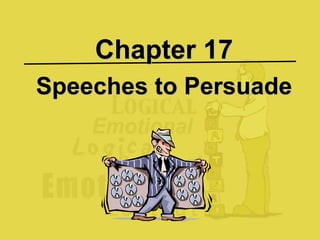
Chapter 17
Speeches to Persuade
What is persuasive
speaking?
• Induce your
audience to
believe as you do.
• Influence your
audience to cause
an action.
Analyzing your Audience
• Supportive- friendly; reinforce what they
already accept & strengthen ties with them
• Uncommitted- neutral; members need
information so they can make up their
minds
Analyzing your Audience
• Indifferent- members are often
apathetic; often they are a captive
audience (forced to be in attendance)
• Opposed- hostile towards you;
objective should be to get a fair
hearing
– compromise
– offer a disclaimer
Appealing to your Audience
• Logical Appeal- Greek “logos”
– be organized
– offer proof
• Emotional Appeal- Greek “pathos”
– words arouse feeling in audience
• Personal Appeal- Greek “ethos”
– honesty
– competency
Recalling the Facts
• Why is audience analysis important?
• What are the four types of audiences?
• How should you treat each type of audience?
• How should you deal with an opposed audience?
• No matter what type of audience you face, what
is your primary purpose in persuasive speaking?
• Discuss logos, pathos, & ethos.
• What two elements form the backbone of ethos?
• Which of the three types of appeals is most
effective?
Look Back on Page 469 of textbook
Vocabulary
• persuasive speaking
• supportive audience
• uncommitted audience
• unbiased
• indifferent audience
• captive audience
• opposed audience
• compromise
• disclaimer
• logos
• proof
• pathos
• ethos
• goodwill
• integrity
• reputation
• sincerity
• competency
• credentials
• composure
List on Page 469 of textbook

Chapter 17 Speeches to Persuade

  • 1.
  • 2.
    What is persuasive speaking? •Induce your audience to believe as you do. • Influence your audience to cause an action.
  • 3.
    Analyzing your Audience •Supportive- friendly; reinforce what they already accept & strengthen ties with them • Uncommitted- neutral; members need information so they can make up their minds
  • 4.
    Analyzing your Audience •Indifferent- members are often apathetic; often they are a captive audience (forced to be in attendance) • Opposed- hostile towards you; objective should be to get a fair hearing – compromise – offer a disclaimer
  • 5.
    Appealing to yourAudience • Logical Appeal- Greek “logos” – be organized – offer proof • Emotional Appeal- Greek “pathos” – words arouse feeling in audience • Personal Appeal- Greek “ethos” – honesty – competency
  • 6.
    Recalling the Facts •Why is audience analysis important? • What are the four types of audiences? • How should you treat each type of audience? • How should you deal with an opposed audience? • No matter what type of audience you face, what is your primary purpose in persuasive speaking? • Discuss logos, pathos, & ethos. • What two elements form the backbone of ethos? • Which of the three types of appeals is most effective? Look Back on Page 469 of textbook
  • 7.
    Vocabulary • persuasive speaking •supportive audience • uncommitted audience • unbiased • indifferent audience • captive audience • opposed audience • compromise • disclaimer • logos • proof • pathos • ethos • goodwill • integrity • reputation • sincerity • competency • credentials • composure List on Page 469 of textbook