CHEM 160 General Chemistry II
    Lecture Presentation
   Coordination Chemistry

          Chapter 24
JEWEL
Why Study Descriptive Chemistry of
              Transition Metals
   Transition metals are found in nature
     Rocks and minerals contain transition metals
     The color of many gemstones is due to the presence of
      transition metal ions
           Rubies are red due to Cr
           Sapphires are blue due to presence of Fe and Ti
     Many biomolecules contain transition metals that are
      involved in the functions of these biomolecules
         Vitamin B12 contains Co
         Hemoglobin, myoglobin, and cytochrome C contain Fe
Why Study Descriptive Chemistry of
              Transition Metals
   Transition metals and their compounds have many
    useful applications
     Fe is used to make steel and stainless steel
     Ti is used to make lightweight alloys
     Transition metal compounds are used as pigments
          TiO2 = white
          PbCrO4 = yellow
          Fe4[Fe(CN)6]3 (prussian blue)= blue
     Transition metal compounds are used in many
      industrial processes
Why Study Descriptive Chemistry of
              Transition Metals
   To understand the uses and applications of
    transition metals and their compounds, we need to
    understand their chemistry.
   Our focus will be on the 4th period transition
    elements.
Periodic Table


d block transition elements


            f block transition elements
Transition Metals
   General Properties
    Have typical metallic properties
    Not as reactive as Grp. IA, IIA metals
    Have high MP’s, high BP’s, high density, and
     are hard and strong
    Have 1 or 2 s electrons in valence shell
    Differ in # d electrons in n-1 energy level
    Exhibit multiple oxidation states
d-Block Transition Elements
                              VIIIB
IIIB IVB   VB VIB VIIB                   IB   IIB

Sc   Ti     V   Cr Mn Fe      Co      Ni Cu Zn
 Y   Zr    Nb Mo Tc      Ru Rh Pd Ag Cd
La   Hf    Ta   W   Re   Os    Ir     Pt Au Hg

  Most have partially occupied d subshells in
          common oxidation states
Electronic Configurations
Element                  Configuration
   Sc                      [Ar]3d14s2
   Ti                      [Ar]3d24s2
   V                       [Ar]3d34s2
   Cr                      [Ar]3d54s1
   Mn                      [Ar]3d54s2


          [Ar] = 1s22s22p63s23p6
Electronic Configurations
Element                   Configuration
    Fe                        [Ar] 3d64s2
    Co                        [Ar] 3d74s2
    Ni                        [Ar] 3d84s2
    Cu                        [Ar]3d104s1
    Zn                        [Ar]3d104s2


          [Ar] = 1s22s22p63s23p6
Transition Metals
   Characteristics due to d electrons:
    Exhibit multiple oxidation states
    Compounds typically have color
    Exhibit interesting magnetic properties
          paramagnetism
          ferromagnetism
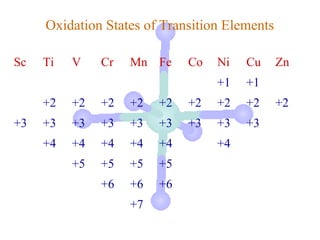
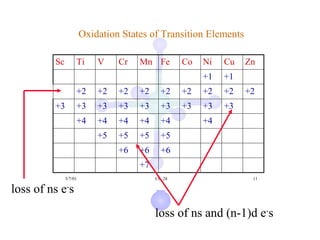
Oxidation States of Transition Elements

Sc   Ti   V    Cr   Mn Fe     Co   Ni   Cu     Zn
                                   +1   +1
     +2   +2   +2   +2   +2   +2   +2   +2     +2
+3   +3   +3   +3   +3   +3   +3   +3   +3
     +4   +4   +4   +4   +4        +4
          +5   +5   +5   +5
               +6   +6   +6
                    +7
Oxidation States of Transition Elements

         Sc        Ti      V    Cr   Mn Fe         Co   Ni   Cu   Zn
                                                        +1   +1
                   +2      +2   +2   +2     +2     +2   +2   +2   +2
         +3        +3      +3   +3   +3     +3     +3   +3   +3
                   +4      +4   +4   +4     +4          +4
                           +5   +5   +5     +5
                                +6   +6     +6
                                     +7
              3/7/01                      Ch. 24                   11

loss of ns e-s
                                          loss of ns and (n-1)d e-s
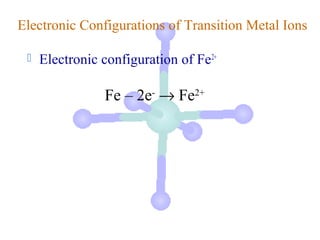
Electronic Configurations of Transition Metal Ions

    Electronic configuration of Fe2+
Electronic Configurations of Transition Metal Ions

    Electronic configuration of Fe2+

                Fe – 2e- → Fe2+
Electronic Configurations of Transition Metal Ions

    Electronic configuration of Fe2+

                 Fe – 2e- → Fe2+
              [Ar]3d64s2


                 valence ns e-’s removed
                          first
Electronic Configurations of Transition Metal Ions

    Electronic configuration of Fe2+

                 Fe – 2e- → Fe2+
              [Ar]3d64s2       [Ar]3d6


                 valence ns e-’s removed
                          first
Electronic Configurations of Transition Metal Ions

    Electronic configuration of Fe3+
Electronic Configurations of Transition Metal Ions

    Electronic configuration of Fe3+

                Fe – 3e- → Fe3+
Electronic Configurations of Transition Metal Ions

    Electronic configuration of Fe3+

                 Fe – 3e- → Fe3+
              [Ar]3d64s2


                 valence ns e-’s removed
                   first, then n-1 d e-’s
Electronic Configurations of Transition Metal Ions

    Electronic configuration of Fe3+

                 Fe – 3e- → Fe3+
              [Ar]3d64s2       [Ar]3d5


                 valence ns e-’s removed
                   first, then n-1 d e-’s
Electronic Configurations of Transition Metal Ions

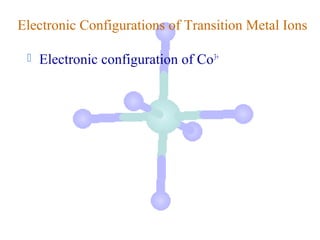
    Electronic configuration of Co3+
Electronic Configurations of Transition Metal Ions

    Electronic configuration of Co3+

                Co – 3e- → Co3+
Electronic Configurations of Transition Metal Ions

    Electronic configuration of Co3+

                Co – 3e- → Co3+
              [Ar]3d74s2


                valence ns e-’s removed
                  first, then n-1 d e-’s
Electronic Configurations of Transition Metal Ions

    Electronic configuration of Co3+

                Co – 3e- → Co3+
              [Ar]3d74s2       [Ar]3d6


                valence ns e-’s removed
                  first, then n-1 d e-’s
Electronic Configurations of Transition Metal Ions

    Electronic configuration of Mn4+
Electronic Configurations of Transition Metal Ions

    Electronic configuration of Mn4+

               Mn – 4e- → Mn4+
Electronic Configurations of Transition Metal Ions

    Electronic configuration of Mn4+

               Mn – 4e- → Mn4+
              [Ar]3d54s2


                valence ns e-’s removed
                  first, then n-1 d e-’s
Electronic Configurations of Transition Metal Ions

    Electronic configuration of Mn4+

               Mn – 4e- → Mn4+
              [Ar]3d54s2       [Ar]3d3


                valence ns e-’s removed
                  first, then n-1 d e-’s
Coordination Chemistry
   Transition metals act as Lewis acids
          Form complexes/complex ions
                  Fe3+(aq) + 6CN-(aq) → Fe(CN)63-(aq)
              Lewis acid       Lewis base       Complex ion

                    Ni2+(aq) + 6NH3(aq) → Ni(NH3)62+(aq)
              Lewis acid    Lewis base          Complex ion


             Complex contains central metal ion bonded to one or more
                               molecules or anions
                    Lewis acid = metal = center of coordination
            Lewis base = ligand = molecules/ions covalently bonded to
                                metal in complex
Coordination Chemistry
   Transition metals act as Lewis acids
          Form complexes/complex ions
                  Fe3+(aq) + 6CN-(aq) → [Fe(CN)6]3-(aq)
              Lewis acid     Lewis base        Complex ion

                  Ni2+(aq) + 6NH3(aq) → [Ni(NH3)6]2+(aq)
              Lewis acid   Lewis base         Complex ion


                    Complex with a net charge = complex ion
                       Complexes have distinct properties
Coordination Chemistry
   Coordination compound
    Compound that contains 1 or more complexes
    Example
          [Co(NH3)6]Cl3
          [Cu(NH3)4][PtCl4]
          [Pt(NH3)2Cl2]
Coordination Chemistry
   Coordination sphere
    Metal and ligands bound to it
   Coordination number
    number of donor atoms bonded to the central
     metal atom or ion in the complex
          Most common = 4, 6
          Determined by ligands
             Larger ligands and those that transfer substantial negative
              charge to metal favor lower coordination numbers
Coordination Chemistry
Complex charge = sum of charges
  on the metal and the ligands

          [Fe(CN)6]3-
Coordination Chemistry
Complex charge = sum of charges
  on the metal and the ligands

            [Fe(CN)6]3-

       +3          6(-1)
Coordination Chemistry
 Neutral charge of coordination compound = sum of
charges on metal, ligands, and counterbalancing ions

                  [Co(NH3)6]Cl2

                neutral compound
Coordination Chemistry
 Neutral charge of coordination compound = sum of
charges on metal, ligands, and counterbalancing ions

                       [Co(NH3)6]Cl2

                  +2      6(0)         2(-1)
Coordination Chemistry
   Ligands
    classified according to the number of donor
     atoms
    Examples
          monodentate = 1
          bidentate = 2
          tetradentate = 4
          hexadentate = 6
          polydentate = 2 or more donor atoms
Coordination Chemistry
   Ligands
    classified according to the number of donor
     atoms
    Examples
          monodentate = 1
          bidentate = 2           chelating agents
          tetradentate = 4
          hexadentate = 6
          polydentate = 2 or more donor atoms
Ligands
   Monodentate
     Examples:
         H2O, CN-, NH3, NO2-, SCN-, OH-, X- (halides), CO, O2-
    Example Complexes
         [Co(NH3)6]3+
         [Fe(SCN)6]3-
Ligands
   Bidentate
    Examples
          oxalate ion = C2O42-
          ethylenediamine (en) = NH2CH2CH2NH2
          ortho-phenanthroline (o-phen)
    Example Complexes
          [Co(en)3]3+
          [Cr(C2O4)3]3-
          [Fe(NH3)4(o-phen)]3+
Ligands
    oxalate ion                           ethylenediamine
O                 O   2-
                                                 CH2 CH2
    C     C
                                    H2N                    NH2
O                 O                      *                 *
*                 *
                      ortho-phenanthroline
                                             CH
                                    *
                                    N             CH
                           *
                           N         C            CH
Donor Atoms           HC        C            C

                      HC        C            CH
                           CH        CH
Ligands

oxalate ion          ethylenediamine
                    H                  C

              C


         O            M     N
  M
Ligands
Ligands
   Hexadentate
     ethylenediaminetetraacetate (EDTA) =
     (O2CCH2)2N(CH2)2N(CH2CO2)24-
    Example Complexes
          [Fe(EDTA)]-1
          [Co(EDTA)]-1
Ligands

     O         EDTA             O

*O   C   CH2                 CH2 C   O*
           *
           N           *
               CH2 CH2 N
*O   C   CH2                 CH2 C   O*

     O                          O

               Donor Atoms
Ligands
        EDTA      O
    H
C
                  N
            M
Ligands
EDTA
Common Geometries of Complexes

Coordination Number    Geometry

     2


                        Linear
Common Geometries of Complexes

Coordination Number      Geometry

     2


                         Linear
  Example: [Ag(NH3)2]+
Common Geometries of Complexes
Coordination Number                                 Geometry
        4
                            tetrahedral
                             (most common)


                       square planar
     (characteristic of metal ions with 8 d e-’s)
Common Geometries of Complexes
Coordination Number                     Geometry
          4
                          tetrahedral

 Examples: [Zn(NH3)4]2+, [FeCl4]-


                     square planar
 Example: [Ni(CN)4]2-
Common Geometries of Complexes
Coordination Number    Geometry
       6


                        octahedral
Common Geometries of Complexes
Coordination Number                    Geometry
          6

  Examples: [Co(CN)6]3-, [Fe(en)3]3+


                                       octahedral
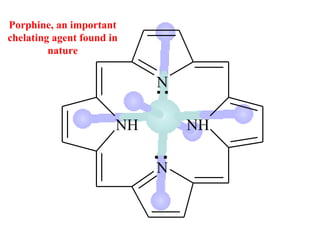
Porphine, an important
chelating agent found in
         nature


                            N

                       NH       NH

                            N
Metalloporphyrin


                   N
                        2+
           N       Fe        N

                   N
Myoglobin, a protein that
   stores O2 in cells
Coordination Environment of Fe2+ in
Oxymyoglobin and Oxyhemoglobin
FG24_014.JPG

Ferrichrome (Involved in Fe transport in bacteria)
Nomenclature of Coordination
        Compounds: IUPAC Rules
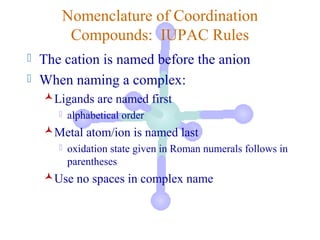
 The cation is named before the anion
 When naming a complex:
    Ligands are named first
         alphabetical order
    Metal atom/ion is named last
         oxidation state given in Roman numerals follows in
          parentheses
    Use no spaces in complex name
Nomenclature: IUPAC Rules
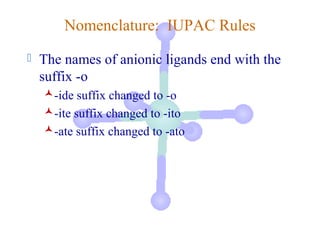
   The names of anionic ligands end with the
    suffix -o
    -ide suffix changed to -o
    -ite suffix changed to -ito
    -ate suffix changed to -ato
Nomenclature: IUPAC Rules
    Ligand        Name
  bromide, Br-    bromo
  chloride, Cl-   chloro
  cyanide, CN-    cyano
 hydroxide, OH-   hydroxo
   oxide, O2-      oxo
   fluoride, F-   fluoro
Nomenclature: IUPAC Rules
     Ligand             Name
carbonate, CO32-      carbonato
 oxalate, C2O42-        oxalato
  sulfate, SO42-        sulfato
thiocyanate, SCN-     thiocyanato
thiosulfate, S2O32-   thiosulfato
  Sulfite, SO32-        sulfito
Nomenclature: IUPAC Rules
   Neutral ligands are referred to by the usual
    name for the molecule
    Example
          ethylenediamine
    Exceptions
          water, H2O = aqua
          ammonia, NH3 = ammine
          carbon monoxide, CO = carbonyl
Nomenclature: IUPAC Rules
   Greek prefixes are used to indicate the number of
    each type of ligand when more than one is present in
    the complex
     di-, 2; tri-, 3; tetra-, 4; penta-, 5; hexa-, 6
   If the ligand name already contains a Greek prefix,
    use alternate prefixes:
     bis-, 2; tris-, 3; tetrakis-,4; pentakis-, 5; hexakis-, 6
     The name of the ligand is placed in parentheses
Nomenclature: IUPAC Rules
   If a complex is an anion, its name ends with
    the -ate
    appended to name of the metal
Nomenclature: IUPAC Rules
Transition    Name if in Cationic   Name if in Anionic Complex
  Metal          Complex
   Sc             Scandium                  Scandate
   Ti             titanium                   titanate
    V             vanadium                  vanadate
   Cr            chromium                   chromate
   Mn            manganese                 manganate
   Fe                iron                    ferrate
   Co               cobalt                  cobaltate
   Ni               nickel                  nickelate
   Cu              Copper                    cuprate
   Zn                Zinc                    zincate
Isomerism
   Isomers
    compounds that have the same composition but
     a different arrangement of atoms
   Major Types
    structural isomers
    stereoisomers
Structural Isomers
   Structural Isomers
    isomers that have different bonds
Structural Isomers
   Coordination-sphere isomers
    differ in a ligand bonded to the metal in the
     complex, as opposed to being outside the
     coordination-sphere
Coordination-Sphere Isomers
   Example
       [Co(NH3)5Cl]Br vs. [Co(NH3)5Br]Cl
Coordination-Sphere Isomers
   Example
       [Co(NH3)5Cl]Br vs. [Co(NH3)5Br]Cl
   Consider ionization in water
    [Co(NH3)5Cl]Br → [Co(NH3)5Cl]+ + Br-


    [Co(NH3)5Br]Cl → [Co(NH3)5Br]+ + Cl-
Coordination-Sphere Isomers
   Example
       [Co(NH3)5Cl]Br vs. [Co(NH3)5Br]Cl
   Consider precipitation
[Co(NH3)5Cl]Br(aq) + AgNO3(aq) → [Co(NH3)5Cl]NO3(aq) + AgBr(s)


[Co(NH3)5Br]Cl(aq) + AgNO3(aq) → [Co(NH3)5Br]NO3(aq) + AgCl(aq)
Structural Isomers
   Linkage isomers
    differ in the atom of a ligand bonded to the
     metal in the complex
Linkage Isomers
   Example
    [Co(NH3)5(ONO)]2+ vs. [Co(NH3)5(NO2)]2+
Linkage Isomers
Linkage Isomers
   Example
    [Co(NH3)5(SCN)]2+ vs. [Co(NH3)5(NCS)]2+

          Co-SCN vs. Co-NCS
Stereoisomers
   Stereoisomers
    Isomers that have the same bonds, but different
     spatial arrangements
Stereoisomers
   Geometric isomers
    Differ in the spatial arrangements of the ligands
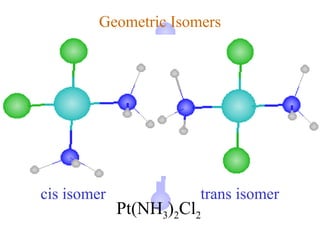
Geometric Isomers


cis isomer             trans isomer
             Pt(NH3)2Cl2
Geometric Isomers


cis isomer            trans isomer
         [Co(H2O)4Cl2]+
Stereoisomers
   Geometric isomers
    Differ in the spatial arrangements of the ligands
    Have different chemical/physical properties
          different colors, melting points, polarities,
           solubilities, reactivities, etc.
Stereoisomers
   Optical isomers
    isomers that are nonsuperimposable mirror
     images
          said to be “chiral” (handed)
          referred to as enantiomers
    A substance is “chiral” if it does not have a
     “plane of symmetry”
Example 1


                    mirror plane


            cis-[Co(en)2Cl2]+
Example 1
            rotate mirror image 180°


                   180 °
Example 1   nonsuperimposable


            cis-[Co(en)2Cl2]+
Example 1      enantiomers


            cis-[Co(en)2Cl2]+
Example 2


                      mirror plane


            trans-[Co(en)2Cl2]+
Example 2
              rotate mirror image 180°


                180 °


            trans-[Co(en)2Cl2]+
Example 2
       Superimposable-not enantiomers


            trans-[Co(en)2Cl2]+
Properties of Optical Isomers
   Enantiomers
    possess many identical properties
          solubility, melting point, boiling point, color,
           chemical reactivity (with nonchiral reagents)
    different in:
          interactions with plane polarized light
Optical Isomers

                               polarizing
                                 filter         plane
                                            polarized light

 light     unpolarized
source        light
         (random vibrations)
                                    (vibrates in one plane)
Optical Isomers

polarizing filter
                      plane
                    polarized   optically active sample
                      light           in solution


                                  rotated polarized
                                        light
Optical Isomers

                  polarizing filter
                                        plane
                                      polarized   optically active sample
                                        light           in solution


Dextrorotatory (d) = right
rotation
Levorotatory (l) = left rotation
Racemic mixture = equal
                                                    rotated polarized
amounts of two enantiomers; no
                                                          light
net rotation
Properties of Optical Isomers
   Enantiomers
    possess many identical properties
          solubility, melting point, boiling point, color, chemical
           reactivity (with nonchiral reagents)
    different in:
          interactions with plane polarized light
          reactivity with “chiral” reagents
           Example
       d-C4H4O62-(aq) + d,l-[Co(en)3]Cl3(aq) →
       d-[Co(en)3](d-C4H4O62- )Cl(s) + l-[Co(en)3]Cl3(aq) +2Cl-(aq)
Properties of Transition Metal Complexes

   Properties of transition metal complexes:
    usually have color
          dependent upon ligand(s) and metal ion
    many are paramagnetic
          due to unpaired d electrons
          degree of paramagnetism dependent on ligand(s)
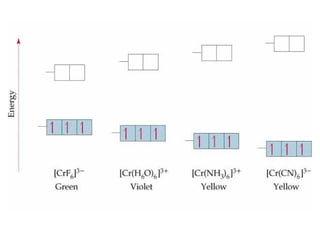
             [Fe(CN)6]3- has 1 unpaired d electron
             [FeF6]3- has 5 unpaired d electrons
Crystal Field Theory
   Crystal Field Theory
    Model for bonding in transition metal
     complexes
          Accounts for observed properties of transition metal
           complexes
    Focuses on d-orbitals
    Ligands = point negative charges
    Assumes ionic bonding
          electrostatic interactions
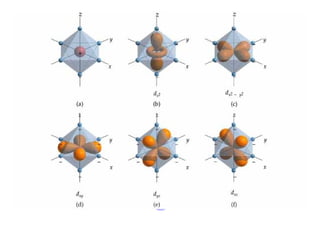
Y                   Z
                   d orbitals

     X                                X


    Y     dx2-y2        Z       dz2       Z


X            X                                Y


    dxy                dxz            dyz
Crystal Field Theory

   Electrostatic Interactions
    (+) metal ion attracted to (-) ligands (anion or
     dipole)
          provides stability
    lone pair e-’s on ligands repulsed by e-’s in metal d
     orbitals
          interaction called crystal field
          influences d orbital energies
              not all d orbitals influenced the same way
Crystal Field Theory

Octahedral Crystal Field
                                               -
 (-) Ligands attracted to (+)
 metal ion; provides stability
                                 -                 -
                                               +
                                   -               -
              d orbital e-’s repulsed by (–)
              ligands; increases d orbital     -
                   potential energy

                    ligands approach along x, y, z axes
Crystal Field Theory


                Lobes directed at ligands

greater electrostatic repulsion = higher potential energy
Crystal Field Theory


          Lobes directed between ligands

less electrostatic repulsion = lower potential energy
Crystal Field Theory
    octahedral crystal field         dz2 dx2- y2
                                        _     _
    d orbital energy levels


                                     _      _      _
E                                   dxy dxz dyz
     isolated
     metal ion
                                  metal ion in octahedral
    _____                                complex

    d-orbitals
Crystal Field Splitting Energy

              dz2         dx2- y2

                                    Determined by metal
∆                                      ion and ligand


        dxy         dxz             dyz
metal ion in octahedral
octahedral crystal field             complex
                                  dz2 dx2- y2
d orbital energy levels             _      _
                                                 ∆
                                  _      _      _
E                                dxy dxz dyz
     isolated
    _____
     metal ion        Metal ion and the nature of the
                          ligand determines ∆
    d-orbitals
Properties of Transition Metal Complexes

   Properties of transition metal complexes:
    usually have color
          dependent upon ligand(s) and metal ion
    many are paramagnetic
          due to unpaired d electrons
          degree of paramagnetism dependent on ligand(s)
             [Fe(CN)6]3- has 1 unpaired d electron
             [FeF6]3- has 5 unpaired d electrons
Crystal Field Theory
   Crystal Field Theory
    Can be used to account for
          Colors of transition metal complexes
             A complex must have partially filled d subshell on metal
              to exhibit color
             A complex with 0 or 10 d e-s is colorless
          Magnetic properties of transition metal complexes
             Many are paramagnetic
             # of unpaired electrons depends on the ligand
Colors of Transition Metal Complexes
   Compounds/complexes that have color:
    absorb specific wavelengths of visible light (400 –700
     nm)
          wavelengths not absorbed are transmitted
Visible Spectrum
                  wavelength, nm
   (Each wavelength corresponds to a different color)


400 nm                                           700 nm
         higher                  lower energy
         energy
      White = all the colors (wavelengths)
Visible Spectrum
Colors of Transition Metal Complexes
   Compounds/complexes that have color:
    absorb specific wavelengths of visible light (400 –700
     nm)
          wavelengths not absorbed are transmitted
          color observed = complementary color of color absorbed
absorbed   observed
color      color
Colors of Transition Metal Complexes
   Absorption of UV-visible radiation by atom,
    ion, or molecule:
    Occurs only if radiation has the energy needed to
     raise an e- from its ground state to an excited state
          i.e., from lower to higher energy orbital
          light energy absorbed = energy difference between the
           ground state and excited state
          “electron jumping”
Colors of Transition Metal Complexes


                                                    green light
white                    red light
                                                     observed
light                    absorbed


    For transition metal                Absorption raises an
complexes, ∆ corresponds to          electron from the lower d
  energies of visible light.          subshell to the higher d
                                             subshell.
Colors of Transition Metal Complexes

   Different complexes exhibit different colors
    because:
    color of light absorbed depends on ∆
          larger ∆ = higher energy light absorbed
             Shorter wavelengths
          smaller ∆ = lower energy light absorbed
             Longer wavelengths
    magnitude of ∆ depends on:
          ligand(s)
          metal
Colors of Transition Metal Complexes


white                                      green light
                      red light
light                                       observed
                      absorbed
                       (lower
                       energy
                        light)


                  [M(H2O)6]3+
Colors of Transition Metal Complexes


white                  blue light        orange light
light                  absorbed           observed
                        (higher
                        energy
                         light)


                  [M(en)3]3+
Colors of Transition Metal Complexes

Spectrochemical Series
Smallest ∆                                      Largest ∆
                     ∆ increases


 I- < Br- < Cl- < OH- < F- < H2O < NH3 < en < CN-


                                          strong field
       weak field
Properties of Transition Metal Complexes

   Properties of transition metal complexes:
    usually have color
          dependent upon ligand(s) and metal ion
    many are paramagnetic
          due to unpaired d electrons
          degree of paramagnetism dependent on ligand(s)
             [Fe(CN)6]3- has 1 unpaired d electron
             [FeF6]3- has 5 unpaired d electrons
Electronic Configurations of Transition Metal
                     Complexes
   Expected orbital filling tendencies for e -’s:
    occupy a set of equal energy orbitals one at a time
     with spins parallel (Hund’s rule)
          minimizes repulsions
    occupy lowest energy vacant orbitals first
   These are not always followed by transition
    metal complexes.
Electronic Configurations of Transition Metal
                 Complexes
   d orbital occupancy depends on ∆ and
    pairing energy, P
    e-’s assume the electron configuration with the
     lowest possible energy cost
    If ∆ > P (∆ large; strong field ligand)
          e-’s pair up in lower energy d subshell first
    If ∆ < P (∆ small; weak field ligand)
          e-’s spread out among all d orbitals before any pair
           up
d-orbital energy level diagrams
     octahedral complex


               d1
d-orbital energy level diagrams
     octahedral complex


               d2
d-orbital energy level diagrams
     octahedral complex


               d3
d-orbital energy level diagrams
       octahedral complex


                 d4


high spin                 low spin
 ∆<P                        ∆>P
d-orbital energy level diagrams
       octahedral complex


                 d5


high spin                 low spin
 ∆<P                        ∆>P
d-orbital energy level diagrams
       octahedral complex


                 d6


high spin                 low spin
 ∆<P                        ∆>P
d-orbital energy level diagrams
       octahedral complex


                 d7


high spin                 low spin
 ∆<P                        ∆>P
d-orbital energy level diagrams
     octahedral complex


               d8
d-orbital energy level diagrams
     octahedral complex


               d9
d-orbital energy level diagrams
     octahedral complex


              d10
Electronic Configurations of Transition Metal
                 Complexes
   Determining d-orbital energy level diagrams:
    determine oxidation # of the metal
    determine # of d e-’s
    determine if ligand is weak field or strong field
    draw energy level diagram
Colors of Transition Metal Complexes

Spectrochemical Series
Smallest ∆                                      Largest ∆
                     ∆ increases


 I- < Br- < Cl- < OH- < F- < H2O < NH3 < en < CN-


                                          strong field
       weak field
d-orbital energy level diagrams
     tetrahedral complex
d-orbital energy level        metal ion in
                         tetrahedral complex
diagram
                              dxy dxz dyz
                               _ _ _
                                            ∆
                                  _     _
E                                dz2 dx2- y2
    isolated
    metal ion                 only high spin
    _____
    d-orbitals
d-orbital energy level diagrams
    square planar complex
d-orbital energy level
                         metal ion in square
diagram                   planar complex
                                 __        dx2- y2
                                 __         dxy
                                     __        dz2
E                              __         __
    isolated
                               dxz        dyz
    metal ion
    _____
                             only low spin
    d-orbitals
Myoglobin, a protein that
   stores O2 in cells
Porphine, an important
chelating agent found in
         nature


                            N

                       NH       NH

                            N
Metalloporphyrin


                   N
                        2+
           N       Fe        N

                   N
Coordination Environment of Fe2+ in
Oxymyoglobin and Oxyhemoglobin
Arterial Blood

          Strong field
     O2
          N
N                                         large ∆
     Fe
N         N
     N


    NH                      Bright red due to
              globin      absorption of greenish
              (protein)           light
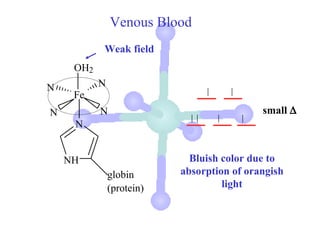
Venous Blood
           Weak field
     OH2
N          N
     Fe
N          N                                small ∆
     N


    NH                       Bluish color due to
               globin      absorption of orangish
               (protein)            light
End of Presentation

Chapter 24

  • 1.
    CHEM 160 GeneralChemistry II Lecture Presentation Coordination Chemistry Chapter 24
  • 2.
  • 4.
    Why Study DescriptiveChemistry of Transition Metals  Transition metals are found in nature  Rocks and minerals contain transition metals  The color of many gemstones is due to the presence of transition metal ions  Rubies are red due to Cr  Sapphires are blue due to presence of Fe and Ti  Many biomolecules contain transition metals that are involved in the functions of these biomolecules  Vitamin B12 contains Co  Hemoglobin, myoglobin, and cytochrome C contain Fe
  • 5.
    Why Study DescriptiveChemistry of Transition Metals  Transition metals and their compounds have many useful applications  Fe is used to make steel and stainless steel  Ti is used to make lightweight alloys  Transition metal compounds are used as pigments  TiO2 = white  PbCrO4 = yellow  Fe4[Fe(CN)6]3 (prussian blue)= blue  Transition metal compounds are used in many industrial processes
  • 6.
    Why Study DescriptiveChemistry of Transition Metals  To understand the uses and applications of transition metals and their compounds, we need to understand their chemistry.  Our focus will be on the 4th period transition elements.
  • 7.
    Periodic Table d blocktransition elements f block transition elements
  • 8.
    Transition Metals  General Properties Have typical metallic properties Not as reactive as Grp. IA, IIA metals Have high MP’s, high BP’s, high density, and are hard and strong Have 1 or 2 s electrons in valence shell Differ in # d electrons in n-1 energy level Exhibit multiple oxidation states
  • 9.
    d-Block Transition Elements VIIIB IIIB IVB VB VIB VIIB IB IIB Sc Ti V Cr Mn Fe Co Ni Cu Zn Y Zr Nb Mo Tc Ru Rh Pd Ag Cd La Hf Ta W Re Os Ir Pt Au Hg Most have partially occupied d subshells in common oxidation states
  • 10.
    Electronic Configurations Element Configuration Sc [Ar]3d14s2 Ti [Ar]3d24s2 V [Ar]3d34s2 Cr [Ar]3d54s1 Mn [Ar]3d54s2 [Ar] = 1s22s22p63s23p6
  • 11.
    Electronic Configurations Element Configuration Fe [Ar] 3d64s2 Co [Ar] 3d74s2 Ni [Ar] 3d84s2 Cu [Ar]3d104s1 Zn [Ar]3d104s2 [Ar] = 1s22s22p63s23p6
  • 12.
    Transition Metals  Characteristics due to d electrons: Exhibit multiple oxidation states Compounds typically have color Exhibit interesting magnetic properties  paramagnetism  ferromagnetism
  • 13.
    Oxidation States ofTransition Elements Sc Ti V Cr Mn Fe Co Ni Cu Zn +1 +1 +2 +2 +2 +2 +2 +2 +2 +2 +2 +3 +3 +3 +3 +3 +3 +3 +3 +3 +4 +4 +4 +4 +4 +4 +5 +5 +5 +5 +6 +6 +6 +7
  • 14.
    Oxidation States ofTransition Elements Sc Ti V Cr Mn Fe Co Ni Cu Zn +1 +1 +2 +2 +2 +2 +2 +2 +2 +2 +2 +3 +3 +3 +3 +3 +3 +3 +3 +3 +4 +4 +4 +4 +4 +4 +5 +5 +5 +5 +6 +6 +6 +7 3/7/01 Ch. 24 11 loss of ns e-s loss of ns and (n-1)d e-s
  • 15.
    Electronic Configurations ofTransition Metal Ions  Electronic configuration of Fe2+
  • 16.
    Electronic Configurations ofTransition Metal Ions  Electronic configuration of Fe2+ Fe – 2e- → Fe2+
  • 17.
    Electronic Configurations ofTransition Metal Ions  Electronic configuration of Fe2+ Fe – 2e- → Fe2+ [Ar]3d64s2 valence ns e-’s removed first
  • 18.
    Electronic Configurations ofTransition Metal Ions  Electronic configuration of Fe2+ Fe – 2e- → Fe2+ [Ar]3d64s2 [Ar]3d6 valence ns e-’s removed first
  • 19.
    Electronic Configurations ofTransition Metal Ions  Electronic configuration of Fe3+
  • 20.
    Electronic Configurations ofTransition Metal Ions  Electronic configuration of Fe3+ Fe – 3e- → Fe3+
  • 21.
    Electronic Configurations ofTransition Metal Ions  Electronic configuration of Fe3+ Fe – 3e- → Fe3+ [Ar]3d64s2 valence ns e-’s removed first, then n-1 d e-’s
  • 22.
    Electronic Configurations ofTransition Metal Ions  Electronic configuration of Fe3+ Fe – 3e- → Fe3+ [Ar]3d64s2 [Ar]3d5 valence ns e-’s removed first, then n-1 d e-’s
  • 23.
    Electronic Configurations ofTransition Metal Ions  Electronic configuration of Co3+
  • 24.
    Electronic Configurations ofTransition Metal Ions  Electronic configuration of Co3+ Co – 3e- → Co3+
  • 25.
    Electronic Configurations ofTransition Metal Ions  Electronic configuration of Co3+ Co – 3e- → Co3+ [Ar]3d74s2 valence ns e-’s removed first, then n-1 d e-’s
  • 26.
    Electronic Configurations ofTransition Metal Ions  Electronic configuration of Co3+ Co – 3e- → Co3+ [Ar]3d74s2 [Ar]3d6 valence ns e-’s removed first, then n-1 d e-’s
  • 27.
    Electronic Configurations ofTransition Metal Ions  Electronic configuration of Mn4+
  • 28.
    Electronic Configurations ofTransition Metal Ions  Electronic configuration of Mn4+ Mn – 4e- → Mn4+
  • 29.
    Electronic Configurations ofTransition Metal Ions  Electronic configuration of Mn4+ Mn – 4e- → Mn4+ [Ar]3d54s2 valence ns e-’s removed first, then n-1 d e-’s
  • 30.
    Electronic Configurations ofTransition Metal Ions  Electronic configuration of Mn4+ Mn – 4e- → Mn4+ [Ar]3d54s2 [Ar]3d3 valence ns e-’s removed first, then n-1 d e-’s
  • 31.
    Coordination Chemistry  Transition metals act as Lewis acids  Form complexes/complex ions Fe3+(aq) + 6CN-(aq) → Fe(CN)63-(aq) Lewis acid Lewis base Complex ion Ni2+(aq) + 6NH3(aq) → Ni(NH3)62+(aq) Lewis acid Lewis base Complex ion Complex contains central metal ion bonded to one or more molecules or anions Lewis acid = metal = center of coordination Lewis base = ligand = molecules/ions covalently bonded to metal in complex
  • 32.
    Coordination Chemistry  Transition metals act as Lewis acids  Form complexes/complex ions Fe3+(aq) + 6CN-(aq) → [Fe(CN)6]3-(aq) Lewis acid Lewis base Complex ion Ni2+(aq) + 6NH3(aq) → [Ni(NH3)6]2+(aq) Lewis acid Lewis base Complex ion Complex with a net charge = complex ion Complexes have distinct properties
  • 33.
    Coordination Chemistry  Coordination compound Compound that contains 1 or more complexes Example  [Co(NH3)6]Cl3  [Cu(NH3)4][PtCl4]  [Pt(NH3)2Cl2]
  • 34.
    Coordination Chemistry  Coordination sphere Metal and ligands bound to it  Coordination number number of donor atoms bonded to the central metal atom or ion in the complex  Most common = 4, 6  Determined by ligands  Larger ligands and those that transfer substantial negative charge to metal favor lower coordination numbers
  • 35.
    Coordination Chemistry Complex charge= sum of charges on the metal and the ligands [Fe(CN)6]3-
  • 36.
    Coordination Chemistry Complex charge= sum of charges on the metal and the ligands [Fe(CN)6]3- +3 6(-1)
  • 37.
    Coordination Chemistry Neutralcharge of coordination compound = sum of charges on metal, ligands, and counterbalancing ions [Co(NH3)6]Cl2 neutral compound
  • 38.
    Coordination Chemistry Neutralcharge of coordination compound = sum of charges on metal, ligands, and counterbalancing ions [Co(NH3)6]Cl2 +2 6(0) 2(-1)
  • 39.
    Coordination Chemistry  Ligands classified according to the number of donor atoms Examples  monodentate = 1  bidentate = 2  tetradentate = 4  hexadentate = 6  polydentate = 2 or more donor atoms
  • 40.
    Coordination Chemistry  Ligands classified according to the number of donor atoms Examples  monodentate = 1  bidentate = 2 chelating agents  tetradentate = 4  hexadentate = 6  polydentate = 2 or more donor atoms
  • 41.
    Ligands  Monodentate  Examples:  H2O, CN-, NH3, NO2-, SCN-, OH-, X- (halides), CO, O2- Example Complexes  [Co(NH3)6]3+  [Fe(SCN)6]3-
  • 42.
    Ligands  Bidentate Examples  oxalate ion = C2O42-  ethylenediamine (en) = NH2CH2CH2NH2  ortho-phenanthroline (o-phen) Example Complexes  [Co(en)3]3+  [Cr(C2O4)3]3-  [Fe(NH3)4(o-phen)]3+
  • 43.
    Ligands oxalate ion ethylenediamine O O 2- CH2 CH2 C C H2N NH2 O O * * * * ortho-phenanthroline CH * N CH * N C CH Donor Atoms HC C C HC C CH CH CH
  • 44.
    Ligands oxalate ion ethylenediamine H C C O M N M
  • 45.
  • 46.
    Ligands  Hexadentate  ethylenediaminetetraacetate (EDTA) = (O2CCH2)2N(CH2)2N(CH2CO2)24- Example Complexes  [Fe(EDTA)]-1  [Co(EDTA)]-1
  • 47.
    Ligands O EDTA O *O C CH2 CH2 C O* * N * CH2 CH2 N *O C CH2 CH2 C O* O O Donor Atoms
  • 48.
    Ligands EDTA O H C N M
  • 49.
  • 50.
    Common Geometries ofComplexes Coordination Number Geometry 2 Linear
  • 51.
    Common Geometries ofComplexes Coordination Number Geometry 2 Linear Example: [Ag(NH3)2]+
  • 52.
    Common Geometries ofComplexes Coordination Number Geometry 4 tetrahedral (most common) square planar (characteristic of metal ions with 8 d e-’s)
  • 53.
    Common Geometries ofComplexes Coordination Number Geometry 4 tetrahedral Examples: [Zn(NH3)4]2+, [FeCl4]- square planar Example: [Ni(CN)4]2-
  • 54.
    Common Geometries ofComplexes Coordination Number Geometry 6 octahedral
  • 55.
    Common Geometries ofComplexes Coordination Number Geometry 6 Examples: [Co(CN)6]3-, [Fe(en)3]3+ octahedral
  • 56.
    Porphine, an important chelatingagent found in nature N NH NH N
  • 57.
    Metalloporphyrin N 2+ N Fe N N
  • 58.
    Myoglobin, a proteinthat stores O2 in cells
  • 59.
    Coordination Environment ofFe2+ in Oxymyoglobin and Oxyhemoglobin
  • 60.
    FG24_014.JPG Ferrichrome (Involved inFe transport in bacteria)
  • 61.
    Nomenclature of Coordination Compounds: IUPAC Rules  The cation is named before the anion  When naming a complex: Ligands are named first  alphabetical order Metal atom/ion is named last  oxidation state given in Roman numerals follows in parentheses Use no spaces in complex name
  • 62.
    Nomenclature: IUPAC Rules  The names of anionic ligands end with the suffix -o -ide suffix changed to -o -ite suffix changed to -ito -ate suffix changed to -ato
  • 63.
    Nomenclature: IUPAC Rules Ligand Name bromide, Br- bromo chloride, Cl- chloro cyanide, CN- cyano hydroxide, OH- hydroxo oxide, O2- oxo fluoride, F- fluoro
  • 64.
    Nomenclature: IUPAC Rules Ligand Name carbonate, CO32- carbonato oxalate, C2O42- oxalato sulfate, SO42- sulfato thiocyanate, SCN- thiocyanato thiosulfate, S2O32- thiosulfato Sulfite, SO32- sulfito
  • 65.
    Nomenclature: IUPAC Rules  Neutral ligands are referred to by the usual name for the molecule Example  ethylenediamine Exceptions  water, H2O = aqua  ammonia, NH3 = ammine  carbon monoxide, CO = carbonyl
  • 66.
    Nomenclature: IUPAC Rules  Greek prefixes are used to indicate the number of each type of ligand when more than one is present in the complex  di-, 2; tri-, 3; tetra-, 4; penta-, 5; hexa-, 6  If the ligand name already contains a Greek prefix, use alternate prefixes:  bis-, 2; tris-, 3; tetrakis-,4; pentakis-, 5; hexakis-, 6  The name of the ligand is placed in parentheses
  • 67.
    Nomenclature: IUPAC Rules  If a complex is an anion, its name ends with the -ate appended to name of the metal
  • 68.
    Nomenclature: IUPAC Rules Transition Name if in Cationic Name if in Anionic Complex Metal Complex Sc Scandium Scandate Ti titanium titanate V vanadium vanadate Cr chromium chromate Mn manganese manganate Fe iron ferrate Co cobalt cobaltate Ni nickel nickelate Cu Copper cuprate Zn Zinc zincate
  • 69.
    Isomerism  Isomers compounds that have the same composition but a different arrangement of atoms  Major Types structural isomers stereoisomers
  • 70.
    Structural Isomers  Structural Isomers isomers that have different bonds
  • 71.
    Structural Isomers  Coordination-sphere isomers differ in a ligand bonded to the metal in the complex, as opposed to being outside the coordination-sphere
  • 72.
    Coordination-Sphere Isomers  Example [Co(NH3)5Cl]Br vs. [Co(NH3)5Br]Cl
  • 73.
    Coordination-Sphere Isomers  Example [Co(NH3)5Cl]Br vs. [Co(NH3)5Br]Cl  Consider ionization in water [Co(NH3)5Cl]Br → [Co(NH3)5Cl]+ + Br- [Co(NH3)5Br]Cl → [Co(NH3)5Br]+ + Cl-
  • 74.
    Coordination-Sphere Isomers  Example [Co(NH3)5Cl]Br vs. [Co(NH3)5Br]Cl  Consider precipitation [Co(NH3)5Cl]Br(aq) + AgNO3(aq) → [Co(NH3)5Cl]NO3(aq) + AgBr(s) [Co(NH3)5Br]Cl(aq) + AgNO3(aq) → [Co(NH3)5Br]NO3(aq) + AgCl(aq)
  • 75.
    Structural Isomers  Linkage isomers differ in the atom of a ligand bonded to the metal in the complex
  • 76.
    Linkage Isomers  Example [Co(NH3)5(ONO)]2+ vs. [Co(NH3)5(NO2)]2+
  • 77.
  • 78.
    Linkage Isomers  Example [Co(NH3)5(SCN)]2+ vs. [Co(NH3)5(NCS)]2+  Co-SCN vs. Co-NCS
  • 79.
    Stereoisomers  Stereoisomers Isomers that have the same bonds, but different spatial arrangements
  • 80.
    Stereoisomers  Geometric isomers Differ in the spatial arrangements of the ligands
  • 81.
    Geometric Isomers cis isomer trans isomer Pt(NH3)2Cl2
  • 82.
    Geometric Isomers cis isomer trans isomer [Co(H2O)4Cl2]+
  • 83.
    Stereoisomers  Geometric isomers Differ in the spatial arrangements of the ligands Have different chemical/physical properties  different colors, melting points, polarities, solubilities, reactivities, etc.
  • 84.
    Stereoisomers  Optical isomers isomers that are nonsuperimposable mirror images  said to be “chiral” (handed)  referred to as enantiomers A substance is “chiral” if it does not have a “plane of symmetry”
  • 86.
    Example 1 mirror plane cis-[Co(en)2Cl2]+
  • 87.
    Example 1 rotate mirror image 180° 180 °
  • 88.
    Example 1 nonsuperimposable cis-[Co(en)2Cl2]+
  • 89.
    Example 1 enantiomers cis-[Co(en)2Cl2]+
  • 90.
    Example 2 mirror plane trans-[Co(en)2Cl2]+
  • 91.
    Example 2 rotate mirror image 180° 180 ° trans-[Co(en)2Cl2]+
  • 92.
    Example 2 Superimposable-not enantiomers trans-[Co(en)2Cl2]+
  • 93.
    Properties of OpticalIsomers  Enantiomers possess many identical properties  solubility, melting point, boiling point, color, chemical reactivity (with nonchiral reagents) different in:  interactions with plane polarized light
  • 94.
    Optical Isomers polarizing filter plane polarized light light unpolarized source light (random vibrations) (vibrates in one plane)
  • 95.
    Optical Isomers polarizing filter plane polarized optically active sample light in solution rotated polarized light
  • 96.
    Optical Isomers polarizing filter plane polarized optically active sample light in solution Dextrorotatory (d) = right rotation Levorotatory (l) = left rotation Racemic mixture = equal rotated polarized amounts of two enantiomers; no light net rotation
  • 97.
    Properties of OpticalIsomers  Enantiomers possess many identical properties  solubility, melting point, boiling point, color, chemical reactivity (with nonchiral reagents) different in:  interactions with plane polarized light  reactivity with “chiral” reagents Example d-C4H4O62-(aq) + d,l-[Co(en)3]Cl3(aq) → d-[Co(en)3](d-C4H4O62- )Cl(s) + l-[Co(en)3]Cl3(aq) +2Cl-(aq)
  • 98.
    Properties of TransitionMetal Complexes  Properties of transition metal complexes: usually have color  dependent upon ligand(s) and metal ion many are paramagnetic  due to unpaired d electrons  degree of paramagnetism dependent on ligand(s)  [Fe(CN)6]3- has 1 unpaired d electron  [FeF6]3- has 5 unpaired d electrons
  • 99.
    Crystal Field Theory  Crystal Field Theory Model for bonding in transition metal complexes  Accounts for observed properties of transition metal complexes Focuses on d-orbitals Ligands = point negative charges Assumes ionic bonding  electrostatic interactions
  • 100.
    Y Z d orbitals X X Y dx2-y2 Z dz2 Z X X Y dxy dxz dyz
  • 101.
    Crystal Field Theory  Electrostatic Interactions (+) metal ion attracted to (-) ligands (anion or dipole)  provides stability lone pair e-’s on ligands repulsed by e-’s in metal d orbitals  interaction called crystal field  influences d orbital energies  not all d orbitals influenced the same way
  • 102.
    Crystal Field Theory OctahedralCrystal Field - (-) Ligands attracted to (+) metal ion; provides stability - - + - - d orbital e-’s repulsed by (–) ligands; increases d orbital - potential energy ligands approach along x, y, z axes
  • 104.
    Crystal Field Theory Lobes directed at ligands greater electrostatic repulsion = higher potential energy
  • 105.
    Crystal Field Theory Lobes directed between ligands less electrostatic repulsion = lower potential energy
  • 106.
    Crystal Field Theory octahedral crystal field dz2 dx2- y2 _ _ d orbital energy levels _ _ _ E dxy dxz dyz isolated metal ion metal ion in octahedral _____ complex d-orbitals
  • 107.
    Crystal Field SplittingEnergy dz2 dx2- y2 Determined by metal ∆ ion and ligand dxy dxz dyz
  • 108.
    metal ion inoctahedral octahedral crystal field complex dz2 dx2- y2 d orbital energy levels _ _ ∆ _ _ _ E dxy dxz dyz isolated _____ metal ion Metal ion and the nature of the ligand determines ∆ d-orbitals
  • 109.
    Properties of TransitionMetal Complexes  Properties of transition metal complexes: usually have color  dependent upon ligand(s) and metal ion many are paramagnetic  due to unpaired d electrons  degree of paramagnetism dependent on ligand(s)  [Fe(CN)6]3- has 1 unpaired d electron  [FeF6]3- has 5 unpaired d electrons
  • 110.
    Crystal Field Theory  Crystal Field Theory Can be used to account for  Colors of transition metal complexes  A complex must have partially filled d subshell on metal to exhibit color  A complex with 0 or 10 d e-s is colorless  Magnetic properties of transition metal complexes  Many are paramagnetic  # of unpaired electrons depends on the ligand
  • 111.
    Colors of TransitionMetal Complexes  Compounds/complexes that have color: absorb specific wavelengths of visible light (400 –700 nm)  wavelengths not absorbed are transmitted
  • 112.
    Visible Spectrum wavelength, nm (Each wavelength corresponds to a different color) 400 nm 700 nm higher lower energy energy White = all the colors (wavelengths)
  • 113.
  • 114.
    Colors of TransitionMetal Complexes  Compounds/complexes that have color: absorb specific wavelengths of visible light (400 –700 nm)  wavelengths not absorbed are transmitted  color observed = complementary color of color absorbed
  • 115.
    absorbed observed color color
  • 116.
    Colors of TransitionMetal Complexes  Absorption of UV-visible radiation by atom, ion, or molecule: Occurs only if radiation has the energy needed to raise an e- from its ground state to an excited state  i.e., from lower to higher energy orbital  light energy absorbed = energy difference between the ground state and excited state  “electron jumping”
  • 117.
    Colors of TransitionMetal Complexes green light white red light observed light absorbed For transition metal Absorption raises an complexes, ∆ corresponds to electron from the lower d energies of visible light. subshell to the higher d subshell.
  • 118.
    Colors of TransitionMetal Complexes  Different complexes exhibit different colors because: color of light absorbed depends on ∆  larger ∆ = higher energy light absorbed  Shorter wavelengths  smaller ∆ = lower energy light absorbed  Longer wavelengths magnitude of ∆ depends on:  ligand(s)  metal
  • 119.
    Colors of TransitionMetal Complexes white green light red light light observed absorbed (lower energy light) [M(H2O)6]3+
  • 120.
    Colors of TransitionMetal Complexes white blue light orange light light absorbed observed (higher energy light) [M(en)3]3+
  • 122.
    Colors of TransitionMetal Complexes Spectrochemical Series Smallest ∆ Largest ∆ ∆ increases I- < Br- < Cl- < OH- < F- < H2O < NH3 < en < CN- strong field weak field
  • 124.
    Properties of TransitionMetal Complexes  Properties of transition metal complexes: usually have color  dependent upon ligand(s) and metal ion many are paramagnetic  due to unpaired d electrons  degree of paramagnetism dependent on ligand(s)  [Fe(CN)6]3- has 1 unpaired d electron  [FeF6]3- has 5 unpaired d electrons
  • 125.
    Electronic Configurations ofTransition Metal Complexes  Expected orbital filling tendencies for e -’s: occupy a set of equal energy orbitals one at a time with spins parallel (Hund’s rule)  minimizes repulsions occupy lowest energy vacant orbitals first  These are not always followed by transition metal complexes.
  • 126.
    Electronic Configurations ofTransition Metal Complexes  d orbital occupancy depends on ∆ and pairing energy, P e-’s assume the electron configuration with the lowest possible energy cost If ∆ > P (∆ large; strong field ligand)  e-’s pair up in lower energy d subshell first If ∆ < P (∆ small; weak field ligand)  e-’s spread out among all d orbitals before any pair up
  • 127.
    d-orbital energy leveldiagrams octahedral complex d1
  • 128.
    d-orbital energy leveldiagrams octahedral complex d2
  • 129.
    d-orbital energy leveldiagrams octahedral complex d3
  • 130.
    d-orbital energy leveldiagrams octahedral complex d4 high spin low spin ∆<P ∆>P
  • 131.
    d-orbital energy leveldiagrams octahedral complex d5 high spin low spin ∆<P ∆>P
  • 132.
    d-orbital energy leveldiagrams octahedral complex d6 high spin low spin ∆<P ∆>P
  • 133.
    d-orbital energy leveldiagrams octahedral complex d7 high spin low spin ∆<P ∆>P
  • 134.
    d-orbital energy leveldiagrams octahedral complex d8
  • 135.
    d-orbital energy leveldiagrams octahedral complex d9
  • 136.
    d-orbital energy leveldiagrams octahedral complex d10
  • 137.
    Electronic Configurations ofTransition Metal Complexes  Determining d-orbital energy level diagrams: determine oxidation # of the metal determine # of d e-’s determine if ligand is weak field or strong field draw energy level diagram
  • 138.
    Colors of TransitionMetal Complexes Spectrochemical Series Smallest ∆ Largest ∆ ∆ increases I- < Br- < Cl- < OH- < F- < H2O < NH3 < en < CN- strong field weak field
  • 139.
    d-orbital energy leveldiagrams tetrahedral complex
  • 140.
    d-orbital energy level metal ion in tetrahedral complex diagram dxy dxz dyz _ _ _ ∆ _ _ E dz2 dx2- y2 isolated metal ion only high spin _____ d-orbitals
  • 141.
    d-orbital energy leveldiagrams square planar complex
  • 142.
    d-orbital energy level metal ion in square diagram planar complex __ dx2- y2 __ dxy __ dz2 E __ __ isolated dxz dyz metal ion _____ only low spin d-orbitals
  • 143.
    Myoglobin, a proteinthat stores O2 in cells
  • 144.
    Porphine, an important chelatingagent found in nature N NH NH N
  • 145.
    Metalloporphyrin N 2+ N Fe N N
  • 146.
    Coordination Environment ofFe2+ in Oxymyoglobin and Oxyhemoglobin
  • 147.
    Arterial Blood Strong field O2 N N large ∆ Fe N N N NH Bright red due to globin absorption of greenish (protein) light
  • 148.
    Venous Blood Weak field OH2 N N Fe N N small ∆ N NH Bluish color due to globin absorption of orangish (protein) light
  • 150.