Electrochemical Cells and Electrode
Potentials
Dr. S. Sreenivasa
Associate Professor and Chairman
DOS and R in Organic Chemistry
Tumkur University, Tumakuru
Electrochemistry
Oxidation/Reduction Reactions
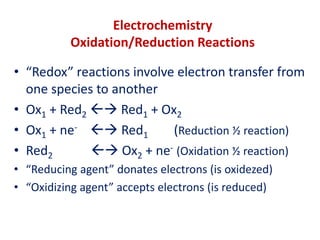
• “Redox” reactions involve electron transfer from
one species to another
• Ox1 + Red2  Red1 + Ox2
• Ox1 + ne-  Red1 (Reduction ½ reaction)
• Red2  Ox2 + ne- (Oxidation ½ reaction)
• “Reducing agent” donates electrons (is oxidezed)
• “Oxidizing agent” accepts electrons (is reduced)
Electrochemistry
Oxidation/Reduction Reactions
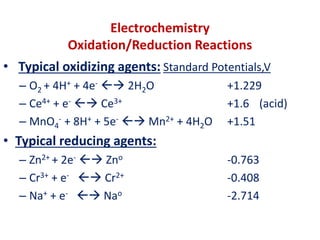
• Typical oxidizing agents: Standard Potentials,V
– O2 + 4H+ + 4e-  2H2O +1.229
– Ce4+ + e-  Ce3+ +1.6 (acid)
– MnO4
- + 8H+ + 5e-  Mn2+ + 4H2O +1.51
• Typical reducing agents:
– Zn2+ + 2e-  Zno -0.763
– Cr3+ + e-  Cr2+ -0.408
– Na+ + e-  Nao -2.714
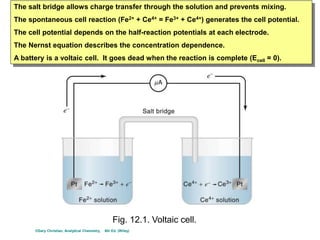
Fig. 12.1. Voltaic cell.
The salt bridge allows charge transfer through the solution and prevents mixing.
The spontaneous cell reaction (Fe2+ + Ce4+ = Fe3+ + Ce4+) generates the cell potential.
The cell potential depends on the half-reaction potentials at each electrode.
The Nernst equation describes the concentration dependence.
A battery is a voltaic cell. It goes dead when the reaction is complete (Ecell = 0).
©Gary Christian, Analytical Chemistry, 6th Ed. (Wiley)
Electrochemistry
Standard Reduction Potentials
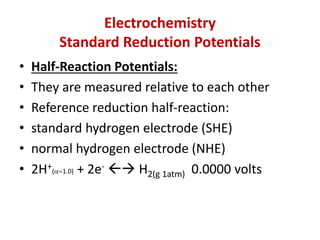
• Half-Reaction Potentials:
• They are measured relative to each other
• Reference reduction half-reaction:
• standard hydrogen electrode (SHE)
• normal hydrogen electrode (NHE)
• 2H+(a=1.0) + 2e-  H2(g 1atm) 0.0000 volts
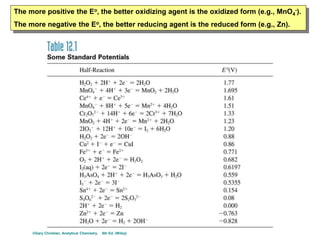
The more positive the Eo, the better oxidizing agent is the oxidized form (e.g., MnO4
-).
The more negative the Eo, the better reducing agent is the reduced form (e.g., Zn).
©Gary Christian, Analytical Chemistry, 6th Ed. (Wiley)
Electrochemistry
Reduction Potentials
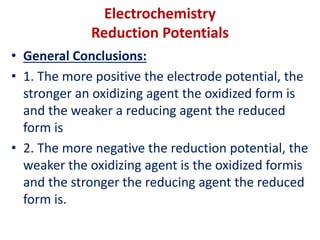
• General Conclusions:
• 1. The more positive the electrode potential, the
stronger an oxidizing agent the oxidized form is
and the weaker a reducing agent the reduced
form is
• 2. The more negative the reduction potential, the
weaker the oxidizing agent is the oxidized formis
and the stronger the reducing agent the reduced
form is.
Electrochemistry
Oxidation/Reduction Reactions
• Typical oxidizing agents: Standard Potentials,V
– O2 + 4H+ + 4e-  2H2O +1.229
– Ce4+ + e-  Ce3+ +1.6 (acid)
– MnO4
- + 8H+ + 5e-  Mn2+ + 4H2O +1.51
• Typical reducing agents:
– Zn2+ + 2e-  Zno -0.763
– Cr3+ + e-  Cr2+ -0.408
– Na+ + e-  Nao -2.714
Electrochemistry
Oxidation/Reduction Reactions
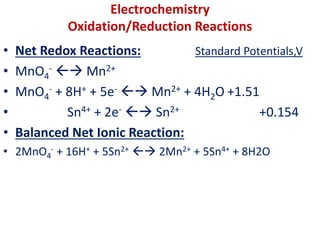
• Net Redox Reactions: Standard Potentials,V
• MnO4
-  Mn2+
• MnO4
- + 8H+ + 5e-  Mn2+ + 4H2O +1.51
• Sn4+ + 2e-  Sn2+ +0.154
• Balanced Net Ionic Reaction:
• 2MnO4
- + 16H+ + 5Sn2+  2Mn2+ + 5Sn4+ + 8H2O
Electrochemistry
Voltaic Cell
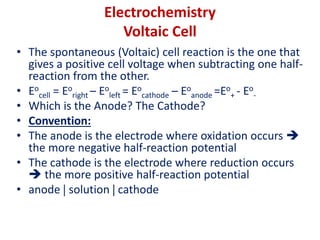
• The spontaneous (Voltaic) cell reaction is the one that
gives a positive cell voltage when subtracting one half-
reaction from the other.
• Eo
cell = Eo
right – Eo
left = Eo
cathode – Eo
anode =Eo
+ - Eo
-
• Which is the Anode? The Cathode?
• Convention:
• The anode is the electrode where oxidation occurs 
the more negative half-reaction potential
• The cathode is the electrode where reduction occurs
 the more positive half-reaction potential
• anode  solution  cathode
Electrochemistry
Oxidation/Reduction Reactions
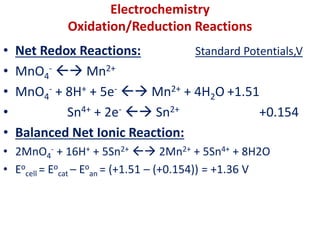
• Net Redox Reactions: Standard Potentials,V
• MnO4
-  Mn2+
• MnO4
- + 8H+ + 5e-  Mn2+ + 4H2O +1.51
• Sn4+ + 2e-  Sn2+ +0.154
• Balanced Net Ionic Reaction:
• 2MnO4
- + 16H+ + 5Sn2+  2Mn2+ + 5Sn4+ + 8H2O
• Eo
cell = Eo
cat – Eo
an = (+1.51 – (+0.154)) = +1.36 V
Electrochemistry
Nernst Equation
• Effects of Concentrations on Potentials:
• aOx + ne-  bRed
• E = Eo – (2.3026RT/nF) log([Red]b/[Ox]a
– Where E is the reduction at specific conc.,
– Eo is standard reduction potential, n is number of electrons
involved in the half reaction,
– R is the gas constant (8.3143 V coul deg-1mol-1),
– T is absolute temperature,
– and F is the Faraday constant (96487 coul eq-1).
• At 25oC(298.16K) the value of 2.3026RT/F is 0.05916
• Note: Concentrations should be activities
Electrochemistry
• Calculations:
• MnO4
- + 8H+ + 5e-  Mn2+ + 4H2O Eo = +1.51 V
• For [H+] = 1.0M, [MnO4
-] = 0.10M, [Mn2+] = 0.010M
• E = Eo – 0.05916/5 (log ([Mn2+]/[MnO4
-][H+]8)
• E = +1.51 – 0.1183(-1) = +1.63 V vs NHE
• Note: This is more positive than Eo
• Greater tendency to be reduced compared to standard
conditions.
Electrochemistry
• Calculations:
• Silver electrode/silver chloride deposit/0.010M NaCl
• AgCl + 1e-  Ago + Cl- E = ?
• Ag+ + 1e-  Ago Eo = +0.799 V
• AgCl  Ag+ + Cl- Ksp= 1.8 x 10⁻¹⁰
• AgCl + e-  Ago + Cl-
• E = Eo - (0.05916/1) Log (1/[Ag+])
• [Ag+] = Ksp/[Cl-] = 1.8 x 10⁻¹⁰/(0.010) = 1.8 x 10⁻⁸
• E = +0.799 – (0.05916)(7.74) = +0.341 V
Thank You

Electrochemical Cells and Electrode Potentials

  • 1.
    Electrochemical Cells andElectrode Potentials Dr. S. Sreenivasa Associate Professor and Chairman DOS and R in Organic Chemistry Tumkur University, Tumakuru
  • 2.
    Electrochemistry Oxidation/Reduction Reactions • “Redox”reactions involve electron transfer from one species to another • Ox1 + Red2  Red1 + Ox2 • Ox1 + ne-  Red1 (Reduction ½ reaction) • Red2  Ox2 + ne- (Oxidation ½ reaction) • “Reducing agent” donates electrons (is oxidezed) • “Oxidizing agent” accepts electrons (is reduced)
  • 3.
    Electrochemistry Oxidation/Reduction Reactions • Typicaloxidizing agents: Standard Potentials,V – O2 + 4H+ + 4e-  2H2O +1.229 – Ce4+ + e-  Ce3+ +1.6 (acid) – MnO4 - + 8H+ + 5e-  Mn2+ + 4H2O +1.51 • Typical reducing agents: – Zn2+ + 2e-  Zno -0.763 – Cr3+ + e-  Cr2+ -0.408 – Na+ + e-  Nao -2.714
  • 4.
    Fig. 12.1. Voltaiccell. The salt bridge allows charge transfer through the solution and prevents mixing. The spontaneous cell reaction (Fe2+ + Ce4+ = Fe3+ + Ce4+) generates the cell potential. The cell potential depends on the half-reaction potentials at each electrode. The Nernst equation describes the concentration dependence. A battery is a voltaic cell. It goes dead when the reaction is complete (Ecell = 0). ©Gary Christian, Analytical Chemistry, 6th Ed. (Wiley)
  • 5.
    Electrochemistry Standard Reduction Potentials •Half-Reaction Potentials: • They are measured relative to each other • Reference reduction half-reaction: • standard hydrogen electrode (SHE) • normal hydrogen electrode (NHE) • 2H+(a=1.0) + 2e-  H2(g 1atm) 0.0000 volts
  • 6.
    The more positivethe Eo, the better oxidizing agent is the oxidized form (e.g., MnO4 -). The more negative the Eo, the better reducing agent is the reduced form (e.g., Zn). ©Gary Christian, Analytical Chemistry, 6th Ed. (Wiley)
  • 7.
    Electrochemistry Reduction Potentials • GeneralConclusions: • 1. The more positive the electrode potential, the stronger an oxidizing agent the oxidized form is and the weaker a reducing agent the reduced form is • 2. The more negative the reduction potential, the weaker the oxidizing agent is the oxidized formis and the stronger the reducing agent the reduced form is.
  • 8.
    Electrochemistry Oxidation/Reduction Reactions • Typicaloxidizing agents: Standard Potentials,V – O2 + 4H+ + 4e-  2H2O +1.229 – Ce4+ + e-  Ce3+ +1.6 (acid) – MnO4 - + 8H+ + 5e-  Mn2+ + 4H2O +1.51 • Typical reducing agents: – Zn2+ + 2e-  Zno -0.763 – Cr3+ + e-  Cr2+ -0.408 – Na+ + e-  Nao -2.714
  • 9.
    Electrochemistry Oxidation/Reduction Reactions • NetRedox Reactions: Standard Potentials,V • MnO4 -  Mn2+ • MnO4 - + 8H+ + 5e-  Mn2+ + 4H2O +1.51 • Sn4+ + 2e-  Sn2+ +0.154 • Balanced Net Ionic Reaction: • 2MnO4 - + 16H+ + 5Sn2+  2Mn2+ + 5Sn4+ + 8H2O
  • 10.
    Electrochemistry Voltaic Cell • Thespontaneous (Voltaic) cell reaction is the one that gives a positive cell voltage when subtracting one half- reaction from the other. • Eo cell = Eo right – Eo left = Eo cathode – Eo anode =Eo + - Eo - • Which is the Anode? The Cathode? • Convention: • The anode is the electrode where oxidation occurs  the more negative half-reaction potential • The cathode is the electrode where reduction occurs  the more positive half-reaction potential • anode  solution  cathode
  • 11.
    Electrochemistry Oxidation/Reduction Reactions • NetRedox Reactions: Standard Potentials,V • MnO4 -  Mn2+ • MnO4 - + 8H+ + 5e-  Mn2+ + 4H2O +1.51 • Sn4+ + 2e-  Sn2+ +0.154 • Balanced Net Ionic Reaction: • 2MnO4 - + 16H+ + 5Sn2+  2Mn2+ + 5Sn4+ + 8H2O • Eo cell = Eo cat – Eo an = (+1.51 – (+0.154)) = +1.36 V
  • 12.
    Electrochemistry Nernst Equation • Effectsof Concentrations on Potentials: • aOx + ne-  bRed • E = Eo – (2.3026RT/nF) log([Red]b/[Ox]a – Where E is the reduction at specific conc., – Eo is standard reduction potential, n is number of electrons involved in the half reaction, – R is the gas constant (8.3143 V coul deg-1mol-1), – T is absolute temperature, – and F is the Faraday constant (96487 coul eq-1). • At 25oC(298.16K) the value of 2.3026RT/F is 0.05916 • Note: Concentrations should be activities
  • 13.
    Electrochemistry • Calculations: • MnO4 -+ 8H+ + 5e-  Mn2+ + 4H2O Eo = +1.51 V • For [H+] = 1.0M, [MnO4 -] = 0.10M, [Mn2+] = 0.010M • E = Eo – 0.05916/5 (log ([Mn2+]/[MnO4 -][H+]8) • E = +1.51 – 0.1183(-1) = +1.63 V vs NHE • Note: This is more positive than Eo • Greater tendency to be reduced compared to standard conditions.
  • 14.
    Electrochemistry • Calculations: • Silverelectrode/silver chloride deposit/0.010M NaCl • AgCl + 1e-  Ago + Cl- E = ? • Ag+ + 1e-  Ago Eo = +0.799 V • AgCl  Ag+ + Cl- Ksp= 1.8 x 10⁻¹⁰ • AgCl + e-  Ago + Cl- • E = Eo - (0.05916/1) Log (1/[Ag+]) • [Ag+] = Ksp/[Cl-] = 1.8 x 10⁻¹⁰/(0.010) = 1.8 x 10⁻⁸ • E = +0.799 – (0.05916)(7.74) = +0.341 V
  • 15.