Class XII
Chemistry
The d-and f-Block Elements
Topics:-
• The d-block elements,
• Transition Elements –
• Physical Properties ,Electronic Configurations , Melting Points , Enthalpies of
Atomization
Prepared by:- Vijay Kumar Sethi
The d-block elements
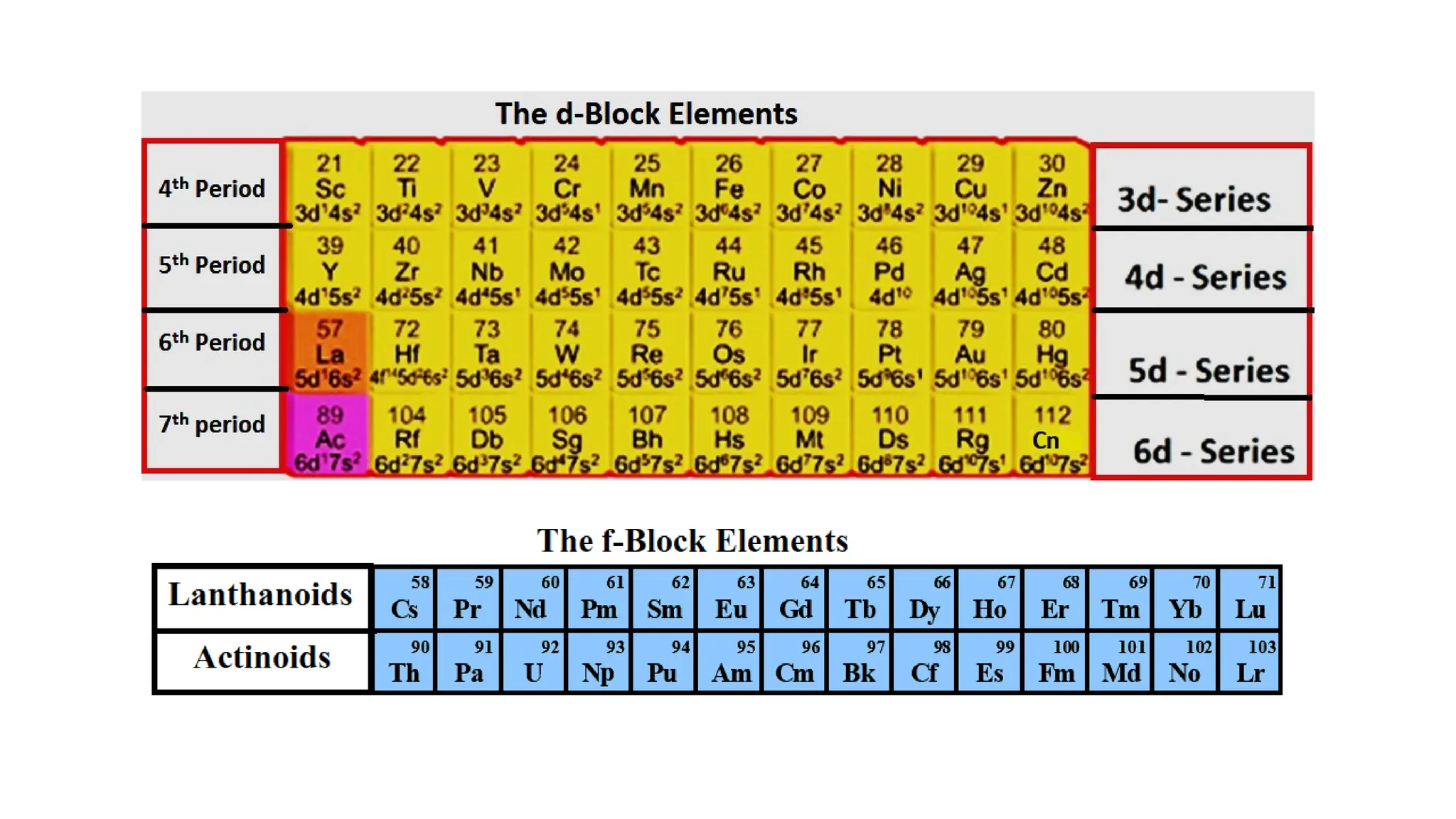
• Elements of the groups 3-12
• d orbitals are progressively filled
• These are placed in four long periods 4,5,6 and 7
• Generally, also called as transition elements
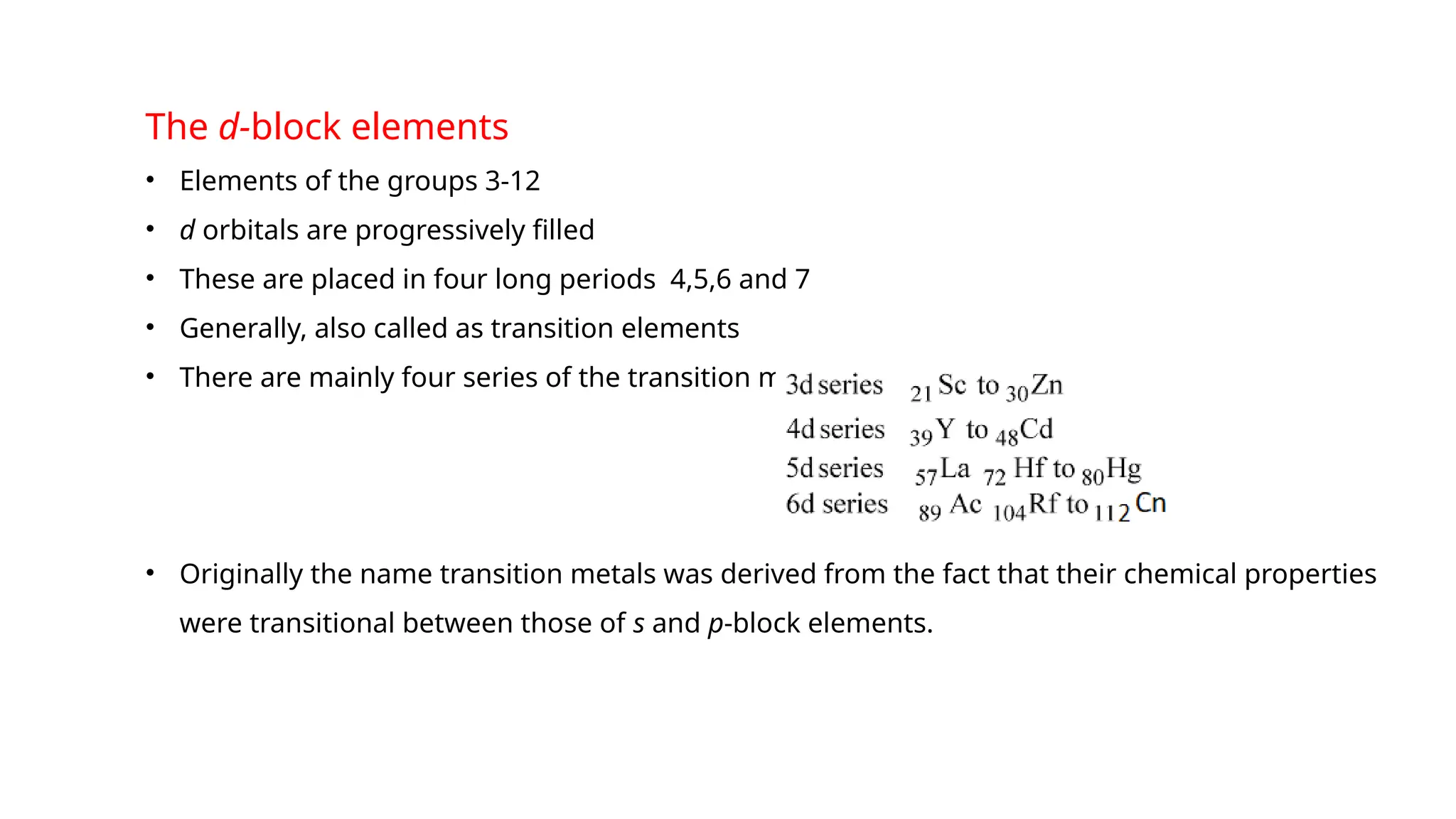
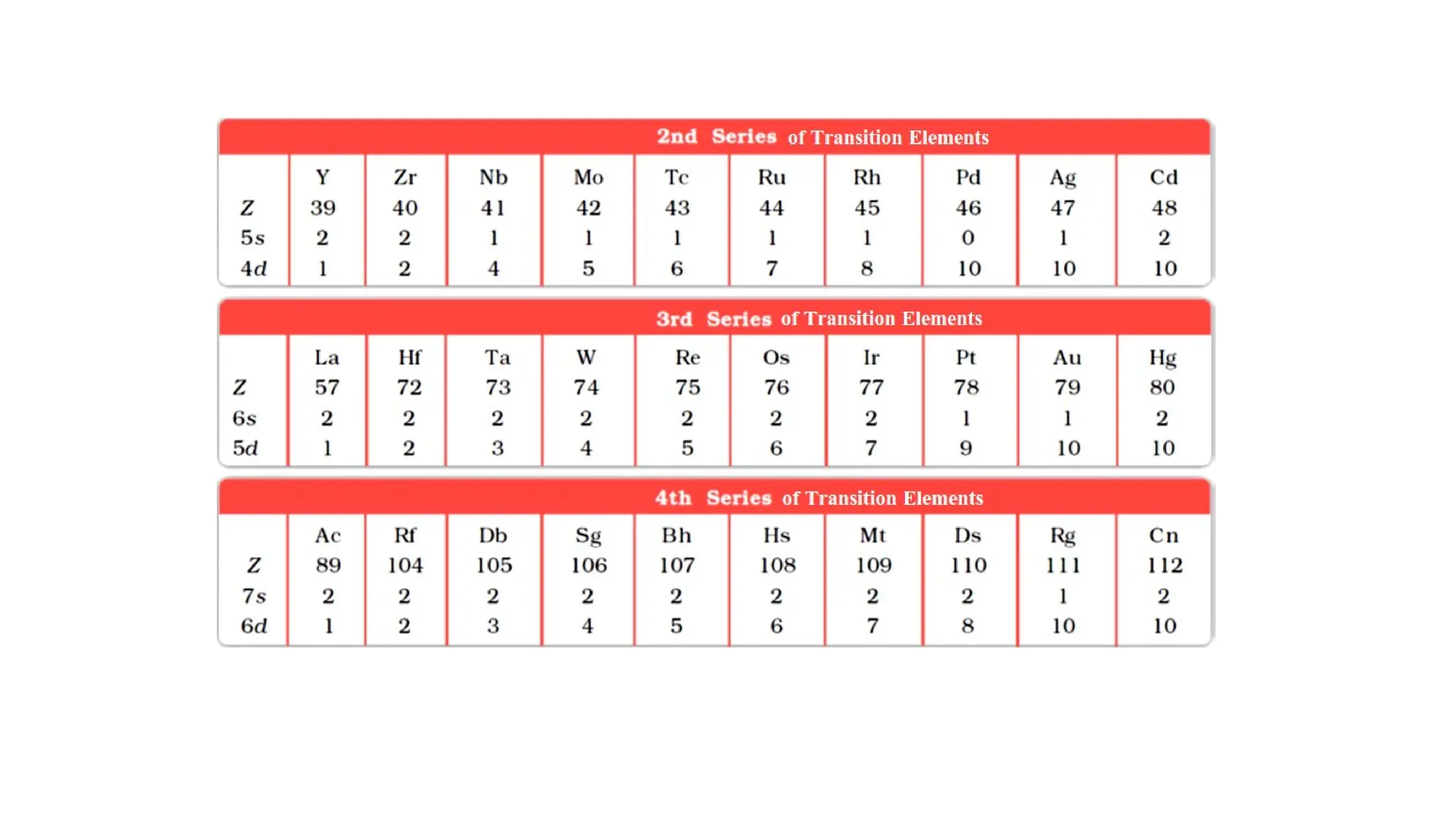
• There are mainly four series of the transition metals,
• Originally the name transition metals was derived from the fact that their chemical properties
were transitional between those of s and p-block elements.
Transition Elements or Transition Metals
• According to IUPAC, transition metals are defined as metals which have incomplete
d subshell either in neutral atom or in their ions.
• Zinc, cadmium and mercury of group 12 have full d10
configuration in their ground
state as well as in their common oxidation states and hence, are not regarded as
transition metals.
• However, being the end members of the 3d, 4d and 5d transition series,
respectively, their chemistry is studied along with the chemistry of the transition
metals.
• Various precious metals such as silver, gold and platinum and industrially important
metals like iron, copper and titanium belong to the transition metals series.
Electronic Configurations of the d-Block Elements
• In general the electronic configuration of outer orbitals of these elements is (n-1)d1–
10
ns1–2
.
• The (n–1) stands for the inner d orbitals (penultimate shell) and outermost ns
orbital
• However, there are several exceptions because of very little energy difference
between (n-1)d and ns orbitals.
• Furthermore, half and completely filled sets of orbitals are relatively more stable.
• For example, Cr (Z=24) 3d5
4s1
configuration instead of 3d4
4s2
;
• Similarly in case of Cu (Z=29), the configuration is 3d10
4s1
and not 3d9
4s2
.
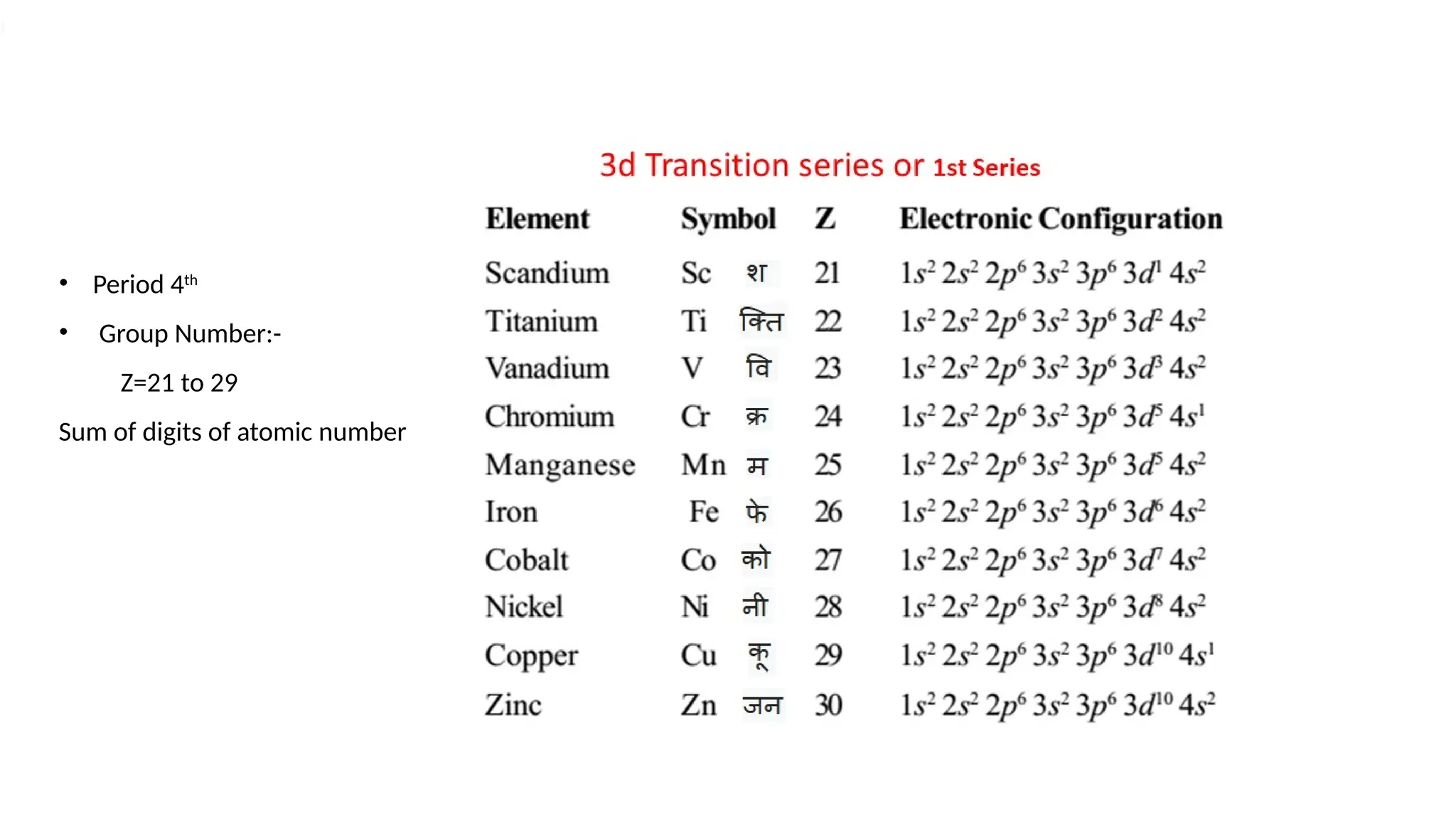
• Period 4th
• Group Number:-
Z=21 to 29
Sum of digits of atomic number
Physical Properties of Transition Elements
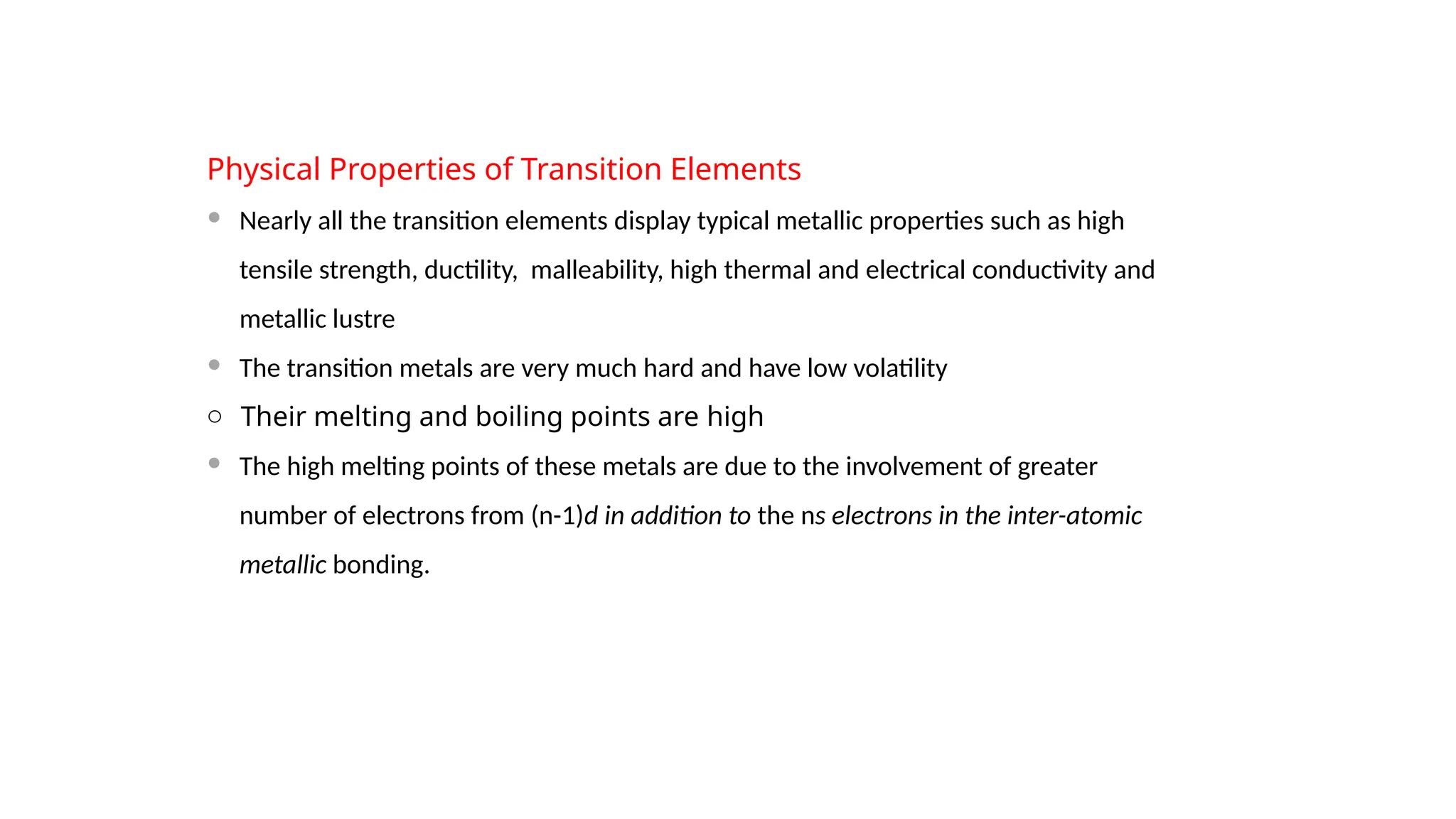
 Nearly all the transition elements display typical metallic properties such as high
tensile strength, ductility, malleability, high thermal and electrical conductivity and
metallic lustre
 The transition metals are very much hard and have low volatility
o Their melting and boiling points are high
 The high melting points of these metals are due to the involvement of greater
number of electrons from (n-1)d in addition to the ns electrons in the inter-atomic
metallic bonding.
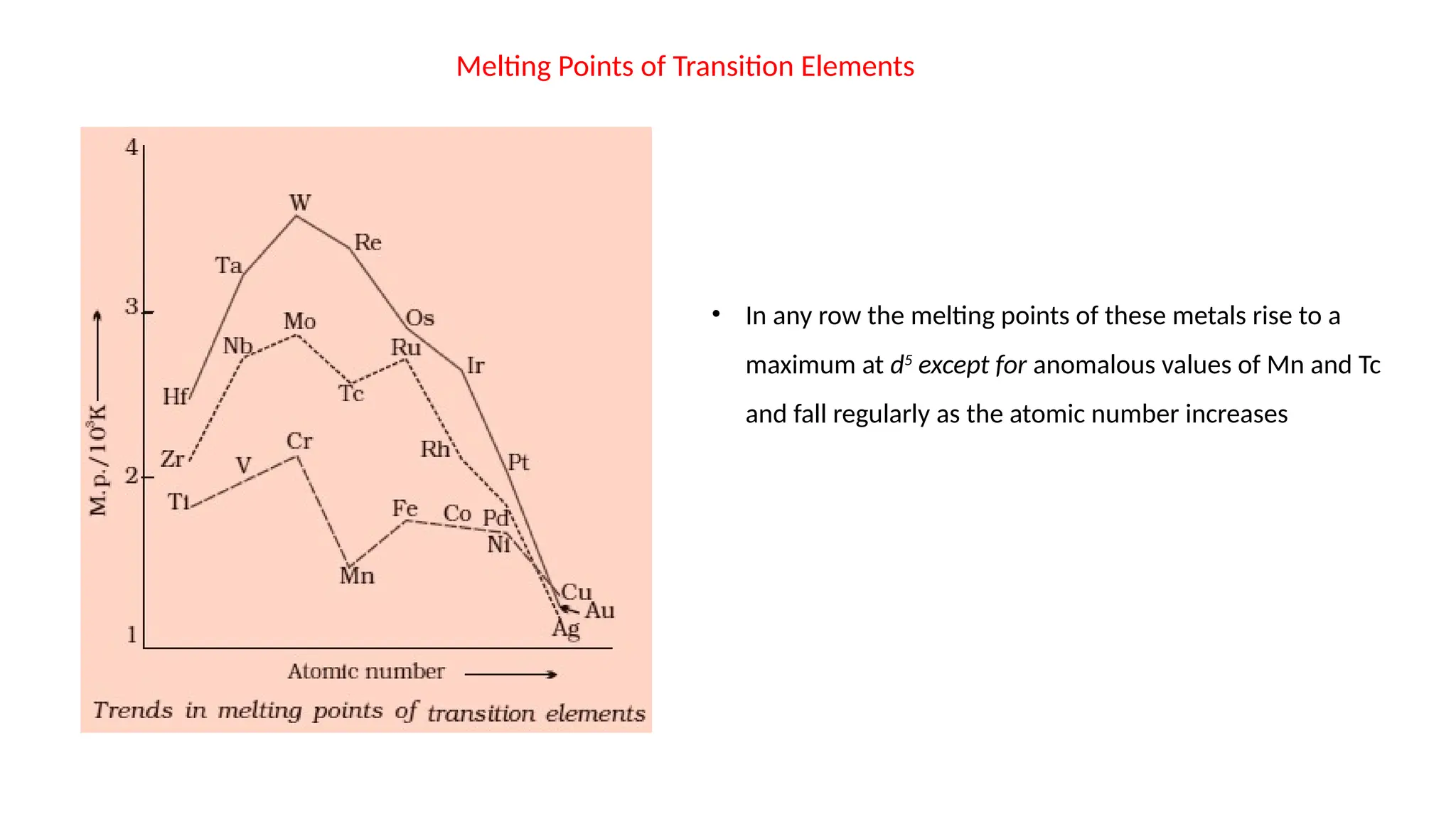
• In any row the melting points of these metals rise to a
maximum at d5
except for anomalous values of Mn and Tc
and fall regularly as the atomic number increases
Melting Points of Transition Elements
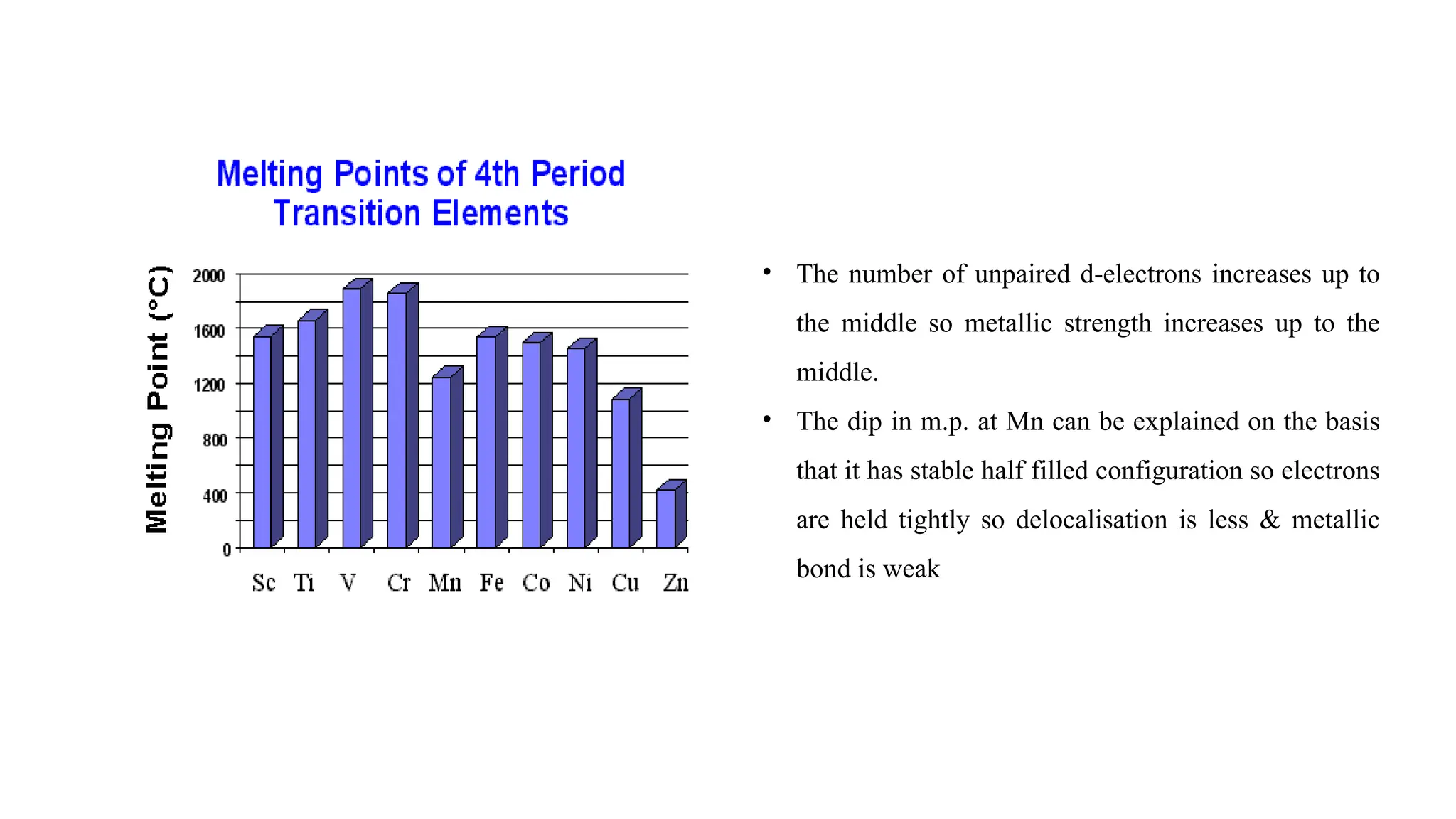
• The number of unpaired d-electrons increases up to
the middle so metallic strength increases up to the
middle.
• The dip in m.p. at Mn can be explained on the basis
that it has stable half filled configuration so electrons
are held tightly so delocalisation is less & metallic
bond is weak
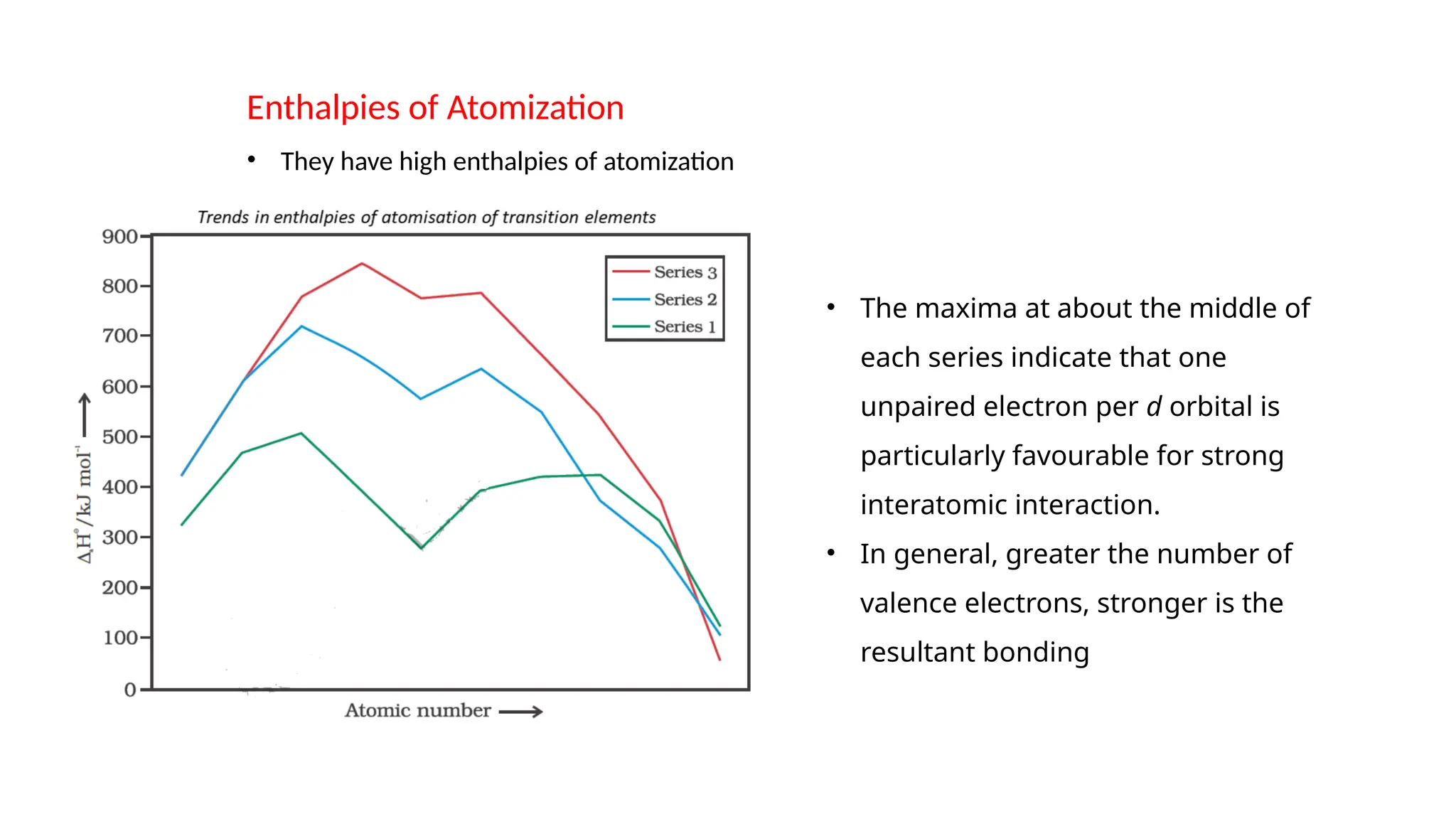
Enthalpies of Atomization
• They have high enthalpies of atomization
• The maxima at about the middle of
each series indicate that one
unpaired electron per d orbital is
particularly favourable for strong
interatomic interaction.
• In general, greater the number of
valence electrons, stronger is the
resultant bonding
Class XII
Chemistry
The d-and f-Block Elements
Topics:-
• Transition Elements –
• Atomic and ionic sizes, Ionisation Enthalpies, Oxidation States
Prepared by:- Vijay Kumar Sethi
Variation in Atomic and Ionic Sizes of Transition
Metals
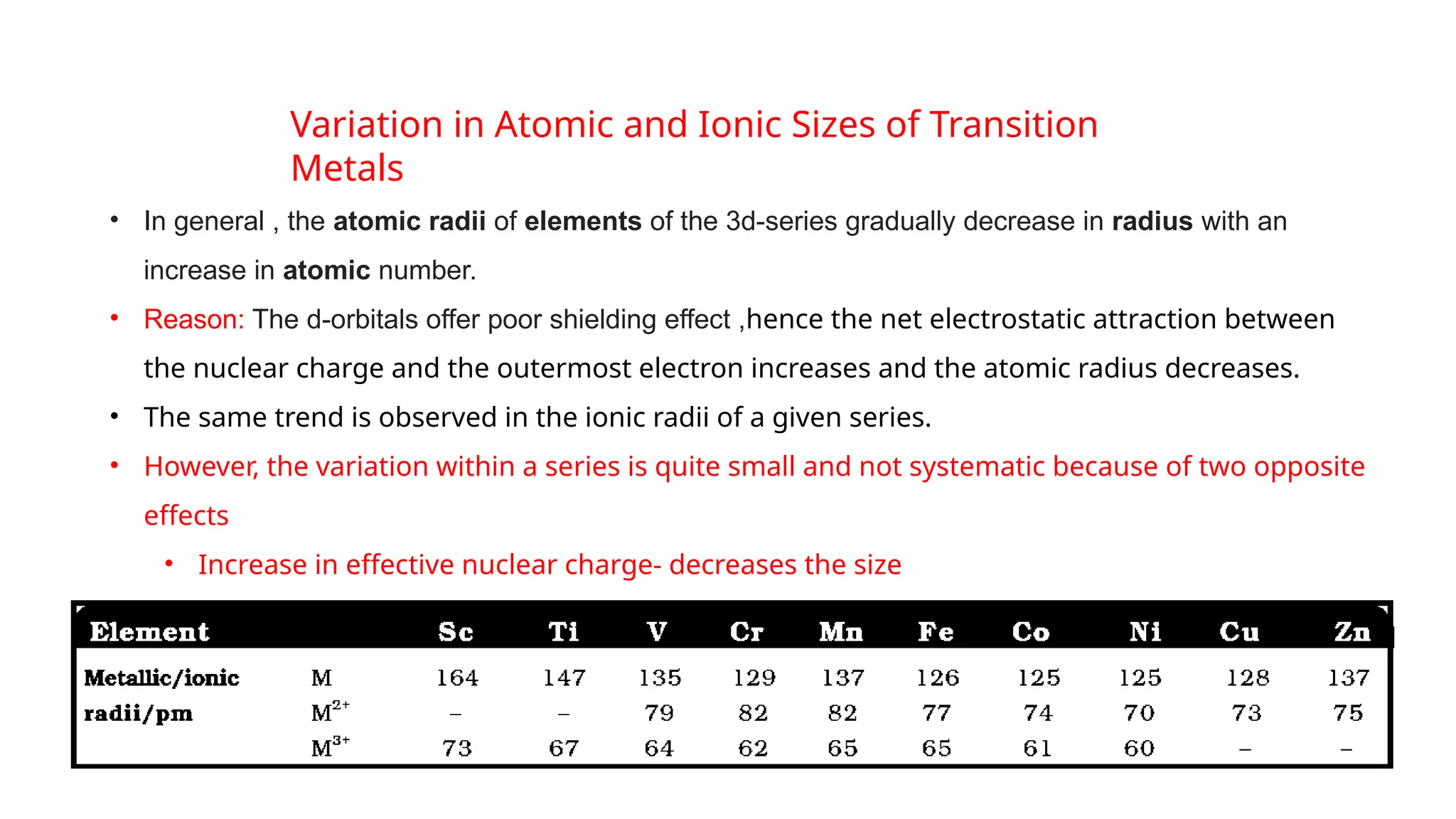
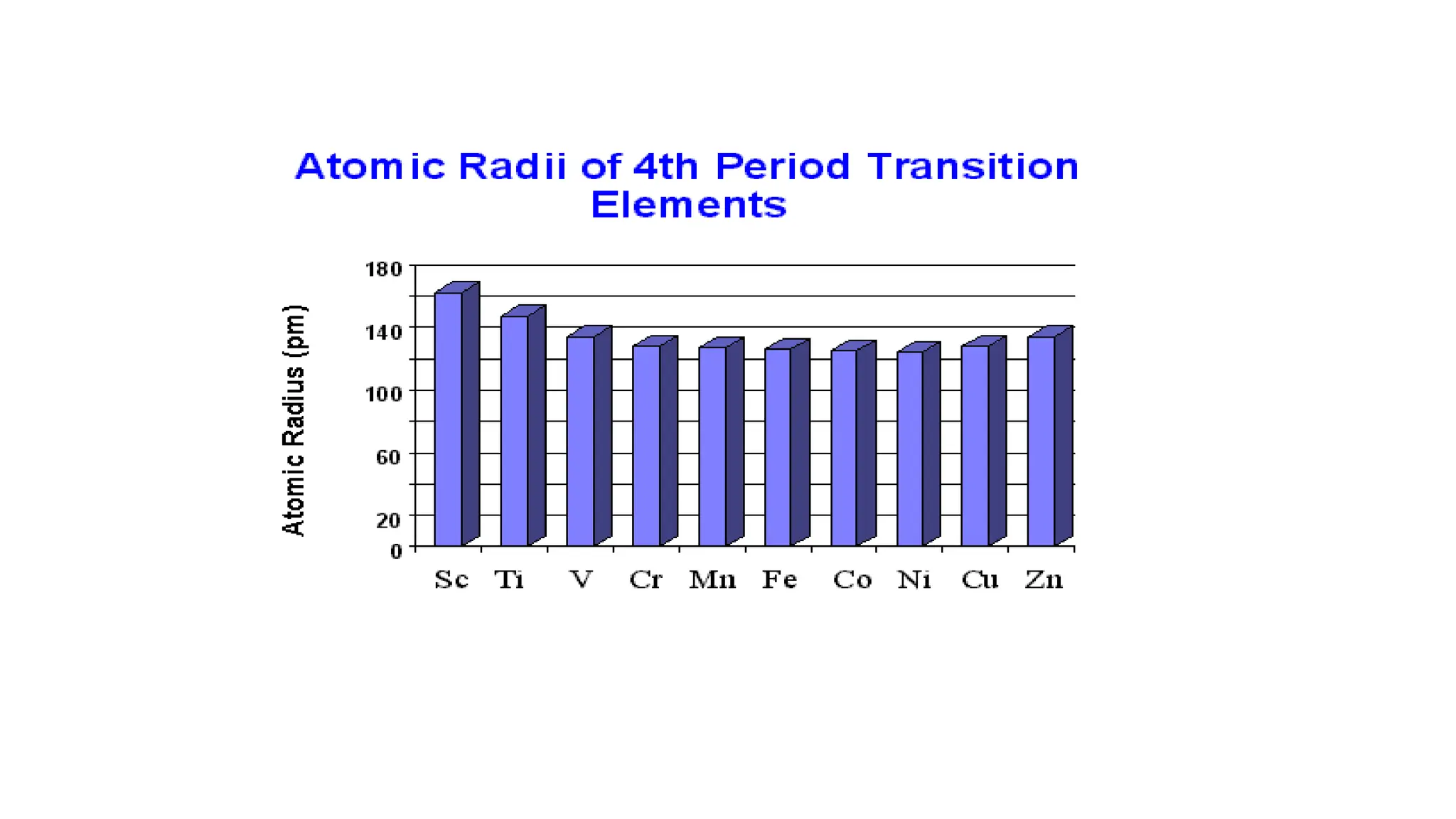
• In general , the atomic radii of elements of the 3d-series gradually decrease in radius with an
increase in atomic number.
• Reason: The d-orbitals offer poor shielding effect ,hence the net electrostatic attraction between
the nuclear charge and the outermost electron increases and the atomic radius decreases.
• The same trend is observed in the ionic radii of a given series.
• However, the variation within a series is quite small and not systematic because of two opposite
effects
• Increase in effective nuclear charge- decreases the size
• Increase in electron-electron repulsion-increases the size
Atomic Radii of Transition Elements
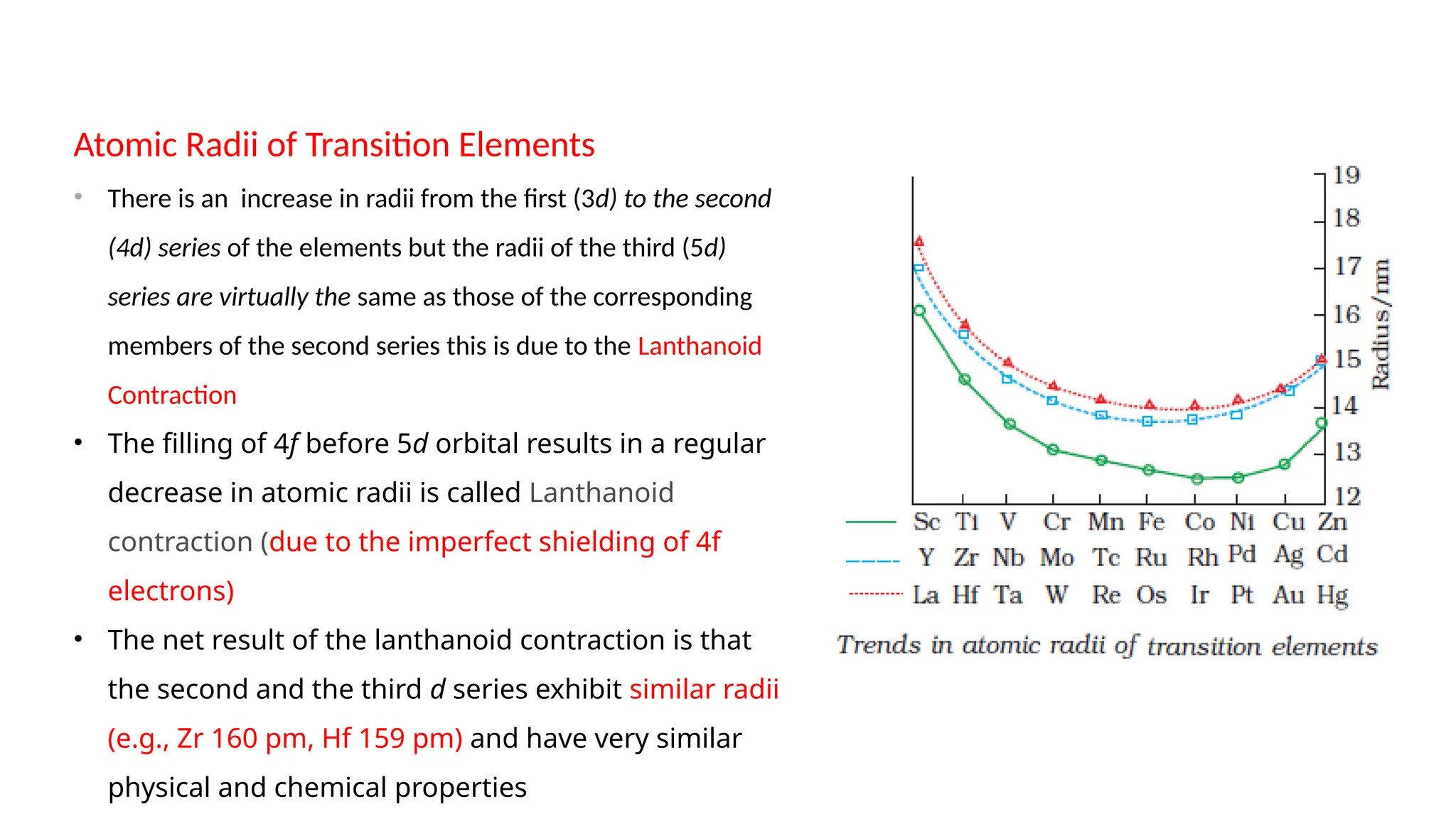
• There is an increase in radii from the first (3d) to the second
(4d) series of the elements but the radii of the third (5d)
series are virtually the same as those of the corresponding
members of the second series this is due to the Lanthanoid
Contraction
• The filling of 4f before 5d orbital results in a regular
decrease in atomic radii is called Lanthanoid
contraction (due to the imperfect shielding of 4f
electrons)
• The net result of the lanthanoid contraction is that
the second and the third d series exhibit similar radii
(e.g., Zr 160 pm, Hf 159 pm) and have very similar
physical and chemical properties
Ionisation Enthalpies
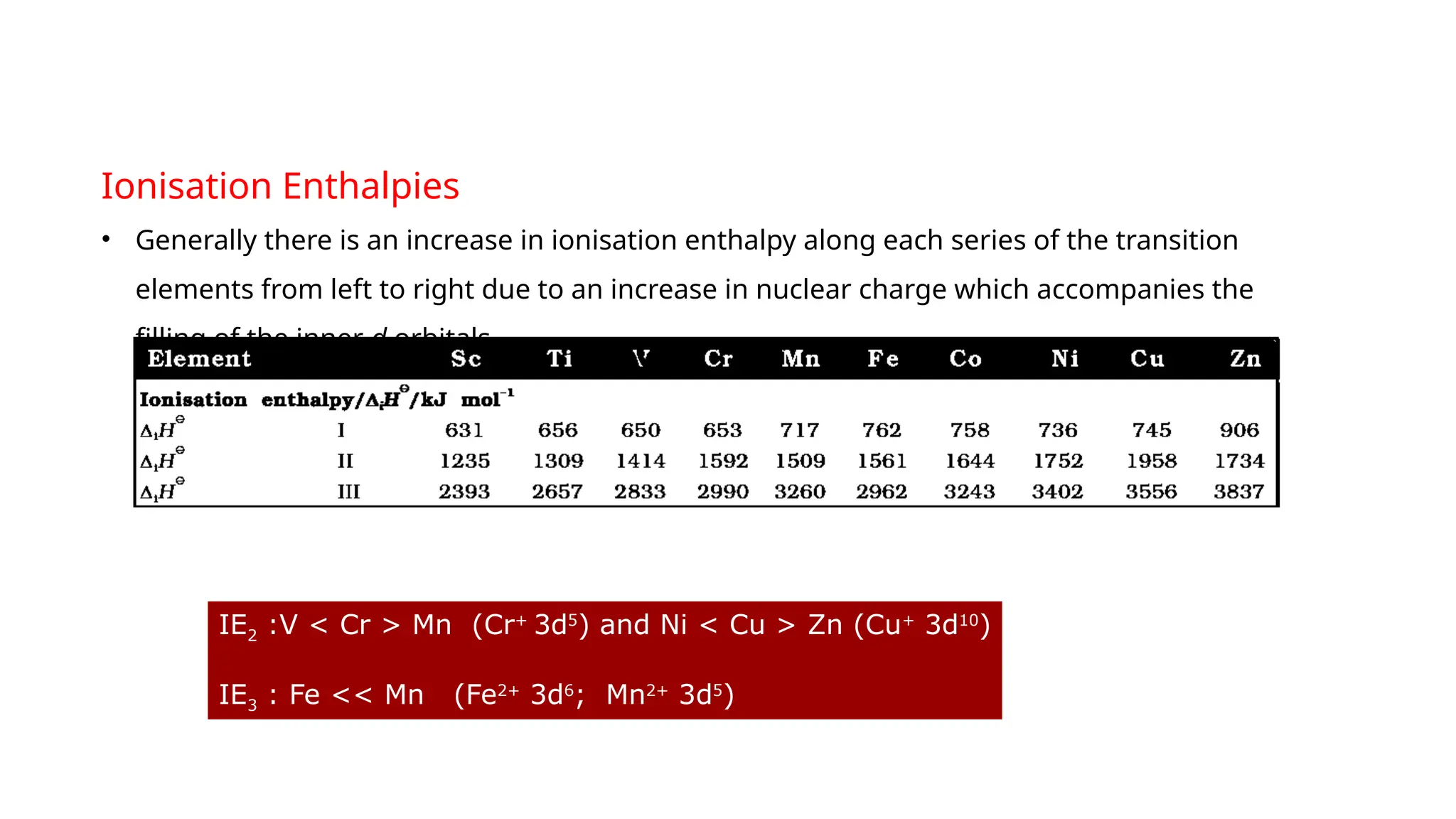
• Generally there is an increase in ionisation enthalpy along each series of the transition
elements from left to right due to an increase in nuclear charge which accompanies the
filling of the inner d orbitals.
IE2 :V < Cr > Mn (Cr+
3d5
) and Ni < Cu > Zn (Cu+
3d10
)
IE3 : Fe << Mn (Fe2+
3d6
; Mn2+
3d5
)
Oxidation States
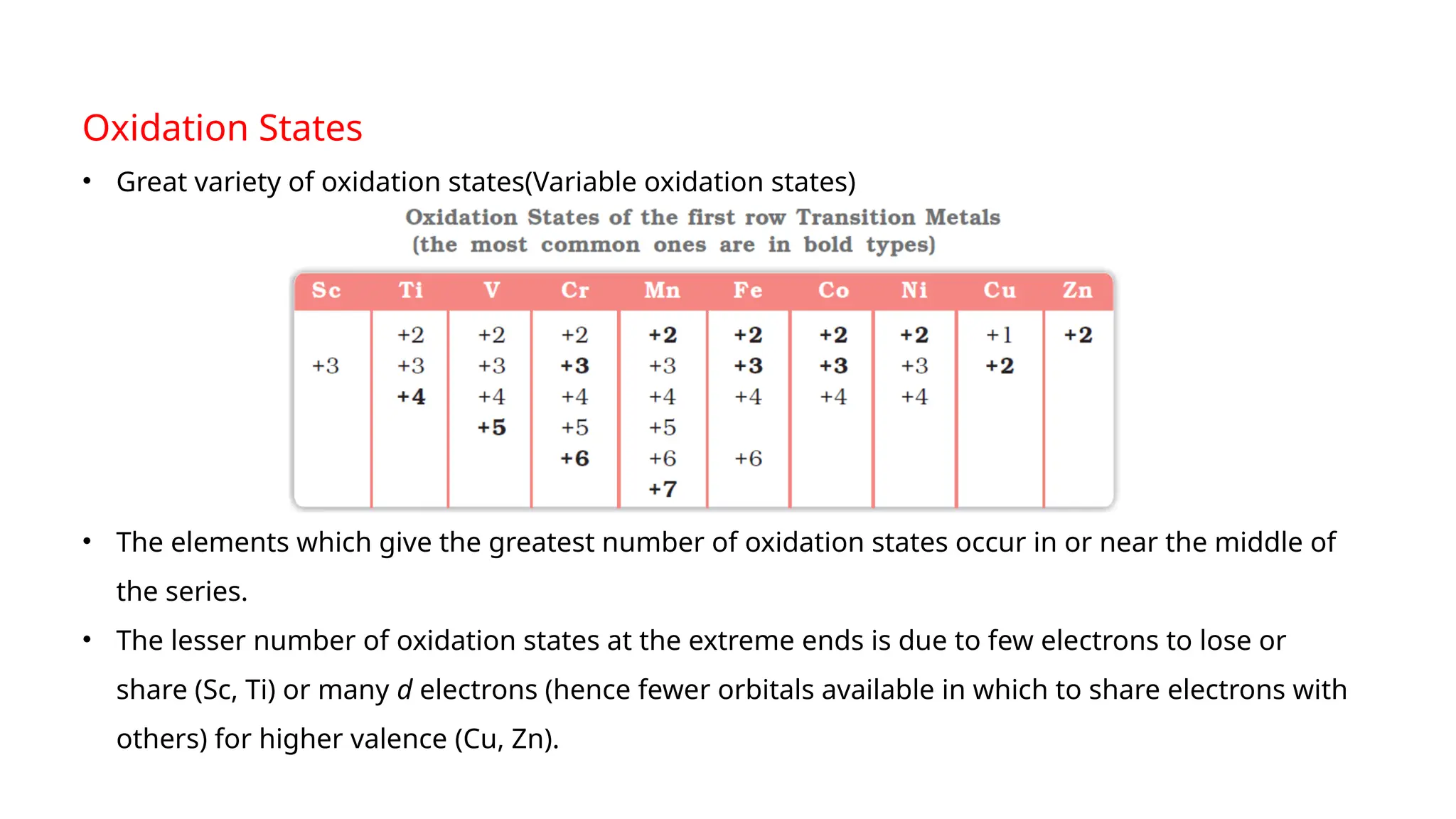
• Great variety of oxidation states(Variable oxidation states)
• The elements which give the greatest number of oxidation states occur in or near the middle of
the series.
• The lesser number of oxidation states at the extreme ends is due to few electrons to lose or
share (Sc, Ti) or many d electrons (hence fewer orbitals available in which to share electrons with
others) for higher valence (Cu, Zn).
Oxidation States
• In solution ,the stability of the compounds depends upon electrode potentials rather than ionisation
enthalpies .
• Electrode potential values depend upon factors such as enthalpy of sublimation of the metal, ionisation
enthalpy and hydration enthalpy.
• The variability of oxidation states, a characteristic of transition
elements, arises out of incomplete filling of d orbitals in such a way
that their oxidation states differ from each other by unity, e.g., VII
,
VIII
, VIV
, VV
. This is in contrast with the variability of oxidation states of
non transition elements where oxidation states normally differ by a
unit of two due to inert pair effect.
Oxidation States
• In the p–block the lower oxidation states are favoured by the heavier members (due to inert pair
effect), the opposite is true in the groups of d-block. For example, in group 6, Mo(VI) and W(VI)
are found to be more stable than Cr(VI). Thus Cr(VI) in the form of dichromate in acidic medium
is a strong oxidising agent, whereas MoO3 and WO3 are not
• Low oxidation states are found when a complex compound has ligands capable of π-acceptor
character in addition to the σ-bonding. For example, in Ni(CO)4 and Fe(CO)5, the oxidation state
of nickel and iron is zero.
Class XII
Chemistry
The d-and f-Block Elements
Topics:-
• Transition Elements –
• Trends in Standard Electrode Potentials of the redox couple M2+
/M and M3+
/M2+
• Trends in Stability of Higher Oxidation States
Prepared by:- Vijay Kumar Sethi
Trends in the M2+
/M Standard Electrode Potentials
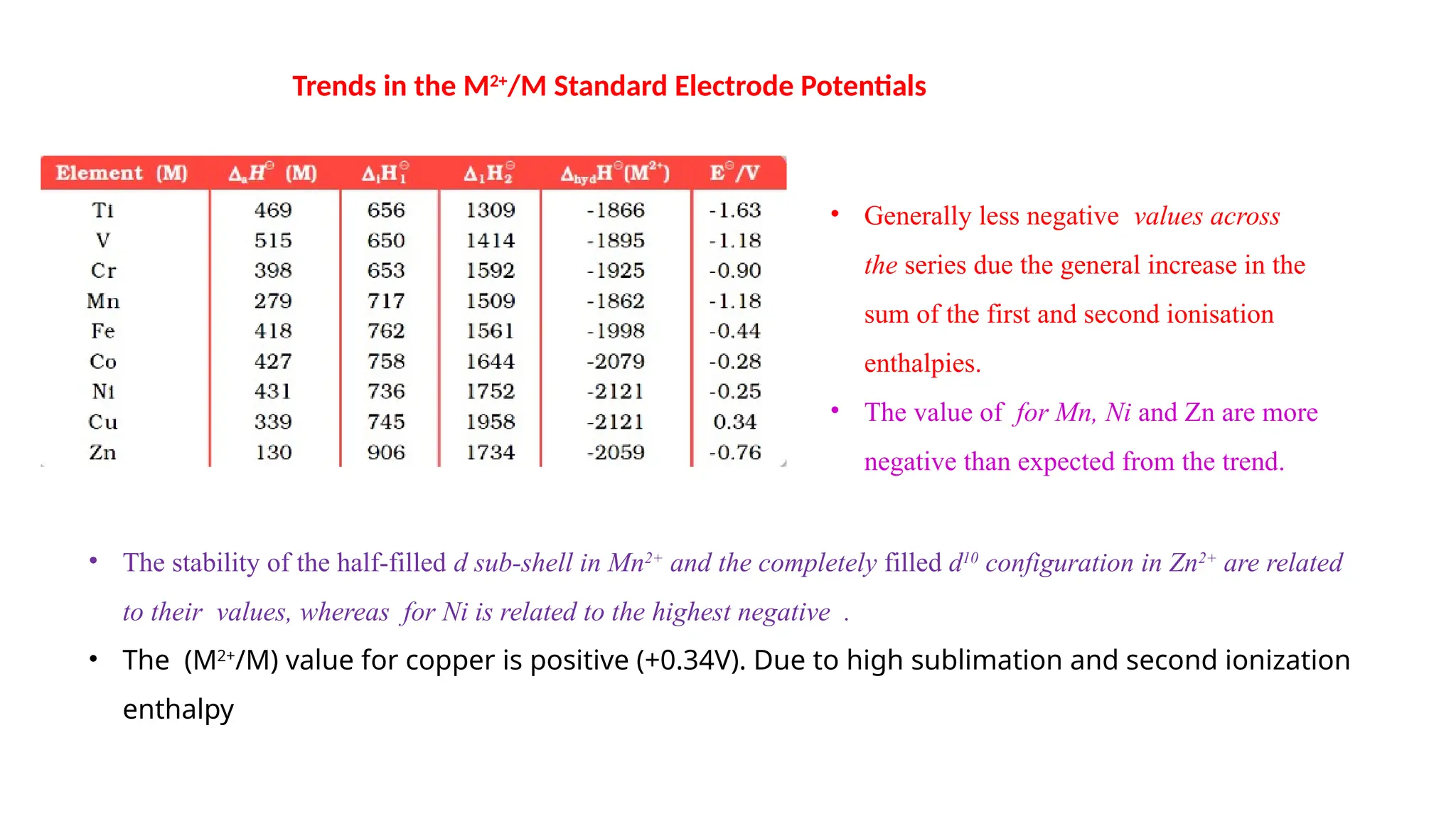
• Generally less negative values across
the series due the general increase in the
sum of the first and second ionisation
enthalpies.
• The value of for Mn, Ni and Zn are more
negative than expected from the trend.
• The stability of the half-filled d sub-shell in Mn2+
and the completely filled d10
configuration in Zn2+
are related
to their values, whereas for Ni is related to the highest negative .
• The (M2+
/M) value for copper is positive (+0.34V). Due to high sublimation and second ionization
enthalpy
Trends in the M3+
/M2+
Standard Electrode Potentials
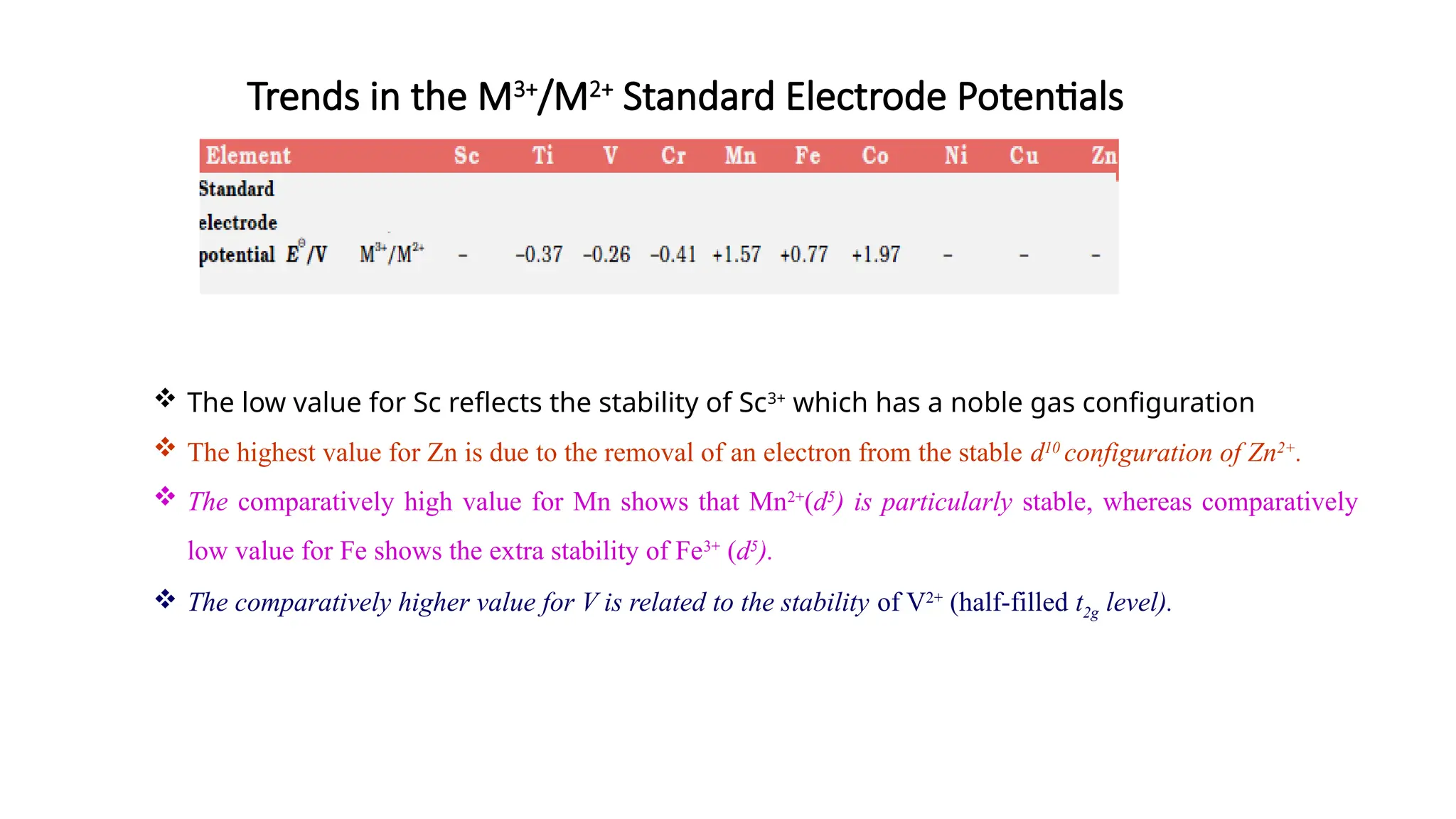
 The low value for Sc reflects the stability of Sc3+
which has a noble gas configuration
 The highest value for Zn is due to the removal of an electron from the stable d10
configuration of Zn2+
.
 The comparatively high value for Mn shows that Mn2+
(d5
) is particularly stable, whereas comparatively
low value for Fe shows the extra stability of Fe3+
(d5
).
 The comparatively higher value for V is related to the stability of V2+
(half-filled t2g level).
Illustrative Example
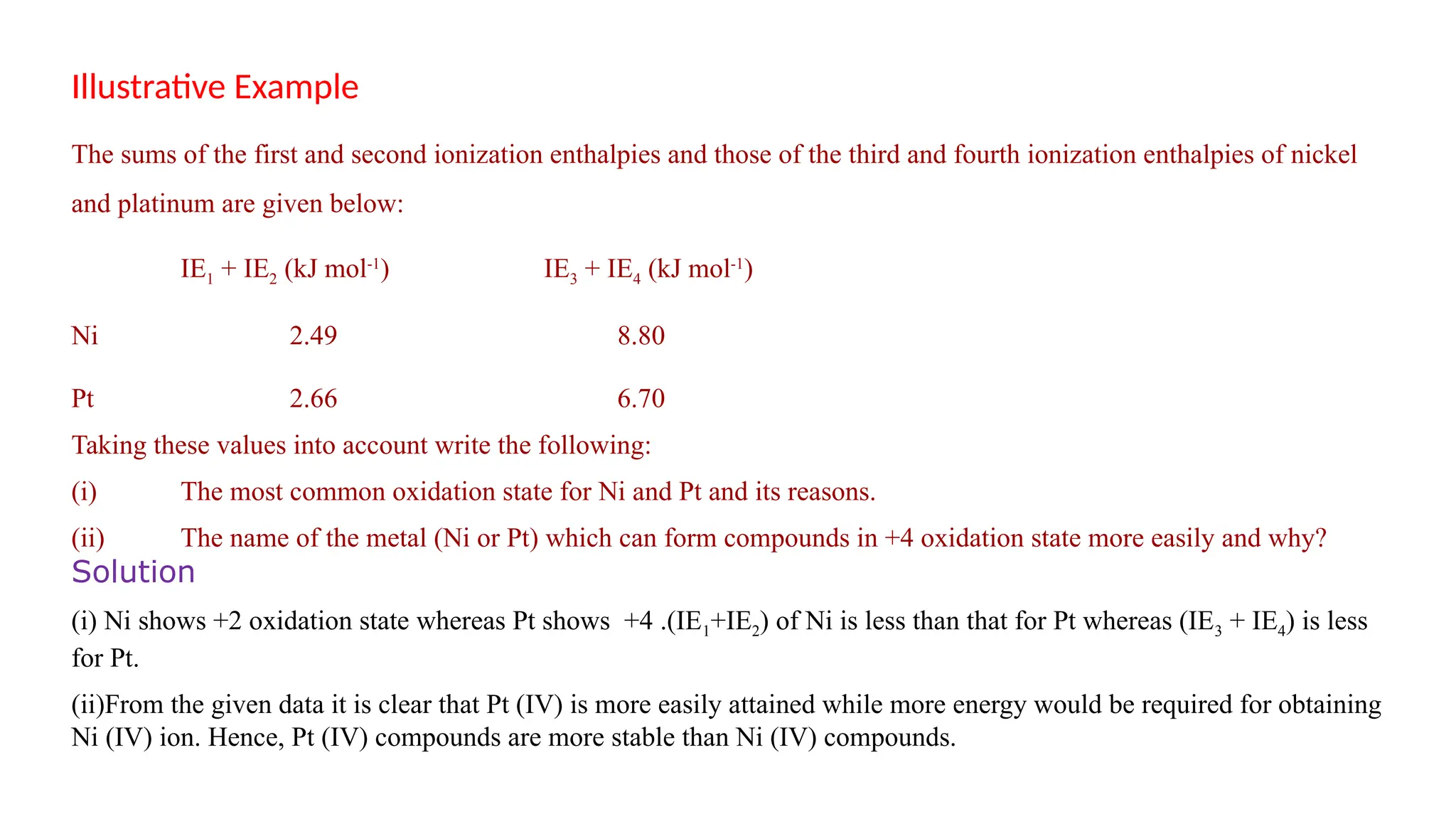
The sums of the first and second ionization enthalpies and those of the third and fourth ionization enthalpies of nickel
and platinum are given below:
IE1 + IE2 (kJ mol-1
) IE3 + IE4 (kJ mol-1
)
Ni 2.49 8.80
Pt 2.66 6.70
Taking these values into account write the following:
(i) The most common oxidation state for Ni and Pt and its reasons.
(ii) The name of the metal (Ni or Pt) which can form compounds in +4 oxidation state more easily and why?
Solution
(i) Ni shows +2 oxidation state whereas Pt shows +4 .(IE1+IE2) of Ni is less than that for Pt whereas (IE3 + IE4) is less
for Pt.
(ii)From the given data it is clear that Pt (IV) is more easily attained while more energy would be required for obtaining
Ni (IV) ion. Hence, Pt (IV) compounds are more stable than Ni (IV) compounds.
Illustrative Example
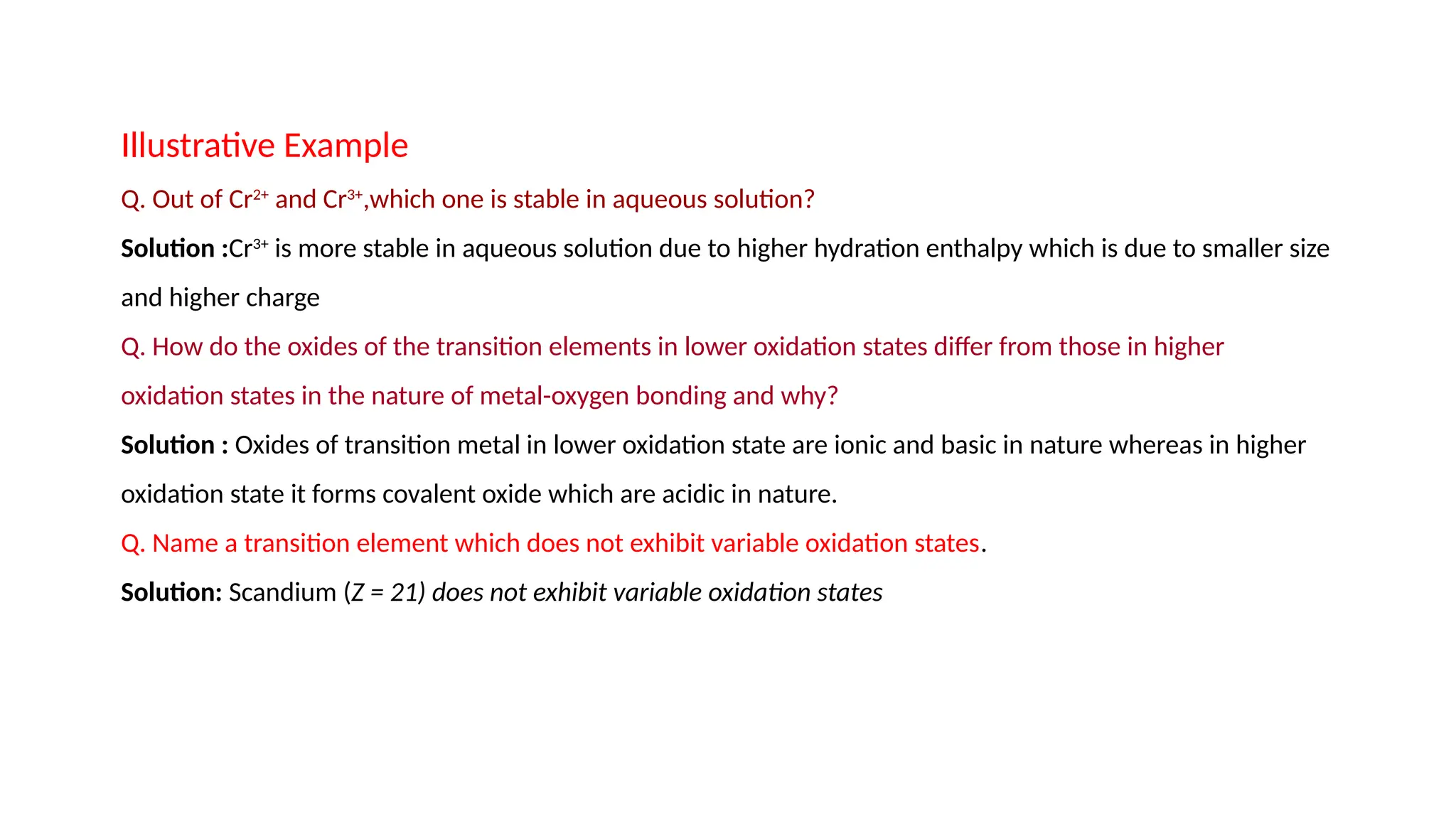
Q. Out of Cr2+
and Cr3+
,which one is stable in aqueous solution?
Solution :Cr3+
is more stable in aqueous solution due to higher hydration enthalpy which is due to smaller size
and higher charge
Q. How do the oxides of the transition elements in lower oxidation states differ from those in higher
oxidation states in the nature of metal-oxygen bonding and why?
Solution : Oxides of transition metal in lower oxidation state are ionic and basic in nature whereas in higher
oxidation state it forms covalent oxide which are acidic in nature.
Q. Name a transition element which does not exhibit variable oxidation states.
Solution: Scandium (Z = 21) does not exhibit variable oxidation states
Illustrative Example
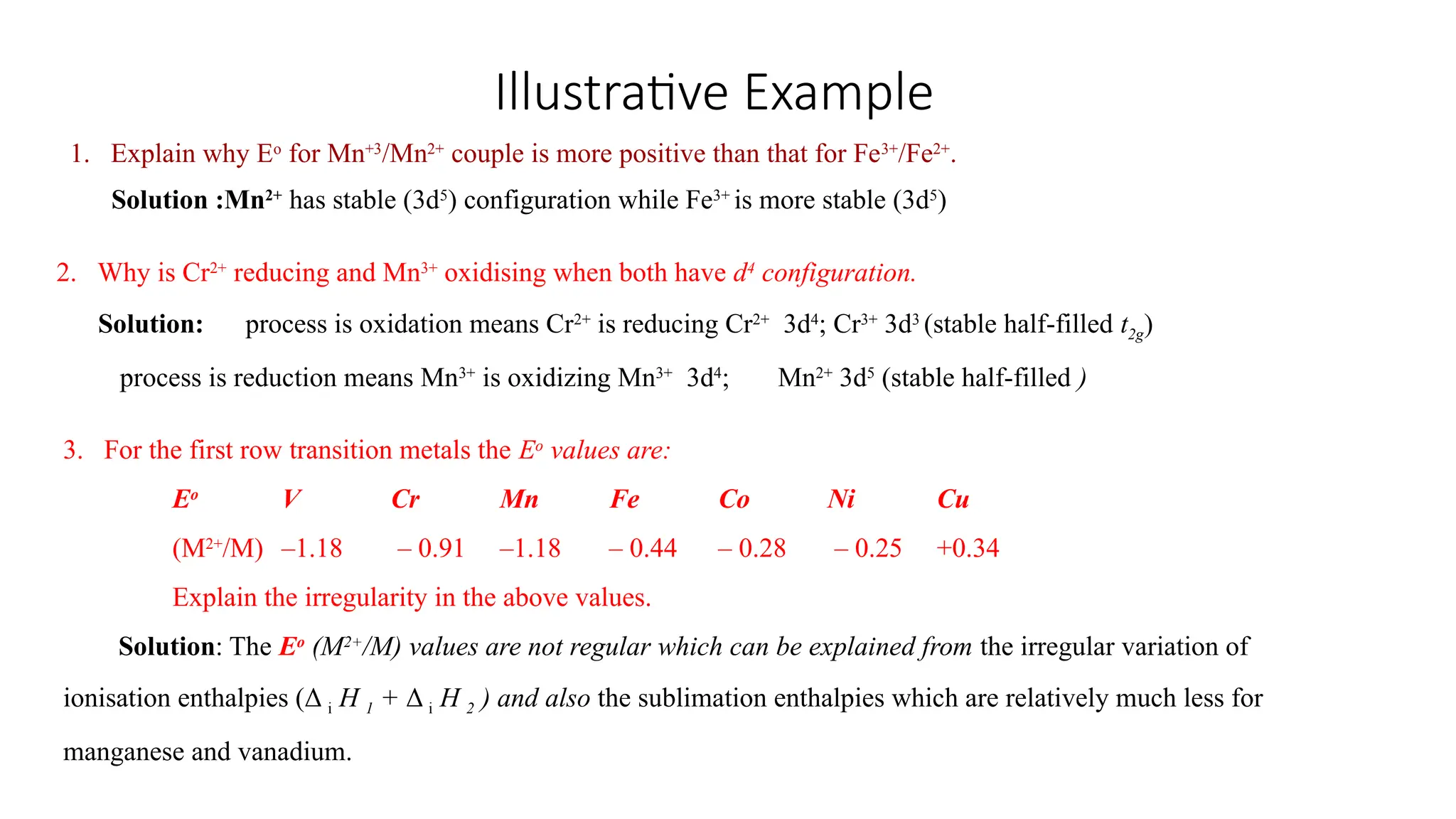
1. Explain why Eo
for Mn+3
/Mn2+
couple is more positive than that for Fe3+
/Fe2+
.
Solution :Mn2+
has stable (3d5
) configuration while Fe3+
is more stable (3d5
)
2. Why is Cr2+
reducing and Mn3+
oxidising when both have d4
configuration.
Solution: process is oxidation means Cr2+
is reducing Cr2+
3d4
; Cr3+
3d3
(stable half-filled t2g)
process is reduction means Mn3+
is oxidizing Mn3+
3d4
; Mn2+
3d5
(stable half-filled )
3. For the first row transition metals the Eo
values are:
Eo
V Cr Mn Fe Co Ni Cu
(M2+
/M) –1.18 – 0.91 –1.18 – 0.44 – 0.28 – 0.25 +0.34
Explain the irregularity in the above values.
Solution: The Eo
(M2+
/M) values are not regular which can be explained from the irregular variation of
ionisation enthalpies (Δ i H 1 + Δ i H 2 ) and also the sublimation enthalpies which are relatively much less for
manganese and vanadium.
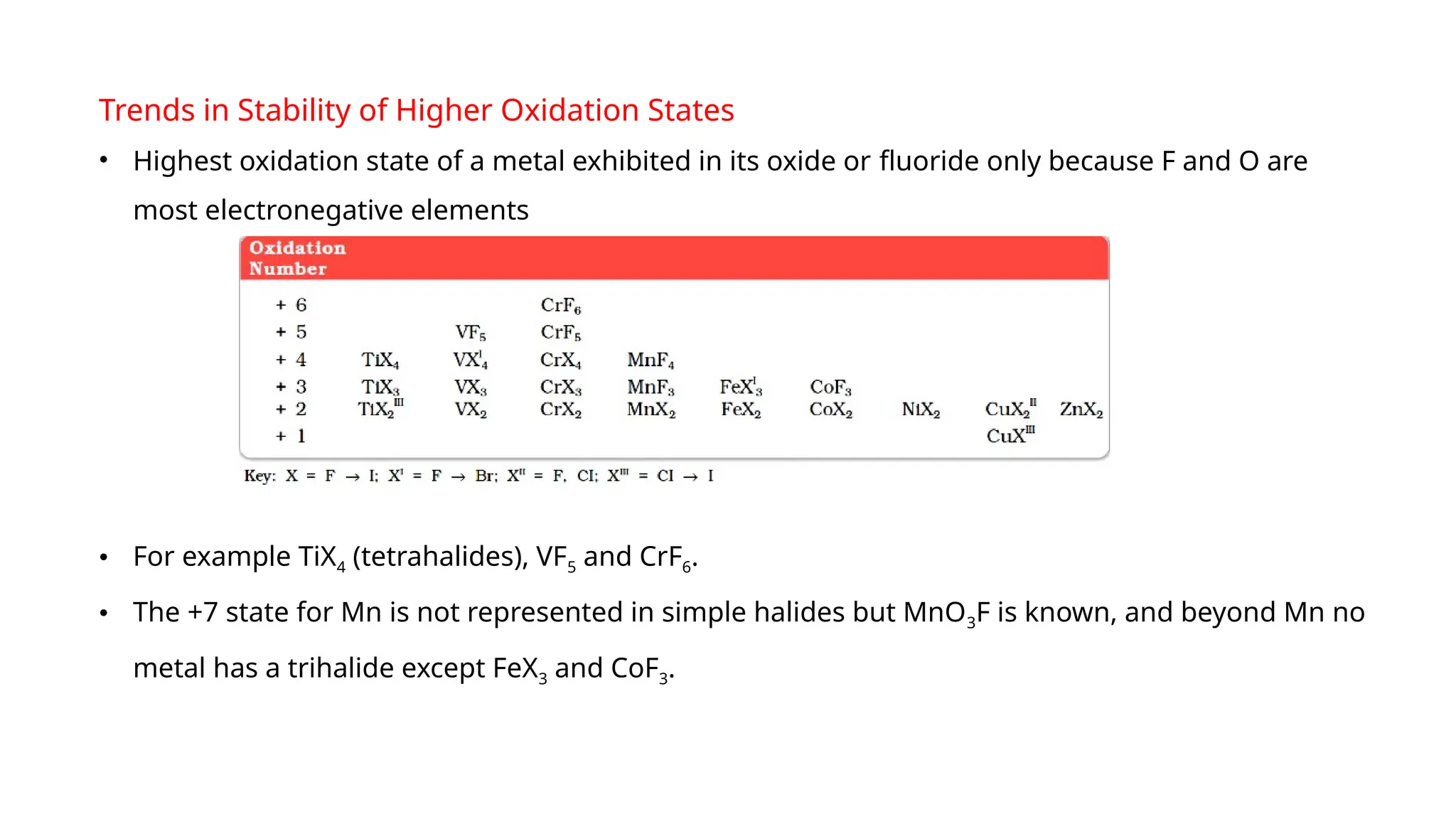
Trends in Stability of Higher Oxidation States
• Highest oxidation state of a metal exhibited in its oxide or fluoride only because F and O are
most electronegative elements
• For example TiX4 (tetrahalides), VF5 and CrF6.
• The +7 state for Mn is not represented in simple halides but MnO3F is known, and beyond Mn no
metal has a trihalide except FeX3 and CoF3.
Trends in Stability of Higher Oxidation States
• The ability of fluorine to stabilise the highest oxidation state is due to either higher lattice
energy as in the case of CoF3, or higher bond enthalpy for the higher covalent compounds,
e.g., VF5 and CrF6.
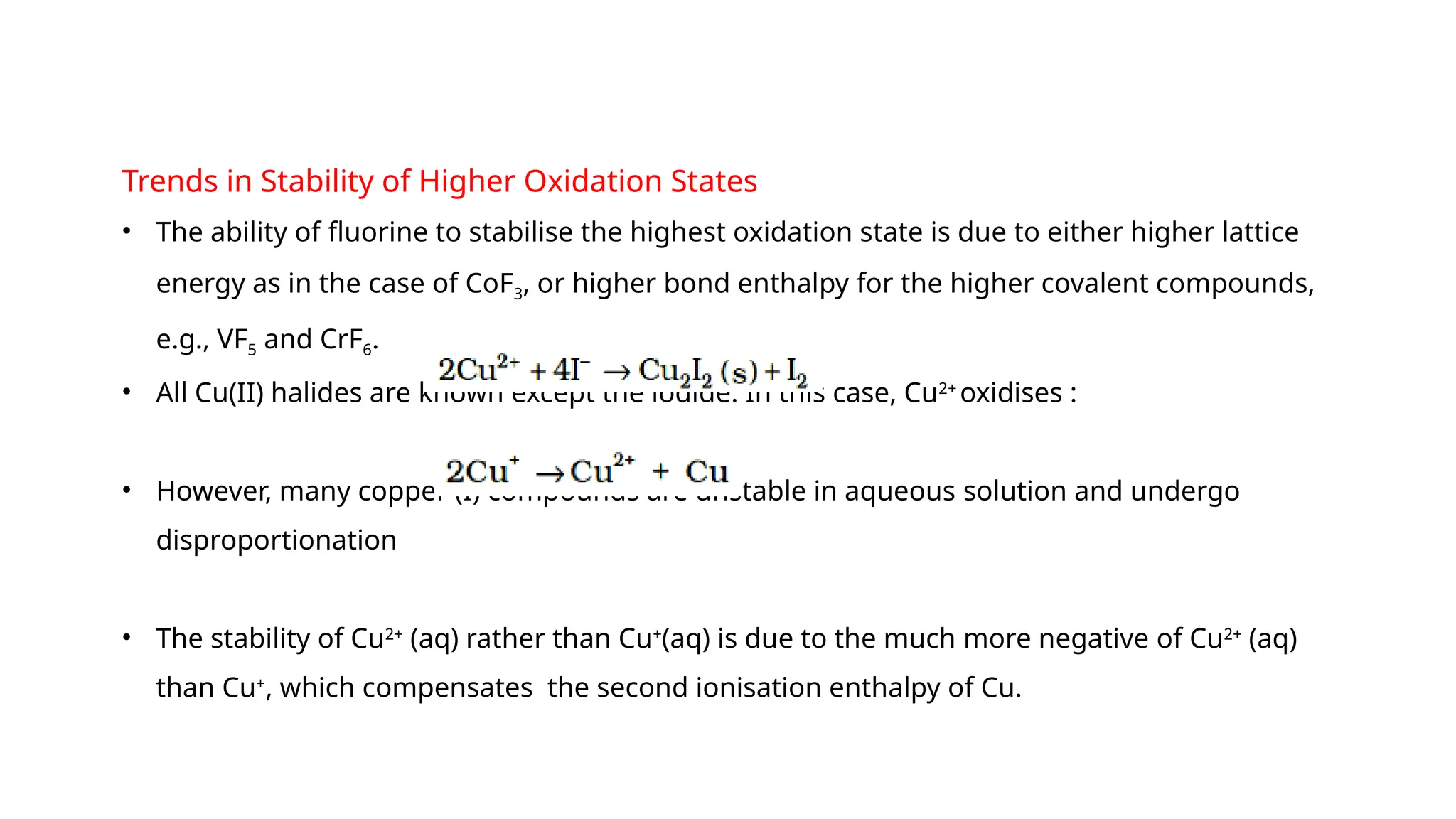
• All Cu(II) halides are known except the iodide. In this case, Cu2+
oxidises :
• However, many copper (I) compounds are unstable in aqueous solution and undergo
disproportionation
• The stability of Cu2+
(aq) rather than Cu+
(aq) is due to the much more negative of Cu2+
(aq)
than Cu+
, which compensates the second ionisation enthalpy of Cu.
Trends in Stability of Higher Oxidation States
• The highest oxidation number in the oxides coincides with the group number and is attained in
Sc2O3 to Mn2O7.
• Beyond Group 7, no higher oxides of Fe above Fe2O3, are known, although ferrates (VI)(FeO4)2–
, are
formed in alkaline media but they readily decompose to Fe2O3 and O2.
• The ability of oxygen to stabilise these high oxidation states exceeds that of fluorine.
• Thus the highest Mn fluoride is MnF4 whereas the highest oxide is Mn2O7.
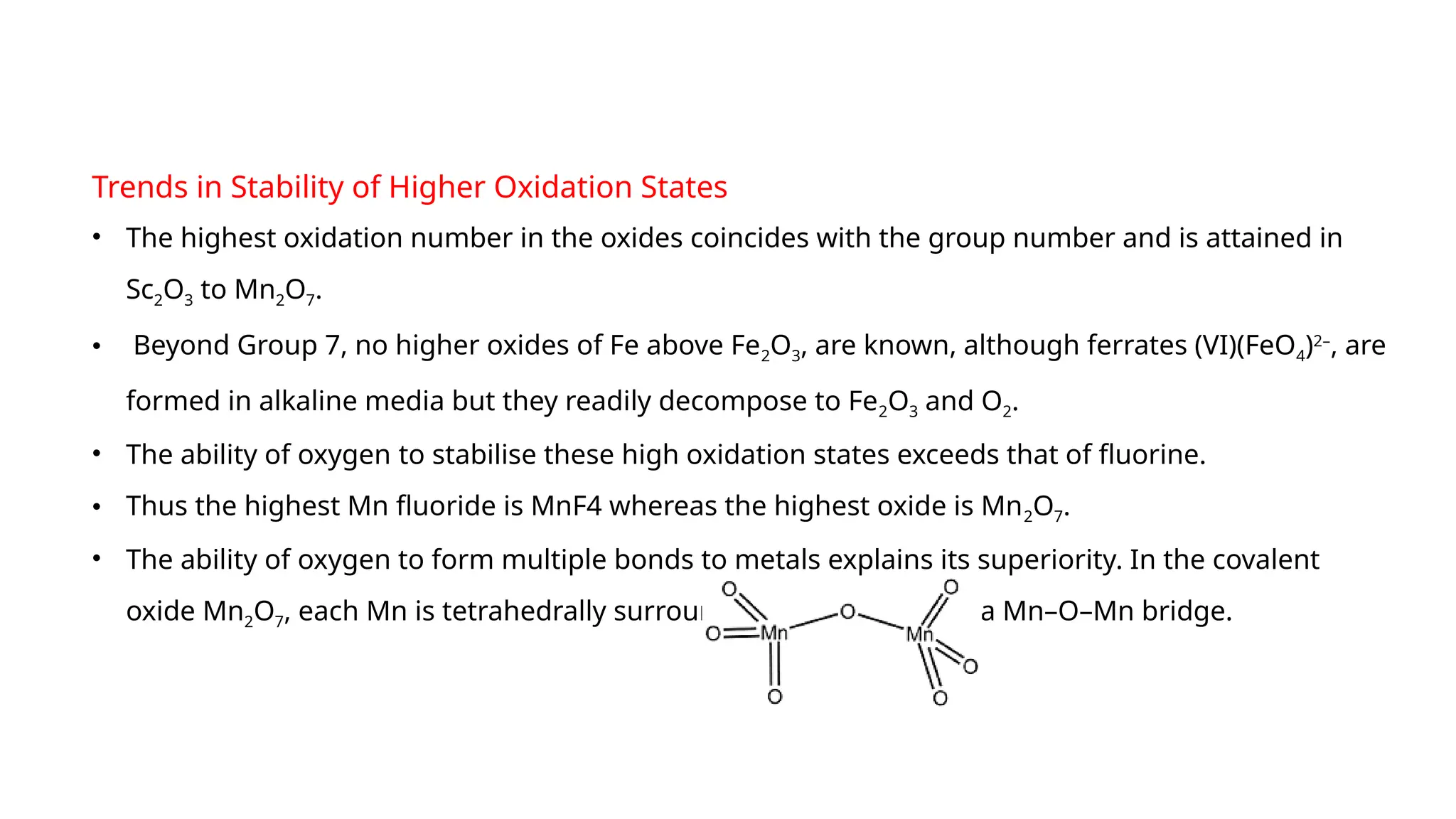
• The ability of oxygen to form multiple bonds to metals explains its superiority. In the covalent
oxide Mn2O7, each Mn is tetrahedrally surrounded by O’s including a Mn–O–Mn bridge.
Class XII
Chemistry
The d-and f-Block Elements
Topics:-
• Transition Elements –
• Magnetic Properties,
• Formation of Coloured Ions,
• Formation of Complex Compounds,
• Catalytic Properties,
• Formation of Interstitial Compounds,
• Alloy Formation
Prepared by:- Vijay Kumar Sethi
Magnetic Properties
• When a magnetic field is applied to substances, mainly two types of magnetic behaviour are
observed: diamagnetism and paramagnetism
• Diamagnetic substances are repelled by the applied field while the paramagnetic substances
are attracted.
• Substances which are attracted very strongly are said to be ferromagnetic. In fact,
ferromagnetism is an extreme form of paramagnetism.
• Many of the transition metal ions are paramagnetic due to the presence of unpaired
electrons.
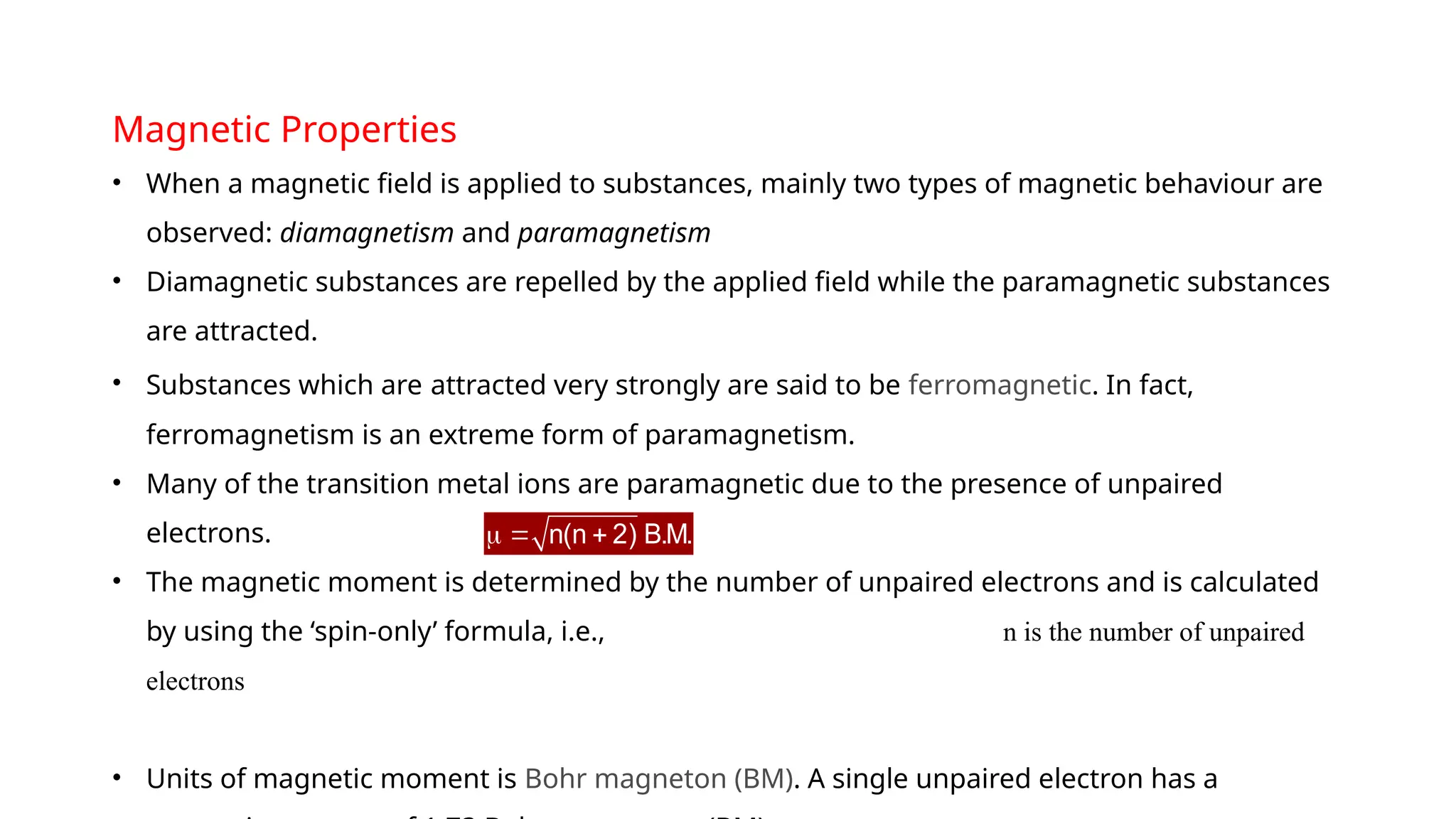
• The magnetic moment is determined by the number of unpaired electrons and is calculated
by using the ‘spin-only’ formula, i.e., n is the number of unpaired
electrons
• Units of magnetic moment is Bohr magneton (BM). A single unpaired electron has a
n(n 2) B.M.
  
Formation of Coloured Ions
• Most transition metals ions are coloured due to d-d-transition of unpaired electrons
• When an electron from a lower energy d orbital is excited to a higher energy d
orbital, the energy of excitation corresponds to the frequency of light absorbed . This
frequency generally lies in the visible region.
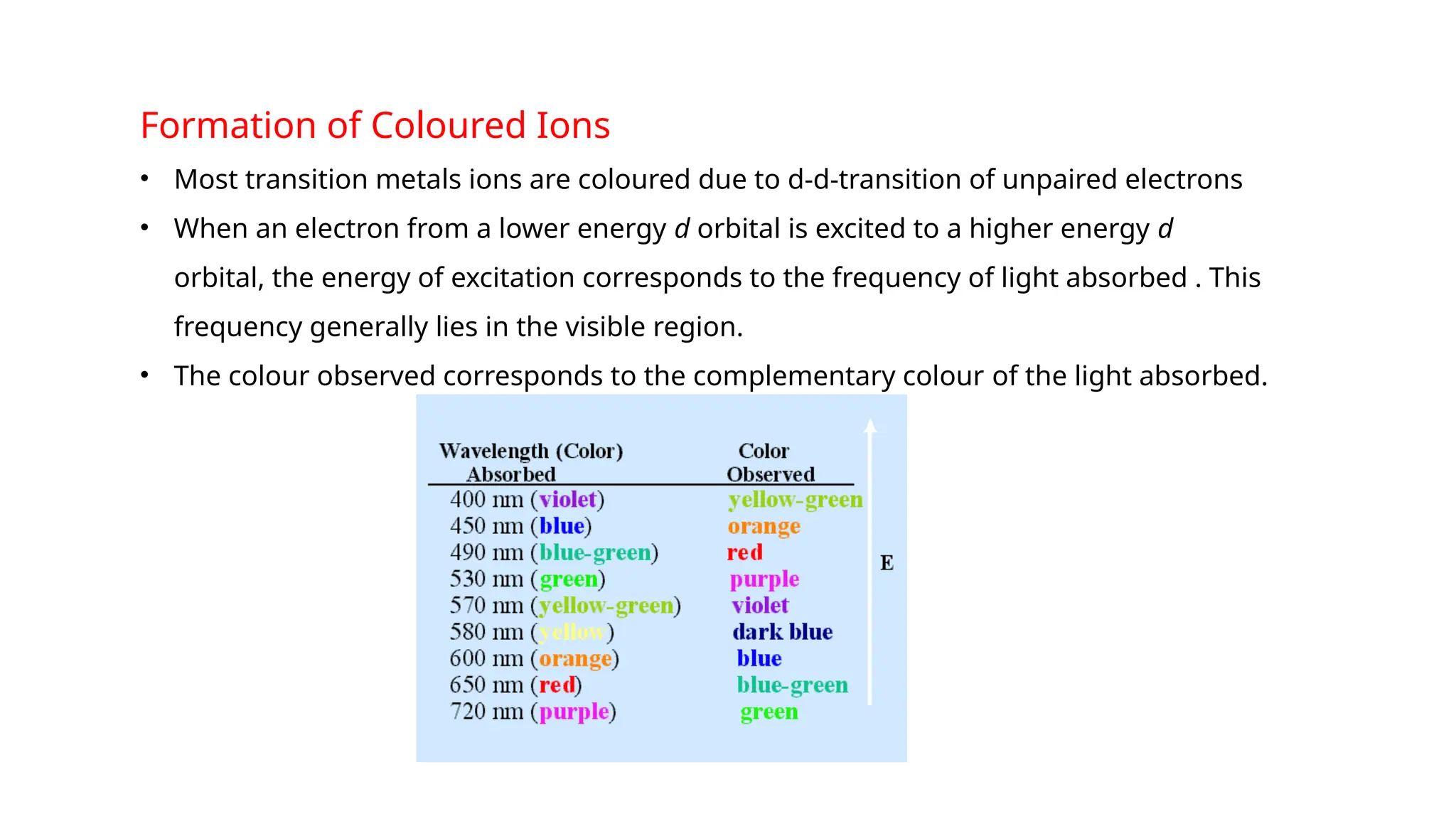
• The colour observed corresponds to the complementary colour of the light absorbed.
Formation of Coloured Ions by Transition
Elements
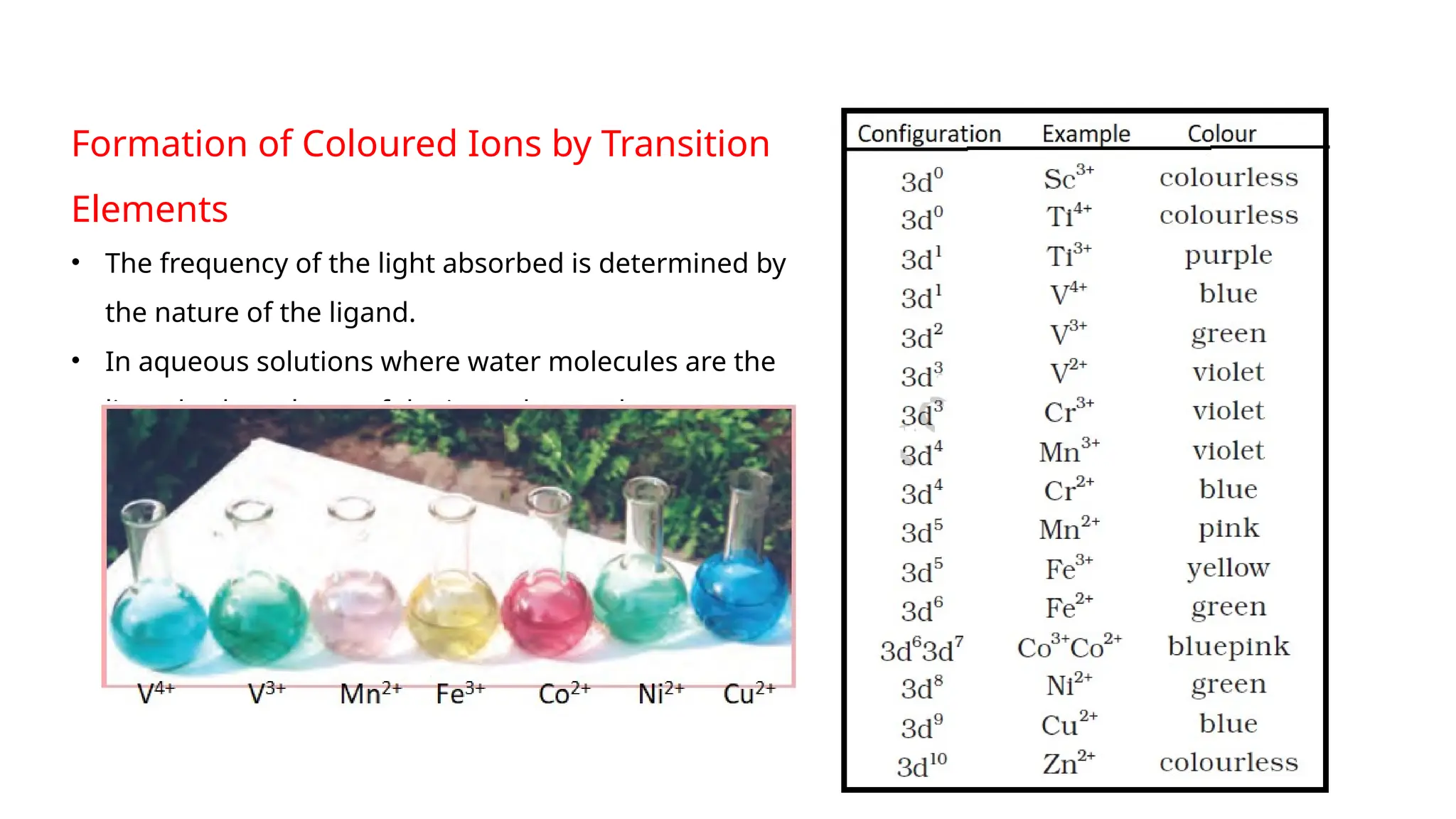
• The frequency of the light absorbed is determined by
the nature of the ligand.
• In aqueous solutions where water molecules are the
ligands, the colours of the ions observed are
Formation of Complex Compounds
• The transition metals form a large number of complex compounds.
• This is due to the comparatively smaller sizes of the metal ions, their high ionic charges and the
availability of d orbitals for bond formation.
• A few examples are: [Fe(CN)6]3–
, [Fe(CN)6]4–
, [Cu(NH3)4]2+
and [PtCl4]2–
.
• Complex compounds are those in which the metal ions bind a number of anions or
neutral molecules giving complex species with characteristic properties.
Catalytic Properties
• The transition metals and their compounds are known for their catalytic activity.
• This activity is due to their ability to adopt multiple oxidation states and to form complexes
• Vanadium(V) oxide (in Contact Process), finely divided iron (in Haber’s Process), and nickel
(in Catalytic Hydrogenation) are some of the examples.
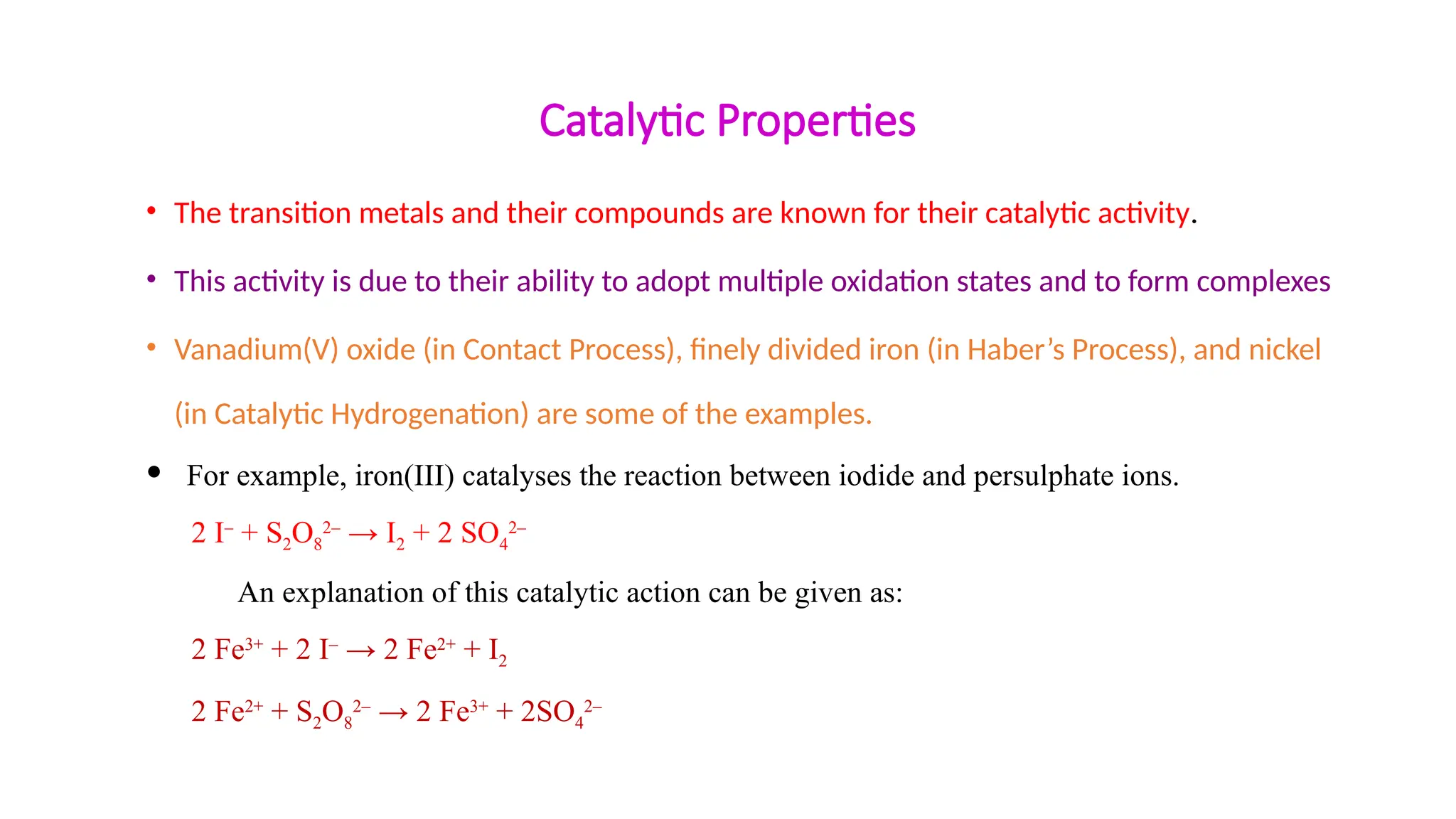
 For example, iron(III) catalyses the reaction between iodide and persulphate ions.
2 I–
+ S2O8
2–
→ I2 + 2 SO4
2–
An explanation of this catalytic action can be given as:
2 Fe3+
+ 2 I–
→ 2 Fe2+
+ I2
2 Fe2+
+ S2O8
2–
→ 2 Fe3+
+ 2SO4
2–
Formation of Interstitial Compounds
• Interstitial compounds are those which are formed when small atoms like H, C or N are
trapped inside the crystal lattices of metals.
• They are usually non stoichiometric and are neither typically ionic nor covalent, for
example, TiC, Mn4N, Fe3H, VH0.56 and TiH1.7, etc.
• The formulas quoted do not correspond to any normal oxidation state of the metal.
Because of the nature of their composition, these compounds are referred to as
interstitial compounds.
• The principal physical and chemical characteristics of these compounds are as follows:
• (i) They have high melting points, higher than those of pure metals.
• (ii) They are very hard, some borides approach diamond in hardness.
• (iii) They retain metallic conductivity.
• (iv) They are chemically inert.
Alloy Formation
• Alloys may be homogeneous solid solutions in which the atoms of one metal are distributed
randomly among the atoms of the other.
• Such alloys are formed by atoms with metallic radii that are within about 15 percent of each
other.
• Because of similar radii and other characteristics of transition metals, alloys are readily formed
by these metals.
• The alloys so formed are hard and have often high melting points.
• The best known are ferrous alloys: chromium, vanadium, tungsten, molybdenum and
manganese are used for the production of a variety of steels and stainless steel.
• Alloys of transition metals with non transition metals such as brass (copper-zinc) and bronze
(copper-tin), are also of considerable industrial importance.
Illustrative Example
 Why does V2O5 acts as catalyst?
 Solution: V2O5 acts as catalyst because it has large surface area. It can form unstable intermediates
which readily change into products
 Of the ions Co2+
, Sc3+
, and Cr3+
, which one will give coloured aqueous solution and respond to a magnetic field?
 Solution:Co2+
and Cr3+
are coloured and attracted in magnetic field because they have unpaired
electrons whereas Sc3+
does not have any unpaired electron hence it will be repelled by magnetic field.
 Account for the following:
Scandium forms no coloured ions and yet it is regarded as a transition element.
 Solution: Sc has incompletely filled d-orbital hence it is regarded as transition metal. It forms no
coloured ion due to absence of unpaired electron in Sc3+
ion.
Illustrative Example
 Give reasons for the following features of transition metal chemistry.
(a) Most of the transition metal ions are coloured in solution
(b) Transition metals are well known to form complex compounds
(c) The second and third members in each group of the transition elements have very similar atomic radii
Solution:-
(a) This is attributed due to presence of unpaired electrons ,they undergo d-d transitions by absorbing light from
visible region and radiate complementary colour.
(b) Small size and high charge of cation and presence of vacant d-orbitals.
(c) Due to lanthanoid contraction.
Class XII
Chemistry
The d-and f-Block Elements
Topics:-
• The f-Block or Inner transition elements-introduction
• Lanthanoids-
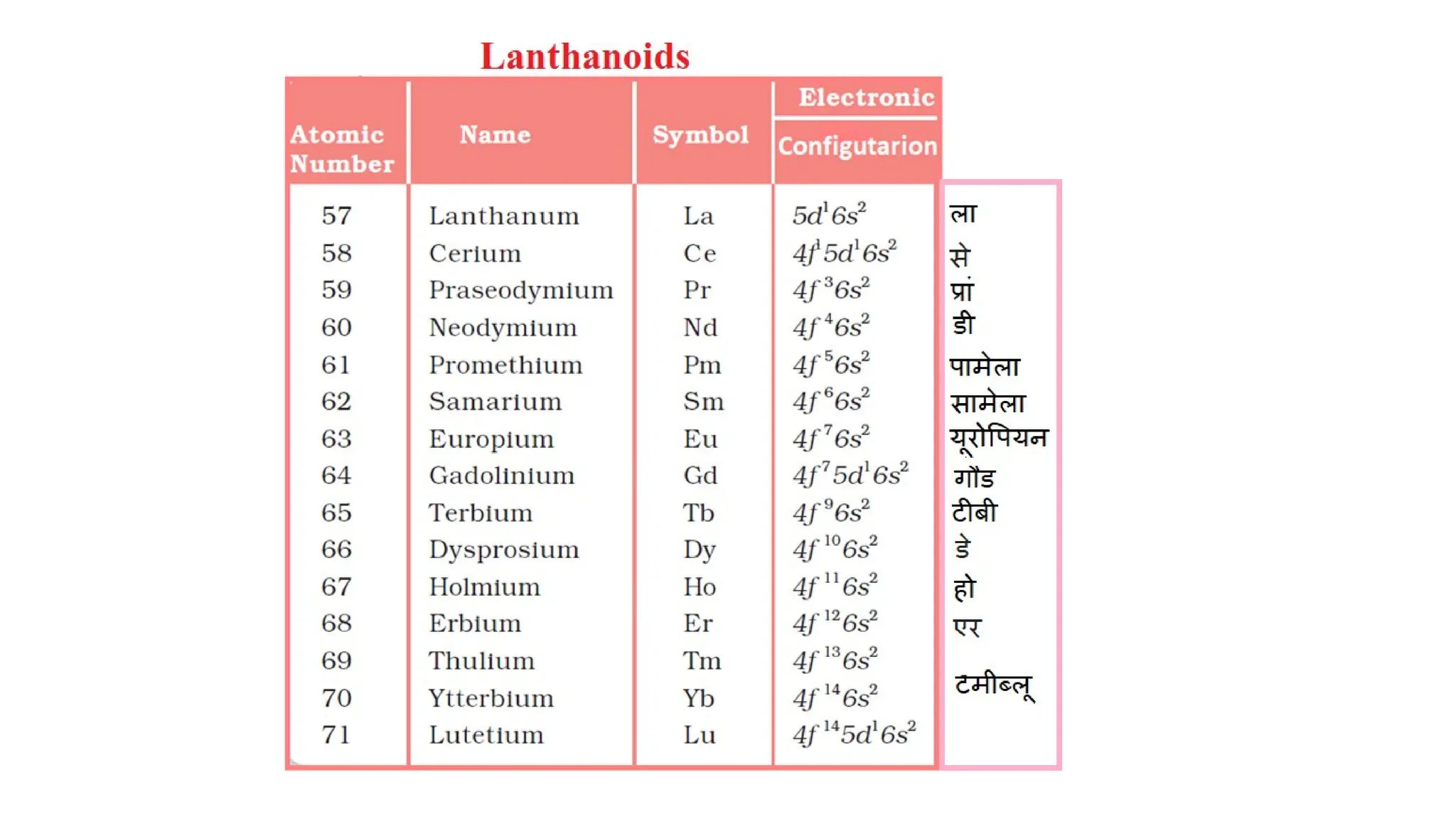
• Electronic configuration,
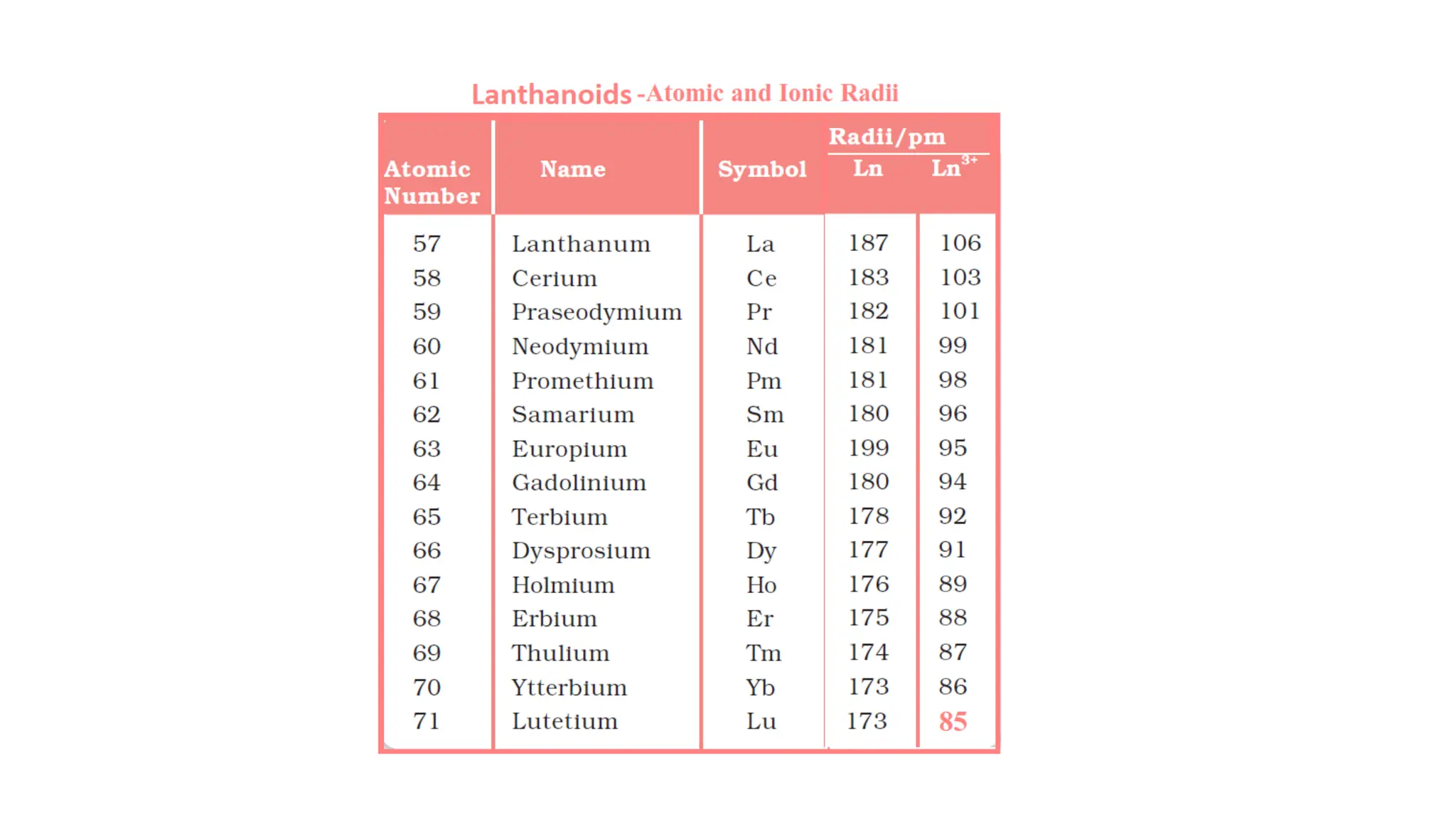
• Atomic and Ionic Radii,
• Lanthanoid Contraction,
• Oxidation states
Prepared by:- Vijay Kumar Sethi
The f-Block or Inner transition elements
• The elements in which the last electron enters (n-2)f orbitals are called inner transition elements.
• The general electronic configuration of these elements can be represented as (n – 2)f0-14
(n – 1)d0-1
ns2
.
• The two series of the inner transition metals;
• 4f inner transition metals (58Ce to 71Lu) known as lanthanoids because they come immediately after
lanthanum
• and 5f inner transition metals (90Th to 103Lr) are known actinoids because they come immediately after
actinium.
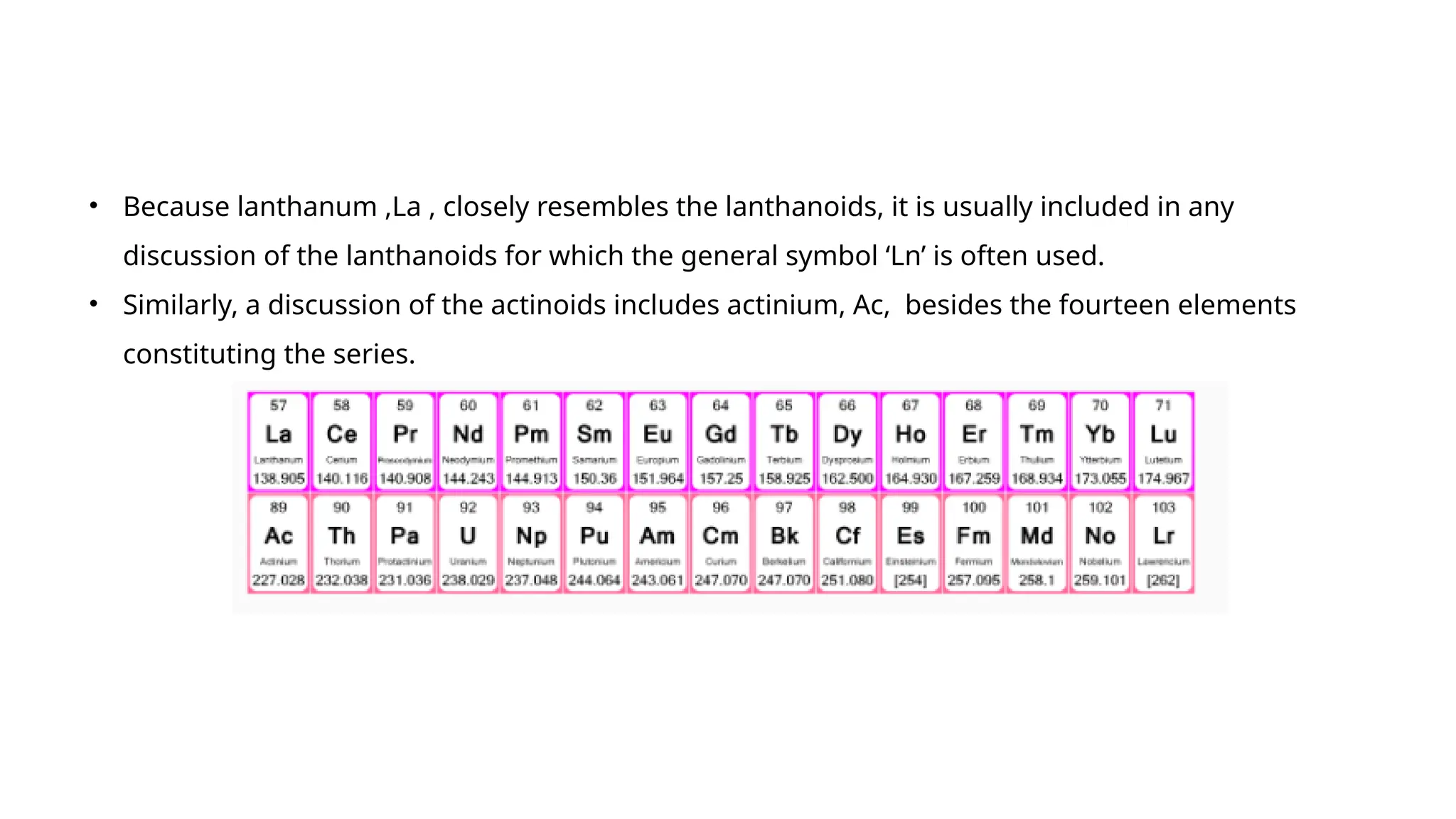
• Because lanthanum ,La , closely resembles the lanthanoids, it is usually included in any
discussion of the lanthanoids for which the general symbol ‘Ln’ is often used.
• Similarly, a discussion of the actinoids includes actinium, Ac, besides the fourteen elements
constituting the series.
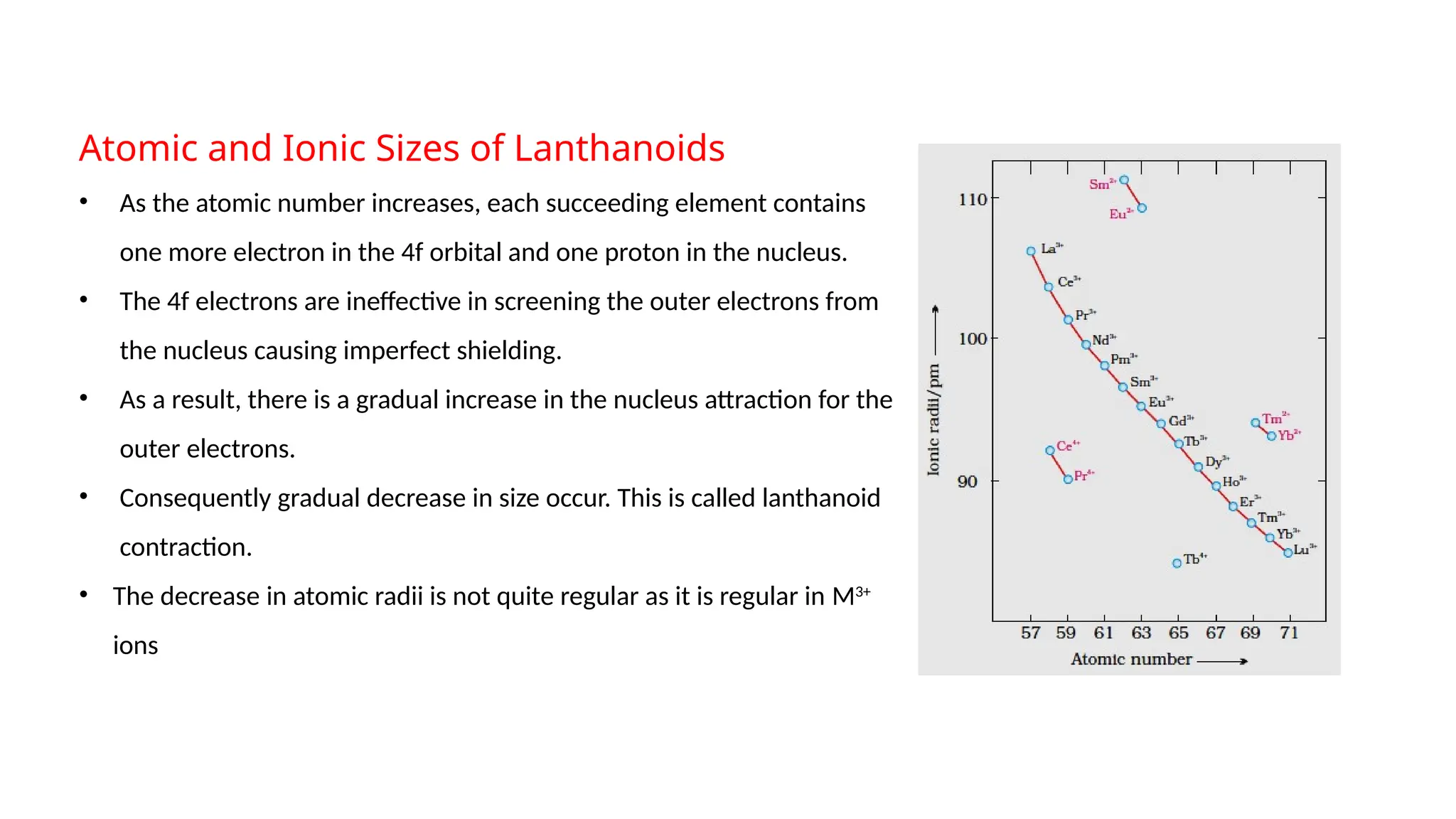
Atomic and Ionic Sizes of Lanthanoids
• As the atomic number increases, each succeeding element contains
one more electron in the 4f orbital and one proton in the nucleus.
• The 4f electrons are ineffective in screening the outer electrons from
the nucleus causing imperfect shielding.
• As a result, there is a gradual increase in the nucleus attraction for the
outer electrons.
• Consequently gradual decrease in size occur. This is called lanthanoid
contraction.
• The decrease in atomic radii is not quite regular as it is regular in M3+
ions
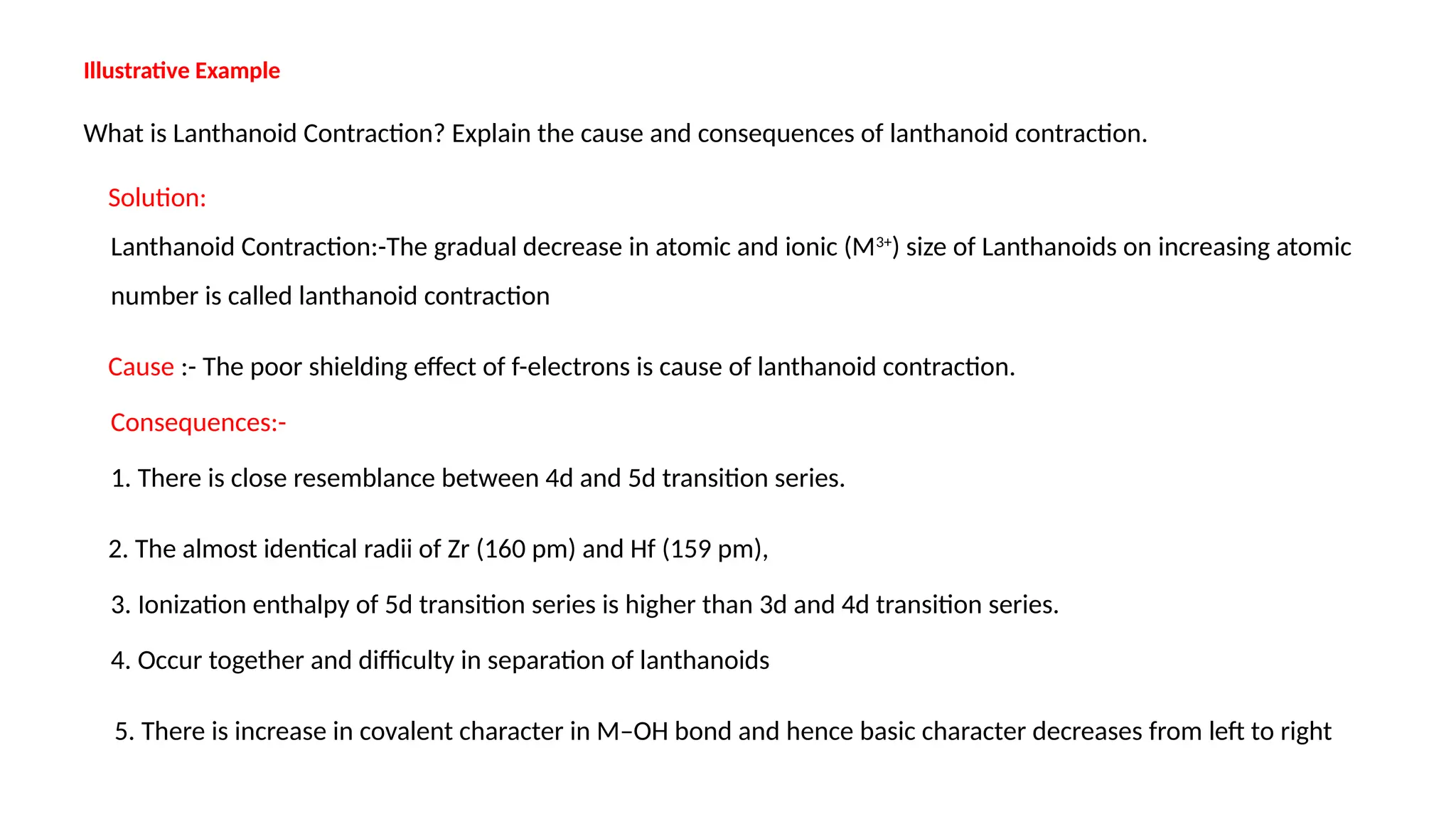
Illustrative Example
What is Lanthanoid Contraction? Explain the cause and consequences of lanthanoid contraction.
Solution:
Lanthanoid Contraction:-The gradual decrease in atomic and ionic (M3+
) size of Lanthanoids on increasing atomic
number is called lanthanoid contraction
Cause :- The poor shielding effect of f-electrons is cause of lanthanoid contraction.
Consequences:-
1. There is close resemblance between 4d and 5d transition series.
2. The almost identical radii of Zr (160 pm) and Hf (159 pm),
3. Ionization enthalpy of 5d transition series is higher than 3d and 4d transition series.
4. Occur together and difficulty in separation of lanthanoids
5. There is increase in covalent character in M–OH bond and hence basic character decreases from left to right
Oxidation States
• Predominantly +3 oxidation state.
• Occasionally +2 and +4 ions in solution or in solid compounds are also obtained.
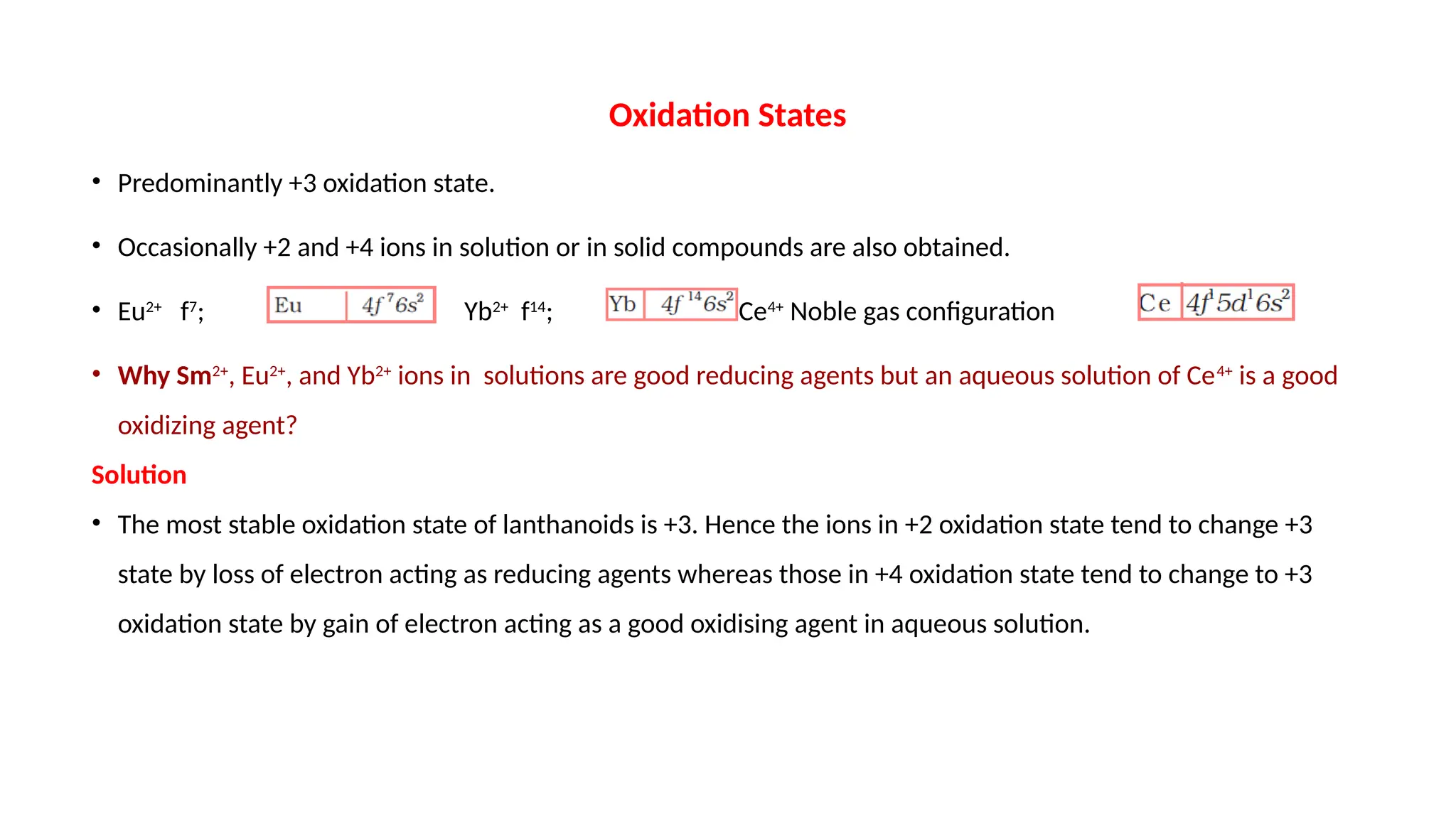
• Eu2+
f7
; Yb2+
f14
; Ce4+
Noble gas configuration
• Why Sm2+
, Eu2+
, and Yb2+
ions in solutions are good reducing agents but an aqueous solution of Ce4+
is a good
oxidizing agent?
Solution
• The most stable oxidation state of lanthanoids is +3. Hence the ions in +2 oxidation state tend to change +3
state by loss of electron acting as reducing agents whereas those in +4 oxidation state tend to change to +3
oxidation state by gain of electron acting as a good oxidising agent in aqueous solution.

Class 12 Chapter 8 The d-and f-Block Elements.pptx

  • 1.
    Class XII Chemistry The d-andf-Block Elements Topics:- • The d-block elements, • Transition Elements – • Physical Properties ,Electronic Configurations , Melting Points , Enthalpies of Atomization Prepared by:- Vijay Kumar Sethi
  • 2.
    The d-block elements •Elements of the groups 3-12 • d orbitals are progressively filled • These are placed in four long periods 4,5,6 and 7 • Generally, also called as transition elements • There are mainly four series of the transition metals, • Originally the name transition metals was derived from the fact that their chemical properties were transitional between those of s and p-block elements.
  • 3.
    Transition Elements orTransition Metals • According to IUPAC, transition metals are defined as metals which have incomplete d subshell either in neutral atom or in their ions. • Zinc, cadmium and mercury of group 12 have full d10 configuration in their ground state as well as in their common oxidation states and hence, are not regarded as transition metals. • However, being the end members of the 3d, 4d and 5d transition series, respectively, their chemistry is studied along with the chemistry of the transition metals. • Various precious metals such as silver, gold and platinum and industrially important metals like iron, copper and titanium belong to the transition metals series.
  • 4.
    Electronic Configurations ofthe d-Block Elements • In general the electronic configuration of outer orbitals of these elements is (n-1)d1– 10 ns1–2 . • The (n–1) stands for the inner d orbitals (penultimate shell) and outermost ns orbital • However, there are several exceptions because of very little energy difference between (n-1)d and ns orbitals. • Furthermore, half and completely filled sets of orbitals are relatively more stable. • For example, Cr (Z=24) 3d5 4s1 configuration instead of 3d4 4s2 ; • Similarly in case of Cu (Z=29), the configuration is 3d10 4s1 and not 3d9 4s2 .
  • 6.
    • Period 4th •Group Number:- Z=21 to 29 Sum of digits of atomic number
  • 8.
    Physical Properties ofTransition Elements  Nearly all the transition elements display typical metallic properties such as high tensile strength, ductility, malleability, high thermal and electrical conductivity and metallic lustre  The transition metals are very much hard and have low volatility o Their melting and boiling points are high  The high melting points of these metals are due to the involvement of greater number of electrons from (n-1)d in addition to the ns electrons in the inter-atomic metallic bonding.
  • 9.
    • In anyrow the melting points of these metals rise to a maximum at d5 except for anomalous values of Mn and Tc and fall regularly as the atomic number increases Melting Points of Transition Elements
  • 10.
    • The numberof unpaired d-electrons increases up to the middle so metallic strength increases up to the middle. • The dip in m.p. at Mn can be explained on the basis that it has stable half filled configuration so electrons are held tightly so delocalisation is less & metallic bond is weak
  • 11.
    Enthalpies of Atomization •They have high enthalpies of atomization • The maxima at about the middle of each series indicate that one unpaired electron per d orbital is particularly favourable for strong interatomic interaction. • In general, greater the number of valence electrons, stronger is the resultant bonding
  • 12.
    Class XII Chemistry The d-andf-Block Elements Topics:- • Transition Elements – • Atomic and ionic sizes, Ionisation Enthalpies, Oxidation States Prepared by:- Vijay Kumar Sethi
  • 13.
    Variation in Atomicand Ionic Sizes of Transition Metals • In general , the atomic radii of elements of the 3d-series gradually decrease in radius with an increase in atomic number. • Reason: The d-orbitals offer poor shielding effect ,hence the net electrostatic attraction between the nuclear charge and the outermost electron increases and the atomic radius decreases. • The same trend is observed in the ionic radii of a given series. • However, the variation within a series is quite small and not systematic because of two opposite effects • Increase in effective nuclear charge- decreases the size • Increase in electron-electron repulsion-increases the size
  • 15.
    Atomic Radii ofTransition Elements • There is an increase in radii from the first (3d) to the second (4d) series of the elements but the radii of the third (5d) series are virtually the same as those of the corresponding members of the second series this is due to the Lanthanoid Contraction • The filling of 4f before 5d orbital results in a regular decrease in atomic radii is called Lanthanoid contraction (due to the imperfect shielding of 4f electrons) • The net result of the lanthanoid contraction is that the second and the third d series exhibit similar radii (e.g., Zr 160 pm, Hf 159 pm) and have very similar physical and chemical properties
  • 16.
    Ionisation Enthalpies • Generallythere is an increase in ionisation enthalpy along each series of the transition elements from left to right due to an increase in nuclear charge which accompanies the filling of the inner d orbitals. IE2 :V < Cr > Mn (Cr+ 3d5 ) and Ni < Cu > Zn (Cu+ 3d10 ) IE3 : Fe << Mn (Fe2+ 3d6 ; Mn2+ 3d5 )
  • 17.
    Oxidation States • Greatvariety of oxidation states(Variable oxidation states) • The elements which give the greatest number of oxidation states occur in or near the middle of the series. • The lesser number of oxidation states at the extreme ends is due to few electrons to lose or share (Sc, Ti) or many d electrons (hence fewer orbitals available in which to share electrons with others) for higher valence (Cu, Zn).
  • 18.
    Oxidation States • Insolution ,the stability of the compounds depends upon electrode potentials rather than ionisation enthalpies . • Electrode potential values depend upon factors such as enthalpy of sublimation of the metal, ionisation enthalpy and hydration enthalpy. • The variability of oxidation states, a characteristic of transition elements, arises out of incomplete filling of d orbitals in such a way that their oxidation states differ from each other by unity, e.g., VII , VIII , VIV , VV . This is in contrast with the variability of oxidation states of non transition elements where oxidation states normally differ by a unit of two due to inert pair effect.
  • 19.
    Oxidation States • Inthe p–block the lower oxidation states are favoured by the heavier members (due to inert pair effect), the opposite is true in the groups of d-block. For example, in group 6, Mo(VI) and W(VI) are found to be more stable than Cr(VI). Thus Cr(VI) in the form of dichromate in acidic medium is a strong oxidising agent, whereas MoO3 and WO3 are not • Low oxidation states are found when a complex compound has ligands capable of π-acceptor character in addition to the σ-bonding. For example, in Ni(CO)4 and Fe(CO)5, the oxidation state of nickel and iron is zero.
  • 20.
    Class XII Chemistry The d-andf-Block Elements Topics:- • Transition Elements – • Trends in Standard Electrode Potentials of the redox couple M2+ /M and M3+ /M2+ • Trends in Stability of Higher Oxidation States Prepared by:- Vijay Kumar Sethi
  • 21.
    Trends in theM2+ /M Standard Electrode Potentials • Generally less negative values across the series due the general increase in the sum of the first and second ionisation enthalpies. • The value of for Mn, Ni and Zn are more negative than expected from the trend. • The stability of the half-filled d sub-shell in Mn2+ and the completely filled d10 configuration in Zn2+ are related to their values, whereas for Ni is related to the highest negative . • The (M2+ /M) value for copper is positive (+0.34V). Due to high sublimation and second ionization enthalpy
  • 22.
    Trends in theM3+ /M2+ Standard Electrode Potentials  The low value for Sc reflects the stability of Sc3+ which has a noble gas configuration  The highest value for Zn is due to the removal of an electron from the stable d10 configuration of Zn2+ .  The comparatively high value for Mn shows that Mn2+ (d5 ) is particularly stable, whereas comparatively low value for Fe shows the extra stability of Fe3+ (d5 ).  The comparatively higher value for V is related to the stability of V2+ (half-filled t2g level).
  • 23.
    Illustrative Example The sumsof the first and second ionization enthalpies and those of the third and fourth ionization enthalpies of nickel and platinum are given below: IE1 + IE2 (kJ mol-1 ) IE3 + IE4 (kJ mol-1 ) Ni 2.49 8.80 Pt 2.66 6.70 Taking these values into account write the following: (i) The most common oxidation state for Ni and Pt and its reasons. (ii) The name of the metal (Ni or Pt) which can form compounds in +4 oxidation state more easily and why? Solution (i) Ni shows +2 oxidation state whereas Pt shows +4 .(IE1+IE2) of Ni is less than that for Pt whereas (IE3 + IE4) is less for Pt. (ii)From the given data it is clear that Pt (IV) is more easily attained while more energy would be required for obtaining Ni (IV) ion. Hence, Pt (IV) compounds are more stable than Ni (IV) compounds.
  • 24.
    Illustrative Example Q. Outof Cr2+ and Cr3+ ,which one is stable in aqueous solution? Solution :Cr3+ is more stable in aqueous solution due to higher hydration enthalpy which is due to smaller size and higher charge Q. How do the oxides of the transition elements in lower oxidation states differ from those in higher oxidation states in the nature of metal-oxygen bonding and why? Solution : Oxides of transition metal in lower oxidation state are ionic and basic in nature whereas in higher oxidation state it forms covalent oxide which are acidic in nature. Q. Name a transition element which does not exhibit variable oxidation states. Solution: Scandium (Z = 21) does not exhibit variable oxidation states
  • 25.
    Illustrative Example 1. Explainwhy Eo for Mn+3 /Mn2+ couple is more positive than that for Fe3+ /Fe2+ . Solution :Mn2+ has stable (3d5 ) configuration while Fe3+ is more stable (3d5 ) 2. Why is Cr2+ reducing and Mn3+ oxidising when both have d4 configuration. Solution: process is oxidation means Cr2+ is reducing Cr2+ 3d4 ; Cr3+ 3d3 (stable half-filled t2g) process is reduction means Mn3+ is oxidizing Mn3+ 3d4 ; Mn2+ 3d5 (stable half-filled ) 3. For the first row transition metals the Eo values are: Eo V Cr Mn Fe Co Ni Cu (M2+ /M) –1.18 – 0.91 –1.18 – 0.44 – 0.28 – 0.25 +0.34 Explain the irregularity in the above values. Solution: The Eo (M2+ /M) values are not regular which can be explained from the irregular variation of ionisation enthalpies (Δ i H 1 + Δ i H 2 ) and also the sublimation enthalpies which are relatively much less for manganese and vanadium.
  • 26.
    Trends in Stabilityof Higher Oxidation States • Highest oxidation state of a metal exhibited in its oxide or fluoride only because F and O are most electronegative elements • For example TiX4 (tetrahalides), VF5 and CrF6. • The +7 state for Mn is not represented in simple halides but MnO3F is known, and beyond Mn no metal has a trihalide except FeX3 and CoF3.
  • 27.
    Trends in Stabilityof Higher Oxidation States • The ability of fluorine to stabilise the highest oxidation state is due to either higher lattice energy as in the case of CoF3, or higher bond enthalpy for the higher covalent compounds, e.g., VF5 and CrF6. • All Cu(II) halides are known except the iodide. In this case, Cu2+ oxidises : • However, many copper (I) compounds are unstable in aqueous solution and undergo disproportionation • The stability of Cu2+ (aq) rather than Cu+ (aq) is due to the much more negative of Cu2+ (aq) than Cu+ , which compensates the second ionisation enthalpy of Cu.
  • 28.
    Trends in Stabilityof Higher Oxidation States • The highest oxidation number in the oxides coincides with the group number and is attained in Sc2O3 to Mn2O7. • Beyond Group 7, no higher oxides of Fe above Fe2O3, are known, although ferrates (VI)(FeO4)2– , are formed in alkaline media but they readily decompose to Fe2O3 and O2. • The ability of oxygen to stabilise these high oxidation states exceeds that of fluorine. • Thus the highest Mn fluoride is MnF4 whereas the highest oxide is Mn2O7. • The ability of oxygen to form multiple bonds to metals explains its superiority. In the covalent oxide Mn2O7, each Mn is tetrahedrally surrounded by O’s including a Mn–O–Mn bridge.
  • 29.
    Class XII Chemistry The d-andf-Block Elements Topics:- • Transition Elements – • Magnetic Properties, • Formation of Coloured Ions, • Formation of Complex Compounds, • Catalytic Properties, • Formation of Interstitial Compounds, • Alloy Formation Prepared by:- Vijay Kumar Sethi
  • 30.
    Magnetic Properties • Whena magnetic field is applied to substances, mainly two types of magnetic behaviour are observed: diamagnetism and paramagnetism • Diamagnetic substances are repelled by the applied field while the paramagnetic substances are attracted. • Substances which are attracted very strongly are said to be ferromagnetic. In fact, ferromagnetism is an extreme form of paramagnetism. • Many of the transition metal ions are paramagnetic due to the presence of unpaired electrons. • The magnetic moment is determined by the number of unpaired electrons and is calculated by using the ‘spin-only’ formula, i.e., n is the number of unpaired electrons • Units of magnetic moment is Bohr magneton (BM). A single unpaired electron has a n(n 2) B.M.   
  • 31.
    Formation of ColouredIons • Most transition metals ions are coloured due to d-d-transition of unpaired electrons • When an electron from a lower energy d orbital is excited to a higher energy d orbital, the energy of excitation corresponds to the frequency of light absorbed . This frequency generally lies in the visible region. • The colour observed corresponds to the complementary colour of the light absorbed.
  • 32.
    Formation of ColouredIons by Transition Elements • The frequency of the light absorbed is determined by the nature of the ligand. • In aqueous solutions where water molecules are the ligands, the colours of the ions observed are
  • 33.
    Formation of ComplexCompounds • The transition metals form a large number of complex compounds. • This is due to the comparatively smaller sizes of the metal ions, their high ionic charges and the availability of d orbitals for bond formation. • A few examples are: [Fe(CN)6]3– , [Fe(CN)6]4– , [Cu(NH3)4]2+ and [PtCl4]2– . • Complex compounds are those in which the metal ions bind a number of anions or neutral molecules giving complex species with characteristic properties.
  • 34.
    Catalytic Properties • Thetransition metals and their compounds are known for their catalytic activity. • This activity is due to their ability to adopt multiple oxidation states and to form complexes • Vanadium(V) oxide (in Contact Process), finely divided iron (in Haber’s Process), and nickel (in Catalytic Hydrogenation) are some of the examples.  For example, iron(III) catalyses the reaction between iodide and persulphate ions. 2 I– + S2O8 2– → I2 + 2 SO4 2– An explanation of this catalytic action can be given as: 2 Fe3+ + 2 I– → 2 Fe2+ + I2 2 Fe2+ + S2O8 2– → 2 Fe3+ + 2SO4 2–
  • 35.
    Formation of InterstitialCompounds • Interstitial compounds are those which are formed when small atoms like H, C or N are trapped inside the crystal lattices of metals. • They are usually non stoichiometric and are neither typically ionic nor covalent, for example, TiC, Mn4N, Fe3H, VH0.56 and TiH1.7, etc. • The formulas quoted do not correspond to any normal oxidation state of the metal. Because of the nature of their composition, these compounds are referred to as interstitial compounds. • The principal physical and chemical characteristics of these compounds are as follows: • (i) They have high melting points, higher than those of pure metals. • (ii) They are very hard, some borides approach diamond in hardness. • (iii) They retain metallic conductivity. • (iv) They are chemically inert.
  • 36.
    Alloy Formation • Alloysmay be homogeneous solid solutions in which the atoms of one metal are distributed randomly among the atoms of the other. • Such alloys are formed by atoms with metallic radii that are within about 15 percent of each other. • Because of similar radii and other characteristics of transition metals, alloys are readily formed by these metals. • The alloys so formed are hard and have often high melting points. • The best known are ferrous alloys: chromium, vanadium, tungsten, molybdenum and manganese are used for the production of a variety of steels and stainless steel. • Alloys of transition metals with non transition metals such as brass (copper-zinc) and bronze (copper-tin), are also of considerable industrial importance.
  • 37.
    Illustrative Example  Whydoes V2O5 acts as catalyst?  Solution: V2O5 acts as catalyst because it has large surface area. It can form unstable intermediates which readily change into products  Of the ions Co2+ , Sc3+ , and Cr3+ , which one will give coloured aqueous solution and respond to a magnetic field?  Solution:Co2+ and Cr3+ are coloured and attracted in magnetic field because they have unpaired electrons whereas Sc3+ does not have any unpaired electron hence it will be repelled by magnetic field.  Account for the following: Scandium forms no coloured ions and yet it is regarded as a transition element.  Solution: Sc has incompletely filled d-orbital hence it is regarded as transition metal. It forms no coloured ion due to absence of unpaired electron in Sc3+ ion.
  • 38.
    Illustrative Example  Givereasons for the following features of transition metal chemistry. (a) Most of the transition metal ions are coloured in solution (b) Transition metals are well known to form complex compounds (c) The second and third members in each group of the transition elements have very similar atomic radii Solution:- (a) This is attributed due to presence of unpaired electrons ,they undergo d-d transitions by absorbing light from visible region and radiate complementary colour. (b) Small size and high charge of cation and presence of vacant d-orbitals. (c) Due to lanthanoid contraction.
  • 39.
    Class XII Chemistry The d-andf-Block Elements Topics:- • The f-Block or Inner transition elements-introduction • Lanthanoids- • Electronic configuration, • Atomic and Ionic Radii, • Lanthanoid Contraction, • Oxidation states Prepared by:- Vijay Kumar Sethi
  • 40.
    The f-Block orInner transition elements • The elements in which the last electron enters (n-2)f orbitals are called inner transition elements. • The general electronic configuration of these elements can be represented as (n – 2)f0-14 (n – 1)d0-1 ns2 . • The two series of the inner transition metals; • 4f inner transition metals (58Ce to 71Lu) known as lanthanoids because they come immediately after lanthanum • and 5f inner transition metals (90Th to 103Lr) are known actinoids because they come immediately after actinium.
  • 41.
    • Because lanthanum,La , closely resembles the lanthanoids, it is usually included in any discussion of the lanthanoids for which the general symbol ‘Ln’ is often used. • Similarly, a discussion of the actinoids includes actinium, Ac, besides the fourteen elements constituting the series.
  • 44.
    Atomic and IonicSizes of Lanthanoids • As the atomic number increases, each succeeding element contains one more electron in the 4f orbital and one proton in the nucleus. • The 4f electrons are ineffective in screening the outer electrons from the nucleus causing imperfect shielding. • As a result, there is a gradual increase in the nucleus attraction for the outer electrons. • Consequently gradual decrease in size occur. This is called lanthanoid contraction. • The decrease in atomic radii is not quite regular as it is regular in M3+ ions
  • 45.
    Illustrative Example What isLanthanoid Contraction? Explain the cause and consequences of lanthanoid contraction. Solution: Lanthanoid Contraction:-The gradual decrease in atomic and ionic (M3+ ) size of Lanthanoids on increasing atomic number is called lanthanoid contraction Cause :- The poor shielding effect of f-electrons is cause of lanthanoid contraction. Consequences:- 1. There is close resemblance between 4d and 5d transition series. 2. The almost identical radii of Zr (160 pm) and Hf (159 pm), 3. Ionization enthalpy of 5d transition series is higher than 3d and 4d transition series. 4. Occur together and difficulty in separation of lanthanoids 5. There is increase in covalent character in M–OH bond and hence basic character decreases from left to right
  • 46.
    Oxidation States • Predominantly+3 oxidation state. • Occasionally +2 and +4 ions in solution or in solid compounds are also obtained. • Eu2+ f7 ; Yb2+ f14 ; Ce4+ Noble gas configuration • Why Sm2+ , Eu2+ , and Yb2+ ions in solutions are good reducing agents but an aqueous solution of Ce4+ is a good oxidizing agent? Solution • The most stable oxidation state of lanthanoids is +3. Hence the ions in +2 oxidation state tend to change +3 state by loss of electron acting as reducing agents whereas those in +4 oxidation state tend to change to +3 oxidation state by gain of electron acting as a good oxidising agent in aqueous solution.