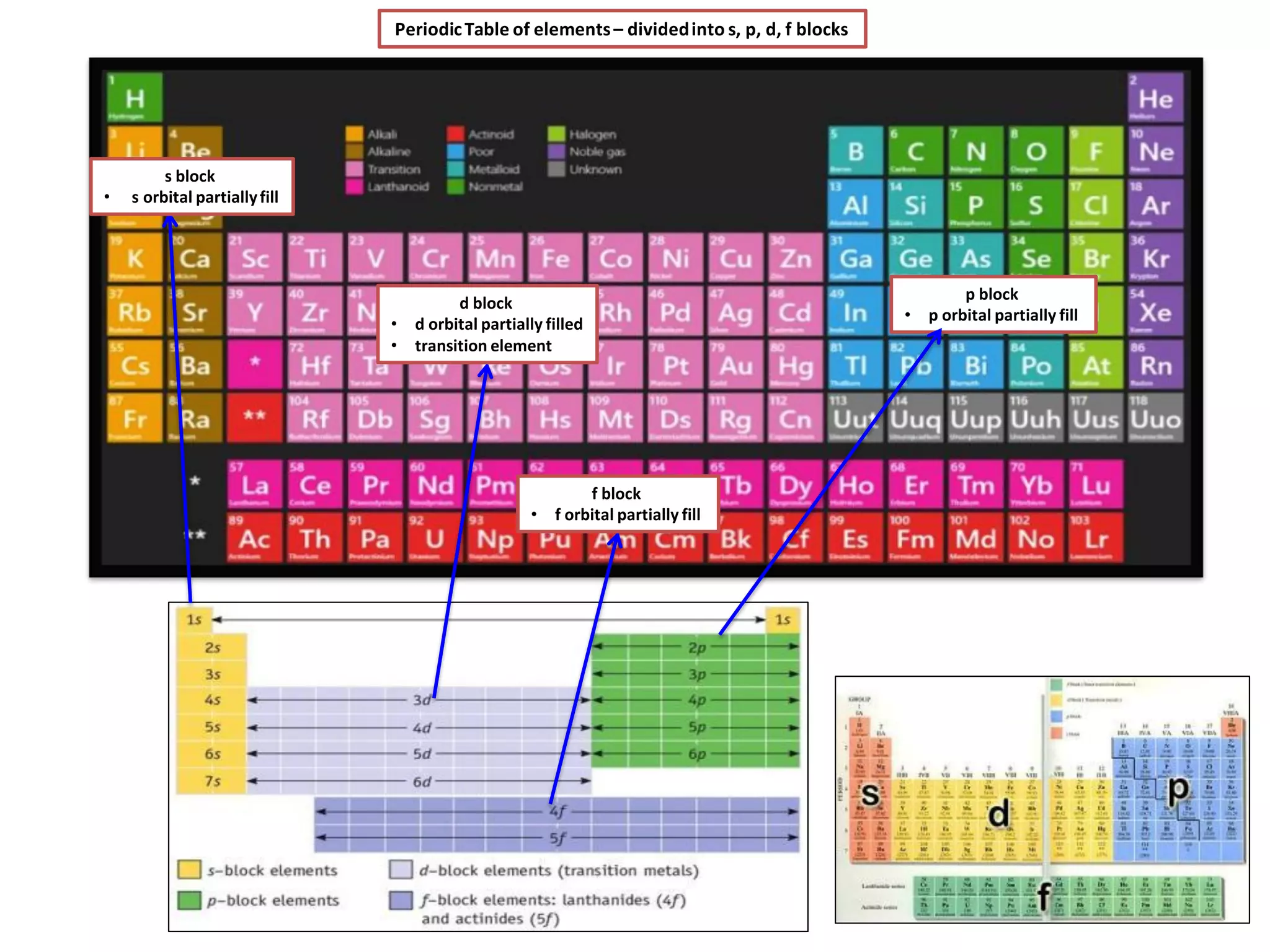
PeriodicTable of elements– dividedinto s, p, d, f blocks
p block
• p orbital partially fill
d block
• d orbital partially filled
• transition element
f block
• f orbital partially fill
s block
• s orbital partiallyfill
Periodic Table – s, p d, f block elements block elements
• s orbitals partially fill
p block elements
• p orbital partially fill
d block elements
• d orbitals partially fill
• transition elements
1 H 1s1
2 He 1s2
11 Na [Ne] 3s1
12 Mg [Ne] 3s2
5 B [He] 2s2 2p1
6 C [He] 2s2 2p2
7 N [He] 2s2 2p3
8 O [He] 2s2 2p4
9 F [He] 2s2 2p5
10 Ne [He] 2s2 2p6
13 Al [Ne] 3s2 3p1
14 Si [Ne] 3s2 3p2
15 P [Ne] 3s2 3p3
16 S [Ne] 3s2 3p4
17 CI [Ne] 3s2 3p5
18 Ar [Ne] 3s2 3p6
19 K [Ar] 4s1
20 Ca [Ar] 4s2
21 Sc [Ar] 4s2 3d1
22 Ti [Ar] 4s2 3d2
23 V [Ar] 4s2 3d3
24 Cr [Ar] 4s1 3d5
25 Mn [Ar] 4s2 3d5
26 Fe [Ar] 4s2 3d6
27 Co [Ar] 4s2 3d7
28 Ni [Ar] 4s2 3d8
29 Cu [Ar] 4s1 3d10
30 Zn [Ar] 4s2 3d10
n = 2 period 2
3 Li [He] 2s1
4 Be [He] 2s2
Click here video s,p,d,f blocks,Click here video on s,p,d,f notationClick here electron structure
Video on electron configuration
f block elements
• f orbitals partially fill
Periodic Table – s, p d, f blocks element
Electron structure
Chromium d block (Period 4)
1s2 2s2 2p6 3s2 3p6 4s1 3d5
[Ar] 4s1 3d5
Electron structure
Germanium p block, Gp 14 (Period 4)
1s2 2s2 2p6 3s2 3p6 4s2 3d10 4p2
[Ar] 4s2 3d10 4p2
Electron structure
Lead p block, Gp 14 (Period 6)
1s2 2s2 2p6 3s2 3p6 3d104s2 4p6 5s2 4d10 5p6 6s2 4f14 5d106p2
[Xe] 6s2 4f14 5d10 6p2
Electron structure
Iodine p block, Gp 7 (Period 5)
1s2 2s2 2p6 3s2 3p6 3d104s2 4p6 5s2 4d10 5p5
[Kr] 5s2 4d10 5p5
Electron structure
Cadmium d block (Period 5)
1s2 2s2 2p6 3s2 3p6 3d104s2 4p6 5s2 4d10
[Kr] 5s2 4d10
Electron structure
Mercury d block (Period 6)
1s2 2s2 2p6 3s2 3p6 3d104s2 4p6 5s2 4d10 5p6 6s2 4f14 5d10
[Xe] 6s2 4f14 5d10
Gp 14 -4 valence electron Gp 17 - 7 valence electron
Gp 14 - 4 valence electrond block – d partially filledd block – d partially filled
d block – d partially filled
О
О
О
О
О
О
3d
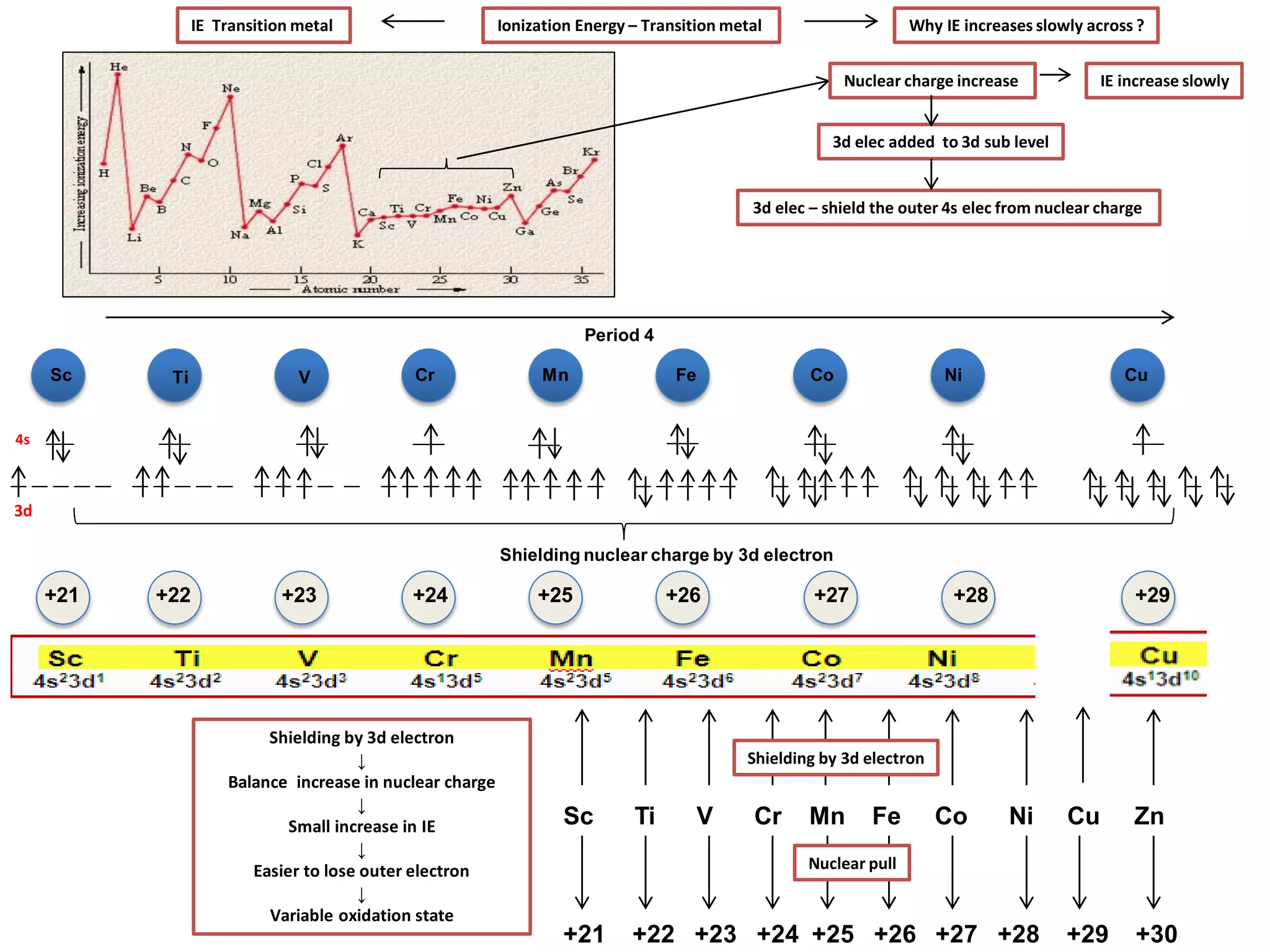
Nuclear charge increase IE increase slowly
3d elec added to 3d sub level
3d elec – shield the outer 4s elec from nuclear charge
Ionization Energy – Transition metal Why IE increases slowly across ?IE Transition metal
Sc Ti V Cr Mn Fe Co
Period 4
Ni Cu
Shielding nuclear charge by 3d electron
+21 +22 +23 +24 +25 +26 +27 +28 +29
4s
Sc Ti V Cr Mn Fe Co Ni Cu Zn
+21 +22 +23 +24 +25 +26 +27 +28 +29 +30
Nuclear pull
Shielding by 3d electron
↓
Balance increase in nuclear charge
↓
Small increase in IE
↓
Easier to lose outer electron
↓
Variable oxidation state
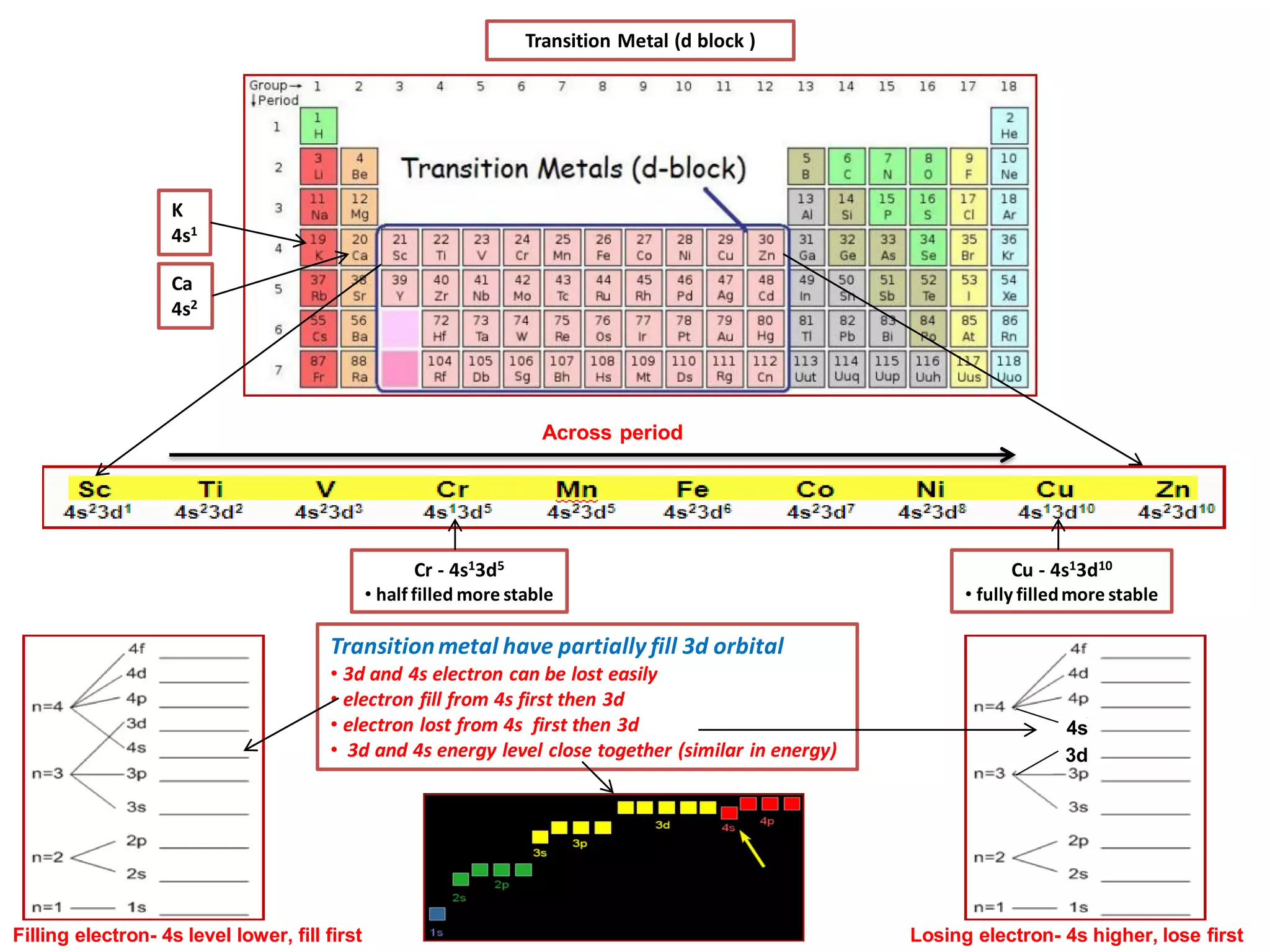
Transition Metal (d block )
Across period
Cr - 4s13d5
• half filled more stable
Cu - 4s13d10
• fully filledmore stable
Ca
4s2
K
4s1
Transitionmetal have partially fill 3d orbital
• 3d and 4s electron can be lost easily
• electron fill from 4s first then 3d
• electron lost from 4s first then 3d
• 3d and 4s energy level close together (similar in energy)
Filling electron- 4s level lower, fill first Losing electron- 4s higher, lose first
3d
4s
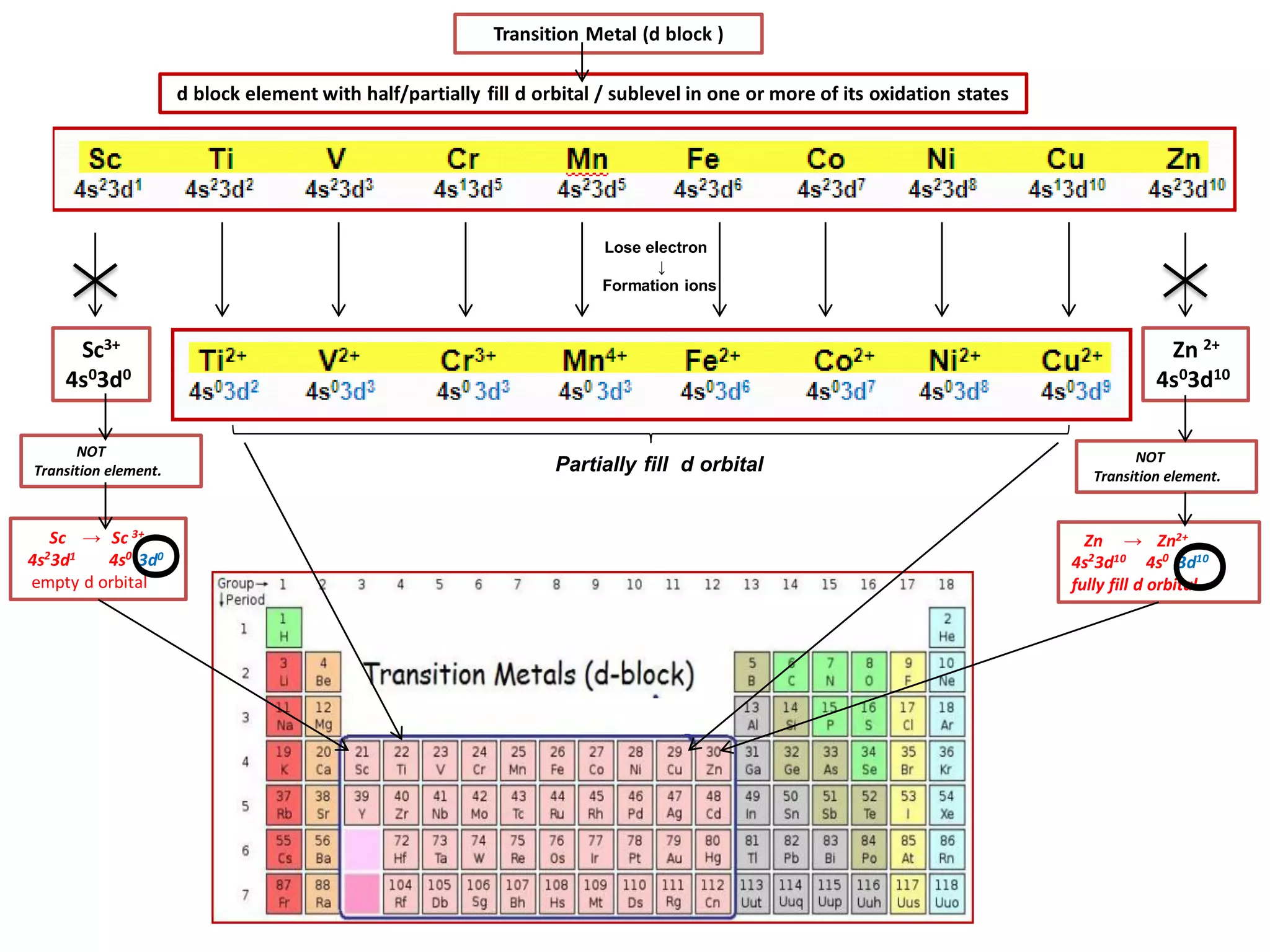
d block element with half/partially fill d orbital / sublevel in one or more of its oxidation states
Partially fill d orbital
Lose electron
↓
Formation ions
Sc3+
4s03d0
Zn 2+
4s03d10
Zn → Zn2+
4s2
3d10 4s0
3d10
fully fill d orbital
Sc → Sc 3+
4s2
3d1 4s0
3d0
empty d orbital
Transition Metal (d block )
NOT
Transition element.
NOT
Transition element.
О
О
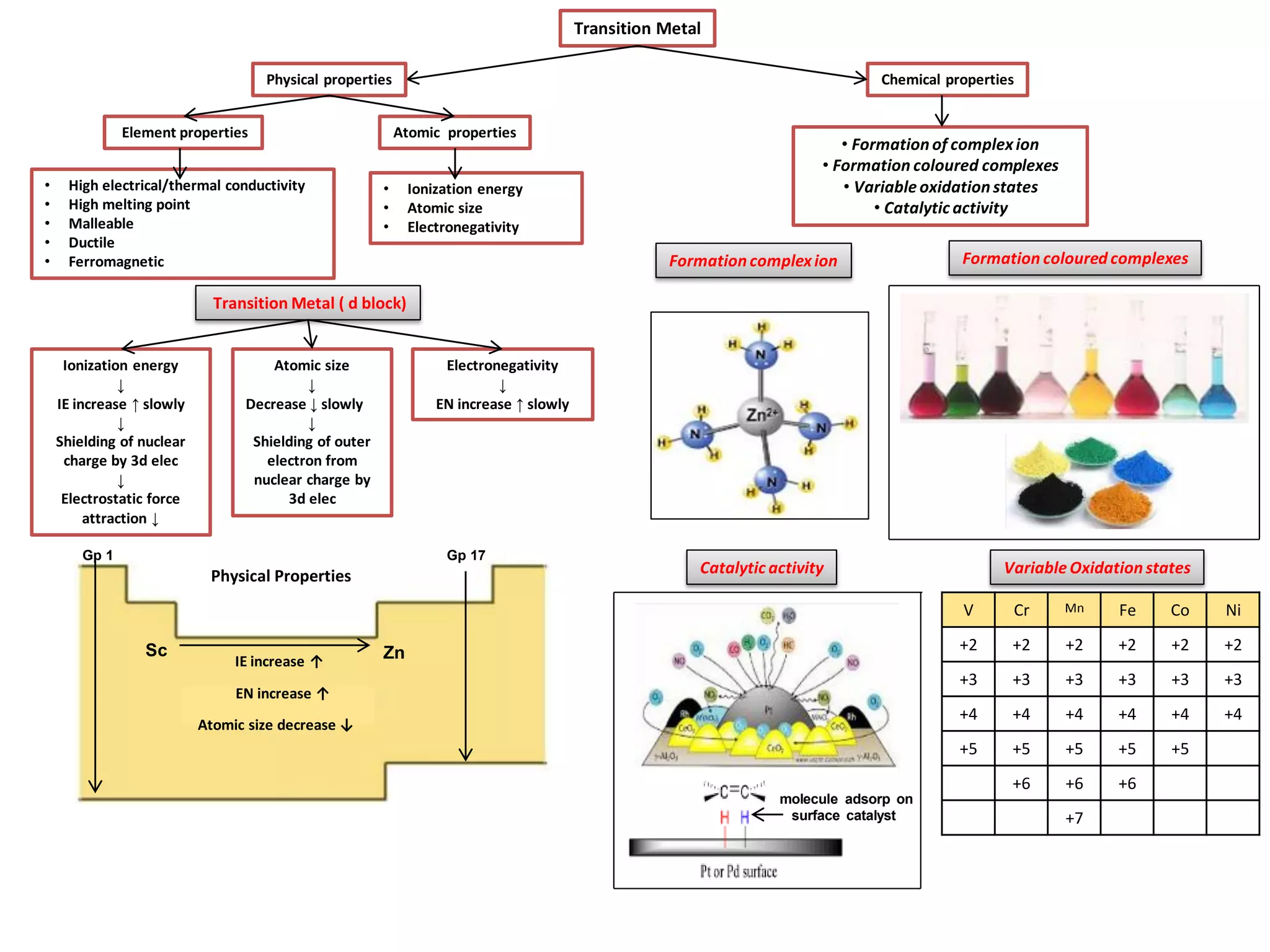
Transition Metal
Physical properties Chemical properties
Element properties Atomic properties
• High electrical/thermal conductivity
• High melting point
• Malleable
• Ductile
• Ferromagnetic
• Ionization energy
• Atomic size
• Electronegativity
Transition Metal ( d block)
Gp 1 Gp 17
Sc
Ionization energy
↓
IE increase ↑ slowly
↓
Shielding of nuclear
charge by 3d elec
↓
Electrostatic force
attraction ↓
Atomic size
↓
Decrease ↓ slowly
↓
Shielding of outer
electron from
nuclear charge by
3d elec
Electronegativity
↓
EN increase ↑ slowly
Physical Properties
Zn
EN increase ↑
Atomic size decrease ↓
IE increase ↑
• Formation of complexion
• Formation coloured complexes
• Variable oxidation states
• Catalytic activity
Formation complexion Formation coloured complexes
Catalytic activity Variable Oxidation states
molecule adsorp on
surface catalyst
V Cr Mn Fe Co Ni
+2 +2 +2 +2 +2 +2
+3 +3 +3 +3 +3 +3
+4 +4 +4 +4 +4 +4
+5 +5 +5 +5 +5
+6 +6 +6
+7
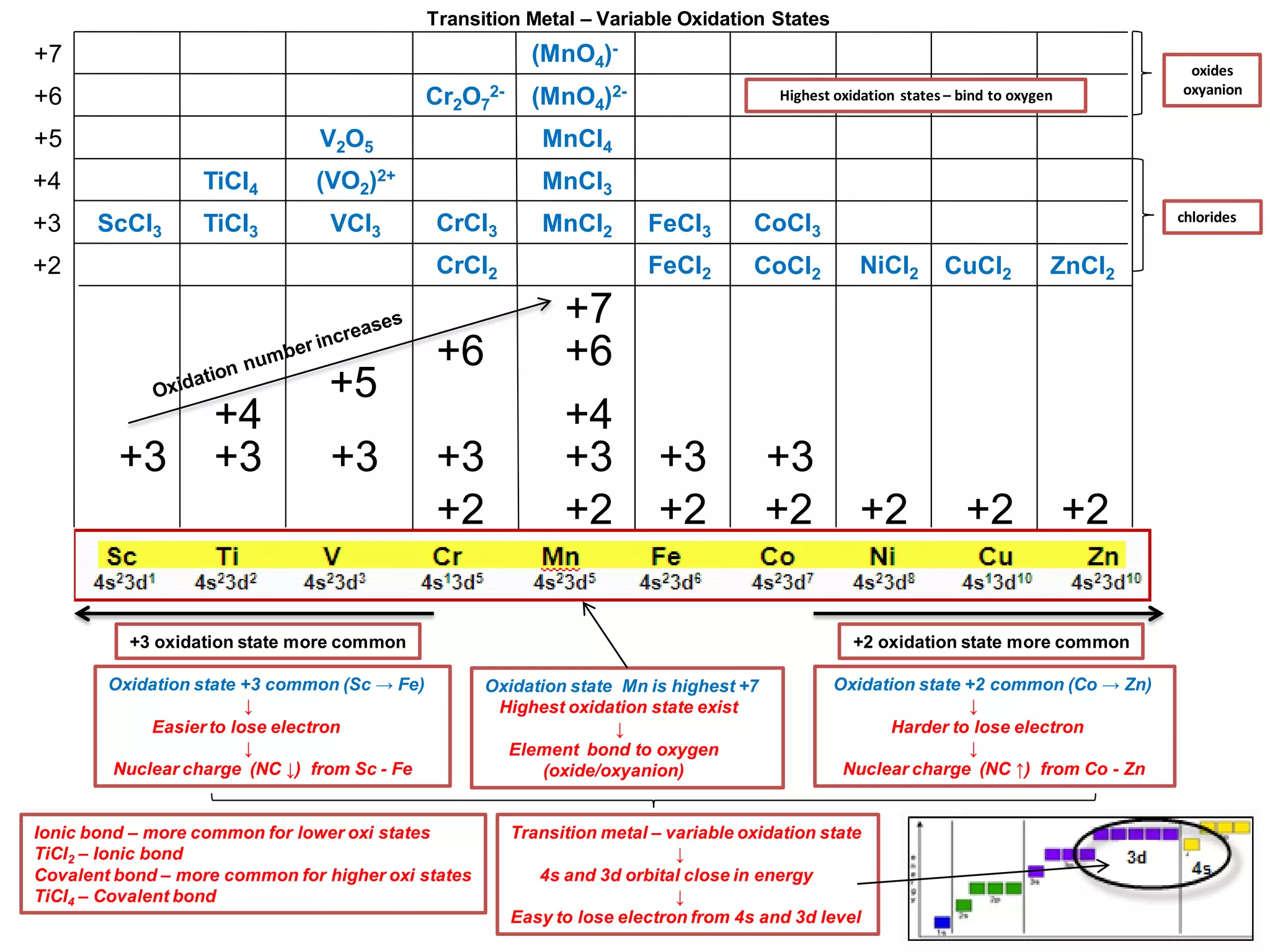
Transition Metal – Variable Oxidation States
+3 +3 +3+3+3 +3
+2 +2 +2 +2 +2
+4 +4
+5
+2
+6 +6
+7
+2
+3
+4
+5
+6
+7
ScCI3 TiCI3 VCI3 CrCI3
MnCI3
FeCI3
CrCI2
MnCI2
FeCI2 CoCI2 NiCI2 CuCI2 ZnCI2
TiCI4
MnCI4V2O5
Cr2O7
2-
+2
(VO2)2+
(MnO4)2-
(MnO4)-
oxides
oxyanion
chlorides
+2 oxidation state more common+3 oxidation state more common
+3
CoCI3
Oxidation state Mn is highest +7
Highest oxidation state exist
↓
Element bond to oxygen
(oxide/oxyanion)
Oxidation state +2 common (Co → Zn)
↓
Harder to lose electron
↓
Nuclear charge (NC ↑) from Co - Zn
Oxidation state +3 common (Sc → Fe)
↓
Easierto lose electron
↓
Nuclear charge (NC ↓) from Sc - Fe
Transition metal – variable oxidation state
↓
4s and 3d orbital close in energy
↓
Easy to lose electron from 4s and 3d level
Ionic bond – more common for lower oxi states
TiCI2 – Ionic bond
Covalent bond – more common for higher oxi states
TiCI4 – Covalent bond
Highest oxidation states – bind to oxygen
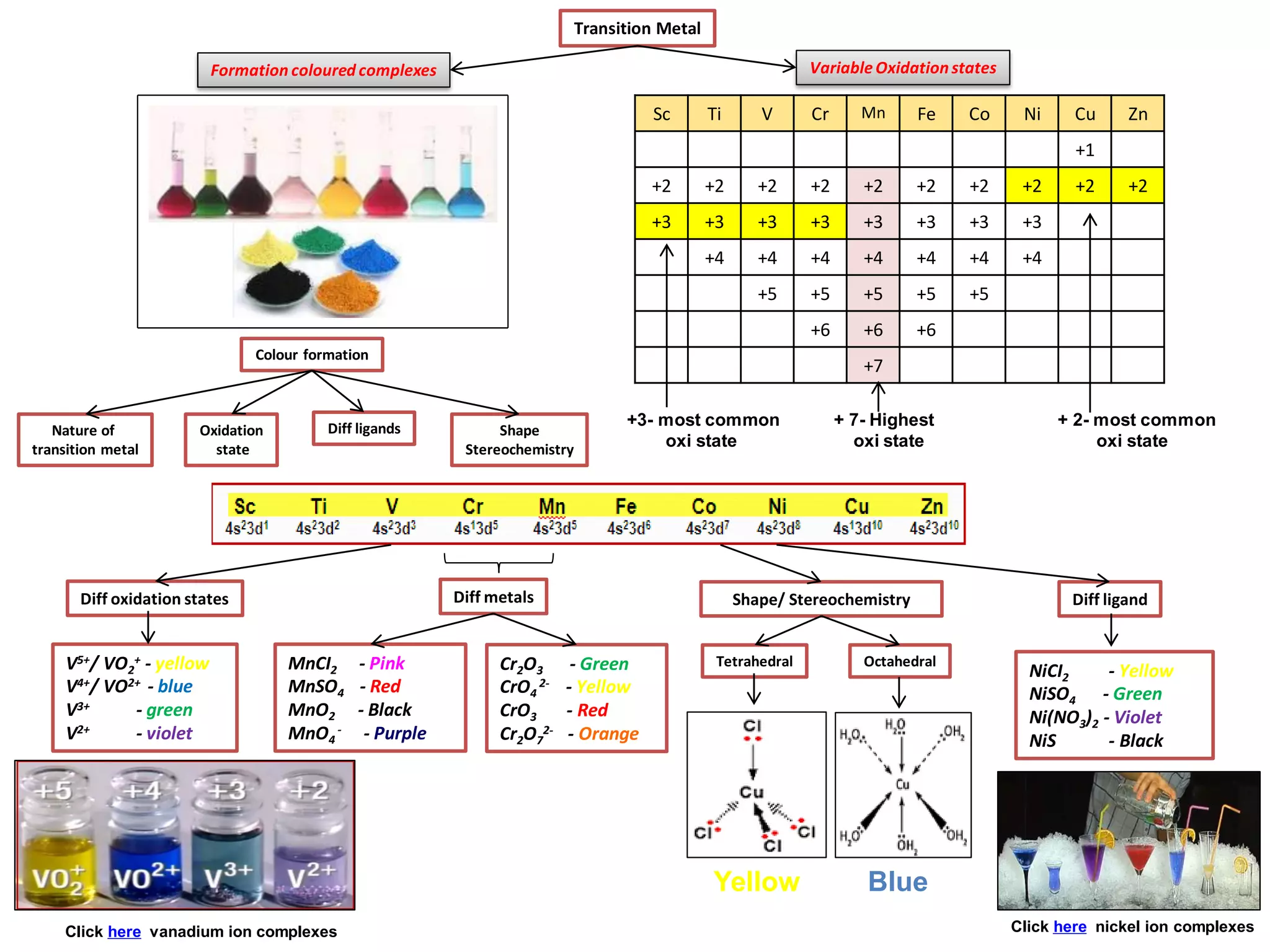
Transition Metal
Formation coloured complexes Variable Oxidation states
Sc Ti V Cr Mn Fe Co Ni Cu Zn
+1
+2 +2 +2 +2 +2 +2 +2 +2 +2 +2
+3 +3 +3 +3 +3 +3 +3 +3
+4 +4 +4 +4 +4 +4 +4
+5 +5 +5 +5 +5
+6 +6 +6
+7
+3- most common
oxi state
+ 2- most common
oxi state
+ 7- Highest
oxi state
Click here vanadium ion complexes Click here nickel ion complexes
V5+/ VO2
+ - yellow
V4+/ VO2+ - blue
V3+ - green
V2+ - violet
NiCI2 - Yellow
NiSO4 - Green
Ni(NO3)2 - Violet
NiS - Black
Diff oxidation states
Colour formation
Nature of
transition metal
Oxidation
state
Diff ligands Shape
Stereochemistry
Diff ligandDiff metals
MnCI2 - Pink
MnSO4 - Red
MnO2 - Black
MnO4
- - Purple
Cr2O3 - Green
CrO4
2- - Yellow
CrO3 - Red
Cr2O7
2- - Orange
Shape/ Stereochemistry
Tetrahedral Octahedral
BlueYellow
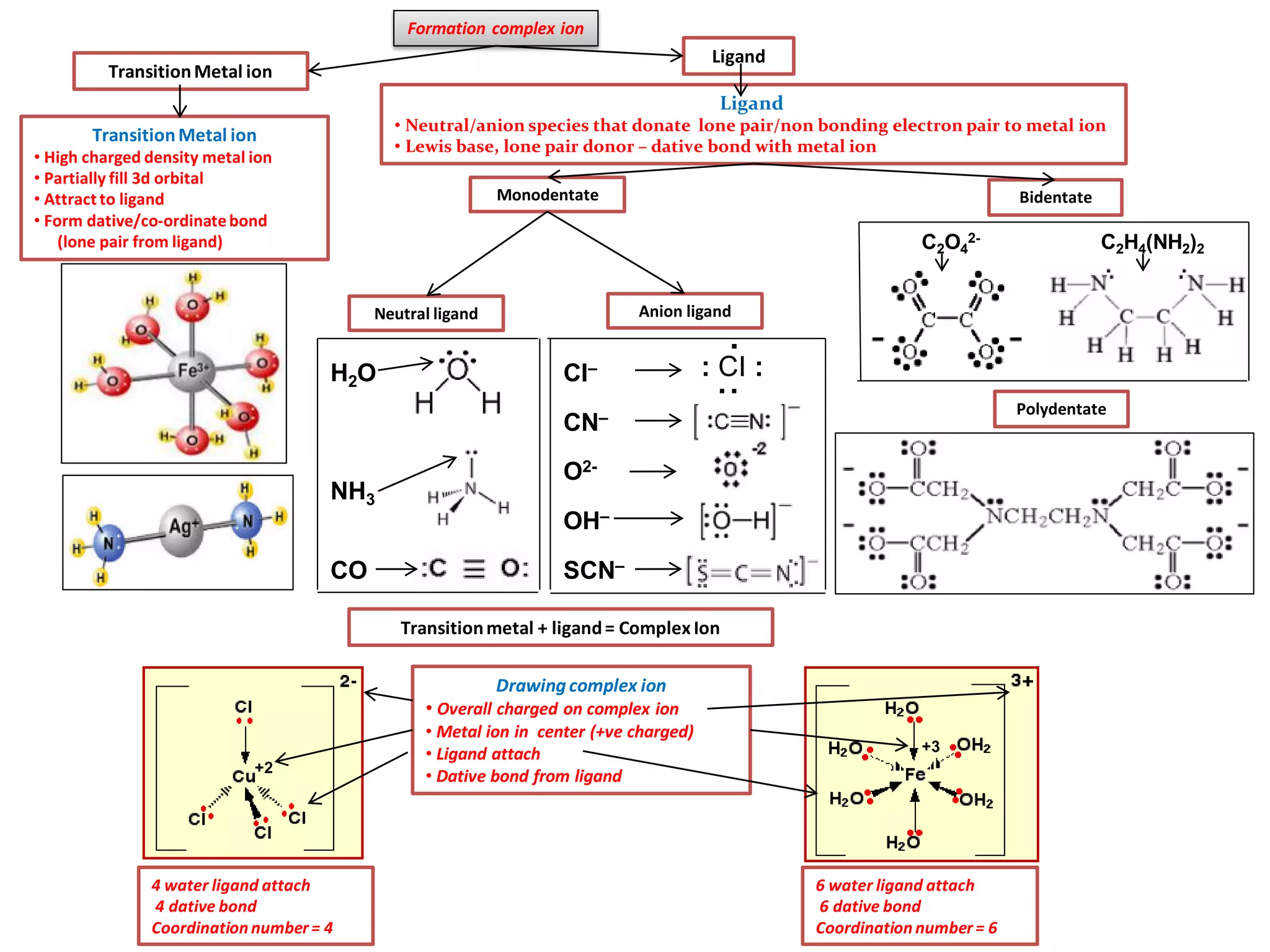
TransitionMetal ion
• High charged density metal ion
• Partially fill 3d orbital
• Attract to ligand
• Form dative/co-ordinatebond
(lone pair from ligand)
Ligand
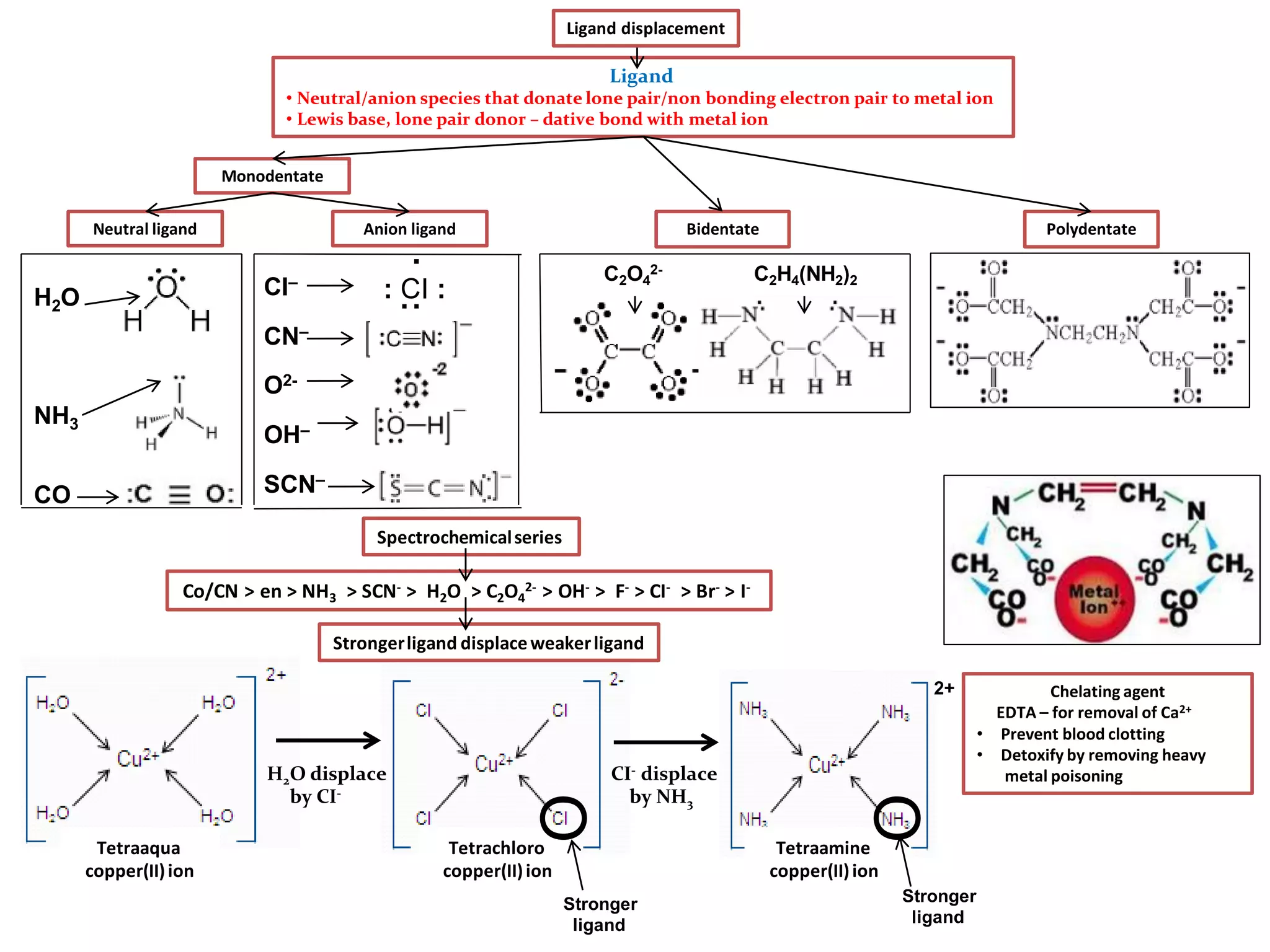
• Neutral/anion species that donate lone pair/non bonding electron pair to metal ion
• Lewis base, lone pair donor – dative bond with metal ion
Ligand
+2
Formation complex ion
TransitionMetal ion
Neutral ligand Anion ligand
H2O
NH3
CO
CI–
CN–
O2-
OH–
SCN–
: CI :
:.
Monodentate Bidentate
Polydentate
C2O4
2- C2H4(NH2)2
Drawingcomplex ion
• Overall charged on complex ion
• Metal ion in center (+ve charged)
• Ligand attach
• Dative bond from ligand
+3
4 water ligand attach
4 dative bond
Coordination number= 4
6 water ligand attach
6 dative bond
Coordination number= 6
Transitionmetal + ligand= Complex Ion
Coordination
number
Shape Complex ion
(metal + ligand)
Ligand
(charged)
Metal ion
(Oxidation #)
Overall charge
on complex ion
linear [Cu(CI2)]- CI = -1 +1 - 1
[Ag(NH3)2]+ NH3 = 0 +1 + 1
[Ag(CN)2]- CN = -1 +1 - 1
Square
planar
[Cu(CI)4]2- CI = -1 +2 - 2
[Cu(NH3)4]2+ NH3 = 0 +2 +2
[Co(CI)4]2- CI = -1 +2 - 2
Tetrahedral [Cu(CI)4]2- CI = -1 +2 - 2
[Zn(NH3)4]2+ NH3 = 0 +2 + 2
[Mn(CI)4]2- CI = -1 +2 - 2
Octahedral [ Cu(H2O)6]2+ H2O = 0 +2 + 2
[Fe(OH)3(H2O)3] OH = -1
H2O = 0
+3 o
[Fe(CN)6]3- CN = -1 +3 - 3
[Cr(NH3)4CI2]+ NH3 = 0
CI = -1
+3 + 1
Types of ligand:
• Monodentate– 1 lone pair electrondonor– H2O, F-, CI-, NH3, OH-, SCN- CN-
• Bidentate – 2 lonepair electrondonor–1,2 diaminoethaneH2NCH2CH2NH2, ethanedioate(C2O4)2-
•Polydentate – 6 lone pair electrondonor– EDTA4- (ethylenediaminetetraaceticacid)
Complex ion with diff metal ion, ligand,oxidationstate and overallcharge
Mn+L: :L
Mn+
:L
:L
L:
L:
Mn+
:L
:L
:L
:L
Mn+
:L
:L
:L
:L
:L
:L
Coordination number
– number of ligand
around central ion
2
4
4
6
Ligand
• Neutral/anion species that donate lone pair/non bonding electron pair to metal ion
• Lewis base, lone pair donor – dative bond with metal ion
Neutral ligand Anion ligand
H2O
NH3
CO
CI–
CN–
O2-
OH–
SCN–
: CI :
:.
Monodentate
Bidentate Polydentate
C2O4
2- C2H4(NH2)2
Ligand displacement
Co/CN > en > NH3 > SCN- > H2O > C2O4
2- > OH- > F- > CI- > Br- > I-
Spectrochemicalseries
Tetraaqua
copper(II)ion
H2O displace
by CI-
2+
CI- displace
by NH3
Tetrachloro
copper(II)ion
Strongerligand displaceweakerligand
Tetraamine
copper(II)ion
О
О
Stronger
ligand
Stronger
ligand
Chelating agent
EDTA – for removal of Ca2+
• Prevent blood clotting
• Detoxify by removing heavy
metal poisoning
4s
3d
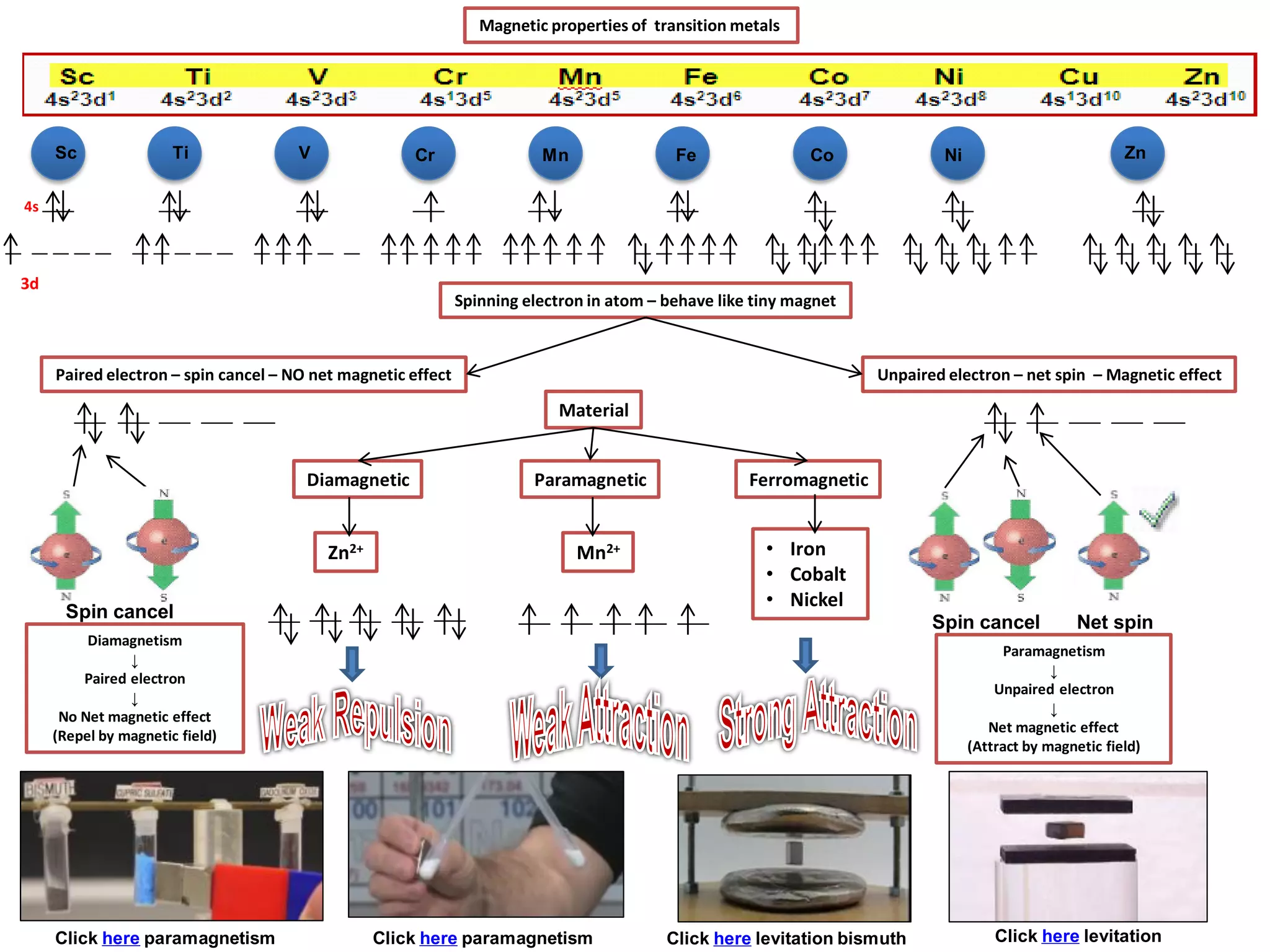
Magnetic properties of transition metals
Paired electron – spin cancel – NO net magnetic effect
Ti V Cr Mn Fe Co
Diamagnetism
↓
Paired electron
↓
No Net magnetic effect
(Repel by magnetic field)
Ni Zn
Spin cancel
Sc
Spinning electron in atom – behave like tiny magnet
Unpaired electron – net spin – Magnetic effect
Spin cancel Net spin
Paramagnetism
↓
Unpaired electron
↓
Net magnetic effect
(Attract by magnetic field)
Material
Diamagnetic Paramagnetic Ferromagnetic
• Iron
• Cobalt
• Nickel
Zn2+ Mn2+
Click here paramagnetism Click here paramagnetism Click here levitation bismuth Click here levitation
4s
3d
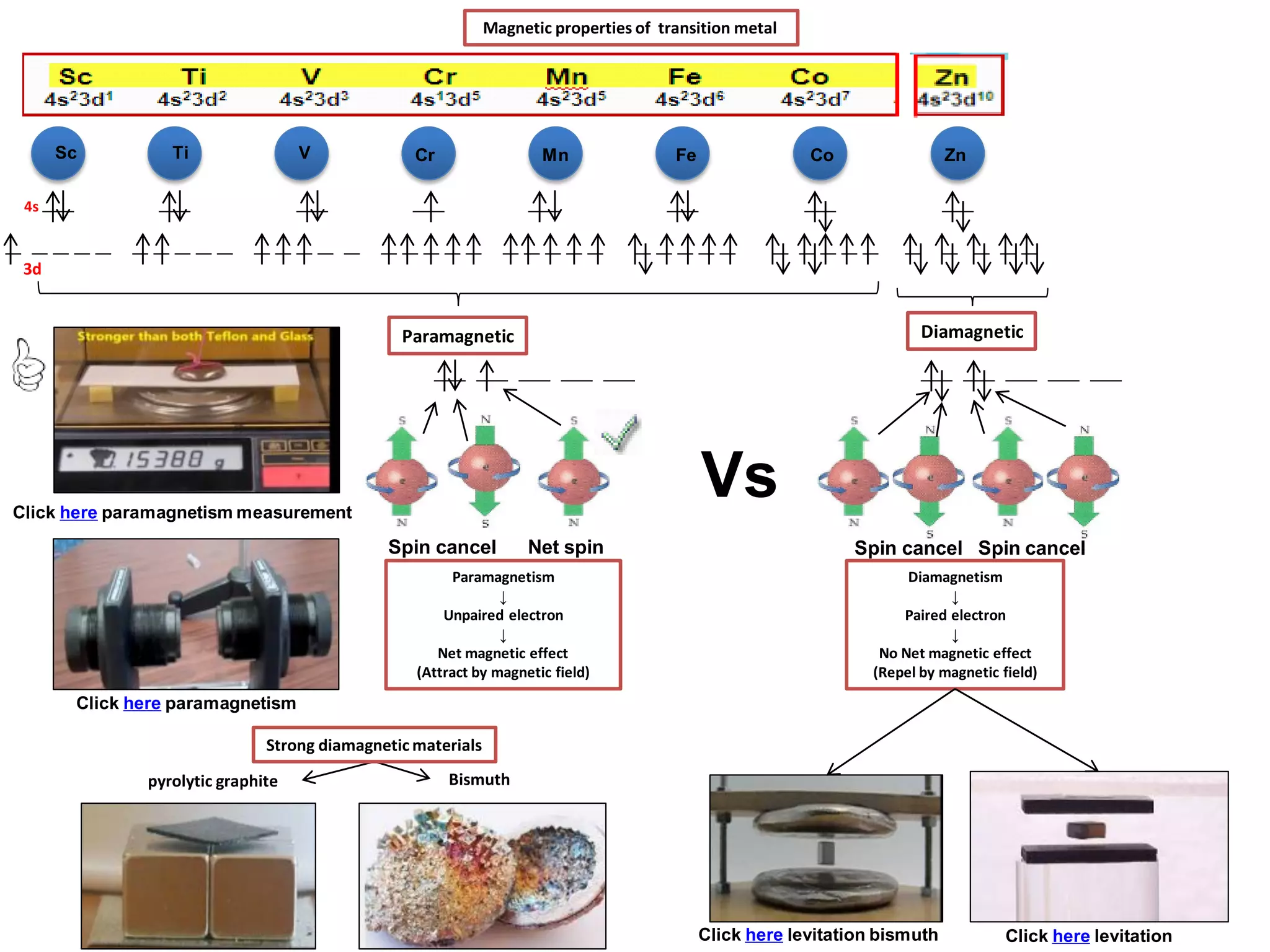
Magnetic properties of transition metal
Ti V Cr Mn Fe Co
Diamagnetism
↓
Paired electron
↓
No Net magnetic effect
(Repel by magnetic field)
Zn
Spin cancel Net spin
Sc
pyrolytic graphite
Spin cancel Spin cancel
Paramagnetism
↓
Unpaired electron
↓
Net magnetic effect
(Attract by magnetic field)
DiamagneticParamagnetic
Click here levitation bismuth Click here levitation
Click here paramagnetism measurement
Vs
Bismuth
Click here paramagnetism
Strong diamagnetic materials
Pt/Pd surface
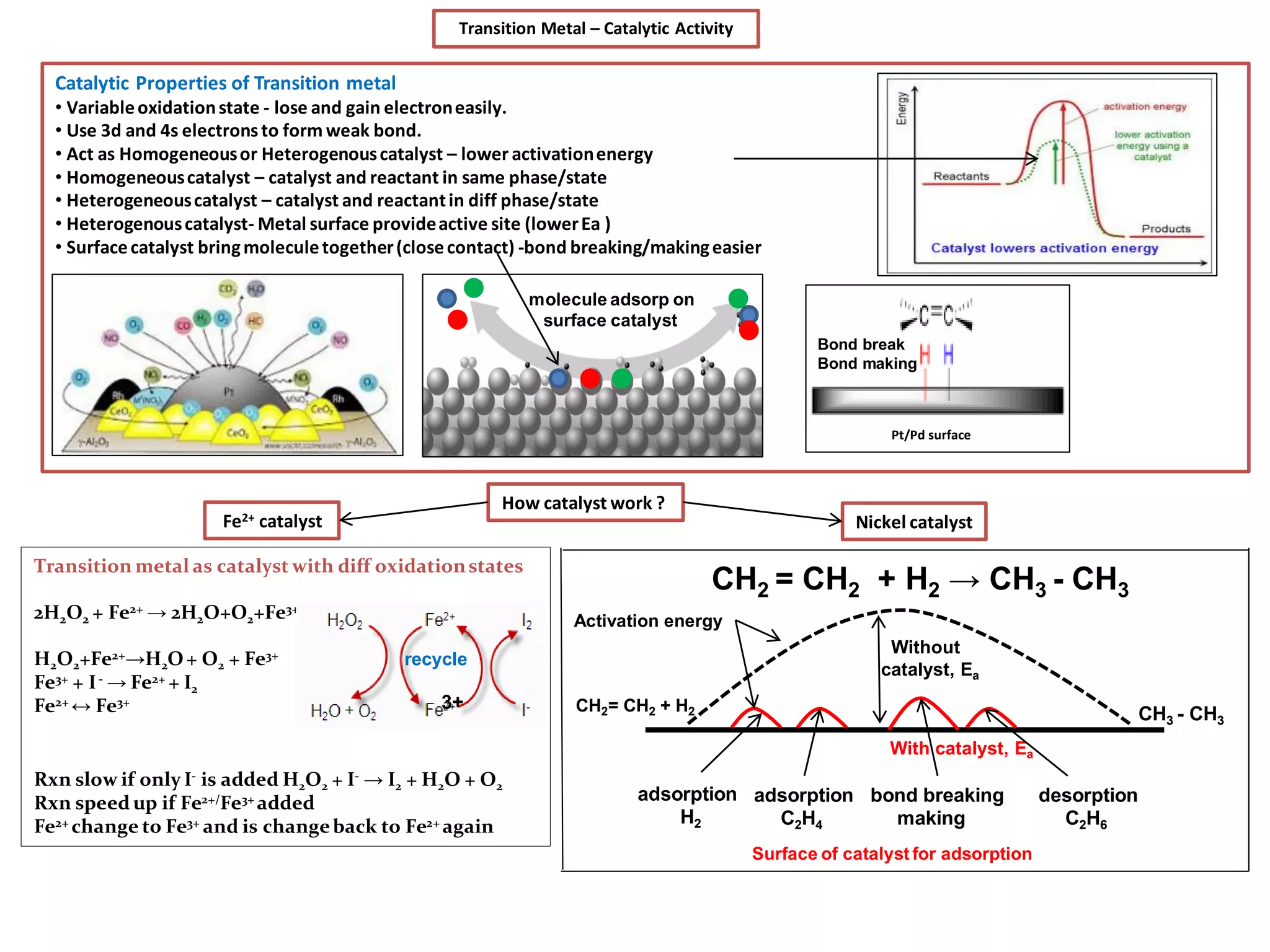
Transition Metal – Catalytic Activity
Catalytic Properties of Transition metal
• Variableoxidationstate - lose and gain electroneasily.
• Use 3d and 4s electronsto form weak bond.
• Act as Homogeneousor Heterogenouscatalyst – lower activationenergy
• Homogeneouscatalyst – catalyst and reactant in same phase/state
• Heterogeneouscatalyst – catalyst and reactantin diff phase/state
• Heterogenouscatalyst- Metal surface provideactive site (lowerEa )
• Surfacecatalyst bringmoleculetogether(closecontact) -bond breaking/makingeasier
Transition metal as catalyst with diff oxidationstates
2H2O2 + Fe2+ → 2H2O+O2+Fe3+
H2O2+Fe2+→H2O+ O2 + Fe3+
Fe3+ + I- → Fe2+ + I2
Fe2+ ↔ Fe3+
Rxn slow if only I- is added H2O2 + I- → I2 + H2O + O2
Rxn speed up if Fe2+/Fe3+ added
Fe2+ change to Fe3+ and is changeback to Fe2+ again
recycle
molecule adsorp on
surface catalyst
Pt/Pd surface
Bond break
Bond making
3+
CH2 = CH2 + H2 → CH3 - CH3
Nickel catalyst
Without
catalyst, Ea
CH2= CH2 + H2 CH3 - CH3
Surface of catalyst for adsorption
With catalyst, Ea
adsorption
H2
adsorption
C2H4
bond breaking
making
desorption
C2H6
Fe2+ catalyst
How catalyst work ?
Activation energy
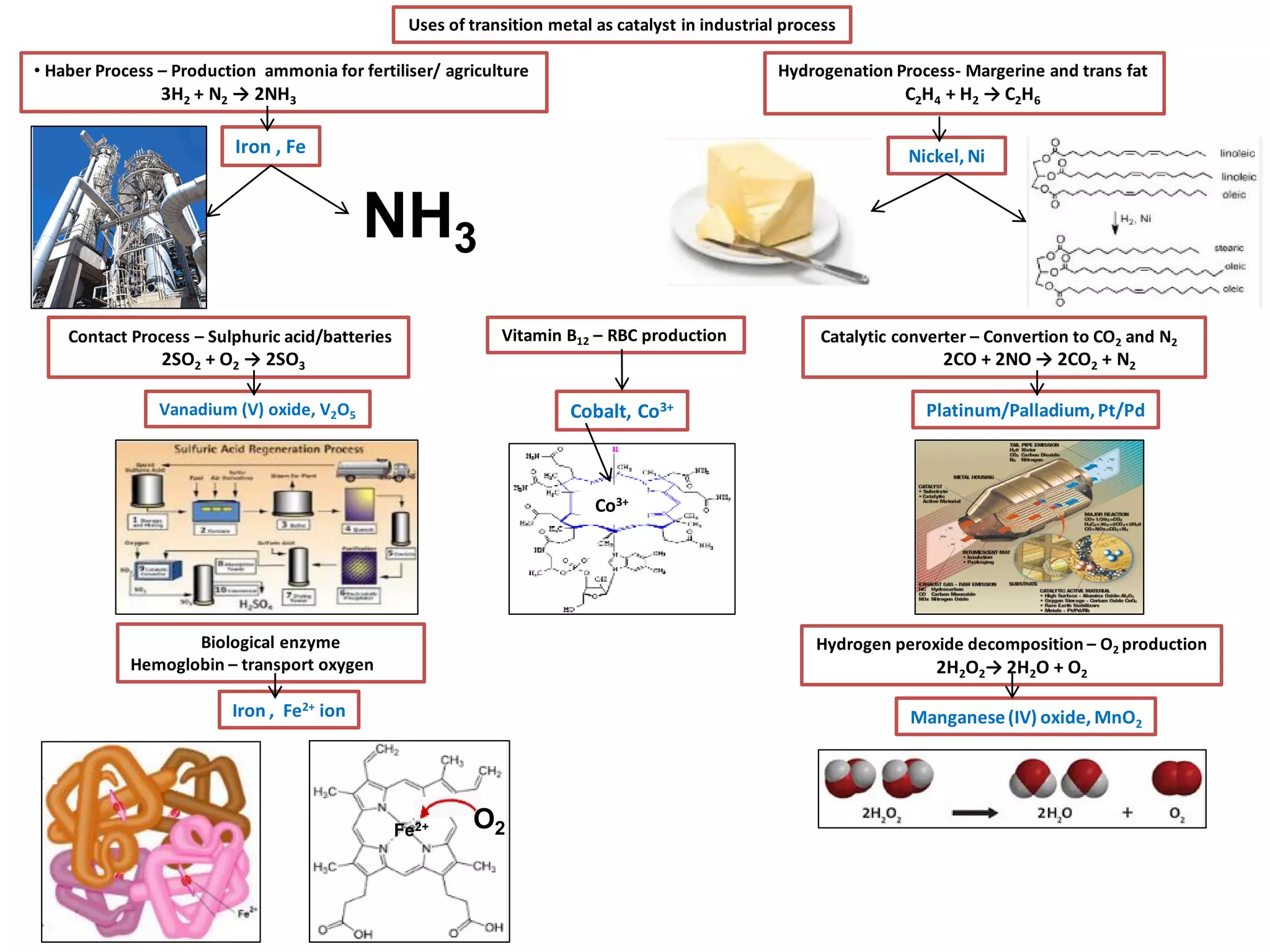
• Haber Process – Production ammonia for fertiliser/ agriculture
3H2 + N2 → 2NH3
Uses of transition metal as catalyst in industrial process
Iron , Fe
Vanadium (V) oxide, V2O5
Nickel, Ni
Manganese(IV) oxide, MnO2
Platinum/Palladium,Pt/PdCobalt, Co3+
Iron , Fe2+ ion
Contact Process – Sulphuric acid/batteries
2SO2 + O2 → 2SO3
Hydrogenation Process- Margerine and trans fat
C2H4 + H2 → C2H6
Hydrogen peroxide decomposition – O2 production
2H2O2→ 2H2O + O2
Catalytic converter – Convertion to CO2 and N2
2CO + 2NO → 2CO2 + N2
Biological enzyme
Hemoglobin – transport oxygen
Vitamin B12 – RBC production
NH3
Co3+
O2Fe2+

IB Chemistry on Properties of Transition Metal and Magnetism

  • 1.
    PeriodicTable of elements–dividedinto s, p, d, f blocks p block • p orbital partially fill d block • d orbital partially filled • transition element f block • f orbital partially fill s block • s orbital partiallyfill
  • 2.
    Periodic Table –s, p d, f block elements block elements • s orbitals partially fill p block elements • p orbital partially fill d block elements • d orbitals partially fill • transition elements 1 H 1s1 2 He 1s2 11 Na [Ne] 3s1 12 Mg [Ne] 3s2 5 B [He] 2s2 2p1 6 C [He] 2s2 2p2 7 N [He] 2s2 2p3 8 O [He] 2s2 2p4 9 F [He] 2s2 2p5 10 Ne [He] 2s2 2p6 13 Al [Ne] 3s2 3p1 14 Si [Ne] 3s2 3p2 15 P [Ne] 3s2 3p3 16 S [Ne] 3s2 3p4 17 CI [Ne] 3s2 3p5 18 Ar [Ne] 3s2 3p6 19 K [Ar] 4s1 20 Ca [Ar] 4s2 21 Sc [Ar] 4s2 3d1 22 Ti [Ar] 4s2 3d2 23 V [Ar] 4s2 3d3 24 Cr [Ar] 4s1 3d5 25 Mn [Ar] 4s2 3d5 26 Fe [Ar] 4s2 3d6 27 Co [Ar] 4s2 3d7 28 Ni [Ar] 4s2 3d8 29 Cu [Ar] 4s1 3d10 30 Zn [Ar] 4s2 3d10 n = 2 period 2 3 Li [He] 2s1 4 Be [He] 2s2 Click here video s,p,d,f blocks,Click here video on s,p,d,f notationClick here electron structure Video on electron configuration f block elements • f orbitals partially fill
  • 3.
    Periodic Table –s, p d, f blocks element Electron structure Chromium d block (Period 4) 1s2 2s2 2p6 3s2 3p6 4s1 3d5 [Ar] 4s1 3d5 Electron structure Germanium p block, Gp 14 (Period 4) 1s2 2s2 2p6 3s2 3p6 4s2 3d10 4p2 [Ar] 4s2 3d10 4p2 Electron structure Lead p block, Gp 14 (Period 6) 1s2 2s2 2p6 3s2 3p6 3d104s2 4p6 5s2 4d10 5p6 6s2 4f14 5d106p2 [Xe] 6s2 4f14 5d10 6p2 Electron structure Iodine p block, Gp 7 (Period 5) 1s2 2s2 2p6 3s2 3p6 3d104s2 4p6 5s2 4d10 5p5 [Kr] 5s2 4d10 5p5 Electron structure Cadmium d block (Period 5) 1s2 2s2 2p6 3s2 3p6 3d104s2 4p6 5s2 4d10 [Kr] 5s2 4d10 Electron structure Mercury d block (Period 6) 1s2 2s2 2p6 3s2 3p6 3d104s2 4p6 5s2 4d10 5p6 6s2 4f14 5d10 [Xe] 6s2 4f14 5d10 Gp 14 -4 valence electron Gp 17 - 7 valence electron Gp 14 - 4 valence electrond block – d partially filledd block – d partially filled d block – d partially filled О О О О О О
  • 4.
    3d Nuclear charge increaseIE increase slowly 3d elec added to 3d sub level 3d elec – shield the outer 4s elec from nuclear charge Ionization Energy – Transition metal Why IE increases slowly across ?IE Transition metal Sc Ti V Cr Mn Fe Co Period 4 Ni Cu Shielding nuclear charge by 3d electron +21 +22 +23 +24 +25 +26 +27 +28 +29 4s Sc Ti V Cr Mn Fe Co Ni Cu Zn +21 +22 +23 +24 +25 +26 +27 +28 +29 +30 Nuclear pull Shielding by 3d electron Shielding by 3d electron ↓ Balance increase in nuclear charge ↓ Small increase in IE ↓ Easier to lose outer electron ↓ Variable oxidation state
  • 5.
    Transition Metal (dblock ) Across period Cr - 4s13d5 • half filled more stable Cu - 4s13d10 • fully filledmore stable Ca 4s2 K 4s1 Transitionmetal have partially fill 3d orbital • 3d and 4s electron can be lost easily • electron fill from 4s first then 3d • electron lost from 4s first then 3d • 3d and 4s energy level close together (similar in energy) Filling electron- 4s level lower, fill first Losing electron- 4s higher, lose first 3d 4s
  • 6.
    d block elementwith half/partially fill d orbital / sublevel in one or more of its oxidation states Partially fill d orbital Lose electron ↓ Formation ions Sc3+ 4s03d0 Zn 2+ 4s03d10 Zn → Zn2+ 4s2 3d10 4s0 3d10 fully fill d orbital Sc → Sc 3+ 4s2 3d1 4s0 3d0 empty d orbital Transition Metal (d block ) NOT Transition element. NOT Transition element. О О
  • 7.
    Transition Metal Physical propertiesChemical properties Element properties Atomic properties • High electrical/thermal conductivity • High melting point • Malleable • Ductile • Ferromagnetic • Ionization energy • Atomic size • Electronegativity Transition Metal ( d block) Gp 1 Gp 17 Sc Ionization energy ↓ IE increase ↑ slowly ↓ Shielding of nuclear charge by 3d elec ↓ Electrostatic force attraction ↓ Atomic size ↓ Decrease ↓ slowly ↓ Shielding of outer electron from nuclear charge by 3d elec Electronegativity ↓ EN increase ↑ slowly Physical Properties Zn EN increase ↑ Atomic size decrease ↓ IE increase ↑ • Formation of complexion • Formation coloured complexes • Variable oxidation states • Catalytic activity Formation complexion Formation coloured complexes Catalytic activity Variable Oxidation states molecule adsorp on surface catalyst V Cr Mn Fe Co Ni +2 +2 +2 +2 +2 +2 +3 +3 +3 +3 +3 +3 +4 +4 +4 +4 +4 +4 +5 +5 +5 +5 +5 +6 +6 +6 +7
  • 8.
    Transition Metal –Variable Oxidation States +3 +3 +3+3+3 +3 +2 +2 +2 +2 +2 +4 +4 +5 +2 +6 +6 +7 +2 +3 +4 +5 +6 +7 ScCI3 TiCI3 VCI3 CrCI3 MnCI3 FeCI3 CrCI2 MnCI2 FeCI2 CoCI2 NiCI2 CuCI2 ZnCI2 TiCI4 MnCI4V2O5 Cr2O7 2- +2 (VO2)2+ (MnO4)2- (MnO4)- oxides oxyanion chlorides +2 oxidation state more common+3 oxidation state more common +3 CoCI3 Oxidation state Mn is highest +7 Highest oxidation state exist ↓ Element bond to oxygen (oxide/oxyanion) Oxidation state +2 common (Co → Zn) ↓ Harder to lose electron ↓ Nuclear charge (NC ↑) from Co - Zn Oxidation state +3 common (Sc → Fe) ↓ Easierto lose electron ↓ Nuclear charge (NC ↓) from Sc - Fe Transition metal – variable oxidation state ↓ 4s and 3d orbital close in energy ↓ Easy to lose electron from 4s and 3d level Ionic bond – more common for lower oxi states TiCI2 – Ionic bond Covalent bond – more common for higher oxi states TiCI4 – Covalent bond Highest oxidation states – bind to oxygen
  • 9.
    Transition Metal Formation colouredcomplexes Variable Oxidation states Sc Ti V Cr Mn Fe Co Ni Cu Zn +1 +2 +2 +2 +2 +2 +2 +2 +2 +2 +2 +3 +3 +3 +3 +3 +3 +3 +3 +4 +4 +4 +4 +4 +4 +4 +5 +5 +5 +5 +5 +6 +6 +6 +7 +3- most common oxi state + 2- most common oxi state + 7- Highest oxi state Click here vanadium ion complexes Click here nickel ion complexes V5+/ VO2 + - yellow V4+/ VO2+ - blue V3+ - green V2+ - violet NiCI2 - Yellow NiSO4 - Green Ni(NO3)2 - Violet NiS - Black Diff oxidation states Colour formation Nature of transition metal Oxidation state Diff ligands Shape Stereochemistry Diff ligandDiff metals MnCI2 - Pink MnSO4 - Red MnO2 - Black MnO4 - - Purple Cr2O3 - Green CrO4 2- - Yellow CrO3 - Red Cr2O7 2- - Orange Shape/ Stereochemistry Tetrahedral Octahedral BlueYellow
  • 10.
    TransitionMetal ion • Highcharged density metal ion • Partially fill 3d orbital • Attract to ligand • Form dative/co-ordinatebond (lone pair from ligand) Ligand • Neutral/anion species that donate lone pair/non bonding electron pair to metal ion • Lewis base, lone pair donor – dative bond with metal ion Ligand +2 Formation complex ion TransitionMetal ion Neutral ligand Anion ligand H2O NH3 CO CI– CN– O2- OH– SCN– : CI : :. Monodentate Bidentate Polydentate C2O4 2- C2H4(NH2)2 Drawingcomplex ion • Overall charged on complex ion • Metal ion in center (+ve charged) • Ligand attach • Dative bond from ligand +3 4 water ligand attach 4 dative bond Coordination number= 4 6 water ligand attach 6 dative bond Coordination number= 6 Transitionmetal + ligand= Complex Ion
  • 11.
    Coordination number Shape Complex ion (metal+ ligand) Ligand (charged) Metal ion (Oxidation #) Overall charge on complex ion linear [Cu(CI2)]- CI = -1 +1 - 1 [Ag(NH3)2]+ NH3 = 0 +1 + 1 [Ag(CN)2]- CN = -1 +1 - 1 Square planar [Cu(CI)4]2- CI = -1 +2 - 2 [Cu(NH3)4]2+ NH3 = 0 +2 +2 [Co(CI)4]2- CI = -1 +2 - 2 Tetrahedral [Cu(CI)4]2- CI = -1 +2 - 2 [Zn(NH3)4]2+ NH3 = 0 +2 + 2 [Mn(CI)4]2- CI = -1 +2 - 2 Octahedral [ Cu(H2O)6]2+ H2O = 0 +2 + 2 [Fe(OH)3(H2O)3] OH = -1 H2O = 0 +3 o [Fe(CN)6]3- CN = -1 +3 - 3 [Cr(NH3)4CI2]+ NH3 = 0 CI = -1 +3 + 1 Types of ligand: • Monodentate– 1 lone pair electrondonor– H2O, F-, CI-, NH3, OH-, SCN- CN- • Bidentate – 2 lonepair electrondonor–1,2 diaminoethaneH2NCH2CH2NH2, ethanedioate(C2O4)2- •Polydentate – 6 lone pair electrondonor– EDTA4- (ethylenediaminetetraaceticacid) Complex ion with diff metal ion, ligand,oxidationstate and overallcharge Mn+L: :L Mn+ :L :L L: L: Mn+ :L :L :L :L Mn+ :L :L :L :L :L :L Coordination number – number of ligand around central ion 2 4 4 6
  • 12.
    Ligand • Neutral/anion speciesthat donate lone pair/non bonding electron pair to metal ion • Lewis base, lone pair donor – dative bond with metal ion Neutral ligand Anion ligand H2O NH3 CO CI– CN– O2- OH– SCN– : CI : :. Monodentate Bidentate Polydentate C2O4 2- C2H4(NH2)2 Ligand displacement Co/CN > en > NH3 > SCN- > H2O > C2O4 2- > OH- > F- > CI- > Br- > I- Spectrochemicalseries Tetraaqua copper(II)ion H2O displace by CI- 2+ CI- displace by NH3 Tetrachloro copper(II)ion Strongerligand displaceweakerligand Tetraamine copper(II)ion О О Stronger ligand Stronger ligand Chelating agent EDTA – for removal of Ca2+ • Prevent blood clotting • Detoxify by removing heavy metal poisoning
  • 13.
    4s 3d Magnetic properties oftransition metals Paired electron – spin cancel – NO net magnetic effect Ti V Cr Mn Fe Co Diamagnetism ↓ Paired electron ↓ No Net magnetic effect (Repel by magnetic field) Ni Zn Spin cancel Sc Spinning electron in atom – behave like tiny magnet Unpaired electron – net spin – Magnetic effect Spin cancel Net spin Paramagnetism ↓ Unpaired electron ↓ Net magnetic effect (Attract by magnetic field) Material Diamagnetic Paramagnetic Ferromagnetic • Iron • Cobalt • Nickel Zn2+ Mn2+ Click here paramagnetism Click here paramagnetism Click here levitation bismuth Click here levitation
  • 14.
    4s 3d Magnetic properties oftransition metal Ti V Cr Mn Fe Co Diamagnetism ↓ Paired electron ↓ No Net magnetic effect (Repel by magnetic field) Zn Spin cancel Net spin Sc pyrolytic graphite Spin cancel Spin cancel Paramagnetism ↓ Unpaired electron ↓ Net magnetic effect (Attract by magnetic field) DiamagneticParamagnetic Click here levitation bismuth Click here levitation Click here paramagnetism measurement Vs Bismuth Click here paramagnetism Strong diamagnetic materials
  • 15.
    Pt/Pd surface Transition Metal– Catalytic Activity Catalytic Properties of Transition metal • Variableoxidationstate - lose and gain electroneasily. • Use 3d and 4s electronsto form weak bond. • Act as Homogeneousor Heterogenouscatalyst – lower activationenergy • Homogeneouscatalyst – catalyst and reactant in same phase/state • Heterogeneouscatalyst – catalyst and reactantin diff phase/state • Heterogenouscatalyst- Metal surface provideactive site (lowerEa ) • Surfacecatalyst bringmoleculetogether(closecontact) -bond breaking/makingeasier Transition metal as catalyst with diff oxidationstates 2H2O2 + Fe2+ → 2H2O+O2+Fe3+ H2O2+Fe2+→H2O+ O2 + Fe3+ Fe3+ + I- → Fe2+ + I2 Fe2+ ↔ Fe3+ Rxn slow if only I- is added H2O2 + I- → I2 + H2O + O2 Rxn speed up if Fe2+/Fe3+ added Fe2+ change to Fe3+ and is changeback to Fe2+ again recycle molecule adsorp on surface catalyst Pt/Pd surface Bond break Bond making 3+ CH2 = CH2 + H2 → CH3 - CH3 Nickel catalyst Without catalyst, Ea CH2= CH2 + H2 CH3 - CH3 Surface of catalyst for adsorption With catalyst, Ea adsorption H2 adsorption C2H4 bond breaking making desorption C2H6 Fe2+ catalyst How catalyst work ? Activation energy
  • 16.
    • Haber Process– Production ammonia for fertiliser/ agriculture 3H2 + N2 → 2NH3 Uses of transition metal as catalyst in industrial process Iron , Fe Vanadium (V) oxide, V2O5 Nickel, Ni Manganese(IV) oxide, MnO2 Platinum/Palladium,Pt/PdCobalt, Co3+ Iron , Fe2+ ion Contact Process – Sulphuric acid/batteries 2SO2 + O2 → 2SO3 Hydrogenation Process- Margerine and trans fat C2H4 + H2 → C2H6 Hydrogen peroxide decomposition – O2 production 2H2O2→ 2H2O + O2 Catalytic converter – Convertion to CO2 and N2 2CO + 2NO → 2CO2 + N2 Biological enzyme Hemoglobin – transport oxygen Vitamin B12 – RBC production NH3 Co3+ O2Fe2+