SEMESTER - III
INORGANIC
CHEMISTRY
UNIT –I
1. Chemistry of d-block elements
By
Anusha Karumuri,
Lecturer in chemistry,
GCW(A),Guntur.
• Characteristics of d-block elements with special reference to
• electronic configuration,
• variable valence,
• magnetic properties,
• catalytic properties and ability to form complexes. Stability of various oxidation
states
• Additional Inputs: Comparative treatment of second and third transition series
with 3d analogues, Study of Ti, Cu, Cr triads.
• From Sc to Zn group in the periodic table comes under d-Block elements.In these
elements the differentiating electron enters into d orbital of penultimate (n-1)
shell, hence called d-BLOCK elements.
• d-Block elements (from Sc to Cu group)are also called as transition elements-
• As the properties are in between those of S and P block elements,
• These show transition of electrons from lower energy d orbital to higher energy
d-orbitals,
• The IUPAC definition defines a transition metal as "an element whose
atom has a partially filled d sub-shell, or which can give rise
to cations with an incomplete d sub-shell"
d-BLOCK elements
Transition Elements
• Importance of D- block elements:
• Fe is the most abundant d block element on earth’s crust which is 4th most abundant element on
whole.
• Most act as catalysts
• Stainless steel-Fe,Cr,Ni,C-Cutting
• Tungsten steel-Fe,W,C-High speed cutting tools
• Invar-Fe+Ni-watches
• Manganees steel:-Fe,Mn,C-Rockdrills
• Permalloy-Ni,Fe,C:-Electromagnets
• Mn is a dietary element which acts as a coenzyme in bone formation.In photosynthesis in the
evolution of O2 Mn plays an imp.role.
• Tc acts as a superconductor below 11K.
• In batteries-disposable batteries include zinc–carbon batteries, rechargeable battery is
the lead–acid battery,dry cells used in laptops,mobiles nickel–cadmium (NiCd), nickel–
zinc (NiZn), nickel metal hydride (NiMH), and lithium-ion (Li-ion) cells. etc
• In paints,varnishes,inks
• Meter was defined as the length of Pt-Ir alloy bar
• Cis Pt is used in cancer therapy.
• (FeMn), and oxides such as nickel oxide (NiO)
•
Coinage metal:Cu,Ag,Au.
•permanent magnets: Neodymium iron boron (NdFeB)
• Samarium cobalt (SmCo)
• Alnico
• Ceramic or ferrite magnets
•copper, silver, and gold, are diamagnetic.
•Paramagnetic materials include magnesium, molybdenum, lithium, and tantalum.
•Iron, nickel and cobalt are all ferromagnetic materials.
• magnetite (iron(II,III) oxide; Fe3O4ferrimagnetic materials include yttrium iron garnet (YIG); cubic ferrites
composed of iron oxides with other element(s) such as aluminum, cobalt, nickel, manganese, and zinc; and
hexagonal ferrites such as PbFe12O19 and BaFe12O19 and pyrrhotite, Fe1−Xs
•Antiferromagnetic materials occur commonly among transition metal compounds, especially oxides. Examples
include hematite, metals such as chromium, alloys such as iron manganese .
•
1.Electronic configuration Of d-Block elements
IIIB IVB VB VIB VIIB VIIIB IB IIB
Group 3 4 5 6 7 8 9 10 11 12
Atomic nr 21 22 23 24 25 26 27 28 29 30
Element Sc Ti V Cr Mn Fe Co Ni Cu Zn
Electron
configurati
on
3d14s2 3d24s2 3d34s2 3d54s1 3d54s2 3d64s2 3d74s2 3d84s2 3d104s1 3d104s2
First (3d) d-block Series (Sc–Zn)
Atomic
nr
39 40 41 42 43 44 45 46 47 48
Element Y Zr Nb Mo Tc Ru Rh Pd Ag Cd
Electron
configura
tion
4d15s2 4d25s2 4d45s1 4d55s1 4d55s2 4d75s1 4d85s1 4d10 4d105s1 4d105s2
Second (4d) d-block Series (Y–Cd)
•
•
Atomic
nr
57 72 73 74 75 76 77 78 79 80
Eleme
nt
La Hf Ta W Re Os Ir Pt Au Hg
Electro
n
config
uration
5d16s2 5d26s2 5d36s2 5d46s2 5d56s2 5d66s2 5d76s2 5d96s1 5d106s1 5d106s2
Third (5d) d-block Series (La,Hf–Hg)
•
Atomic
nr
89 104 105 106 107 108 109 110 111 112
Element Ac Rf Db Sg Bh Hs Mt Ds Rg Cn
Electron
configur
ation
6d17s2 6d27s2 6d37s2 6d47s2 6d57s2 6d67s2 6d77s2 6d87s2 6d97s2 6d107s2
Fourth (6d) d-block Series (Ac,Rf–Cn)
• Exercise:
• 1. The correct ground state electronic configuration of chromium Atom is
• A) [Ar]3d54s1 B) [Ar]3d54s1 C) [Ar]3d54s1 D) [Ar]3d54s1
2.Variable valency
• Valency:
• Electrons exist in orbits around an atomic nucleus. The higher the orbit
number, the greater the distance of the electrons from the nucleus.
Atoms try to achieve a stable state similar to that of the noble gases or
the inert elements in their outermost orbit by accepting or donating
electrons. This property is called the atom’s valency.
• Variable valency:
• Some elements differ in their capacity to combine with other elements
depending on the nature of the reaction; this property is called variable
valency. For example, the iron in ferrous oxide exhibits a valency of +2,
whereas in ferric oxide, it has a valency of +3.
•
• The electrons that lost depends on Internal electronic repulsions and variation in effective nuclear
charge.The energy level of 4s< 3d.so in the first transition series 4s orbital is filled first and then 3d
orbitals are filled.Hence,in the first transition series, ions should be formed by the loss of 3d electrons
rather than 4s electrons .Actually this is not true. In fact atoms of first transition series lose 4s electrons
before they lose electron from 3d orbitals. The reason for this behaviour is that after the electrons have
entered 3d orbitals the energy of 3d orbitals becomes less than that of 4s orbital. For example the
electronic configuration of titanium(Z=22) will be as Ti:[Ar]3d24s2
• Therefore electronic configuration of Ti 2+ will be as Ti2+ : [Ar] 3d2
• Similarly for electronic configuration of Ti 3+ will be as Ti3+ : [Ar] 3d1
• The transition elements have their valence electrons in two different sets of orbitals that is (n-1)d and ns.
As there is very little difference in the energies of these orbitals, both energy levels can be used for bond
formation.
• In simple compounds the two electrons from ns orbital of a transition element are used to give an
oxidation state of +2 and the (n-1)d electrons remain unaffected.
• The higher oxidation states like +3, +4, +5, +6 and +7 correspond to the use of all 4s and 3d electrons in
the transition series of elements.
• In excited state, the (n-1)d electrons become bonding and thus give variable oxidation states to the atoms
of transition elements.
• Thus, transition elements show variable valencies due to involvement of penultimate d shell electrons.
• In first row of transition elements:
• 1.There is the relation between outer electronic configuration of a
transition element and its various possible oxidation states.
• 2. Many elements exhibit oxidation states which differ from each other
only by one Unit.
• 3.The common oxidation states for each element include +2 ,+3 or
both.+3 States are relatively more common at the beginning of the
Series whereas +2 states are more common towards the end due to high
nuclear charge .
• 4.Up to manganese the highest oxidation states involve all 3d and 4s
electrons. After manganese there is a decrease in the number of
oxidation states shown by each element due to loss of outershell s
electrons and unpaired d electrons.
• Similar but not identical pyramids of o.s are found in the 2nd and 3rd rows as
electronic structures do not always follow the pattern of the1st row.
• Ex: Ni: 3d84s2
• Pd:4d105s0
• pt:5d96s1
Y Zr Nb Mo Tc Ru Rh Pd Ag Cd
1 1
2 2 2 2 2 2
3 3 3 3 3 3 3 3
4 4 4 4 4 4 4
5 5 5
6 6 6 6
7 7
8
•
La Hf Ta W Re Os Ir Pt Au Hg
1 1
2 2 2 2 2 2 2 2
3 3 3 3 3 3 3 3
4 4 4 4 4 4 4
5 5 5 5 5
6 6 6 6 6
7
8 8
9
• The maximum oxidation state shown in 3d series is +7 by
Manganese (Mn2O7)
• The maximum oxidation state shown in 4d series is + 8 by
Ruthenium(RuO4)
• The maximum oxidation state shown in 5d series is + 9 by
Iridium( recent) (IrO+ )
Sc
+3
Ti
+4
V
+4,+5
Cr
+3
Mn
+2,+4,+7
Fe
+3
Co
+2
Ni
+2
Cu
+1 at
mod.tem
+2 in aq.
Zn
+2
Y
+3
Zr
+4
Nb
+5
Mo
+6
Tc
(Radioac
tive)
Ru
+2,+3,+4
Rh
+3
Pd
+2,+4
Ag
+1
Cd
+2
La
+3
Hf
+4
Ta
+2,+3,+4,
+5
W
+6
Re
+1,+2,+3.
+4,+5,+6,
+7
Os
+2,+3,+4,
+6,+8
Ir
+1,+3,+4,
+9
Pt
+2,+4
Au
+1,+3
Hg
+1,+2
Ac
+3
Rf Db Sg Bh Hs Mt Ds Rg Cn
Stable oxidation states
Typical
transition
elements
Exist at room temp.,not oxidised by air,not hydrolysed by water
vapour,not disproportionate or decompose at normal
temperatures.
Radioactive
The +II and +III states are important for all the first row transition elements.
Simple ions M2+ and M3+ are common with the first row but are less important for second and 3rd row elements
,which have few ionic compounds. Similarly the first row form a large number of extremely stable complexes such
as [CrCl6]3-and [CO(NH)3]6 .No equalent complexes of Mo or W or Rh or Ir are known.
The higher oxidation states of the second and 3rd row elements are more important and much more stable than
those of the first row elements .
Thus the chromate ion[CrO4]2- is a strong oxidising agent but molybdate [MoO4]2- and tungstate [WO4]2- are stable.
similarly the Permanganate ion [MnO4]- Is a strong oxidizing agent but pertechnetate [TcO4]- and perrhenate
[ReO4]- ions are stable.
some compounds exist in high oxidation states which have no counterparts in the first row. for example wCl 6, ReF
7, RuF4,OsO4 and PtF 6 .
+2,+3 form ionic compounds
Higher o.s form covalent compounds
The o.s of metal in solvents depend on solvent’s nature.
Ex:
Cu+1 in H2O---unstable
Cu+2 in H20---Stable.
With F&O—high o.s(the stability of particular oxidation state depends on the nature of the combining elwement)
The relative stabilities of o.s is known from std.electrode potentials.
• Ionization energy values of transition elements determine the stability of
various oxidation states of these elements .
• EX:A)The sum of the first two ionization energies of nickel is approximately 2.49
* 10 3 KJ /mole, this value is less than that of platinum that is 2.66 * 10 power 3
KJ / mole thus in Ni(II) is thermodynamically more stable than platinum (IV)
compounds.
• B)The sum of the first four ionization energies of nickel is approximately 11.29x
103 KJ/mole and this value is more than that of a Pt 9.36 x10³ KJ/ mole. Thus
Ni(IV) is thermodynamically less stable than Pt(IV) ion .
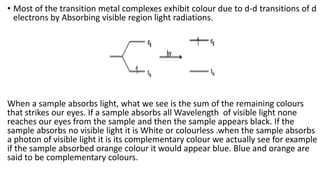
• Most of the transition metal complexes exhibit colour due to d-d transitions of d
electrons by Absorbing visible region light radiations.
When a sample absorbs light, what we see is the sum of the remaining colours
that strikes our eyes. If a sample absorbs all Wavelength of visible light none
reaches our eyes from the sample and then the sample appears black. If the
sample absorbs no visible light it is White or colourless .when the sample absorbs
a photon of visible light it is its complementary colour we actually see for example
if the sample absorbed orange colour it would appear blue. Blue and orange are
said to be complementary colours.
• Complementary colours :
• VIBGYOR X YOR
Catalytic properties
• Transition elements are very good catalysts.Ex:Fe,Co,Ni,Cr,Pt,V and Mn are used
as very good catalysts in many industries.
• The catalytic activity of transition metals is due to
• A)the presence of vacant(n-1)d orbitals .Transition metal atoms accept electrons
from the reacting molecules and so the reactants get adsorbed on the surface of
the metal.
• B) some metals provide low energy path of reaction to cross the energy barrier by
change of oxidation state.
• Ex: V2O5 is used as catalyst in the manufacture of SO3.
• the +5 oxidation state of V in V2O5 is reduced to + 4 state due to the formation
of tetroxide.
• V2O5 + SO2 V2O4+SO3
• decomposition of bleaching powder in presence of cobalt compound is another
example the oxidation state of cobalt changes from +2 to + 3 in this reaction .
• 1.The Sc(OTf)3 complex enabled epoxidation of a wide range of
alpha,beta-unsaturated ketones and amides in overall excellent yields and
enantioselectivites.
• 2.TiCl3 used as the Ziegler-Natta catalyst in the production of Polyethene.
• 3.V2O5 Converts SO2 to SO3 in the contact process for making
H2SO4.previously Pt was used.
• 4. Phillips catalyst-Cr2O3 chromium oxide supported on silica gel is used to
produce approximately half of the world's polyethylene
• 5.MnO2 used to decompose KClO3 to give O2
• 6.Fe Promoted iron is used as a catalyst in Haber Bosch process for
making NH 3 .
• 7.FeCl3 Used in the production of CCl4 from CS2 on Cl 2 .
• 8.Fenton’s reagent(FeSO4+H2O2) Used for oxidizing alcohols to aldehydes.
• 9.Ni used as a catalyst in the hydrogenation of oils(unsaturated fatty acids) to
fats(saturated) and in numerous reduction processes.
• 10.Cu is used in the direct process for manufacture of (CH3)2SiCl2 used to make
silicones.
• 11.Pd used for hydrogenation of phenol to cyclohexanone.
• 12.Pt/PtO called as Adam’s catalyst used for reductions.
• 13.Wilkinson’s catalyst Chlorotristriphenylphosphenerhodium(1).
Complex formation ability
• Complex compounds are compounds wherein a number of neutral molecules or
anions are bound to a metal. Metals which are a part of the d block elements
form many complex compounds owing to their small ionic size, high charge,
and relative availability of d orbitals for the formation of bonds.
• Transition metal and their ions with their larger nuclear charge and smaller size
can attract electrons and receive lone pair of electrons from anions and neutral
molecules into their empty d-orbitals forming coordinate bonds.
• Transition elements thus form complex molecules with CO, NO, NH3, H2O, F–,
Cl–, CN–. Examples of transition metal complexes are
[Co(NH3) 6] 3+ [Cu(NH3)4] 2+, Y(H2O) 6]2+, [Fe(CN)6]4−, [FeF6] 3−, [Ni(CO)4]
The coordination number 6 is widespread in the transition elements giving an octahedral
structure .The coordination number four is much less common giving tetrahedral and square
planar complexes .
Coordination no. of 7 and 8 are uncommon for the first row but are much more common in
the other members of the second and 3rd rows.
Magnetic Properties
•
Magnetic Properties Of Transition Elements
There are various substances which show magnetic behavior. We have substances that are
attracted by the magnetic field and are called paramagnetic. This phenomenon is called
paramagnetism.
Paramagnetic property is only shown when the substance contains one or more unpaired
electrons.
When a substance acquires a permanent magnetic moment, it is known as ferromagnetic and
the phenomenon is called ferromagnetism.
On the other hand, we also have substances which are repelled by magnetic field and are called
as diamagnetic substances. A substance shows diamagnetism when it contains only paired
electrons.
Most of the transition elements show paramagnetic behavior. The unpaired electrons in (n-1) d
orbitals are responsible for the magnetic properties. The paramagnetic character of the
transition metals increases on moving from left to right as the number of unpaired electron
increases from one to five. The middle elements are found to possess the maximum
paramagnetic property. The magnetic properties decrease with the decrease in the number of
unpaired electrons. The transition metals which contain paired electrons depict diamagnetic
behavior.
• Explanation for magnetic properties
• An electron is a charged particle (negatively charged) which revolves around the
nucleus and spins on its own axis.
• A magnetic field is generated due to the orbital motion and spin of the electron.
• The spinning of an electron in an orbit is very much similar to flow of electric current
in a closed circuit. Therefore an unpaired electron is regarded as a micro magnet which
has a definite magnetic moment. A substance which contains an unpaired electron
when placed in a magnetic field interacts with the applied field. Consequently, an
attractive force is exerted and paramagnetic property is shown. The number of
unpaired electrons determines the magnitude of magnetic moment. Higher the
number of unpaired electrons more is the magnetic moment and greater will be the
paramagnetic behavior of the substance.
• In the case of paired electrons, the electrons in each pair will have opposite spin. The
magnetic field created by the electrons of same pair is equal and opposite in nature.
Hence the magnetic field which is created by one electron is canceled by the other. So
the net effect of the magnetic moment is zero. These kinds of substances show
diamagnetic property and are repelled by the applied magnetic field.
• Most of the transition elements and their compounds are paramagnetic and are
attracted by the magnetic field. Greater the number of unpaired electrons in the
substance greater is the paramagnetic character, The magnetic character of a
substance is expressed in terms of magnetic moments. The magnetic moment
can be calculated using the relation
• μ = √{n(n + 2)} BM (BohrMagneton)
• n = number of unpaired electrons
• Example
• Ti3+ – The number of unpaired electrons is 1. Hence
• μ = √{1(1+ 2)} BM = 3 = 1.732 B.M
• Larger the value of the magnetic moment, the greater is the paramagnetic
character.
• In addition to paramagnetic and diamagnetic substance, there are a few
substances such as iron which are highly magnetic as compared to ordinary
metals.
• These substances are called ferromagnetic substances.
•
• Motion of electric charge creates a magnetic field .Electron being a negatively
charged particle may be considered as a small magnet.This electron has orbital
motion and also spin .Thus the magnetic momentum of an electron is due to its
spin and orbital motion .
• When a substance is kept in a magnetic field the induced magnetic field may act
opposite to the external magnetic field or it may add to the external field .
• Thus compounds are Atoms may show different types of magnetic behaviour,
paramagnetism ,diamagnetism ,ferromagnetism, ferrimagnetism and
antiferromagnetism are some such type of magnetic behaviour .
• 1) paramagnetism :
• If the substance is attracted to the external magnetic field it is called
paramagnetism and the substance is paramagnetic. paramagnetic
substance is attracted by the magnetic lines of force .
• Presence of one or more unpaired electrons in the substance (atoms,
ions or molecules) causes paramagnetism .
• Ex:alkali metals,IIIA,IVA,VA,VIA,VIIA,IIIB –IB,Ti3+,Cr3+,Fe2+,Cu2+,NO etc.
• 2)Diamagnetism:
• The magnetic field induced in the compound acts in the opposite direction of the
external magnetic field and the compound rejects the field. In other words the
substance repelled by the magnetic lines of force. The substance is diamagnetic
and the property is called diamagnetism .
• Substances containing completely filled orbitals are diamagnetic .
• EX: IIA, Zero group,IIB,CO,N2etc.
• 3)Ferromagnetism:
• Ferromagnetism is the basic mechanism by which certain materials (such as iron) form permanent
magnets, or are attracted to magnets.
• Permanent magnets (materials that can be magnetized by an external magnetic field and remain
magnetized after the external field is removed) are either ferromagnetic or ferrimagnetic, as are the
materials that are noticeably attracted to them. Only a few substances are ferromagnetic.
• The common ones are iron, cobalt, nickel and most of their alloys, and some compounds of rare earth
metals.
• Ferromagnetism is very important in industry and modern technology, and is the basis for many electrical
and electromechanical devices such as electromagnets, electric motors, generators, transformers,
and magnetic storage such as tape recorders, and hard disks, and nondestructive testing of ferrous
materials.
• After curie temperature they behave as paramagnetic substances.
• 4)Ferrimagnetism:
• A ferrimagnetic material is one that has populations of atoms with opposing magnetic moments, as
in antiferromagnetism; however, in ferrimagnetic materials, the opposing moments are unequal and
a spontaneous magnetization remains.
• This happens when the populations consist of different materials or ions (such as Fe2+ and Fe3+).
• Ferrimagnetism is exhibited by ferrites and magnetic garnets. The oldest known magnetic
substance, magnetite (iron(II,III) oxide; Fe3O4), is a ferrimagnet.
• yttrium iron garnet (YIG); cubic ferrites composed of iron oxides with other element(s) such
as aluminum, cobalt, nickel, manganese, and zinc; and hexagonal ferrites such as PbFe12O19 and
BaFe12O19 and pyrrhotite, Fe1−xS.
• After curie temperature they behave as paramagnetic substances like ferromagnets.
• However, there is sometimes a temperature below the Curie temperature, at which the two opposing
moments are equal, resulting in a net magnetic moment of zero; this is called the magnetization
compensation point.
• This compensation point is a crucial point for achieving high speed magnetization reversal in magnetic
memory devices.
• Antiferromagnetic substances:
• In materials that exhibit antiferromagnetism, the magnetic
moments of atoms or molecules, usually related to the spins of electrons, align in a
regular pattern with neighboring spins (on different sublattices) pointing in opposite
directions.
• This is,like ferromagnetism and ferrimagnetism, a manifestation of
ordered magnetism.
• Generally, antiferromagnetic order may exist at sufficiently low temperatures, but
vanishes at and above the Néel temperature – named after Louis Néel, who had first
identified this type of magnetic ordering.
• Ex:Superconductors.
• Above the Néel temperature, the material is typically paramagnetic.
Calculation of Magnetic moment by Gouy method:
• The Gouy balance measures the apparent change in the mass of the sample as it
is repelled or attracted by the region of high magnetic field between the poles. The
sample is suspended between the magnetic poles through an attached string. The
experimental procedure requires two separate reading to be performed. An initial
balance reading is performed on the sample of interest without a magnetic field. A
subsequent balance reading is taken with an applied magnetic field. The apparent
change in mass from the two balance readings is the result of magnetic force on
the sample.
• Gouy method:
• In this method the finely powdered solid sample (0.1 to 1.0 gram) or solution is
taken in a Pyrex glass tube of uniform cross section(2 to10 mm). The height of the
column is 5 to 10 mm .
• The tube is suspended from the top of the balance inside a moisture and dirt proof
compartment between pole pieces of an electromagnet in such a way that bottom
is half way between the 2 poles and top of the tube out of the magnetic field .
• The sample is weighed without the magnetic field and then with the magnetic field
on .
• If the sample is paramagnetic it will be drawn into the field while it will be repelled
• The change in weight ΔW is thus obtained.
• Before filling the tube with sample ,the weight of the empty Gouy tube with
magnetic field and without magnetic field is taken .The loss in weight of the tube
(as glass is diamagnetic) ’δ’ is calculated from the difference in the 2 weights.
• The volume susceptibility K1 of a compound is measured using Gouy balance,K1
is dimensionless and is readily converted into the molar susceptibility χm.
• Magnetic moment of the compound μ can be calculated by applying following
relation,
• μ= 3𝐾/𝑁μ0 X √ χmT B.M
• =2.84 X √ χmT B.M
• Where K=Boltzmann constant,its value is 1.3805 x 10⁻²³JK -1
• 𝑁 = 𝐴𝑣𝑎𝑔𝑎𝑑𝑟𝑜 𝑐𝑜𝑛𝑠𝑡𝑎𝑛𝑡, μ0 =Permiability of free space
• T=Absolute temperature
•
Comparative treatment of second and third
transition series with 3d analogues
• 1.Abundance :The first row transition elements are reasonably common in the
earths crust .The elements of second and 3rd row are very scarce .Technicium
does not occur in nature.
Sc
31
Ti
9
V
19
Cr
21
Mn
12
Fe
4
Co
30
Ni
22
Cu
25
Zn
24
Y
29
Zr
18
Nb
32
Mo
56
Tc
Man
Made
Radioactive
Ru
77
Rh
77
Pd
69
Ag
66
Cd
65
La
28
Hf
45
Ta
53
W
56
Re
76
Os
72
Ir
74
Pt
70
Au
73
Hg
66
• 2.Covalent radii :
The atomic radii increases from top
to bottom however the atomic radii
of second and 3rd row transition
series are very close or similar due
to lanthanide contraction .
Sc
1.44
Ti
1.32
V
1.22
Cr
1.17
Mn
1.17
Fe
1.17
Co
1.16
Ni
1.15
Cu
1.17
Zn
1.25
Y
1.62
Zr
1.45
Nb
1.34
Mo
1.29
Tc
-
Ru
1.24
Rh
1.25
Pd
1.28
Ag
1.34
Cd
1.41
La
1.69
Hf
1.44
Ta
1.34
W
1.30
Re
1.28
Os
1.26
Ir
1.26
Pt
1.29
Au
1.34
Hg
1.44
• 3.Electronic configuration :
The anomalous electronic configuration of first row transition series
(Cr(3d54s1),Cu(3d104s1)) can be explained on the basis of special stability associated
with half filled and completely filled d-orbitals .
The anomalous electronic configuration of 2nd (Nb (4d45s1),Ru(4d75s1),Rh (4d85s1),)
and 3rd row transition series(Pt (5d96s1))have got no reasonable explanation.
4.Oxidation states :
The highest oxidation state in first series is +7(for Mn)
The highest oxidation state in 2nd and 3rd series is +8 (Ru)and +9(for Ir)
In the first series the lower oxidation states are stable .
Higher oxidation states are more stable in second and 3rd series .
5.Coordination number :The highest coordination number in first series is 6 and for
second and 3rd series it is 7 and 8 respectively .
• 6.Density:
• Density increases from top to bottom due to lanthanide contraction .
Density increases from left to right and reaches a max. at VIII group.
The density of second transition series are more than First series while
the 3rd series are more dense than second transition series .
Os in 3rd series has max. density.
7.Complex formation :
First row elements form stable complexes with ligands such as N,O and
F.Such complexes are not formed by second and 3rd series elements,
they form more stable complexes with P,S and I.
8.Reactivity of metals:
Decreases from first row to 3rd row
•
Study of Ti, Cr, Cu triads.
1.Titanium,Zirconium and Hafnium triad
Titanium group consists of 4 elements namely titanium, zirconium, hafnium and
rutherfordium.The 3 elements Ti,Zr&Hf are called titanium triad.The general
properties of the titanium triad are presented in table:
Element Ti Zr Hf
Electronic configuration 3d24S2 4d25S2 4f145d26S2
covalent radius 1.32 1.45 1.44
M.P(0 C) 1667 1857 2222
B.P(0 C) 3285 4200 4450
Density 4.5 6.51 13.28
E.N 1.5 1.4 1.3
Oxidation state +4 +4 +4
• I.E:
• The first ionsation energy of Zr is greater than that of Ti. It is due to strong
attraction of valency electrons by nucleus because of poor screening by the
newly added d- electrons (4d25s2)compared to increase in effective nuclear
charge however the first Ionisation energy of Hf is less than that of Zr as due to
increased screening effect as compared to effective nuclear charge .(4f145d26s2)
Hf+(IE1)<Zr+(I.E1)>Ti+(IE1)
• Basic nature:
• Increases from top to bottom.
TiO2 amphoteric
ZrO2 ,HfO2 strongly basic.
• Halides:
TiCl4 undergo complete hydrolysis with H2O giving TiO2(H2O)n
ZrCl4 doesn’t undergo complete hydrolysis but a stable ZrOCl2 is formed.
• Complex formation:
• The tetrahalides of these elements act as Lewis acids with a wide variety of
donors, forming and large number of stable octahedral complexes.
• TiF4 [TiF6]2-
• TiCl4 [TiCl6]2-
• On going down the group the size of M4+ ion increases and the tendency of the
elements to form complexes decreases .
• Hence Ti 4+ form complexes more easily than Zr4+ and Hf 4 +
.
• Colour and magnetism:
• M4+ ions with d0 configuration are colourless and diamagnetic.
• M3+ ions with d1 configuration are coloured and paramagnetic.
• Ex:[Ti(H2O)6]3+ is violet due to unpaired electron.
Conc.HF
Conc.HCl
Chromium,Molybdinum and Tungsten triad
• This group consist of 4 elements namely chromium, molybdenum ,tungsten and
seaborgium.
• The 3 elements viz Cr,Mo,W are called as chromium triad.
• The general properties are as follows:
•
Element Cr Mo W
Electronic
configuration
3d54S1 4d55S1 4f145d46S2
covalent radius 1.17 1.29 1.30
M.P(0 C) 1900 2620 3380
B.P(0 C) 2690 2620 5500
Density 7.14 10.28 19.3
E.N 1.6 1.8 1.7
Oxidation state +3 +6 +6
• Basic nature:
• Decreases from top to bottom.
Cr(OH)2 is ionic and basic.
CrO3 is strongly acidic ,WO3 is amphoteric.
The strength of oxyacids and oxidizing properties decrease down the group.
Ex: H2CrO4(Chromic acid ) is very strong acid and oxidant while
H2WO4 (tungstic acid ) is v.weak acid and v.weak oxidant.
Copper,Silver and Gold triad
(Noble metals)
• Group consists of 4 elements namely copper silver gold and Rontgenium.The 3
elements viz Cu,Ag and Au are called copper triads.The general properties of
copper triad are :
Element Cu Ag Au
Electronic
configuration
3d54S1 4d55S1 4f145d46S2
covalent radius 1.17 1.34 1.34
M.P(0 C) 1083 961 1064
B.P(0 C) 2570 2155 2808
Density 8.95 10.49 19.3
E.N 1.9 1.9 2.4
Oxidation state +1,+2 +1,+2,+3 +1,+3
• Reactivity:
• The elements of this group are least reactive and are called Noble metals.
• silver soluble in concentrated HNO3 and in hot concentrated sulfuric acid.
• Au is inert to all acids and soluble in aquaregia(3:1 ratio of conc.HCl and CON
HNO3)
• copper reacts with oxygen at high temperature but silver and gold are inert.
• Cu+O2 CuO Cu2O+O2
• Cu and silver metals react with H2S and S but Au does not.
• Polished silver articles gradually blacken in air due to traces of H2 S in the air
reacts with Ag and from black Ag2S.
• 2Ag+H2S Ag2S(black)+H2
• similarly passing H2S into solutions containing Cu2+ and Ag+ gives black ppt of
CuS and Ag2S. All the three metals react with the halogens.
• Complexes:
• Cu(II) Forms stable complexes like [Cu(CN)4]2-(square planar) and [CuCl4]2-
(tetrahedral ).
• Ag(I) forms Stable compounds like AgCl.It forms ammine complexes like
[Ag(NH3)2]+.

Dblock

  • 1.
    SEMESTER - III INORGANIC CHEMISTRY UNIT–I 1. Chemistry of d-block elements By Anusha Karumuri, Lecturer in chemistry, GCW(A),Guntur.
  • 2.
    • Characteristics ofd-block elements with special reference to • electronic configuration, • variable valence, • magnetic properties, • catalytic properties and ability to form complexes. Stability of various oxidation states • Additional Inputs: Comparative treatment of second and third transition series with 3d analogues, Study of Ti, Cu, Cr triads.
  • 3.
    • From Scto Zn group in the periodic table comes under d-Block elements.In these elements the differentiating electron enters into d orbital of penultimate (n-1) shell, hence called d-BLOCK elements. • d-Block elements (from Sc to Cu group)are also called as transition elements- • As the properties are in between those of S and P block elements, • These show transition of electrons from lower energy d orbital to higher energy d-orbitals, • The IUPAC definition defines a transition metal as "an element whose atom has a partially filled d sub-shell, or which can give rise to cations with an incomplete d sub-shell"
  • 4.
  • 5.
    • Importance ofD- block elements: • Fe is the most abundant d block element on earth’s crust which is 4th most abundant element on whole. • Most act as catalysts • Stainless steel-Fe,Cr,Ni,C-Cutting • Tungsten steel-Fe,W,C-High speed cutting tools • Invar-Fe+Ni-watches • Manganees steel:-Fe,Mn,C-Rockdrills • Permalloy-Ni,Fe,C:-Electromagnets • Mn is a dietary element which acts as a coenzyme in bone formation.In photosynthesis in the evolution of O2 Mn plays an imp.role. • Tc acts as a superconductor below 11K. • In batteries-disposable batteries include zinc–carbon batteries, rechargeable battery is the lead–acid battery,dry cells used in laptops,mobiles nickel–cadmium (NiCd), nickel– zinc (NiZn), nickel metal hydride (NiMH), and lithium-ion (Li-ion) cells. etc • In paints,varnishes,inks • Meter was defined as the length of Pt-Ir alloy bar • Cis Pt is used in cancer therapy. • (FeMn), and oxides such as nickel oxide (NiO)
  • 6.
    • Coinage metal:Cu,Ag,Au. •permanent magnets:Neodymium iron boron (NdFeB) • Samarium cobalt (SmCo) • Alnico • Ceramic or ferrite magnets •copper, silver, and gold, are diamagnetic. •Paramagnetic materials include magnesium, molybdenum, lithium, and tantalum. •Iron, nickel and cobalt are all ferromagnetic materials. • magnetite (iron(II,III) oxide; Fe3O4ferrimagnetic materials include yttrium iron garnet (YIG); cubic ferrites composed of iron oxides with other element(s) such as aluminum, cobalt, nickel, manganese, and zinc; and hexagonal ferrites such as PbFe12O19 and BaFe12O19 and pyrrhotite, Fe1−Xs •Antiferromagnetic materials occur commonly among transition metal compounds, especially oxides. Examples include hematite, metals such as chromium, alloys such as iron manganese .
  • 7.
  • 8.
    IIIB IVB VBVIB VIIB VIIIB IB IIB Group 3 4 5 6 7 8 9 10 11 12 Atomic nr 21 22 23 24 25 26 27 28 29 30 Element Sc Ti V Cr Mn Fe Co Ni Cu Zn Electron configurati on 3d14s2 3d24s2 3d34s2 3d54s1 3d54s2 3d64s2 3d74s2 3d84s2 3d104s1 3d104s2 First (3d) d-block Series (Sc–Zn)
  • 9.
    Atomic nr 39 40 4142 43 44 45 46 47 48 Element Y Zr Nb Mo Tc Ru Rh Pd Ag Cd Electron configura tion 4d15s2 4d25s2 4d45s1 4d55s1 4d55s2 4d75s1 4d85s1 4d10 4d105s1 4d105s2 Second (4d) d-block Series (Y–Cd)
  • 10.
    • • Atomic nr 57 72 7374 75 76 77 78 79 80 Eleme nt La Hf Ta W Re Os Ir Pt Au Hg Electro n config uration 5d16s2 5d26s2 5d36s2 5d46s2 5d56s2 5d66s2 5d76s2 5d96s1 5d106s1 5d106s2 Third (5d) d-block Series (La,Hf–Hg)
  • 11.
    • Atomic nr 89 104 105106 107 108 109 110 111 112 Element Ac Rf Db Sg Bh Hs Mt Ds Rg Cn Electron configur ation 6d17s2 6d27s2 6d37s2 6d47s2 6d57s2 6d67s2 6d77s2 6d87s2 6d97s2 6d107s2 Fourth (6d) d-block Series (Ac,Rf–Cn)
  • 12.
    • Exercise: • 1.The correct ground state electronic configuration of chromium Atom is • A) [Ar]3d54s1 B) [Ar]3d54s1 C) [Ar]3d54s1 D) [Ar]3d54s1
  • 13.
  • 14.
    • Valency: • Electronsexist in orbits around an atomic nucleus. The higher the orbit number, the greater the distance of the electrons from the nucleus. Atoms try to achieve a stable state similar to that of the noble gases or the inert elements in their outermost orbit by accepting or donating electrons. This property is called the atom’s valency. • Variable valency: • Some elements differ in their capacity to combine with other elements depending on the nature of the reaction; this property is called variable valency. For example, the iron in ferrous oxide exhibits a valency of +2, whereas in ferric oxide, it has a valency of +3.
  • 15.
  • 16.
    • The electronsthat lost depends on Internal electronic repulsions and variation in effective nuclear charge.The energy level of 4s< 3d.so in the first transition series 4s orbital is filled first and then 3d orbitals are filled.Hence,in the first transition series, ions should be formed by the loss of 3d electrons rather than 4s electrons .Actually this is not true. In fact atoms of first transition series lose 4s electrons before they lose electron from 3d orbitals. The reason for this behaviour is that after the electrons have entered 3d orbitals the energy of 3d orbitals becomes less than that of 4s orbital. For example the electronic configuration of titanium(Z=22) will be as Ti:[Ar]3d24s2 • Therefore electronic configuration of Ti 2+ will be as Ti2+ : [Ar] 3d2 • Similarly for electronic configuration of Ti 3+ will be as Ti3+ : [Ar] 3d1 • The transition elements have their valence electrons in two different sets of orbitals that is (n-1)d and ns. As there is very little difference in the energies of these orbitals, both energy levels can be used for bond formation. • In simple compounds the two electrons from ns orbital of a transition element are used to give an oxidation state of +2 and the (n-1)d electrons remain unaffected. • The higher oxidation states like +3, +4, +5, +6 and +7 correspond to the use of all 4s and 3d electrons in the transition series of elements. • In excited state, the (n-1)d electrons become bonding and thus give variable oxidation states to the atoms of transition elements. • Thus, transition elements show variable valencies due to involvement of penultimate d shell electrons.
  • 18.
    • In firstrow of transition elements: • 1.There is the relation between outer electronic configuration of a transition element and its various possible oxidation states. • 2. Many elements exhibit oxidation states which differ from each other only by one Unit. • 3.The common oxidation states for each element include +2 ,+3 or both.+3 States are relatively more common at the beginning of the Series whereas +2 states are more common towards the end due to high nuclear charge . • 4.Up to manganese the highest oxidation states involve all 3d and 4s electrons. After manganese there is a decrease in the number of oxidation states shown by each element due to loss of outershell s electrons and unpaired d electrons.
  • 19.
    • Similar butnot identical pyramids of o.s are found in the 2nd and 3rd rows as electronic structures do not always follow the pattern of the1st row. • Ex: Ni: 3d84s2 • Pd:4d105s0 • pt:5d96s1
  • 20.
    Y Zr NbMo Tc Ru Rh Pd Ag Cd 1 1 2 2 2 2 2 2 3 3 3 3 3 3 3 3 4 4 4 4 4 4 4 5 5 5 6 6 6 6 7 7 8
  • 21.
    • La Hf TaW Re Os Ir Pt Au Hg 1 1 2 2 2 2 2 2 2 2 3 3 3 3 3 3 3 3 4 4 4 4 4 4 4 5 5 5 5 5 6 6 6 6 6 7 8 8 9
  • 22.
    • The maximumoxidation state shown in 3d series is +7 by Manganese (Mn2O7) • The maximum oxidation state shown in 4d series is + 8 by Ruthenium(RuO4) • The maximum oxidation state shown in 5d series is + 9 by Iridium( recent) (IrO+ )
  • 23.
    Sc +3 Ti +4 V +4,+5 Cr +3 Mn +2,+4,+7 Fe +3 Co +2 Ni +2 Cu +1 at mod.tem +2 inaq. Zn +2 Y +3 Zr +4 Nb +5 Mo +6 Tc (Radioac tive) Ru +2,+3,+4 Rh +3 Pd +2,+4 Ag +1 Cd +2 La +3 Hf +4 Ta +2,+3,+4, +5 W +6 Re +1,+2,+3. +4,+5,+6, +7 Os +2,+3,+4, +6,+8 Ir +1,+3,+4, +9 Pt +2,+4 Au +1,+3 Hg +1,+2 Ac +3 Rf Db Sg Bh Hs Mt Ds Rg Cn Stable oxidation states Typical transition elements Exist at room temp.,not oxidised by air,not hydrolysed by water vapour,not disproportionate or decompose at normal temperatures. Radioactive
  • 24.
    The +II and+III states are important for all the first row transition elements. Simple ions M2+ and M3+ are common with the first row but are less important for second and 3rd row elements ,which have few ionic compounds. Similarly the first row form a large number of extremely stable complexes such as [CrCl6]3-and [CO(NH)3]6 .No equalent complexes of Mo or W or Rh or Ir are known. The higher oxidation states of the second and 3rd row elements are more important and much more stable than those of the first row elements . Thus the chromate ion[CrO4]2- is a strong oxidising agent but molybdate [MoO4]2- and tungstate [WO4]2- are stable. similarly the Permanganate ion [MnO4]- Is a strong oxidizing agent but pertechnetate [TcO4]- and perrhenate [ReO4]- ions are stable. some compounds exist in high oxidation states which have no counterparts in the first row. for example wCl 6, ReF 7, RuF4,OsO4 and PtF 6 . +2,+3 form ionic compounds Higher o.s form covalent compounds The o.s of metal in solvents depend on solvent’s nature. Ex: Cu+1 in H2O---unstable Cu+2 in H20---Stable. With F&O—high o.s(the stability of particular oxidation state depends on the nature of the combining elwement) The relative stabilities of o.s is known from std.electrode potentials.
  • 25.
    • Ionization energyvalues of transition elements determine the stability of various oxidation states of these elements . • EX:A)The sum of the first two ionization energies of nickel is approximately 2.49 * 10 3 KJ /mole, this value is less than that of platinum that is 2.66 * 10 power 3 KJ / mole thus in Ni(II) is thermodynamically more stable than platinum (IV) compounds. • B)The sum of the first four ionization energies of nickel is approximately 11.29x 10³ KJ/mole and this value is more than that of a Pt 9.36 x10³ KJ/ mole. Thus Ni(IV) is thermodynamically less stable than Pt(IV) ion .
  • 26.
    • Most ofthe transition metal complexes exhibit colour due to d-d transitions of d electrons by Absorbing visible region light radiations. When a sample absorbs light, what we see is the sum of the remaining colours that strikes our eyes. If a sample absorbs all Wavelength of visible light none reaches our eyes from the sample and then the sample appears black. If the sample absorbs no visible light it is White or colourless .when the sample absorbs a photon of visible light it is its complementary colour we actually see for example if the sample absorbed orange colour it would appear blue. Blue and orange are said to be complementary colours.
  • 27.
    • Complementary colours: • VIBGYOR X YOR
  • 28.
  • 29.
    • Transition elementsare very good catalysts.Ex:Fe,Co,Ni,Cr,Pt,V and Mn are used as very good catalysts in many industries. • The catalytic activity of transition metals is due to • A)the presence of vacant(n-1)d orbitals .Transition metal atoms accept electrons from the reacting molecules and so the reactants get adsorbed on the surface of the metal. • B) some metals provide low energy path of reaction to cross the energy barrier by change of oxidation state. • Ex: V2O5 is used as catalyst in the manufacture of SO3. • the +5 oxidation state of V in V2O5 is reduced to + 4 state due to the formation of tetroxide. • V2O5 + SO2 V2O4+SO3 • decomposition of bleaching powder in presence of cobalt compound is another example the oxidation state of cobalt changes from +2 to + 3 in this reaction .
  • 30.
    • 1.The Sc(OTf)3complex enabled epoxidation of a wide range of alpha,beta-unsaturated ketones and amides in overall excellent yields and enantioselectivites. • 2.TiCl3 used as the Ziegler-Natta catalyst in the production of Polyethene. • 3.V2O5 Converts SO2 to SO3 in the contact process for making H2SO4.previously Pt was used. • 4. Phillips catalyst-Cr2O3 chromium oxide supported on silica gel is used to produce approximately half of the world's polyethylene • 5.MnO2 used to decompose KClO3 to give O2 • 6.Fe Promoted iron is used as a catalyst in Haber Bosch process for making NH 3 .
  • 31.
    • 7.FeCl3 Usedin the production of CCl4 from CS2 on Cl 2 . • 8.Fenton’s reagent(FeSO4+H2O2) Used for oxidizing alcohols to aldehydes. • 9.Ni used as a catalyst in the hydrogenation of oils(unsaturated fatty acids) to fats(saturated) and in numerous reduction processes. • 10.Cu is used in the direct process for manufacture of (CH3)2SiCl2 used to make silicones. • 11.Pd used for hydrogenation of phenol to cyclohexanone. • 12.Pt/PtO called as Adam’s catalyst used for reductions. • 13.Wilkinson’s catalyst Chlorotristriphenylphosphenerhodium(1).
  • 32.
  • 33.
    • Complex compoundsare compounds wherein a number of neutral molecules or anions are bound to a metal. Metals which are a part of the d block elements form many complex compounds owing to their small ionic size, high charge, and relative availability of d orbitals for the formation of bonds. • Transition metal and their ions with their larger nuclear charge and smaller size can attract electrons and receive lone pair of electrons from anions and neutral molecules into their empty d-orbitals forming coordinate bonds. • Transition elements thus form complex molecules with CO, NO, NH3, H2O, F–, Cl–, CN–. Examples of transition metal complexes are [Co(NH3) 6] 3+ [Cu(NH3)4] 2+, Y(H2O) 6]2+, [Fe(CN)6]4−, [FeF6] 3−, [Ni(CO)4] The coordination number 6 is widespread in the transition elements giving an octahedral structure .The coordination number four is much less common giving tetrahedral and square planar complexes . Coordination no. of 7 and 8 are uncommon for the first row but are much more common in the other members of the second and 3rd rows.
  • 34.
  • 35.
    • Magnetic Properties OfTransition Elements There are various substances which show magnetic behavior. We have substances that are attracted by the magnetic field and are called paramagnetic. This phenomenon is called paramagnetism. Paramagnetic property is only shown when the substance contains one or more unpaired electrons. When a substance acquires a permanent magnetic moment, it is known as ferromagnetic and the phenomenon is called ferromagnetism. On the other hand, we also have substances which are repelled by magnetic field and are called as diamagnetic substances. A substance shows diamagnetism when it contains only paired electrons. Most of the transition elements show paramagnetic behavior. The unpaired electrons in (n-1) d orbitals are responsible for the magnetic properties. The paramagnetic character of the transition metals increases on moving from left to right as the number of unpaired electron increases from one to five. The middle elements are found to possess the maximum paramagnetic property. The magnetic properties decrease with the decrease in the number of unpaired electrons. The transition metals which contain paired electrons depict diamagnetic behavior.
  • 36.
    • Explanation formagnetic properties • An electron is a charged particle (negatively charged) which revolves around the nucleus and spins on its own axis. • A magnetic field is generated due to the orbital motion and spin of the electron. • The spinning of an electron in an orbit is very much similar to flow of electric current in a closed circuit. Therefore an unpaired electron is regarded as a micro magnet which has a definite magnetic moment. A substance which contains an unpaired electron when placed in a magnetic field interacts with the applied field. Consequently, an attractive force is exerted and paramagnetic property is shown. The number of unpaired electrons determines the magnitude of magnetic moment. Higher the number of unpaired electrons more is the magnetic moment and greater will be the paramagnetic behavior of the substance. • In the case of paired electrons, the electrons in each pair will have opposite spin. The magnetic field created by the electrons of same pair is equal and opposite in nature. Hence the magnetic field which is created by one electron is canceled by the other. So the net effect of the magnetic moment is zero. These kinds of substances show diamagnetic property and are repelled by the applied magnetic field.
  • 37.
    • Most ofthe transition elements and their compounds are paramagnetic and are attracted by the magnetic field. Greater the number of unpaired electrons in the substance greater is the paramagnetic character, The magnetic character of a substance is expressed in terms of magnetic moments. The magnetic moment can be calculated using the relation • μ = √{n(n + 2)} BM (BohrMagneton) • n = number of unpaired electrons • Example • Ti3+ – The number of unpaired electrons is 1. Hence • μ = √{1(1+ 2)} BM = 3 = 1.732 B.M • Larger the value of the magnetic moment, the greater is the paramagnetic character. • In addition to paramagnetic and diamagnetic substance, there are a few substances such as iron which are highly magnetic as compared to ordinary metals. • These substances are called ferromagnetic substances.
  • 38.
  • 39.
    • Motion ofelectric charge creates a magnetic field .Electron being a negatively charged particle may be considered as a small magnet.This electron has orbital motion and also spin .Thus the magnetic momentum of an electron is due to its spin and orbital motion . • When a substance is kept in a magnetic field the induced magnetic field may act opposite to the external magnetic field or it may add to the external field . • Thus compounds are Atoms may show different types of magnetic behaviour, paramagnetism ,diamagnetism ,ferromagnetism, ferrimagnetism and antiferromagnetism are some such type of magnetic behaviour .
  • 40.
    • 1) paramagnetism: • If the substance is attracted to the external magnetic field it is called paramagnetism and the substance is paramagnetic. paramagnetic substance is attracted by the magnetic lines of force . • Presence of one or more unpaired electrons in the substance (atoms, ions or molecules) causes paramagnetism . • Ex:alkali metals,IIIA,IVA,VA,VIA,VIIA,IIIB –IB,Ti3+,Cr3+,Fe2+,Cu2+,NO etc.
  • 41.
    • 2)Diamagnetism: • Themagnetic field induced in the compound acts in the opposite direction of the external magnetic field and the compound rejects the field. In other words the substance repelled by the magnetic lines of force. The substance is diamagnetic and the property is called diamagnetism . • Substances containing completely filled orbitals are diamagnetic . • EX: IIA, Zero group,IIB,CO,N2etc.
  • 42.
    • 3)Ferromagnetism: • Ferromagnetismis the basic mechanism by which certain materials (such as iron) form permanent magnets, or are attracted to magnets. • Permanent magnets (materials that can be magnetized by an external magnetic field and remain magnetized after the external field is removed) are either ferromagnetic or ferrimagnetic, as are the materials that are noticeably attracted to them. Only a few substances are ferromagnetic. • The common ones are iron, cobalt, nickel and most of their alloys, and some compounds of rare earth metals. • Ferromagnetism is very important in industry and modern technology, and is the basis for many electrical and electromechanical devices such as electromagnets, electric motors, generators, transformers, and magnetic storage such as tape recorders, and hard disks, and nondestructive testing of ferrous materials. • After curie temperature they behave as paramagnetic substances.
  • 43.
    • 4)Ferrimagnetism: • Aferrimagnetic material is one that has populations of atoms with opposing magnetic moments, as in antiferromagnetism; however, in ferrimagnetic materials, the opposing moments are unequal and a spontaneous magnetization remains. • This happens when the populations consist of different materials or ions (such as Fe2+ and Fe3+). • Ferrimagnetism is exhibited by ferrites and magnetic garnets. The oldest known magnetic substance, magnetite (iron(II,III) oxide; Fe3O4), is a ferrimagnet. • yttrium iron garnet (YIG); cubic ferrites composed of iron oxides with other element(s) such as aluminum, cobalt, nickel, manganese, and zinc; and hexagonal ferrites such as PbFe12O19 and BaFe12O19 and pyrrhotite, Fe1−xS. • After curie temperature they behave as paramagnetic substances like ferromagnets. • However, there is sometimes a temperature below the Curie temperature, at which the two opposing moments are equal, resulting in a net magnetic moment of zero; this is called the magnetization compensation point. • This compensation point is a crucial point for achieving high speed magnetization reversal in magnetic memory devices.
  • 44.
    • Antiferromagnetic substances: •In materials that exhibit antiferromagnetism, the magnetic moments of atoms or molecules, usually related to the spins of electrons, align in a regular pattern with neighboring spins (on different sublattices) pointing in opposite directions. • This is,like ferromagnetism and ferrimagnetism, a manifestation of ordered magnetism. • Generally, antiferromagnetic order may exist at sufficiently low temperatures, but vanishes at and above the Néel temperature – named after Louis Néel, who had first identified this type of magnetic ordering. • Ex:Superconductors. • Above the Néel temperature, the material is typically paramagnetic.
  • 45.
    Calculation of Magneticmoment by Gouy method:
  • 46.
    • The Gouybalance measures the apparent change in the mass of the sample as it is repelled or attracted by the region of high magnetic field between the poles. The sample is suspended between the magnetic poles through an attached string. The experimental procedure requires two separate reading to be performed. An initial balance reading is performed on the sample of interest without a magnetic field. A subsequent balance reading is taken with an applied magnetic field. The apparent change in mass from the two balance readings is the result of magnetic force on the sample. • Gouy method: • In this method the finely powdered solid sample (0.1 to 1.0 gram) or solution is taken in a Pyrex glass tube of uniform cross section(2 to10 mm). The height of the column is 5 to 10 mm . • The tube is suspended from the top of the balance inside a moisture and dirt proof compartment between pole pieces of an electromagnet in such a way that bottom is half way between the 2 poles and top of the tube out of the magnetic field . • The sample is weighed without the magnetic field and then with the magnetic field on . • If the sample is paramagnetic it will be drawn into the field while it will be repelled
  • 47.
    • The changein weight ΔW is thus obtained. • Before filling the tube with sample ,the weight of the empty Gouy tube with magnetic field and without magnetic field is taken .The loss in weight of the tube (as glass is diamagnetic) ’δ’ is calculated from the difference in the 2 weights. • The volume susceptibility K1 of a compound is measured using Gouy balance,K1 is dimensionless and is readily converted into the molar susceptibility χm. • Magnetic moment of the compound μ can be calculated by applying following relation, • μ= 3𝐾/𝑁μ0 X √ χmT B.M • =2.84 X √ χmT B.M • Where K=Boltzmann constant,its value is 1.3805 x 10⁻²³JK -1 • 𝑁 = 𝐴𝑣𝑎𝑔𝑎𝑑𝑟𝑜 𝑐𝑜𝑛𝑠𝑡𝑎𝑛𝑡, μ0 =Permiability of free space • T=Absolute temperature
  • 48.
    • Comparative treatment ofsecond and third transition series with 3d analogues
  • 49.
    • 1.Abundance :Thefirst row transition elements are reasonably common in the earths crust .The elements of second and 3rd row are very scarce .Technicium does not occur in nature. Sc 31 Ti 9 V 19 Cr 21 Mn 12 Fe 4 Co 30 Ni 22 Cu 25 Zn 24 Y 29 Zr 18 Nb 32 Mo 56 Tc Man Made Radioactive Ru 77 Rh 77 Pd 69 Ag 66 Cd 65 La 28 Hf 45 Ta 53 W 56 Re 76 Os 72 Ir 74 Pt 70 Au 73 Hg 66
  • 50.
    • 2.Covalent radii: The atomic radii increases from top to bottom however the atomic radii of second and 3rd row transition series are very close or similar due to lanthanide contraction . Sc 1.44 Ti 1.32 V 1.22 Cr 1.17 Mn 1.17 Fe 1.17 Co 1.16 Ni 1.15 Cu 1.17 Zn 1.25 Y 1.62 Zr 1.45 Nb 1.34 Mo 1.29 Tc - Ru 1.24 Rh 1.25 Pd 1.28 Ag 1.34 Cd 1.41 La 1.69 Hf 1.44 Ta 1.34 W 1.30 Re 1.28 Os 1.26 Ir 1.26 Pt 1.29 Au 1.34 Hg 1.44
  • 51.
    • 3.Electronic configuration: The anomalous electronic configuration of first row transition series (Cr(3d54s1),Cu(3d104s1)) can be explained on the basis of special stability associated with half filled and completely filled d-orbitals . The anomalous electronic configuration of 2nd (Nb (4d45s1),Ru(4d75s1),Rh (4d85s1),) and 3rd row transition series(Pt (5d96s1))have got no reasonable explanation. 4.Oxidation states : The highest oxidation state in first series is +7(for Mn) The highest oxidation state in 2nd and 3rd series is +8 (Ru)and +9(for Ir) In the first series the lower oxidation states are stable . Higher oxidation states are more stable in second and 3rd series . 5.Coordination number :The highest coordination number in first series is 6 and for second and 3rd series it is 7 and 8 respectively .
  • 52.
    • 6.Density: • Densityincreases from top to bottom due to lanthanide contraction . Density increases from left to right and reaches a max. at VIII group. The density of second transition series are more than First series while the 3rd series are more dense than second transition series . Os in 3rd series has max. density. 7.Complex formation : First row elements form stable complexes with ligands such as N,O and F.Such complexes are not formed by second and 3rd series elements, they form more stable complexes with P,S and I. 8.Reactivity of metals: Decreases from first row to 3rd row
  • 53.
    • Study of Ti,Cr, Cu triads.
  • 54.
  • 55.
    Titanium group consistsof 4 elements namely titanium, zirconium, hafnium and rutherfordium.The 3 elements Ti,Zr&Hf are called titanium triad.The general properties of the titanium triad are presented in table: Element Ti Zr Hf Electronic configuration 3d24S2 4d25S2 4f145d26S2 covalent radius 1.32 1.45 1.44 M.P(0 C) 1667 1857 2222 B.P(0 C) 3285 4200 4450 Density 4.5 6.51 13.28 E.N 1.5 1.4 1.3 Oxidation state +4 +4 +4
  • 56.
    • I.E: • Thefirst ionsation energy of Zr is greater than that of Ti. It is due to strong attraction of valency electrons by nucleus because of poor screening by the newly added d- electrons (4d25s2)compared to increase in effective nuclear charge however the first Ionisation energy of Hf is less than that of Zr as due to increased screening effect as compared to effective nuclear charge .(4f145d26s2) Hf+(IE1)<Zr+(I.E1)>Ti+(IE1) • Basic nature: • Increases from top to bottom. TiO2 amphoteric ZrO2 ,HfO2 strongly basic. • Halides: TiCl4 undergo complete hydrolysis with H2O giving TiO2(H2O)n ZrCl4 doesn’t undergo complete hydrolysis but a stable ZrOCl2 is formed.
  • 57.
    • Complex formation: •The tetrahalides of these elements act as Lewis acids with a wide variety of donors, forming and large number of stable octahedral complexes. • TiF4 [TiF6]2- • TiCl4 [TiCl6]2- • On going down the group the size of M4+ ion increases and the tendency of the elements to form complexes decreases . • Hence Ti 4+ form complexes more easily than Zr4+ and Hf 4 + . • Colour and magnetism: • M4+ ions with d0 configuration are colourless and diamagnetic. • M3+ ions with d1 configuration are coloured and paramagnetic. • Ex:[Ti(H2O)6]3+ is violet due to unpaired electron. Conc.HF Conc.HCl
  • 58.
  • 59.
    • This groupconsist of 4 elements namely chromium, molybdenum ,tungsten and seaborgium. • The 3 elements viz Cr,Mo,W are called as chromium triad. • The general properties are as follows: • Element Cr Mo W Electronic configuration 3d54S1 4d55S1 4f145d46S2 covalent radius 1.17 1.29 1.30 M.P(0 C) 1900 2620 3380 B.P(0 C) 2690 2620 5500 Density 7.14 10.28 19.3 E.N 1.6 1.8 1.7 Oxidation state +3 +6 +6
  • 60.
    • Basic nature: •Decreases from top to bottom. Cr(OH)2 is ionic and basic. CrO3 is strongly acidic ,WO3 is amphoteric. The strength of oxyacids and oxidizing properties decrease down the group. Ex: H2CrO4(Chromic acid ) is very strong acid and oxidant while H2WO4 (tungstic acid ) is v.weak acid and v.weak oxidant.
  • 61.
    Copper,Silver and Goldtriad (Noble metals)
  • 62.
    • Group consistsof 4 elements namely copper silver gold and Rontgenium.The 3 elements viz Cu,Ag and Au are called copper triads.The general properties of copper triad are : Element Cu Ag Au Electronic configuration 3d54S1 4d55S1 4f145d46S2 covalent radius 1.17 1.34 1.34 M.P(0 C) 1083 961 1064 B.P(0 C) 2570 2155 2808 Density 8.95 10.49 19.3 E.N 1.9 1.9 2.4 Oxidation state +1,+2 +1,+2,+3 +1,+3
  • 63.
    • Reactivity: • Theelements of this group are least reactive and are called Noble metals. • silver soluble in concentrated HNO3 and in hot concentrated sulfuric acid. • Au is inert to all acids and soluble in aquaregia(3:1 ratio of conc.HCl and CON HNO3) • copper reacts with oxygen at high temperature but silver and gold are inert. • Cu+O2 CuO Cu2O+O2 • Cu and silver metals react with H2S and S but Au does not. • Polished silver articles gradually blacken in air due to traces of H2 S in the air reacts with Ag and from black Ag2S. • 2Ag+H2S Ag2S(black)+H2 • similarly passing H2S into solutions containing Cu2+ and Ag+ gives black ppt of CuS and Ag2S. All the three metals react with the halogens.
  • 64.
    • Complexes: • Cu(II)Forms stable complexes like [Cu(CN)4]2-(square planar) and [CuCl4]2- (tetrahedral ). • Ag(I) forms Stable compounds like AgCl.It forms ammine complexes like [Ag(NH3)2]+.