Chapter 23
Elementary Graph
Algorithms
Dr. Muhammad Hanif Durad
Department of Computer and Information Sciences
Pakistan Institute Engineering and Applied Sciences
hanif@pieas.edu.pk
Some slides have bee adapted with thanks from some other lectures
available on Internet. It made my life easier, thanks to Allah
Almighty .
Lecture Outline
 Definition and Representation
 Breadth-First Search
 Depth-First Search
 Topological Sort
 Strongly Connected Components (SCC)
Importance of Graphs
 Used to model a huge number of important (electrical
and computer) engineering problems
 General Scheduling and Allocation Problems
 relevant to parallel processing, manufacturing, etc…
 Design of Digital Systems (Synthesis, Verification and Test)
 from the physical level of abstraction to the system of abstraction
 Compilers
 All phases of compilation
 Analysis and Design of Communication Networks
 routing, bandwidth allocation, etc…
3
SL10.ppt
Graphs (1/2)
 Graph G = (V, E)
 V = set of vertices and E = set of edges
 Types of graphs
 Undirected: edge (u, v) = (v, u); for all v, (v, v)  E (No self
loops.)
 Directed: (u, v) is edge from u to v, denoted as u  v. Self loops
are allowed.
 Weighted: each edge has an associated weight, given by a weight
function w : E  R.
 Dense: |E|  |V|2.
 Sparse: |E| << |V|2
 |E| = O(|V|2)
19-graph1.ppt
Graphs (2/2)
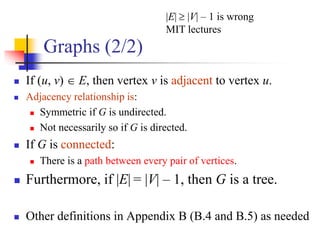
 If (u, v)  E, then vertex v is adjacent to vertex u.
 Adjacency relationship is:
 Symmetric if G is undirected.
 Not necessarily so if G is directed.
 If G is connected:
 There is a path between every pair of vertices.
 Furthermore, if |E| = |V| – 1, then G is a tree.
 Other definitions in Appendix B (B.4 and B.5) as needed
|E|  |V| – 1 is wrong
MIT lectures
Representation of Graphs
 Two standard ways.
 Adjacency Lists.
 Adjacency Matrix
Dr. Hanif Durad 6
a
dc
b a
b
c
d
b
a
d
d c
c
a b
a c
a
dc
b
1 2
3 4
1 2 3 4
1 0 1 1 1
2 1 0 1 0
3 1 1 0 1
4 1 0 1 0
Adjacency Lists
 Consists of an array Adj of |V| lists.
 One list per vertex.
 For u  V, Adj[u] consists of all vertices adjacent to u.
a
dc
b a
b
c
d
b
c
d
d c
a
dc
b a
b
c
d
b
a
d
d c
c
a b
a c
If weighted, store weights also in
adjacency lists.
Storage Requirement
 For directed graphs:
 Sum of lengths of all adj. lists is
out-degree(v) = |E|
vV
 Total storage: (V+E)
 For undirected graphs:
 Sum of lengths of all adj. lists is
degree(v) = 2|E|
vV
 Total storage: (V+E)
No. of edges leaving v
No. of edges incident on v. Edge (u,v) is incident
on vertices u and v.
Pros and Cons: Adjacency Lists
 Pros
 Space-efficient, when a graph is sparse.
 Can be modified to support many graph variants.
 Cons
 Determining if an edge (u,v) G is not efficient.
 Have to search in u’s adjacency list. (degree(u)) time.
 (V) in the worst case.
Dr. Hanif Durad 9
Adjacency Matrix
 V|  |V| matrix A.
 Number vertices from 1 to |V| in some arbitrary manner.
 A is then given by:
a
dc
b
3 4
1 2 3 4
1 0 1 1 1
2 0 0 1 0
3 0 0 0 1
4 0 0 0 0
a
dc
b
1 2
3 4
1 2 3 4
1 0 1 1 1
2 1 0 1 0
3 1 1 0 1
4 1 0 1 0


 

otherwise0
),(if1
],[
Eji
ajiA ij
A = AT for undirected graphs.
Space and Time
 Space: (V2).
 Not memory efficient for large graphs.
 Time: to list all vertices adjacent to u: (V).
 Time: to determine if (u, v)  E: (1).
 Can store weights instead of bits for weighted graph.
Dr. Hanif Durad 11
Assignment 1
 Problems 22.1-1  22.1-3, 22.1-5 22.4-7,
page 530 531
 Last Date
 Tuesday -15 June 2010
Dr. Hanif Durad 12
Graph-searching Algorithms
 Searching a graph:
 Systematically follow the edges of a graph to visit the vertices
of the graph.
 Used to discover the structure of a graph.
 Efficiency and correctness
 Efficiency: Don’t loop or visit vertices repeatedly.
 Correctness: Don’t miss any vertex.
Dr. Hanif Durad 13
Ref: lecture11_elementary_graph_algorithms.pdf
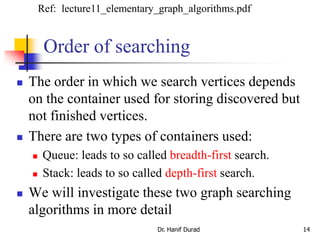
Order of searching
 The order in which we search vertices depends
on the container used for storing discovered but
not finished vertices.
 There are two types of containers used:
 Queue: leads to so called breadth-first search.
 Stack: leads to so called depth-first search.
 We will investigate these two graph searching
algorithms in more detail
Dr. Hanif Durad 14
Ref: lecture11_elementary_graph_algorithms.pdf
22.2 Breadth-First
Search (BFS)
Dr. Hanif Durad 15
Breadth-First Search (BFS)
 Input: Graph G = (V, E), either directed or undirected,
and source vertex s  V.
 Output:
 d[v] = distance (smallest # of edges, or shortest path) from s
to v, for all v  V. d[v] =  if v is not reachable from s.
 [v] = u such that (u, v) is last edge on “shortest path” from s
to v.
 u is v’s predecessor.
 Builds breadth-first tree with root s that contains all reachable
vertices.
16
19-graph1.ppt
Shortest Path- path containing smallest no. of edges
Data Structure for BFS
 Expands the frontier between discovered and undiscovered
vertices uniformly across the breadth of the frontier.
 A vertex is “discovered” the first time it is encountered during the
search.
 A vertex is “finished” if all vertices adjacent to it have been
discovered.
 Colors the vertices to keep track of progress.
 White – Undiscovered.
 Gray – Discovered but not finished.
 Black – Finished.
 Colors are required only to reason about the algorithm. Can be implemented
without colors.
19-graph1.ppt
BFS for Shortest Paths
Dr. Hanif Durad 18
FinishedDiscoveredUndiscovered
S
11
1
S2
2
2
2
2
2
S
3
3 3
3
3
19
BFS(G,s)
1. for each vertex u in V[G] – {s}
2 do color[u]  white
3 d[u]  
4 [u]  nil
5 color[s]  gray
6 d[s]  0
7 [s]  nil
8 Q  
9 enqueue(Q,s)
10 while Q  
11 do u  dequeue(Q)
12 for each v in Adj[u]
13 do if color[v] = white
14 then color[v]  gray
15 d[v]  d[u] + 1
16 [v]  u
17 enqueue(Q,v)
18 color[u]  black
white: undiscovered
gray: discovered
black: finished
Q: a queue of discovered
vertices
color[v]: color of v
d[v]: distance from s to v
[u]: predecessor of v
Example: animation.
Initialization
Set up s and initialize Q
Explore all the vertices
adjacent to u and update
d,  and Q
Example (BFS)
 0
  
 

r s t u
v w x y
Q: s
0
(Courtesy of Prof. Jim Anderson)
Dr. Hanif Durad 20
Example (BFS)
1 0
1  
 

r s t u
v w x y
Q: w r
1 1
Dr. Hanif Durad 21
Example (BFS)
1 0
1 2 
2 

r s t u
v w x y
Q: r t x
1 2 2
Dr. Hanif Durad 22
Example (BFS)
1 0
1 2 
2 
2
r s t u
v w x y
Q: t x v
2 2 2
Dr. Hanif Durad 23
Example (BFS)
1 0
1 2 
2 3
2
r s t u
v w x y
Q: x v u
2 2 3
Dr. Hanif Durad 24
Example (BFS)
1 0
1 2 3
2 3
2
r s t u
v w x y
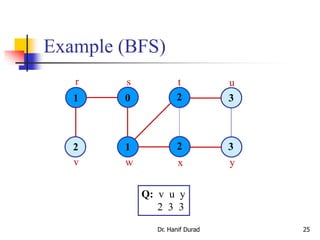
Q: v u y
2 3 3
Dr. Hanif Durad 25
Example (BFS)
1 0
1 2 3
2 3
2
r s t u
v w x y
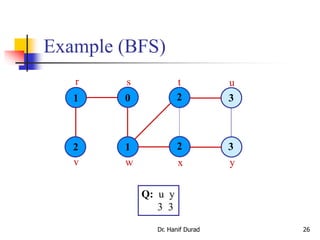
Q: u y
3 3
Dr. Hanif Durad 26
Example (BFS)
1 0
1 2 3
2 3
2
r s t u
v w x y
Q: y
3
Dr. Hanif Durad 27
Example (BFS)
1 0
1 2 3
2 3
2
r s t u
v w x y
Q: 
Output=?
Dr. Hanif Durad 28
Analysis of BFS (1/2)
 Initialization takes O(V).
 Outer loop (while):
 Can we bound the time until Q becomes empty?
 Only white vertices are enqueued, and they are
always grayed when enqueued
 Thus a vertex can be enqueued at most once
 One vertex dequeued for every lap
 Thus outer while loop executed O(|V|) times
29Dr. Hanif Durad
Analysis of BFS (2/2)
 Inner loop (for):
 The adjacency list of a vertex is scanned at most once,
and each element in the list is accessed only once
 Thus, the total time in inner loop is proportional
to sum of lengths of all adjacency lists O(|E|)
 Whole loop nest  O(|V|) + O(|E|) = O(|V| + |E|)
 Correctness Proof
 Self Study
30Dr. Hanif Durad
O(|V| + |E|)≠O (|EV|)
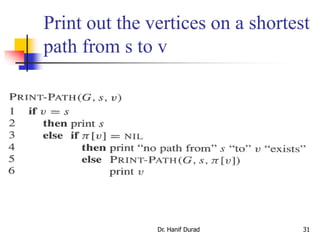
Print out the vertices on a shortest
path from s to v
Dr. Hanif Durad 31
PRINT-PATH Illustration
Dr. Hanif Durad 32
(1) PRINT-PATH(G, s, y)
(2) PRINT-PATH(G, s, x)
y
(3) PRINT-PATH(G, s, w)
x
y
(4) PRINT-PATH(G, s, s)
w
x
y
(5) s
w
x
y
BF Tree 1
3
y
1
r 0
s
2
t
3
u
2
v 2
x
BF Tree
1
w
Unique ?
Predecessor Subgraph
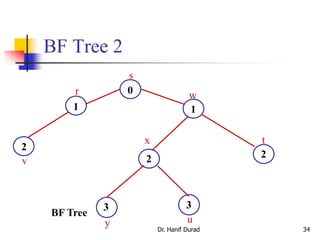
BF Tree 2
1
r 0
s
2
t
2
v 2
x
BF Tree
1
w
3
y
3
u
Dr. Hanif Durad 34
BF Tree 3
3
y
1
r 0
s
2
t
3
u
2
v 2
x
BF Tree
1
w
Dr. Hanif Durad 35
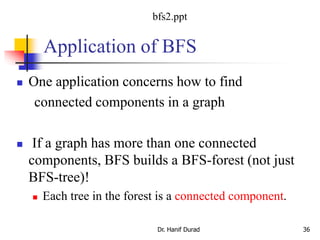
Application of BFS
 One application concerns how to find
connected components in a graph
 If a graph has more than one connected
components, BFS builds a BFS-forest (not just
BFS-tree)!
 Each tree in the forest is a connected component.
Dr. Hanif Durad 36
bfs2.ppt
BFS-forest
 Tree
 connected graph
without cycles
 Forest
 collection of trees
22_Graph.pdf
Dr. Hanif Durad 37
Assignment 2
 Problems 22.2-1, 22.2-3 22.4-8, Page 538
539
 C++ coding for BFS problem
 Last Date
 Tuesday -15 June 2010
Dr. Hanif Durad 38
22.3 Depth-First
Search (DFS)
Dr. Hanif Durad 39
Depth-first Search (DFS)
 Explore edges out of the most recently discovered vertex v.
 When all edges of v have been explored, “backtrack” to
explore other edges leaving the vertex from which v was
discovered (its predecessor).
 “Search as deep as possible first.”
 Continue until all vertices reachable from the original
source are discovered.
 If any undiscovered vertices remain, then one of them is
chosen as a new source and search is repeated from that
source.
19-graph1.ppt
Dr. Hanif Durad 40
Data Structure for DFS
 Adjacency list
 color[u] for each vertex
 WHITE if u has not been discovered
 GRAY if u is discovered but not finished
 BLACK if u is finished
 Timestamps: 1  d[u] < f[u]  2|V|
 d[u] records when u is first discovered (and grayed)
 f[u] records when the search finishes examining u’s
adjacency list (and blacken u)
 [u] for predecessor of u
unit14.ppt
Depth-first Search (DFS)
 Input: G = (V, E), directed or undirected. No source
vertex given!
 Output:
 2 timestamps on each vertex. Integers between 1 and
2|V|.
 d[v] = discovery time (v turns from white to gray)
 f [v] = finishing time (v turns from gray to black)
 [v] : predecessor of v = u, such that v was discovered
during the scan of u’s adjacency list.
 Uses the same coloring scheme for vertices as BFS.
19-graph1.ppt
Pseudo-code
DFS(G)
1. for each vertex u  V[G]
2. do color[u]  white
3. [u]  NIL
4. time  0
5. for each vertex u  V[G]
6. do if color[u] = white
7. then DFS-Visit(u)
Uses a global timestamp time.
DFS-Visit(u)
1. color[u]  GRAY  White vertex u
has been discovered
2. time  time + 1
3. d[u]  time
4. for each v  Adj[u]
5. do if color[v] = WHITE
6. then [v]  u
7. DFS-Visit(v)
8. color[u]  BLACK  Blacken u;
it is finished.
9. f[u]  time  time + 1
Example: animation.
43
Init all
vertices
Visit all
children
recursively
Dr. Hanif Durad
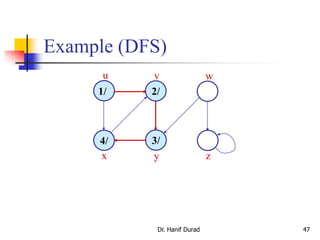
Example (DFS)
1/
u v w
x y z
(Courtesy of Prof. Jim Anderson)
Dr. Hanif Durad 44
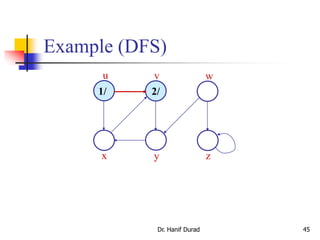
Example (DFS)
1/ 2/
u v w
x y z
Dr. Hanif Durad 45
Example (DFS)
1/
3/
2/
u v w
x y z
Dr. Hanif Durad 46
Example (DFS)
1/
4/ 3/
2/
u v w
x y z
Dr. Hanif Durad 47
Example (DFS)
1/
4/ 3/
2/
u v w
x y z
B
Dr. Hanif Durad 48
Example (DFS)
1/
4/5 3/
2/
u v w
x y z
B
Dr. Hanif Durad 49
Example (DFS)
1/
4/5 3/6
2/
u v w
x y z
B
Dr. Hanif Durad 50
Example (DFS)
1/
4/5 3/6
2/7
u v w
x y z
B
Dr. Hanif Durad 51
Example (DFS)
1/
4/5 3/6
2/7
u v w
x y z
BF
Dr. Hanif Durad 52
Example (DFS)
1/8
4/5 3/6
2/7
u v w
x y z
BF
Dr. Hanif Durad 53
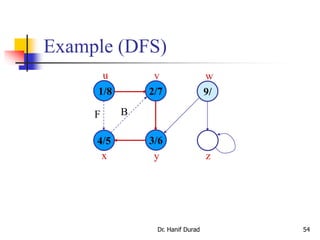
Example (DFS)
1/8
4/5 3/6
2/7 9/
u v w
x y z
BF
Dr. Hanif Durad 54
Example (DFS)
1/8
4/5 3/6
2/7 9/
u v w
x y z
BF C
Dr. Hanif Durad 55
Example (DFS)
1/8
4/5 3/6 10/
2/7 9/
u v w
x y z
BF C
Dr. Hanif Durad 56
Example (DFS)
1/8
4/5 3/6 10/
2/7 9/
u v w
x y z
BF C
B
Dr. Hanif Durad 57
Example (DFS)
1/8
4/5 3/6 10/11
2/7 9/
u v w
x y z
BF C
B
Dr. Hanif Durad 58
Example (DFS)
1/8
4/5 3/6 10/11
2/7 9/12
u v w
x y z
BF C
B
Dr. Hanif Durad 59
Analysis of DFS
 Loops on lines 1-2 & 5-7 take (V) time,
excluding time to execute DFS-Visit.
 DFS-Visit is called once for each white vertex vV
when it’s painted gray the first time. Lines 3-6 of
DFS-Visit is executed |Adj[v]| times. The total
cost of executing DFS-Visit is vV|Adj[v]| = (E)
 Total running time of DFS is (V+E).
Dr. Hanif Durad 60
Output
 Tree or forest ?
 Is there any other forest possibility ?
1/8
4/5 3/6 10/11
2/7 9/12
x y z
BF C
B
Forest
Yes
 May depend upon order
 examined in line 5 of DFS,
 order in which the neighbors visited in line 4 of
DFS-VISIT.
 Don’t to cause problems in practice result
with essentially equivalent results
IA, P-542
Depth-First Trees
 Predecessor subgraph defined slightly different from
that of BFS.
 The predecessor subgraph of DFS is G = (V, E) where
E ={([v],v) : v  V and [v]  NIL}.
 How does it differ from that of BFS?
 The predecessor subgraph G forms a depth-first forest
composed of several depth-first trees. The edges in E are
called tree edges.
Dr. Hanif Durad 62
Definition:
Forest: An acyclic graph G that may be disconnected.
DFS on Undirected Graphs
 DFS on an undirected graph is complicated by the fact
that edges should be explored in one direction only,
 but they are represented twice in the data structure
(symmetric digraph equivalence)
 Depth-first search provides an orientation for each of its
edges
 they are oriented in the direction in which they are first
encountered (during exploring)
 the reverse direction is then ignored.
Dr. Hanif Durad 63
Modify Algo ?
CH07.ppt, P 32/36
Theorem 22.7
For all u, v, exactly one of the following holds:
1. d[u] < f [u] < d[v] < f [v] or d[v] < f [v] < d[u] < f [u] and neither
u nor v is a descendant of the other.
2. d[u] < d[v] < f [v] < f [u] and v is a descendant of u.
3. d[v] < d[u] < f [u] < f [v] and u is a descendant of v.
 So d[u] < d[v] < f [u] < f [v] cannot happen.
 Like parentheses:
 OK: ( ) [ ] ( [ ] ) [ ( ) ]
 Not OK: ( [ ) ] [ ( ] )
Corollary
v is a proper descendant of u if and only if d[u] < d[v] < f [v] < f [u].
Parenthesis Theorem
19-graph1.ppt
Dr. Hanif Durad 65
Relation to Stack ?
Stack Stack
White-path Theorem
Dr. Hanif Durad 66
Theorem 22.9
The white path property states that v is a descendant of u if
and only if, at the time of discovery of u, there is a white path
from u to v.
http://www.cs.mcgill.ca/~cs251/OldCourses/1997/topic26/
 Proof
 Self Study
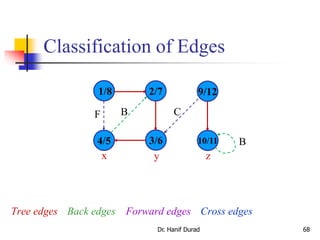
Classification of Edges
 Tree edge: in the depth-first forest. Found by
exploring (u, v).
 Back edge: (u, v), where u is a descendant of v (in
the depth-first tree).
 Forward edge: (u, v), where v is a descendant of
u, but not a tree edge.
 Cross edge: any other edge. Can go between
vertices in same depth-first tree or in different
depth-first trees.
Dr. Hanif Durad 67
Classification of Edges
Dr. Hanif Durad 68
1/8
4/5 3/6 10/11
2/7 9/12
x y z
BF C
B
Tree edges Back edges Forward edges Cross edges
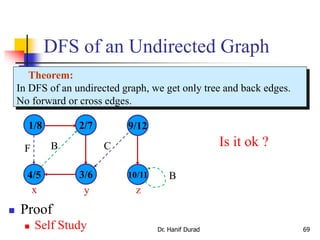
DFS of an Undirected Graph
Dr. Hanif Durad 69
Theorem:
In DFS of an undirected graph, we get only tree and back edges.
No forward or cross edges.
 Proof
 Self Study
1/8
4/5 3/6 10/11
2/7 9/12
x y z
BF C
B
Is it ok ?
Assignment 3
 Problems 22.3-1, 22.3-4, 22.3-7, 22.3-9 
22.3-12, Page 547 549
 C++ coding for DFS problem
 Last Date
 Tuesday -22 June 2010
Dr. Hanif Durad 70
Applications of
Depth-First
Search
Dr. Hanif Durad 71
22.4 Topological
Sort
Dr. Hanif Durad 72
Directed Acyclic Graph (DAG)
 A directed path is a sequence of vertices
(v0, v1, . . . , vk)
 Such that (vi, vi+1) is an arc
 A directed cycle is a directed path such that the
first and last vertices are the same.
 A directed graph is acyclic if it does not contain
any directed cycles
Dr. Hanif Durad 73
connectivity-directed_graph.ppt
Topological Sort
 A topological sort of a DAG is a linear order of all
its vertices such that if G contains an edge (u, v),
then u appears before v in the ordering
 If the graph is not acyclic, then no linear ordering is
possible.
 A topological sort can be viewed as an ordering of its
vertices along a horizontal line so that all directed edges
go from left to right
 DAG are used in many applications to indicate
precedence among events
unit14.ppt
Topological Sort
Dr. Hanif Durad 75
Topological-Sort (G)
1. call DFS(G) to compute finishing times f [v] for all v  V
2. as each vertex is finished, insert it onto the front of a linked
list
3. return the linked list of vertices
Time: (V + E).
20-graph2.ppt
Characterizing a DAG (1/2)
Proof: : Show that back edge  cycle.
 Suppose there is a back edge (u, v). Then v is ancestor of
u in depth-first forest.
 Therefore, there is a path from v u, so v u v is
a cycle.
76
Lemma 22.11
A directed graph G is acyclic iff a DFS of G yields no back edges.
v u
T T T
B
20-graph2.ppt
Characterizing a DAG (2/2)
 Proof (Contd.):  : Show that a cycle implies a back edge.
 c : cycle in G, v : first vertex discovered in c, (u, v) : preceding
edge in c.
 At time d[v], vertices of c form a white path v u. Why?
 By white-path theorem, u is a descendent of v in depth-first forest.
 Therefore, (u, v) is a back edge.
77
Lemma 22.11
A directed graph G is acyclic iff a DFS of G yields no back edges.
v u
T T T
B
20-graph2.ppt
78
unit14.ppt
Theorem 22.12
• TOPOLOGICAL-SORT(G) produces a
topological sort of a directed acyclic graph G
– Suppose that DFS is run on a given DAG G to determine
finishing times for its vertices. It suffices to show that for
any pair of distinct vertices u, v, if there is an edge in G
from u to v, then f[v] < f[u].
• The linear ordering is corresponding to finishing time ordering
– Consider any edge (u, v) explored by DFS(G). When this
edge is explored, v cannot be gray (otherwise, (u, v) will be
a back edge). Therefore v must be either white or black
• If v is white, v becomes a descendant of u, f[v] <f[u] (ex. pants &
shoes)
• If v is black, it has already been finished, so that f[v] has already
been set  f[v] < f[u] (ex. belt & jacket)
Dr. Hanif Durad 79
Self Study
Assignment 4
 Problems 22.4-1 22.4-5, Page 551 552
 C++ coding for Topological Sort
 Last Date
 Tuesday -22 June 2010
Dr. Hanif Durad 80
Strongly Connected Components
 G is strongly connected if every pair (u, v) of vertices in
G is reachable from one another.
 A strongly connected component (SCC) of G is a
maximal set of vertices C  V such that for all u, v  C,
both u v and v u exist.
20-graph2.ppt
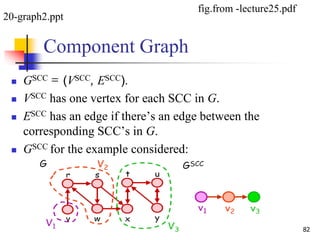
Component Graph
 GSCC = (VSCC, ESCC).
 VSCC has one vertex for each SCC in G.
 ESCC has an edge if there’s an edge between the
corresponding SCC’s in G.
 GSCC for the example considered:
Dr. Hanif Durad 82
20-graph2.ppt
fig.from -lecture25.pdf
GSCC is a DAG
Dr. Hanif Durad 83
Lemma 22.13
Let C and C be distinct SCC’s in G, let u, v  C, u, v  C, and
suppose there is a path u u in G. Then there cannot also be a path
v v in G.
Proof:
 Suppose there is a path v v in G.
 Then there are paths u u v and v v u in G.
 Therefore, u and v are reachable from each other, so
they are not in separate SCC’s.
20-graph2.ppt
Transpose of a Directed Graph
 GT = transpose of directed G.
 GT = (V, ET), ET = {(u, v) : (v, u)  E}.
 GT is G with all edges reversed.
 Can create GT in Θ(V + E) time if using adjacency
lists.
 G and GT have the same SCC’s. (u and v are
reachable from each other in G if and only if
reachable from each other in GT.)
Dr. Hanif Durad 84
20-graph2.ppt
Algorithm to determine SCCs
Dr. Hanif Durad 85
SCC(G)
1. call DFS(G) to compute finishing times f [u] for all u
2. compute GT
3. call DFS(GT), but in the main loop, consider vertices in order of
decreasing f [u] (as computed in first DFS)
4. output the vertices in each tree of the depth-first forest formed in
second DFS as a separate SCC
Time: (V + E).
20-graph2.ppt
Example (1/5)
Dr. Hanif Durad 86
(Courtesy of Prof. Jim Anderson)
13/14
12/15 3/4 2/7
11/16 1/10
a b c
e f g
5/6
8/9
h
d
G
Sort nodes on their finishing time:
b,e,a,c,d,g,f,h
1. call DFS(G) to compute finishing times f [u] for all u
20-graph2.ppt
text taken from: lecture11_elementary_graph_algorithms.pdf
Example (2/5)
Dr. Hanif Durad 87
a b c
e f g h
d
GT
2. compute GT
Example (3/5)
Dr. Hanif Durad 88
(Courtesy of Prof. Jim Anderson)
Deep- first- trees found: {b,a,e}, {c,d}, {g,f}, {h}
3. call DFS(GT), but in the main loop, consider vertices in order of
decreasing f [u] (as computed in line 1  b,e,a,c,d,g,f,h)
a b c
e f g h
d
GT
Example (4/5)
Dr. Hanif Durad 89
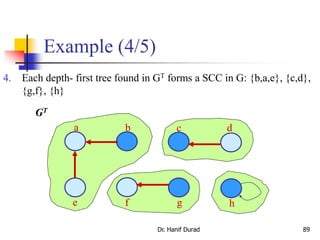
4. Each depth- first tree found in GT forms a SCC in G: {b,a,e}, {c,d},
{g,f}, {h}
a b c
e f g h
d
GT
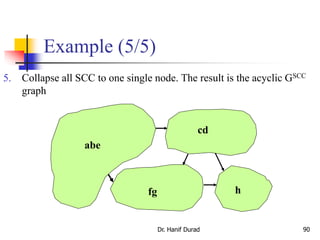
Example (5/5)
Dr. Hanif Durad 90
cd
hfg
abe
5. Collapse all SCC to one single node. The result is the acyclic GSCC
graph
Analysis of SCC algorithm
1. Call DFS(G) to compute finishing times f[u] for each
vertex u in G Θ(V + E)
2. Compute transpose graph GT  Θ(V + E)
3. Call DFS(GT), but in he main loop, consider the
vertices in decreasing f[u] (as computed in line 1)
 Θ(V + E)
4. Collapse each depth-first tree found in GT to a SCC
 Θ(V + E)
Overall total time: Θ(V + E)
Dr. Hanif Durad 91
Assignment 5
 Section Problems 22.5-1, 22.5-3, 22.5-5
22.5-6, Page 557
 Chapter Problems 22-122-4 Page 558 560
 C++ coding for SCC
 Last Date
 Tuesday -22 June 2010
Dr. Hanif Durad 92
Graph Connectivity
 Connectivity
 Biconnectivity
 Articulation Points and Bridges
 Connectivity in Directed Graphs
Dr. Hanif Durad 93
L25-Connectivity.ppt
Connectivity
 Definition:
 An undirected graph is said to be connected if for
any pair of nodes of the graph, the two nodes are
reachable from one another (i.e. there is a path
between them).
 If starting from any vertex we can visit all other
vertices, then the graph is connected
Dr. Hanif Durad 94
Biconnectivity
Dr. Hanif Durad 95
A graph is biconnected, if there are no vertices
whose removal will disconnect the graph.
A B
C
D
E
A B
C
D
E
biconnected not biconnected
Articulation Points
Dr. Hanif Durad 96
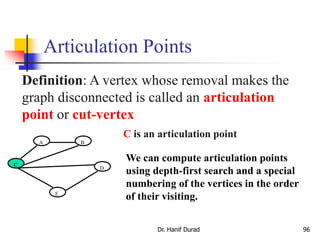
Definition: A vertex whose removal makes the
graph disconnected is called an articulation
point or cut-vertex
A B
C
D
E
C is an articulation point
We can compute articulation points
using depth-first search and a special
numbering of the vertices in the order
of their visiting.
Bridges
Dr. Hanif Durad 97
Definition:
An edge in a graph is called a bridge, if its removal
disconnects the graph.
Any edge in a graph, that does not lie on a cycle, is a bridge.
Obviously, a bridge has at least one articulation point at its end,
however an articulation point is not necessarily linked in a bridge.
A B
C
D
E
(C,D) and (E,D) are bridges
98
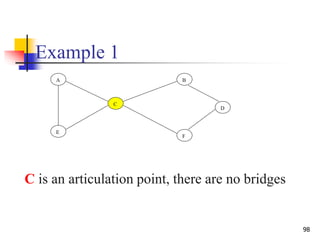
Example 1
A B
C
E
F
D
C is an articulation point, there are no bridges
99
Example 2
A B
C
E
F
D
C is an articulation point, CB is a bridge
100
Example 3
A
B
C
E
F
G
D
B and C are articulation points, BC is a bridge
101
Example 4
A
B C D
E
B and C are articulation points. All edges are bridges
102
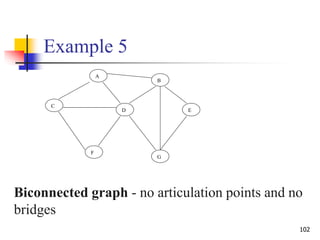
Example 5
A
B
C
D E
F
G
Biconnected graph - no articulation points and no
bridges
103
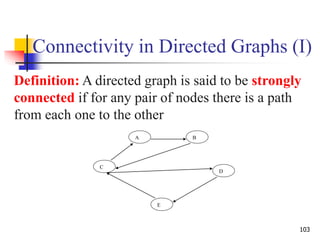
Connectivity in Directed Graphs (I)
Definition: A directed graph is said to be strongly
connected if for any pair of nodes there is a path
from each one to the other
A B
C
D
E
104
Connectivity in Directed Graphs
(II)
Definition: A directed graph is said to be
unilaterally connected if for any pair of nodes at
least one of the nodes is reachable from the other
A B
C
D
E
Each strongly
connected graph is
also unilaterally
connected.
105
Connectivity in Directed Graphs
(III)
Definition: A directed graph is said to be weakly
connected if the underlying undirected graph is
connected
A B
C
D
E
There is no path
between B and D
Each unilaterally
connected graph is
also weakly connected
Self Study Articles
 Articulation Points and Bridges
 Bi-connected Component
 Algorithm to Articulation Points in a Graph
 Euler Tour
 Reachability
Dr. Hanif Durad 106
Are Related Chapter Problems 22-122-4
Page 558 560
Self Study Slides
from here onward
Dr. Hanif Durad 107
How does it work? (1/2)
 Idea:
 By considering vertices in second DFS in decreasing
order of finishing times from first DFS, we are
visiting vertices of the component graph in
topologically sorted order.
 Because we are running DFS on GT, we will not be
visiting any v from a u, where v and u are in different
components.
Dr. Hanif Durad 108
How does it work? (2/2)
 Notation:
 d[u] and f [u] always refer to first DFS.
 Extend notation for d and f to sets of vertices U  V:
 d(U) = minuU{d[u]} (earliest discovery time)
 f (U) = maxuU{ f [u]} (latest finishing time)
Dr. Hanif Durad 109
110
SCCs and DFS finishing times
Proof:
 Case 1: d(C) < d(C)
» Let x be the first vertex discovered in
C.
» At time d[x], all vertices in C and C
are white. Thus, there exist paths of
white vertices from x to all vertices in
C and C.
» By the white-path theorem, all
vertices in C and C are descendants
of x in depth-first tree.
» By the parenthesis theorem, f [x] = f
(C) > f(C).
Lemma 22.14
Let C and C be distinct SCC’s in G = (V, E). Suppose there is an
edge (u, v)  E such that u  C and v C. Then f (C) > f (C).
C C
u v
x
111
SCCs and DFS finishing times
Proof:
 Case 2: d(C) > d(C)
» Let y be the first vertex discovered in C.
» At time d[y], all vertices in C are white
and there is a white path from y to each
vertex in C  all vertices in C become
descendants of y. Again, f [y] = f (C).
» At time d[y], all vertices in C are also
white.
» By earlier lemma, since there is an edge
(u, v), we cannot have a path from C to
C.
» So no vertex in C is reachable from y.
» Therefore, at time f [y], all vertices in C
are still white.
» Therefore, for all w  C, f [w] > f [y],
which implies that f (C) > f (C).
Lemma 22.14
Let C and C be distinct SCC’s in G = (V, E). Suppose there is an
edge (u, v)  E such that u  C and v C. Then f (C) > f (C).
C C
u v
yx
112
SCCs and DFS finishing times
Dr. Hanif Durad
Proof:
 (u, v)  ET  (v, u)  E.
 Since SCC’s of G and GT are the same, f(C) > f (C),
by Lemma 22.14.
Corollary 22.15
Let C and C be distinct SCC’s in G = (V, E). Suppose there is an edge
(u, v)  ET, where u  C and v  C. Then f(C) < f(C).
Correctness of SCC (1/3)
 When we do the second DFS, on GT, start with
SCC C such that f(C) is maximum.
 The second DFS starts from some x  C, and it visits
all vertices in C.
 Corollary 22.15 says that since f(C) > f (C) for all C
 C, there are no edges from C to C in GT.
 Therefore, DFS will visit only vertices in C.
 Which means that the depth-first tree rooted at x
contains exactly the vertices of C.
Dr. Hanif Durad 113
Correctness of SCC (2/3)
 The next root chosen in the second DFS is in
SCC C such that f (C) is maximum over all
SCC’s other than C.
 DFS visits all vertices in C, but the only edges out of
C go to C, which we’ve already visited.
 Therefore, the only tree edges will be to vertices in C.
 We can continue the process.
Dr. Hanif Durad 114
Correctness of SCC (3/3)
 Each time we choose a root for the second DFS,
it can reach only
 vertices in its SCC—get tree edges to these,
 vertices in SCC’s already visited in second DFS—get
no tree edges to these.
Dr. Hanif Durad 115

Chapter 23 aoa

  • 1.
    Chapter 23 Elementary Graph Algorithms Dr.Muhammad Hanif Durad Department of Computer and Information Sciences Pakistan Institute Engineering and Applied Sciences hanif@pieas.edu.pk Some slides have bee adapted with thanks from some other lectures available on Internet. It made my life easier, thanks to Allah Almighty .
  • 2.
    Lecture Outline  Definitionand Representation  Breadth-First Search  Depth-First Search  Topological Sort  Strongly Connected Components (SCC)
  • 3.
    Importance of Graphs Used to model a huge number of important (electrical and computer) engineering problems  General Scheduling and Allocation Problems  relevant to parallel processing, manufacturing, etc…  Design of Digital Systems (Synthesis, Verification and Test)  from the physical level of abstraction to the system of abstraction  Compilers  All phases of compilation  Analysis and Design of Communication Networks  routing, bandwidth allocation, etc… 3 SL10.ppt
  • 4.
    Graphs (1/2)  GraphG = (V, E)  V = set of vertices and E = set of edges  Types of graphs  Undirected: edge (u, v) = (v, u); for all v, (v, v)  E (No self loops.)  Directed: (u, v) is edge from u to v, denoted as u  v. Self loops are allowed.  Weighted: each edge has an associated weight, given by a weight function w : E  R.  Dense: |E|  |V|2.  Sparse: |E| << |V|2  |E| = O(|V|2) 19-graph1.ppt
  • 5.
    Graphs (2/2)  If(u, v)  E, then vertex v is adjacent to vertex u.  Adjacency relationship is:  Symmetric if G is undirected.  Not necessarily so if G is directed.  If G is connected:  There is a path between every pair of vertices.  Furthermore, if |E| = |V| – 1, then G is a tree.  Other definitions in Appendix B (B.4 and B.5) as needed |E|  |V| – 1 is wrong MIT lectures
  • 6.
    Representation of Graphs Two standard ways.  Adjacency Lists.  Adjacency Matrix Dr. Hanif Durad 6 a dc b a b c d b a d d c c a b a c a dc b 1 2 3 4 1 2 3 4 1 0 1 1 1 2 1 0 1 0 3 1 1 0 1 4 1 0 1 0
  • 7.
    Adjacency Lists  Consistsof an array Adj of |V| lists.  One list per vertex.  For u  V, Adj[u] consists of all vertices adjacent to u. a dc b a b c d b c d d c a dc b a b c d b a d d c c a b a c If weighted, store weights also in adjacency lists.
  • 8.
    Storage Requirement  Fordirected graphs:  Sum of lengths of all adj. lists is out-degree(v) = |E| vV  Total storage: (V+E)  For undirected graphs:  Sum of lengths of all adj. lists is degree(v) = 2|E| vV  Total storage: (V+E) No. of edges leaving v No. of edges incident on v. Edge (u,v) is incident on vertices u and v.
  • 9.
    Pros and Cons:Adjacency Lists  Pros  Space-efficient, when a graph is sparse.  Can be modified to support many graph variants.  Cons  Determining if an edge (u,v) G is not efficient.  Have to search in u’s adjacency list. (degree(u)) time.  (V) in the worst case. Dr. Hanif Durad 9
  • 10.
    Adjacency Matrix  V| |V| matrix A.  Number vertices from 1 to |V| in some arbitrary manner.  A is then given by: a dc b 3 4 1 2 3 4 1 0 1 1 1 2 0 0 1 0 3 0 0 0 1 4 0 0 0 0 a dc b 1 2 3 4 1 2 3 4 1 0 1 1 1 2 1 0 1 0 3 1 1 0 1 4 1 0 1 0      otherwise0 ),(if1 ],[ Eji ajiA ij A = AT for undirected graphs.
  • 11.
    Space and Time Space: (V2).  Not memory efficient for large graphs.  Time: to list all vertices adjacent to u: (V).  Time: to determine if (u, v)  E: (1).  Can store weights instead of bits for weighted graph. Dr. Hanif Durad 11
  • 12.
    Assignment 1  Problems22.1-1  22.1-3, 22.1-5 22.4-7, page 530 531  Last Date  Tuesday -15 June 2010 Dr. Hanif Durad 12
  • 13.
    Graph-searching Algorithms  Searchinga graph:  Systematically follow the edges of a graph to visit the vertices of the graph.  Used to discover the structure of a graph.  Efficiency and correctness  Efficiency: Don’t loop or visit vertices repeatedly.  Correctness: Don’t miss any vertex. Dr. Hanif Durad 13 Ref: lecture11_elementary_graph_algorithms.pdf
  • 14.
    Order of searching The order in which we search vertices depends on the container used for storing discovered but not finished vertices.  There are two types of containers used:  Queue: leads to so called breadth-first search.  Stack: leads to so called depth-first search.  We will investigate these two graph searching algorithms in more detail Dr. Hanif Durad 14 Ref: lecture11_elementary_graph_algorithms.pdf
  • 15.
  • 16.
    Breadth-First Search (BFS) Input: Graph G = (V, E), either directed or undirected, and source vertex s  V.  Output:  d[v] = distance (smallest # of edges, or shortest path) from s to v, for all v  V. d[v] =  if v is not reachable from s.  [v] = u such that (u, v) is last edge on “shortest path” from s to v.  u is v’s predecessor.  Builds breadth-first tree with root s that contains all reachable vertices. 16 19-graph1.ppt Shortest Path- path containing smallest no. of edges
  • 17.
    Data Structure forBFS  Expands the frontier between discovered and undiscovered vertices uniformly across the breadth of the frontier.  A vertex is “discovered” the first time it is encountered during the search.  A vertex is “finished” if all vertices adjacent to it have been discovered.  Colors the vertices to keep track of progress.  White – Undiscovered.  Gray – Discovered but not finished.  Black – Finished.  Colors are required only to reason about the algorithm. Can be implemented without colors. 19-graph1.ppt
  • 18.
    BFS for ShortestPaths Dr. Hanif Durad 18 FinishedDiscoveredUndiscovered S 11 1 S2 2 2 2 2 2 S 3 3 3 3 3
  • 19.
    19 BFS(G,s) 1. for eachvertex u in V[G] – {s} 2 do color[u]  white 3 d[u]   4 [u]  nil 5 color[s]  gray 6 d[s]  0 7 [s]  nil 8 Q   9 enqueue(Q,s) 10 while Q   11 do u  dequeue(Q) 12 for each v in Adj[u] 13 do if color[v] = white 14 then color[v]  gray 15 d[v]  d[u] + 1 16 [v]  u 17 enqueue(Q,v) 18 color[u]  black white: undiscovered gray: discovered black: finished Q: a queue of discovered vertices color[v]: color of v d[v]: distance from s to v [u]: predecessor of v Example: animation. Initialization Set up s and initialize Q Explore all the vertices adjacent to u and update d,  and Q
  • 20.
    Example (BFS)  0      r s t u v w x y Q: s 0 (Courtesy of Prof. Jim Anderson) Dr. Hanif Durad 20
  • 21.
    Example (BFS) 1 0 1     r s t u v w x y Q: w r 1 1 Dr. Hanif Durad 21
  • 22.
    Example (BFS) 1 0 12  2   r s t u v w x y Q: r t x 1 2 2 Dr. Hanif Durad 22
  • 23.
    Example (BFS) 1 0 12  2  2 r s t u v w x y Q: t x v 2 2 2 Dr. Hanif Durad 23
  • 24.
    Example (BFS) 1 0 12  2 3 2 r s t u v w x y Q: x v u 2 2 3 Dr. Hanif Durad 24
  • 25.
    Example (BFS) 1 0 12 3 2 3 2 r s t u v w x y Q: v u y 2 3 3 Dr. Hanif Durad 25
  • 26.
    Example (BFS) 1 0 12 3 2 3 2 r s t u v w x y Q: u y 3 3 Dr. Hanif Durad 26
  • 27.
    Example (BFS) 1 0 12 3 2 3 2 r s t u v w x y Q: y 3 Dr. Hanif Durad 27
  • 28.
    Example (BFS) 1 0 12 3 2 3 2 r s t u v w x y Q:  Output=? Dr. Hanif Durad 28
  • 29.
    Analysis of BFS(1/2)  Initialization takes O(V).  Outer loop (while):  Can we bound the time until Q becomes empty?  Only white vertices are enqueued, and they are always grayed when enqueued  Thus a vertex can be enqueued at most once  One vertex dequeued for every lap  Thus outer while loop executed O(|V|) times 29Dr. Hanif Durad
  • 30.
    Analysis of BFS(2/2)  Inner loop (for):  The adjacency list of a vertex is scanned at most once, and each element in the list is accessed only once  Thus, the total time in inner loop is proportional to sum of lengths of all adjacency lists O(|E|)  Whole loop nest  O(|V|) + O(|E|) = O(|V| + |E|)  Correctness Proof  Self Study 30Dr. Hanif Durad O(|V| + |E|)≠O (|EV|)
  • 31.
    Print out thevertices on a shortest path from s to v Dr. Hanif Durad 31
  • 32.
    PRINT-PATH Illustration Dr. HanifDurad 32 (1) PRINT-PATH(G, s, y) (2) PRINT-PATH(G, s, x) y (3) PRINT-PATH(G, s, w) x y (4) PRINT-PATH(G, s, s) w x y (5) s w x y
  • 33.
    BF Tree 1 3 y 1 r0 s 2 t 3 u 2 v 2 x BF Tree 1 w Unique ? Predecessor Subgraph
  • 34.
    BF Tree 2 1 r0 s 2 t 2 v 2 x BF Tree 1 w 3 y 3 u Dr. Hanif Durad 34
  • 35.
    BF Tree 3 3 y 1 r0 s 2 t 3 u 2 v 2 x BF Tree 1 w Dr. Hanif Durad 35
  • 36.
    Application of BFS One application concerns how to find connected components in a graph  If a graph has more than one connected components, BFS builds a BFS-forest (not just BFS-tree)!  Each tree in the forest is a connected component. Dr. Hanif Durad 36 bfs2.ppt
  • 37.
    BFS-forest  Tree  connectedgraph without cycles  Forest  collection of trees 22_Graph.pdf Dr. Hanif Durad 37
  • 38.
    Assignment 2  Problems22.2-1, 22.2-3 22.4-8, Page 538 539  C++ coding for BFS problem  Last Date  Tuesday -15 June 2010 Dr. Hanif Durad 38
  • 39.
  • 40.
    Depth-first Search (DFS) Explore edges out of the most recently discovered vertex v.  When all edges of v have been explored, “backtrack” to explore other edges leaving the vertex from which v was discovered (its predecessor).  “Search as deep as possible first.”  Continue until all vertices reachable from the original source are discovered.  If any undiscovered vertices remain, then one of them is chosen as a new source and search is repeated from that source. 19-graph1.ppt Dr. Hanif Durad 40
  • 41.
    Data Structure forDFS  Adjacency list  color[u] for each vertex  WHITE if u has not been discovered  GRAY if u is discovered but not finished  BLACK if u is finished  Timestamps: 1  d[u] < f[u]  2|V|  d[u] records when u is first discovered (and grayed)  f[u] records when the search finishes examining u’s adjacency list (and blacken u)  [u] for predecessor of u unit14.ppt
  • 42.
    Depth-first Search (DFS) Input: G = (V, E), directed or undirected. No source vertex given!  Output:  2 timestamps on each vertex. Integers between 1 and 2|V|.  d[v] = discovery time (v turns from white to gray)  f [v] = finishing time (v turns from gray to black)  [v] : predecessor of v = u, such that v was discovered during the scan of u’s adjacency list.  Uses the same coloring scheme for vertices as BFS. 19-graph1.ppt
  • 43.
    Pseudo-code DFS(G) 1. for eachvertex u  V[G] 2. do color[u]  white 3. [u]  NIL 4. time  0 5. for each vertex u  V[G] 6. do if color[u] = white 7. then DFS-Visit(u) Uses a global timestamp time. DFS-Visit(u) 1. color[u]  GRAY  White vertex u has been discovered 2. time  time + 1 3. d[u]  time 4. for each v  Adj[u] 5. do if color[v] = WHITE 6. then [v]  u 7. DFS-Visit(v) 8. color[u]  BLACK  Blacken u; it is finished. 9. f[u]  time  time + 1 Example: animation. 43 Init all vertices Visit all children recursively Dr. Hanif Durad
  • 44.
    Example (DFS) 1/ u vw x y z (Courtesy of Prof. Jim Anderson) Dr. Hanif Durad 44
  • 45.
    Example (DFS) 1/ 2/ uv w x y z Dr. Hanif Durad 45
  • 46.
    Example (DFS) 1/ 3/ 2/ u vw x y z Dr. Hanif Durad 46
  • 47.
    Example (DFS) 1/ 4/ 3/ 2/ uv w x y z Dr. Hanif Durad 47
  • 48.
    Example (DFS) 1/ 4/ 3/ 2/ uv w x y z B Dr. Hanif Durad 48
  • 49.
    Example (DFS) 1/ 4/5 3/ 2/ uv w x y z B Dr. Hanif Durad 49
  • 50.
    Example (DFS) 1/ 4/5 3/6 2/ uv w x y z B Dr. Hanif Durad 50
  • 51.
    Example (DFS) 1/ 4/5 3/6 2/7 uv w x y z B Dr. Hanif Durad 51
  • 52.
    Example (DFS) 1/ 4/5 3/6 2/7 uv w x y z BF Dr. Hanif Durad 52
  • 53.
    Example (DFS) 1/8 4/5 3/6 2/7 uv w x y z BF Dr. Hanif Durad 53
  • 54.
    Example (DFS) 1/8 4/5 3/6 2/79/ u v w x y z BF Dr. Hanif Durad 54
  • 55.
    Example (DFS) 1/8 4/5 3/6 2/79/ u v w x y z BF C Dr. Hanif Durad 55
  • 56.
    Example (DFS) 1/8 4/5 3/610/ 2/7 9/ u v w x y z BF C Dr. Hanif Durad 56
  • 57.
    Example (DFS) 1/8 4/5 3/610/ 2/7 9/ u v w x y z BF C B Dr. Hanif Durad 57
  • 58.
    Example (DFS) 1/8 4/5 3/610/11 2/7 9/ u v w x y z BF C B Dr. Hanif Durad 58
  • 59.
    Example (DFS) 1/8 4/5 3/610/11 2/7 9/12 u v w x y z BF C B Dr. Hanif Durad 59
  • 60.
    Analysis of DFS Loops on lines 1-2 & 5-7 take (V) time, excluding time to execute DFS-Visit.  DFS-Visit is called once for each white vertex vV when it’s painted gray the first time. Lines 3-6 of DFS-Visit is executed |Adj[v]| times. The total cost of executing DFS-Visit is vV|Adj[v]| = (E)  Total running time of DFS is (V+E). Dr. Hanif Durad 60
  • 61.
    Output  Tree orforest ?  Is there any other forest possibility ? 1/8 4/5 3/6 10/11 2/7 9/12 x y z BF C B Forest Yes  May depend upon order  examined in line 5 of DFS,  order in which the neighbors visited in line 4 of DFS-VISIT.  Don’t to cause problems in practice result with essentially equivalent results IA, P-542
  • 62.
    Depth-First Trees  Predecessorsubgraph defined slightly different from that of BFS.  The predecessor subgraph of DFS is G = (V, E) where E ={([v],v) : v  V and [v]  NIL}.  How does it differ from that of BFS?  The predecessor subgraph G forms a depth-first forest composed of several depth-first trees. The edges in E are called tree edges. Dr. Hanif Durad 62 Definition: Forest: An acyclic graph G that may be disconnected.
  • 63.
    DFS on UndirectedGraphs  DFS on an undirected graph is complicated by the fact that edges should be explored in one direction only,  but they are represented twice in the data structure (symmetric digraph equivalence)  Depth-first search provides an orientation for each of its edges  they are oriented in the direction in which they are first encountered (during exploring)  the reverse direction is then ignored. Dr. Hanif Durad 63 Modify Algo ? CH07.ppt, P 32/36
  • 64.
    Theorem 22.7 For allu, v, exactly one of the following holds: 1. d[u] < f [u] < d[v] < f [v] or d[v] < f [v] < d[u] < f [u] and neither u nor v is a descendant of the other. 2. d[u] < d[v] < f [v] < f [u] and v is a descendant of u. 3. d[v] < d[u] < f [u] < f [v] and u is a descendant of v.  So d[u] < d[v] < f [u] < f [v] cannot happen.  Like parentheses:  OK: ( ) [ ] ( [ ] ) [ ( ) ]  Not OK: ( [ ) ] [ ( ] ) Corollary v is a proper descendant of u if and only if d[u] < d[v] < f [v] < f [u]. Parenthesis Theorem 19-graph1.ppt
  • 65.
    Dr. Hanif Durad65 Relation to Stack ? Stack Stack
  • 66.
    White-path Theorem Dr. HanifDurad 66 Theorem 22.9 The white path property states that v is a descendant of u if and only if, at the time of discovery of u, there is a white path from u to v. http://www.cs.mcgill.ca/~cs251/OldCourses/1997/topic26/  Proof  Self Study
  • 67.
    Classification of Edges Tree edge: in the depth-first forest. Found by exploring (u, v).  Back edge: (u, v), where u is a descendant of v (in the depth-first tree).  Forward edge: (u, v), where v is a descendant of u, but not a tree edge.  Cross edge: any other edge. Can go between vertices in same depth-first tree or in different depth-first trees. Dr. Hanif Durad 67
  • 68.
    Classification of Edges Dr.Hanif Durad 68 1/8 4/5 3/6 10/11 2/7 9/12 x y z BF C B Tree edges Back edges Forward edges Cross edges
  • 69.
    DFS of anUndirected Graph Dr. Hanif Durad 69 Theorem: In DFS of an undirected graph, we get only tree and back edges. No forward or cross edges.  Proof  Self Study 1/8 4/5 3/6 10/11 2/7 9/12 x y z BF C B Is it ok ?
  • 70.
    Assignment 3  Problems22.3-1, 22.3-4, 22.3-7, 22.3-9  22.3-12, Page 547 549  C++ coding for DFS problem  Last Date  Tuesday -22 June 2010 Dr. Hanif Durad 70
  • 71.
  • 72.
  • 73.
    Directed Acyclic Graph(DAG)  A directed path is a sequence of vertices (v0, v1, . . . , vk)  Such that (vi, vi+1) is an arc  A directed cycle is a directed path such that the first and last vertices are the same.  A directed graph is acyclic if it does not contain any directed cycles Dr. Hanif Durad 73 connectivity-directed_graph.ppt
  • 74.
    Topological Sort  Atopological sort of a DAG is a linear order of all its vertices such that if G contains an edge (u, v), then u appears before v in the ordering  If the graph is not acyclic, then no linear ordering is possible.  A topological sort can be viewed as an ordering of its vertices along a horizontal line so that all directed edges go from left to right  DAG are used in many applications to indicate precedence among events unit14.ppt
  • 75.
    Topological Sort Dr. HanifDurad 75 Topological-Sort (G) 1. call DFS(G) to compute finishing times f [v] for all v  V 2. as each vertex is finished, insert it onto the front of a linked list 3. return the linked list of vertices Time: (V + E). 20-graph2.ppt
  • 76.
    Characterizing a DAG(1/2) Proof: : Show that back edge  cycle.  Suppose there is a back edge (u, v). Then v is ancestor of u in depth-first forest.  Therefore, there is a path from v u, so v u v is a cycle. 76 Lemma 22.11 A directed graph G is acyclic iff a DFS of G yields no back edges. v u T T T B 20-graph2.ppt
  • 77.
    Characterizing a DAG(2/2)  Proof (Contd.):  : Show that a cycle implies a back edge.  c : cycle in G, v : first vertex discovered in c, (u, v) : preceding edge in c.  At time d[v], vertices of c form a white path v u. Why?  By white-path theorem, u is a descendent of v in depth-first forest.  Therefore, (u, v) is a back edge. 77 Lemma 22.11 A directed graph G is acyclic iff a DFS of G yields no back edges. v u T T T B 20-graph2.ppt
  • 78.
  • 79.
    Theorem 22.12 • TOPOLOGICAL-SORT(G)produces a topological sort of a directed acyclic graph G – Suppose that DFS is run on a given DAG G to determine finishing times for its vertices. It suffices to show that for any pair of distinct vertices u, v, if there is an edge in G from u to v, then f[v] < f[u]. • The linear ordering is corresponding to finishing time ordering – Consider any edge (u, v) explored by DFS(G). When this edge is explored, v cannot be gray (otherwise, (u, v) will be a back edge). Therefore v must be either white or black • If v is white, v becomes a descendant of u, f[v] <f[u] (ex. pants & shoes) • If v is black, it has already been finished, so that f[v] has already been set  f[v] < f[u] (ex. belt & jacket) Dr. Hanif Durad 79 Self Study
  • 80.
    Assignment 4  Problems22.4-1 22.4-5, Page 551 552  C++ coding for Topological Sort  Last Date  Tuesday -22 June 2010 Dr. Hanif Durad 80
  • 81.
    Strongly Connected Components G is strongly connected if every pair (u, v) of vertices in G is reachable from one another.  A strongly connected component (SCC) of G is a maximal set of vertices C  V such that for all u, v  C, both u v and v u exist. 20-graph2.ppt
  • 82.
    Component Graph  GSCC= (VSCC, ESCC).  VSCC has one vertex for each SCC in G.  ESCC has an edge if there’s an edge between the corresponding SCC’s in G.  GSCC for the example considered: Dr. Hanif Durad 82 20-graph2.ppt fig.from -lecture25.pdf
  • 83.
    GSCC is aDAG Dr. Hanif Durad 83 Lemma 22.13 Let C and C be distinct SCC’s in G, let u, v  C, u, v  C, and suppose there is a path u u in G. Then there cannot also be a path v v in G. Proof:  Suppose there is a path v v in G.  Then there are paths u u v and v v u in G.  Therefore, u and v are reachable from each other, so they are not in separate SCC’s. 20-graph2.ppt
  • 84.
    Transpose of aDirected Graph  GT = transpose of directed G.  GT = (V, ET), ET = {(u, v) : (v, u)  E}.  GT is G with all edges reversed.  Can create GT in Θ(V + E) time if using adjacency lists.  G and GT have the same SCC’s. (u and v are reachable from each other in G if and only if reachable from each other in GT.) Dr. Hanif Durad 84 20-graph2.ppt
  • 85.
    Algorithm to determineSCCs Dr. Hanif Durad 85 SCC(G) 1. call DFS(G) to compute finishing times f [u] for all u 2. compute GT 3. call DFS(GT), but in the main loop, consider vertices in order of decreasing f [u] (as computed in first DFS) 4. output the vertices in each tree of the depth-first forest formed in second DFS as a separate SCC Time: (V + E). 20-graph2.ppt
  • 86.
    Example (1/5) Dr. HanifDurad 86 (Courtesy of Prof. Jim Anderson) 13/14 12/15 3/4 2/7 11/16 1/10 a b c e f g 5/6 8/9 h d G Sort nodes on their finishing time: b,e,a,c,d,g,f,h 1. call DFS(G) to compute finishing times f [u] for all u 20-graph2.ppt text taken from: lecture11_elementary_graph_algorithms.pdf
  • 87.
    Example (2/5) Dr. HanifDurad 87 a b c e f g h d GT 2. compute GT
  • 88.
    Example (3/5) Dr. HanifDurad 88 (Courtesy of Prof. Jim Anderson) Deep- first- trees found: {b,a,e}, {c,d}, {g,f}, {h} 3. call DFS(GT), but in the main loop, consider vertices in order of decreasing f [u] (as computed in line 1  b,e,a,c,d,g,f,h) a b c e f g h d GT
  • 89.
    Example (4/5) Dr. HanifDurad 89 4. Each depth- first tree found in GT forms a SCC in G: {b,a,e}, {c,d}, {g,f}, {h} a b c e f g h d GT
  • 90.
    Example (5/5) Dr. HanifDurad 90 cd hfg abe 5. Collapse all SCC to one single node. The result is the acyclic GSCC graph
  • 91.
    Analysis of SCCalgorithm 1. Call DFS(G) to compute finishing times f[u] for each vertex u in G Θ(V + E) 2. Compute transpose graph GT  Θ(V + E) 3. Call DFS(GT), but in he main loop, consider the vertices in decreasing f[u] (as computed in line 1)  Θ(V + E) 4. Collapse each depth-first tree found in GT to a SCC  Θ(V + E) Overall total time: Θ(V + E) Dr. Hanif Durad 91
  • 92.
    Assignment 5  SectionProblems 22.5-1, 22.5-3, 22.5-5 22.5-6, Page 557  Chapter Problems 22-122-4 Page 558 560  C++ coding for SCC  Last Date  Tuesday -22 June 2010 Dr. Hanif Durad 92
  • 93.
    Graph Connectivity  Connectivity Biconnectivity  Articulation Points and Bridges  Connectivity in Directed Graphs Dr. Hanif Durad 93 L25-Connectivity.ppt
  • 94.
    Connectivity  Definition:  Anundirected graph is said to be connected if for any pair of nodes of the graph, the two nodes are reachable from one another (i.e. there is a path between them).  If starting from any vertex we can visit all other vertices, then the graph is connected Dr. Hanif Durad 94
  • 95.
    Biconnectivity Dr. Hanif Durad95 A graph is biconnected, if there are no vertices whose removal will disconnect the graph. A B C D E A B C D E biconnected not biconnected
  • 96.
    Articulation Points Dr. HanifDurad 96 Definition: A vertex whose removal makes the graph disconnected is called an articulation point or cut-vertex A B C D E C is an articulation point We can compute articulation points using depth-first search and a special numbering of the vertices in the order of their visiting.
  • 97.
    Bridges Dr. Hanif Durad97 Definition: An edge in a graph is called a bridge, if its removal disconnects the graph. Any edge in a graph, that does not lie on a cycle, is a bridge. Obviously, a bridge has at least one articulation point at its end, however an articulation point is not necessarily linked in a bridge. A B C D E (C,D) and (E,D) are bridges
  • 98.
    98 Example 1 A B C E F D Cis an articulation point, there are no bridges
  • 99.
    99 Example 2 A B C E F D Cis an articulation point, CB is a bridge
  • 100.
    100 Example 3 A B C E F G D B andC are articulation points, BC is a bridge
  • 101.
    101 Example 4 A B CD E B and C are articulation points. All edges are bridges
  • 102.
    102 Example 5 A B C D E F G Biconnectedgraph - no articulation points and no bridges
  • 103.
    103 Connectivity in DirectedGraphs (I) Definition: A directed graph is said to be strongly connected if for any pair of nodes there is a path from each one to the other A B C D E
  • 104.
    104 Connectivity in DirectedGraphs (II) Definition: A directed graph is said to be unilaterally connected if for any pair of nodes at least one of the nodes is reachable from the other A B C D E Each strongly connected graph is also unilaterally connected.
  • 105.
    105 Connectivity in DirectedGraphs (III) Definition: A directed graph is said to be weakly connected if the underlying undirected graph is connected A B C D E There is no path between B and D Each unilaterally connected graph is also weakly connected
  • 106.
    Self Study Articles Articulation Points and Bridges  Bi-connected Component  Algorithm to Articulation Points in a Graph  Euler Tour  Reachability Dr. Hanif Durad 106 Are Related Chapter Problems 22-122-4 Page 558 560
  • 107.
    Self Study Slides fromhere onward Dr. Hanif Durad 107
  • 108.
    How does itwork? (1/2)  Idea:  By considering vertices in second DFS in decreasing order of finishing times from first DFS, we are visiting vertices of the component graph in topologically sorted order.  Because we are running DFS on GT, we will not be visiting any v from a u, where v and u are in different components. Dr. Hanif Durad 108
  • 109.
    How does itwork? (2/2)  Notation:  d[u] and f [u] always refer to first DFS.  Extend notation for d and f to sets of vertices U  V:  d(U) = minuU{d[u]} (earliest discovery time)  f (U) = maxuU{ f [u]} (latest finishing time) Dr. Hanif Durad 109
  • 110.
    110 SCCs and DFSfinishing times Proof:  Case 1: d(C) < d(C) » Let x be the first vertex discovered in C. » At time d[x], all vertices in C and C are white. Thus, there exist paths of white vertices from x to all vertices in C and C. » By the white-path theorem, all vertices in C and C are descendants of x in depth-first tree. » By the parenthesis theorem, f [x] = f (C) > f(C). Lemma 22.14 Let C and C be distinct SCC’s in G = (V, E). Suppose there is an edge (u, v)  E such that u  C and v C. Then f (C) > f (C). C C u v x
  • 111.
    111 SCCs and DFSfinishing times Proof:  Case 2: d(C) > d(C) » Let y be the first vertex discovered in C. » At time d[y], all vertices in C are white and there is a white path from y to each vertex in C  all vertices in C become descendants of y. Again, f [y] = f (C). » At time d[y], all vertices in C are also white. » By earlier lemma, since there is an edge (u, v), we cannot have a path from C to C. » So no vertex in C is reachable from y. » Therefore, at time f [y], all vertices in C are still white. » Therefore, for all w  C, f [w] > f [y], which implies that f (C) > f (C). Lemma 22.14 Let C and C be distinct SCC’s in G = (V, E). Suppose there is an edge (u, v)  E such that u  C and v C. Then f (C) > f (C). C C u v yx
  • 112.
    112 SCCs and DFSfinishing times Dr. Hanif Durad Proof:  (u, v)  ET  (v, u)  E.  Since SCC’s of G and GT are the same, f(C) > f (C), by Lemma 22.14. Corollary 22.15 Let C and C be distinct SCC’s in G = (V, E). Suppose there is an edge (u, v)  ET, where u  C and v  C. Then f(C) < f(C).
  • 113.
    Correctness of SCC(1/3)  When we do the second DFS, on GT, start with SCC C such that f(C) is maximum.  The second DFS starts from some x  C, and it visits all vertices in C.  Corollary 22.15 says that since f(C) > f (C) for all C  C, there are no edges from C to C in GT.  Therefore, DFS will visit only vertices in C.  Which means that the depth-first tree rooted at x contains exactly the vertices of C. Dr. Hanif Durad 113
  • 114.
    Correctness of SCC(2/3)  The next root chosen in the second DFS is in SCC C such that f (C) is maximum over all SCC’s other than C.  DFS visits all vertices in C, but the only edges out of C go to C, which we’ve already visited.  Therefore, the only tree edges will be to vertices in C.  We can continue the process. Dr. Hanif Durad 114
  • 115.
    Correctness of SCC(3/3)  Each time we choose a root for the second DFS, it can reach only  vertices in its SCC—get tree edges to these,  vertices in SCC’s already visited in second DFS—get no tree edges to these. Dr. Hanif Durad 115