Algorithms
Graphs
Paths and cycles
● A path is a sequence of nodes
v1, v2, …, vN such that (vi,vi+1)E for 0<i<N
■ The length of the path is N-1.
■ Simple path: all vi are distinct, 0<i<N
● A cycle is a path such that v1=vN
■ An acyclic graph has no cycles
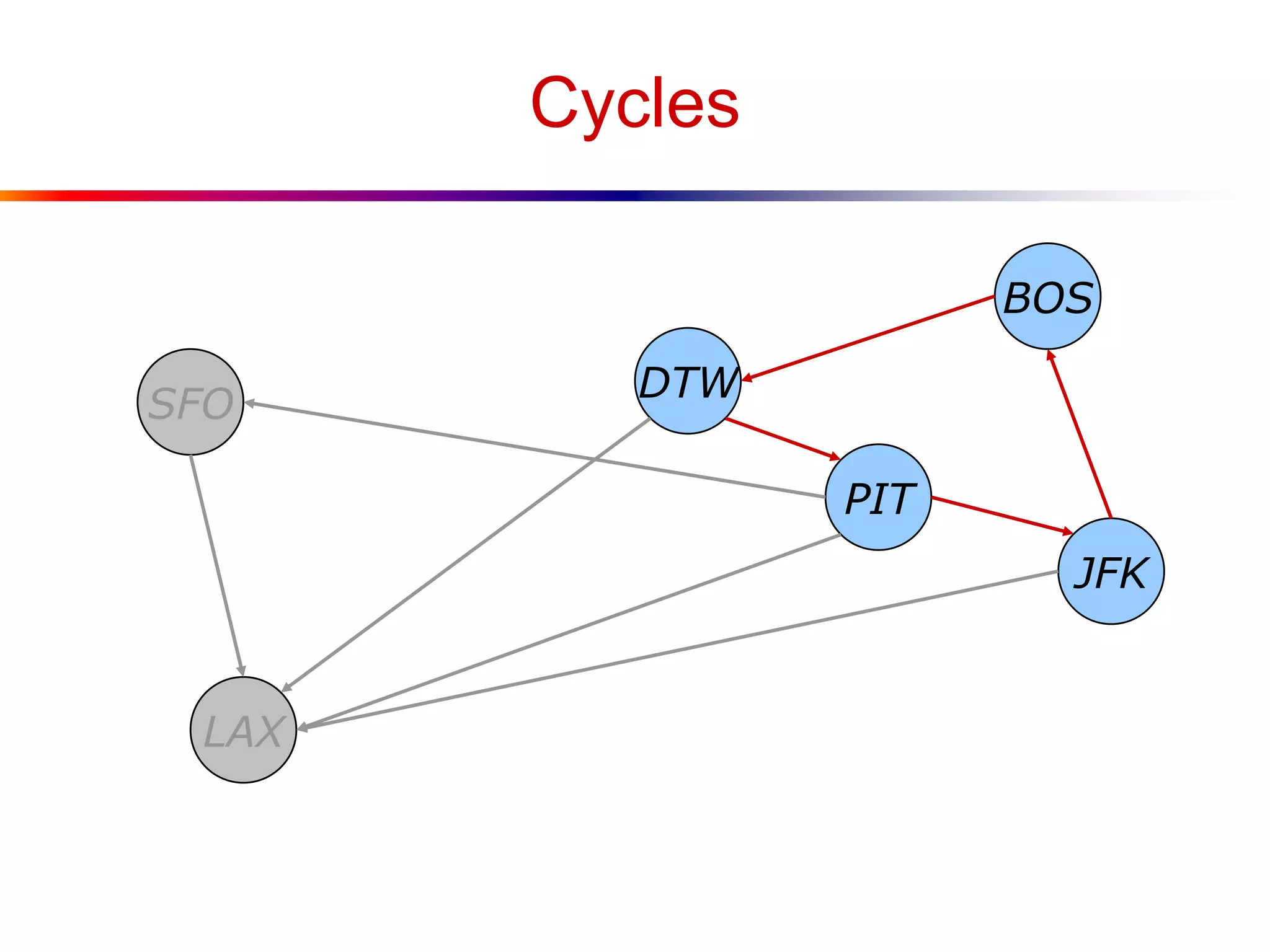
Cycles
PIT
BOS
JFK
DTW
LAX
SFO
More useful definitions
● The degree of a vertex is the number of
edges incident to that vertex
● In a directed graph:
● The indegree of a node v is the number of
distinct edges (w,v)E.
● The outdegree of a node v is the number of
distinct edges (v,w)E.
● A node with indegree 0 is a root.
Trees are graphs
● A dag is a directed acyclic graph.
● A tree is a connected acyclic undirected graph.
● A forest is an acyclic undirected graph (not
necessarily connected), i.e., each connected
component is a tree.
Even More Terminology
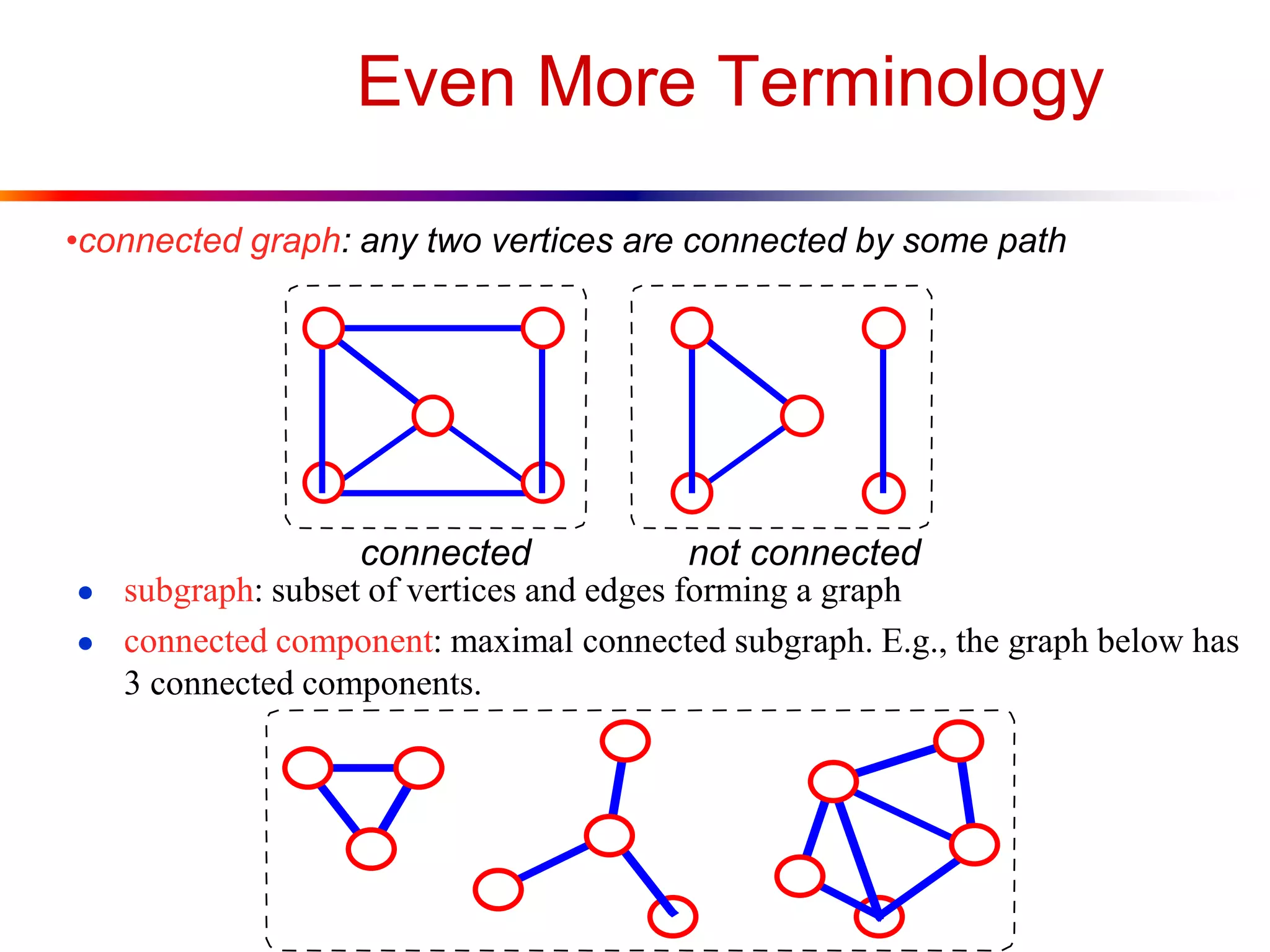
● subgraph: subset of vertices and edges forming a graph
● connected component: maximal connected subgraph. E.g., the graph below has
3 connected components.
connected not connected
•connected graph: any two vertices are connected by some path
Connectivity
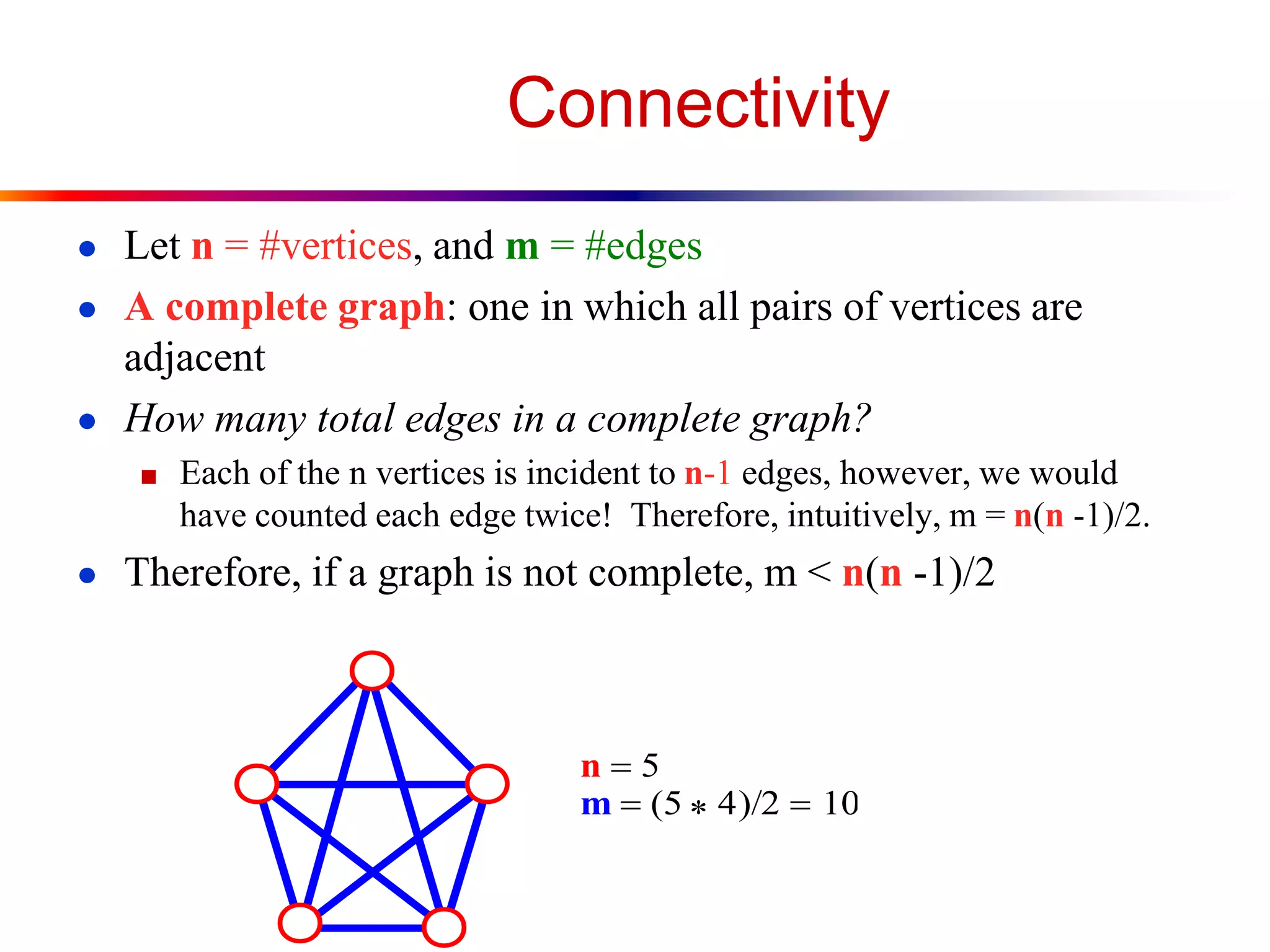
● Let n = #vertices, and m = #edges
● A complete graph: one in which all pairs of vertices are
adjacent
● How many total edges in a complete graph?
■ Each of the n vertices is incident to n-1 edges, however, we would
have counted each edge twice! Therefore, intuitively, m = n(n -1)/2.
● Therefore, if a graph is not complete, m < n(n -1)/2
n 5
m  (5 
More Connectivity
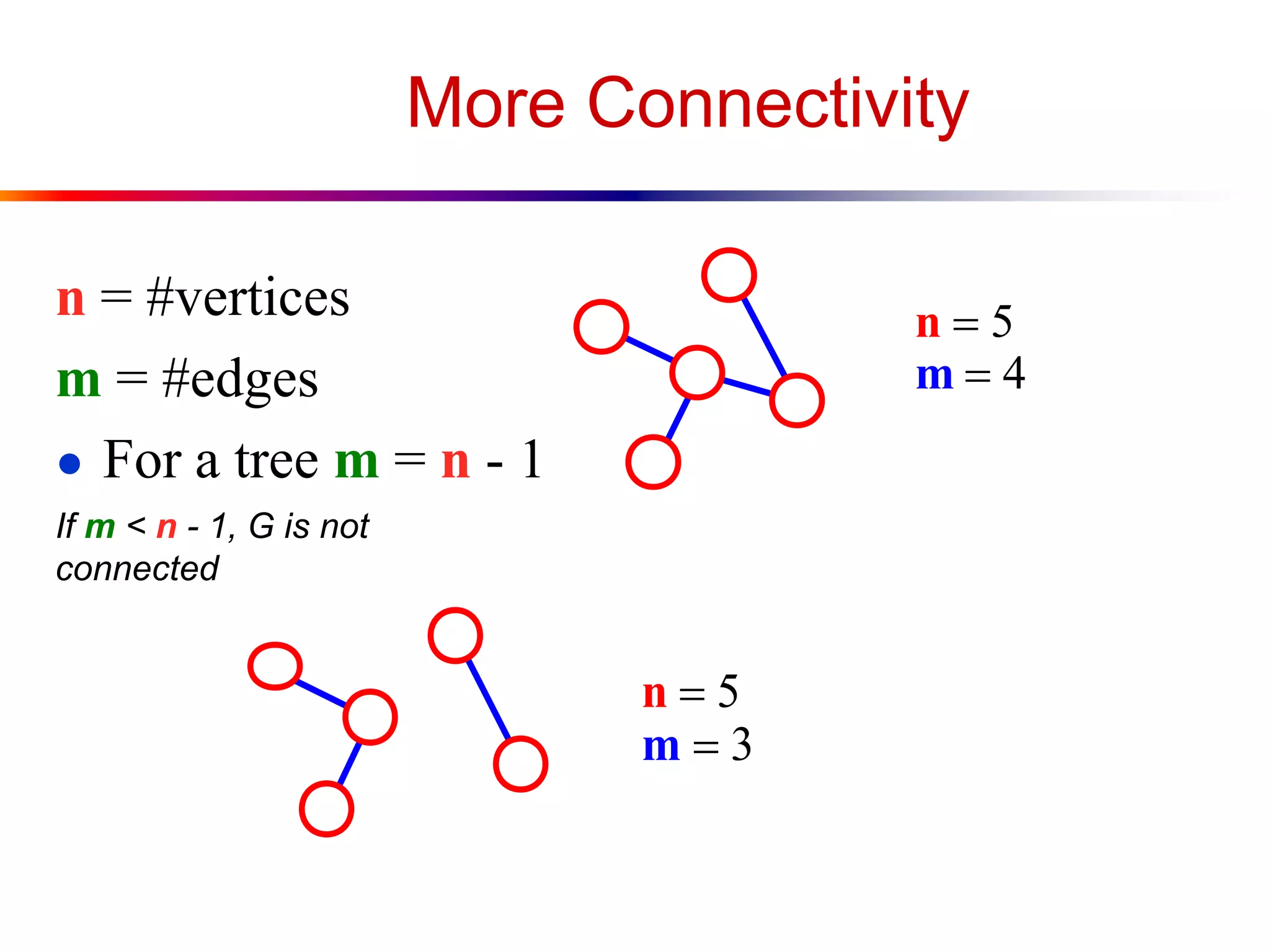
n = #vertices
m = #edges
● For a tree m = n - 1
n  5
m  4
n  5
m  3
If m < n - 1, G is not
connected
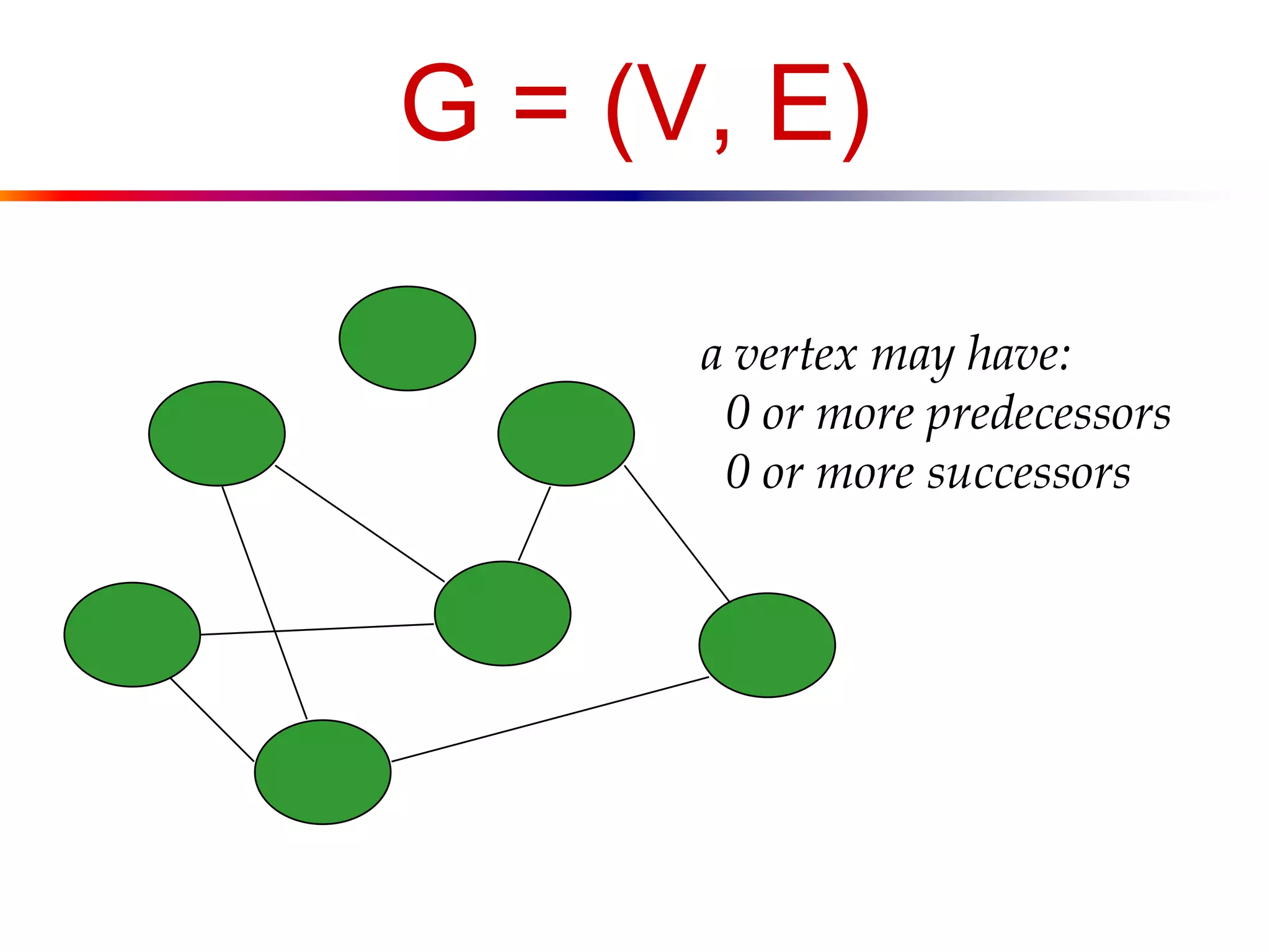
G = (V, E)
a vertex may have:
0 or more predecessors
0 or more successors
some problems that can be
represented by a graph
● computer networks
● airline flights
● road map
● course prerequisite structure
● tasks for completing a job
● flow of control through a program
● many more
Graphs in Computer Science: How
do they help?
● What do they model?
■ An abstraction in Core CS.
○ Examples: VLSI Circuits, Communication Networks, Logical
flow of a computer program, Data structures.
■ An abstraction for data and relationships.
○ Examples: The Web, Social Networks, Flows and Flow
Networks, Biological Data, Taxonomies, Citations, Explicit
relations within a DB system.
● What aspects are studied?
■ Algorithms, Data Structures and Complexity Theory.
■ Characterization and Modeling of Graphs.
■ Implementations of Graph Algorithms in Specific
contexts.
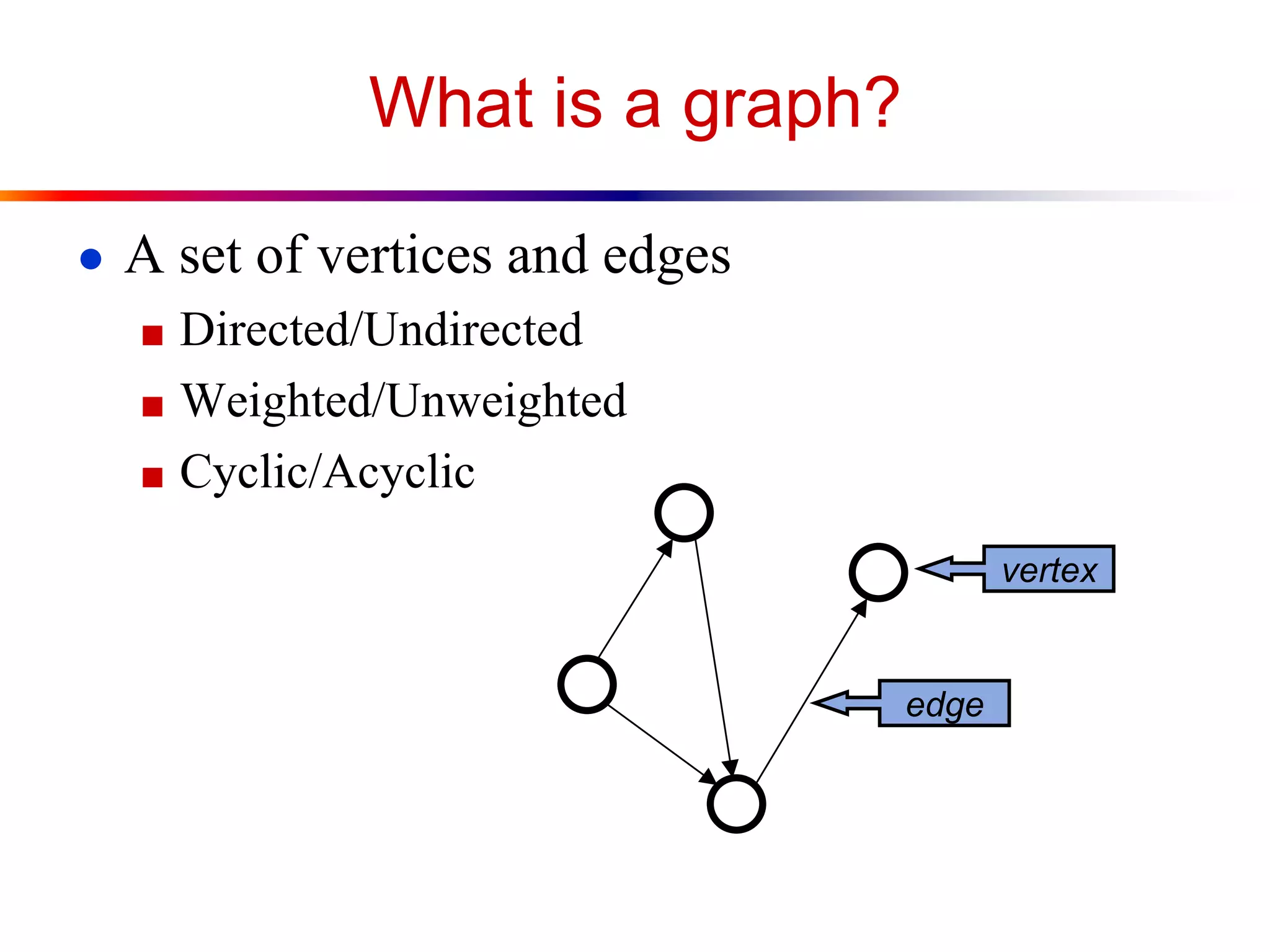
What is a graph?
● A set of vertices and edges
■ Directed/Undirected
■ Weighted/Unweighted
■ Cyclic/Acyclic
vertex
edge
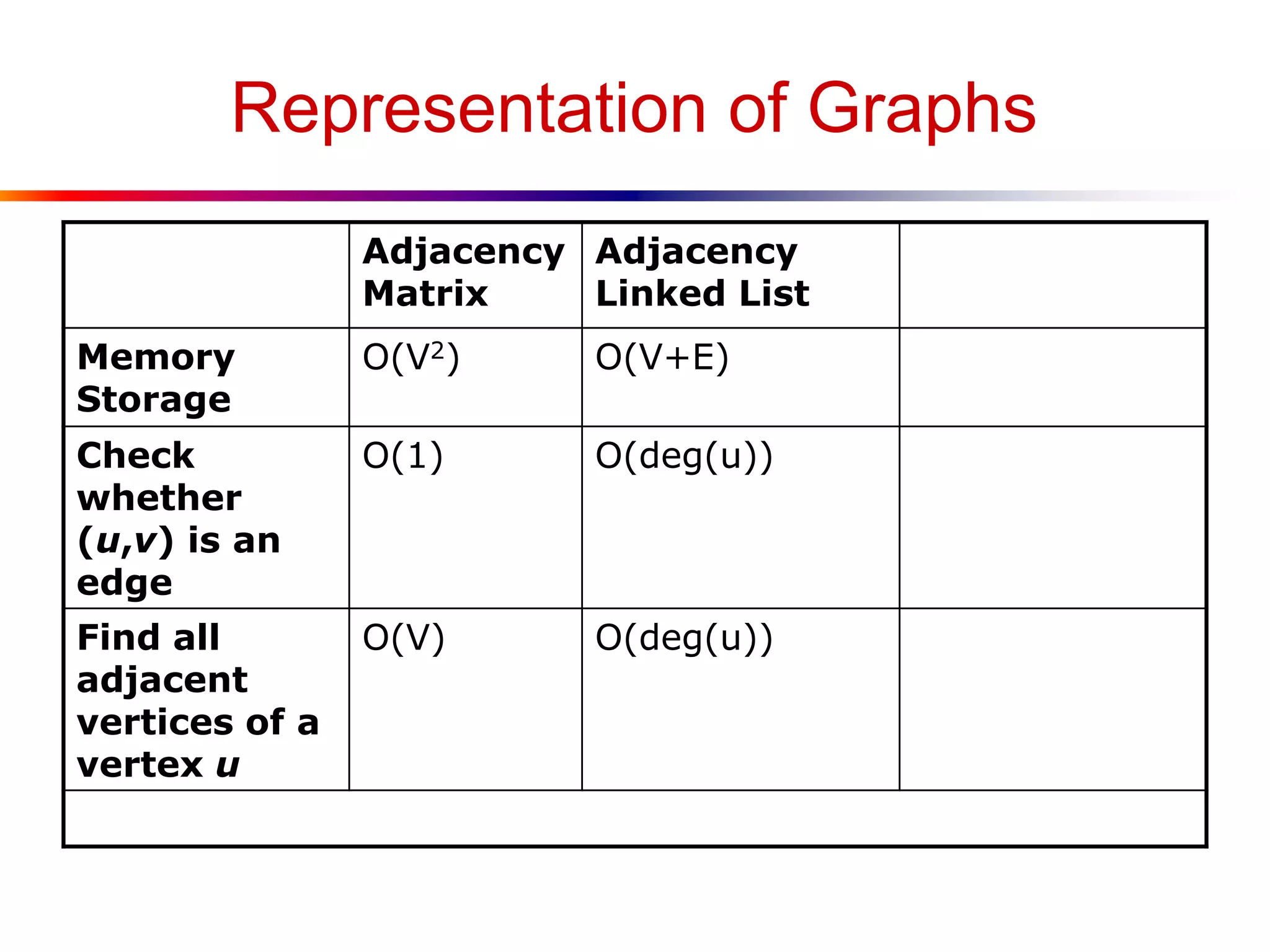
Representation of Graphs
● Adjacency Matrix
■ A V x V array, with matrix[i][j] storing whether
there is an edge between the ith vertex and the jth
vertex
● Adjacency Linked List
■ One linked list per vertex, each storing directly
reachable vertices
Representation of Graphs
Adjacency
Matrix
Adjacency
Linked List
Memory
Storage
O(V2) O(V+E)
Check
whether
(u,v) is an
edge
O(1) O(deg(u))
Find all
adjacent
vertices of a
vertex u
O(V) O(deg(u))
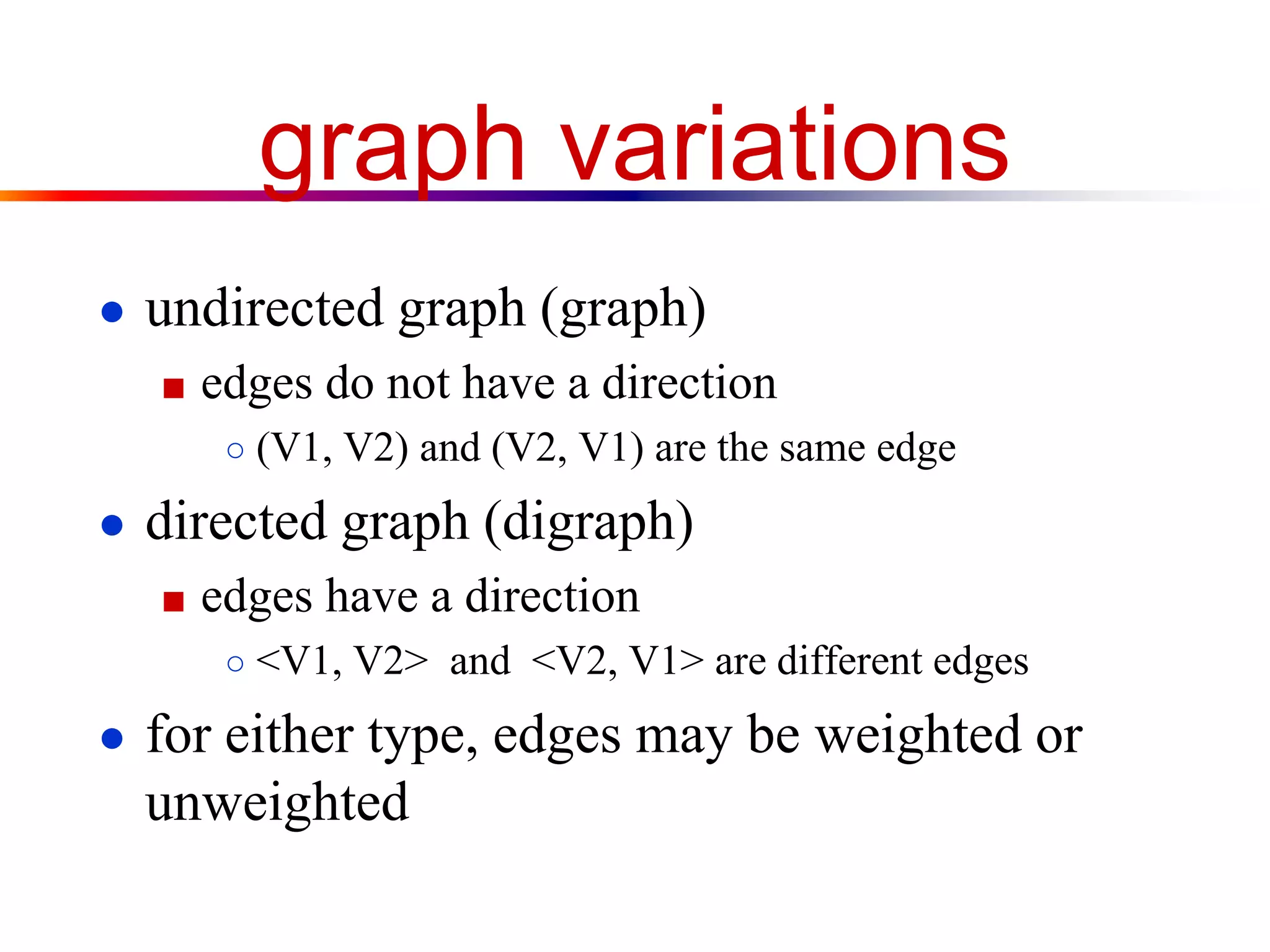
graph variations
● undirected graph (graph)
■ edges do not have a direction
○ (V1, V2) and (V2, V1) are the same edge
● directed graph (digraph)
■ edges have a direction
○ <V1, V2> and <V2, V1> are different edges
● for either type, edges may be weighted or
unweighted
a digraph
A
B
C D
E
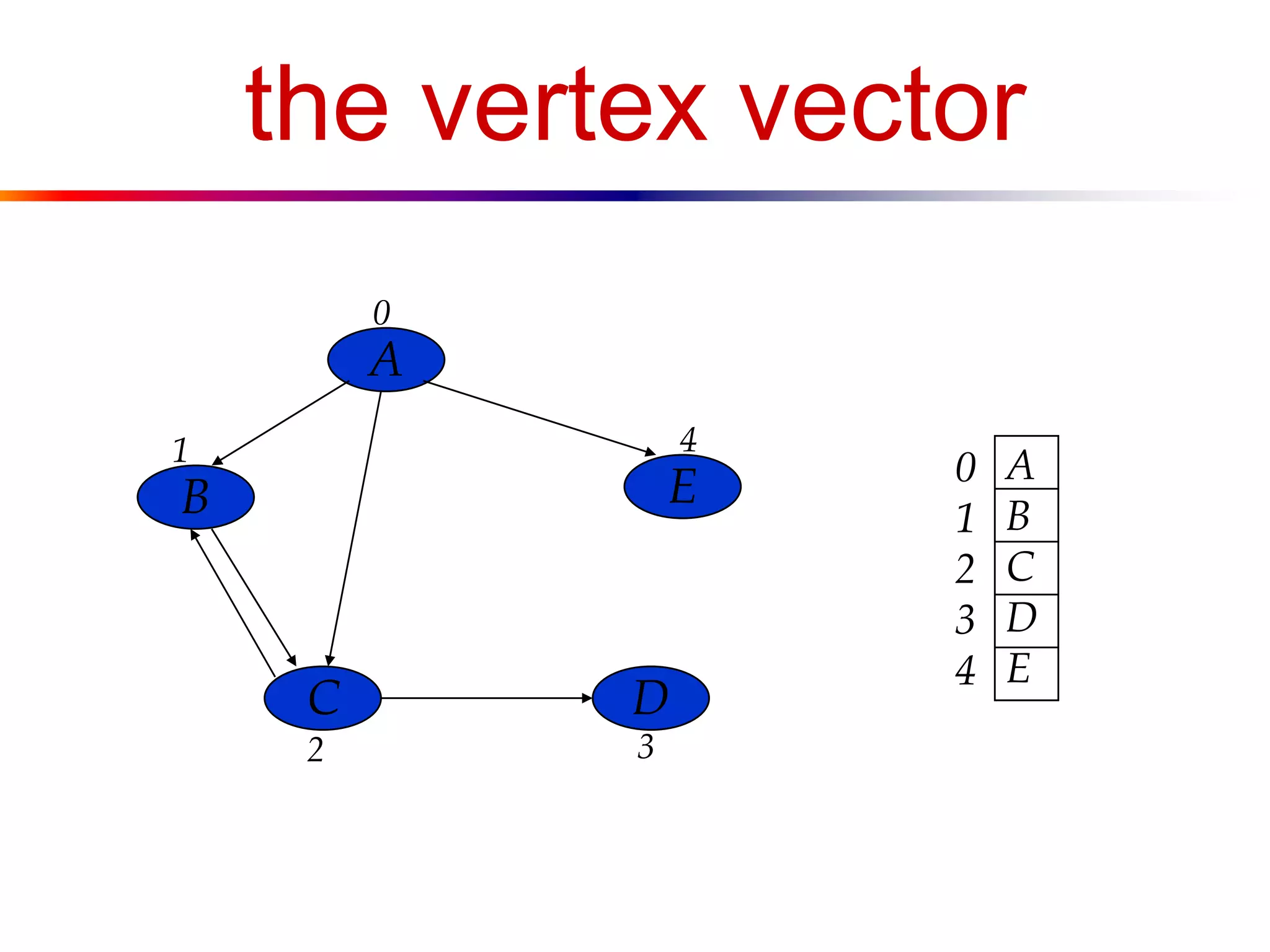
V = [A, B, C, D, E]
E = [<A,B>, <B,C>, <C,B>, <A,C>, <A,E>, <C,D>]
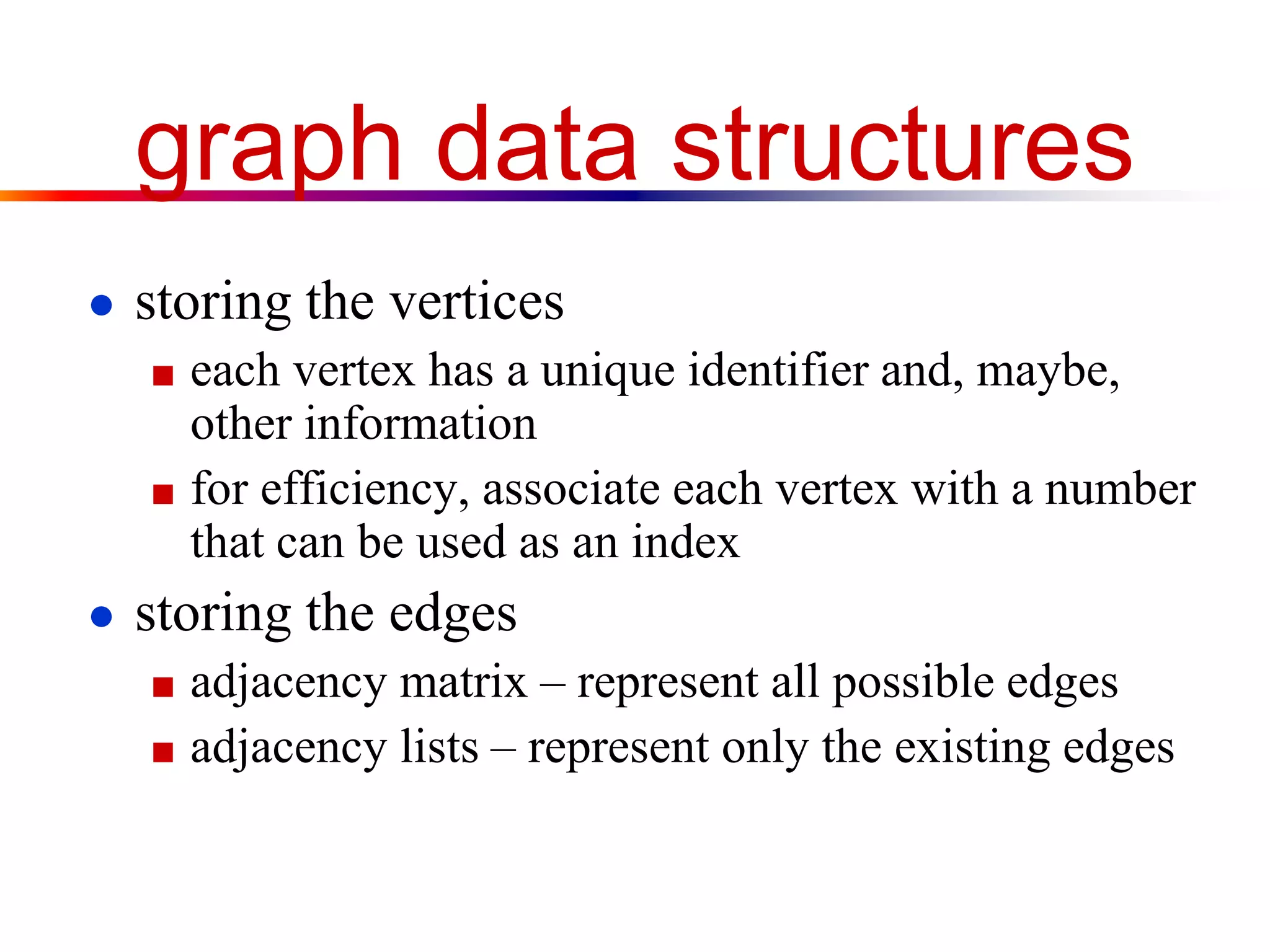
graph data structures
● storing the vertices
■ each vertex has a unique identifier and, maybe,
other information
■ for efficiency, associate each vertex with a number
that can be used as an index
● storing the edges
■ adjacency matrix – represent all possible edges
■ adjacency lists – represent only the existing edges
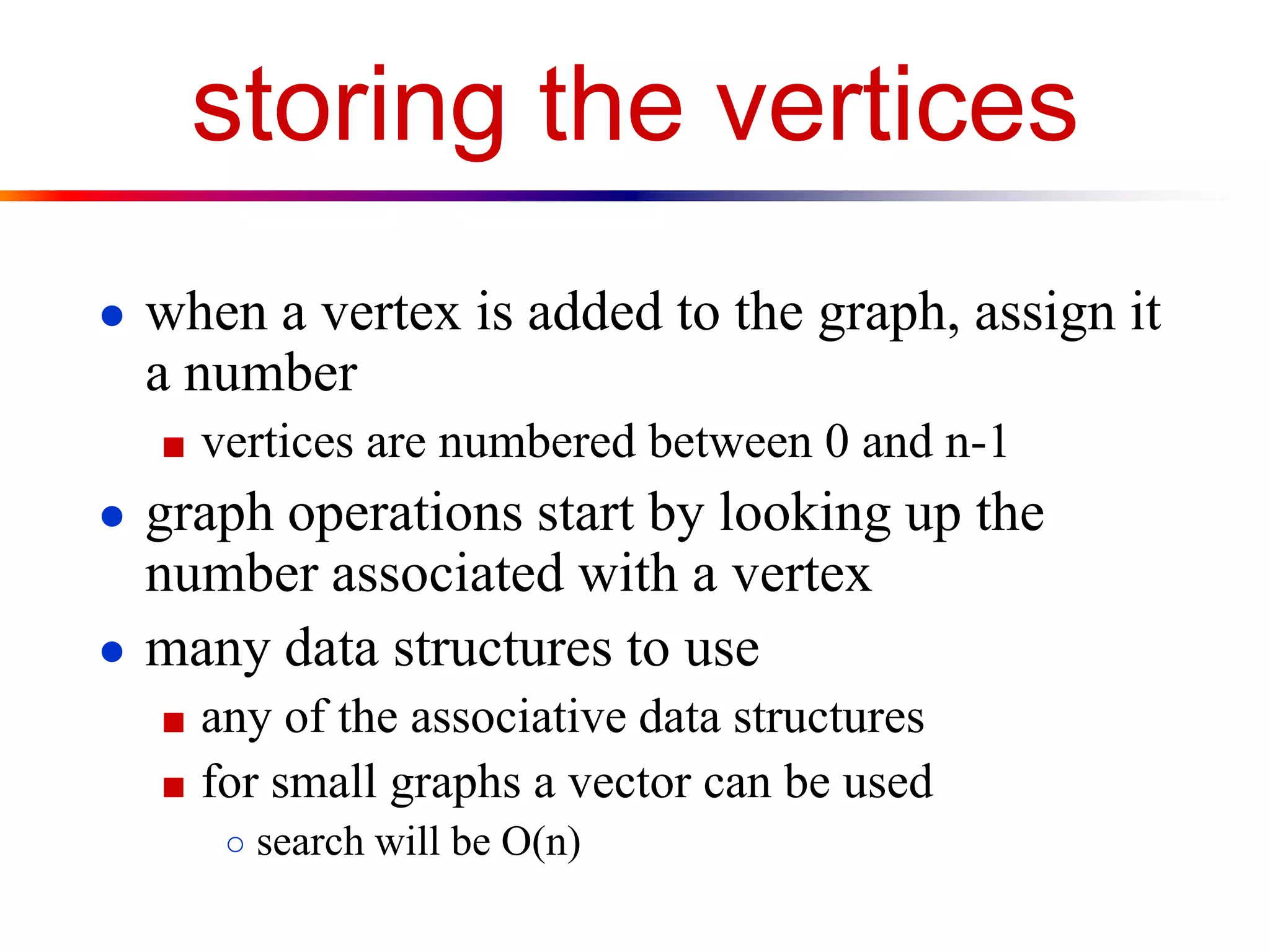
storing the vertices
● when a vertex is added to the graph, assign it
a number
■ vertices are numbered between 0 and n-1
● graph operations start by looking up the
number associated with a vertex
● many data structures to use
■ any of the associative data structures
■ for small graphs a vector can be used
○ search will be O(n)
the vertex vector
A
B
C D
E
0
1
2 3
4
0
1
2
3
4
A
B
C
D
E
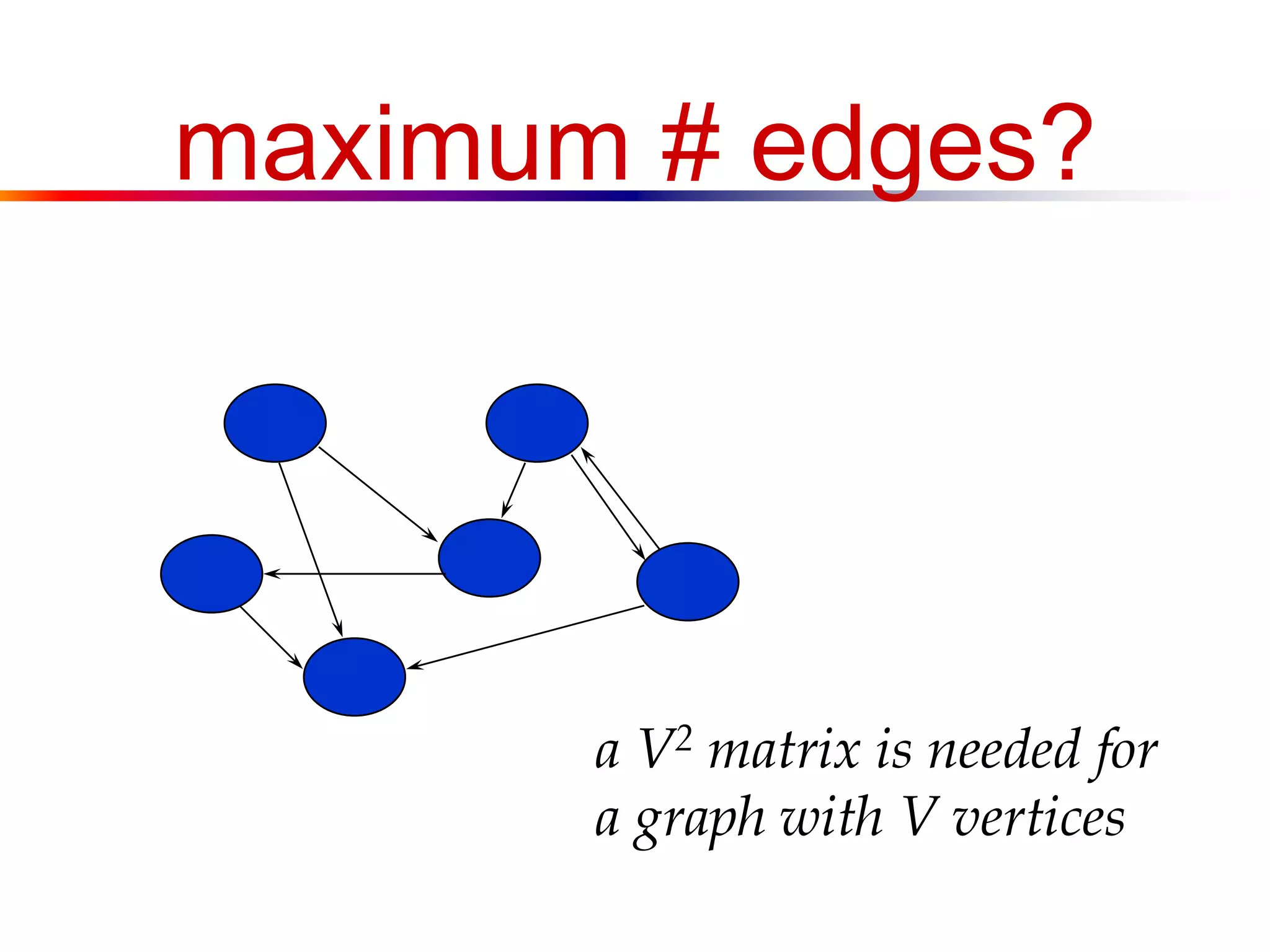
maximum # edges?
a V2 matrix is needed for
a graph with V vertices
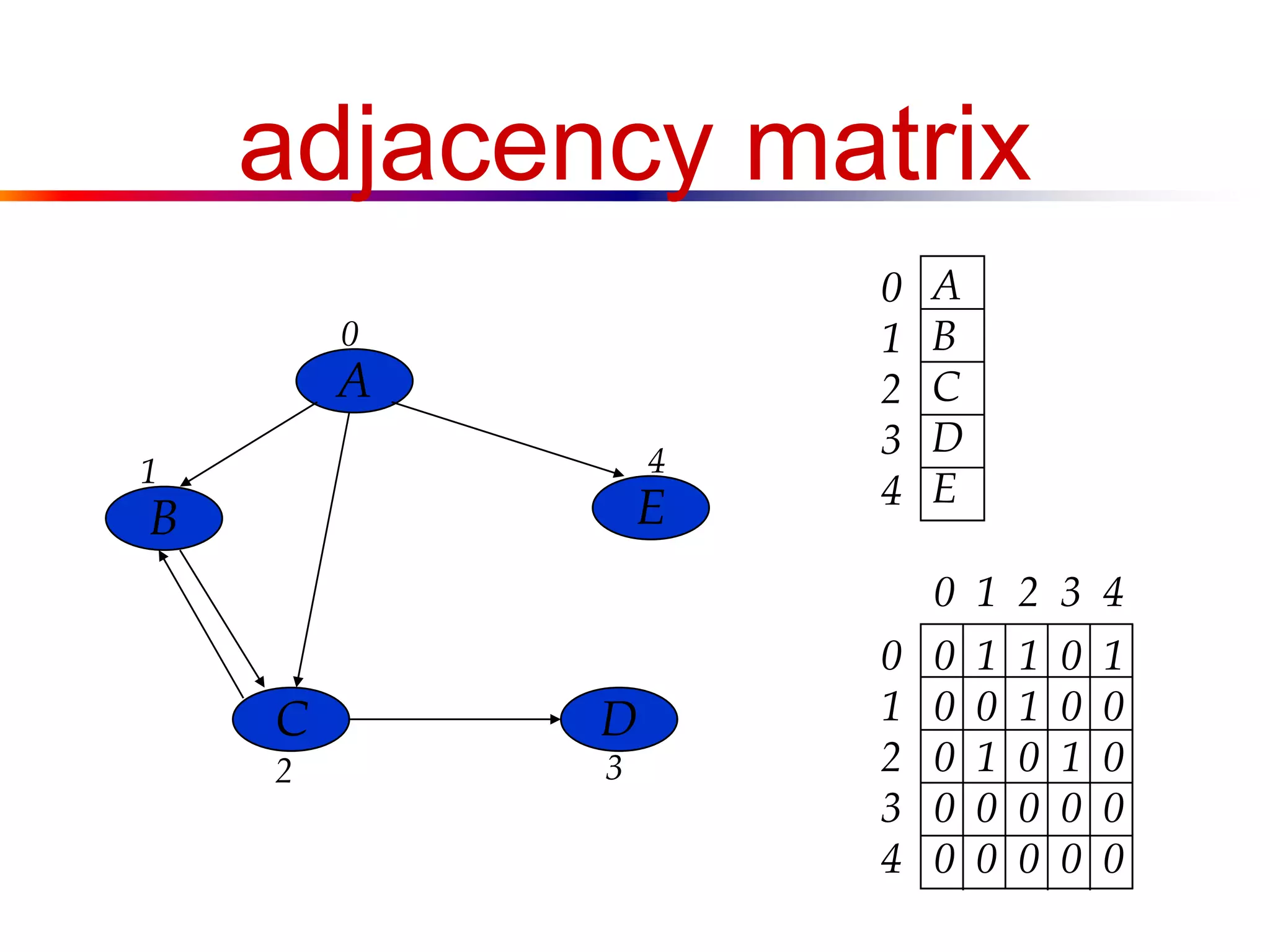
adjacency matrix
A
B
C D
E
0
1
2 3
4
0
1
2
3
4
A
B
C
D
E
0 1 1 0 1
0 0 1 0 0
0 1 0 1 0
0 0 0 0 0
0 0 0 0 0
0
1
2
3
4
0 1 2 3 4
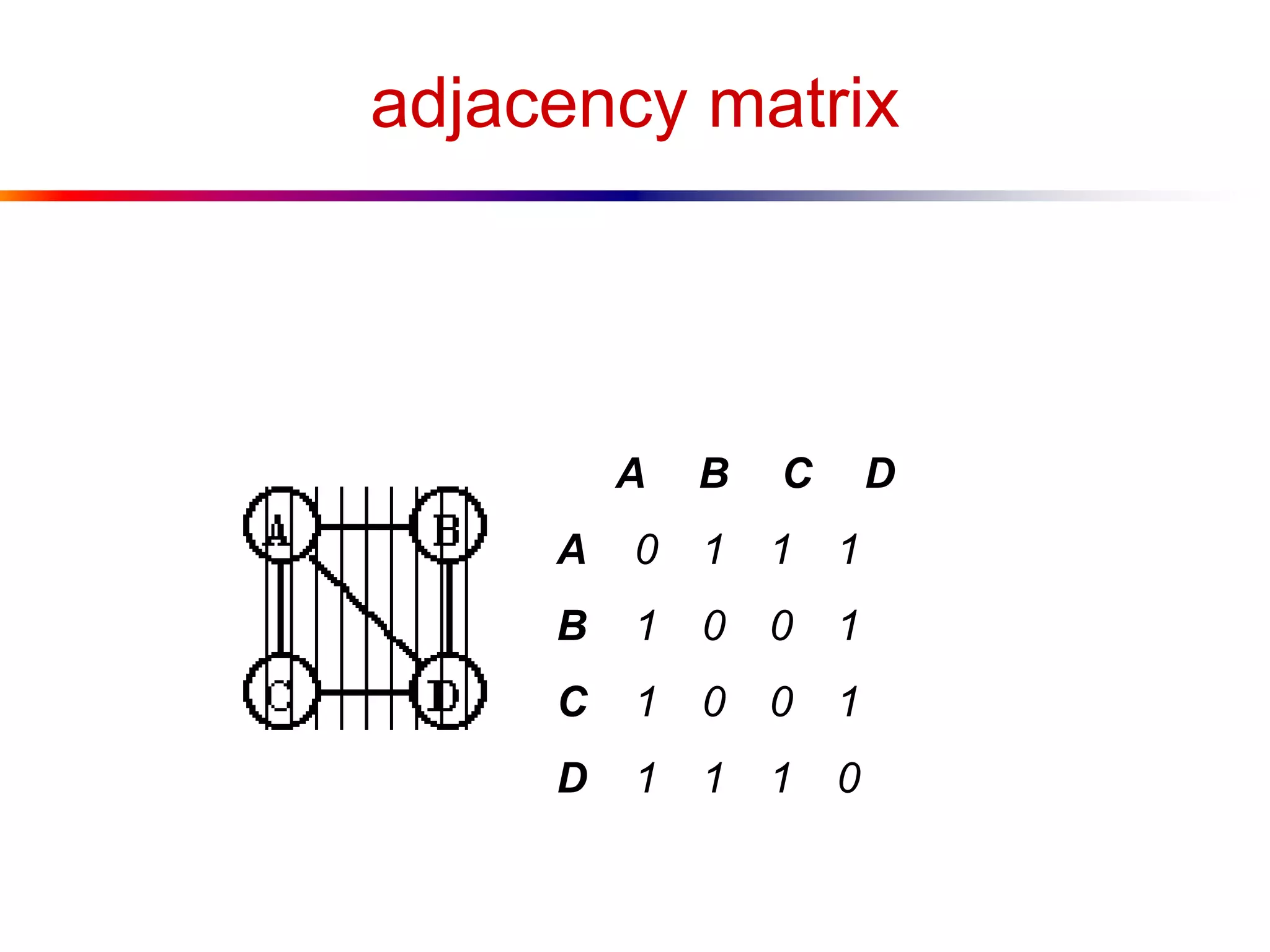
adjacency matrix
A B C D
A 0 1 1 1
B 1 0 0 1
C 1 0 0 1
D 1 1 1 0
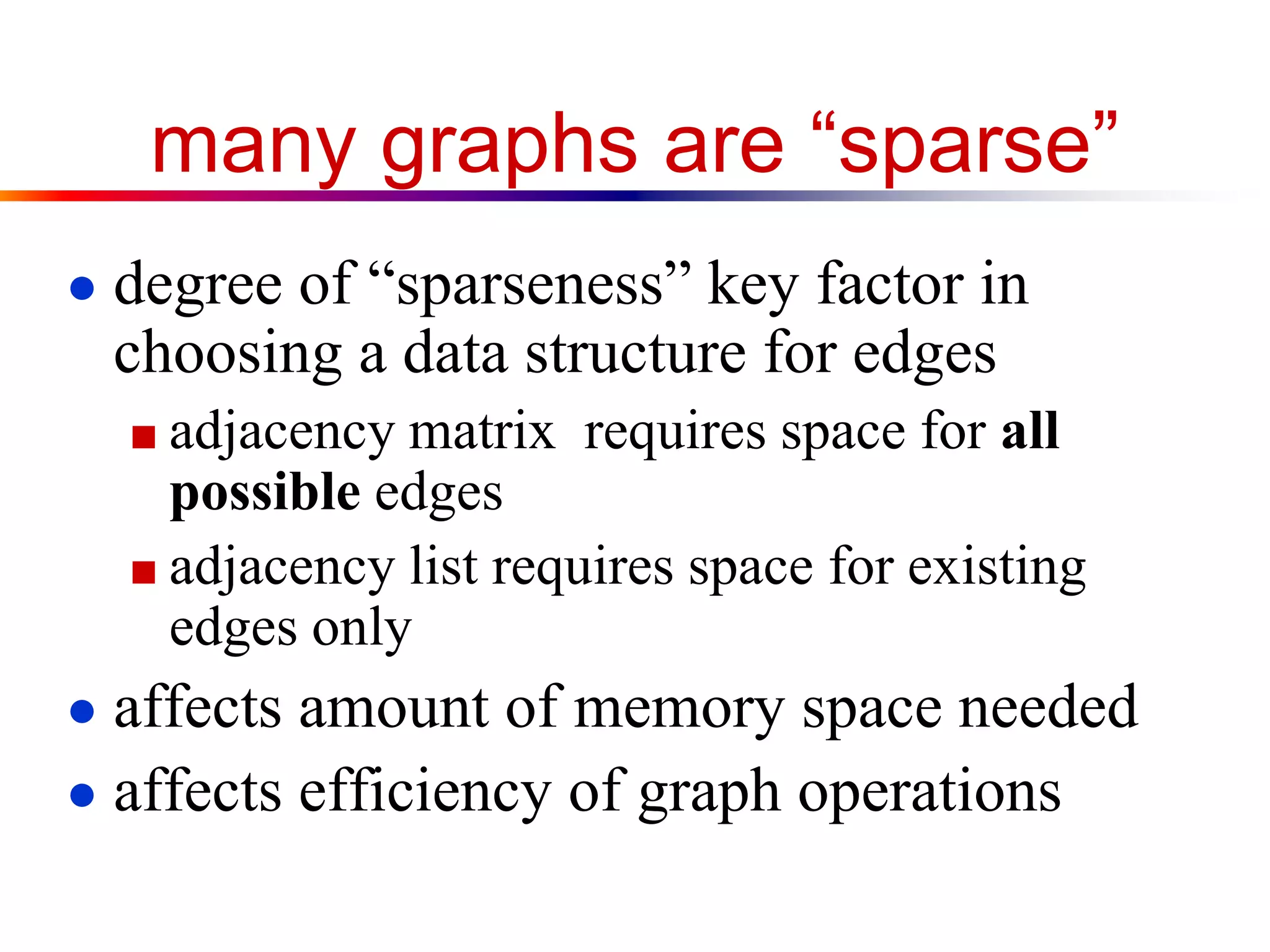
many graphs are “sparse”
● degree of “sparseness” key factor in
choosing a data structure for edges
■ adjacency matrix requires space for all
possible edges
■ adjacency list requires space for existing
edges only
● affects amount of memory space needed
● affects efficiency of graph operations
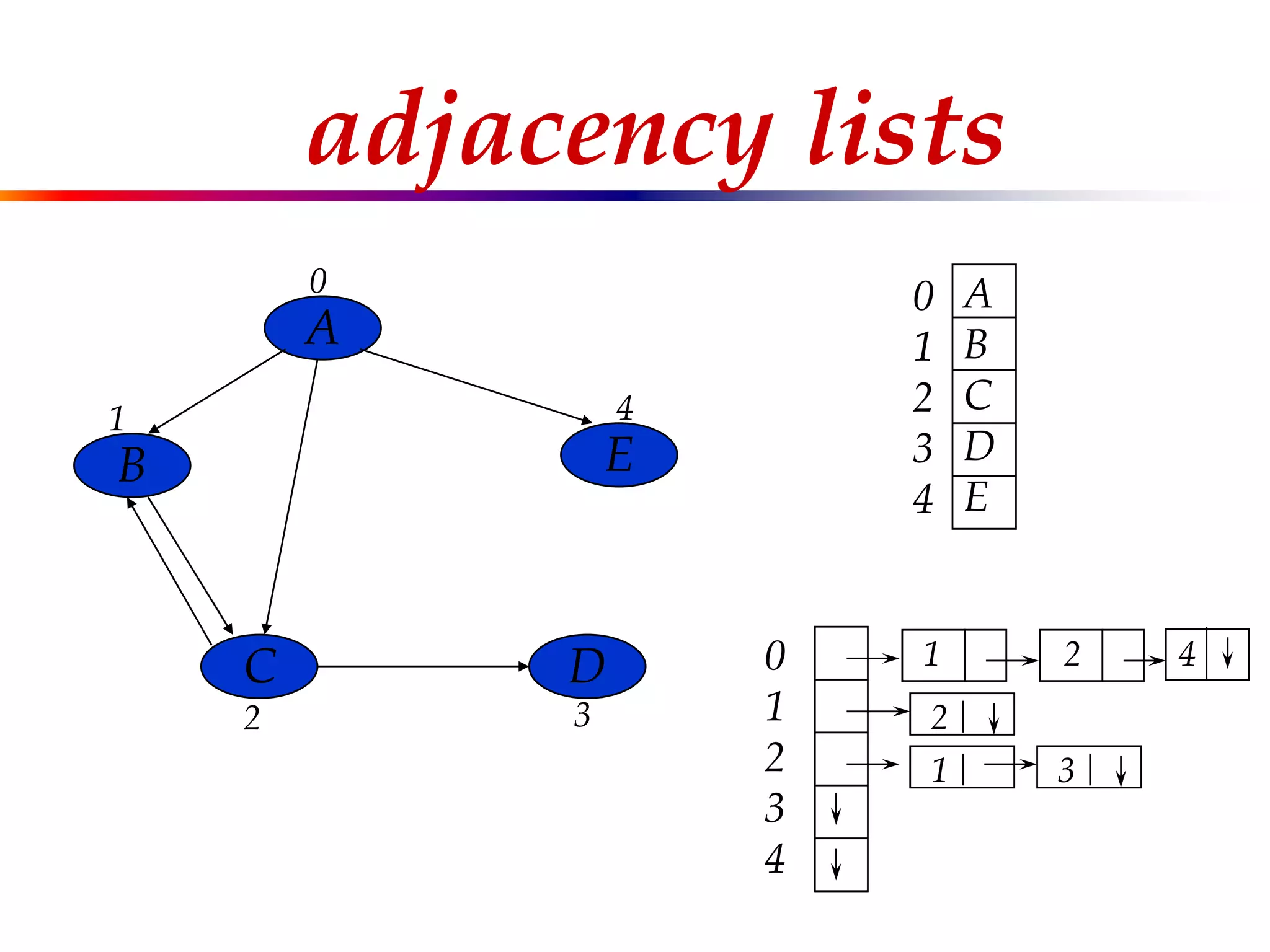
adjacency lists
A
B
C D
E
0
1
2 3
4
0
1
2
3
4
1 2 4
2
1 3
0
1
2
3
4
A
B
C
D
E
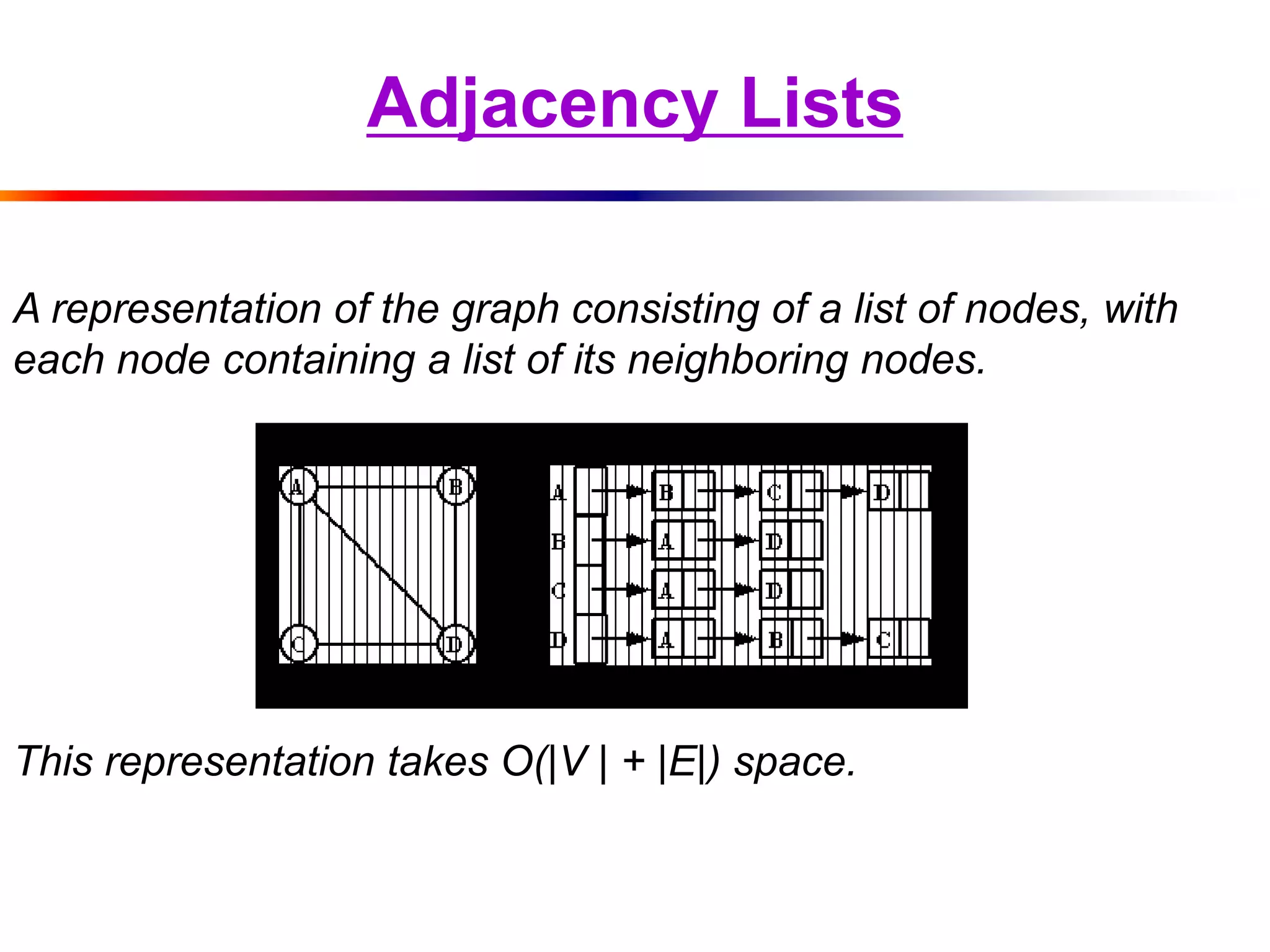
Adjacency Lists
A representation of the graph consisting of a list of nodes, with
each node containing a list of its neighboring nodes.
This representation takes O(|V | + |E|) space.
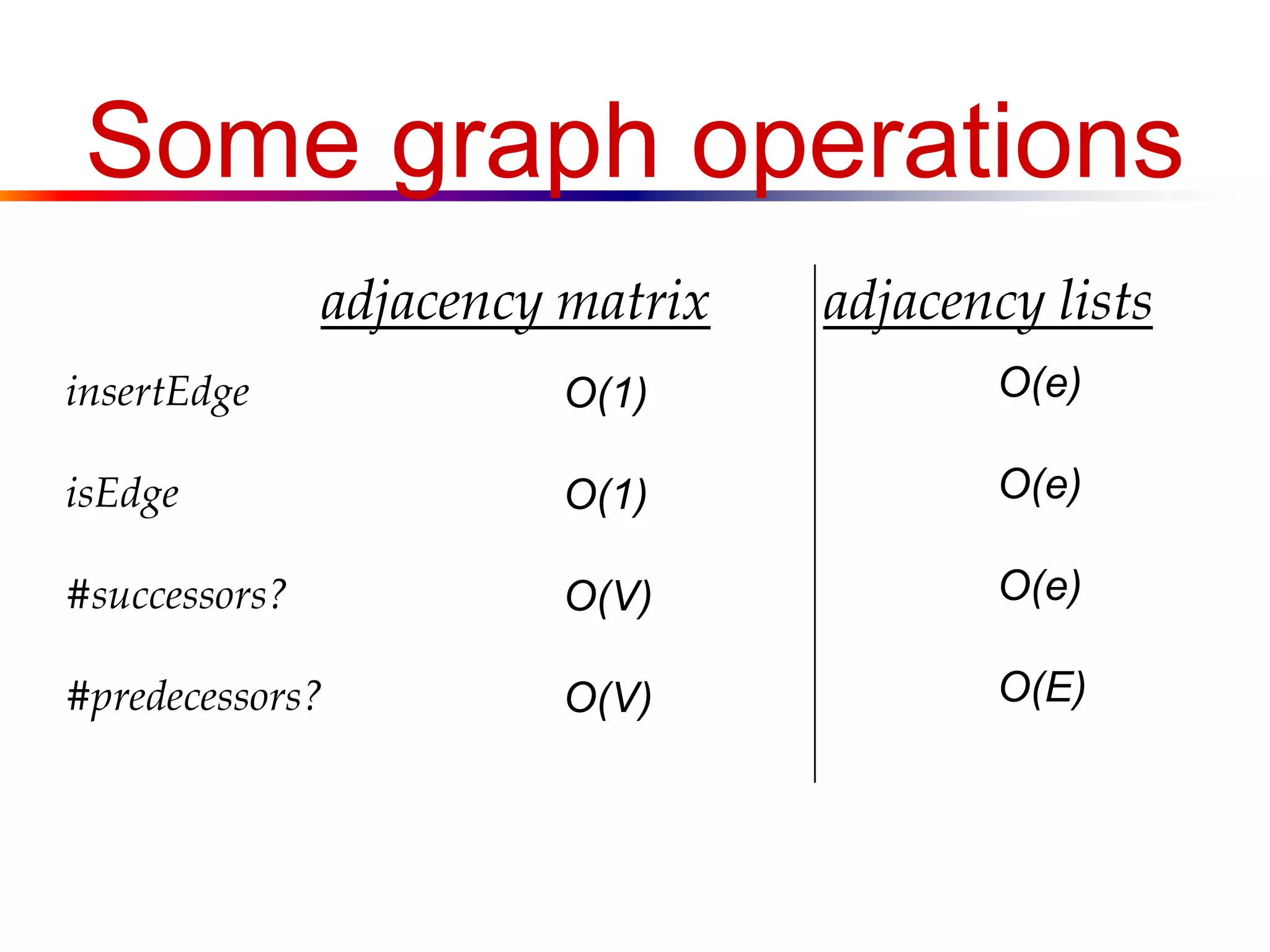
Some graph operations
adjacency matrix adjacency lists
insertEdge
isEdge
#successors?
#predecessors?
O(1)
O(1)
O(V)
O(V)
O(e)
O(e)
O(e)
O(E)
Introduction
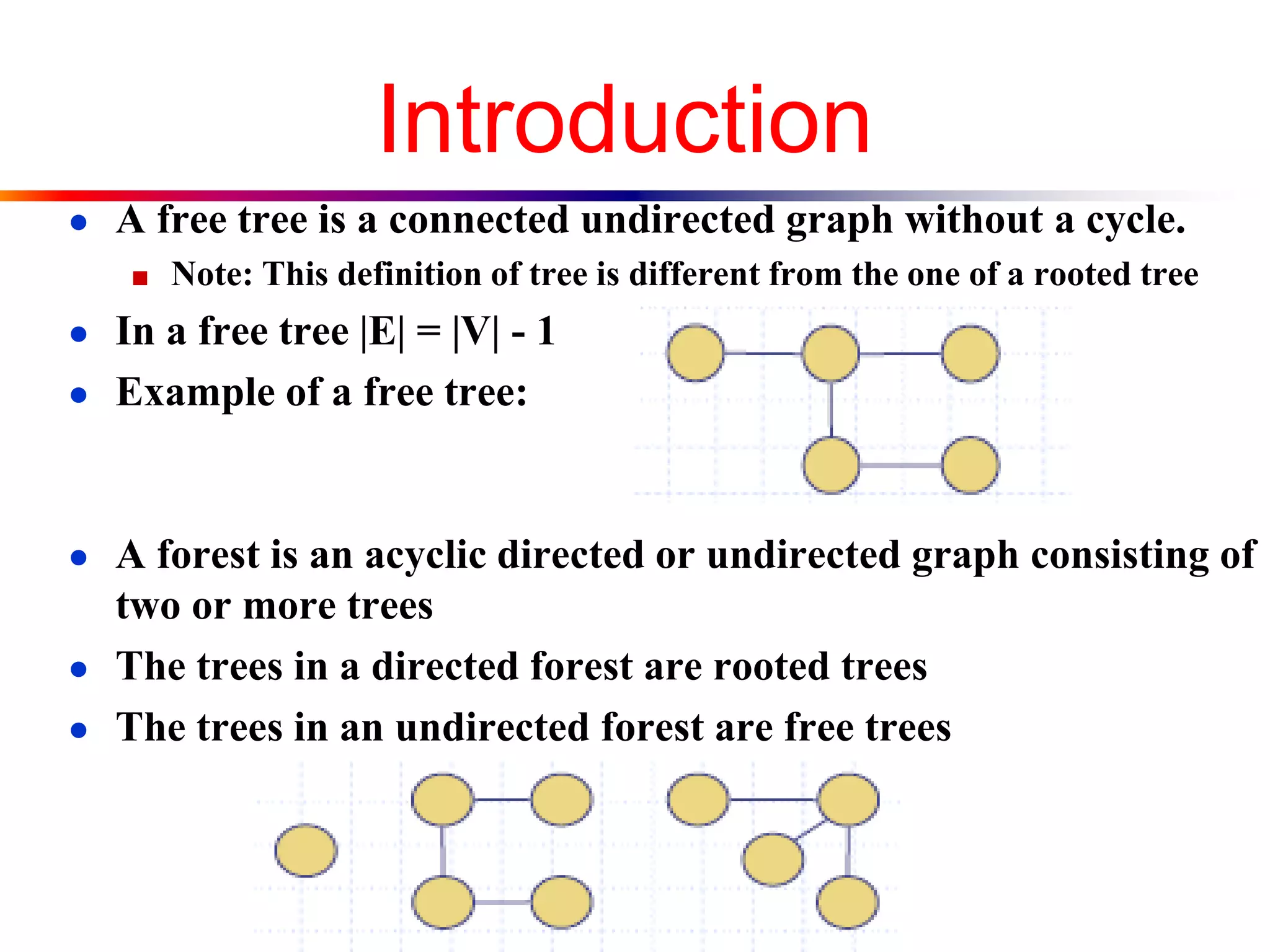
● A free tree is a connected undirected graph without a cycle.
■ Note: This definition of tree is different from the one of a rooted tree
● In a free tree |E| = |V| - 1
● Example of a free tree:
● A forest is an acyclic directed or undirected graph consisting of
two or more trees
● The trees in a directed forest are rooted trees
● The trees in an undirected forest are free trees
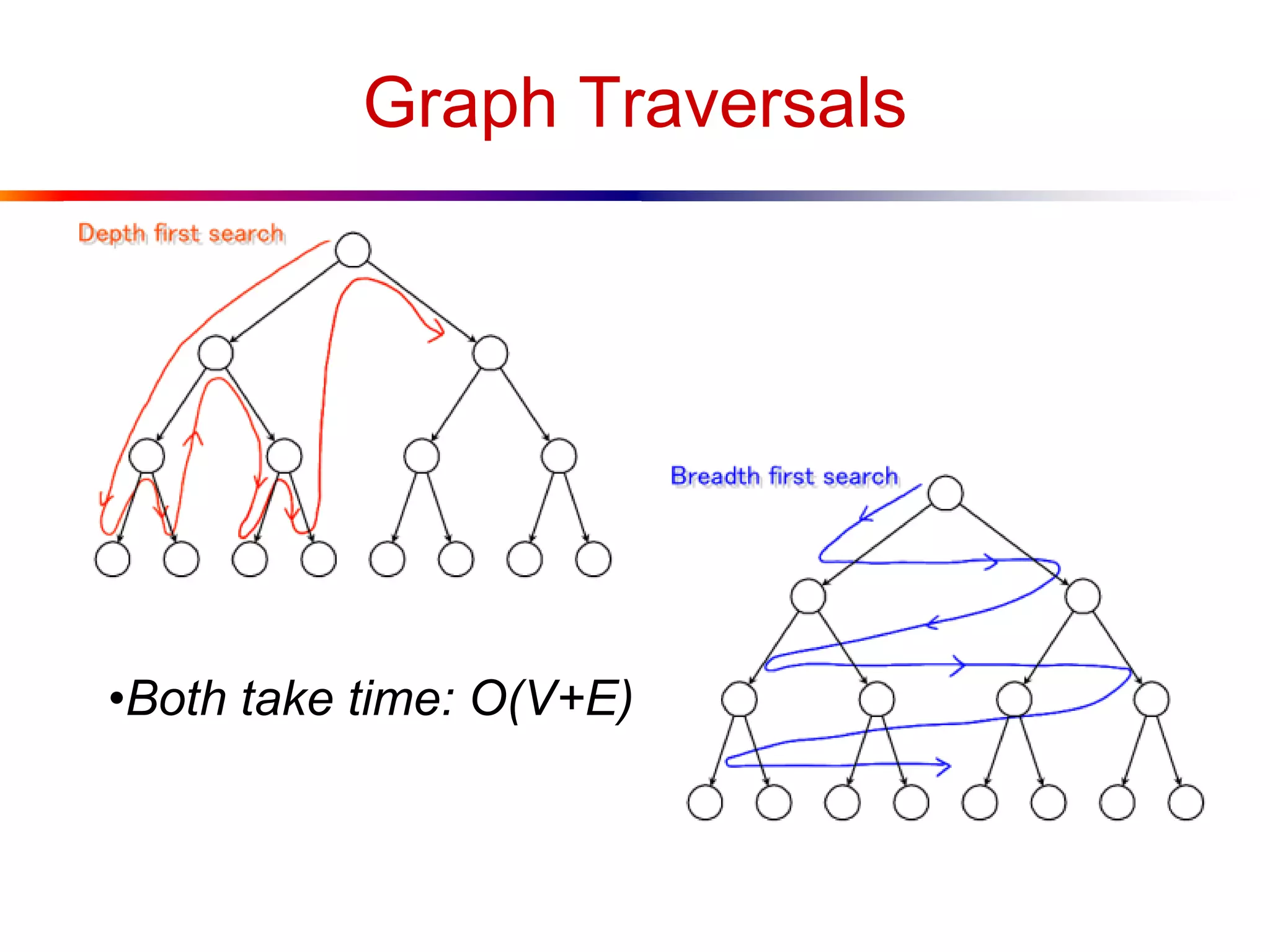
Graph Traversals
•Both take time: O(V+E)
Use of a stack
● It is very common to use a stack to keep track
of:
■ nodes to be visited next, or
■ nodes that we have already visited.
● Typically, use of a stack leads to a depth-first
visit order.
● Depth-first visit order is “aggressive” in the
sense that it examines complete paths.
Use of a queue
● It is very common to use a queue to keep track
of:
■ nodes to be visited next, or
■ nodes that we have already visited.
● Typically, use of a queue leads to a breadth-
first visit order.
● Breadth-first visit order is “cautious” in the
sense that it examines every path of length i
before going on to paths of length i+1.
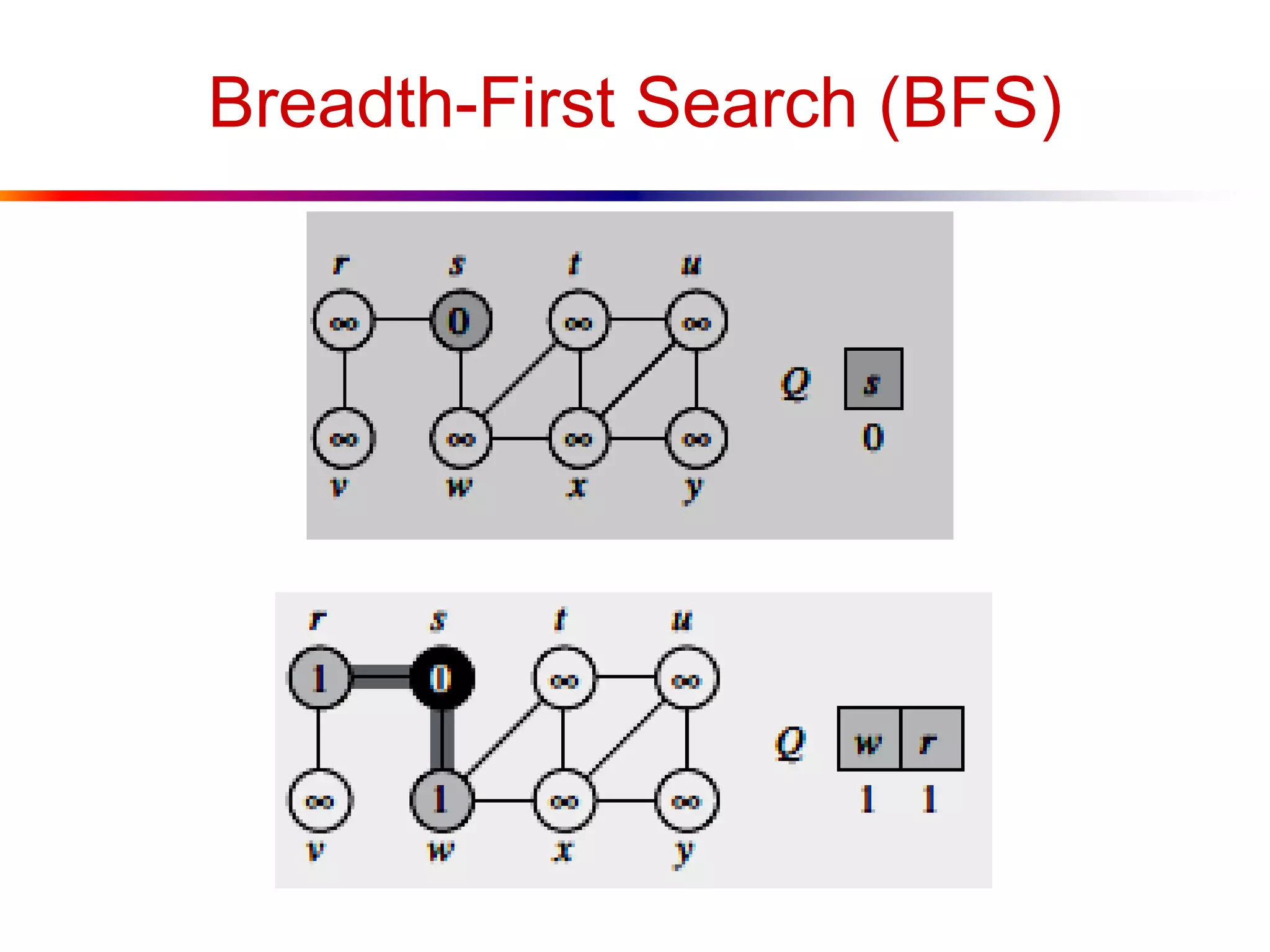
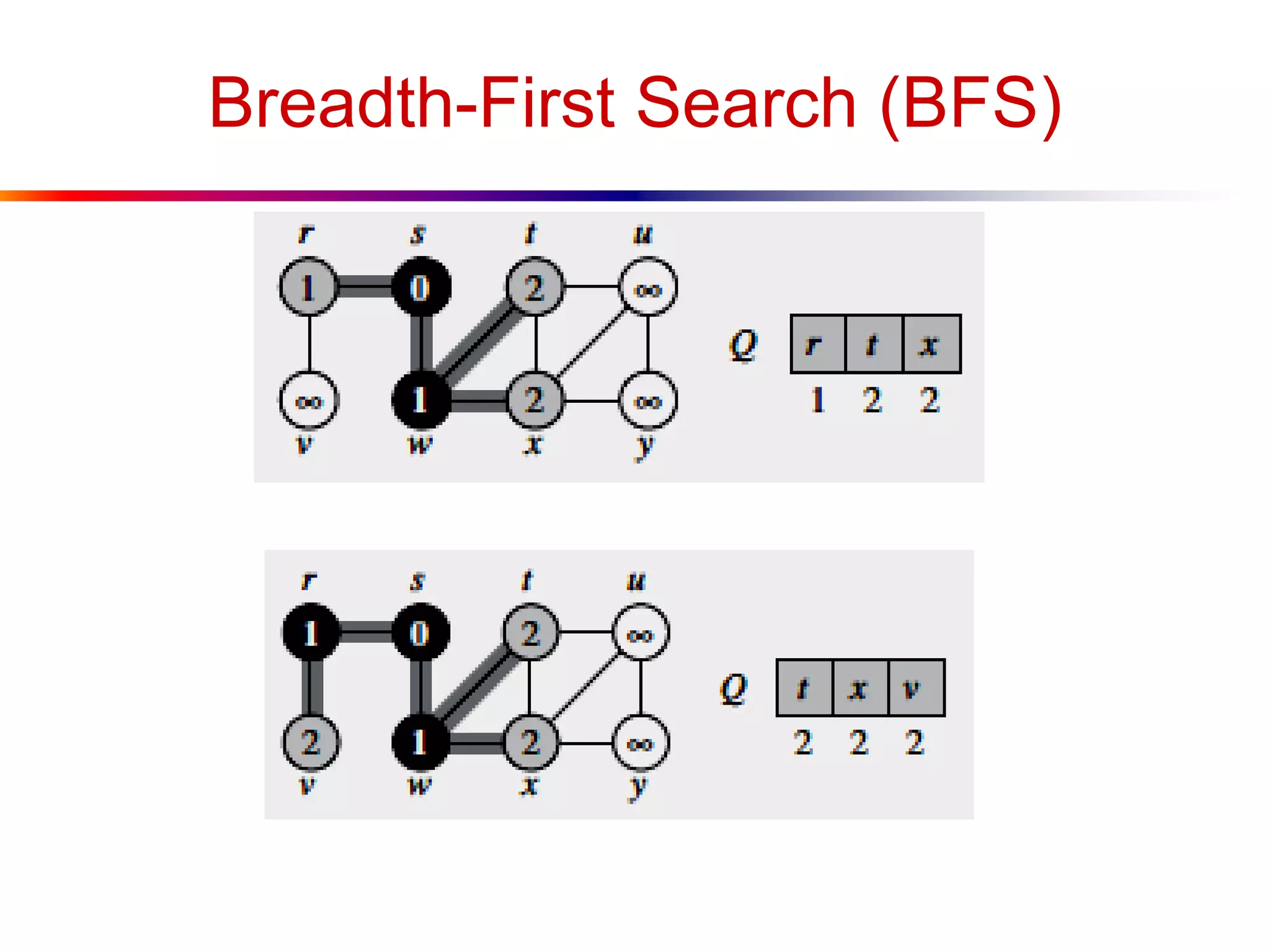
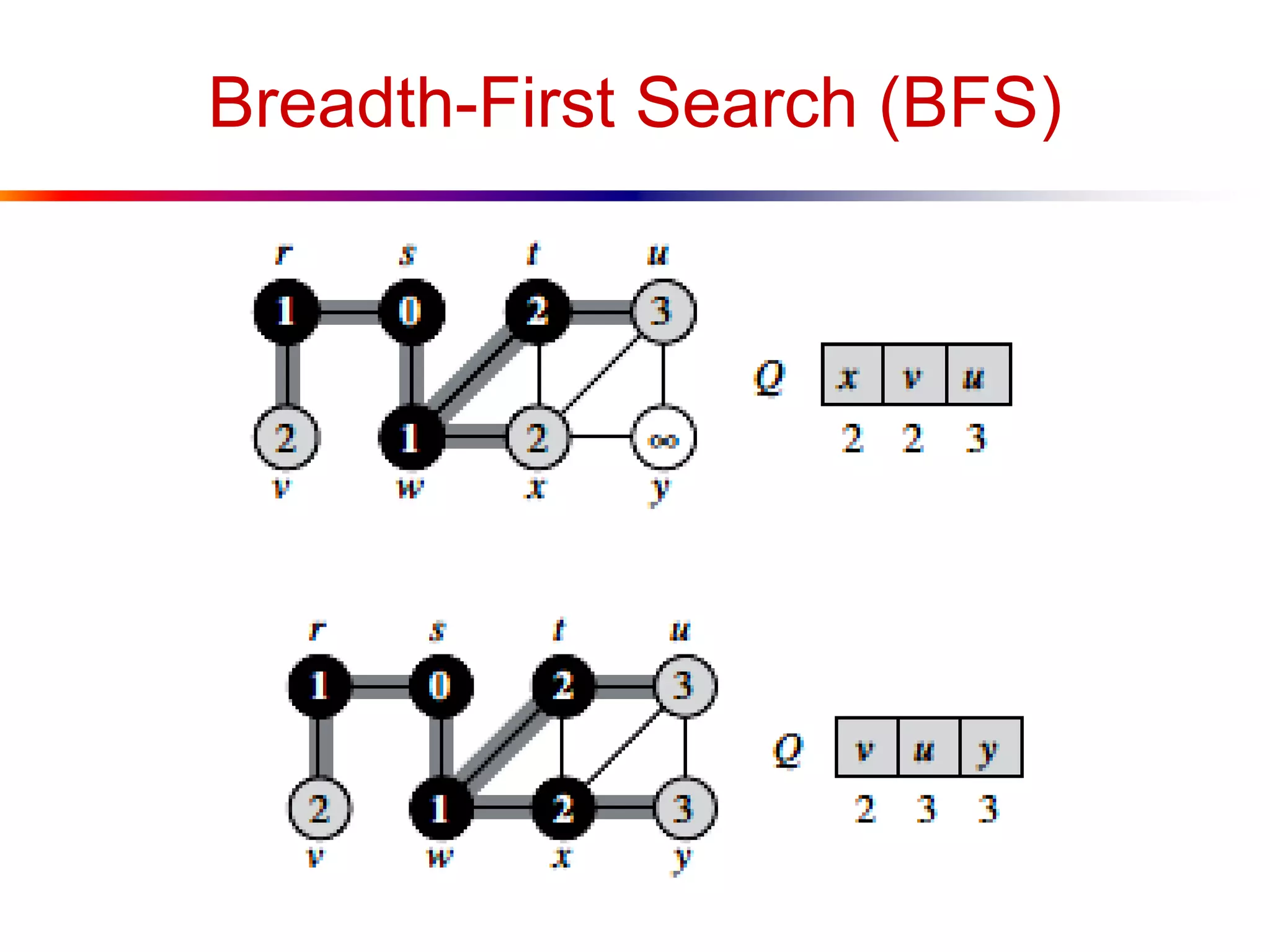
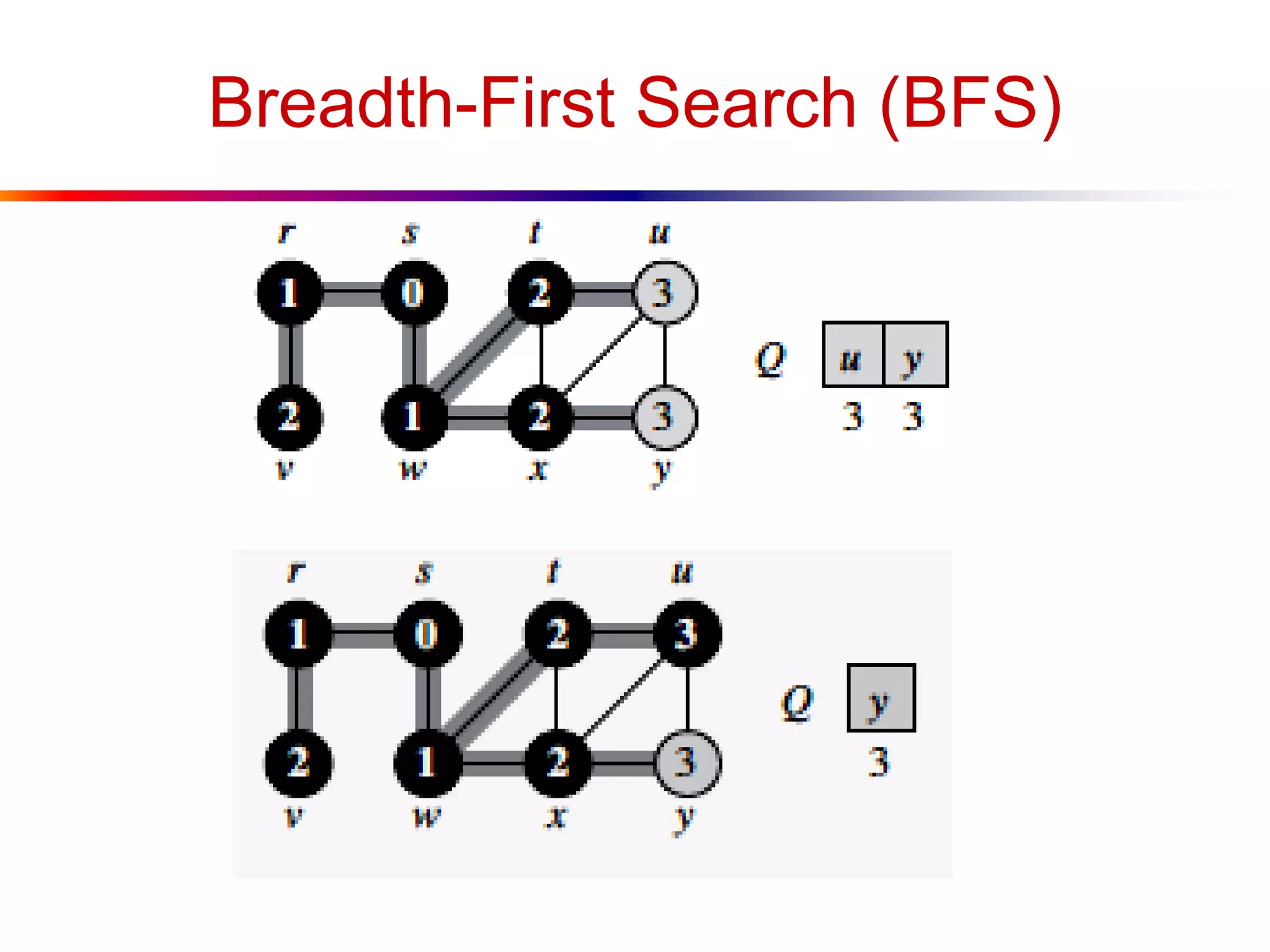
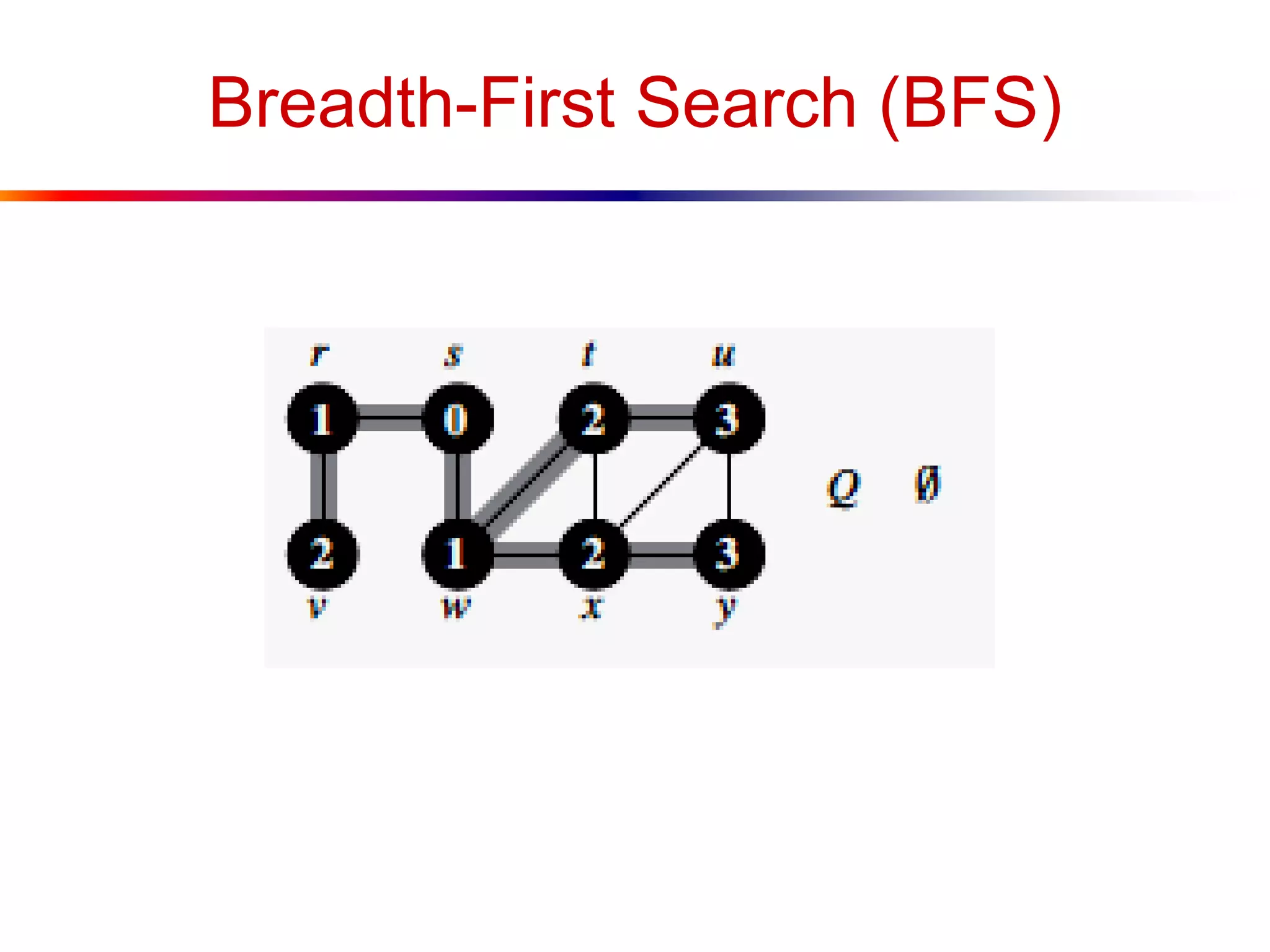
Breadth-First Search (BFS)
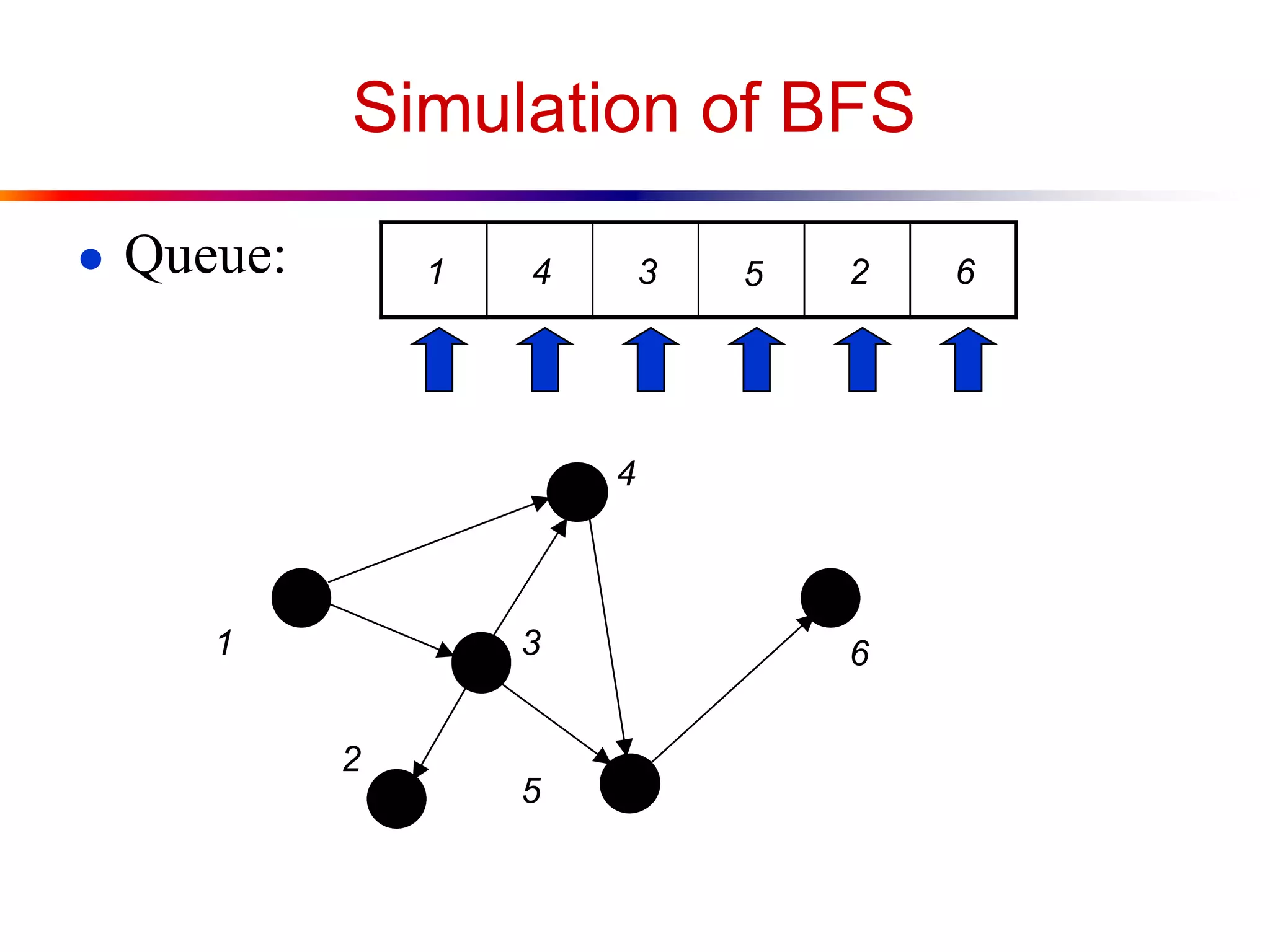
● BFS tries to search all paths.
● BFS makes use of a queue to store visited (but
not dead) vertices, expanding the path from the
earliest visited vertices.
1
4
3
2
5
6
Simulation of BFS
● Queue: 1 4 3 5 2 6
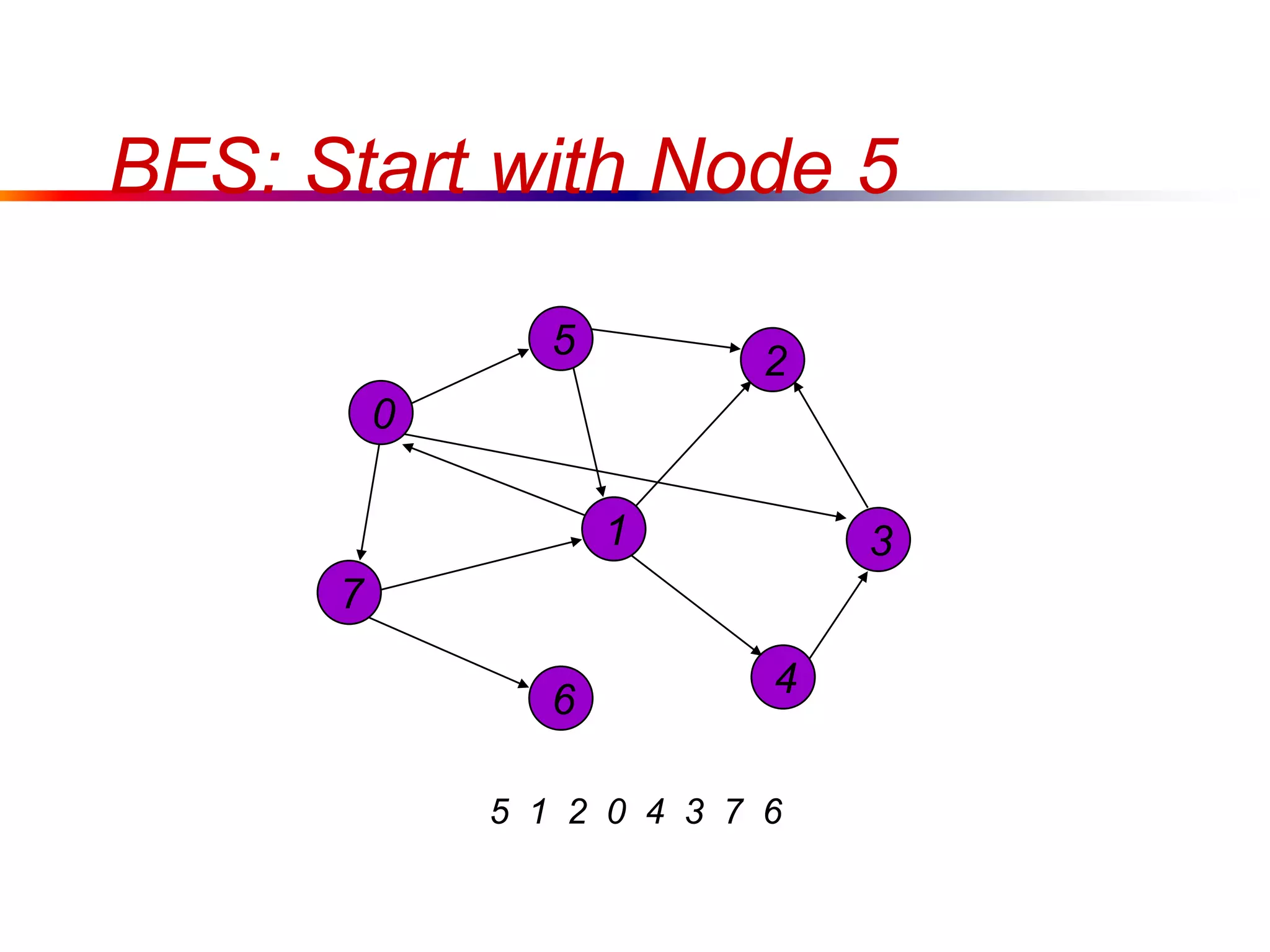
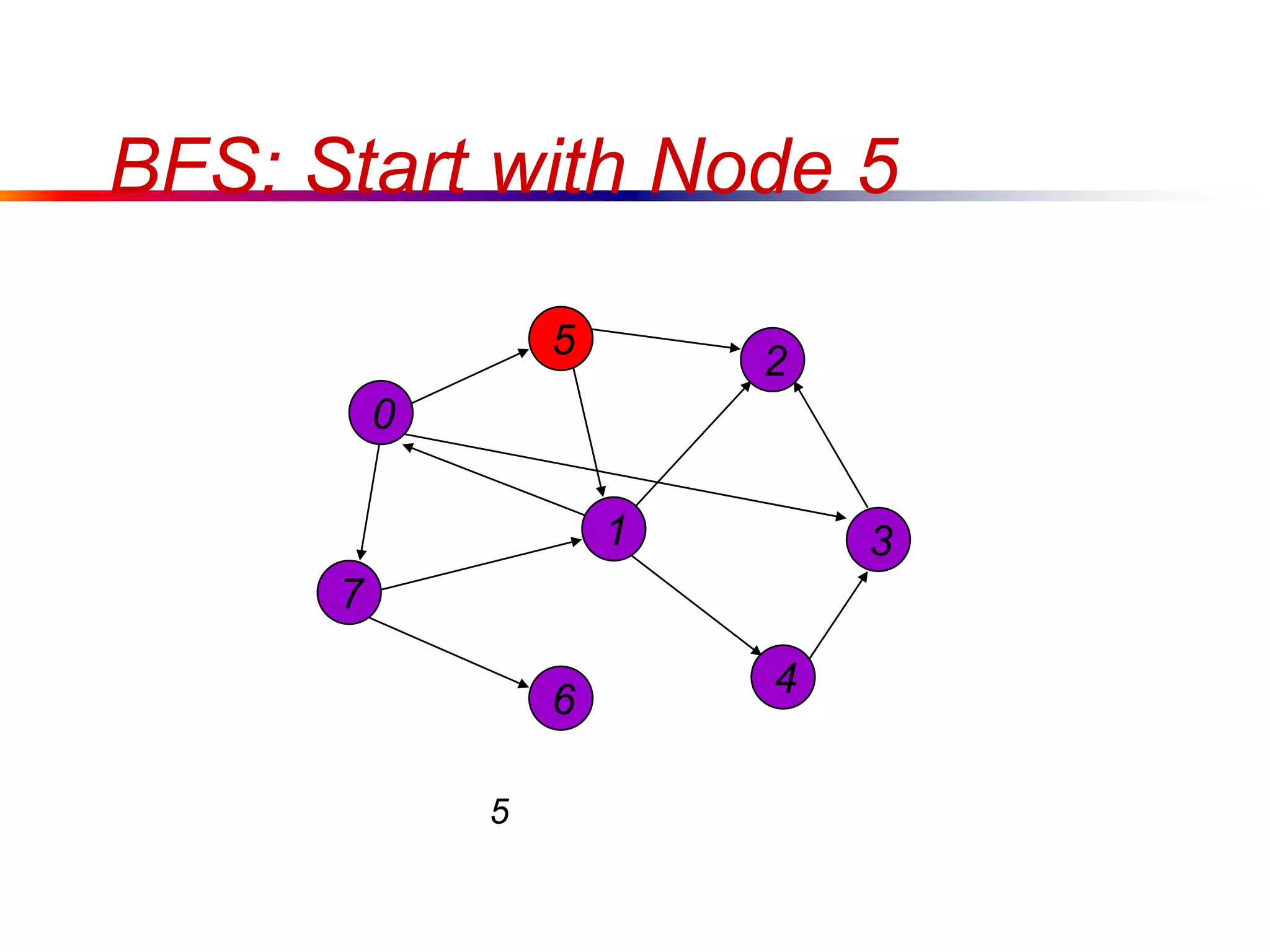
BFS: Start with Node 5
7
1
5
4
3
2
6
5 1 2 0 4 3 7 6
0
BFS: Start with Node 5
7
1
5
4
3
2
6
5
0
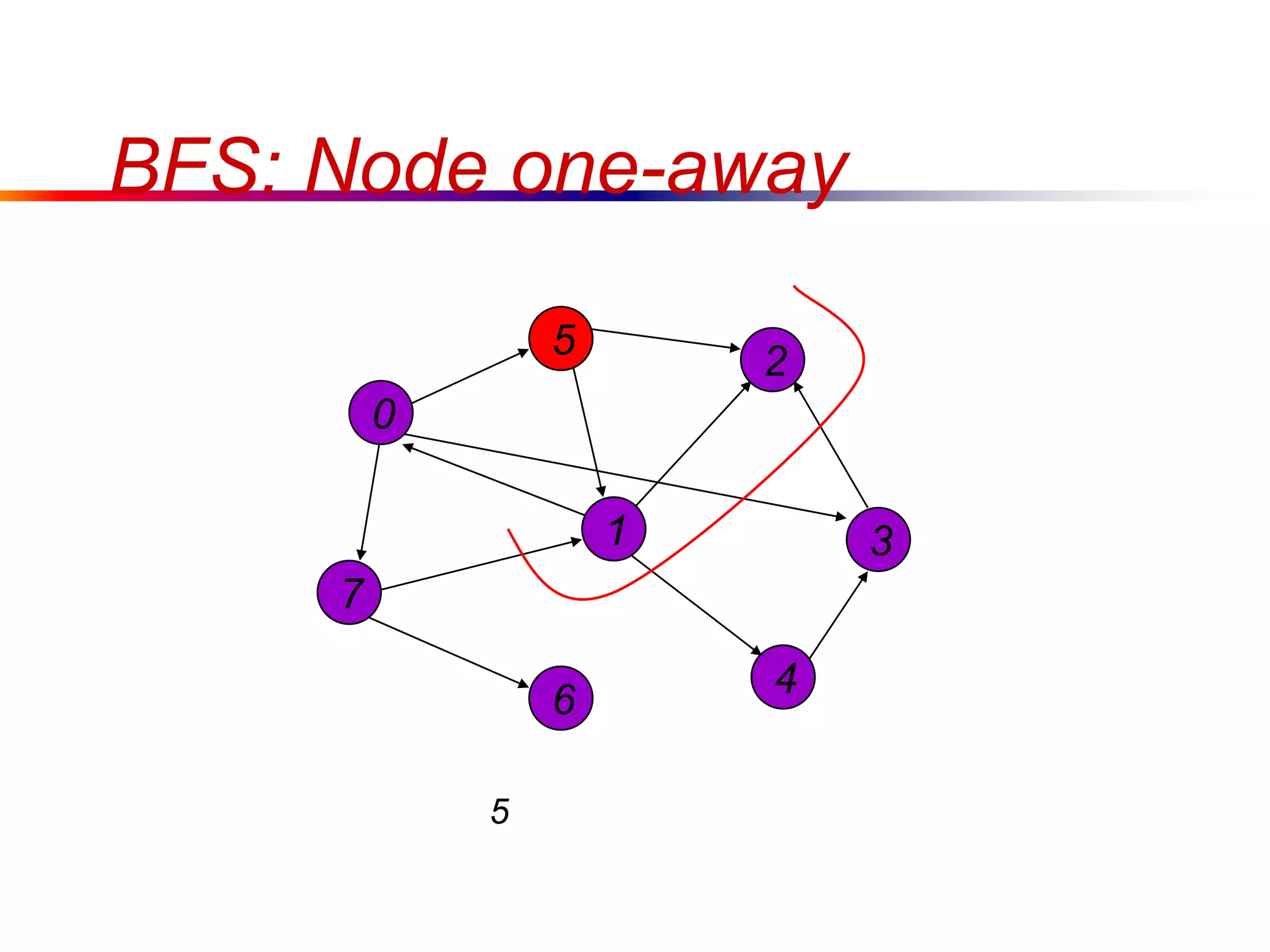
BFS: Node one-away
7
1
5
4
3
2
6
5
0
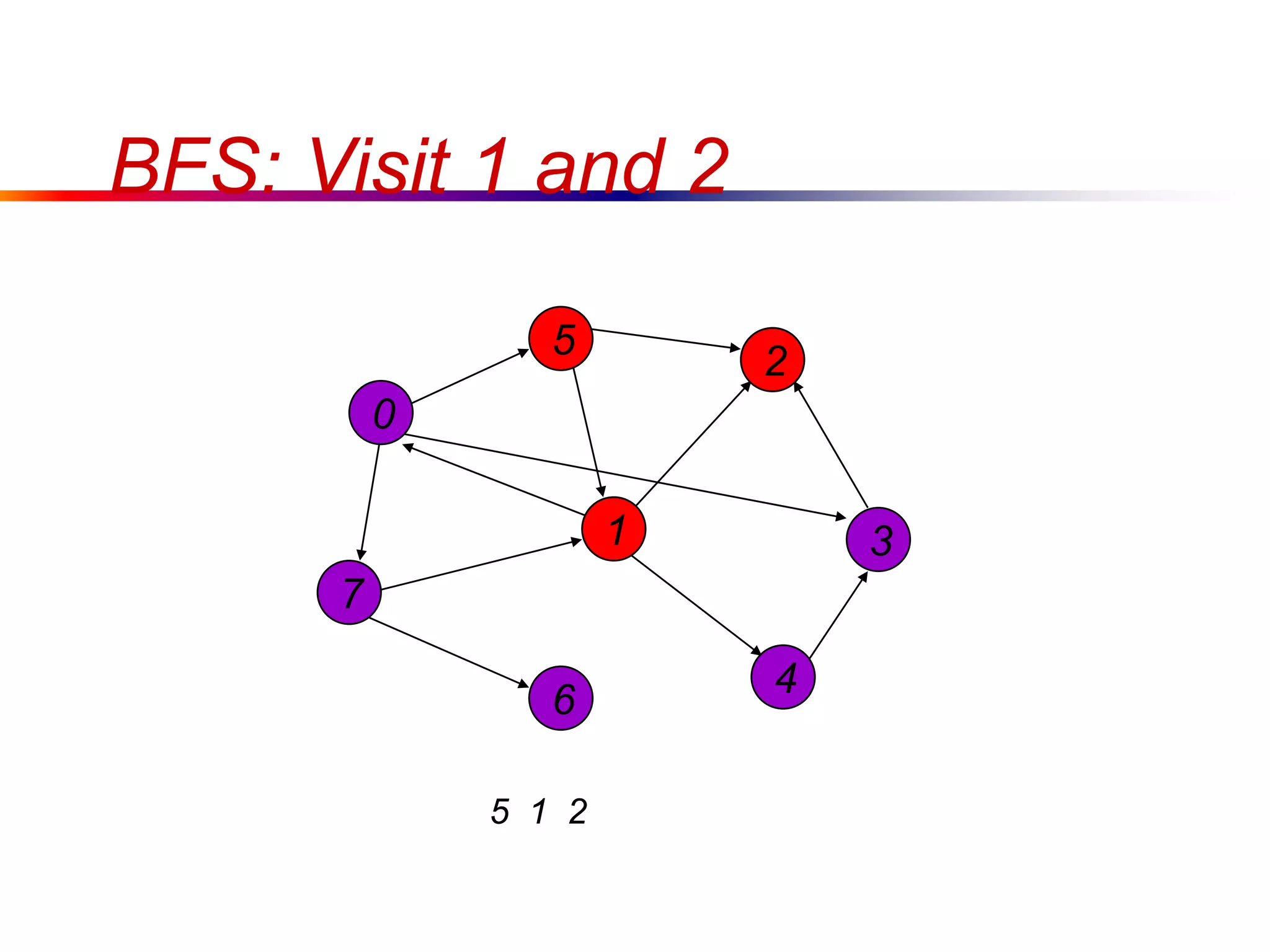
BFS: Visit 1 and 2
7
1
5
4
3
2
6
5 1 2
0
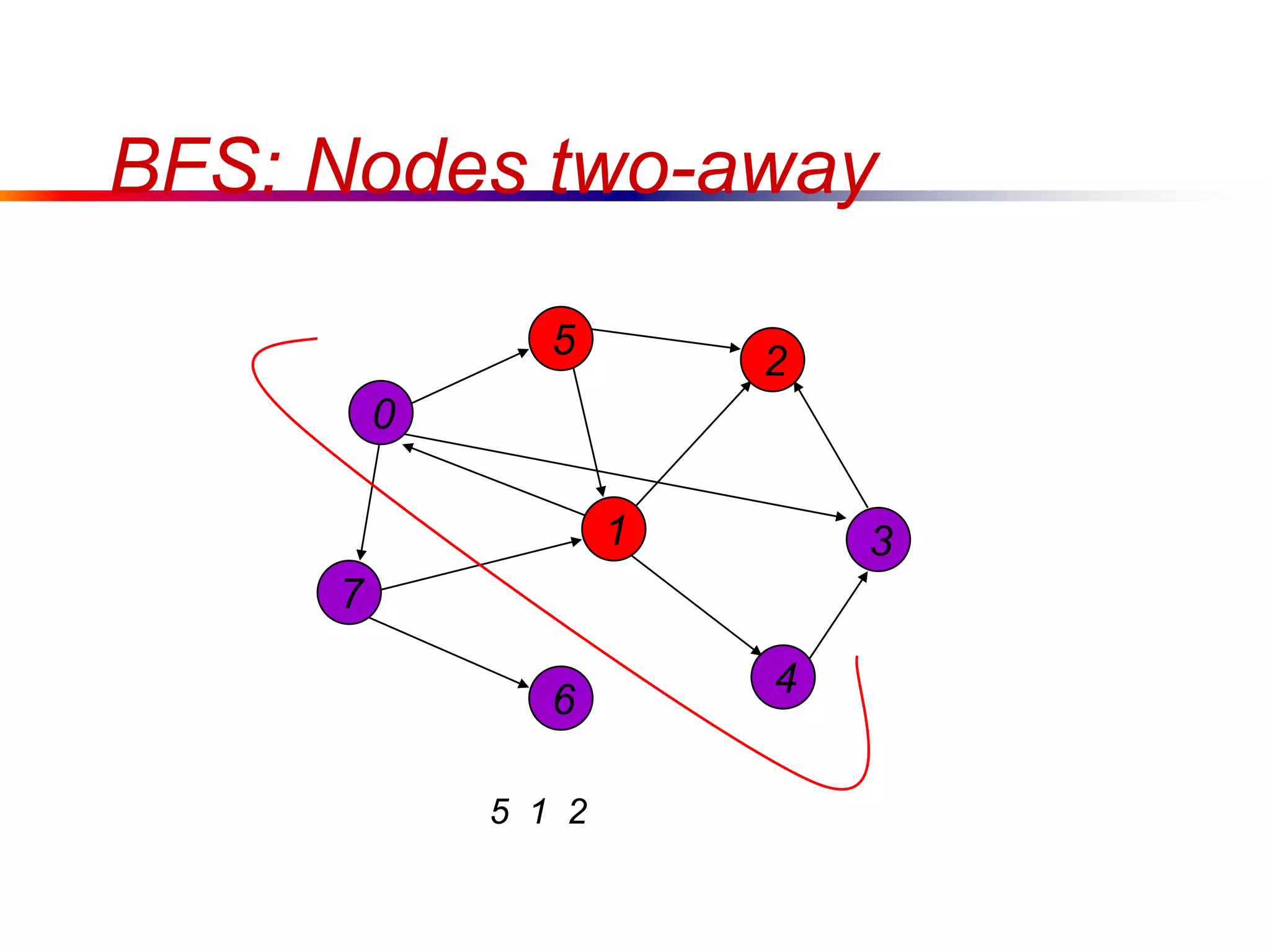
BFS: Nodes two-away
7
1
5
4
3
2
6
5 1 2
0
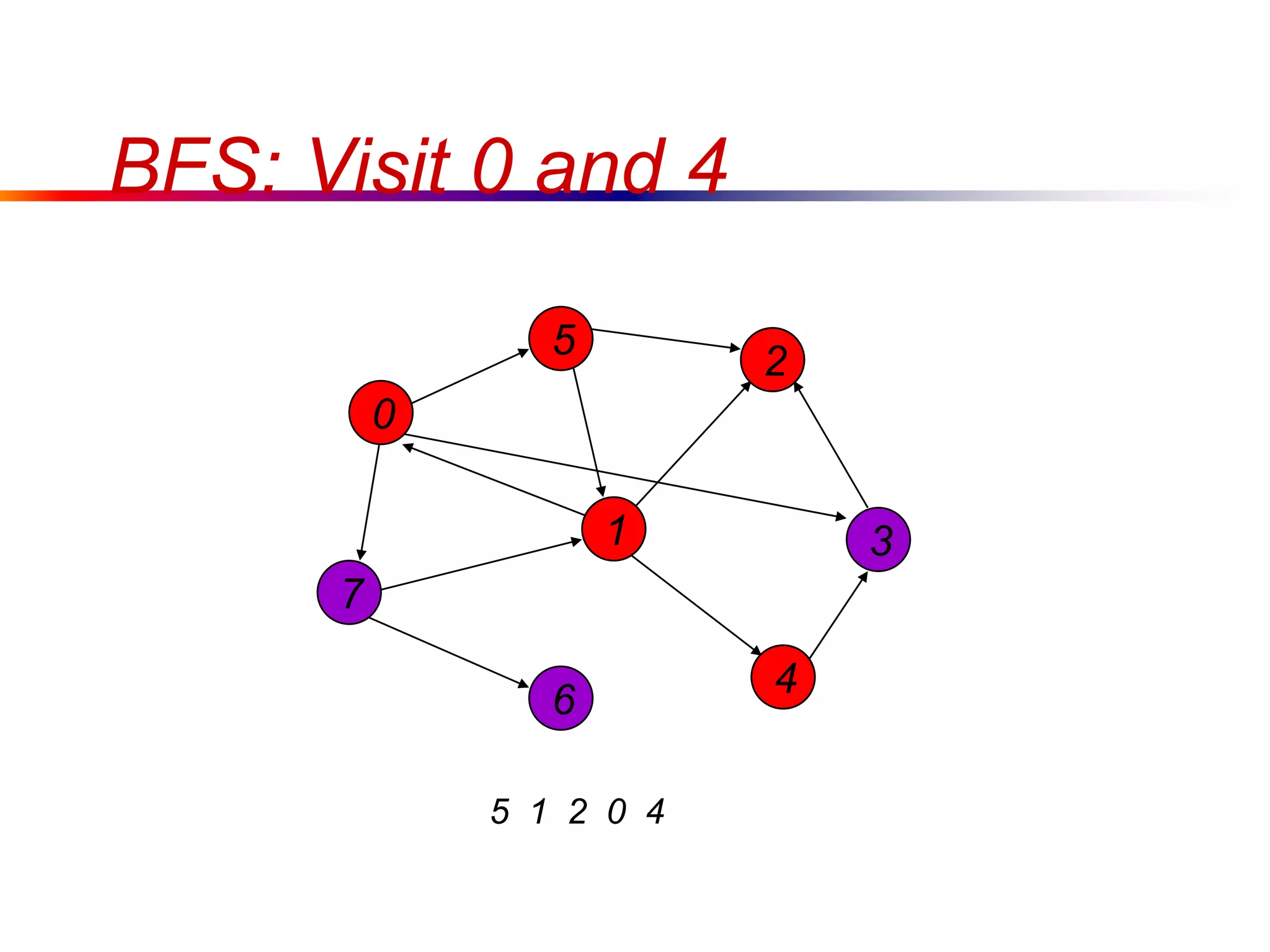
BFS: Visit 0 and 4
7
1
5
4
3
2
6
5 1 2 0 4
0
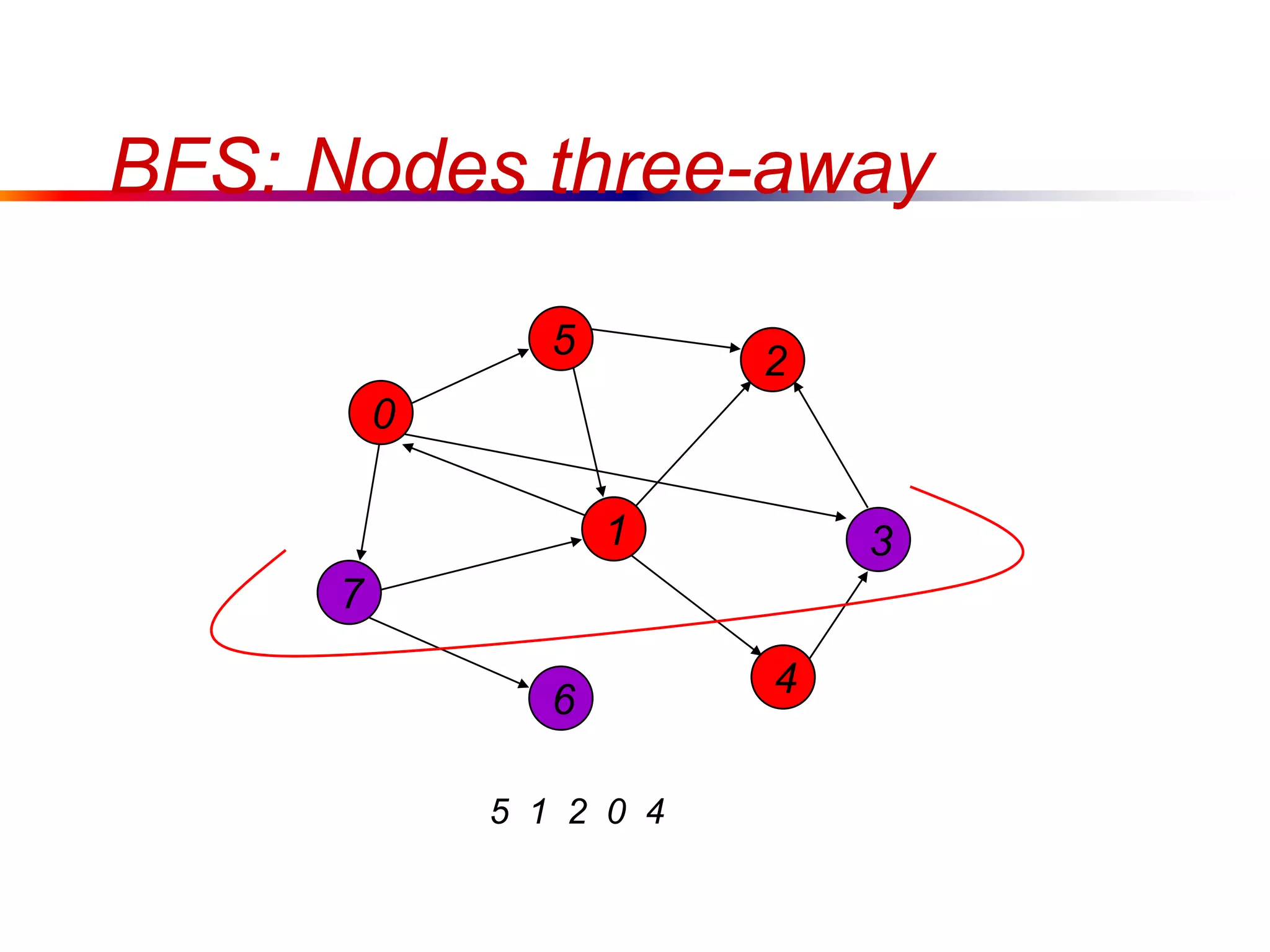
BFS: Nodes three-away
7
1
5
4
3
2
6
5 1 2 0 4
0
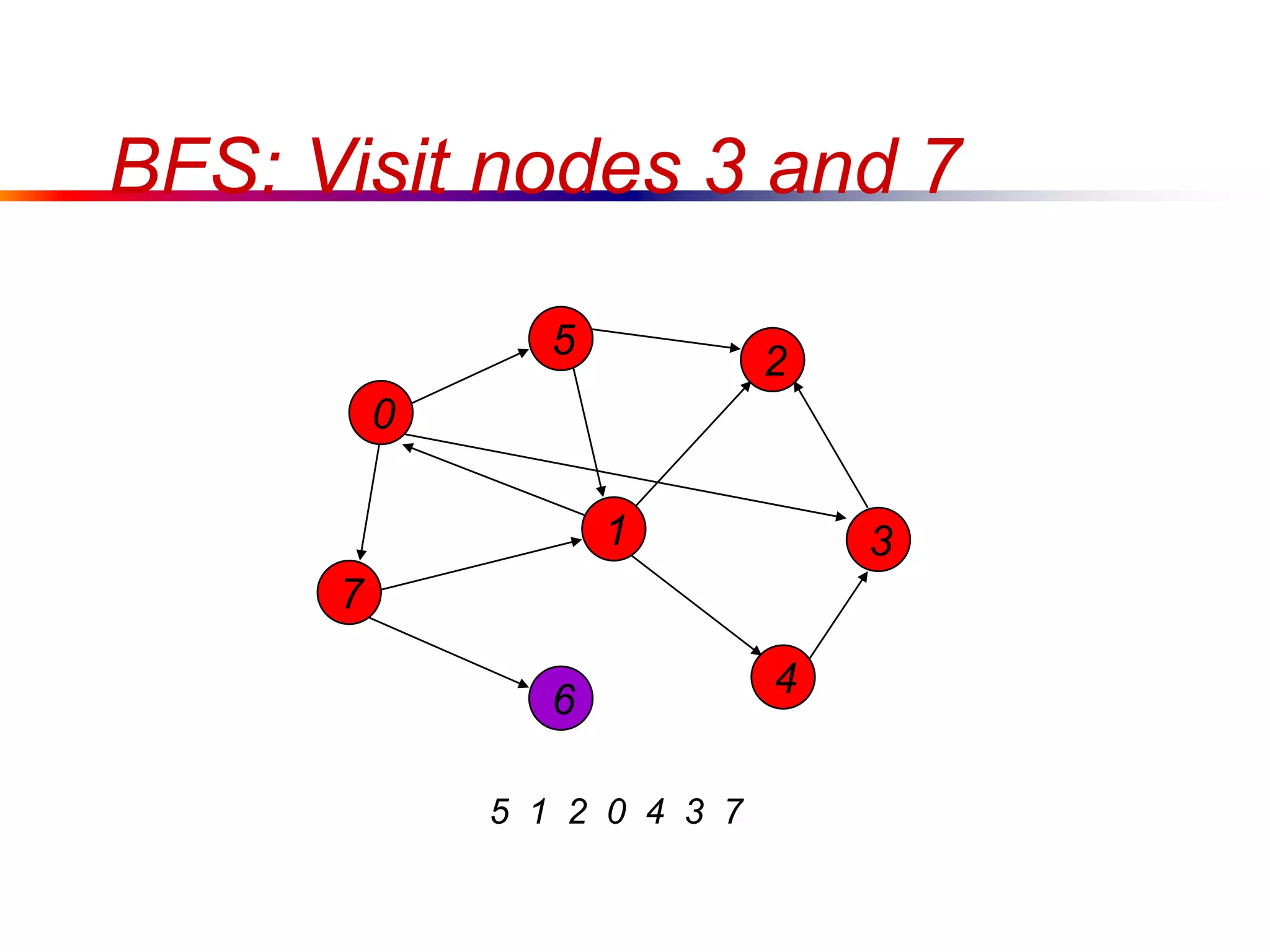
BFS: Visit nodes 3 and 7
7
1
5
4
3
2
6
5 1 2 0 4 3 7
0
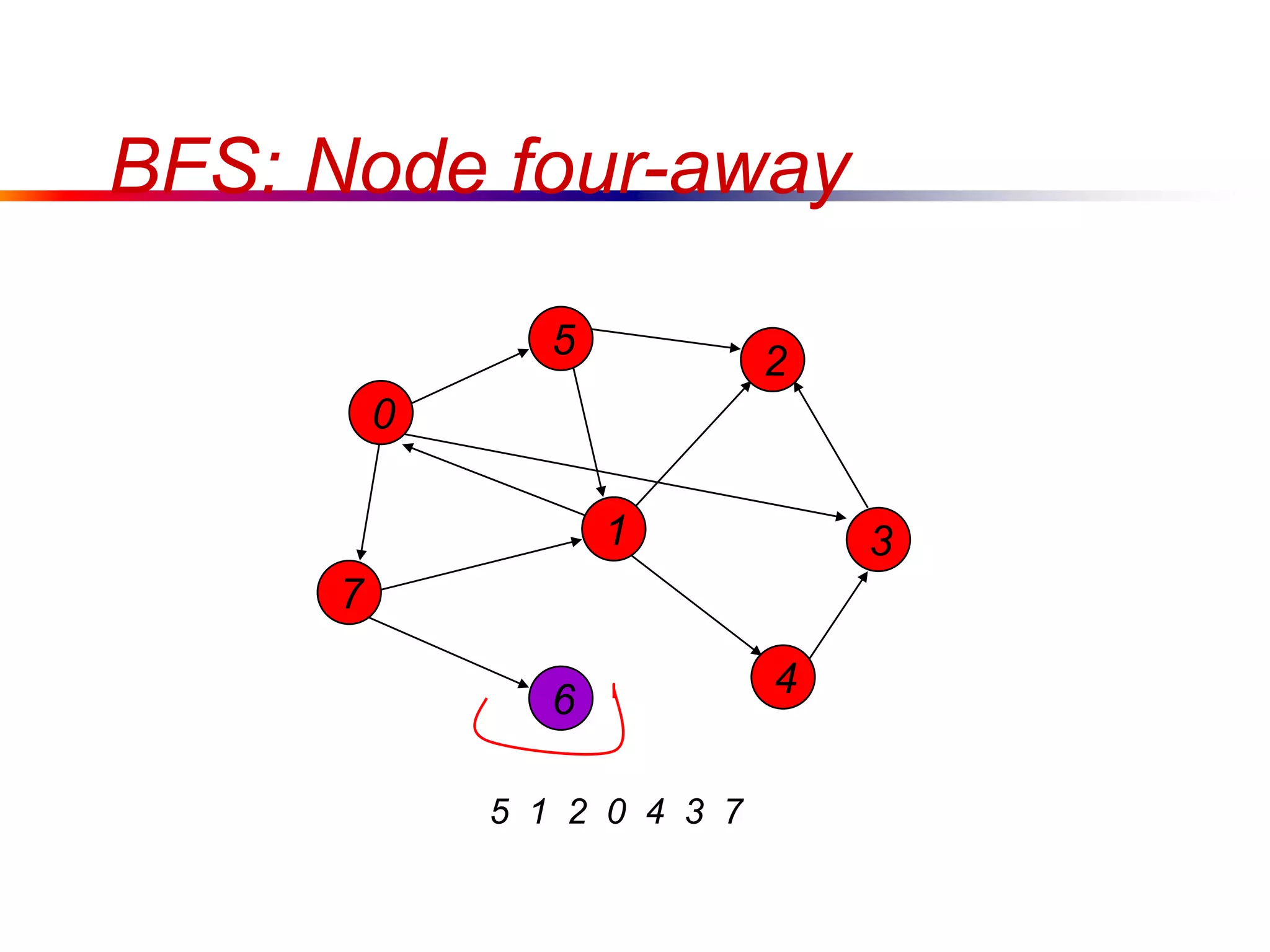
BFS: Node four-away
7
1
5
4
3
2
6
5 1 2 0 4 3 7
0
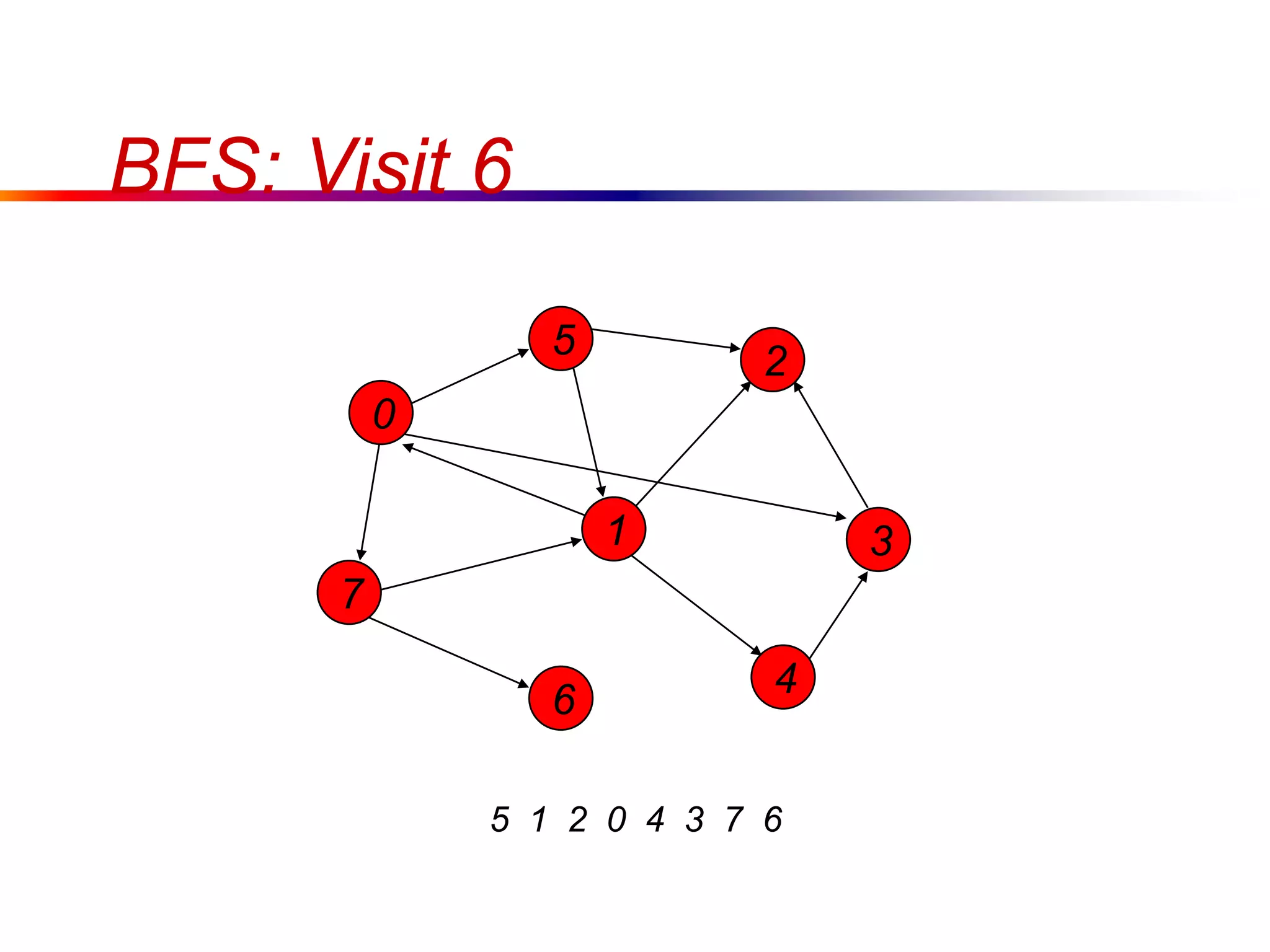
BFS: Visit 6
7
1
5
4
3
2
6
5 1 2 0 4 3 7 6
0
Breadth-First Search (BFS)
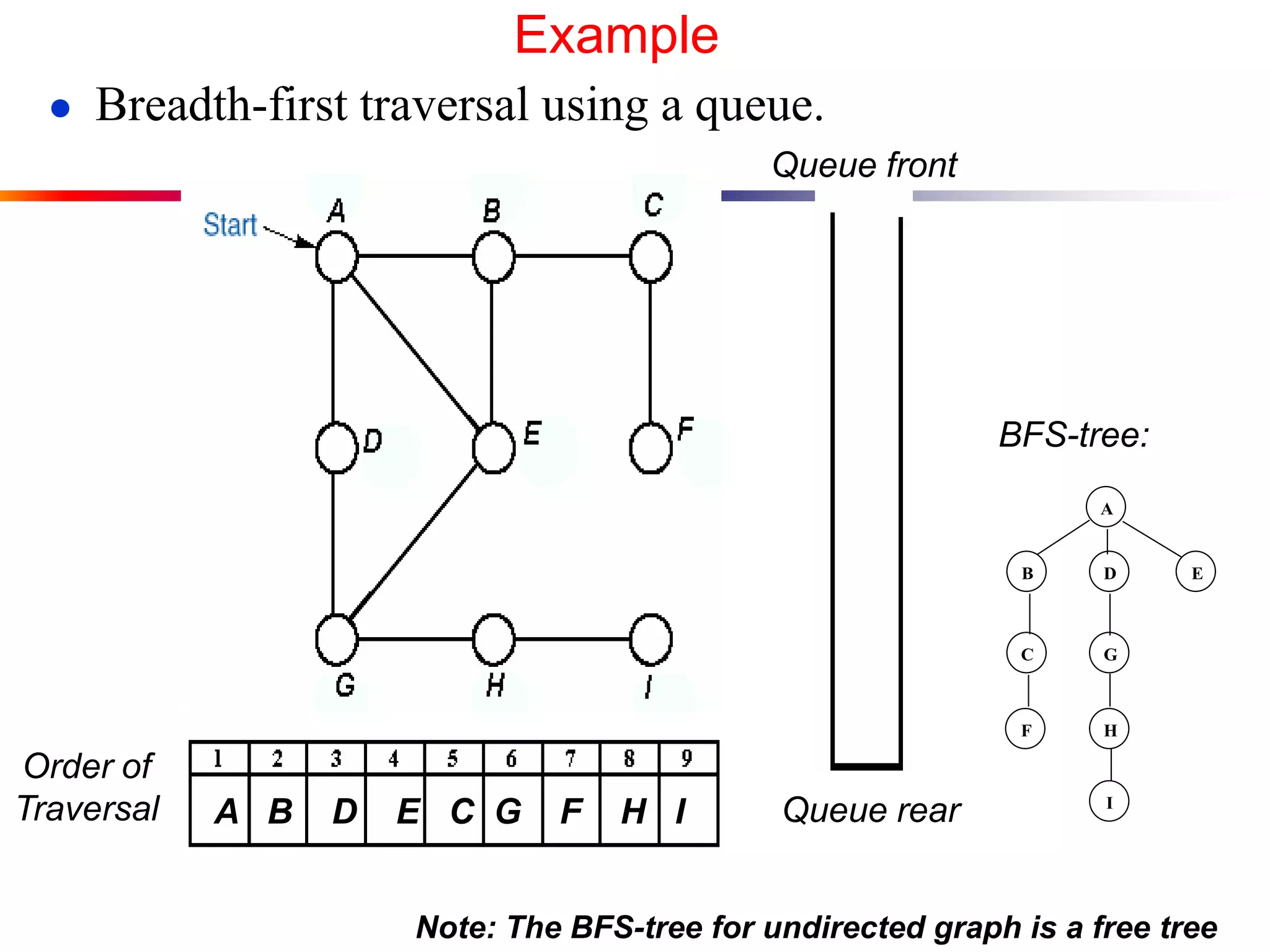
Example
● Breadth-first traversal using a queue.
Order of
Traversal Queue rearA B D E C G F H I
Queue front
A
B D E
C G
F H
I
BFS-tree:
Note: The BFS-tree for undirected graph is a free tree
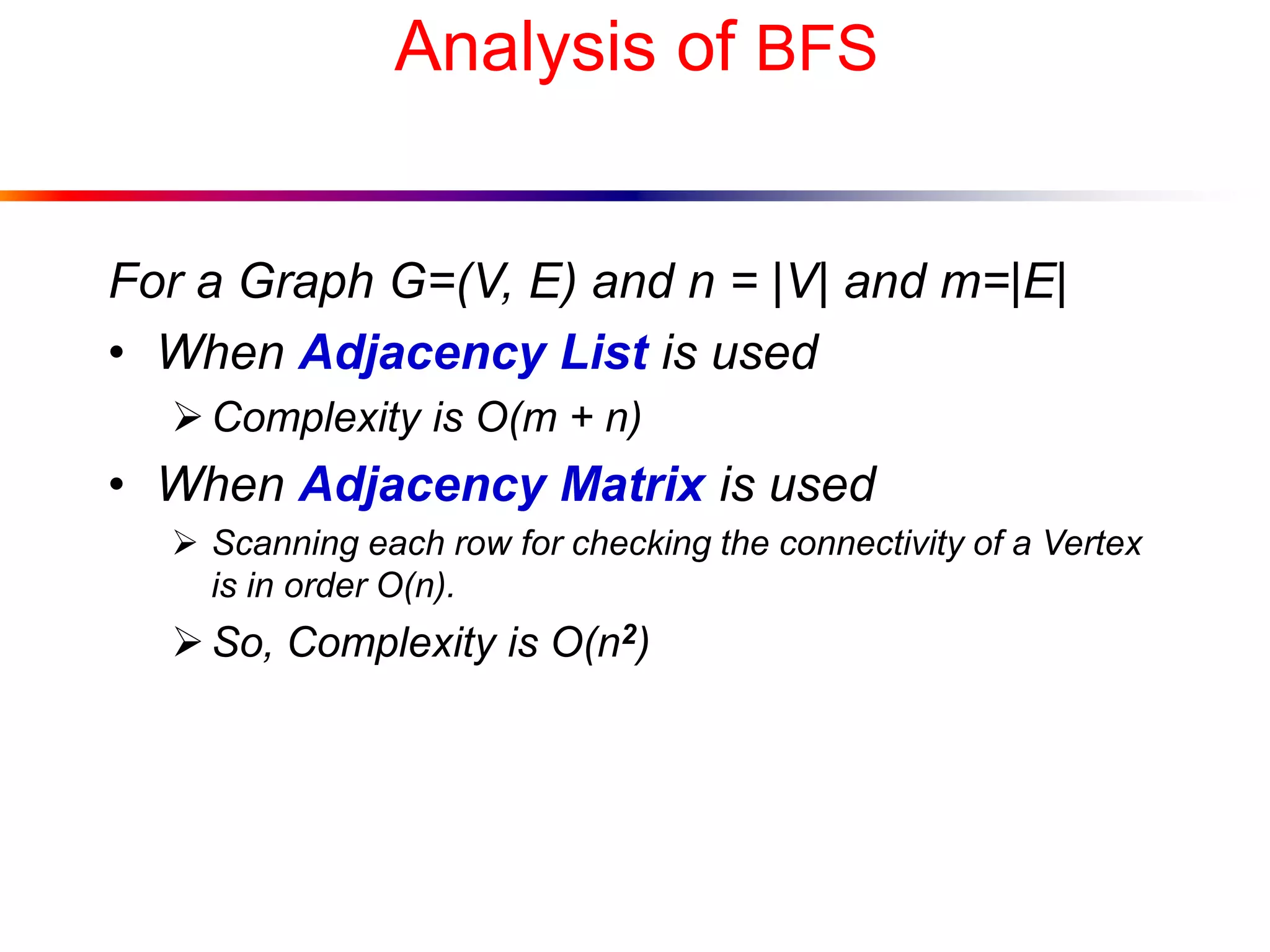
Analysis of BFS
For a Graph G=(V, E) and n = |V| and m=|E|
• When Adjacency List is used
Complexity is O(m + n)
• When Adjacency Matrix is used
 Scanning each row for checking the connectivity of a Vertex
is in order O(n).
So, Complexity is O(n2)
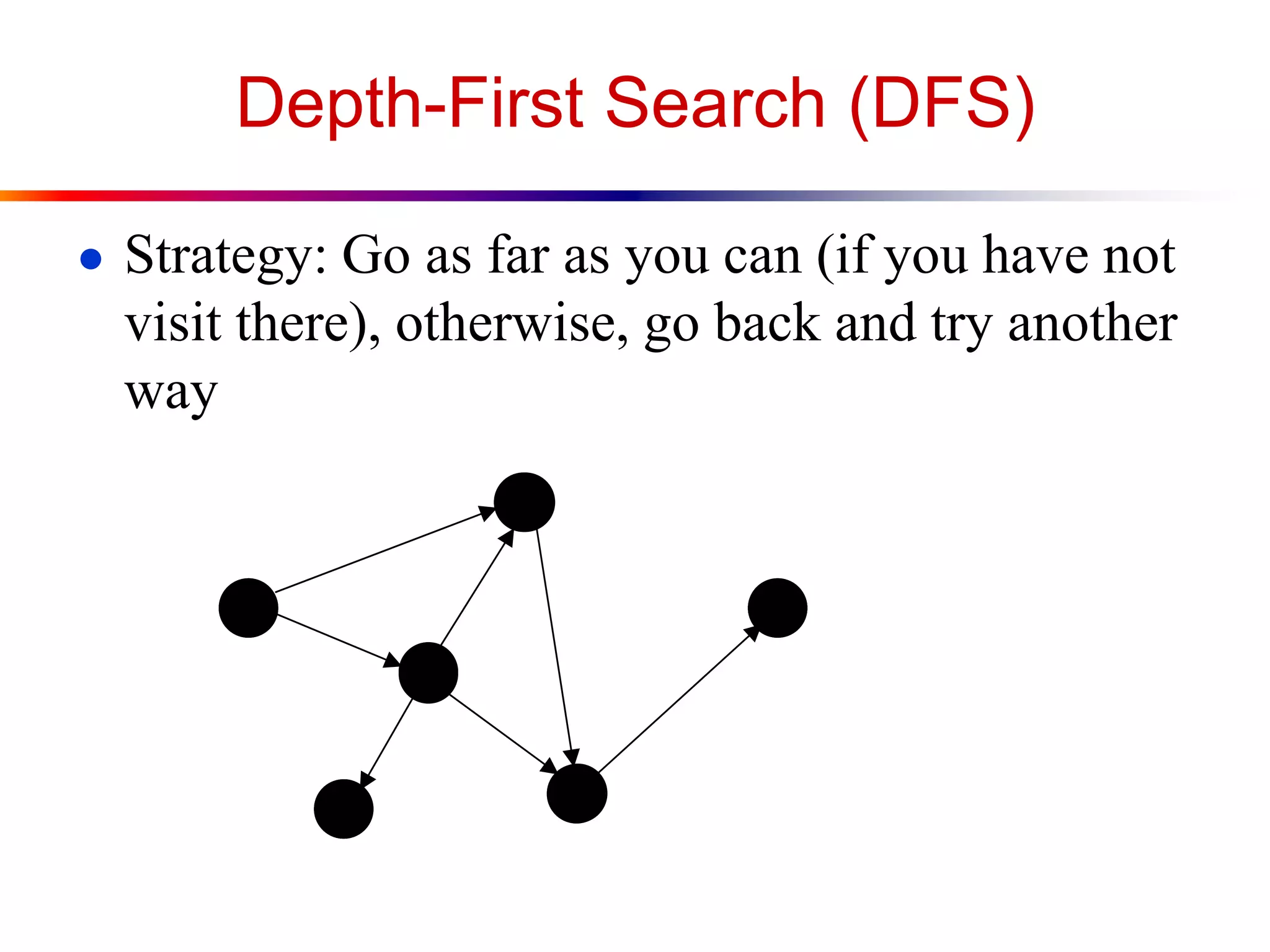
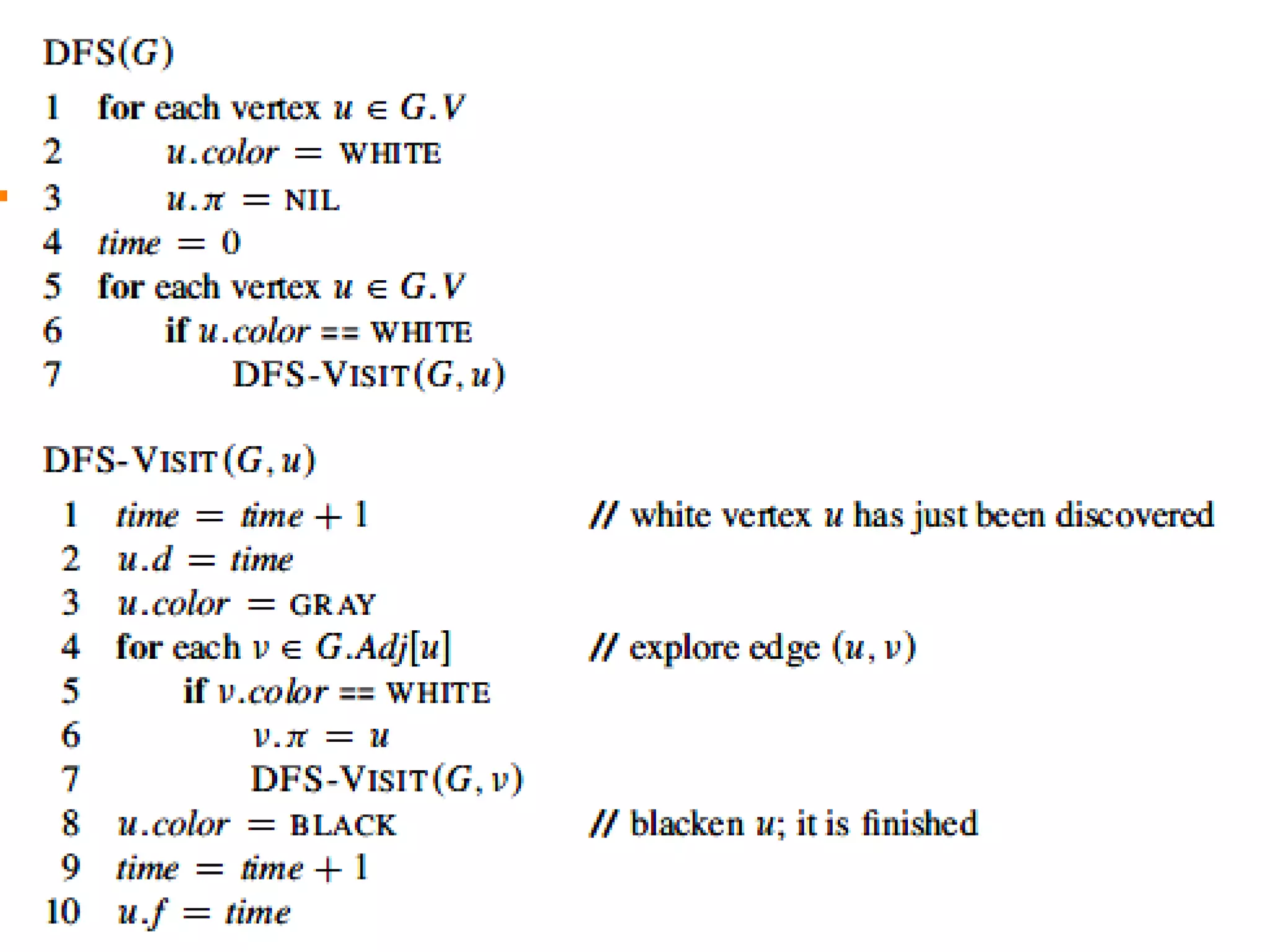
Depth-First Search (DFS)
● Strategy: Go as far as you can (if you have not
visit there), otherwise, go back and try another
way
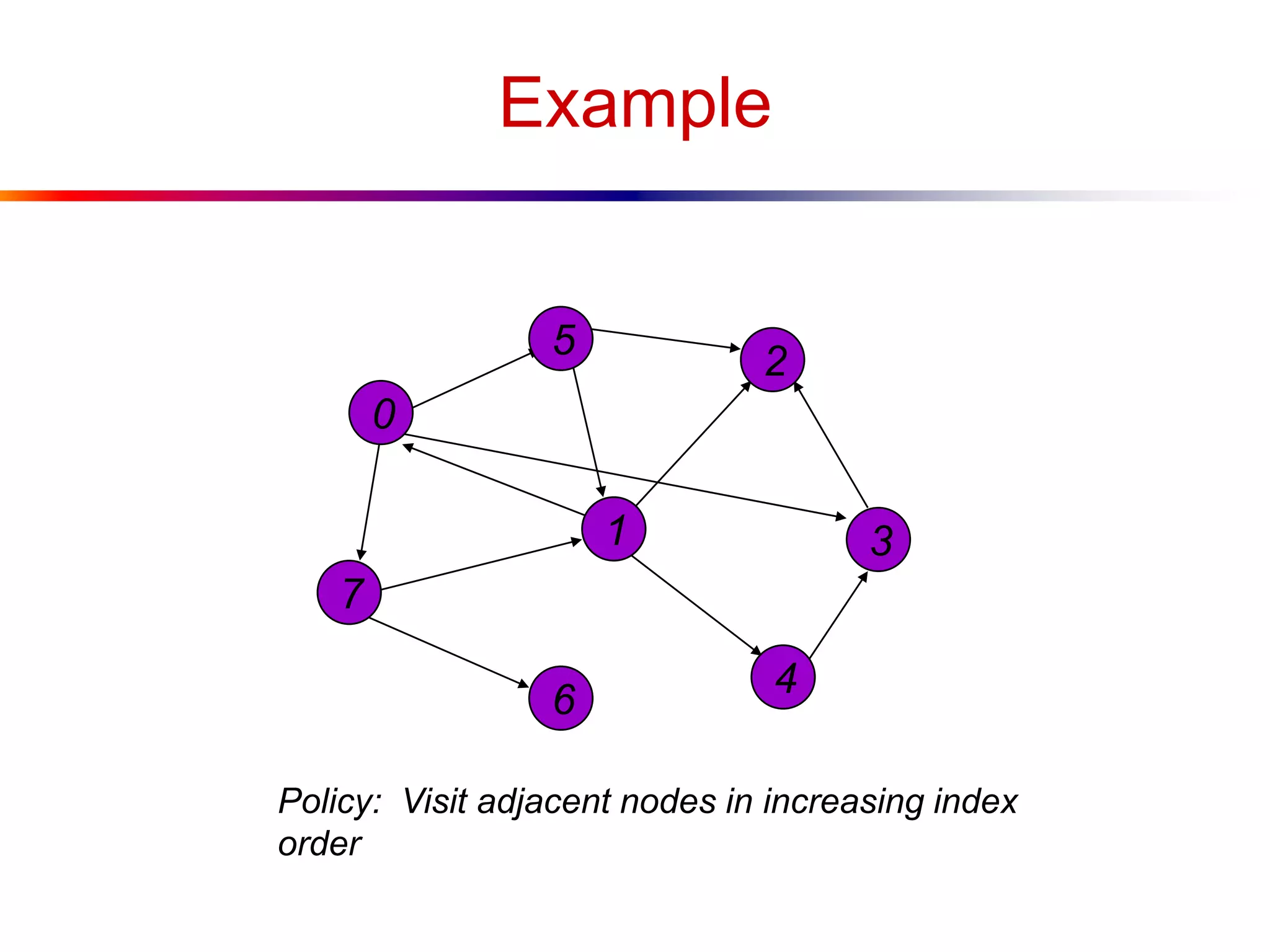
Example
0
7
1
5
4
3
2
6
Policy: Visit adjacent nodes in increasing index
order
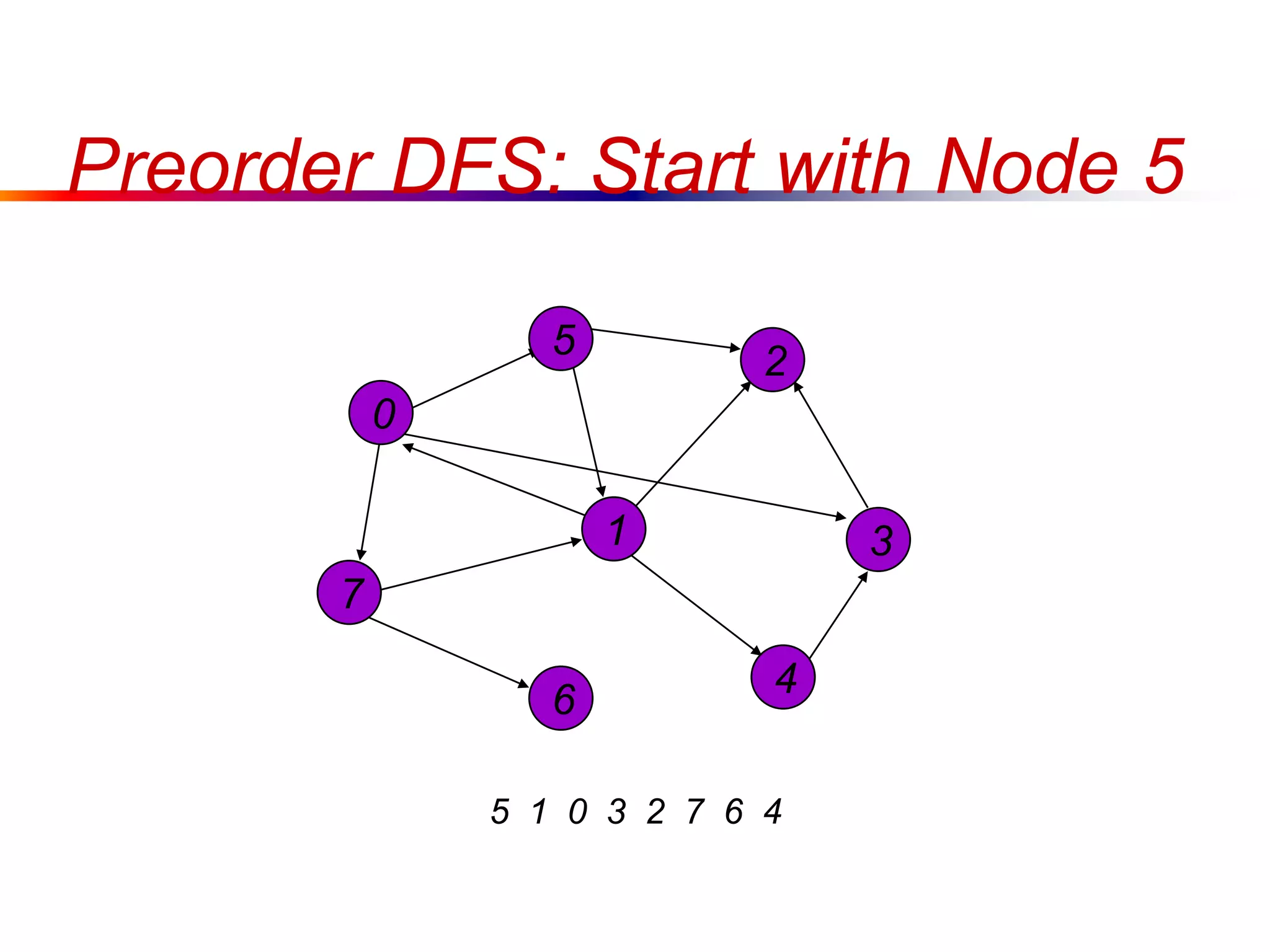
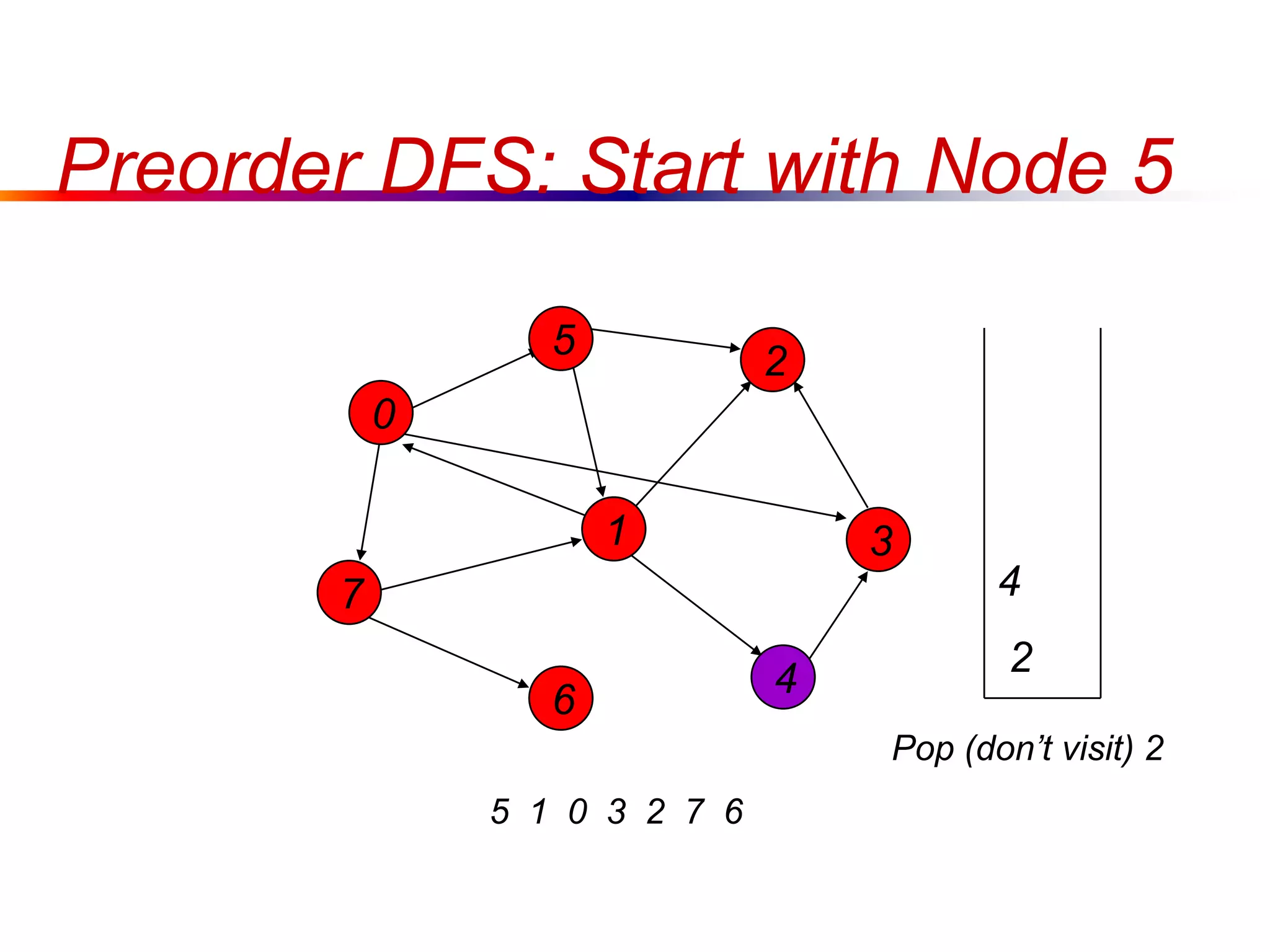
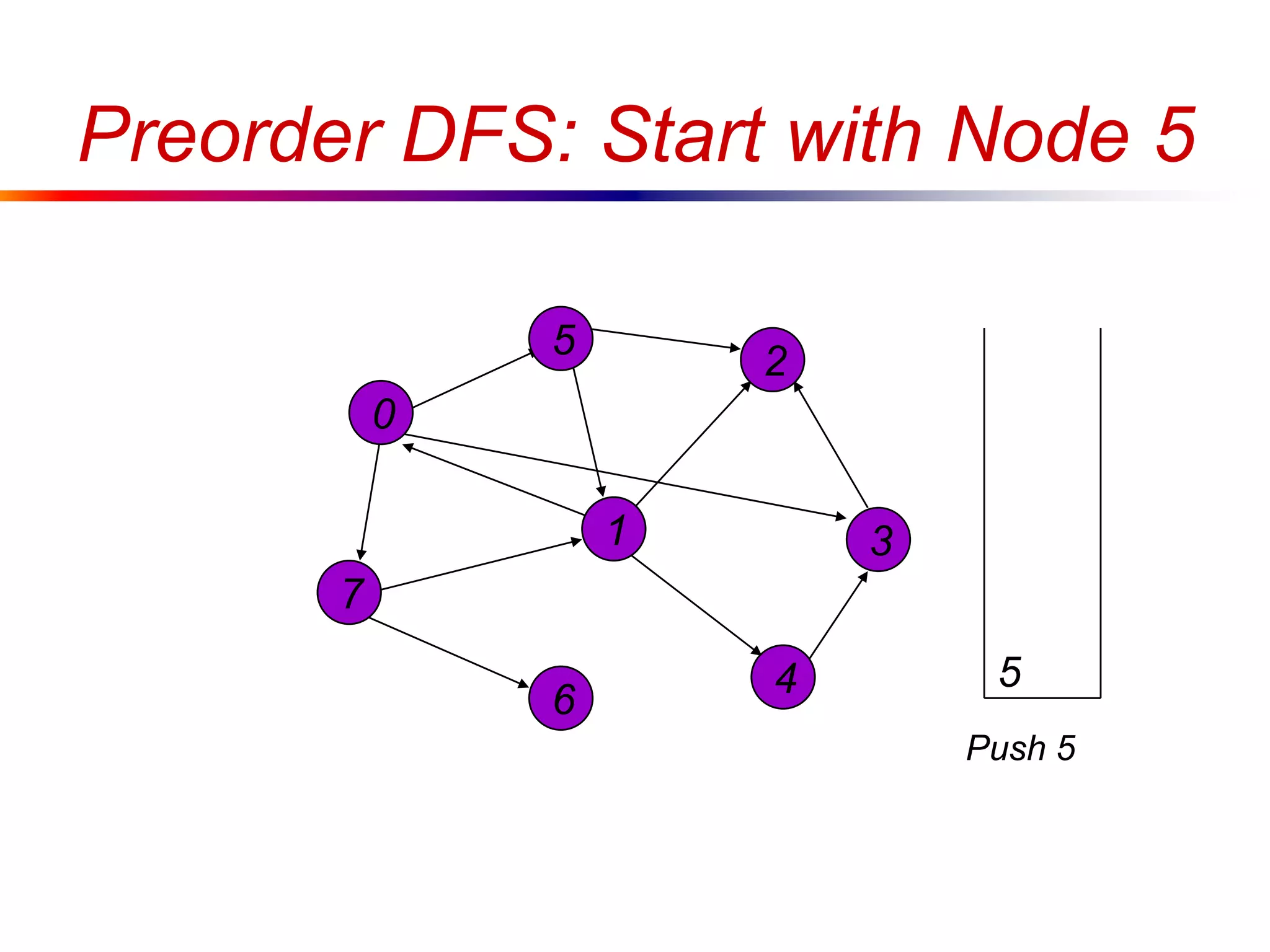
Preorder DFS: Start with Node 5
0
7
1
5
4
3
2
6
5 1 0 3 2 7 6 4
Preorder DFS: Start with Node 5
0
7
1
5
4
3
2
6
5
Push 5
Preorder DFS: Start with Node 5
0
7
1
5
4
3
2
6
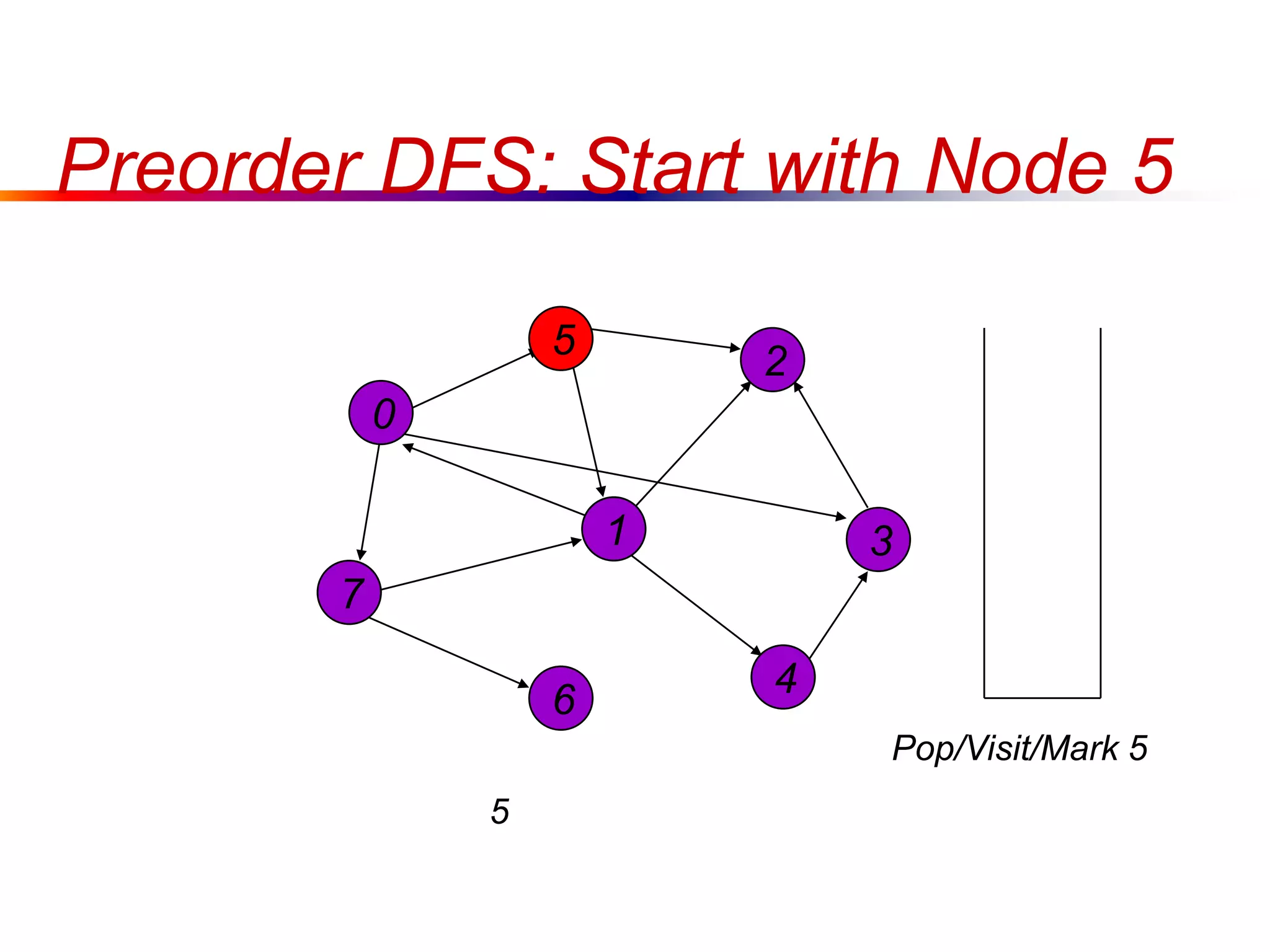
5
Pop/Visit/Mark 5
Preorder DFS: Start with Node 5
0
7
1
5
4
3
2
6
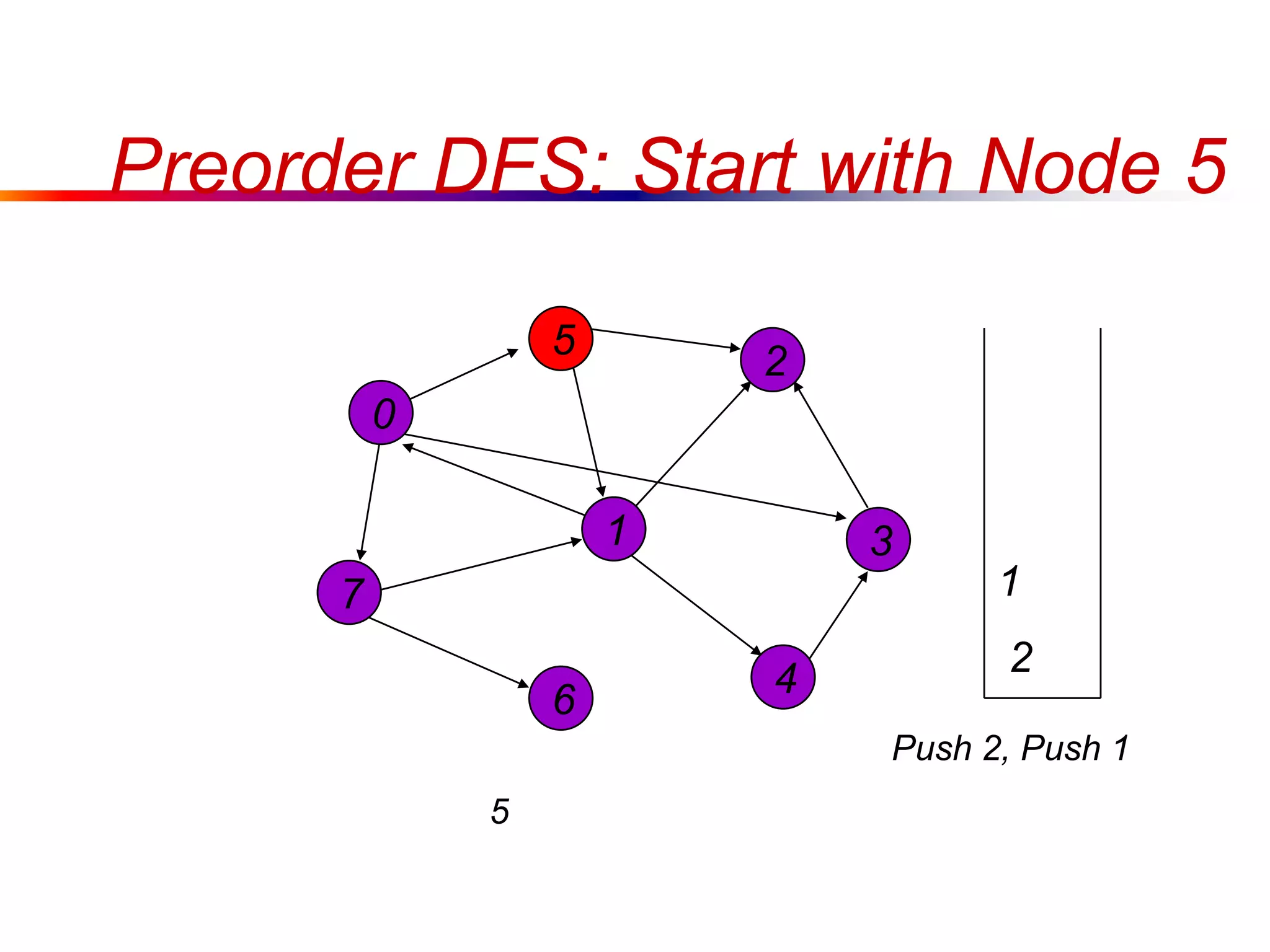
5
1
2
Push 2, Push 1
Preorder DFS: Start with Node 5
0
7
1
5
4
3
2
6
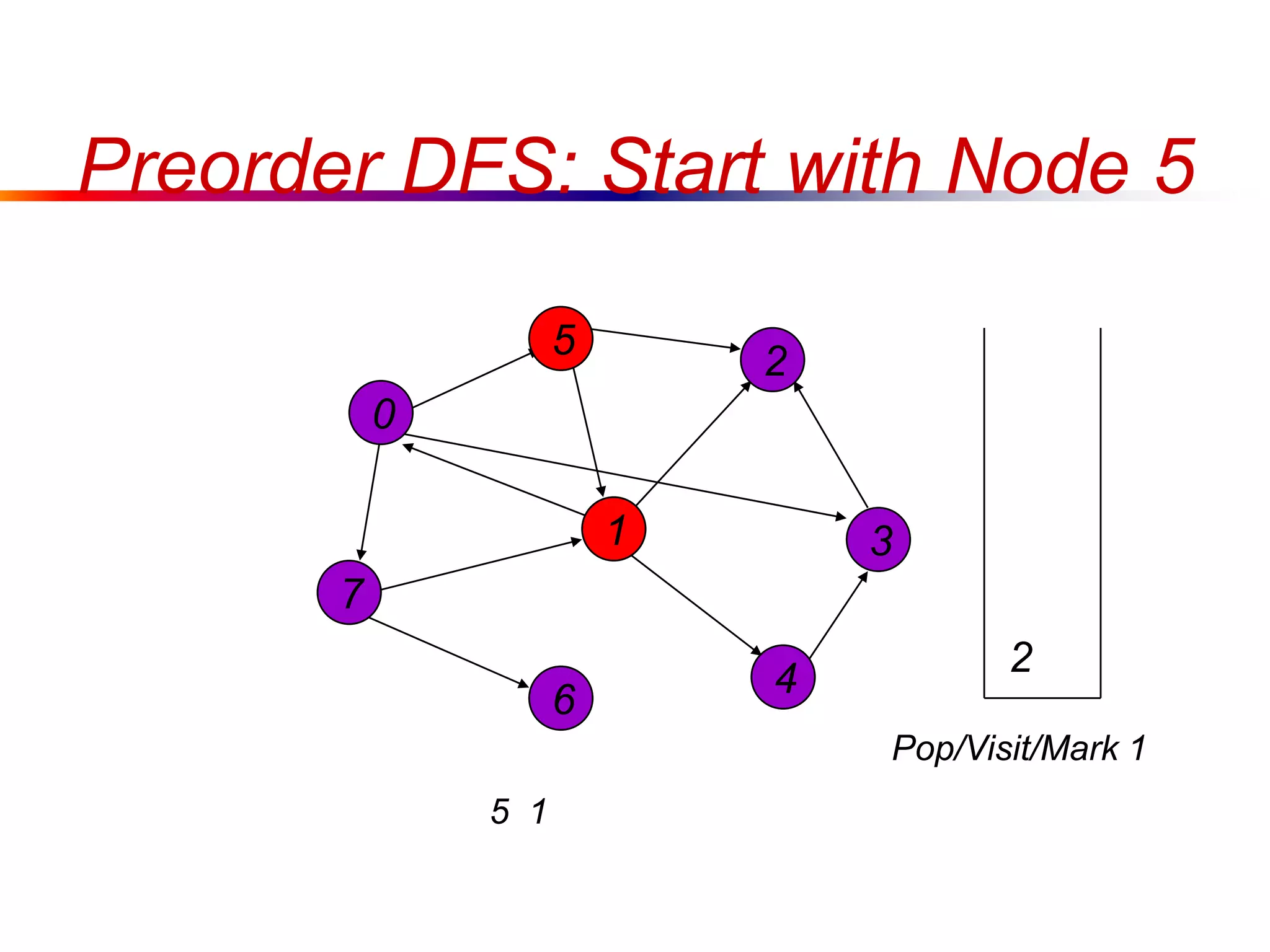
5 1
2
Pop/Visit/Mark 1
Preorder DFS: Start with Node 5
0
7
1
5
4
3
2
6
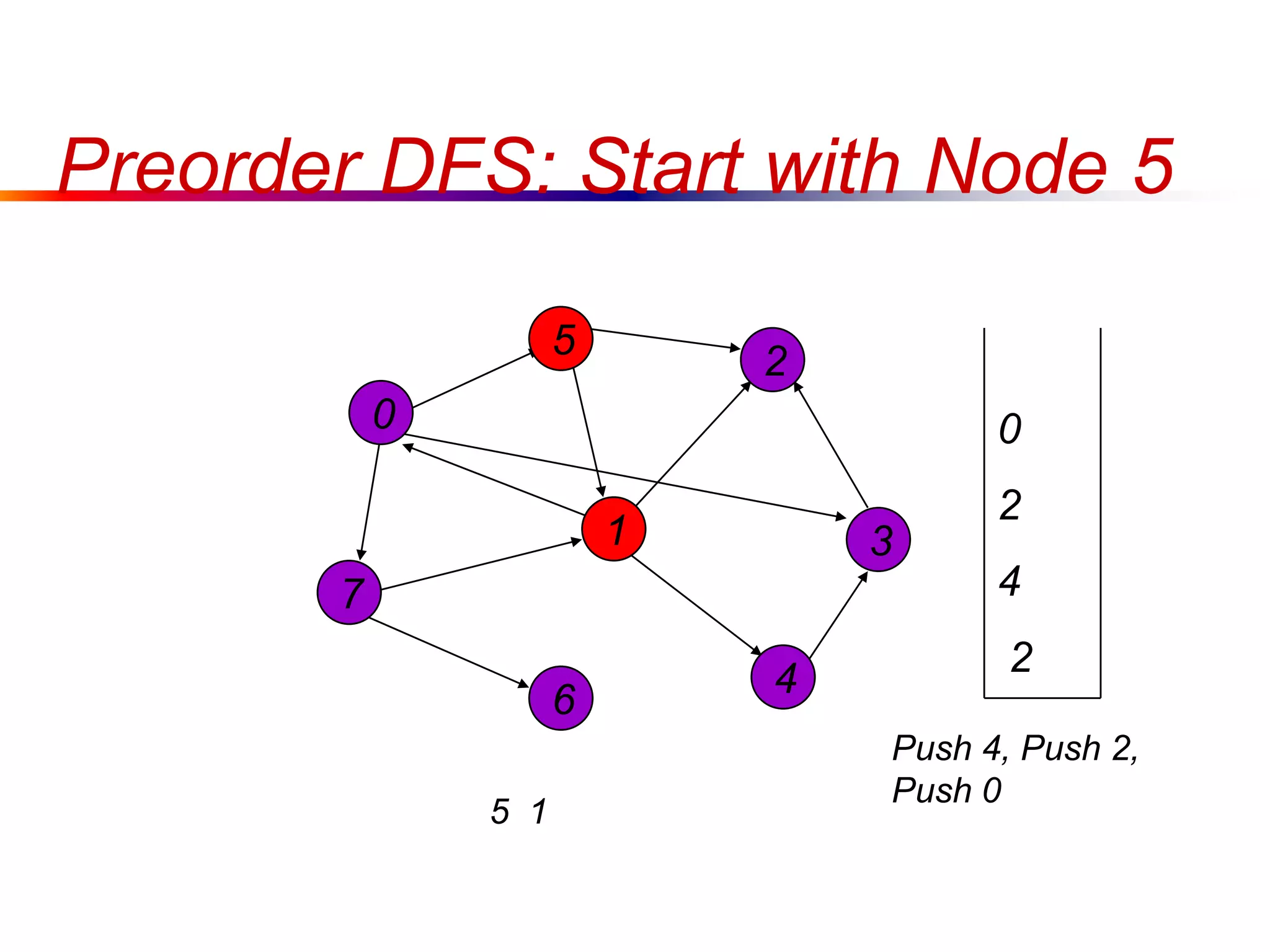
5 1
0
2
4
2
Push 4, Push 2,
Push 0
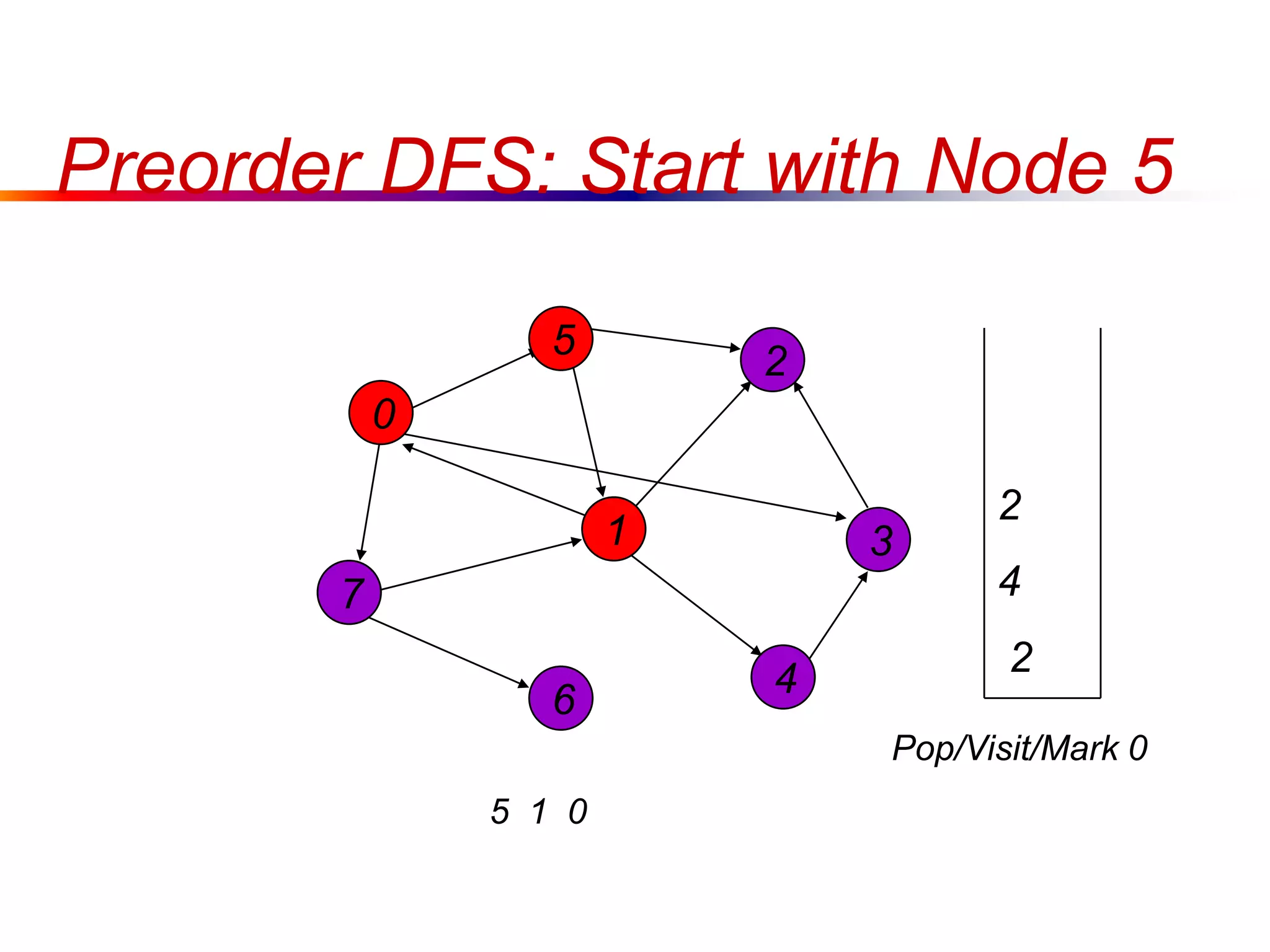
Preorder DFS: Start with Node 5
0
7
1
5
4
3
2
6
5 1 0
2
4
2
Pop/Visit/Mark 0
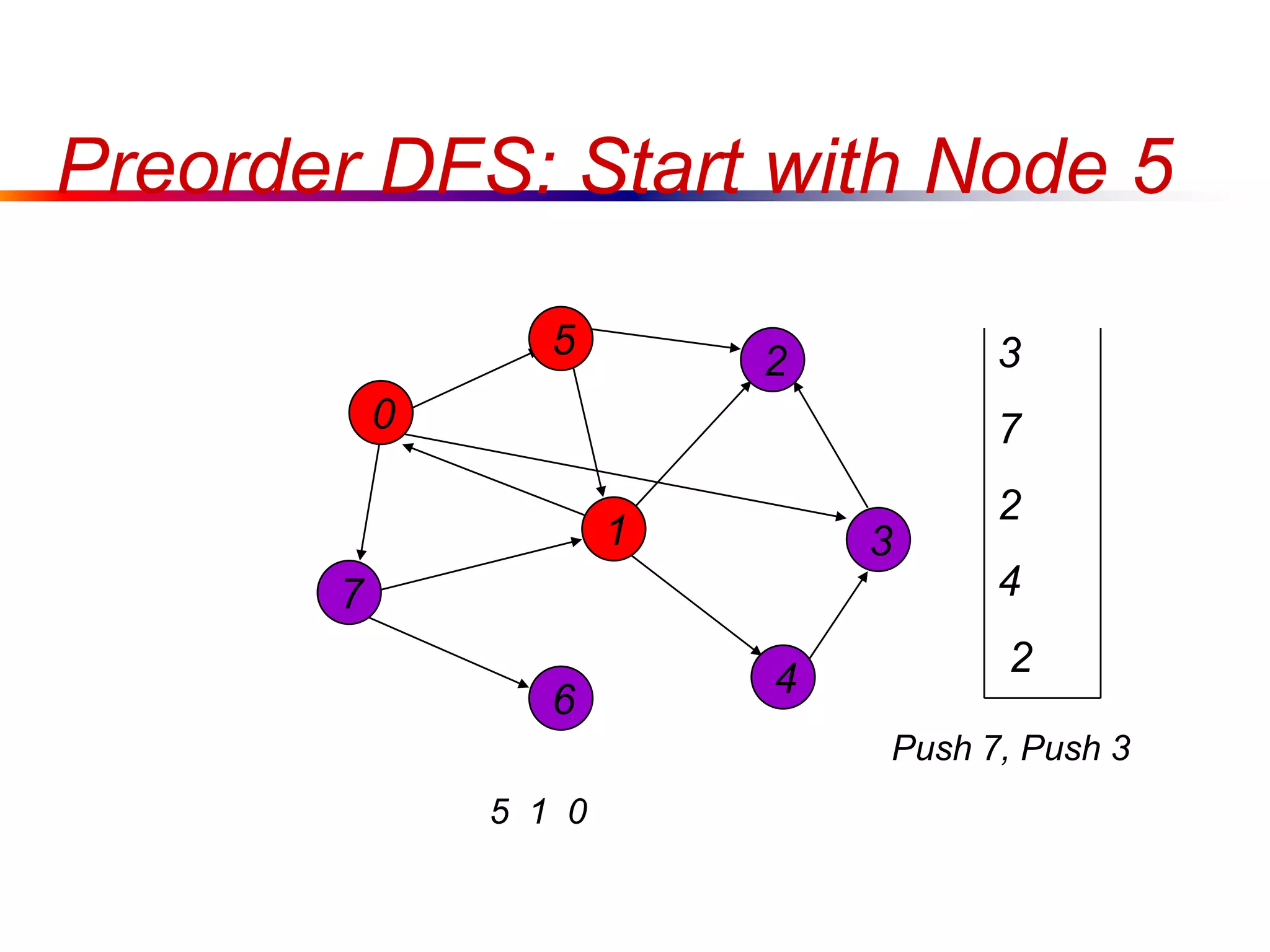
Preorder DFS: Start with Node 5
0
7
1
5
4
3
2
6
5 1 0
3
7
2
4
2
Push 7, Push 3
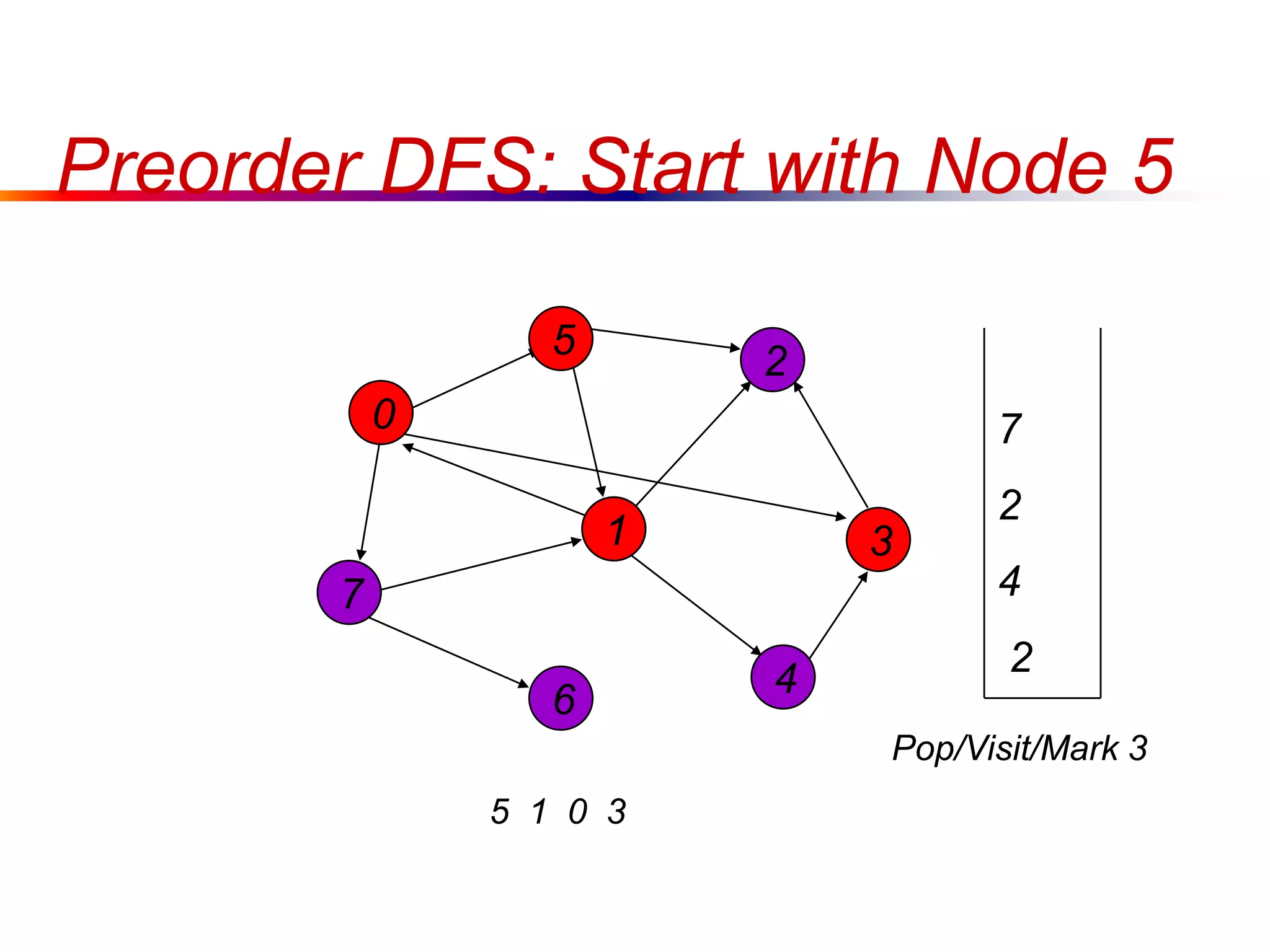
Preorder DFS: Start with Node 5
0
7
1
5
4
3
2
6
5 1 0 3
7
2
4
2
Pop/Visit/Mark 3
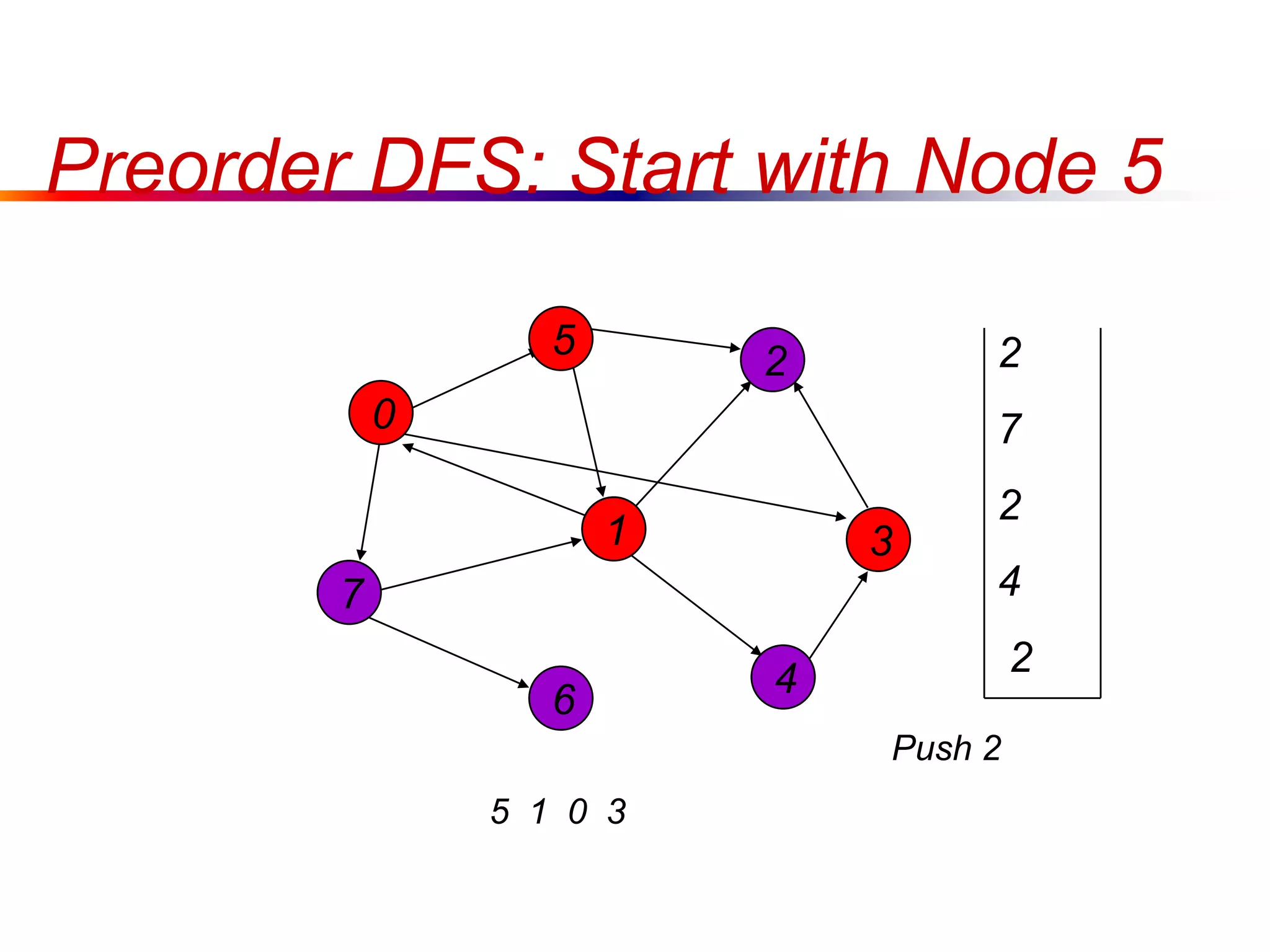
Preorder DFS: Start with Node 5
0
7
1
5
4
3
2
6
5 1 0 3
2
7
2
4
2
Push 2
Preorder DFS: Start with Node 5
0
7
1
5
4
3
2
6
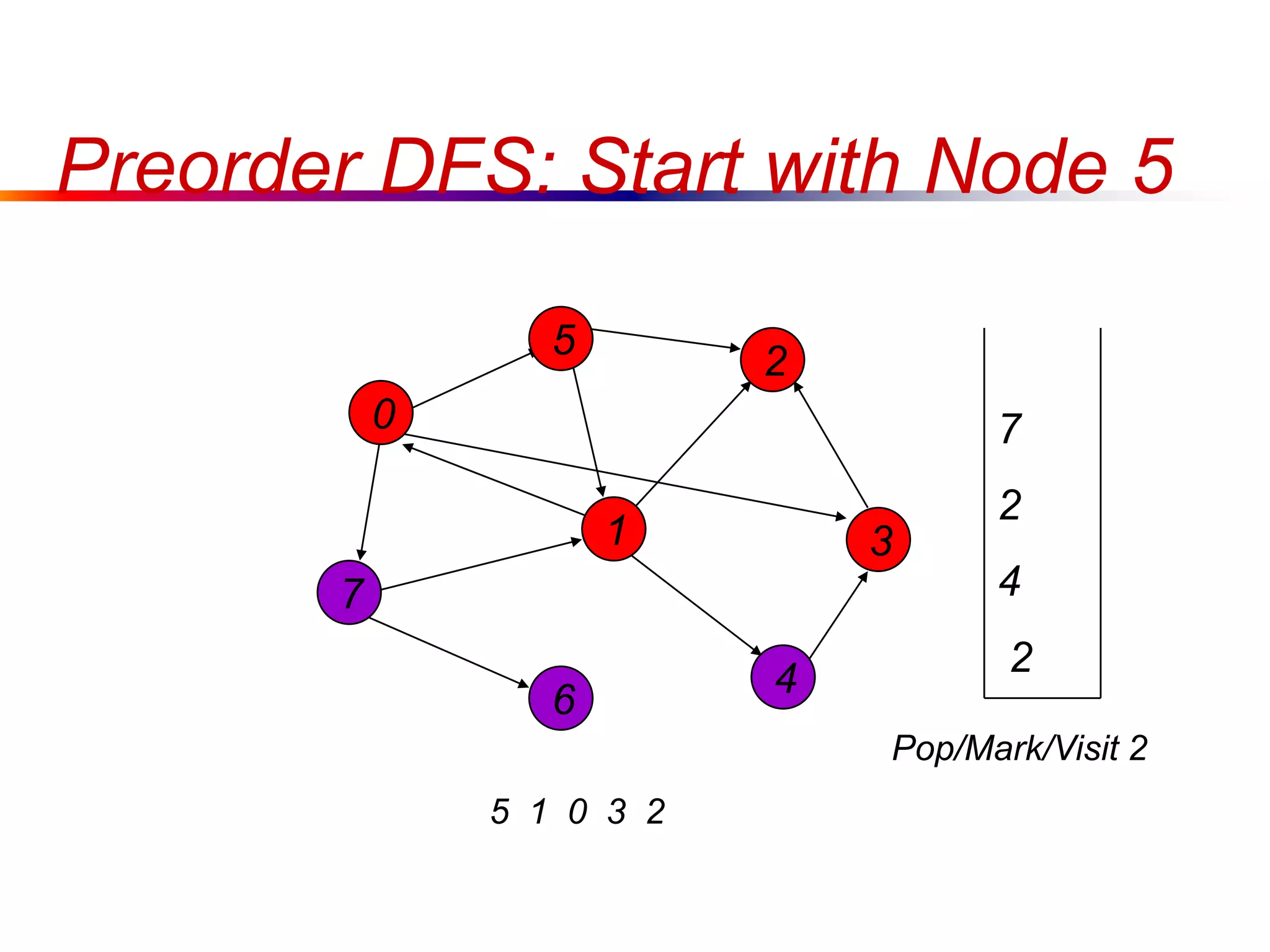
5 1 0 3 2
7
2
4
2
Pop/Mark/Visit 2
Preorder DFS: Start with Node 5
0
7
1
5
4
3
2
6
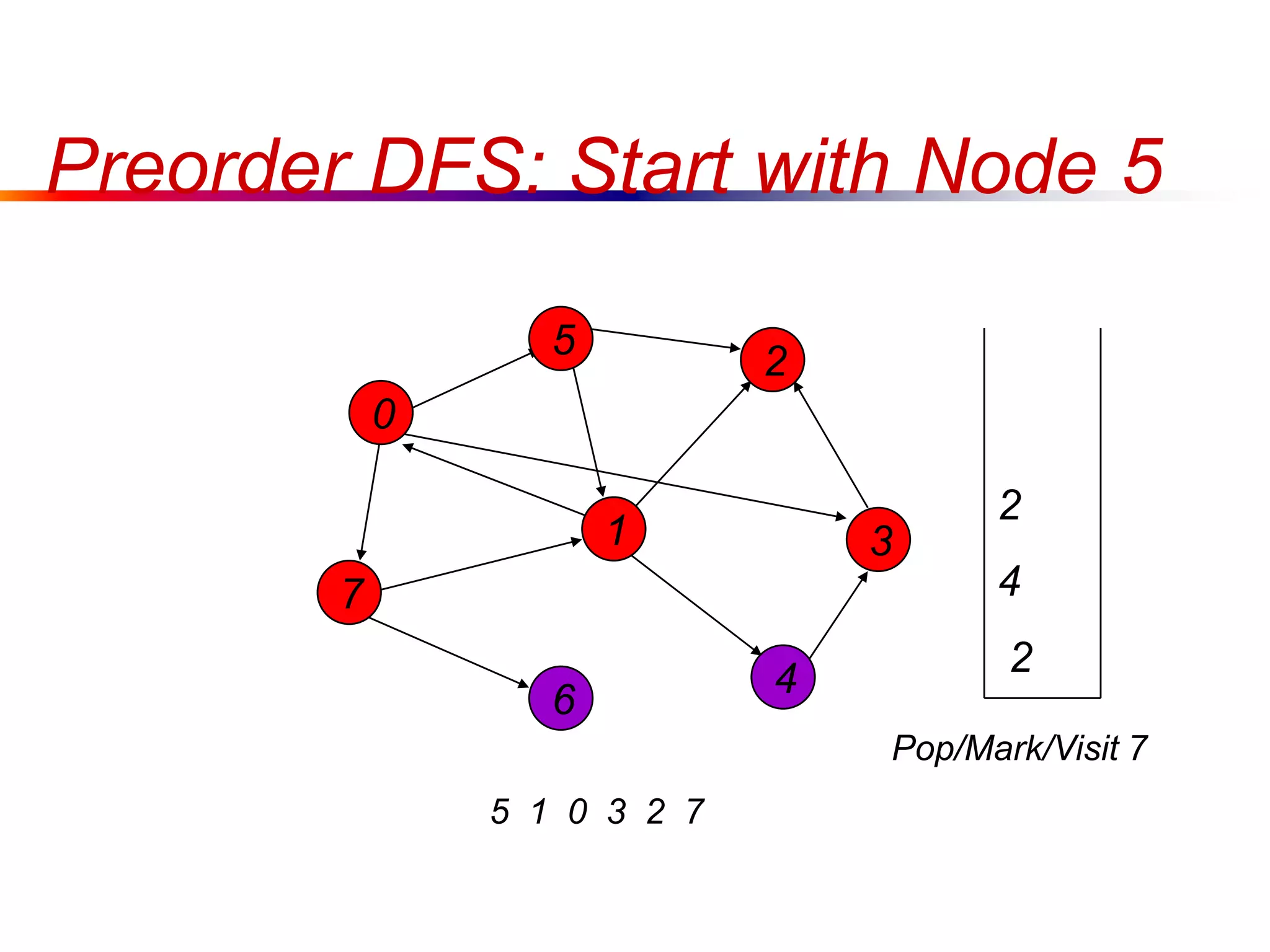
5 1 0 3 2 7
2
4
2
Pop/Mark/Visit 7
Preorder DFS: Start with Node 5
0
7
1
5
4
3
2
6
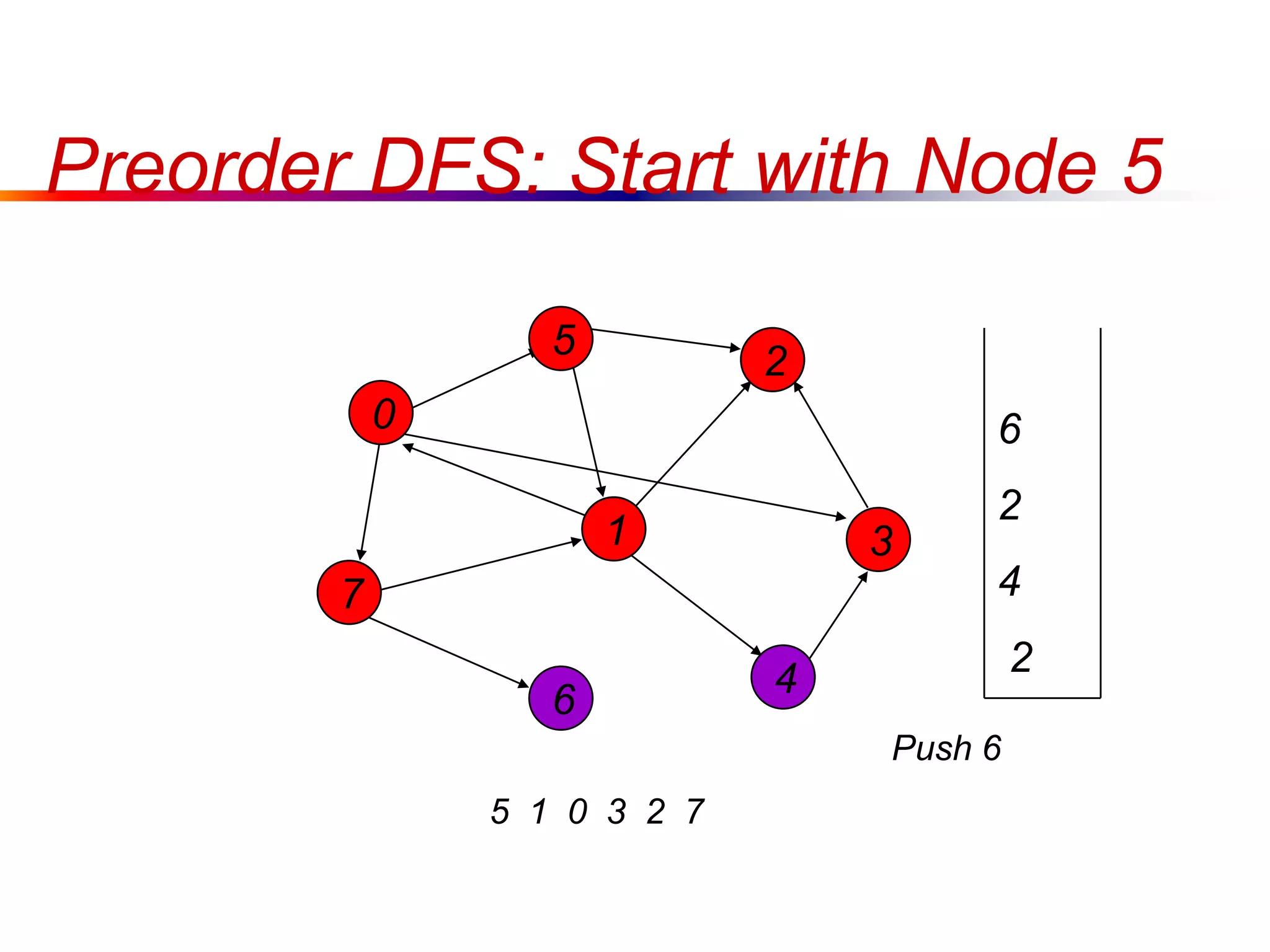
5 1 0 3 2 7
6
2
4
2
Push 6
Preorder DFS: Start with Node 5
0
7
1
5
4
3
2
6
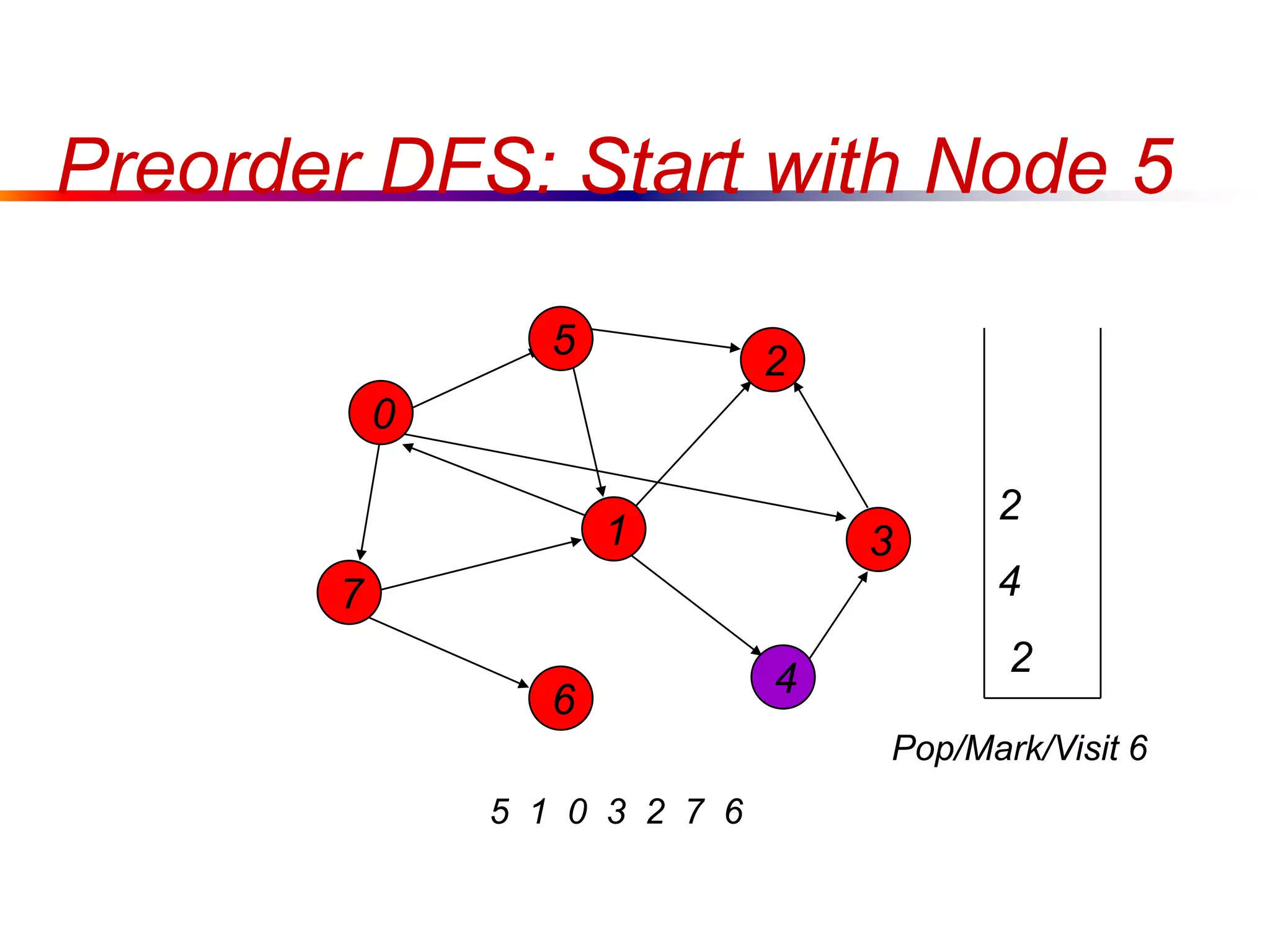
5 1 0 3 2 7 6
2
4
2
Pop/Mark/Visit 6
Preorder DFS: Start with Node 5
0
7
1
5
4
3
2
6
5 1 0 3 2 7 6
4
2
Pop (don’t visit) 2
Preorder DFS: Start with Node 5
0
7
1
5
4
3
2
6
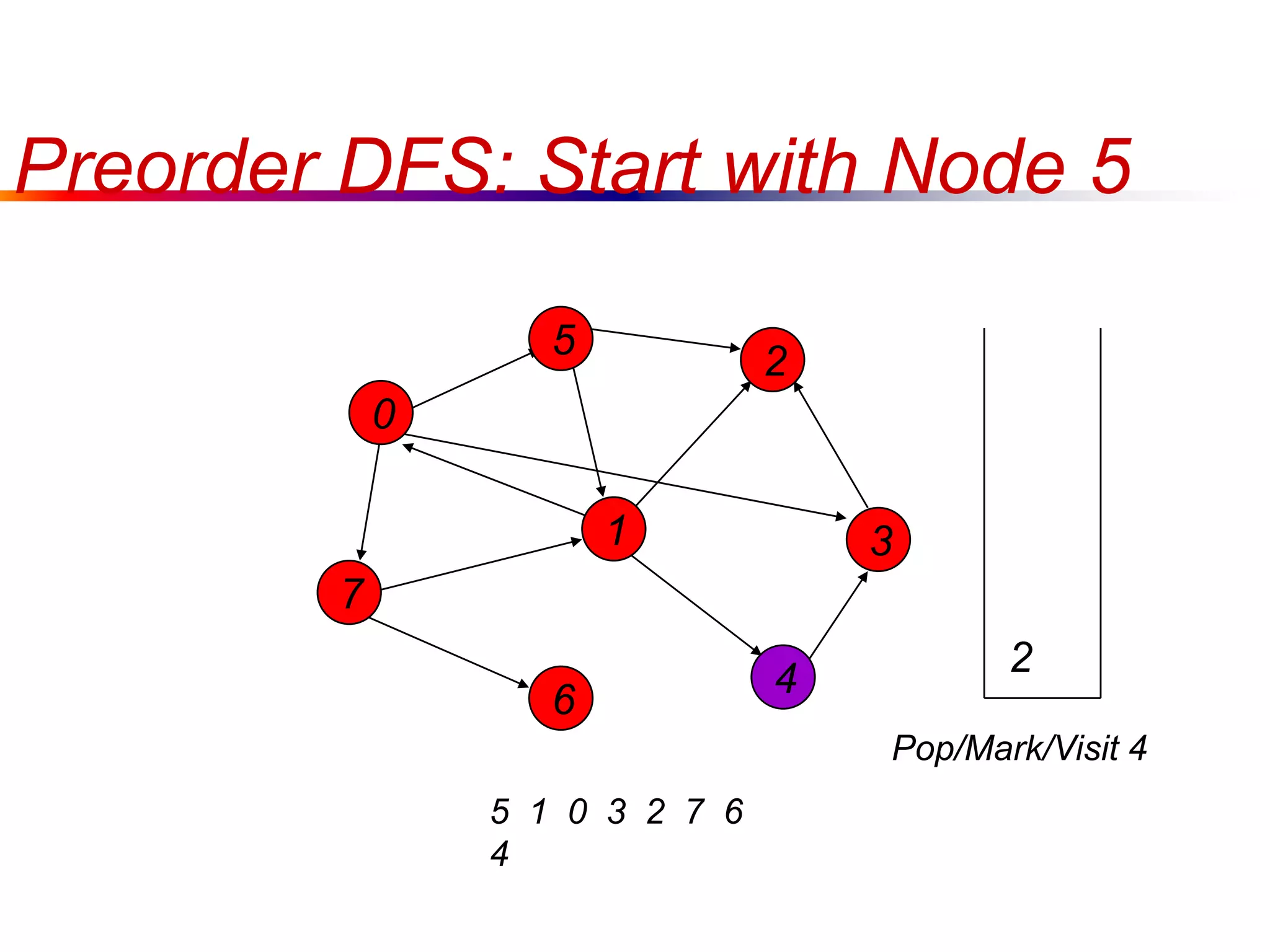
5 1 0 3 2 7 6
4
2
Pop/Mark/Visit 4
Preorder DFS: Start with Node 5
0
7
1
5
4
3
2
6
5 1 0 3 2 7 6
4
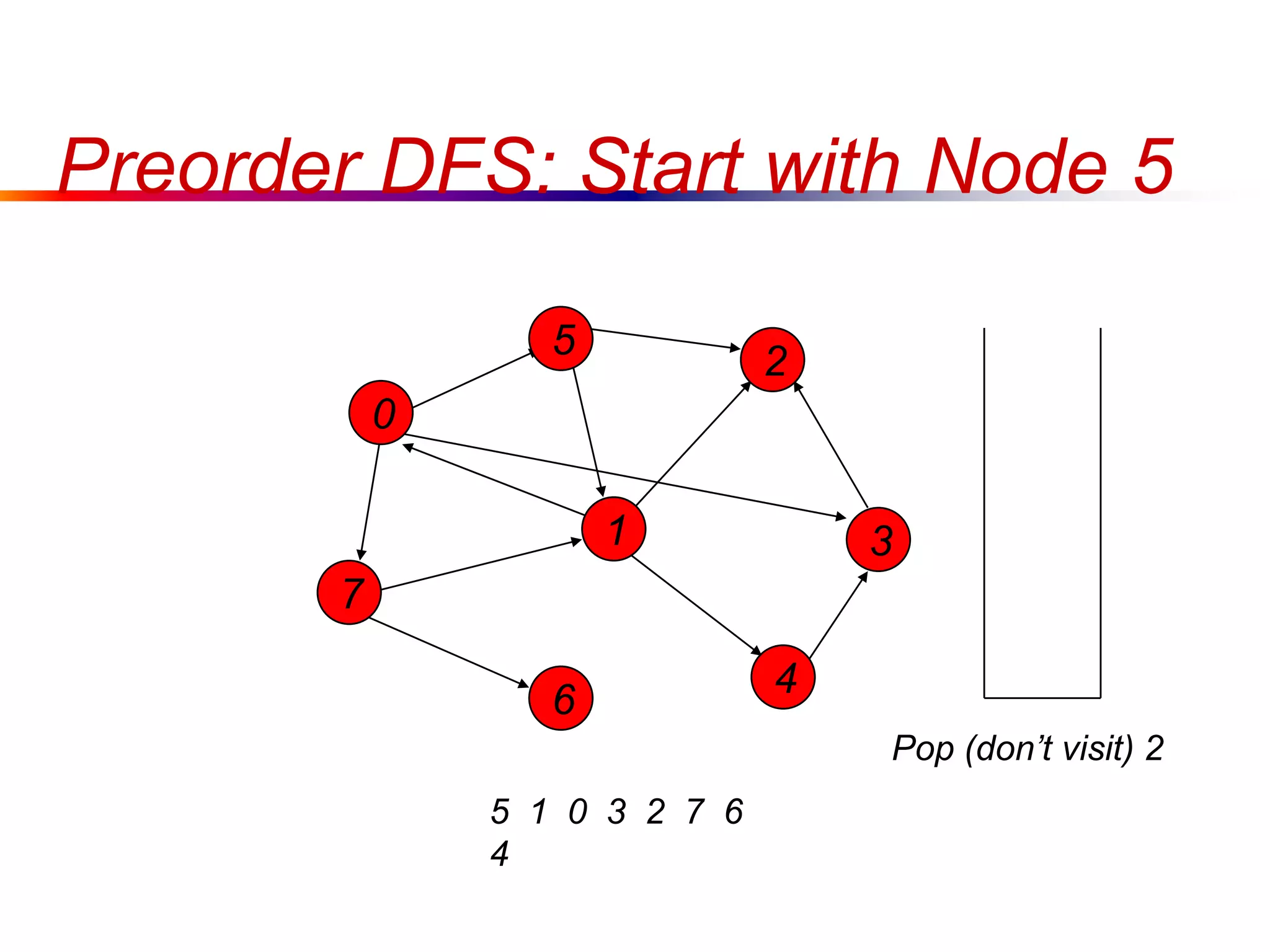
Pop (don’t visit) 2
Preorder DFS: Start with Node 5
0
7
1
5
4
3
2
6
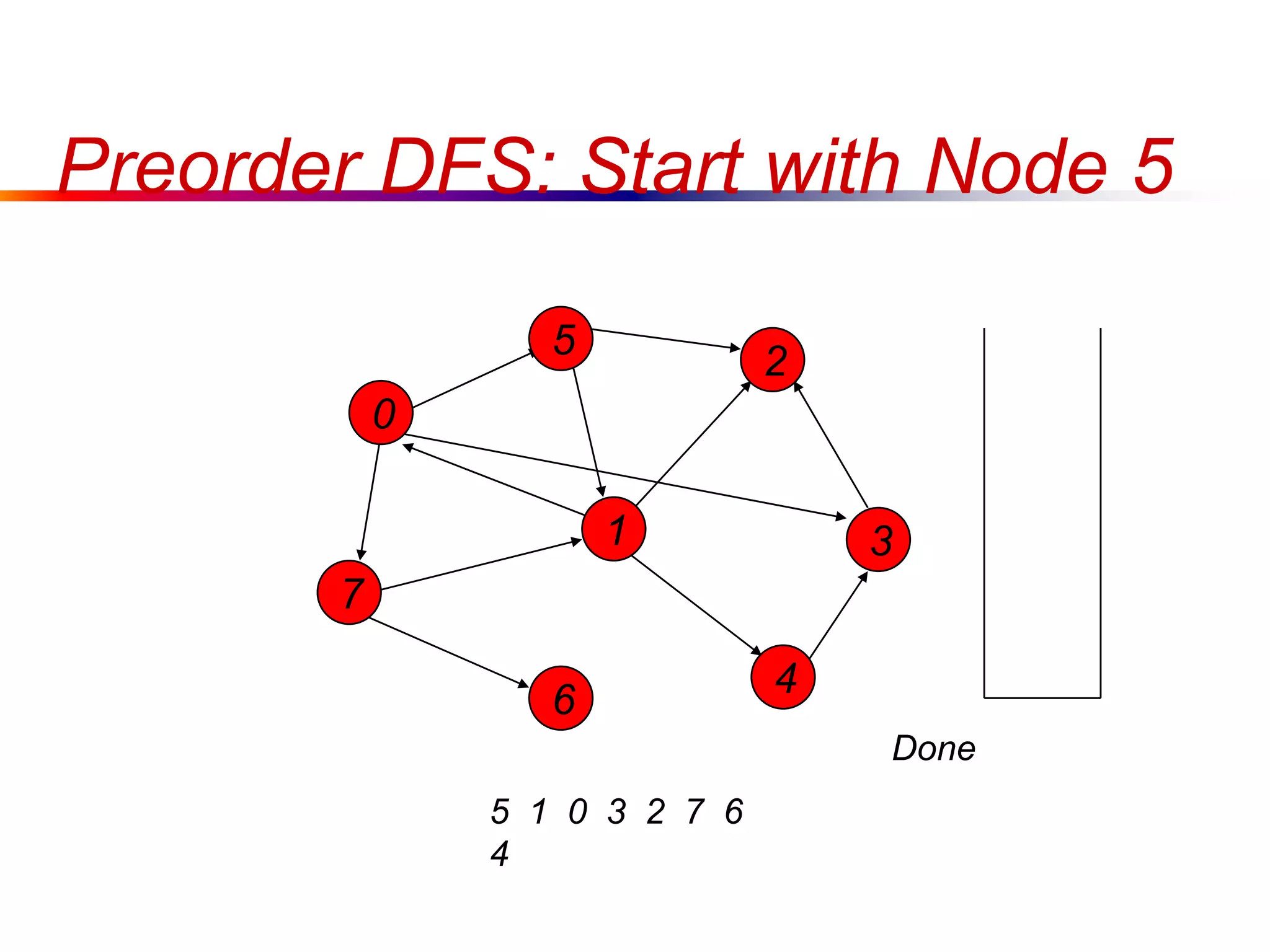
5 1 0 3 2 7 6
4
Done
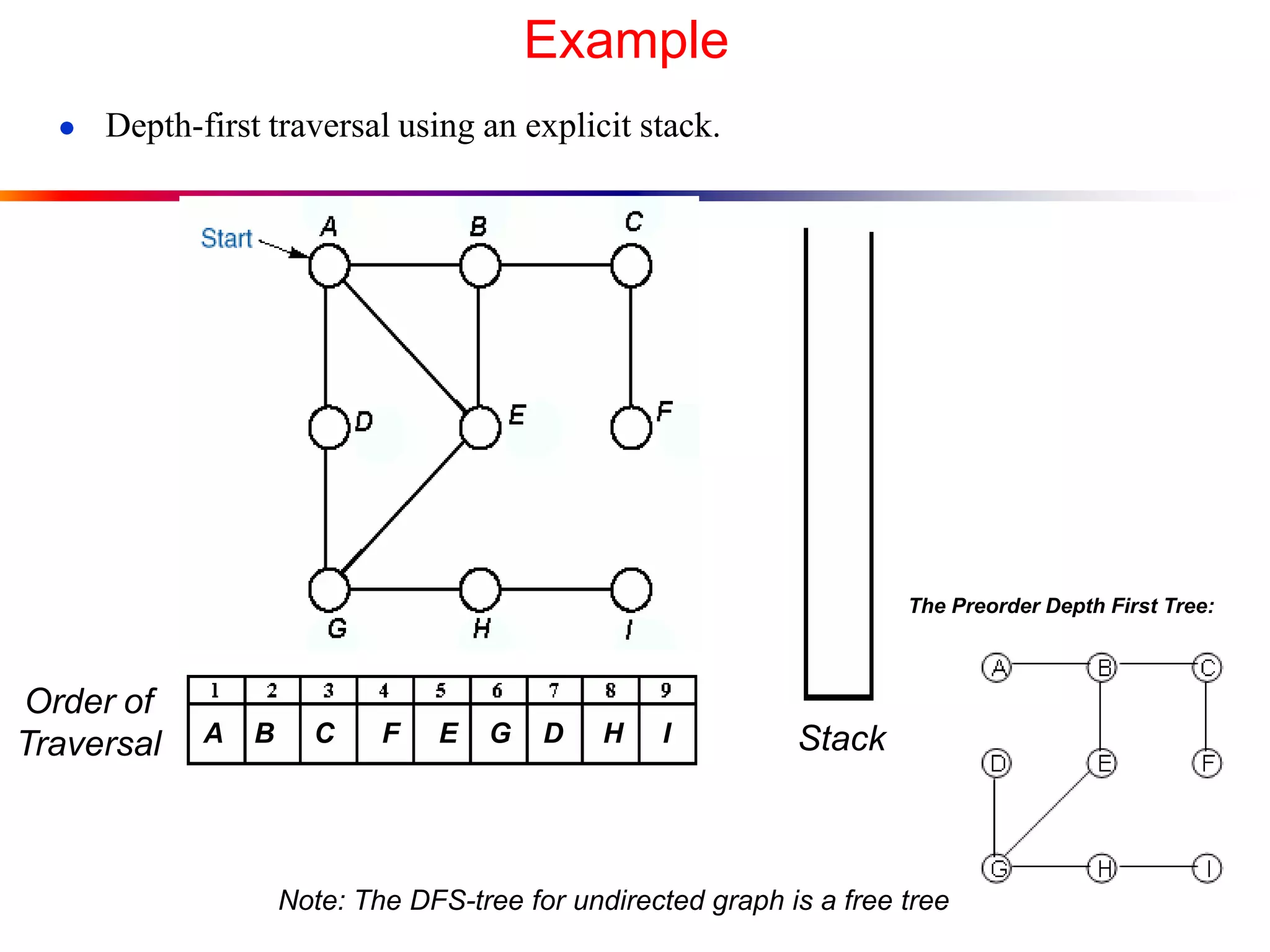
Example
● Depth-first traversal using an explicit stack.
Order of
Traversal StackA B C F E G D H I
The Preorder Depth First Tree:
Note: The DFS-tree for undirected graph is a free tree
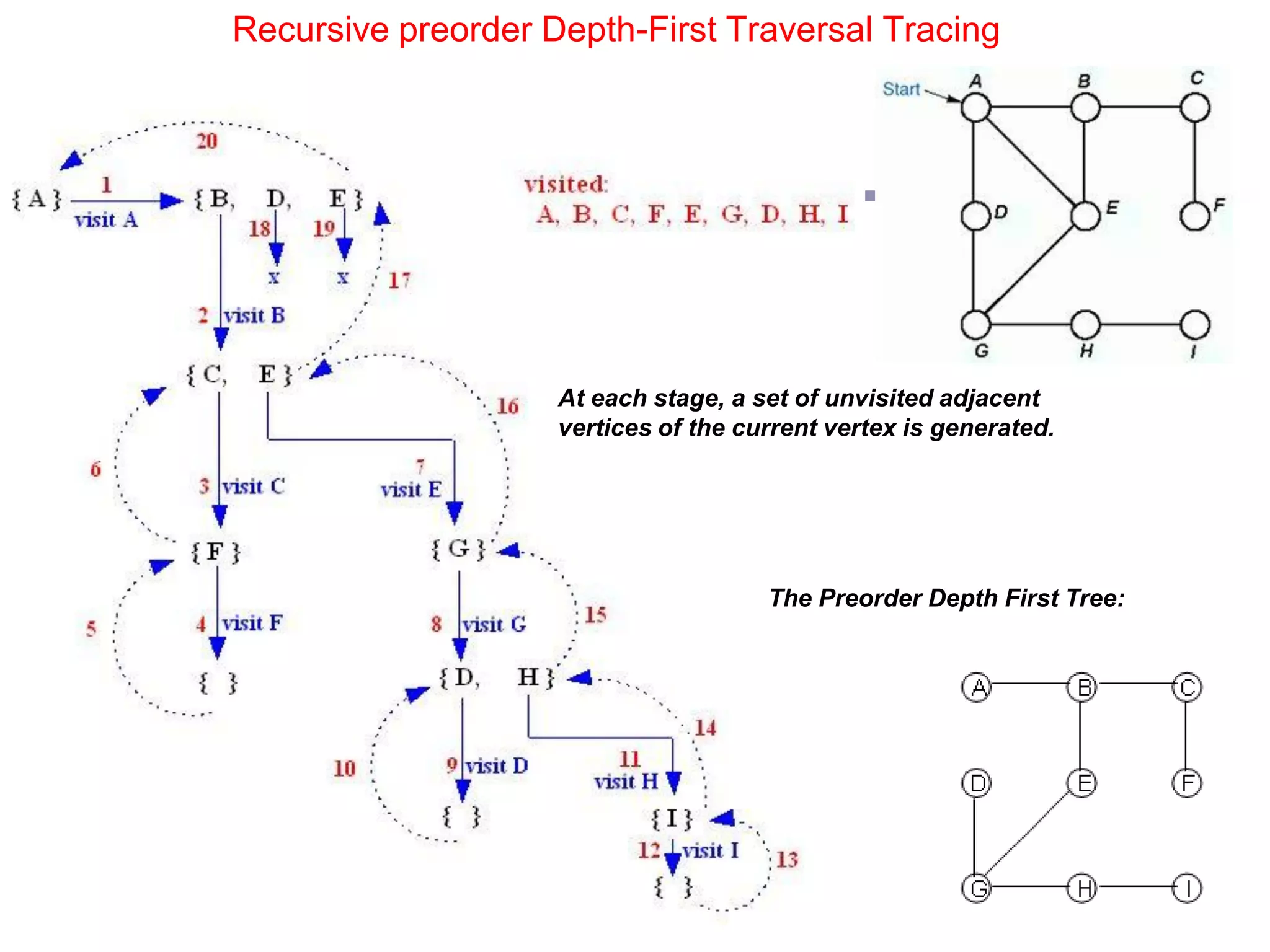
Recursive preorder Depth-First Traversal Tracing
At each stage, a set of unvisited adjacent
vertices of the current vertex is generated.
The Preorder Depth First Tree:
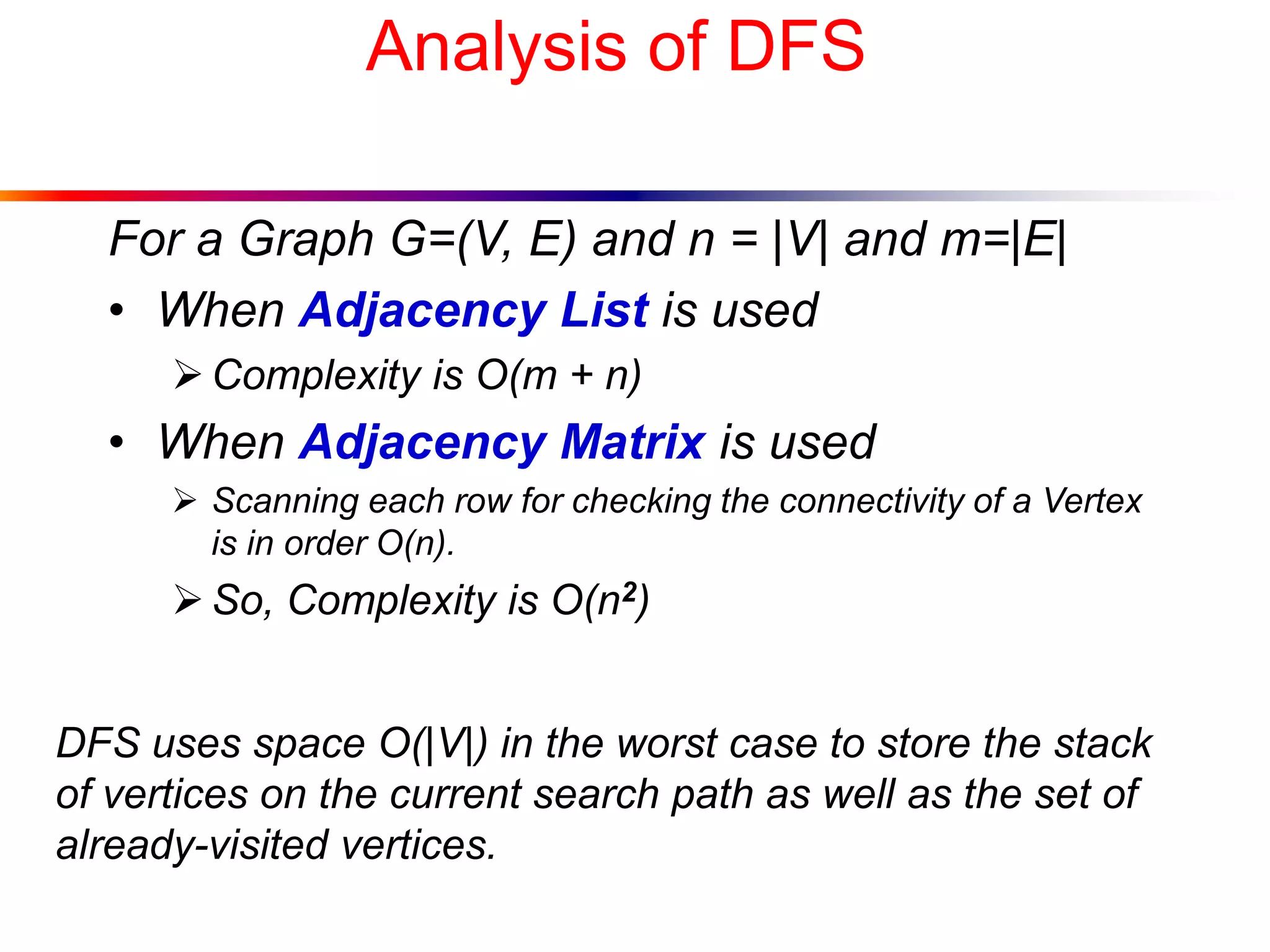
Analysis of DFS
For a Graph G=(V, E) and n = |V| and m=|E|
• When Adjacency List is used
Complexity is O(m + n)
• When Adjacency Matrix is used
 Scanning each row for checking the connectivity of a Vertex
is in order O(n).
So, Complexity is O(n2)
DFS uses space O(|V|) in the worst case to store the stack
of vertices on the current search path as well as the set of
already-visited vertices.

Graph

  • 1.
  • 2.
    Paths and cycles ●A path is a sequence of nodes v1, v2, …, vN such that (vi,vi+1)E for 0<i<N ■ The length of the path is N-1. ■ Simple path: all vi are distinct, 0<i<N ● A cycle is a path such that v1=vN ■ An acyclic graph has no cycles
  • 3.
  • 4.
    More useful definitions ●The degree of a vertex is the number of edges incident to that vertex ● In a directed graph: ● The indegree of a node v is the number of distinct edges (w,v)E. ● The outdegree of a node v is the number of distinct edges (v,w)E. ● A node with indegree 0 is a root.
  • 5.
    Trees are graphs ●A dag is a directed acyclic graph. ● A tree is a connected acyclic undirected graph. ● A forest is an acyclic undirected graph (not necessarily connected), i.e., each connected component is a tree.
  • 6.
    Even More Terminology ●subgraph: subset of vertices and edges forming a graph ● connected component: maximal connected subgraph. E.g., the graph below has 3 connected components. connected not connected •connected graph: any two vertices are connected by some path
  • 7.
    Connectivity ● Let n= #vertices, and m = #edges ● A complete graph: one in which all pairs of vertices are adjacent ● How many total edges in a complete graph? ■ Each of the n vertices is incident to n-1 edges, however, we would have counted each edge twice! Therefore, intuitively, m = n(n -1)/2. ● Therefore, if a graph is not complete, m < n(n -1)/2 n 5 m  (5 
  • 8.
    More Connectivity n =#vertices m = #edges ● For a tree m = n - 1 n  5 m  4 n  5 m  3 If m < n - 1, G is not connected
  • 9.
    G = (V,E) a vertex may have: 0 or more predecessors 0 or more successors
  • 10.
    some problems thatcan be represented by a graph ● computer networks ● airline flights ● road map ● course prerequisite structure ● tasks for completing a job ● flow of control through a program ● many more
  • 11.
    Graphs in ComputerScience: How do they help? ● What do they model? ■ An abstraction in Core CS. ○ Examples: VLSI Circuits, Communication Networks, Logical flow of a computer program, Data structures. ■ An abstraction for data and relationships. ○ Examples: The Web, Social Networks, Flows and Flow Networks, Biological Data, Taxonomies, Citations, Explicit relations within a DB system. ● What aspects are studied? ■ Algorithms, Data Structures and Complexity Theory. ■ Characterization and Modeling of Graphs. ■ Implementations of Graph Algorithms in Specific contexts.
  • 12.
    What is agraph? ● A set of vertices and edges ■ Directed/Undirected ■ Weighted/Unweighted ■ Cyclic/Acyclic vertex edge
  • 13.
    Representation of Graphs ●Adjacency Matrix ■ A V x V array, with matrix[i][j] storing whether there is an edge between the ith vertex and the jth vertex ● Adjacency Linked List ■ One linked list per vertex, each storing directly reachable vertices
  • 14.
    Representation of Graphs Adjacency Matrix Adjacency LinkedList Memory Storage O(V2) O(V+E) Check whether (u,v) is an edge O(1) O(deg(u)) Find all adjacent vertices of a vertex u O(V) O(deg(u))
  • 15.
    graph variations ● undirectedgraph (graph) ■ edges do not have a direction ○ (V1, V2) and (V2, V1) are the same edge ● directed graph (digraph) ■ edges have a direction ○ <V1, V2> and <V2, V1> are different edges ● for either type, edges may be weighted or unweighted
  • 16.
    a digraph A B C D E V= [A, B, C, D, E] E = [<A,B>, <B,C>, <C,B>, <A,C>, <A,E>, <C,D>]
  • 17.
    graph data structures ●storing the vertices ■ each vertex has a unique identifier and, maybe, other information ■ for efficiency, associate each vertex with a number that can be used as an index ● storing the edges ■ adjacency matrix – represent all possible edges ■ adjacency lists – represent only the existing edges
  • 18.
    storing the vertices ●when a vertex is added to the graph, assign it a number ■ vertices are numbered between 0 and n-1 ● graph operations start by looking up the number associated with a vertex ● many data structures to use ■ any of the associative data structures ■ for small graphs a vector can be used ○ search will be O(n)
  • 19.
    the vertex vector A B CD E 0 1 2 3 4 0 1 2 3 4 A B C D E
  • 20.
    maximum # edges? aV2 matrix is needed for a graph with V vertices
  • 21.
    adjacency matrix A B C D E 0 1 23 4 0 1 2 3 4 A B C D E 0 1 1 0 1 0 0 1 0 0 0 1 0 1 0 0 0 0 0 0 0 0 0 0 0 0 1 2 3 4 0 1 2 3 4
  • 22.
    adjacency matrix A BC D A 0 1 1 1 B 1 0 0 1 C 1 0 0 1 D 1 1 1 0
  • 23.
    many graphs are“sparse” ● degree of “sparseness” key factor in choosing a data structure for edges ■ adjacency matrix requires space for all possible edges ■ adjacency list requires space for existing edges only ● affects amount of memory space needed ● affects efficiency of graph operations
  • 24.
    adjacency lists A B C D E 0 1 23 4 0 1 2 3 4 1 2 4 2 1 3 0 1 2 3 4 A B C D E
  • 25.
    Adjacency Lists A representationof the graph consisting of a list of nodes, with each node containing a list of its neighboring nodes. This representation takes O(|V | + |E|) space.
  • 26.
    Some graph operations adjacencymatrix adjacency lists insertEdge isEdge #successors? #predecessors? O(1) O(1) O(V) O(V) O(e) O(e) O(e) O(E)
  • 27.
    Introduction ● A freetree is a connected undirected graph without a cycle. ■ Note: This definition of tree is different from the one of a rooted tree ● In a free tree |E| = |V| - 1 ● Example of a free tree: ● A forest is an acyclic directed or undirected graph consisting of two or more trees ● The trees in a directed forest are rooted trees ● The trees in an undirected forest are free trees
  • 28.
  • 29.
    Use of astack ● It is very common to use a stack to keep track of: ■ nodes to be visited next, or ■ nodes that we have already visited. ● Typically, use of a stack leads to a depth-first visit order. ● Depth-first visit order is “aggressive” in the sense that it examines complete paths.
  • 30.
    Use of aqueue ● It is very common to use a queue to keep track of: ■ nodes to be visited next, or ■ nodes that we have already visited. ● Typically, use of a queue leads to a breadth- first visit order. ● Breadth-first visit order is “cautious” in the sense that it examines every path of length i before going on to paths of length i+1.
  • 31.
    Breadth-First Search (BFS) ●BFS tries to search all paths. ● BFS makes use of a queue to store visited (but not dead) vertices, expanding the path from the earliest visited vertices.
  • 33.
  • 34.
    BFS: Start withNode 5 7 1 5 4 3 2 6 5 1 2 0 4 3 7 6 0
  • 35.
    BFS: Start withNode 5 7 1 5 4 3 2 6 5 0
  • 36.
  • 37.
    BFS: Visit 1and 2 7 1 5 4 3 2 6 5 1 2 0
  • 38.
  • 39.
    BFS: Visit 0and 4 7 1 5 4 3 2 6 5 1 2 0 4 0
  • 40.
  • 41.
    BFS: Visit nodes3 and 7 7 1 5 4 3 2 6 5 1 2 0 4 3 7 0
  • 42.
  • 43.
  • 44.
  • 45.
  • 46.
  • 47.
  • 48.
  • 49.
    Example ● Breadth-first traversalusing a queue. Order of Traversal Queue rearA B D E C G F H I Queue front A B D E C G F H I BFS-tree: Note: The BFS-tree for undirected graph is a free tree
  • 50.
    Analysis of BFS Fora Graph G=(V, E) and n = |V| and m=|E| • When Adjacency List is used Complexity is O(m + n) • When Adjacency Matrix is used  Scanning each row for checking the connectivity of a Vertex is in order O(n). So, Complexity is O(n2)
  • 51.
    Depth-First Search (DFS) ●Strategy: Go as far as you can (if you have not visit there), otherwise, go back and try another way
  • 53.
    Example 0 7 1 5 4 3 2 6 Policy: Visit adjacentnodes in increasing index order
  • 54.
    Preorder DFS: Startwith Node 5 0 7 1 5 4 3 2 6 5 1 0 3 2 7 6 4
  • 55.
    Preorder DFS: Startwith Node 5 0 7 1 5 4 3 2 6 5 Push 5
  • 56.
    Preorder DFS: Startwith Node 5 0 7 1 5 4 3 2 6 5 Pop/Visit/Mark 5
  • 57.
    Preorder DFS: Startwith Node 5 0 7 1 5 4 3 2 6 5 1 2 Push 2, Push 1
  • 58.
    Preorder DFS: Startwith Node 5 0 7 1 5 4 3 2 6 5 1 2 Pop/Visit/Mark 1
  • 59.
    Preorder DFS: Startwith Node 5 0 7 1 5 4 3 2 6 5 1 0 2 4 2 Push 4, Push 2, Push 0
  • 60.
    Preorder DFS: Startwith Node 5 0 7 1 5 4 3 2 6 5 1 0 2 4 2 Pop/Visit/Mark 0
  • 61.
    Preorder DFS: Startwith Node 5 0 7 1 5 4 3 2 6 5 1 0 3 7 2 4 2 Push 7, Push 3
  • 62.
    Preorder DFS: Startwith Node 5 0 7 1 5 4 3 2 6 5 1 0 3 7 2 4 2 Pop/Visit/Mark 3
  • 63.
    Preorder DFS: Startwith Node 5 0 7 1 5 4 3 2 6 5 1 0 3 2 7 2 4 2 Push 2
  • 64.
    Preorder DFS: Startwith Node 5 0 7 1 5 4 3 2 6 5 1 0 3 2 7 2 4 2 Pop/Mark/Visit 2
  • 65.
    Preorder DFS: Startwith Node 5 0 7 1 5 4 3 2 6 5 1 0 3 2 7 2 4 2 Pop/Mark/Visit 7
  • 66.
    Preorder DFS: Startwith Node 5 0 7 1 5 4 3 2 6 5 1 0 3 2 7 6 2 4 2 Push 6
  • 67.
    Preorder DFS: Startwith Node 5 0 7 1 5 4 3 2 6 5 1 0 3 2 7 6 2 4 2 Pop/Mark/Visit 6
  • 68.
    Preorder DFS: Startwith Node 5 0 7 1 5 4 3 2 6 5 1 0 3 2 7 6 4 2 Pop (don’t visit) 2
  • 69.
    Preorder DFS: Startwith Node 5 0 7 1 5 4 3 2 6 5 1 0 3 2 7 6 4 2 Pop/Mark/Visit 4
  • 70.
    Preorder DFS: Startwith Node 5 0 7 1 5 4 3 2 6 5 1 0 3 2 7 6 4 Pop (don’t visit) 2
  • 71.
    Preorder DFS: Startwith Node 5 0 7 1 5 4 3 2 6 5 1 0 3 2 7 6 4 Done
  • 72.
    Example ● Depth-first traversalusing an explicit stack. Order of Traversal StackA B C F E G D H I The Preorder Depth First Tree: Note: The DFS-tree for undirected graph is a free tree
  • 73.
    Recursive preorder Depth-FirstTraversal Tracing At each stage, a set of unvisited adjacent vertices of the current vertex is generated. The Preorder Depth First Tree:
  • 78.
    Analysis of DFS Fora Graph G=(V, E) and n = |V| and m=|E| • When Adjacency List is used Complexity is O(m + n) • When Adjacency Matrix is used  Scanning each row for checking the connectivity of a Vertex is in order O(n). So, Complexity is O(n2) DFS uses space O(|V|) in the worst case to store the stack of vertices on the current search path as well as the set of already-visited vertices.