
Chapter 9
Binary Search Trees
Dr. Muhammad Hanif Durad
Department of Computer and Information Sciences
Pakistan Institute Engineering and Applied Sciences
hanif@pieas.edu.pk
Some slides have bee adapted with thanks from some other lectures
available on Internet. It made my life easier, as life is always
miserable at PIEAS (Sir Muhammad Yusaf Kakakhil )
Dr. Hanif Durad 2
Lecture Outline
 Binary Search Trees
 BST – Representation
 Various Operation in Binary Search Trees
 Inorder Traversal
 Tree Search
 Finding Min & Max
 Predecessor and Successor
 Insertion and Delete
 BST Problems
 Better Search Trees
IA, Chapter 12 P-251
Binary Search Trees-
Introduction
 View today as data structures that can support
dynamic set operations.
 Search, Minimum, Maximum, Predecessor, Successor,
Insert, and Delete.
 Can be used to build
 Dictionaries.
 Priority Queues.
 Basic operations take time proportional to the height
of the tree – O(h).
D:DSALCOMP 550-00115-btrees.ppt
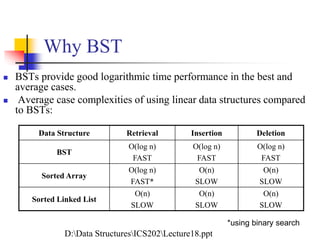
Why BST
DeletionInsertionRetrievalData Structure
O(log n)
FAST
O(log n)
FAST
O(log n)
FAST
BST
O(n)
SLOW
O(n)
SLOW
O(log n)
FAST*
Sorted Array
O(n)
SLOW
O(n)
SLOW
O(n)
SLOW
Sorted Linked List
 BSTs provide good logarithmic time performance in the best and
average cases.
 Average case complexities of using linear data structures compared
to BSTs:
*using binary search
D:Data StructuresICS202Lecture18.ppt
9.2 Binary Search Tree Property
(1/2)
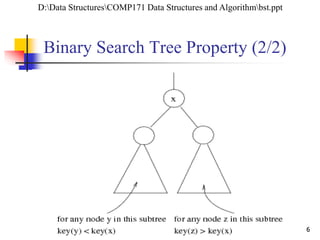
 Stored keys must satisfy
the binary search tree
property.
  y in left subtree of x,
then key[y]  key[x].
  y in right subtree of x,
then key[y]  key[x].
56
26 200
18 28 190 213
12 24 27
666
Binary Search Tree Property (2/2)
6
D:Data StructuresCOMP171 Data Structures and Algorithmbst.ppt
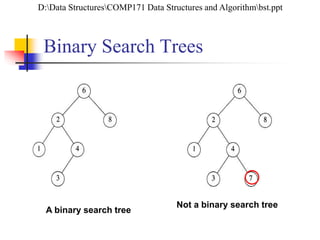
Binary Search Trees
A binary search tree
Not a binary search tree
D:Data StructuresCOMP171 Data Structures and Algorithmbst.ppt
BST – Representation
 Represented by a linked data structure of
nodes.
 root(T) points to the root of tree T.
 Each node contains fields:
 key
 left – pointer to left child: root of left subtree.
 right – pointer to right child : root of right subtree.
 p – pointer to parent. p[root[T]] = NIL (optional).
Rightleft
key
Parent
D:DSALCOMP 550-00115-btrees.ppt
9.3 Various Operation in Binary
Search Trees
Inorder Traversal (1/2)
Inorder-Tree-Walk (x)
1. if x  NIL
2. then Inorder-Tree-Walk(left[p])
3. print key[x]
4. Inorder-Tree-Walk(right[p])
The binary-search-tree property allows the keys of a binary search
tree to be printed, in (monotonically increasing) order, recursively.
D:DSALCOMP 550-00115-btrees.ppt
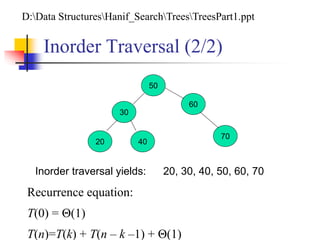
Inorder Traversal (2/2)
50
70
60
30
4020
Inorder traversal yields: 20, 30, 40, 50, 60, 70
D:Data StructuresHanif_SearchTreesTreesPart1.ppt
Recurrence equation:
T(0) = Θ(1)
T(n)=T(k) + T(n – k –1) + Θ(1)
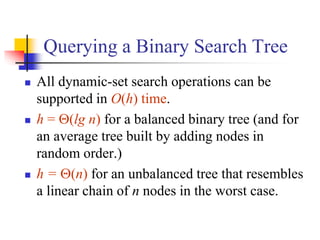
Querying a Binary Search Tree
 All dynamic-set search operations can be
supported in O(h) time.
 h = (lg n) for a balanced binary tree (and for
an average tree built by adding nodes in
random order.)
 h = (n) for an unbalanced tree that resembles
a linear chain of n nodes in the worst case.
Tree Search
Tree-Search(x, k)
1. if x = NIL or k = key[x]
2. then return x
3. if k < key[x]
4. then return Tree-Search(left[x], k)
5. else return Tree-Search(right[x], k)
Running time: O(h)
56
26 200
18 28 190 213
12 24 27
IA, P-256
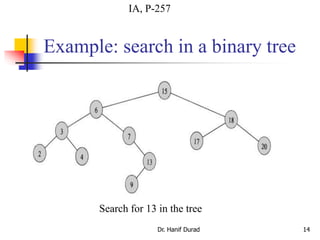
Example: search in a binary tree
Dr. Hanif Durad 14
IA, P-257
Search for 13 in the tree
Iterative Tree Search
Iterative-Tree-Search(x, k)
1. while x  NIL and k  key[x]
2. do if k < key[x]
3. then x  left[x]
4. else x  right[x]
5. return x
The iterative tree search is more efficient on most computers.
The recursive tree search is more straightforward.
56
26 200
18 28 190 213
12 24 27
Finding Min & Max
Tree-Minimum(x) Tree-Maximum(x)
1. while left[x]  NIL 1. while right[x]  NIL
2. do x  left[x] 2. do x  right[x]
3. return x 3. return x
Q: How long do they take?
 The binary-search-tree property guarantees that:
 The minimum is located at the left-most node.
 The maximum is located at the right-most node.
Predecessor and Successor
 Successor of node x is the node y such that key[y] is
the smallest key greater than key[x].
 The successor of the largest key is NIL.
 Search consists of two cases.
 If node x has a non-empty right subtree, then x’s successor is
the minimum in the right subtree of x.
 If node x has an empty right subtree, then:
 As long as we move to the left up the tree (move up through right
children), we are visiting smaller keys.
 x’s successor y is the node that x is the predecessor of (x is the
maximum in y’s left subtree).
 In other words, x’s successor y, is the lowest ancestor of x whose left
child is also an ancestor of x.
Pseudo-code for Successor
Code for predecessor is symmetric.
Running time: O(h)
56
26 200
18 28 190 213
12 24 27
Tree-Successor(x)
 if right[x]  NIL
2. then return Tree-Minimum(right[x])
3. y  p[x]
4. while y  NIL and x = right[y]
5. do x  y
6. y  p[y]
7. return y
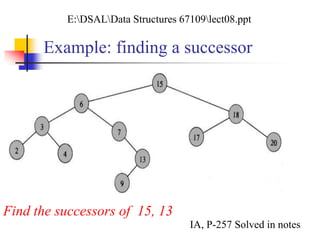
Example: finding a successor
Find the successors of 15, 13
IA, P-257 Solved in notes
E:DSALData Structures 67109lect08.ppt
BST Insertion – Pseudocode
Tree-Insert(T, z)
1. y  NIL
2. x  root[T]
3. while x  NIL
4. do y  x
5. if key[z] < key[x]
6. then x  left[x]
7. else x  right[x]
8. p[z]  y
9. if y = NIL
10. then root[t]  z
11. else if key[z] < key[y]
12. then left[y]  z
13. else right[y]  z
 Change the dynamic set
represented by a BST.
 Ensure the binary-search-
tree property holds after
change.
 Insertion is easier than
deletion.
56
26 200
18 28 190 213
12 24 27
Analysis of Insertion
 Initialization: O(1)
 While loop in lines 3-7
searches for place to
insert z, maintaining
parent y.
This takes O(h) time.
 Lines 8-13 insert the
value: O(1)
 TOTAL: O(h) time to
insert a node.
Tree-Insert(T, z)
1. y  NIL
2. x  root[T]
3. while x  NIL
4. do y  x
5. if key[z] < key[x]
6. then x  left[x]
7. else x  right[x]
8. p[z]  y
9. if y = NIL
10. then root[t]  z
11. else if key[z] < key[y]
12. then left[y]  z
13. else right[y]  z
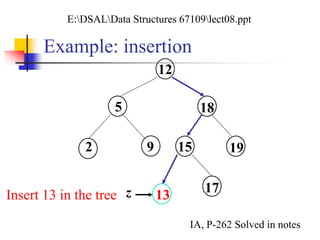
Example: insertion
12
5
9
18
1915
17
2
13Insert 13 in the tree z
IA, P-262 Solved in notes
E:DSALData Structures 67109lect08.ppt
Exercise: Sorting Using BSTs
Sort (A)
for i  1 to n
do tree-insert(A[i])
inorder-tree-walk(root)
 What are the worst case and best case running times?
 In practice, how would this compare to other sorting
algorithms?
Answers to Exercise: Sorting
Using BSTs
 Analysis
 Each item’s insertion takes O(logN)
 N times- O(N*logN) or O(N2)
 Traversal O(N)
Printed as 5A
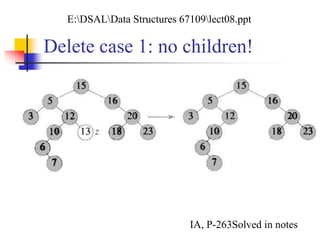
Tree-Delete (T, x)
if x has no children  case 0
then remove x
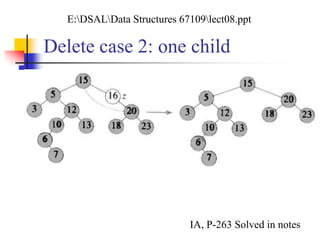
if x has one child  case 1
then make p[x] point to child
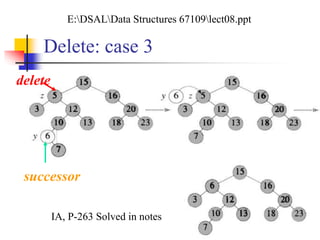
if x has two children (subtrees)  case 2
then swap x with its successor
perform case 0 or case 1 to delete it
 TOTAL: O(h) time to delete a node
Deletion – Pseudocode (1/2)
Tree-Delete(T, z)
/* Determine which node to splice out: either z or z’s successor. */
 if left[z] = NIL or right[z] = NIL
 then y  z
 else y  Tree-Successor[z]
/* Set x to a non-NIL child of x, or to NIL if y has no children. */
4. if left[y]  NIL
5. then x  left[y]
6. else x  right[y]
/* y is removed from the tree by manipulating pointers of p[y] and x */
7. if x  NIL
8. then p[x]  p[y]
/* Continued on next slide */
Deletion – Pseudocode (2/2)
Tree-Delete(T, z) (Contd. from previous slide)
9. if p[y] = NIL
10. then root[T]  x
11. else if y  left[p[i]]
12. then left[p[y]]  x
13. else right[p[y]]  x
/* If z’s successor was spliced out, copy its data into z */
14. if y  z
15. then key[z]  key[y]
16. copy y’s satellite data into z.
17. return y
Delete case 1: no children!
IA, P-263Solved in notes
E:DSALData Structures 67109lect08.ppt
Delete case 2: one child
IA, P-263 Solved in notes
E:DSALData Structures 67109lect08.ppt
Delete: case 3
successor
delete
IA, P-263 Solved in notes
E:DSALData Structures 67109lect08.ppt
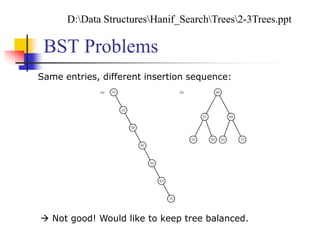
Inefficiency of general BSTs
 All operations in BST are performed in time
O(h), where h is the height of BST
 Unfortunately h might be as large as n, e.g.,
after n consecutive insertions of elements with
keys in increasing order
 The advantages of the binary search (O(log n)
time update) might be lost if BST is not
balanced
E:DSALcomp202 ULPweek3[1].ppt
BST Problems
Same entries, different insertion sequence:
 Not good! Would like to keep tree balanced.
D:Data StructuresHanif_SearchTrees2-3Trees.ppt
 Prevent the degeneration of the BST :
 A BST can be set up to maintain balance during
updating operations (insertions and removals)
 Types of ST which maintain the optimal performance:
 splay trees
 AVL trees
 2-4 Trees
 Red-Black trees
 B-trees
Better Search Trees
E:Data StructuresCSCE3110BinarySearchTrees.ppt

Chapter 9 ds

  • 1.
    Chapter 9 Binary SearchTrees Dr. Muhammad Hanif Durad Department of Computer and Information Sciences Pakistan Institute Engineering and Applied Sciences hanif@pieas.edu.pk Some slides have bee adapted with thanks from some other lectures available on Internet. It made my life easier, as life is always miserable at PIEAS (Sir Muhammad Yusaf Kakakhil )
  • 2.
    Dr. Hanif Durad2 Lecture Outline  Binary Search Trees  BST – Representation  Various Operation in Binary Search Trees  Inorder Traversal  Tree Search  Finding Min & Max  Predecessor and Successor  Insertion and Delete  BST Problems  Better Search Trees IA, Chapter 12 P-251
  • 3.
    Binary Search Trees- Introduction View today as data structures that can support dynamic set operations.  Search, Minimum, Maximum, Predecessor, Successor, Insert, and Delete.  Can be used to build  Dictionaries.  Priority Queues.  Basic operations take time proportional to the height of the tree – O(h). D:DSALCOMP 550-00115-btrees.ppt
  • 4.
    Why BST DeletionInsertionRetrievalData Structure O(logn) FAST O(log n) FAST O(log n) FAST BST O(n) SLOW O(n) SLOW O(log n) FAST* Sorted Array O(n) SLOW O(n) SLOW O(n) SLOW Sorted Linked List  BSTs provide good logarithmic time performance in the best and average cases.  Average case complexities of using linear data structures compared to BSTs: *using binary search D:Data StructuresICS202Lecture18.ppt
  • 5.
    9.2 Binary SearchTree Property (1/2)  Stored keys must satisfy the binary search tree property.   y in left subtree of x, then key[y]  key[x].   y in right subtree of x, then key[y]  key[x]. 56 26 200 18 28 190 213 12 24 27
  • 6.
    666 Binary Search TreeProperty (2/2) 6 D:Data StructuresCOMP171 Data Structures and Algorithmbst.ppt
  • 7.
    Binary Search Trees Abinary search tree Not a binary search tree D:Data StructuresCOMP171 Data Structures and Algorithmbst.ppt
  • 8.
    BST – Representation Represented by a linked data structure of nodes.  root(T) points to the root of tree T.  Each node contains fields:  key  left – pointer to left child: root of left subtree.  right – pointer to right child : root of right subtree.  p – pointer to parent. p[root[T]] = NIL (optional). Rightleft key Parent D:DSALCOMP 550-00115-btrees.ppt
  • 9.
    9.3 Various Operationin Binary Search Trees
  • 10.
    Inorder Traversal (1/2) Inorder-Tree-Walk(x) 1. if x  NIL 2. then Inorder-Tree-Walk(left[p]) 3. print key[x] 4. Inorder-Tree-Walk(right[p]) The binary-search-tree property allows the keys of a binary search tree to be printed, in (monotonically increasing) order, recursively. D:DSALCOMP 550-00115-btrees.ppt
  • 11.
    Inorder Traversal (2/2) 50 70 60 30 4020 Inordertraversal yields: 20, 30, 40, 50, 60, 70 D:Data StructuresHanif_SearchTreesTreesPart1.ppt Recurrence equation: T(0) = Θ(1) T(n)=T(k) + T(n – k –1) + Θ(1)
  • 12.
    Querying a BinarySearch Tree  All dynamic-set search operations can be supported in O(h) time.  h = (lg n) for a balanced binary tree (and for an average tree built by adding nodes in random order.)  h = (n) for an unbalanced tree that resembles a linear chain of n nodes in the worst case.
  • 13.
    Tree Search Tree-Search(x, k) 1.if x = NIL or k = key[x] 2. then return x 3. if k < key[x] 4. then return Tree-Search(left[x], k) 5. else return Tree-Search(right[x], k) Running time: O(h) 56 26 200 18 28 190 213 12 24 27 IA, P-256
  • 14.
    Example: search ina binary tree Dr. Hanif Durad 14 IA, P-257 Search for 13 in the tree
  • 15.
    Iterative Tree Search Iterative-Tree-Search(x,k) 1. while x  NIL and k  key[x] 2. do if k < key[x] 3. then x  left[x] 4. else x  right[x] 5. return x The iterative tree search is more efficient on most computers. The recursive tree search is more straightforward. 56 26 200 18 28 190 213 12 24 27
  • 16.
    Finding Min &Max Tree-Minimum(x) Tree-Maximum(x) 1. while left[x]  NIL 1. while right[x]  NIL 2. do x  left[x] 2. do x  right[x] 3. return x 3. return x Q: How long do they take?  The binary-search-tree property guarantees that:  The minimum is located at the left-most node.  The maximum is located at the right-most node.
  • 17.
    Predecessor and Successor Successor of node x is the node y such that key[y] is the smallest key greater than key[x].  The successor of the largest key is NIL.  Search consists of two cases.  If node x has a non-empty right subtree, then x’s successor is the minimum in the right subtree of x.  If node x has an empty right subtree, then:  As long as we move to the left up the tree (move up through right children), we are visiting smaller keys.  x’s successor y is the node that x is the predecessor of (x is the maximum in y’s left subtree).  In other words, x’s successor y, is the lowest ancestor of x whose left child is also an ancestor of x.
  • 18.
    Pseudo-code for Successor Codefor predecessor is symmetric. Running time: O(h) 56 26 200 18 28 190 213 12 24 27 Tree-Successor(x)  if right[x]  NIL 2. then return Tree-Minimum(right[x]) 3. y  p[x] 4. while y  NIL and x = right[y] 5. do x  y 6. y  p[y] 7. return y
  • 19.
    Example: finding asuccessor Find the successors of 15, 13 IA, P-257 Solved in notes E:DSALData Structures 67109lect08.ppt
  • 20.
    BST Insertion –Pseudocode Tree-Insert(T, z) 1. y  NIL 2. x  root[T] 3. while x  NIL 4. do y  x 5. if key[z] < key[x] 6. then x  left[x] 7. else x  right[x] 8. p[z]  y 9. if y = NIL 10. then root[t]  z 11. else if key[z] < key[y] 12. then left[y]  z 13. else right[y]  z  Change the dynamic set represented by a BST.  Ensure the binary-search- tree property holds after change.  Insertion is easier than deletion. 56 26 200 18 28 190 213 12 24 27
  • 21.
    Analysis of Insertion Initialization: O(1)  While loop in lines 3-7 searches for place to insert z, maintaining parent y. This takes O(h) time.  Lines 8-13 insert the value: O(1)  TOTAL: O(h) time to insert a node. Tree-Insert(T, z) 1. y  NIL 2. x  root[T] 3. while x  NIL 4. do y  x 5. if key[z] < key[x] 6. then x  left[x] 7. else x  right[x] 8. p[z]  y 9. if y = NIL 10. then root[t]  z 11. else if key[z] < key[y] 12. then left[y]  z 13. else right[y]  z
  • 22.
    Example: insertion 12 5 9 18 1915 17 2 13Insert 13in the tree z IA, P-262 Solved in notes E:DSALData Structures 67109lect08.ppt
  • 23.
    Exercise: Sorting UsingBSTs Sort (A) for i  1 to n do tree-insert(A[i]) inorder-tree-walk(root)  What are the worst case and best case running times?  In practice, how would this compare to other sorting algorithms?
  • 24.
    Answers to Exercise:Sorting Using BSTs  Analysis  Each item’s insertion takes O(logN)  N times- O(N*logN) or O(N2)  Traversal O(N) Printed as 5A
  • 25.
    Tree-Delete (T, x) ifx has no children  case 0 then remove x if x has one child  case 1 then make p[x] point to child if x has two children (subtrees)  case 2 then swap x with its successor perform case 0 or case 1 to delete it  TOTAL: O(h) time to delete a node
  • 26.
    Deletion – Pseudocode(1/2) Tree-Delete(T, z) /* Determine which node to splice out: either z or z’s successor. */  if left[z] = NIL or right[z] = NIL  then y  z  else y  Tree-Successor[z] /* Set x to a non-NIL child of x, or to NIL if y has no children. */ 4. if left[y]  NIL 5. then x  left[y] 6. else x  right[y] /* y is removed from the tree by manipulating pointers of p[y] and x */ 7. if x  NIL 8. then p[x]  p[y] /* Continued on next slide */
  • 27.
    Deletion – Pseudocode(2/2) Tree-Delete(T, z) (Contd. from previous slide) 9. if p[y] = NIL 10. then root[T]  x 11. else if y  left[p[i]] 12. then left[p[y]]  x 13. else right[p[y]]  x /* If z’s successor was spliced out, copy its data into z */ 14. if y  z 15. then key[z]  key[y] 16. copy y’s satellite data into z. 17. return y
  • 28.
    Delete case 1:no children! IA, P-263Solved in notes E:DSALData Structures 67109lect08.ppt
  • 29.
    Delete case 2:one child IA, P-263 Solved in notes E:DSALData Structures 67109lect08.ppt
  • 30.
    Delete: case 3 successor delete IA,P-263 Solved in notes E:DSALData Structures 67109lect08.ppt
  • 31.
    Inefficiency of generalBSTs  All operations in BST are performed in time O(h), where h is the height of BST  Unfortunately h might be as large as n, e.g., after n consecutive insertions of elements with keys in increasing order  The advantages of the binary search (O(log n) time update) might be lost if BST is not balanced E:DSALcomp202 ULPweek3[1].ppt
  • 32.
    BST Problems Same entries,different insertion sequence:  Not good! Would like to keep tree balanced. D:Data StructuresHanif_SearchTrees2-3Trees.ppt
  • 33.
     Prevent thedegeneration of the BST :  A BST can be set up to maintain balance during updating operations (insertions and removals)  Types of ST which maintain the optimal performance:  splay trees  AVL trees  2-4 Trees  Red-Black trees  B-trees Better Search Trees E:Data StructuresCSCE3110BinarySearchTrees.ppt

Editor's Notes

  • #7 Washington State University