Data Structures and Algorithms


              Graphs
  Single-Source Shortest Paths
      (Dijkstra’s Algorithm)
           PLSD210(ii)
Graphs - Shortest Paths
• Application
  • In a graph in which edges have costs ..
  • Find the shortest path from a source to a destination
  • Surprisingly ..
      • While finding the shortest path from a source to one
        destination,
      • we can find the shortest paths to all over
        destinations as well!
  • Common algorithm for
          single-source shortest paths
    is due to Edsger Dijkstra
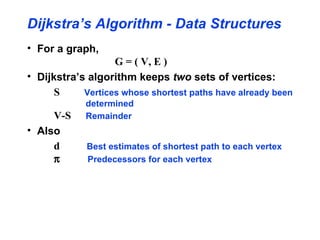
Dijkstra’s Algorithm - Data Structures
• For a graph,
                   G = ( V, E )
• Dijkstra’s algorithm keeps two sets of vertices:
      S     Vertices whose shortest paths have already been
             determined
     V-S     Remainder
• Also
     d       Best estimates of shortest path to each vertex
     π       Predecessors for each vertex
Predecessor Sub-graph
• Array of vertex indices, π[j], j = 1 .. |V|
   •   π[j] contains the pre-decessor for node j
   •   j’s predecessor is in π[π[j]], and so on ....
   •   The edges in the pre-decessor sub-graph are
                   ( π[j], j )
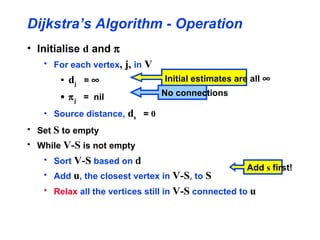
Dijkstra’s Algorithm - Operation
• Initialise d and π
   • For each vertex, j, in V
       • dj = ∞                 Initial estimates are all ∞

       • π j = nil              No connections

   • Source distance, ds = 0
• Set S to empty
• While V-S is not empty
   • Sort V-S based on d
                                                     Add s first!
   • Add u, the closest vertex in V-S, to S
   • Relax all the vertices still in V-S connected to u
Dijkstra’s Algorithm - Operation
• Initialise d and π
   • For each vertex, j, in V
       • dj = ∞
       • π j = nil               Initial estimates are all ∞
                                No connections
   • Source distance, ds = 0
• Set S to empty
• While V-S is not empty
   • Sort V-S based on d
   • Add u, the closest vertex in V-S, to S
                                                     Add s first!
   • Relax all the vertices still in V-S connected to u
Dijkstra’s Algorithm - Operation
• The Relaxation process

Relax the node v
attached to node u   Edge cost matrix

                                        If the current best
relax( Node u, Node v, double w[][] )
                                        estimate to v is
    if d[v] > d[u] + w[u,v] then
                                        greater than the
        d[v] := d[u] + w[u,v]
                                        path through u ..
        pi[v] := u
                       Update the
 Make v’s predecessor estimate to v
      point to u
Dijkstra’s Algorithm - Full
  • The Shortest Paths algorithm

Given a graph, g, and a source, s

shortest_paths( Graph g, Node s )
    initialise_single_source( g, s )
    S := { 0 }         /* Make S empty */
    Q := Vertices( g ) /* Put the vertices in a PQ */
    while not Empty(Q)
        u := ExtractCheapest( Q );
        AddNode( S, u ); /* Add u to S */
        for each vertex v in Adjacent( u )
            relax( u, v, w )
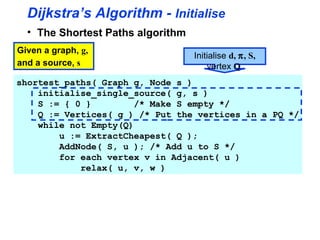
Dijkstra’s Algorithm - Initialise
  • The Shortest Paths algorithm
Given a graph, g,
                                   Initialise d, π, S,
and a source, s                        vertex Q
shortest_paths( Graph g, Node s )
    initialise_single_source( g, s )
    S := { 0 }         /* Make S empty */
    Q := Vertices( g ) /* Put the vertices in a PQ */
    while not Empty(Q)
        u := ExtractCheapest( Q );
        AddNode( S, u ); /* Add u to S */
        for each vertex v in Adjacent( u )
            relax( u, v, w )
Dijkstra’s Algorithm - Loop
  • The Shortest Paths algorithm
Given a graph, g,
and a source, s

shortest_paths( GraphthereNode s )
                While g, are
    initialise_single_source( g, s )
                still nodes in Q
    S := { 0 }           /* Make S empty */
    Q := Vertices( g ) /* Put the vertices in a PQ */
    while not Empty(Q)
        u := ExtractCheapest( Q );             Greedy!
        AddNode( S, u ); /* Add u to S */
        for each vertex v in Adjacent( u )
            relax( u, v, w )
Dijkstra’s Algorithm - Relax neighbours
  • The Shortest Paths algorithm
Given a graph, g,
and a source, s     Update the
                  estimate of the
shortest_paths( Graph g, paths to )
                 shortest Node s
    initialise_single_source( g, s )
                      all nodes
    S := { 0 }     attached to u S empty */
                        /* Make
    Q := Vertices( g ) /* Put the vertices in a PQ */
    while not Empty(Q)
        u := ExtractCheapest( Q );             Greedy!
        AddNode( S, u ); /* Add u to S */
        for each vertex v in Adjacent( u )
            relax( u, v, w )
Dijkstra’s Algorithm - Operation
• Initial Graph

 Source
Mark 0                    Distance to all
                         nodes marked ∞
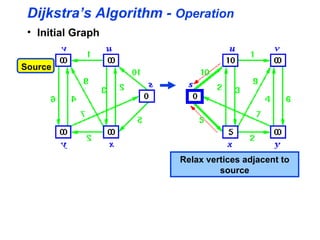
Dijkstra’s Algorithm - Operation
 • Initial Graph


Source


                        Relax vertices adjacent to
                                 source
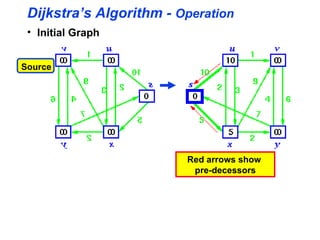
Dijkstra’s Algorithm - Operation
 • Initial Graph


Source


                         Red arrows show
                          pre-decessors
Dijkstra’s Algorithm - Operation


Source is now in S        Sort vertices and
                           choose closest
Dijkstra’s Algorithm - Operation
                 Relax u because a
                 shorter path via x
                       exists


Source is now in S                    Relax y because a
                                      shorter path via x
                                            exists
Dijkstra’s Algorithm - Operation


                        Change u’s
                     pre-decessor also


Source is now in S                       Relax y because a
                                         shorter path via x
                                               exists
Dijkstra’s Algorithm - Operation


 S is now { s, x }        Sort vertices and
                           choose closest
Dijkstra’s Algorithm - Operation
                                Relax v because a
                                shorter path via y
                                      exists


 S is now { s, x }
                          Sort vertices and
                           choose closest
Dijkstra’s Algorithm - Operation


 S is now { s, x, y }      Sort vertices and
                           choose closest, u
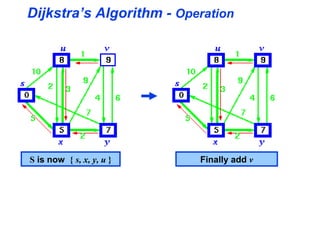
Dijkstra’s Algorithm - Operation


S is now { s, x, y, u }   Finally add v
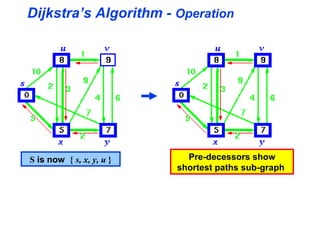
Dijkstra’s Algorithm - Operation


S is now { s, x, y, u }     Pre-decessors show
                          shortest paths sub-graph
Dijkstra’s Algorithm - Proof
• Greedy Algorithm
  • Proof by contradiction best
• Lemma 1
  • Shortest paths are composed of shortest paths
• Proof
  • If there was a shorter path than any sub-path, then
    substitution of that path would make the whole path
    shorter
Dijkstra’s Algorithm - Proof
• Denote
    δ(s,v) - the cost of the shortest path from s to v
• Lemma 2
  • If s→...→u→v is a shortest path from s to v,
    then after u has been added to S and relax(u,v,w) called,
    d[v] = δ(s,v) and d[v] is not changed thereafter.
• Proof
  • Follows from the fact that at all times d[v] ≥ δ(s,v)
  • See Cormen (or any other text) for the details
Dijkstra’s Algorithm - Proof
• Using Lemma 2
   • After running Dijkstra’s algorithm, we assert
     d[v] = δ(s,v) for all v
• Proof (by contradiction)
   • Suppose that u is the first vertex added to S for which
     d[u] ≠ δ(s,u)
   • Note
       • v is not s because d[s] = 0
       • There must be a path s→...→u,
         otherwise d[u] would be ∞
       • Since there’s a path, there must be a shortest path
Dijkstra’s Algorithm - Proof
• Proof (by contradiction)
   • Suppose that u is the first vertex added to S for which
     d[u] ≠ δ(s,u)
   • Let s→x→y→u be the shortest path
     s→u,
     where x is in S and y is the
     first outside S
   • When x was added to S, d[x] = δ(s,x)
   • Edge x→y was relaxed at that time,
     so d[y] = δ(s,y)
Dijkstra’s Algorithm - Proof
• Proof (by contradiction)
   • Edge x→y was relaxed at that time,
     so d[y] = δ(s,y)
             ≤ δ(s,u) ≤ d[u]
   • But, when we chose u,
     both u and y where in V-S,
     so d[u] ≤ d[y]
     (otherwise we would have chosen y)
   • Thus the inequalities must be equalities
   ∴ d[y] = δ(s,y) = δ(s,u) = d[u]
   • And our hypothesis (d[u] ≠ δ(s,u)) is contradicted!
Dijkstra’s Algorithm - Time Complexity
• Dijkstra’s Algorithm
   • Similar to MST algorithms
   • Key step is sort on the edges
   • Complexity is
       • O( (|E|+|V|)log|V| ) or
       • O( n2 log n )
         for a dense graph with n = |V|

Dijkstra c

  • 1.
    Data Structures andAlgorithms Graphs Single-Source Shortest Paths (Dijkstra’s Algorithm) PLSD210(ii)
  • 2.
    Graphs - ShortestPaths • Application • In a graph in which edges have costs .. • Find the shortest path from a source to a destination • Surprisingly .. • While finding the shortest path from a source to one destination, • we can find the shortest paths to all over destinations as well! • Common algorithm for single-source shortest paths is due to Edsger Dijkstra
  • 3.
    Dijkstra’s Algorithm -Data Structures • For a graph, G = ( V, E ) • Dijkstra’s algorithm keeps two sets of vertices: S Vertices whose shortest paths have already been determined V-S Remainder • Also d Best estimates of shortest path to each vertex π Predecessors for each vertex
  • 4.
    Predecessor Sub-graph • Arrayof vertex indices, π[j], j = 1 .. |V| • π[j] contains the pre-decessor for node j • j’s predecessor is in π[π[j]], and so on .... • The edges in the pre-decessor sub-graph are ( π[j], j )
  • 5.
    Dijkstra’s Algorithm -Operation • Initialise d and π • For each vertex, j, in V • dj = ∞ Initial estimates are all ∞ • π j = nil No connections • Source distance, ds = 0 • Set S to empty • While V-S is not empty • Sort V-S based on d Add s first! • Add u, the closest vertex in V-S, to S • Relax all the vertices still in V-S connected to u
  • 6.
    Dijkstra’s Algorithm -Operation • Initialise d and π • For each vertex, j, in V • dj = ∞ • π j = nil Initial estimates are all ∞ No connections • Source distance, ds = 0 • Set S to empty • While V-S is not empty • Sort V-S based on d • Add u, the closest vertex in V-S, to S Add s first! • Relax all the vertices still in V-S connected to u
  • 7.
    Dijkstra’s Algorithm -Operation • The Relaxation process Relax the node v attached to node u Edge cost matrix If the current best relax( Node u, Node v, double w[][] ) estimate to v is if d[v] > d[u] + w[u,v] then greater than the d[v] := d[u] + w[u,v] path through u .. pi[v] := u Update the Make v’s predecessor estimate to v point to u
  • 8.
    Dijkstra’s Algorithm -Full • The Shortest Paths algorithm Given a graph, g, and a source, s shortest_paths( Graph g, Node s ) initialise_single_source( g, s ) S := { 0 } /* Make S empty */ Q := Vertices( g ) /* Put the vertices in a PQ */ while not Empty(Q) u := ExtractCheapest( Q ); AddNode( S, u ); /* Add u to S */ for each vertex v in Adjacent( u ) relax( u, v, w )
  • 9.
    Dijkstra’s Algorithm -Initialise • The Shortest Paths algorithm Given a graph, g, Initialise d, π, S, and a source, s vertex Q shortest_paths( Graph g, Node s ) initialise_single_source( g, s ) S := { 0 } /* Make S empty */ Q := Vertices( g ) /* Put the vertices in a PQ */ while not Empty(Q) u := ExtractCheapest( Q ); AddNode( S, u ); /* Add u to S */ for each vertex v in Adjacent( u ) relax( u, v, w )
  • 10.
    Dijkstra’s Algorithm -Loop • The Shortest Paths algorithm Given a graph, g, and a source, s shortest_paths( GraphthereNode s ) While g, are initialise_single_source( g, s ) still nodes in Q S := { 0 } /* Make S empty */ Q := Vertices( g ) /* Put the vertices in a PQ */ while not Empty(Q) u := ExtractCheapest( Q ); Greedy! AddNode( S, u ); /* Add u to S */ for each vertex v in Adjacent( u ) relax( u, v, w )
  • 11.
    Dijkstra’s Algorithm -Relax neighbours • The Shortest Paths algorithm Given a graph, g, and a source, s Update the estimate of the shortest_paths( Graph g, paths to ) shortest Node s initialise_single_source( g, s ) all nodes S := { 0 } attached to u S empty */ /* Make Q := Vertices( g ) /* Put the vertices in a PQ */ while not Empty(Q) u := ExtractCheapest( Q ); Greedy! AddNode( S, u ); /* Add u to S */ for each vertex v in Adjacent( u ) relax( u, v, w )
  • 12.
    Dijkstra’s Algorithm -Operation • Initial Graph Source Mark 0 Distance to all nodes marked ∞
  • 13.
    Dijkstra’s Algorithm -Operation • Initial Graph Source Relax vertices adjacent to source
  • 14.
    Dijkstra’s Algorithm -Operation • Initial Graph Source Red arrows show pre-decessors
  • 15.
    Dijkstra’s Algorithm -Operation Source is now in S Sort vertices and choose closest
  • 16.
    Dijkstra’s Algorithm -Operation Relax u because a shorter path via x exists Source is now in S Relax y because a shorter path via x exists
  • 17.
    Dijkstra’s Algorithm -Operation Change u’s pre-decessor also Source is now in S Relax y because a shorter path via x exists
  • 18.
    Dijkstra’s Algorithm -Operation S is now { s, x } Sort vertices and choose closest
  • 19.
    Dijkstra’s Algorithm -Operation Relax v because a shorter path via y exists S is now { s, x } Sort vertices and choose closest
  • 20.
    Dijkstra’s Algorithm -Operation S is now { s, x, y } Sort vertices and choose closest, u
  • 21.
    Dijkstra’s Algorithm -Operation S is now { s, x, y, u } Finally add v
  • 22.
    Dijkstra’s Algorithm -Operation S is now { s, x, y, u } Pre-decessors show shortest paths sub-graph
  • 23.
    Dijkstra’s Algorithm -Proof • Greedy Algorithm • Proof by contradiction best • Lemma 1 • Shortest paths are composed of shortest paths • Proof • If there was a shorter path than any sub-path, then substitution of that path would make the whole path shorter
  • 24.
    Dijkstra’s Algorithm -Proof • Denote δ(s,v) - the cost of the shortest path from s to v • Lemma 2 • If s→...→u→v is a shortest path from s to v, then after u has been added to S and relax(u,v,w) called, d[v] = δ(s,v) and d[v] is not changed thereafter. • Proof • Follows from the fact that at all times d[v] ≥ δ(s,v) • See Cormen (or any other text) for the details
  • 25.
    Dijkstra’s Algorithm -Proof • Using Lemma 2 • After running Dijkstra’s algorithm, we assert d[v] = δ(s,v) for all v • Proof (by contradiction) • Suppose that u is the first vertex added to S for which d[u] ≠ δ(s,u) • Note • v is not s because d[s] = 0 • There must be a path s→...→u, otherwise d[u] would be ∞ • Since there’s a path, there must be a shortest path
  • 26.
    Dijkstra’s Algorithm -Proof • Proof (by contradiction) • Suppose that u is the first vertex added to S for which d[u] ≠ δ(s,u) • Let s→x→y→u be the shortest path s→u, where x is in S and y is the first outside S • When x was added to S, d[x] = δ(s,x) • Edge x→y was relaxed at that time, so d[y] = δ(s,y)
  • 27.
    Dijkstra’s Algorithm -Proof • Proof (by contradiction) • Edge x→y was relaxed at that time, so d[y] = δ(s,y) ≤ δ(s,u) ≤ d[u] • But, when we chose u, both u and y where in V-S, so d[u] ≤ d[y] (otherwise we would have chosen y) • Thus the inequalities must be equalities ∴ d[y] = δ(s,y) = δ(s,u) = d[u] • And our hypothesis (d[u] ≠ δ(s,u)) is contradicted!
  • 28.
    Dijkstra’s Algorithm -Time Complexity • Dijkstra’s Algorithm • Similar to MST algorithms • Key step is sort on the edges • Complexity is • O( (|E|+|V|)log|V| ) or • O( n2 log n ) for a dense graph with n = |V|